automatic transmission fluid FORD F53 2017 Owners Manual
[x] Cancel search | Manufacturer: FORD, Model Year: 2017, Model line: F53, Model: FORD F53 2017Pages: 164, PDF Size: 2.57 MB
Page 5 of 164
Reduced Engine Performance...................51
Economical Driving
.........................................51
Driving Through Water
..................................52
Roadside Emergencies
Roadside Assistance
.....................................53
Hazard Warning Flashers............................54
Jump Starting the Vehicle...........................54
Transporting the Vehicle
.............................56
Customer Assistance
Getting the Services You Need
.................58
In California (U.S. Only)
...............................59
The Better Business Bureau (BBB) Auto Line Program (U.S. Only).......................60
Utilizing the Mediation/Arbitration Program (Canada Only)
...........................61
Getting Assistance Outside the U.S. and Canada...........................................................61
Ordering Additional Owner's Literature.......................................................62
Reporting Safety Defects (U.S. Only)...............................................................63
Reporting Safety Defects (Canada Only)...............................................................63
Fuses
Fuse Specification Chart.............................65
Changing a Fuse
.............................................83
Maintenance
General Information
.....................................85
Under Hood Overview - Commercial Chassis..........................................................86
Under Hood Overview - Motorhome Chassis
...........................................................87
Engine Oil Dipstick
........................................88
Engine Oil Check............................................88
Oil Change Indicator Reset
........................89
Engine Coolant Check
.................................89
Automatic Transmission Fluid Check..............................................................93 Brake Fluid Check
..........................................95
Power Steering Fluid Check.......................97
Fuel Filter
..........................................................98
Changing the 12V Battery...........................98
Changing the Engine Air Filter.................100
Vehicle Care
General Information.....................................101
Cleaning the Exterior....................................101
Cleaning the Engine.....................................102
Cleaning the Alloy Wheels
........................102
Vehicle Storage.............................................103
Wheels and Tires
Tire Care
...........................................................105
Using Snow Chains
......................................120
Changing a Road Wheel
.............................121
Technical Specifications
............................124
Capacities and Specific- ations
Engine Specifications
..................................125
Motorcraft Parts
............................................125
Vehicle Identification Number
.................127
Vehicle Certification Label.........................127
Transmission Code Designation.............128
Capacities and Specifications
.................129
Ford Protect
Ford Protect....................................................134
Scheduled Maintenance
General Maintenance Information
........136
Normal Scheduled Maintenance...........139
Special Operating Conditions Scheduled Maintenance...............................................141
Scheduled Maintenance Record
............143
Appendices
Type Approvals
.............................................154
2
Motorhome (TY3) Canada/United States of America, enUSA, First Printing Table of Contents
Page 89 of 164
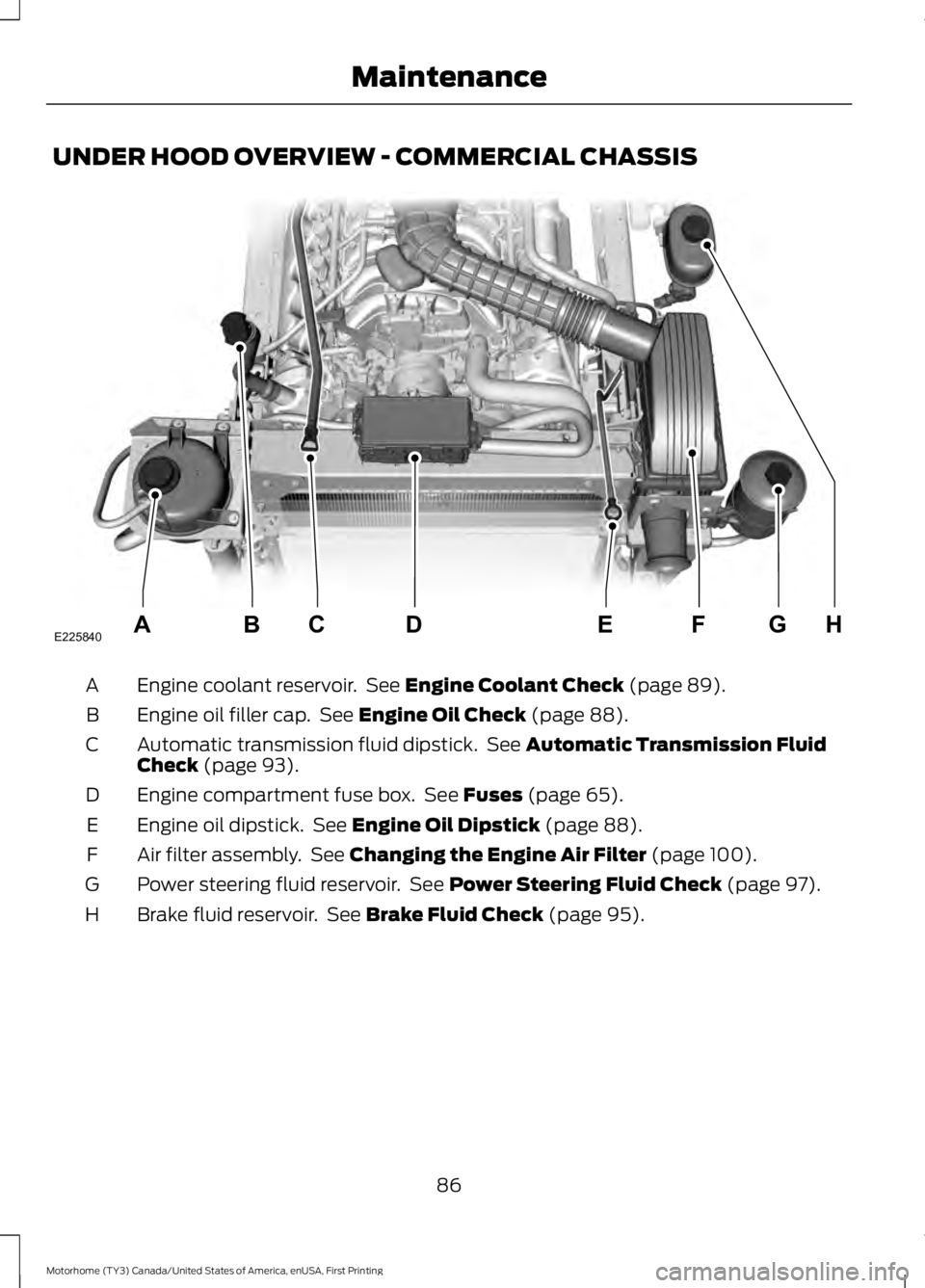
UNDER HOOD OVERVIEW - COMMERCIAL CHASSIS
Engine coolant reservoir. See Engine Coolant Check (page 89).
A
Engine oil filler cap. See
Engine Oil Check (page 88).
B
Automatic transmission fluid dipstick. See
Automatic Transmission Fluid
Check (page 93).
C
Engine compartment fuse box. See
Fuses (page 65).
D
Engine oil dipstick. See
Engine Oil Dipstick (page 88).
E
Air filter assembly. See
Changing the Engine Air Filter (page 100).
F
Power steering fluid reservoir. See
Power Steering Fluid Check (page 97).
G
Brake fluid reservoir. See
Brake Fluid Check (page 95).
H
86
Motorhome (TY3) Canada/United States of America, enUSA, First Printing MaintenanceE225840HGFEABCD
Page 90 of 164
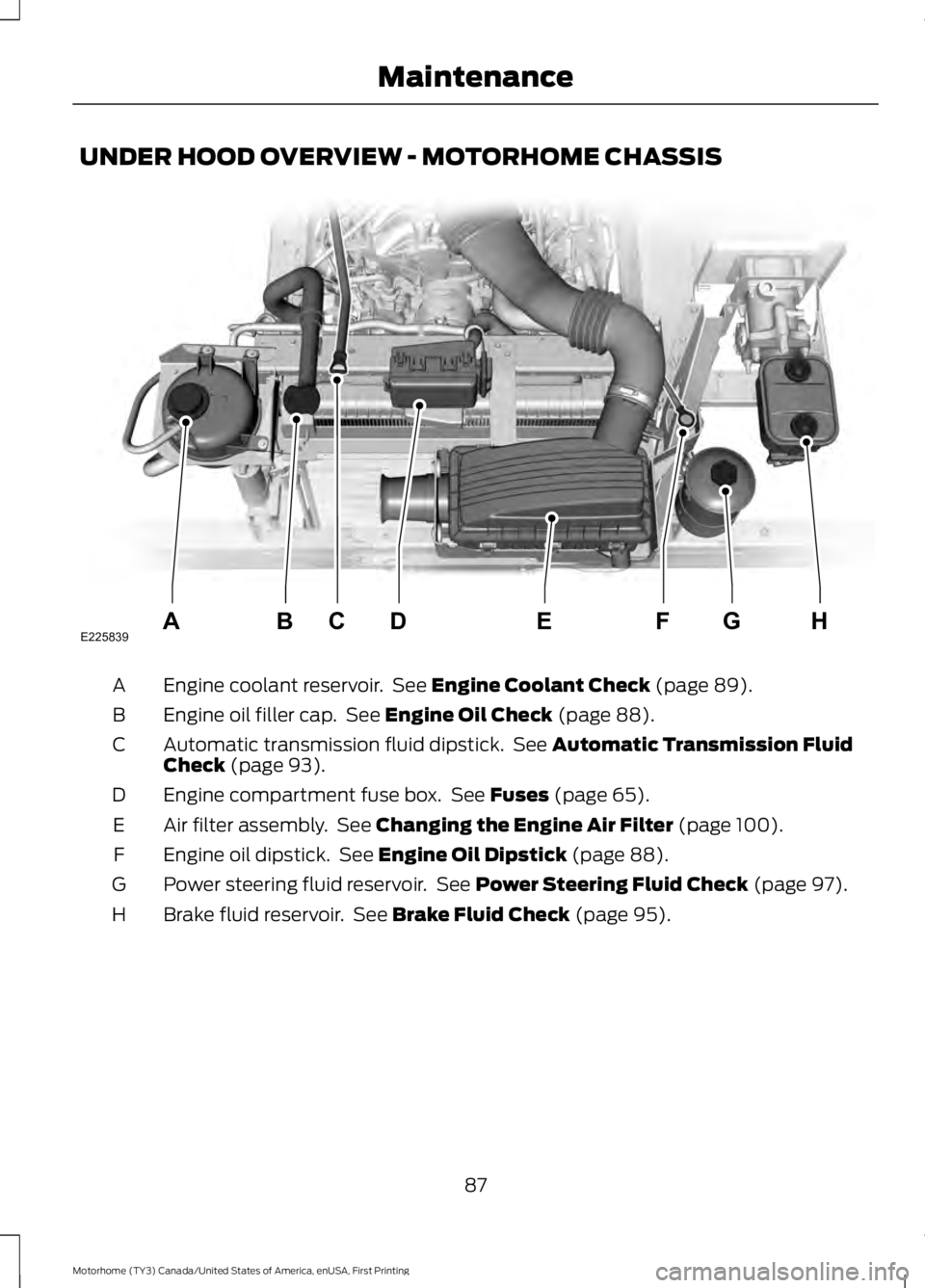
UNDER HOOD OVERVIEW - MOTORHOME CHASSIS
Engine coolant reservoir. See Engine Coolant Check (page 89).
A
Engine oil filler cap. See
Engine Oil Check (page 88).
B
Automatic transmission fluid dipstick. See
Automatic Transmission Fluid
Check (page 93).
C
Engine compartment fuse box. See
Fuses (page 65).
D
Air filter assembly. See
Changing the Engine Air Filter (page 100).
E
Engine oil dipstick. See
Engine Oil Dipstick (page 88).
F
Power steering fluid reservoir. See
Power Steering Fluid Check (page 97).
G
Brake fluid reservoir. See
Brake Fluid Check (page 95).
H
87
Motorhome (TY3) Canada/United States of America, enUSA, First Printing MaintenanceE225839HGFEABCD
Page 96 of 164
Engine Coolant Temperature
Management (If Equipped)
WARNING
To reduce the risk of crash and injury,
be prepared that the vehicle speed
may reduce and the vehicle may not
be able to accelerate with full power until
the coolant temperature reduces. If you tow a trailer with your vehicle, the
engine may temporarily reach higher a
temperature during severe operating
conditions, for example ascending a long
or steep grade in high ambient
temperatures.
At this time, you may notice the coolant
temperature gauge moves toward the red
zone and a message may appear in the
information display.
You may notice a reduction in vehicle
speed caused by reduced engine power.
In order to manage the engine coolant
temperature. Your vehicle may enter this
mode if certain high-temperature and
high-load conditions take place. The
amount of speed reduction depends on
vehicle loading, grade and ambient
temperature. If this occurs, there is no need
to pull off the road. You can continue to
drive your vehicle.
The air conditioning may automatically
turn on and off during severe operating
conditions to protect the engine from
overheating. When the coolant
temperature decreases to the normal
operating temperature, the air conditioning
turns on.
If the coolant temperature gauge moves
fully into the red zone, or if the coolant
temperature warning or service engine
soon messages appear in your information
display, do the following: 1. Pull off the road as soon as safely
possible and shift the transmission into
park (P).
2. Leave the engine running until the coolant temperature gauge needle
returns to the normal position. After
several minutes, if the temperature
does not drop, follow the remaining
steps.
3. Switch the engine off and wait for it to
cool. Check the coolant level.
4. If the coolant level is at or below the minimum mark, add prediluted coolant
immediately.
5. If the coolant level is normal, restart the engine and continue.
AUTOMATIC TRANSMISSION
FLUID CHECK WARNING
The dipstick cap and surrounding
components may be hot; gloves are
recommended.
Note:
Automatic transmission fluid
expands when warmed. To obtain an
accurate fluid check, drive the vehicle until
it is at normal operating temperature
(approximately 20 miles [30 km]). If your
vehicle has been operated for an extended
period at high speeds, in city traffic during
hot weather or pulling a trailer, the vehicle
should be turned off for about 30 minutes
to allow fluid to cool to normal operating
temperature 196°F - 215°F (91°C - 102°C)
before checking.
Refer to your scheduled maintenance
information for scheduled intervals for fluid
checks and changes.
93
Motorhome (TY3) Canada/United States of America, enUSA, First Printing Maintenance
Page 98 of 164
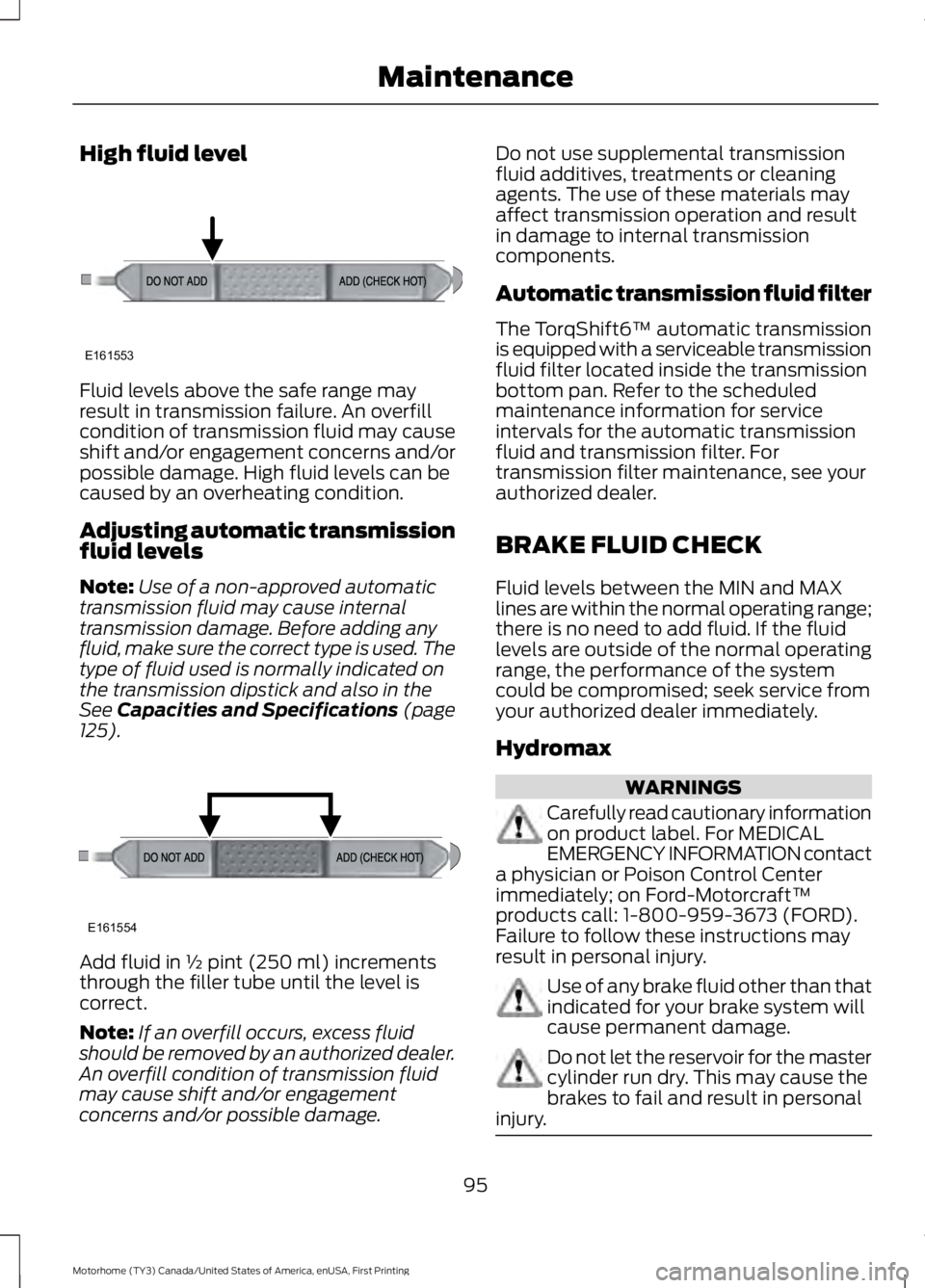
High fluid level
Fluid levels above the safe range may
result in transmission failure. An overfill
condition of transmission fluid may cause
shift and/or engagement concerns and/or
possible damage. High fluid levels can be
caused by an overheating condition.
Adjusting automatic transmission
fluid levels
Note:
Use of a non-approved automatic
transmission fluid may cause internal
transmission damage. Before adding any
fluid, make sure the correct type is used. The
type of fluid used is normally indicated on
the transmission dipstick and also in the
See Capacities and Specifications (page
125). Add fluid in ½ pint (250 ml) increments
through the filler tube until the level is
correct.
Note:
If an overfill occurs, excess fluid
should be removed by an authorized dealer.
An overfill condition of transmission fluid
may cause shift and/or engagement
concerns and/or possible damage. Do not use supplemental transmission
fluid additives, treatments or cleaning
agents. The use of these materials may
affect transmission operation and result
in damage to internal transmission
components.
Automatic transmission fluid filter
The TorqShift6™ automatic transmission
is equipped with a serviceable transmission
fluid filter located inside the transmission
bottom pan. Refer to the scheduled
maintenance information for service
intervals for the automatic transmission
fluid and transmission filter. For
transmission filter maintenance, see your
authorized dealer.
BRAKE FLUID CHECK
Fluid levels between the MIN and MAX
lines are within the normal operating range;
there is no need to add fluid. If the fluid
levels are outside of the normal operating
range, the performance of the system
could be compromised; seek service from
your authorized dealer immediately.
Hydromax
WARNINGS
Carefully read cautionary information
on product label. For MEDICAL
EMERGENCY INFORMATION contact
a physician or Poison Control Center
immediately; on Ford-Motorcraft™
products call: 1-800-959-3673 (FORD).
Failure to follow these instructions may
result in personal injury. Use of any brake fluid other than that
indicated for your brake system will
cause permanent damage.
Do not let the reservoir for the master
cylinder run dry. This may cause the
brakes to fail and result in personal
injury. 95
Motorhome (TY3) Canada/United States of America, enUSA, First Printing MaintenanceE161553 E161554
Page 132 of 164
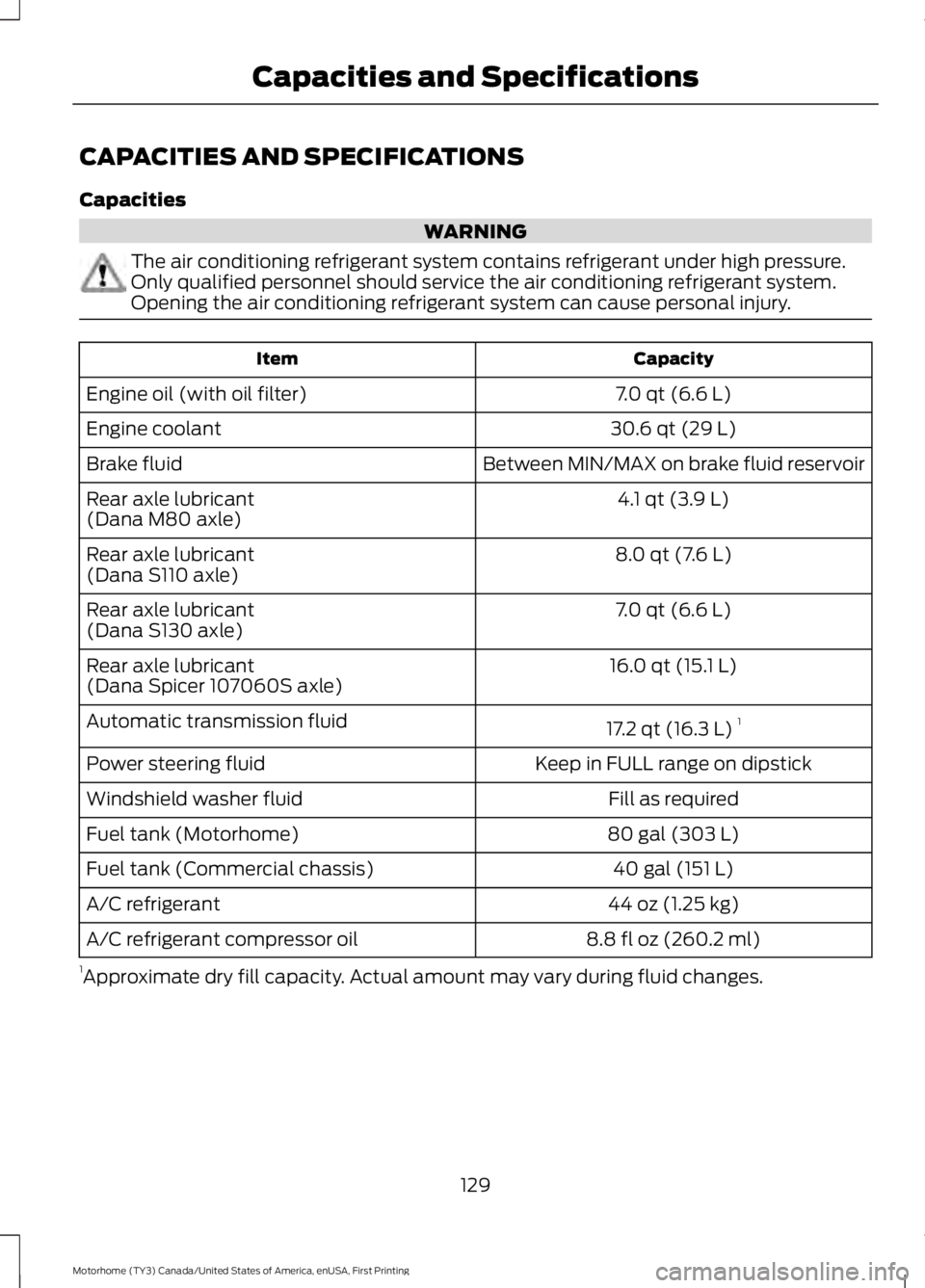
CAPACITIES AND SPECIFICATIONS
Capacities
WARNING
The air conditioning refrigerant system contains refrigerant under high pressure.
Only qualified personnel should service the air conditioning refrigerant system.
Opening the air conditioning refrigerant system can cause personal injury.
Capacity
Item
7.0 qt (6.6 L)
Engine oil (with oil filter)
30.6 qt (29 L)
Engine coolant
Between MIN/MAX on brake fluid reservoir
Brake fluid
4.1 qt (3.9 L)
Rear axle lubricant
(Dana M80 axle)
8.0 qt (7.6 L)
Rear axle lubricant
(Dana S110 axle)
7.0 qt (6.6 L)
Rear axle lubricant
(Dana S130 axle)
16.0 qt (15.1 L)
Rear axle lubricant
(Dana Spicer 107060S axle)
17.2 qt (16.3 L)1
Automatic transmission fluid
Keep in FULL range on dipstick
Power steering fluid
Fill as required
Windshield washer fluid
80 gal (303 L)
Fuel tank (Motorhome)
40 gal (151 L)
Fuel tank (Commercial chassis)
44 oz (1.25 kg)
A/C refrigerant
8.8 fl oz (260.2 ml)
A/C refrigerant compressor oil
1 Approximate dry fill capacity. Actual amount may vary during fluid changes.
129
Motorhome (TY3) Canada/United States of America, enUSA, First Printing Capacities and Specifications
Page 134 of 164
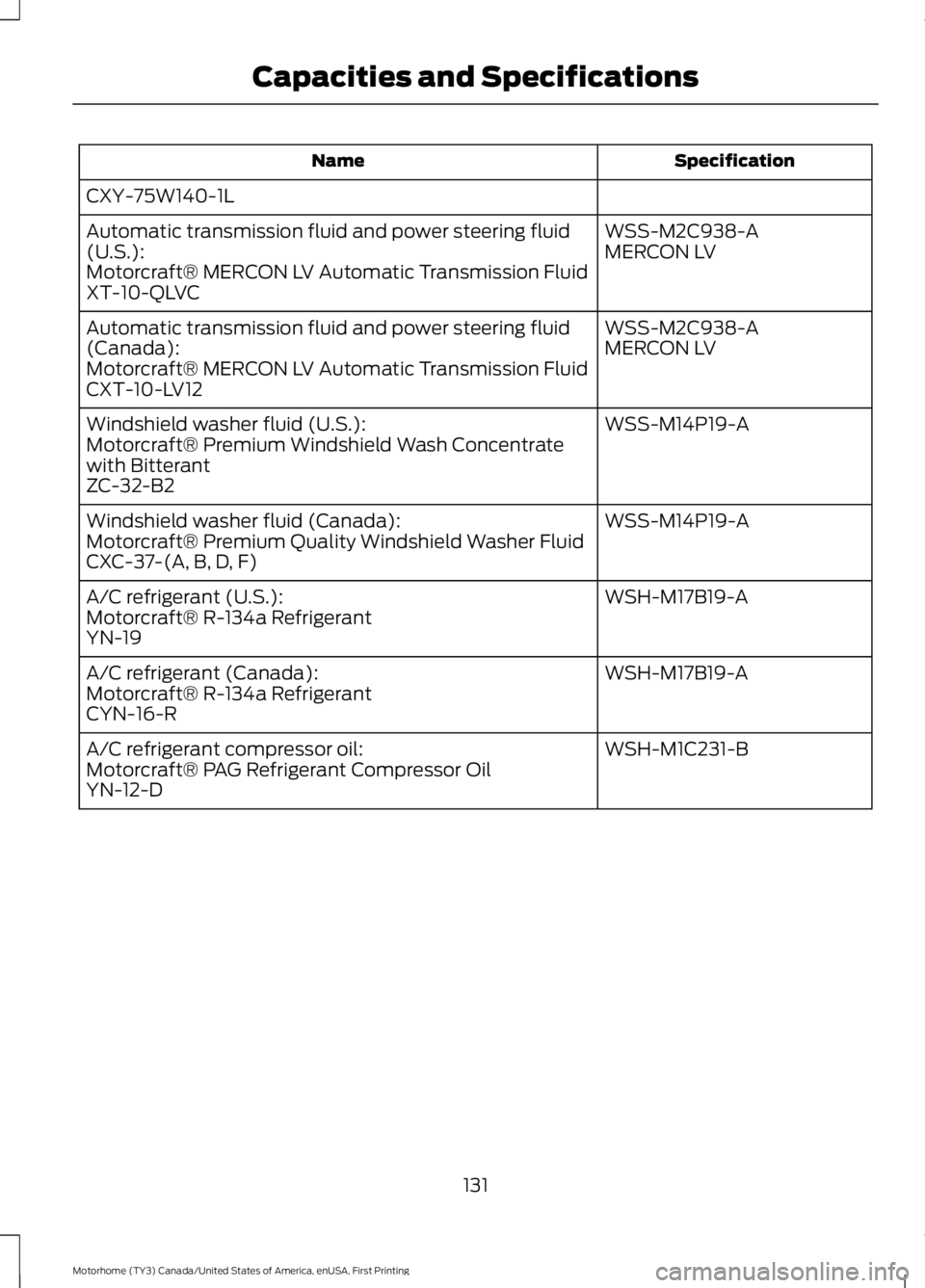
Specification
Name
CXY-75W140-1L WSS-M2C938-A
Automatic transmission fluid and power steering fluid
(U.S.): MERCON LV
Motorcraft® MERCON LV Automatic Transmission Fluid
XT-10-QLVC
WSS-M2C938-A
Automatic transmission fluid and power steering fluid
(Canada): MERCON LV
Motorcraft® MERCON LV Automatic Transmission Fluid
CXT-10-LV12
WSS-M14P19-A
Windshield washer fluid (U.S.):
Motorcraft® Premium Windshield Wash Concentrate
with Bitterant
ZC-32-B2
WSS-M14P19-A
Windshield washer fluid (Canada):
Motorcraft® Premium Quality Windshield Washer Fluid
CXC-37-(A, B, D, F)
WSH-M17B19-A
A/C refrigerant (U.S.):
Motorcraft® R-134a Refrigerant
YN-19
WSH-M17B19-A
A/C refrigerant (Canada):
Motorcraft® R-134a Refrigerant
CYN-16-R
WSH-M1C231-B
A/C refrigerant compressor oil:
Motorcraft® PAG Refrigerant Compressor Oil
YN-12-D
131
Motorhome (TY3) Canada/United States of America, enUSA, First Printing Capacities and Specifications
Page 136 of 164
Note:
Ford recommends using DOT 3 High
Performance Brake Fluid or equivalent
meeting WSS-M6C65-A1 or DOT 5.1 Motor
Vehicle Brake Fluid WSS-M6C65-A3. Use
of any fluid other than the recommended
fluid may cause degraded brake
performance and not meet the Ford
performance standards. Keep brake fluid
clean and dry. Contamination with dirt,
water, petroleum products or other
materials may result in brake system
damage and possible failure.
Note: Automatic transmissions that require
MERCON LV transmission fluid should only
use MERCON LV transmission fluid. The
use of any other fluid may cause
transmission damage.
133
Motorhome (TY3) Canada/United States of America, enUSA, First Printing Capacities and Specifications
Page 141 of 164
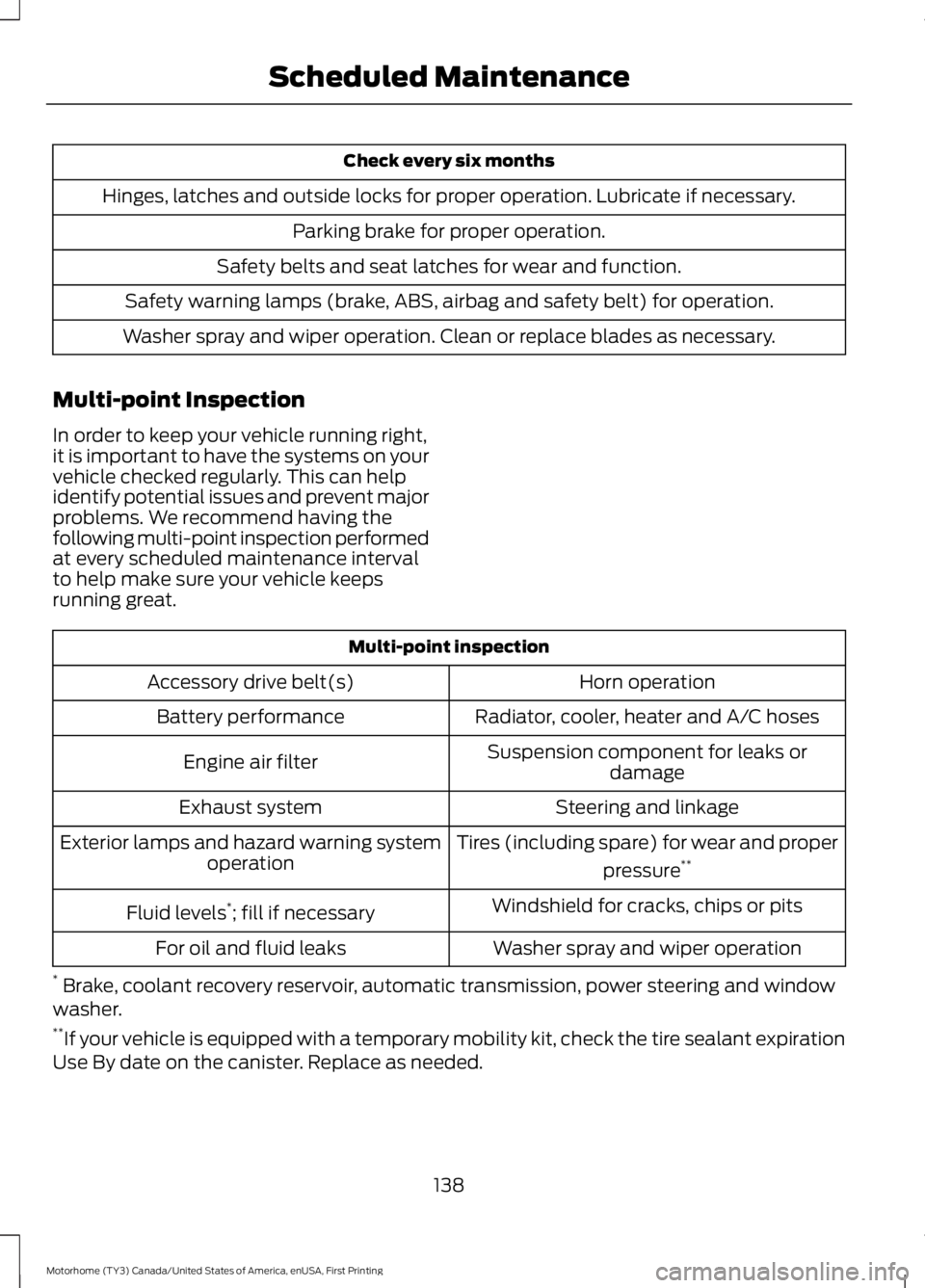
Check every six months
Hinges, latches and outside locks for proper operation. Lubricate if necessary. Parking brake for proper operation.
Safety belts and seat latches for wear and function.
Safety warning lamps (brake, ABS, airbag and safety belt) for operation.
Washer spray and wiper operation. Clean or replace blades as necessary.
Multi-point Inspection
In order to keep your vehicle running right,
it is important to have the systems on your
vehicle checked regularly. This can help
identify potential issues and prevent major
problems. We recommend having the
following multi-point inspection performed
at every scheduled maintenance interval
to help make sure your vehicle keeps
running great. Multi-point inspection
Horn operation
Accessory drive belt(s)
Radiator, cooler, heater and A/C hoses
Battery performance
Suspension component for leaks ordamage
Engine air filter
Steering and linkage
Exhaust system
Tires (including spare) for wear and properpressure**
Exterior lamps and hazard warning system
operation
Windshield for cracks, chips or pits
Fluid levels *
; fill if necessary
Washer spray and wiper operation
For oil and fluid leaks
* Brake, coolant recovery reservoir, automatic transmission, power steering and window
washer.
** If your vehicle is equipped with a temporary mobility kit, check the tire sealant expiration
Use By date on the canister. Replace as needed.
138
Motorhome (TY3) Canada/United States of America, enUSA, First Printing Scheduled Maintenance
Page 142 of 164
Be sure to ask your dealership service
advisor or technician about the multi-point
vehicle inspection. It is a comprehensive
way to perform a thorough inspection of
your vehicle. Your checklist gives you
immediate feedback on the overall
condition of your vehicle.
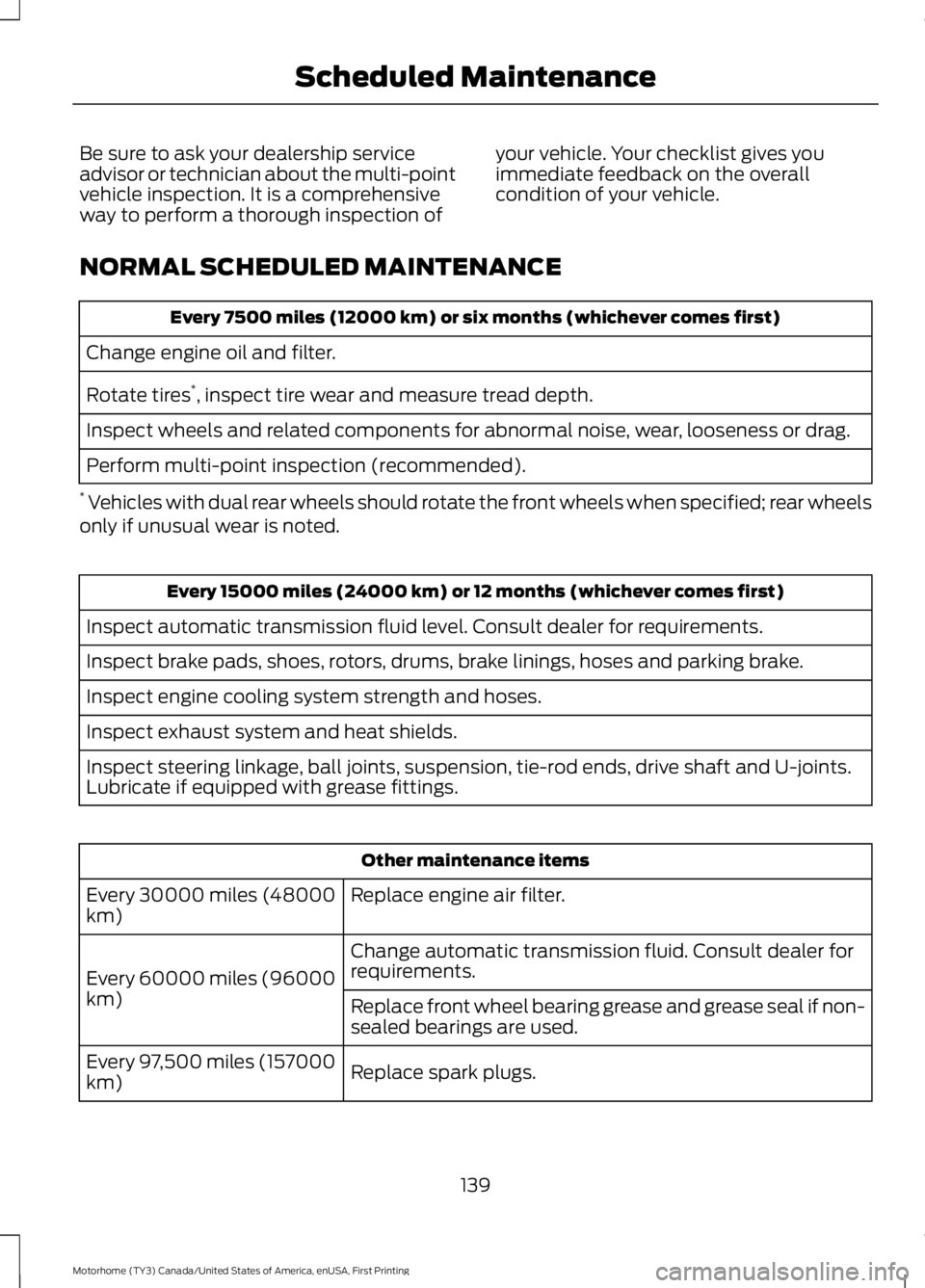
NORMAL SCHEDULED MAINTENANCE Every 7500 miles (12000 km) or six months (whichever comes first)
Change engine oil and filter.
Rotate tires *
, inspect tire wear and measure tread depth.
Inspect wheels and related components for abnormal noise, wear, looseness or drag.
Perform multi-point inspection (recommended).
* Vehicles with dual rear wheels should rotate the front wheels when specified; rear wheels
only if unusual wear is noted. Every 15000 miles (24000 km) or 12 months (whichever comes first)
Inspect automatic transmission fluid level. Consult dealer for requirements.
Inspect brake pads, shoes, rotors, drums, brake linings, hoses and parking brake.
Inspect engine cooling system strength and hoses.
Inspect exhaust system and heat shields.
Inspect steering linkage, ball joints, suspension, tie-rod ends, drive shaft and U-joints.
Lubricate if equipped with grease fittings. Other maintenance items
Replace engine air filter.
Every 30000 miles (48000
km)
Change automatic transmission fluid. Consult dealer for
requirements.
Every 60000 miles (96000
km) Replace front wheel bearing grease and grease seal if non-
sealed bearings are used.
Replace spark plugs.
Every 97,500 miles (157000
km)
139
Motorhome (TY3) Canada/United States of America, enUSA, First Printing Scheduled Maintenance