engine FORD F650 2000 10.G User Guide
[x] Cancel search | Manufacturer: FORD, Model Year: 2000, Model line: F650, Model: FORD F650 2000 10.GPages: 208, PDF Size: 1.08 MB
Page 17 of 208
Never remove the coolant reservoir cap while the engine is
running or hot.
This gauge indicates the temperature of the engine coolant, not the
coolant level. If the coolant is not at its proper level the gauge indication
will not be accurate.
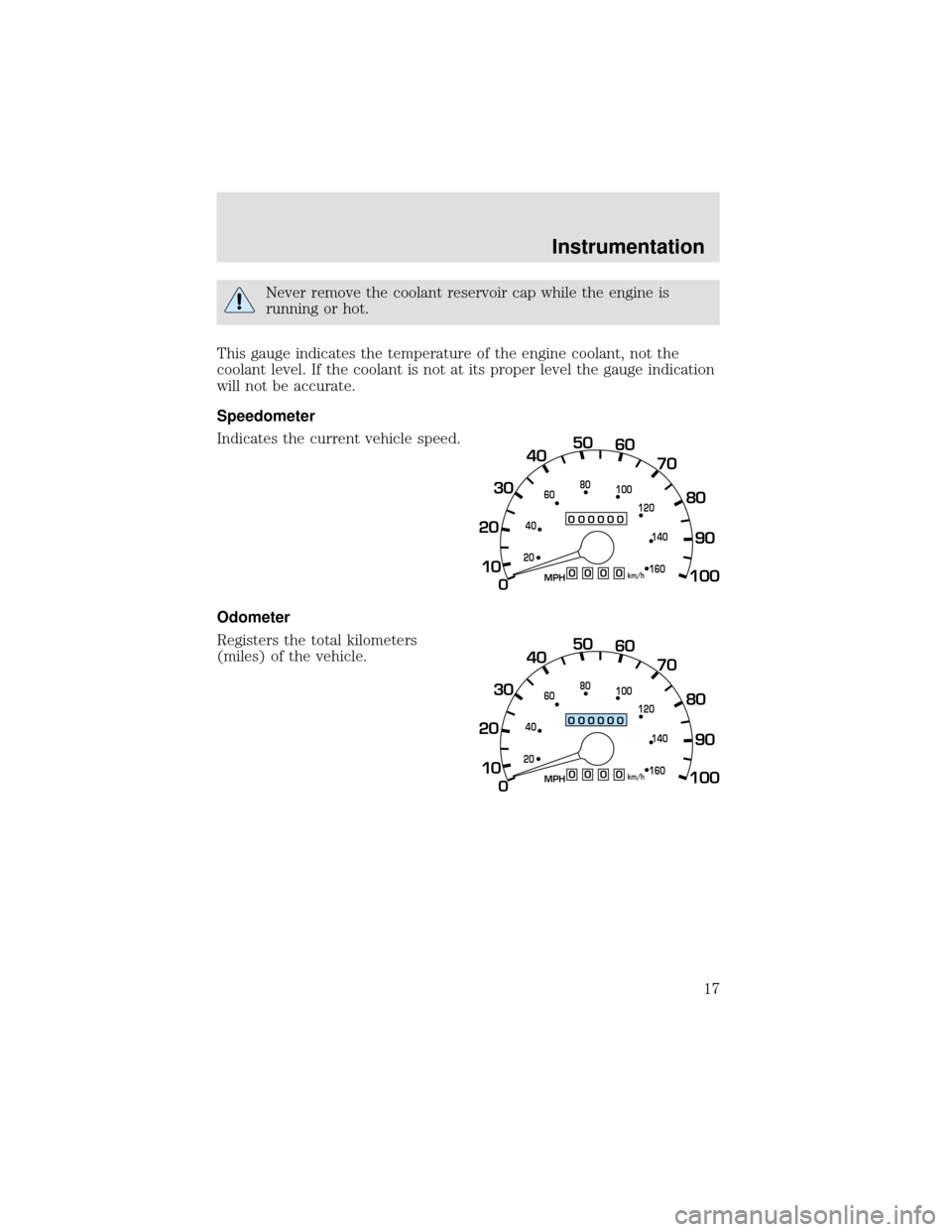
Speedometer
Indicates the current vehicle speed.
Odometer
Registers the total kilometers
(miles) of the vehicle.
0
000000000
MPH
20
km/h
406080
100
120
140
160
0
10 20304050
60
70
80
90
100
0000MPH
20
km/h
406080
100
120
140
160
0
10 20304050
60
70
80
90
100
000000
Instrumentation
17
Page 18 of 208
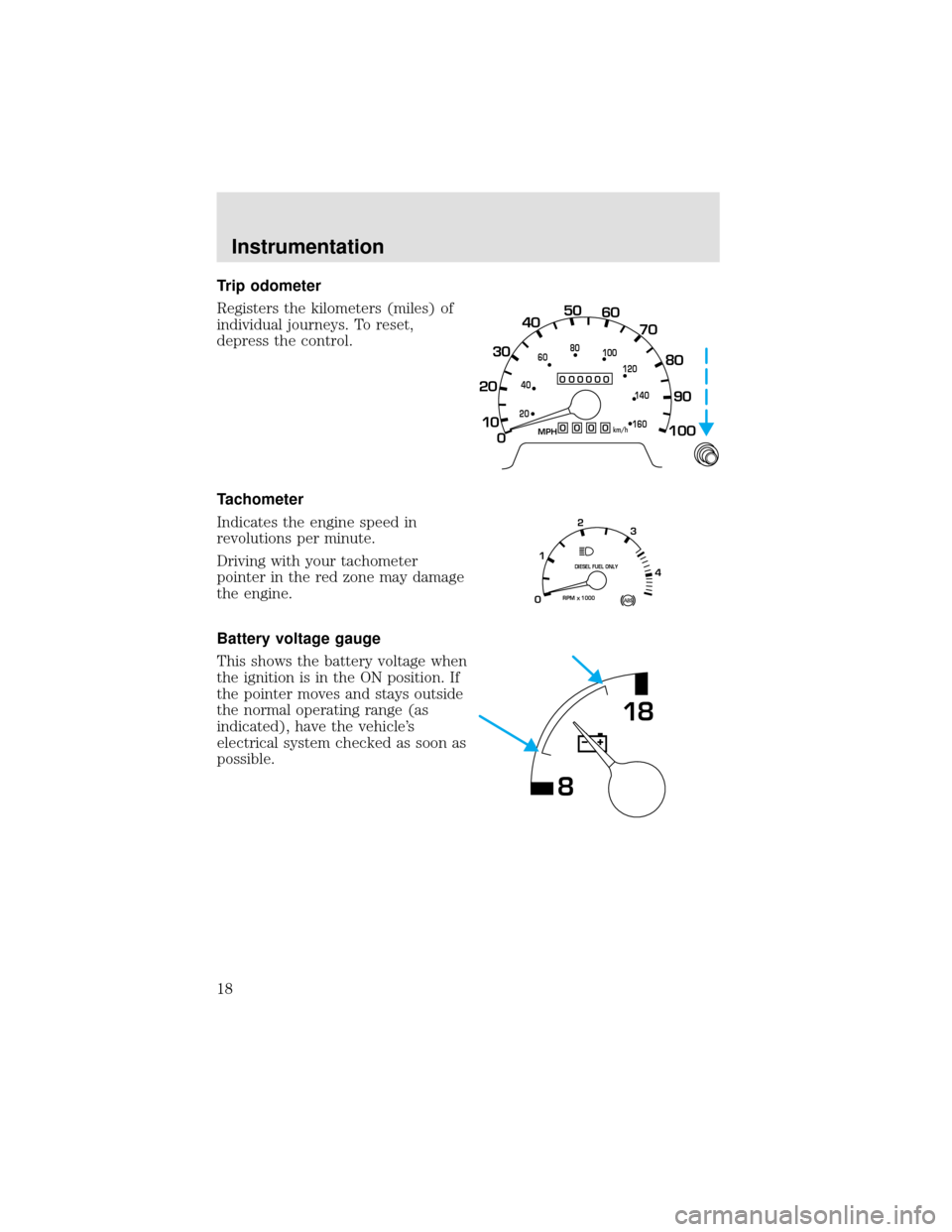
Trip odometer
Registers the kilometers (miles) of
individual journeys. To reset,
depress the control.
Tachometer
Indicates the engine speed in
revolutions per minute.
Driving with your tachometer
pointer in the red zone may damage
the engine.
Battery voltage gauge
This shows the battery voltage when
the ignition is in the ON position. If
the pointer moves and stays outside
the normal operating range (as
indicated), have the vehicle’s
electrical system checked as soon as
possible.
0
000000000
MPH
20km/h
406080
100
120
140
160
0
10 20304050
60
70
80
90
100
RPM1000
DIESEL FUEL ONLY
X012
3
4
818
Instrumentation
18
Page 19 of 208
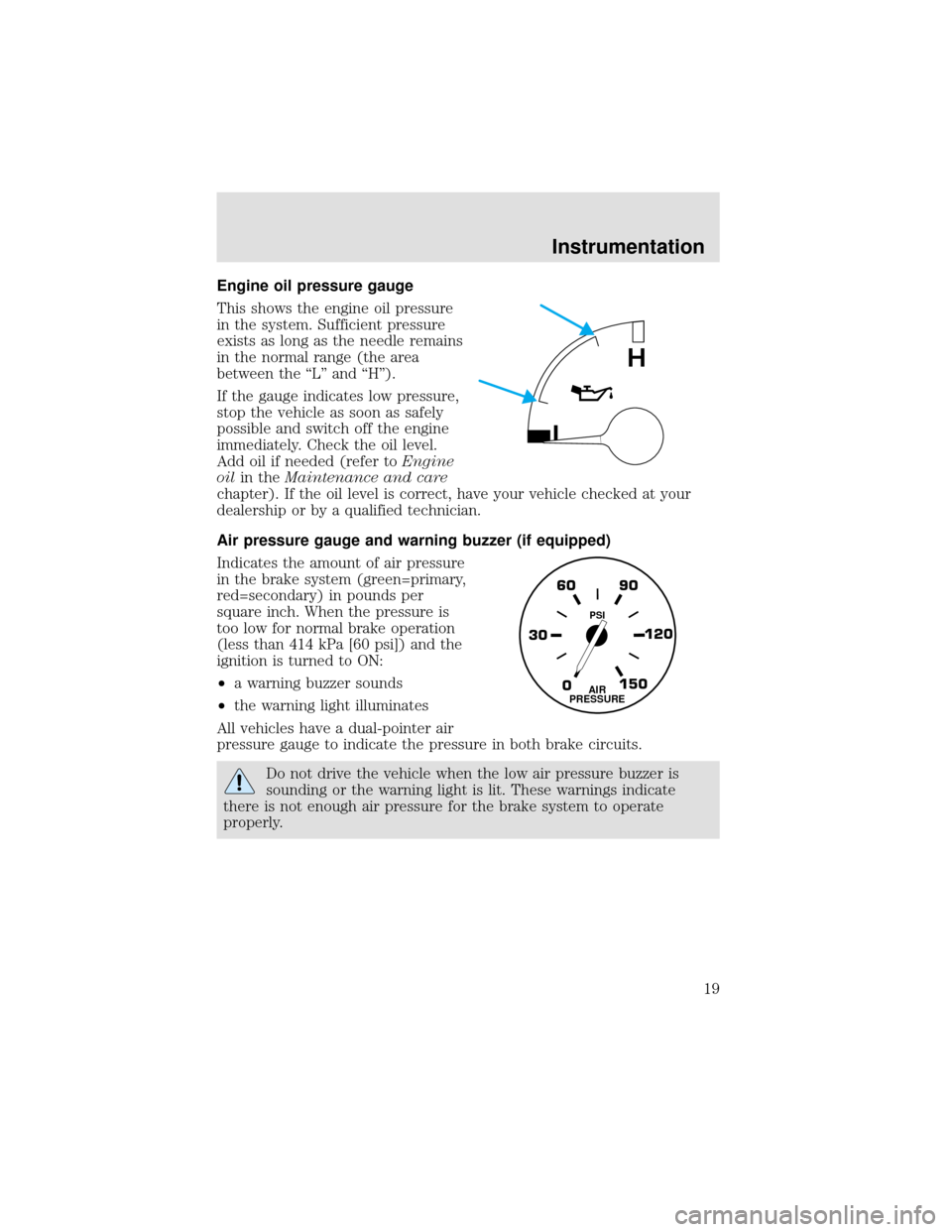
Engine oil pressure gauge
This shows the engine oil pressure
in the system. Sufficient pressure
exists as long as the needle remains
in the normal range (the area
between the“L”and“H”).
If the gauge indicates low pressure,
stop the vehicle as soon as safely
possible and switch off the engine
immediately. Check the oil level.
Add oil if needed (refer toEngine
oilin theMaintenance and care
chapter). If the oil level is correct, have your vehicle checked at your
dealership or by a qualified technician.
Air pressure gauge and warning buzzer (if equipped)
Indicates the amount of air pressure
in the brake system (green=primary,
red=secondary) in pounds per
square inch. When the pressure is
too low for normal brake operation
(less than 414 kPa [60 psi]) and the
ignition is turned to ON:
•a warning buzzer sounds
•the warning light illuminates
All vehicles have a dual-pointer air
pressure gauge to indicate the pressure in both brake circuits.
Do not drive the vehicle when the low air pressure buzzer is
sounding or the warning light is lit. These warnings indicate
there is not enough air pressure for the brake system to operate
properly.
L
H
0 30120 90 60
150AIR
PRESSURE
PSI
Instrumentation
19
Page 49 of 208
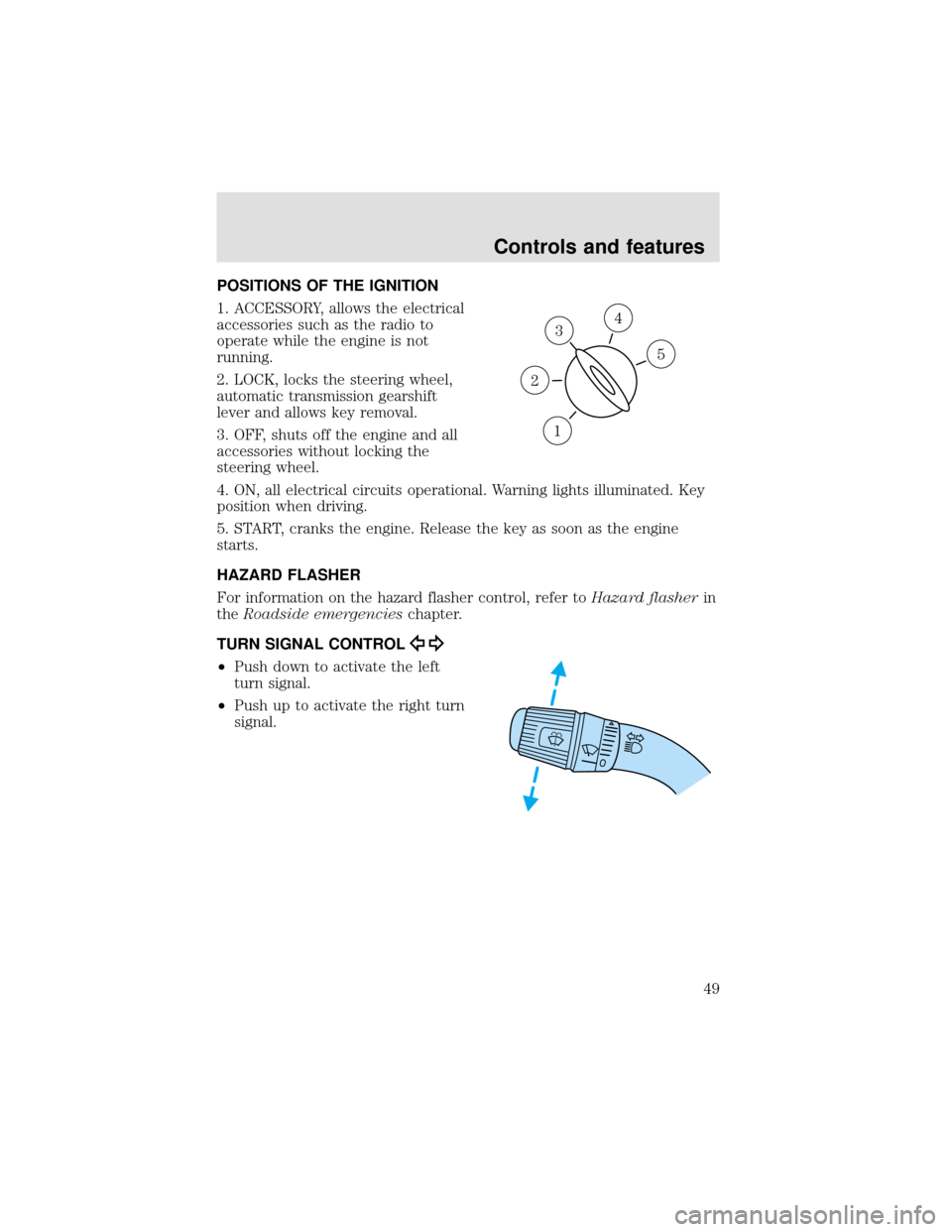
POSITIONS OF THE IGNITION
1. ACCESSORY, allows the electrical
accessories such as the radio to
operate while the engine is not
running.
2. LOCK, locks the steering wheel,
automatic transmission gearshift
lever and allows key removal.
3. OFF, shuts off the engine and all
accessories without locking the
steering wheel.
4. ON, all electrical circuits operational. Warning lights illuminated. Key
position when driving.
5. START, cranks the engine. Release the key as soon as the engine
starts.
HAZARD FLASHER
For information on the hazard flasher control, refer toHazard flasherin
theRoadside emergencieschapter.
TURN SIGNAL CONTROL
•Push down to activate the left
turn signal.
•Push up to activate the right turn
signal.
3
1
2
5
4
Controls and features
49
Page 69 of 208
One time disable
Anytime the safety belt is buckled and then unbuckled during an ignition
ON cycle, Belt Minder will be disabled for that ignition cycle only.
Deactivating/activating the belt minder feature
Read steps1-9thoroughly before proceeding with the
deactivation/activation programming procedure.
The Belt Minder feature can be deactivated/activated by performing the
following procedure:
Before following the procedure, make sure that:
•the parking brake is set
•the gearshift is in P (Park) (automatic transmission) or the neutral
position (manual transmission).
•the ignition switch is in the OFF position
•all vehicle doors are closed
•the driver’s safety belt is unbuckled
•the parklamps/headlamps are in OFF position (If vehicle is equipped
with Autolamps, this will not affect the procedure.)
To reduce the risk of injury, do not deactivate/activate the Belt
Minder feature while driving the vehicle.
1. Turn the ignition switch to the RUN (or ON) position. (DO NOT
START THE ENGINE)
2. Wait until the safety belt warning light turns off. (Approximately 1–2
minutes)
•Steps 3–5 must be completed within 60 seconds or the procedure will
have to be repeated.
3. Buckle then unbuckle the safety belt three times, ending with the
safety belt unbuckled. This can be done before or during Belt Minder
warning activation.
4. Turn on the parklamps/headlamps, turn off the parklamps/headlamps.
5. Buckle then unbuckle the safety belt three times, ending with the
safety belt unbuckled.
•After step 5 the safety belt warning light will be turned on for three
seconds.
Seating and safety restraints
69
Page 77 of 208
STARTING PROCEDURES
Operating precautions
•Always shift to a lower gear at high altitudes to prevent engine
smoking.
•Avoid extended and unnecessary idling.
Do not operate a diesel engine where the vapors can be
combustible. These vapors can be sucked through the air intake
system and cause engine acceleration and overspeeding, which may
result in bodily injury and extensive property damage. The equipment
owner and operator are responsible for safe operation in a hostile
environment.
STARTING THE ENGINE
1. Ensure headlamps and all accessories are turned off and the parking
brake is applied.
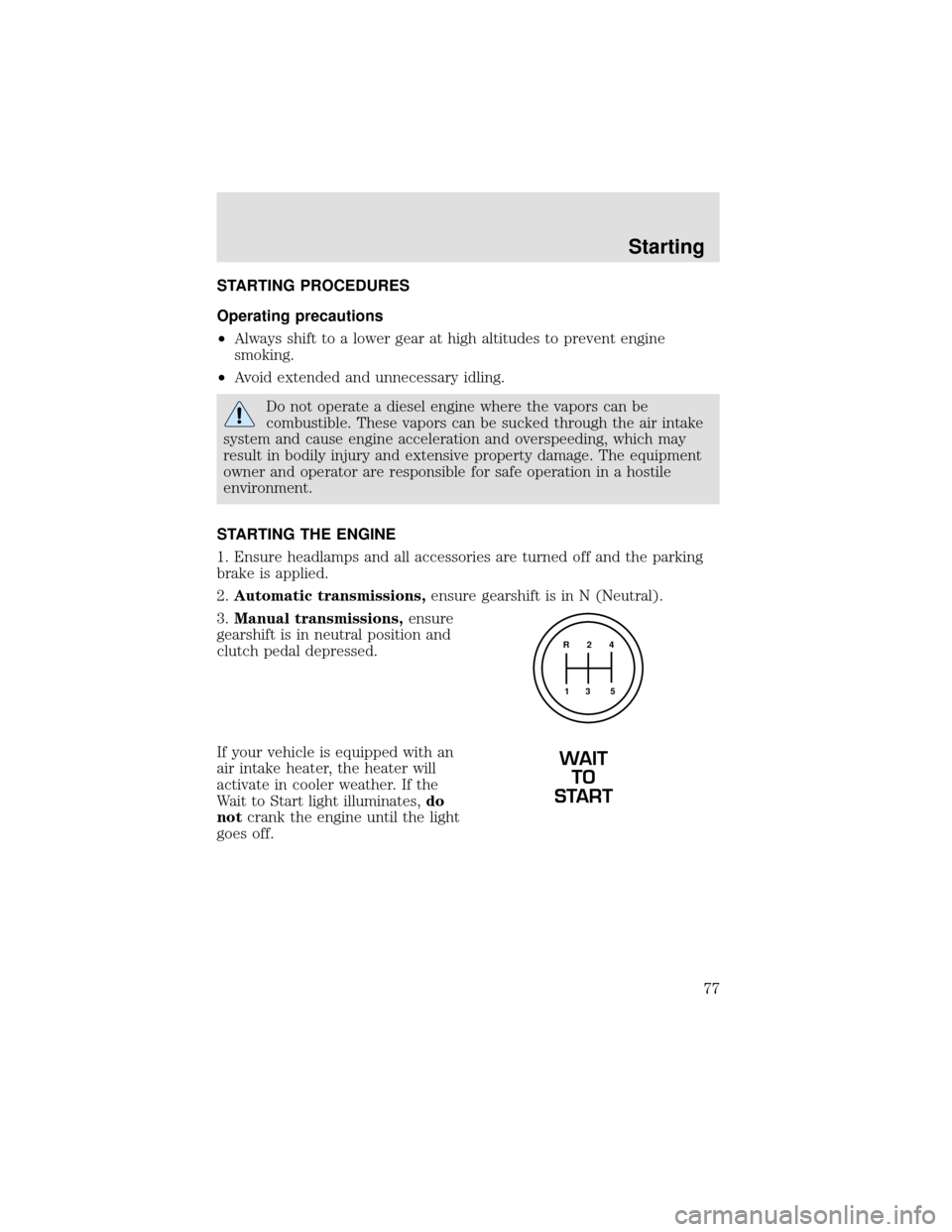
2.Automatic transmissions,ensure gearshift is in N (Neutral).
3.Manual transmissions,ensure
gearshift is in neutral position and
clutch pedal depressed.
If your vehicle is equipped with an
air intake heater, the heater will
activate in cooler weather. If the
Wait to Start light illuminates,do
notcrank the engine until the light
goes off.
R 2 4
3 5 1
WAIT
TO
START
Starting
77
Page 78 of 208
If equipped with an air intake heater, DO NOT use ether or any
other starting fluids. The use of starting fluids (ether) in an
engine equipped with an air intake heater could result in damage
and/or personal injury.
4. Do not depress the accelerator during starting the engine.
5. Start the engine.
If the engine does not start after 30 seconds of cranking, allow two
minutes for the starter to cool before trying again. Excessive cranking
may damage the starter.
After the engine starts:
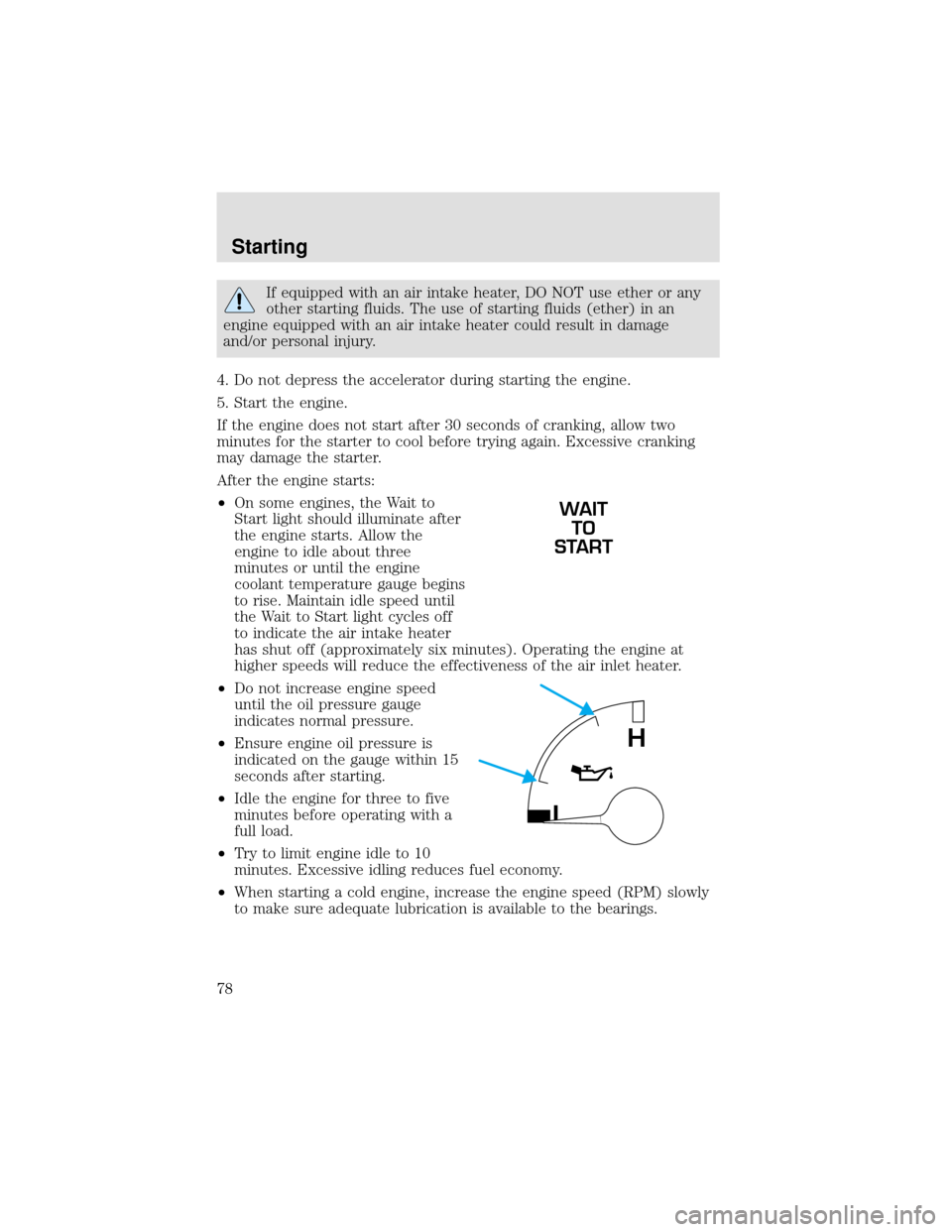
•On some engines, the Wait to
Start light should illuminate after
the engine starts. Allow the
engine to idle about three
minutes or until the engine
coolant temperature gauge begins
to rise. Maintain idle speed until
the Wait to Start light cycles off
to indicate the air intake heater
has shut off (approximately six minutes). Operating the engine at
higher speeds will reduce the effectiveness of the air inlet heater.
•Do not increase engine speed
until the oil pressure gauge
indicates normal pressure.
•Ensure engine oil pressure is
indicated on the gauge within 15
seconds after starting.
•Idle the engine for three to five
minutes before operating with a
full load.
•Try to limit engine idle to 10
minutes. Excessive idling reduces fuel economy.
•When starting a cold engine, increase the engine speed (RPM) slowly
to make sure adequate lubrication is available to the bearings.
WAIT
TO
START
L
H
Starting
78
Page 79 of 208
RESTARTING AFTER RUNNING OUT OF FUEL
The fuel system may need to be purged of air, refer toRunning out of
fuelin theMaintenance and carechapter.
OPERATING THE ENGINE
Do not operate the engine at full throttle below peak torque engine
speed (RPM) for more than one minute at a time (peak torque RPM
varies from 1200-1500 RPM depending on engine rated speed).
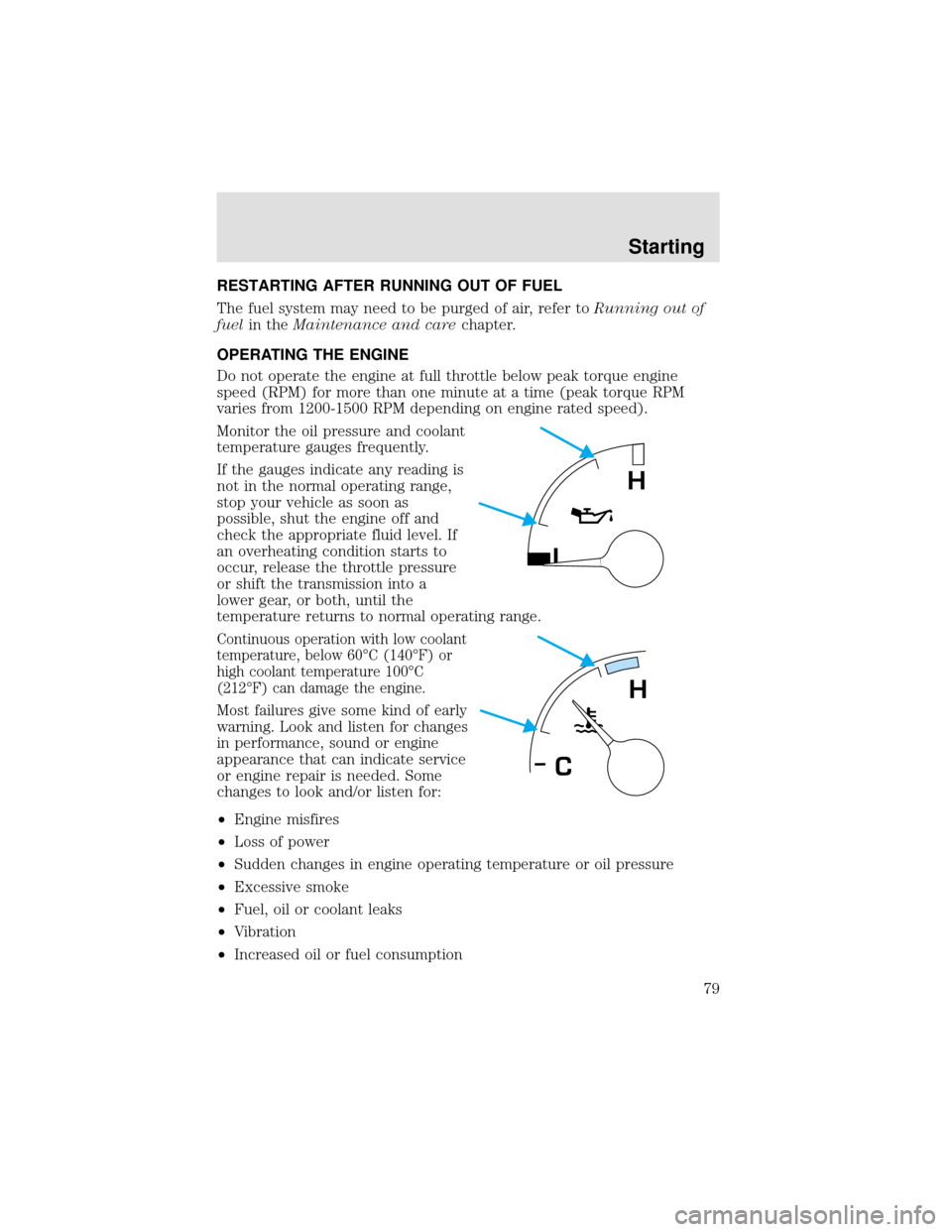
Monitor the oil pressure and coolant
temperature gauges frequently.
If the gauges indicate any reading is
not in the normal operating range,
stop your vehicle as soon as
possible, shut the engine off and
check the appropriate fluid level. If
an overheating condition starts to
occur, release the throttle pressure
or shift the transmission into a
lower gear, or both, until the
temperature returns to normal operating range.
Continuous operation with low coolant
temperature, below 60°C (140°F) or
high coolant temperature 100°C
(212°F) can damage the engine.
Most failures give some kind of early
warning. Look and listen for changes
in performance, sound or engine
appearance that can indicate service
or engine repair is needed. Some
changes to look and/or listen for:
•Engine misfires
•Loss of power
•Sudden changes in engine operating temperature or oil pressure
•Excessive smoke
•Fuel, oil or coolant leaks
•Vibration
•Increased oil or fuel consumption
L
H
H
C
Starting
79
Page 80 of 208
Excessive full throttle operation below peak torque RPM will shorten
engine life to overhaul and can cause serious engine damage. Operation
of the engine below peak torque RPM can occur during gear shifting due
to difference of gear ratios.
COLD WEATHER STARTING
Perform the following to assure efficient starting in cold weather:
•Use the proper grade oil for your climate. Refer to your engine
operator’s manual for proper grade oil.
•Test the battery more frequently to assure ample power for starting.
•All electrical connections should be tight and in good condition to
prevent losses through loose or corroded connections.
USING THE ENGINE BLOCK HEATER (IF EQUIPPED)
An engine block heater warms the engine coolant, which improves
starting, warms up the engine faster and allows the heater-defroster
system to respond quickly. Use of an engine block heater is strongly
recommended if you live in a region where temperatures reach -23°C
(-10°F) or below.
For best results, plug the heater in at least three hours before starting the
vehicle. Using the heater for longer than three hours will not harm the
engine, so the heater can be plugged in the night before starting the vehicle.
To prevent electrical shock, do not use your heater with
ungrounded electrical systems or two-pronged (cheater)
adapters.
ENGINE SHUTDOWN SYSTEM (IF EQUIPPED)
This system is designed to help prevent engine damage that could result
from operating the engine during a prolonged period of low engine oil
pressure, high engine coolant temperature or low coolant level. If any of
these conditions occur, a warning light will illuminate and a chime will
sound warning the operator that the engine will shutdown in 30 seconds.
This is to allow time for the operator to move the vehicle off the road. If
additional time is required, the engine can be restarted and run each
time for approximately 30 seconds.
Do not attempt to use this restarting feature to drive the vehicle, serious
engine damage could result.
Starting
80
Page 81 of 208
EXHAUST FUMES
Never idle the engine in closed areas. Never sit in a parked or
stopped vehicle for any amount of time with engine running.
If you ever smell exhaust fumes of any kind inside your vehicle,
have your dealer inspect and fix your vehicle immediately. Do
not drive if you smell exhaust fumes. These fumes are harmful and
could kill you.
In order to guard against fumes entering your vehicle, the exhaust
system and body ventilation system should be checked by a qualified
technician:
•Each time the vehicle is raised for service.
•Whenever a change in exhaust system noise is noted.
•Whenever the vehicle has been damaged by impact from another
vehicle, object or road obstruction.
In order to afford proper operation, all air inlet vents should be kept
clear of snow, leaves and other debris.
If you run the engine while stopped (idled) in an unconfined area, open
the windows at least 2.5 cm (one inch) and adjust the heating or air
conditioning to draw outside air into the vehicle as follows:
•If your vehicle has outside air control vents, open them fully.
•Set fan speed on high with function control to any position except
OFF or MAX A/C and the temperature control on any desired position.
•Adjust air control system to force outside air into the vehicle.
BACKING UP
To avoid the possibility of personal injury while backing the
vehicle, always be sure your vehicle’s path is clear.
Before backing your vehicle, be sure you can do so safely. If anything
behind the cab limits your view, do not rely on mirrors alone to assure
that your intended path is clear. If other persons are in the vicinity, have
someone standing well behind the vehicle and outside your intended
path - visible through an exterior mirror - guide you as you back up.
Driving
81