engine FORD F650 2000 10.G Owner's Manual
[x] Cancel search | Manufacturer: FORD, Model Year: 2000, Model line: F650, Model: FORD F650 2000 10.GPages: 208, PDF Size: 1.08 MB
Page 83 of 208
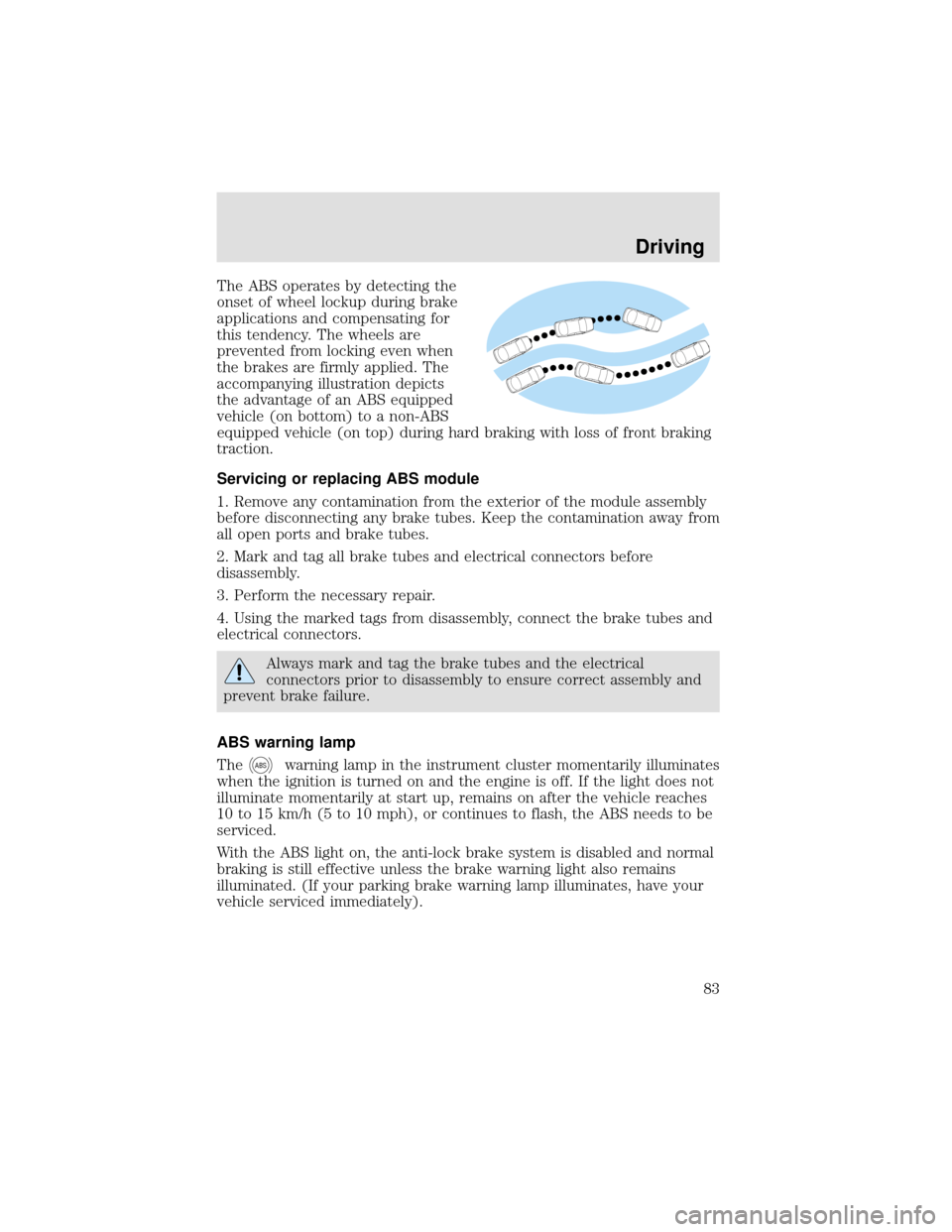
The ABS operates by detecting the
onset of wheel lockup during brake
applications and compensating for
this tendency. The wheels are
prevented from locking even when
the brakes are firmly applied. The
accompanying illustration depicts
the advantage of an ABS equipped
vehicle (on bottom) to a non-ABS
equipped vehicle (on top) during hard braking with loss of front braking
traction.
Servicing or replacing ABS module
1. Remove any contamination from the exterior of the module assembly
before disconnecting any brake tubes. Keep the contamination away from
all open ports and brake tubes.
2. Mark and tag all brake tubes and electrical connectors before
disassembly.
3. Perform the necessary repair.
4. Using the marked tags from disassembly, connect the brake tubes and
electrical connectors.
Always mark and tag the brake tubes and the electrical
connectors prior to disassembly to ensure correct assembly and
prevent brake failure.
ABS warning lamp
The
ABSwarning lamp in the instrument cluster momentarily illuminates
when the ignition is turned on and the engine is off. If the light does not
illuminate momentarily at start up, remains on after the vehicle reaches
10 to 15 km/h (5 to 10 mph), or continues to flash, the ABS needs to be
serviced.
With the ABS light on, the anti-lock brake system is disabled and normal
braking is still effective unless the brake warning light also remains
illuminated. (If your parking brake warning lamp illuminates, have your
vehicle serviced immediately).
Driving
83
Page 84 of 208

Using ABS
•In an emergency or when maximum efficiency from the ABS is
required, apply continuous full force on the brake. The ABS will be
activated immediately, thus allowing you to retain full steering control
of your vehicle and, providing there is sufficient space, will enable you
to avoid obstacles and bring the vehicle to a controlled stop.
•The Anti-Lock system does not decrease the time necessary to apply
the brakes or always reduce stopping distance. Always leave enough
room between your vehicle and the vehicle in front of you to stop.
•We recommend that you familiarize yourself with this braking
technique. However, avoid taking any unnecessary risks.
Hydraulic brake booster system (Hydromax)
The Hydromax systems receive fluid pressure from the power steering
pump to provide power assist during braking.
The Hydromax booster receives backup pressure from the reserve
system electric pump whenever the fluid in the power steering system is
not flowing. When the engine is OFF, the pump will turn on if the brake
pedal is applied, or if the ignition is turned to the ON position.
The sound of the pump operating may be heard by the driver, but this is
a normal characteristic of the system.
The reserve system provides reduced braking power, so the vehicle
should be operated under these conditions with caution, and only to seek
service repair and remove the vehicle from the roadway.
For Hydromax under normal operating conditions noise of the fluid
flowing through the booster may be heard whenever the brake is applied.
This condition is normal. Vehicle service is not required.
If braking performance or pedal response becomes very poor, even when
the pedal is strongly applied, this may indicate the presence of air in the
hydraulic system or fluid leakage. Stop the vehicle safely as soon as
possible and seek service immediately.
If the red BRAKE warning lamp in
the instrument cluster remains
illuminated after engine start up,
this indicates a system failure in the
master cylinder of the brake system.
Stop the vehicle safely as soon as possible and seek service immediately.
!
BRAKE
Driving
84
Page 85 of 208
If the yellow BRAKE RESERVE
(E-motor) warning light remains on
while the engine is running, this
indicates inadequate hydraulic
booster pressure or reserve pump
system failure. Stop the vehicle safely as soon as possible and seek
service immediately.
Parking brake
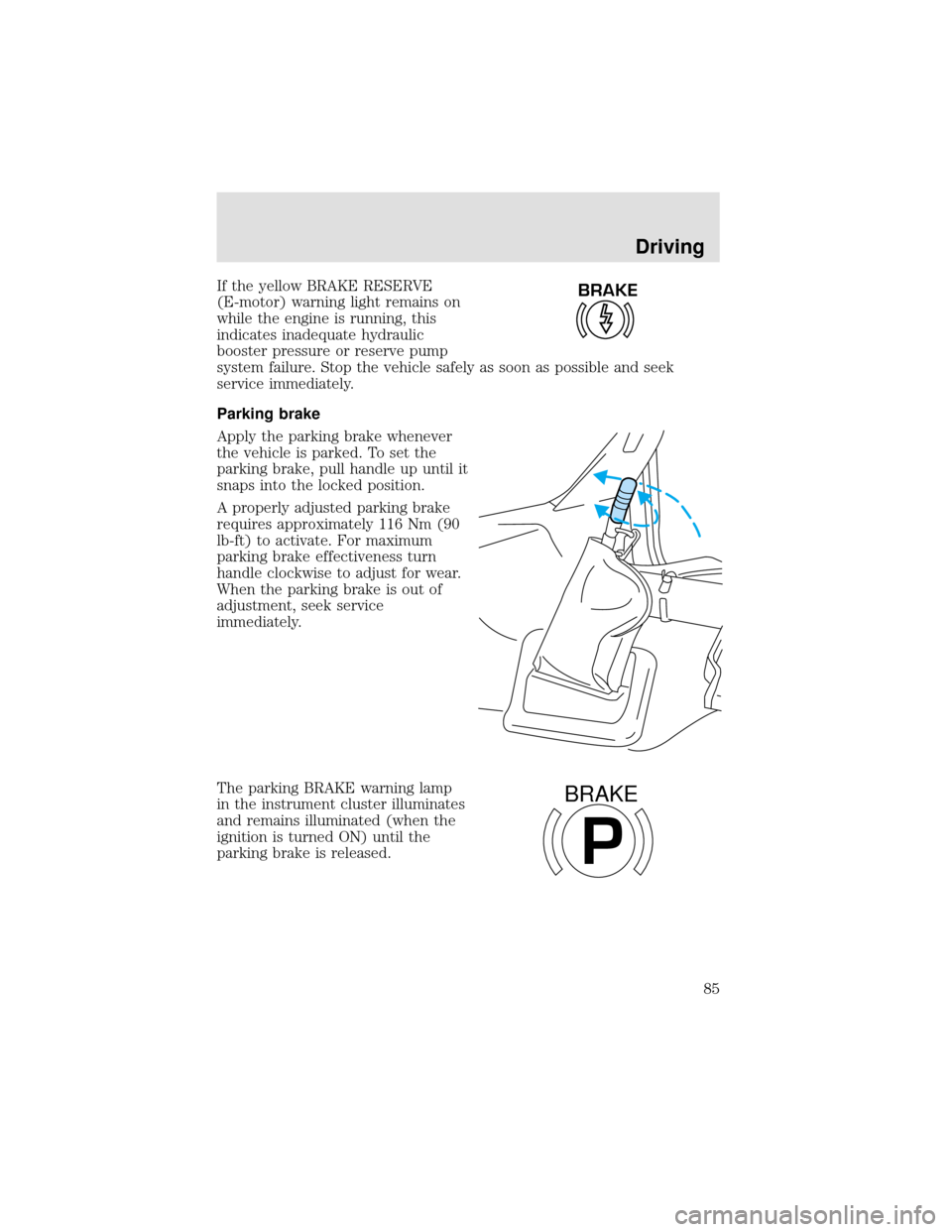
Apply the parking brake whenever
the vehicle is parked. To set the
parking brake, pull handle up until it
snaps into the locked position.
A properly adjusted parking brake
requires approximately 116 Nm (90
lb-ft) to activate. For maximum
parking brake effectiveness turn
handle clockwise to adjust for wear.
When the parking brake is out of
adjustment, seek service
immediately.
The parking BRAKE warning lamp
in the instrument cluster illuminates
and remains illuminated (when the
ignition is turned ON) until the
parking brake is released.BRAKE
P
BRAKE
Driving
85
Page 87 of 208
Burnish procedure
For optimal performance of a new parking brake system/new linings
perform the following procedure:
1. Make ten stops from 40 km/h (20 mph) with the parking brake lever
force set at 18kg (40 lbs).
2. While driving the vehicle at 40 km/h (20 mph) apply the parking brake
(with applicable force to set to approximately 18kg [40 lbs.]). Allow the
vehicle to come to a complete stop, release the parking brake.
3. Drive 16.8 km (1.5 miles) to cool the brakes.
4. Repeat steps 1 through 3 ten times.
AIR BRAKES (if equipped)
Foot service brakes
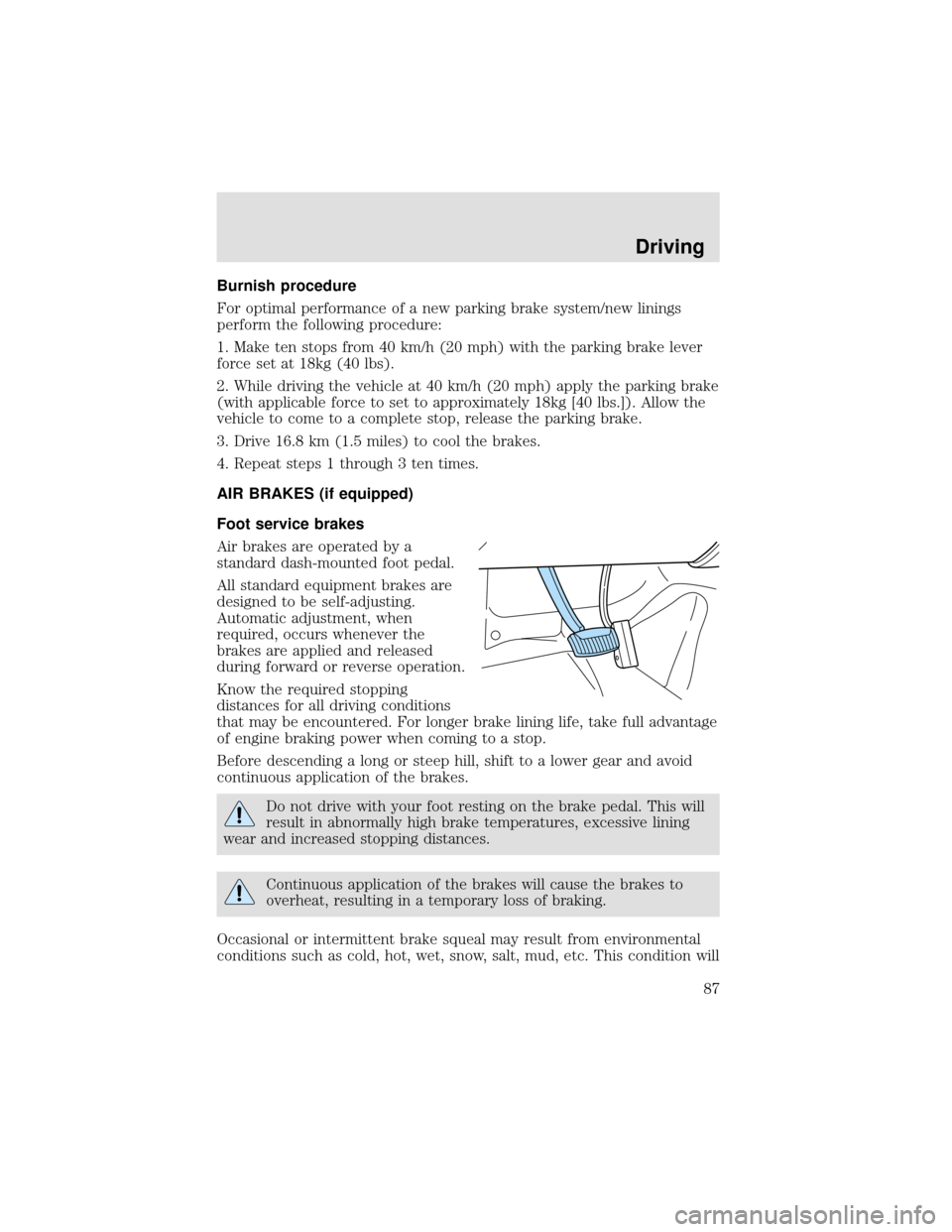
Air brakes are operated by a
standard dash-mounted foot pedal.
All standard equipment brakes are
designed to be self-adjusting.
Automatic adjustment, when
required, occurs whenever the
brakes are applied and released
during forward or reverse operation.
Know the required stopping
distances for all driving conditions
that may be encountered. For longer brake lining life, take full advantage
of engine braking power when coming to a stop.
Before descending a long or steep hill, shift to a lower gear and avoid
continuous application of the brakes.
Do not drive with your foot resting on the brake pedal. This will
result in abnormally high brake temperatures, excessive lining
wear and increased stopping distances.
Continuous application of the brakes will cause the brakes to
overheat, resulting in a temporary loss of braking.
Occasional or intermittent brake squeal may result from environmental
conditions such as cold, hot, wet, snow, salt, mud, etc. This condition will
Driving
87
Page 88 of 208
not affect braking effectiveness. The brakes should be checked only if
squeal occurs continuously with every application.
If brakes do not grip well
•If you have been driving through deep water, gently apply the brakes
several times while the vehicle is moving slowly.
•Let the brakes cool if you have been using them excessively, as in
mountain driving or after several fast, high speed stops.
•Check brake adjustment.
•Check brake linings for excessive wear.
•Check system air pressure.
Air brakes
After starting the engine, give the air compressor time to build up the air
pressure to 414 kPa (60 psi) before moving the vehicle.
Do not drive or continue to drive if the low air pressure buzzer
is sounding or the brake warning light is lit. These warnings
indicate that air pressure is not to normal operating level. Continued
use of the vehicle could result in loss of braking ability.
Avoid repeated light application of the brake pedal. This will
deplete air pressure faster and could result in loss of braking
capability.
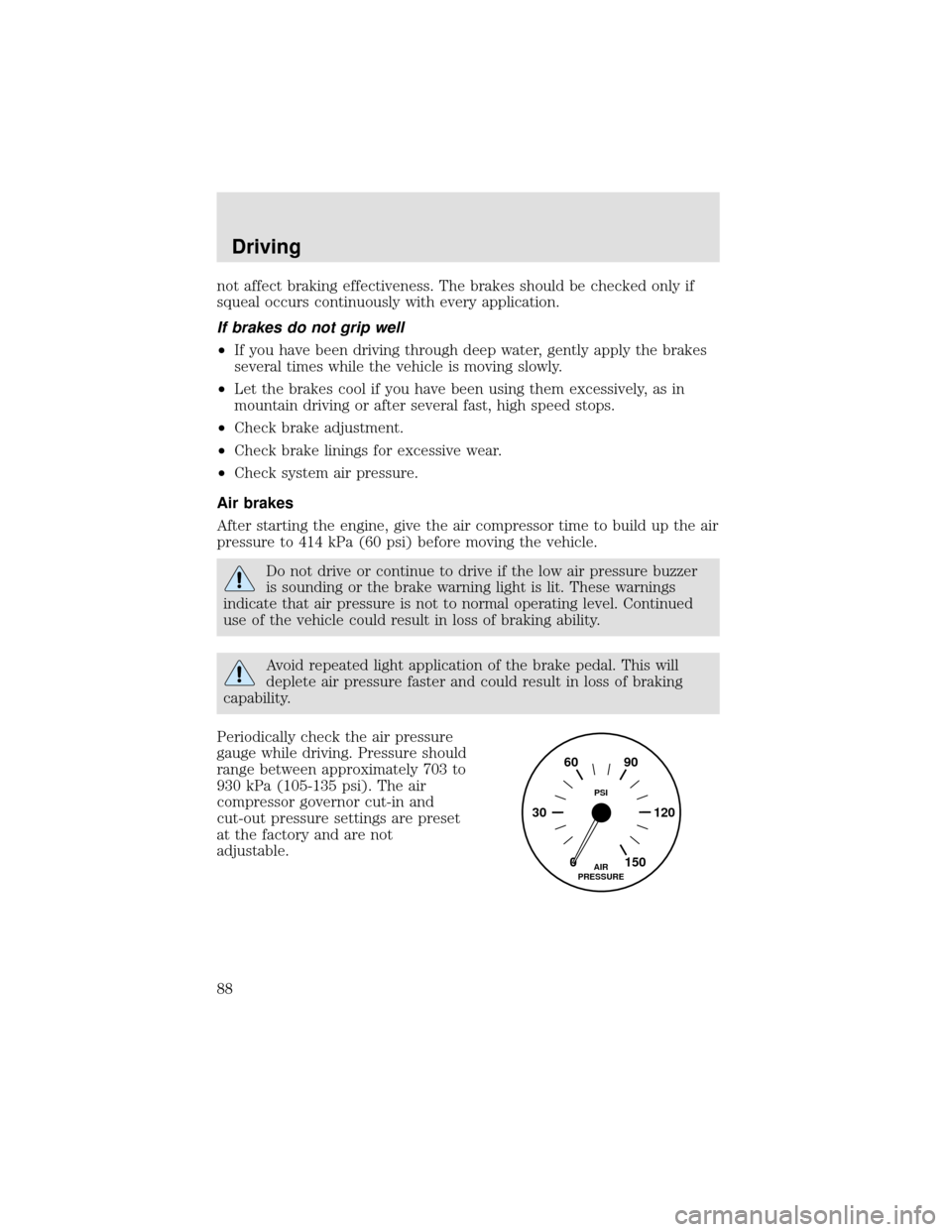
Periodically check the air pressure
gauge while driving. Pressure should
range between approximately 703 to
930 kPa (105-135 psi). The air
compressor governor cut-in and
cut-out pressure settings are preset
at the factory and are not
adjustable.
0 30 12090 60
150AIR
PRESSUREPSI
Driving
88
Page 89 of 208
![FORD F650 2000 10.G Owners Manual When air pressure is insufficient
(below 534 kPa [60 psi]), a warning
light illuminates and a buzzer
sounds when the ignition is in the
ON position.
This condition may be caused by excessive brake app](/img/11/5066/w960_5066-88.png "FORD F650 2000 10.G Owners Manual When air pressure is insufficient
(below 534 kPa [60 psi]), a warning
light illuminates and a buzzer
sounds when the ignition is in the
ON position.
This condition may be caused by excessive brake app")
When air pressure is insufficient
(below 534 kPa [60 psi]), a warning
light illuminates and a buzzer
sounds when the ignition is in the
ON position.
This condition may be caused by excessive brake applications depleting
the system air pressure. If this condition occurs, stop driving the vehicle
until the compressor has fully recharged the air system. Do not move the
vehicle in this condition because the brake system may be inoperative.
Select a gear ratio to help slow your vehicle before descending grades.
Supplement with brakes as required to safely slow the vehicle and avoid
overspeeding the engine.
Air chamber stroke indication
All Ford air chamber push rods have orange stroke indicator stripes that
alert the operator when the braking system requires adjustment or
repair. The orange stripe is painted on the air chamber push rod at the
slack adjuster readjustment stroke dimension.
Air brake inspection and adjustment should be performed by a qualified
service technician in accordance with the instructions in the Ford Truck
Service Manual.
Cam brakes—automatic slack adjusters
Standard air brakes (cam) are
equipped with automatic brake
adjusters. Automatic adjustment
occurs during forward and reverse
brake applications. Inspect brakes
for proper adjustment at the
intervals listed in the vehicle Service
Maintenance Guide.
!
BRAKE
Driving
89
Page 95 of 208
non-override feature. The yellow control (parking brake) will pop out at
approximately 138 to 207 kPa (20-30 psi).
Reservoir selection
The number one service reservoir will at all times be selected as the
primary supply source for the MV-3. This is accomplished automatically
by the function of the dual circuit supply valve contained in the body of
the MV-3. Only in the event of a pressure drop of more than 207 kPa
(30 psi) below that of the number two service reservoir will the dual
circuit supply valve shuttle and establish the front service reservoir as
the supply.
Air brake reservoir draining
Failure to drain air brake reservoirs can result in a reduction or
loss of braking ability due to fluid accumulation in the reservoir
and/or possible freeze-up during cold weather.
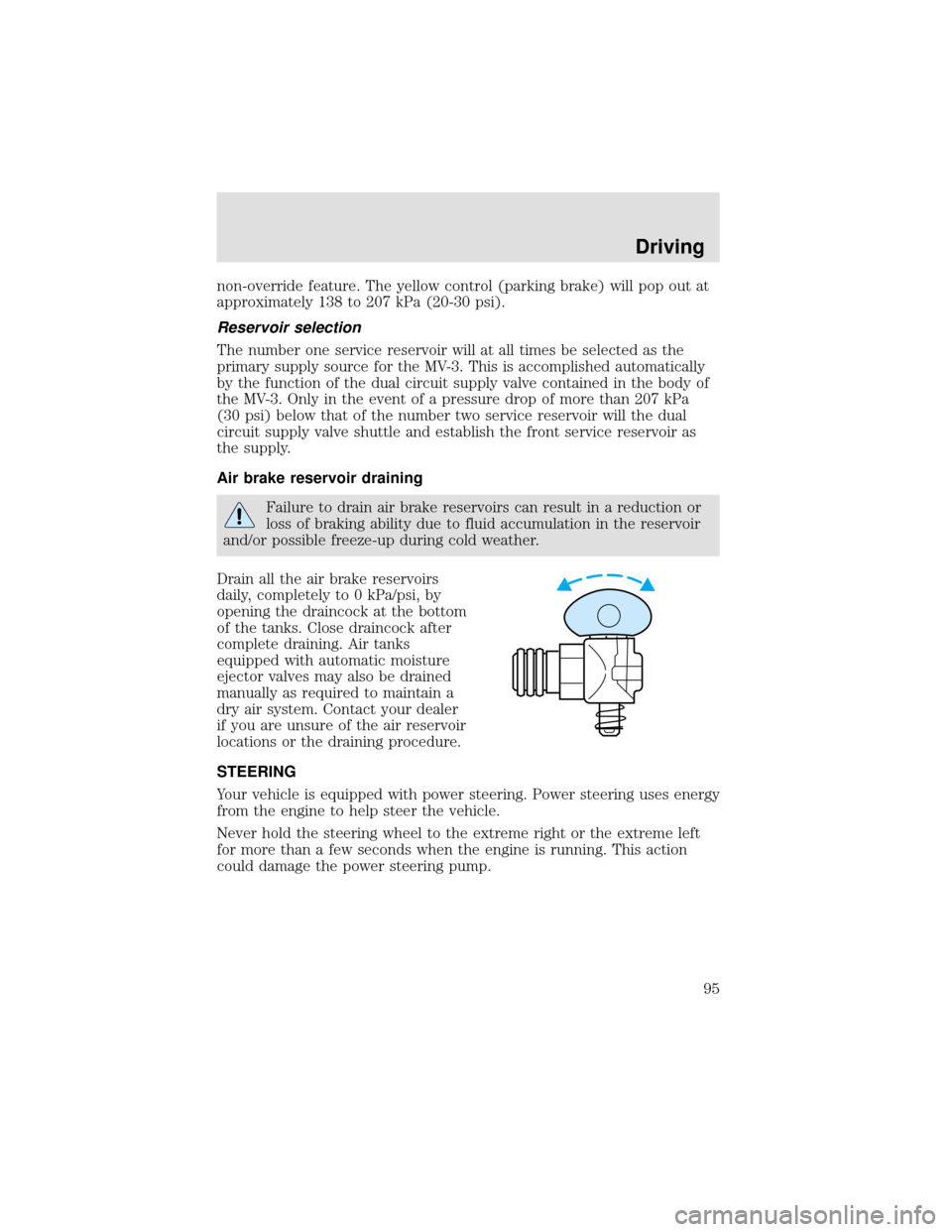
Drain all the air brake reservoirs
daily, completely to 0 kPa/psi, by
opening the draincock at the bottom
of the tanks. Close draincock after
complete draining. Air tanks
equipped with automatic moisture
ejector valves may also be drained
manually as required to maintain a
dry air system. Contact your dealer
if you are unsure of the air reservoir
locations or the draining procedure.
STEERING
Your vehicle is equipped with power steering. Power steering uses energy
from the engine to help steer the vehicle.
Never hold the steering wheel to the extreme right or the extreme left
for more than a few seconds when the engine is running. This action
could damage the power steering pump.
Driving
95
Page 97 of 208
•Lack of lubricant in the front spindle bearings or linkage components
•Low oil level in the power steering system
•Broken or loose power steering pump direct drive connection
•Malfunctioning relief valve in power steering gear or steering pump
•Malfunctioning power steering pump
•Restriction in power steering lines
•Improperly set turn stops
•Air entrapped in power steering system fluid
DRIVING WITH A MANUAL TRANSMISSION, IF EQUIPPED
Continued use of a damaged or worn clutch, prolonged clutch
slippage or downshifting at excessive speeds can result in a
failure of the engine, transmission or clutch components.
To avoid premature clutch wear and failure, do not drive with
your foot resting on the clutch pedal or use it to hold the vehicle
at a standstill on an upgrade as when waiting for a traffic light.
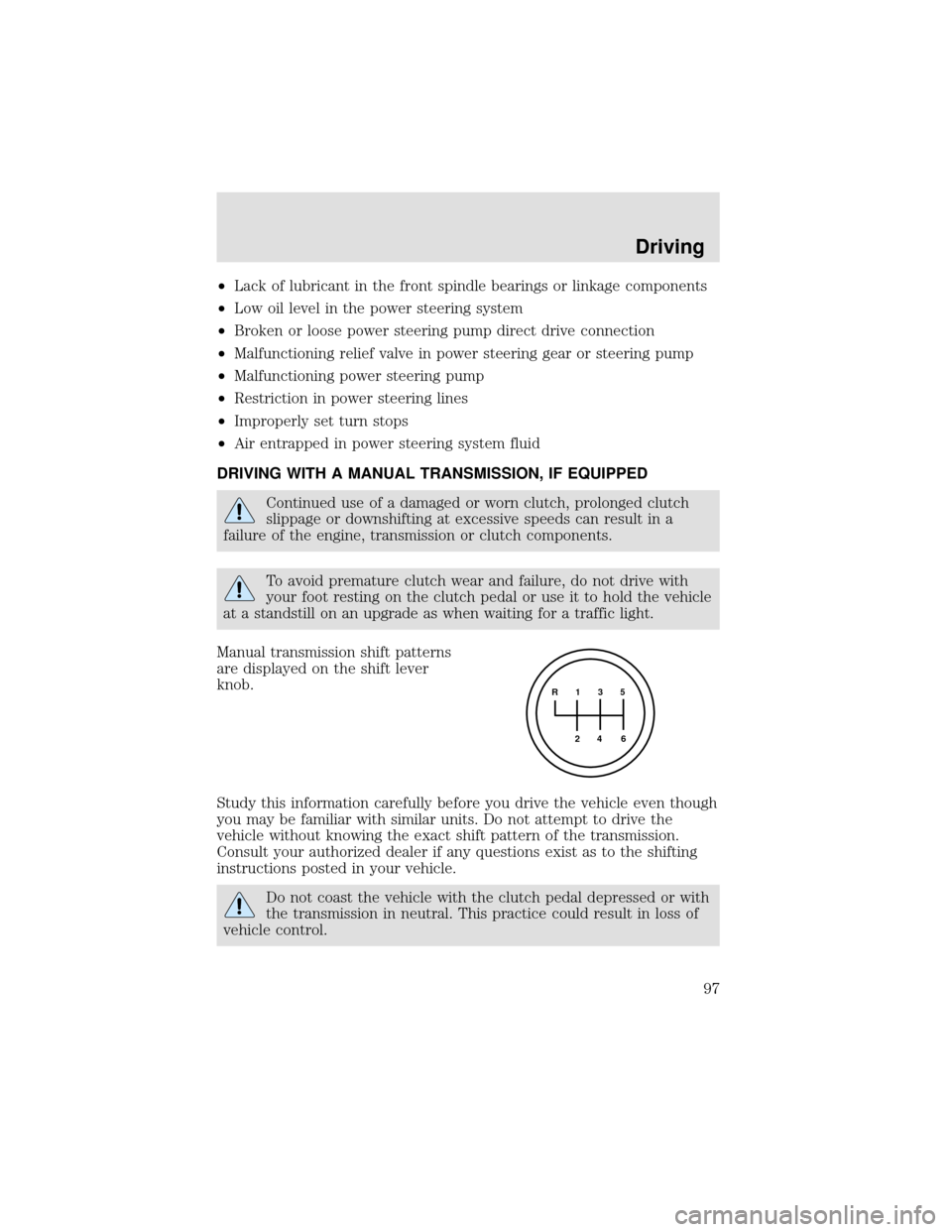
Manual transmission shift patterns
are displayed on the shift lever
knob.
Study this information carefully before you drive the vehicle even though
you may be familiar with similar units. Do not attempt to drive the
vehicle without knowing the exact shift pattern of the transmission.
Consult your authorized dealer if any questions exist as to the shifting
instructions posted in your vehicle.
Do not coast the vehicle with the clutch pedal depressed or with
the transmission in neutral. This practice could result in loss of
vehicle control.
R 1 3 5
4
6 2
Driving
97
Page 98 of 208

Always use a gear ratio low enough to allow the engine to operate above
the minimum engine operation speed range. Do not lug the engine. When
more power is required, shift to a lower gear and accelerate the engine
near the governed speed.
Driving hints
The following driving hints are provided as a brief, general guide in
operating the different manual transmissions used in your vehicle.
•Always use the lowest gear to start the vehicle.
•Do not slam or jerk lever into gear.
•When shifting into 1 (First) or R (Reverse) with vehicle standing still,
quickly release and depress the clutch pedal (if necessary to complete
gear engagement).
Operating the Eaton FS-4205A and FS-5205A 5–speed
transmissions
The 5-speed transmission is
equipped with five forward gears
and one reverse. All forwards gears
are synchronized. The shift pattern
is embossed on the gear shift knob.
Do not shift the transmission into R (Reverse) while the vehicle is
moving as this could damage the transmission.
To go forward
With the engine idling, depress the
clutch pedal and shift into 1 (First).
Engage the clutch while pressing
the accelerator to start forward.
Operate the clutch and upshift as
required by driving conditions.
R 2 4
3 5 1
R 2 4
3 5
1
Driving
98
Page 99 of 208

To go backward
Reverse is obtained by putting the
gearshift lever in R (Reverse) and
engaging the clutch while pressing
lightly on the accelerator.
Operating the Eaton FS-5306A and FS–6306A 6-speed
transmissions
These 6-speed transmissions are
equipped with six forward gears and
one reverse. The 2nd, 3rd, 4th, 5th
and 6th gears are synchronized. The
shift pattern is embossed on the
gear shift knob.
Do not shift the transmission into 1 (First) or R (Reverse) while the
vehicle is moving as this could damage the transmission.
To go forward
With the engine idling, depress the
clutch pedal and shift into 1 (First).
Engage the clutch while pressing
the accelerator to start forward.
Operate the clutch and upshift as
required by driving conditions.
R 2 4
3 5 1
R 1 3 5
4
6 2
R 1 3 5
4
6 2
Driving
99