engine FORD F650 2003 10.G User Guide
[x] Cancel search | Manufacturer: FORD, Model Year: 2003, Model line: F650, Model: FORD F650 2003 10.GPages: 248, PDF Size: 2.54 MB
Page 19 of 248
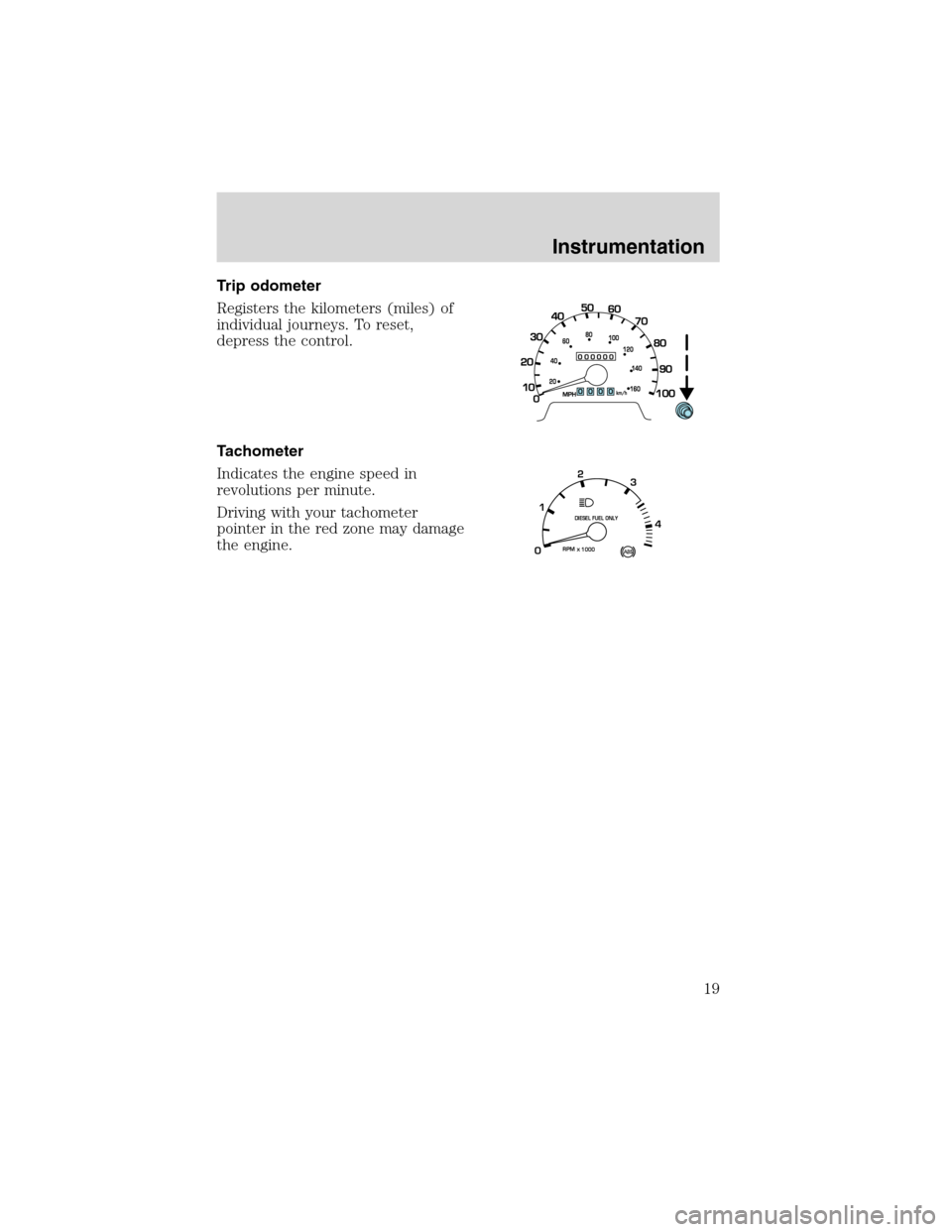
Trip odometer
Registers the kilometers (miles) of
individual journeys. To reset,
depress the control.
Tachometer
Indicates the engine speed in
revolutions per minute.
Driving with your tachometer
pointer in the red zone may damage
the engine.
RPM1000
DIESEL FUEL ONLY
X012
3
4
Instrumentation
19
Page 76 of 248
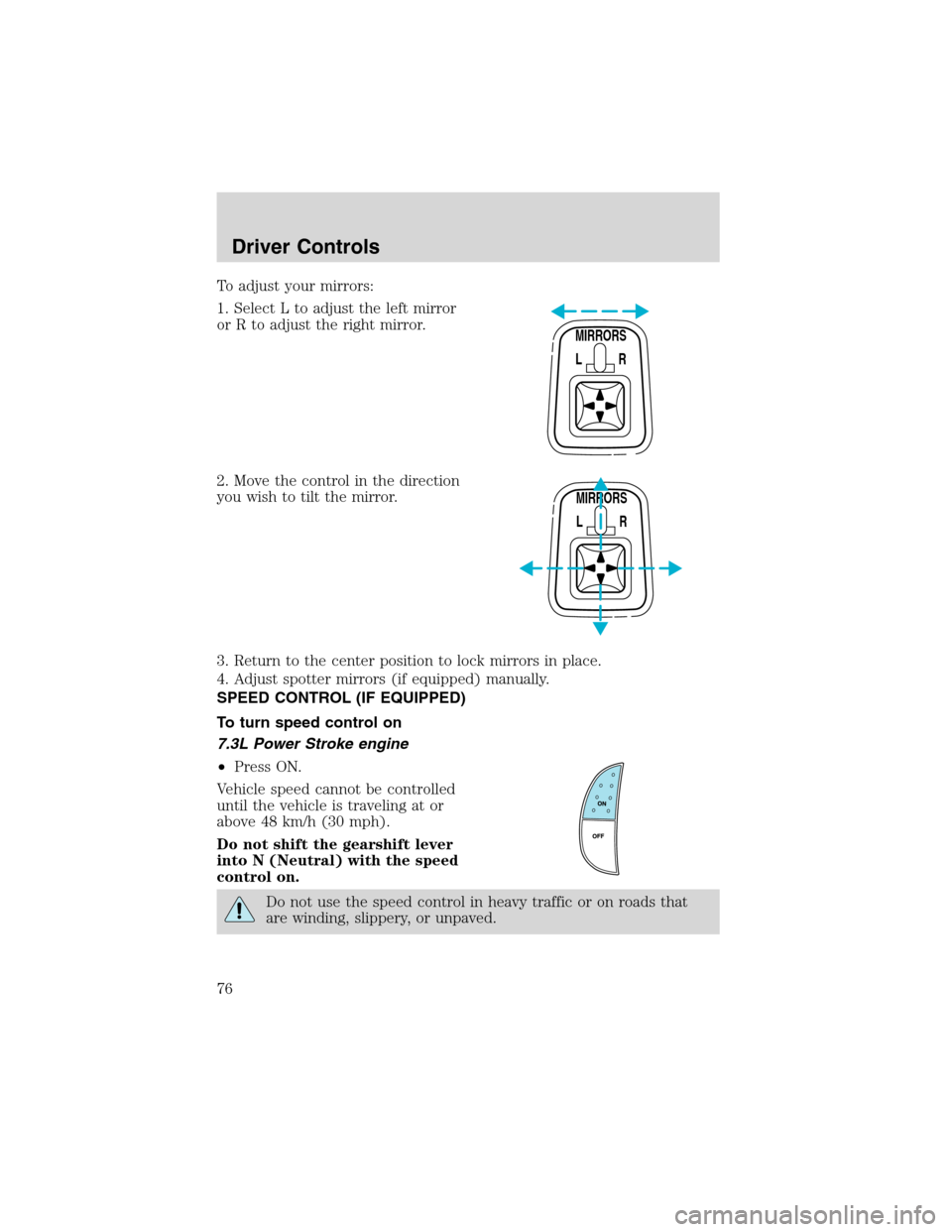
To adjust your mirrors:
1. Select L to adjust the left mirror
or R to adjust the right mirror.
2. Move the control in the direction
you wish to tilt the mirror.
3. Return to the center position to lock mirrors in place.
4. Adjust spotter mirrors (if equipped) manually.
SPEED CONTROL (IF EQUIPPED)
To turn speed control on
7.3L Power Stroke engine
•Press ON.
Vehicle speed cannot be controlled
until the vehicle is traveling at or
above 48 km/h (30 mph).
Do not shift the gearshift lever
into N (Neutral) with the speed
control on.
Do not use the speed control in heavy traffic or on roads that
are winding, slippery, or unpaved.
MIRRORS
L R
MIRRORS
L R
Driver Controls
76
Page 77 of 248
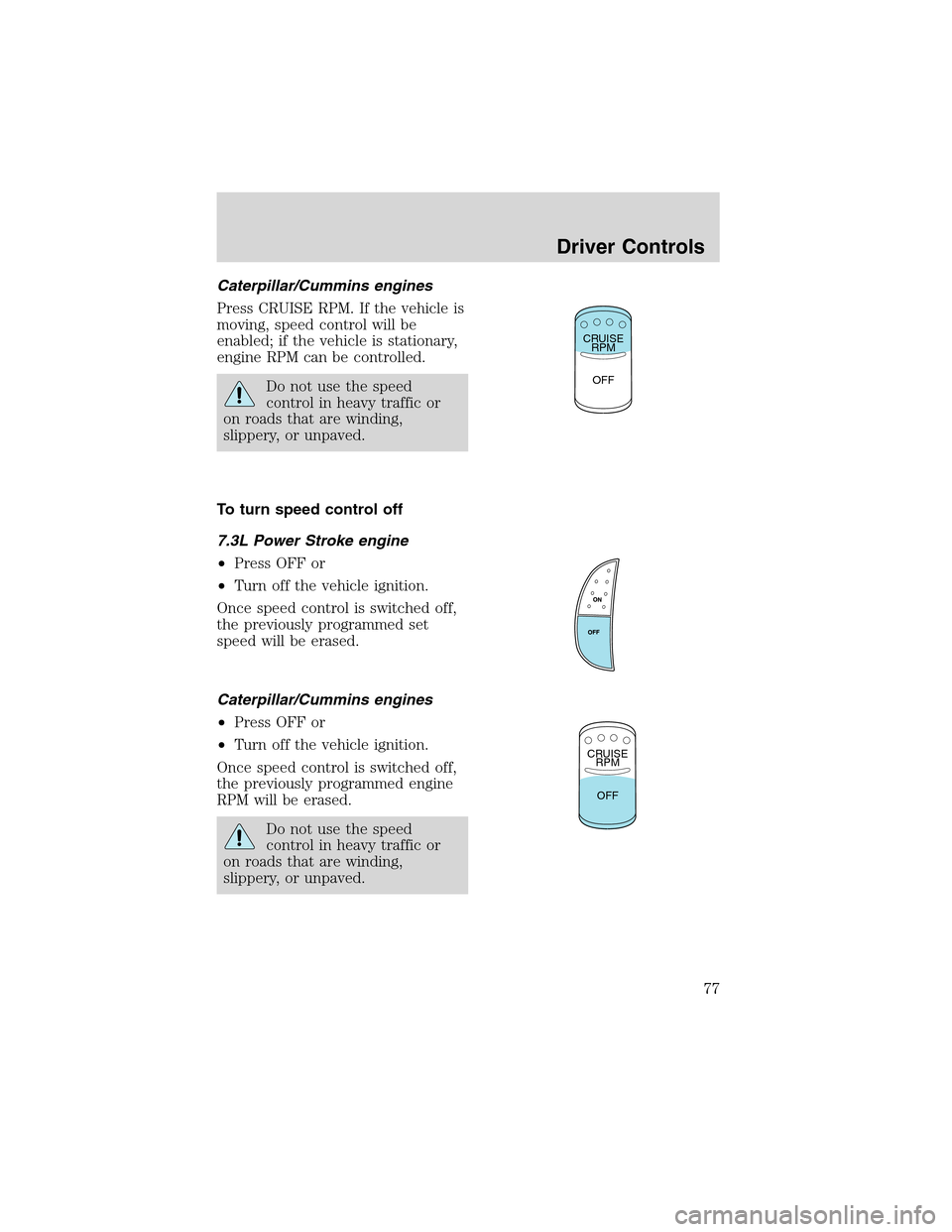
Caterpillar/Cummins engines
Press CRUISE RPM. If the vehicle is
moving, speed control will be
enabled; if the vehicle is stationary,
engine RPM can be controlled.
Do not use the speed
control in heavy traffic or
on roads that are winding,
slippery, or unpaved.
To turn speed control off
7.3L Power Stroke engine
•Press OFF or
•Turn off the vehicle ignition.
Once speed control is switched off,
the previously programmed set
speed will be erased.
Caterpillar/Cummins engines
•Press OFF or
•Turn off the vehicle ignition.
Once speed control is switched off,
the previously programmed engine
RPM will be erased.
Do not use the speed
control in heavy traffic or
on roads that are winding,
slippery, or unpaved.
CRUISE
RPM
OFF
CRUISE
RPM
OFF
Driver Controls
77
Page 78 of 248
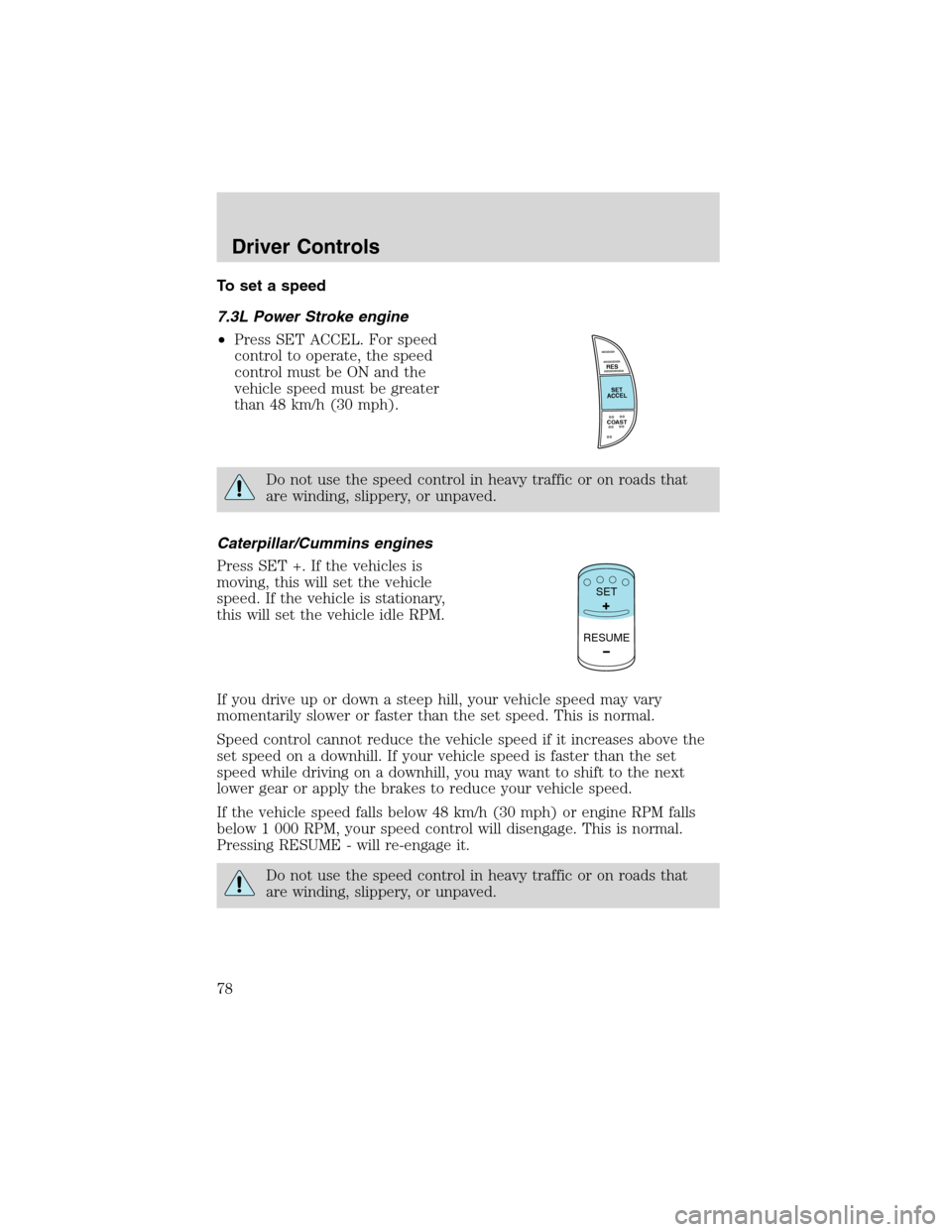
To set a speed
7.3L Power Stroke engine
•Press SET ACCEL. For speed
control to operate, the speed
control must be ON and the
vehicle speed must be greater
than 48 km/h (30 mph).
Do not use the speed control in heavy traffic or on roads that
are winding, slippery, or unpaved.
Caterpillar/Cummins engines
Press SET +. If the vehicles is
moving, this will set the vehicle
speed. If the vehicle is stationary,
this will set the vehicle idle RPM.
If you drive up or down a steep hill, your vehicle speed may vary
momentarily slower or faster than the set speed. This is normal.
Speed control cannot reduce the vehicle speed if it increases above the
set speed on a downhill. If your vehicle speed is faster than the set
speed while driving on a downhill, you may want to shift to the next
lower gear or apply the brakes to reduce your vehicle speed.
If the vehicle speed falls below 48 km/h (30 mph) or engine RPM falls
below 1 000 RPM, your speed control will disengage. This is normal.
Pressing RESUME - will re-engage it.
Do not use the speed control in heavy traffic or on roads that
are winding, slippery, or unpaved.
RES
SET
ACCEL
COAST
SET
RESUME
Driver Controls
78
Page 79 of 248
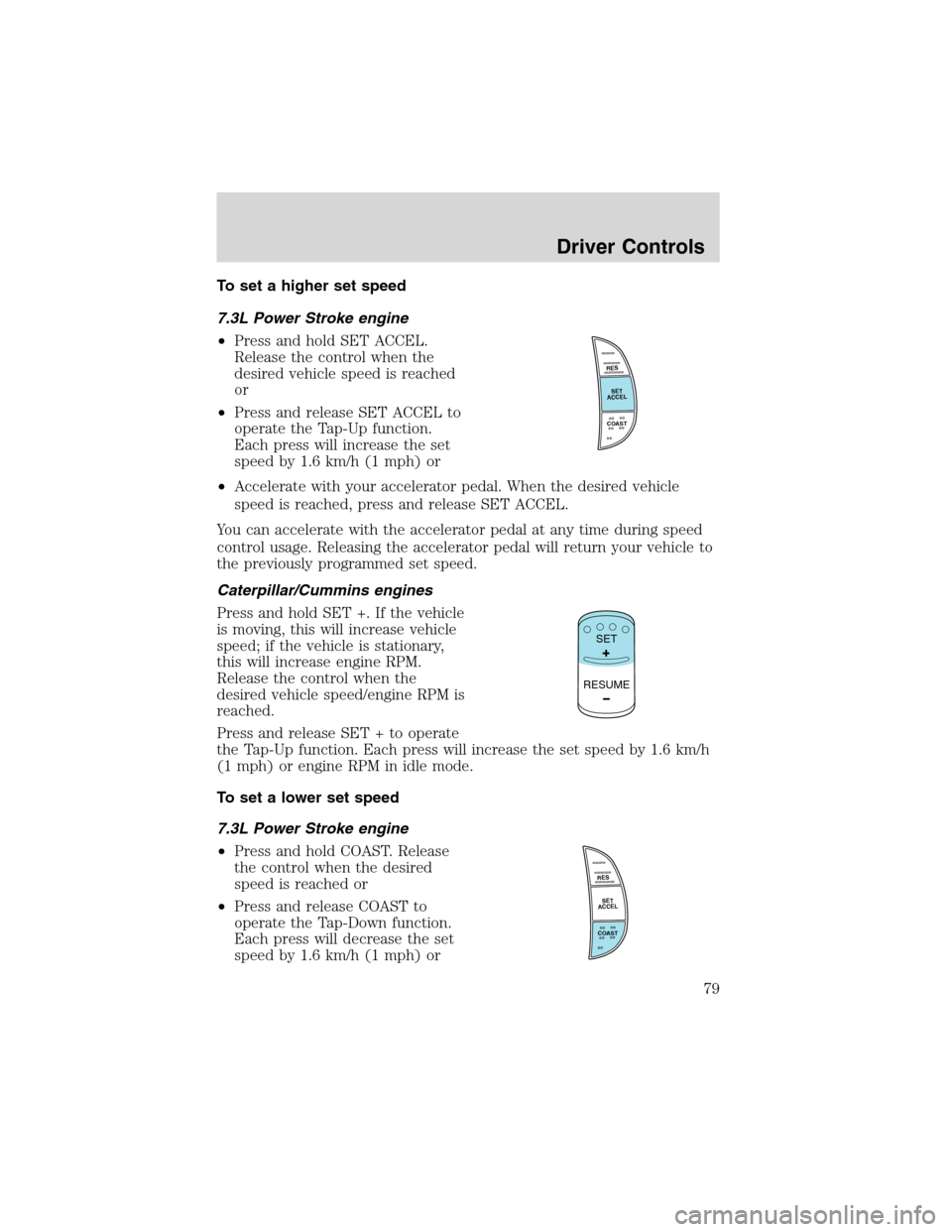
To set a higher set speed
7.3L Power Stroke engine
•Press and hold SET ACCEL.
Release the control when the
desired vehicle speed is reached
or
•Press and release SET ACCEL to
operate the Tap-Up function.
Each press will increase the set
speed by 1.6 km/h (1 mph) or
•Accelerate with your accelerator pedal. When the desired vehicle
speed is reached, press and release SET ACCEL.
You can accelerate with the accelerator pedal at any time during speed
control usage. Releasing the accelerator pedal will return your vehicle to
the previously programmed set speed.
Caterpillar/Cummins engines
Press and hold SET +. If the vehicle
is moving, this will increase vehicle
speed; if the vehicle is stationary,
this will increase engine RPM.
Release the control when the
desired vehicle speed/engine RPM is
reached.
Press and release SET + to operate
the Tap-Up function. Each press will increase the set speed by 1.6 km/h
(1 mph) or engine RPM in idle mode.
To set a lower set speed
7.3L Power Stroke engine
•Press and hold COAST. Release
the control when the desired
speed is reached or
•Press and release COAST to
operate the Tap-Down function.
Each press will decrease the set
speed by 1.6 km/h (1 mph) or
RES
SET
ACCEL
COAST
SET
RESUME
RES
SET
ACCEL
COAST
Driver Controls
79
Page 80 of 248
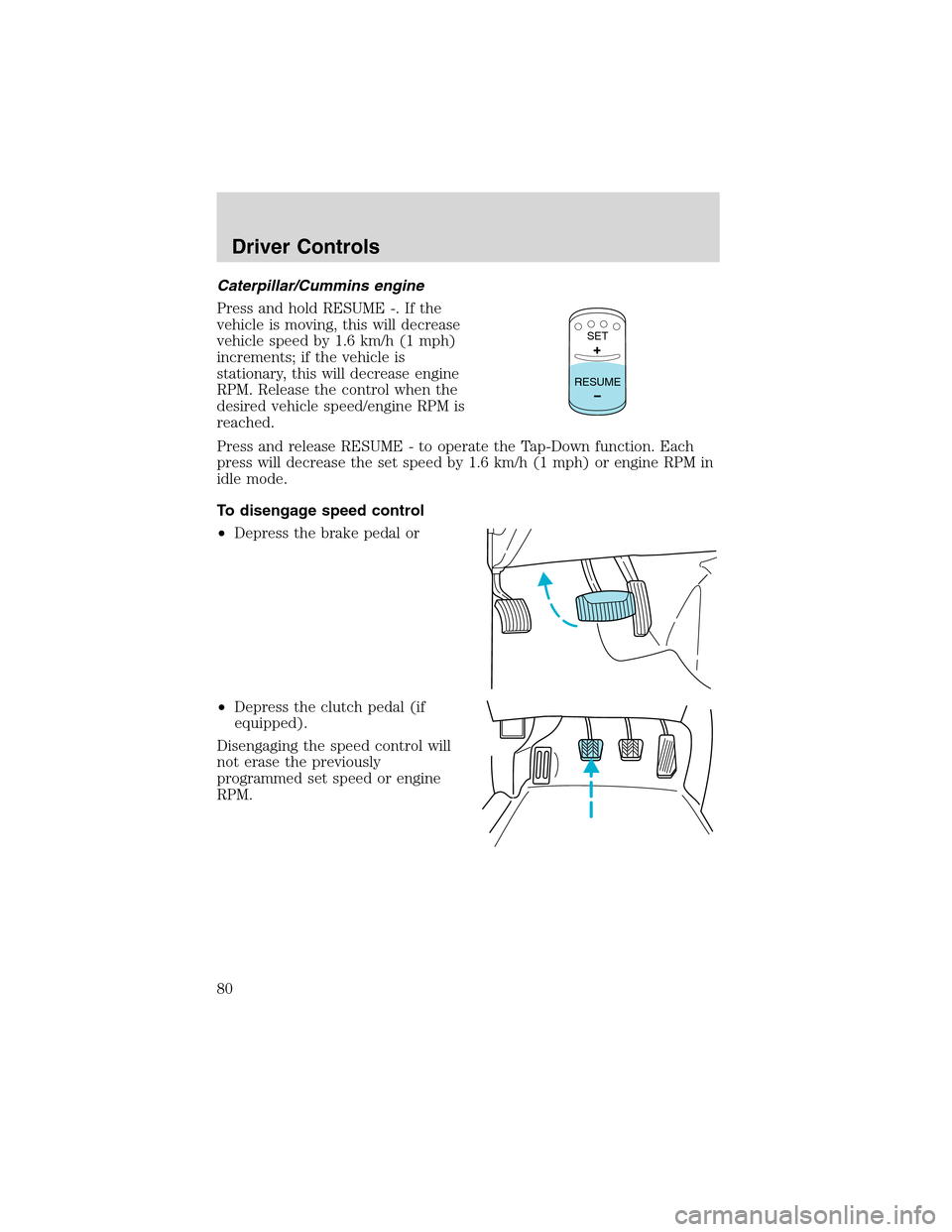
Caterpillar/Cummins engine
Press and hold RESUME -. If the
vehicle is moving, this will decrease
vehicle speed by 1.6 km/h (1 mph)
increments; if the vehicle is
stationary, this will decrease engine
RPM. Release the control when the
desired vehicle speed/engine RPM is
reached.
Press and release RESUME - to operate the Tap-Down function. Each
press will decrease the set speed by 1.6 km/h (1 mph) or engine RPM in
idle mode.
To disengage speed control
•Depress the brake pedal or
•Depress the clutch pedal (if
equipped).
Disengaging the speed control will
not erase the previously
programmed set speed or engine
RPM.
SET
RESUME
Driver Controls
80
Page 81 of 248
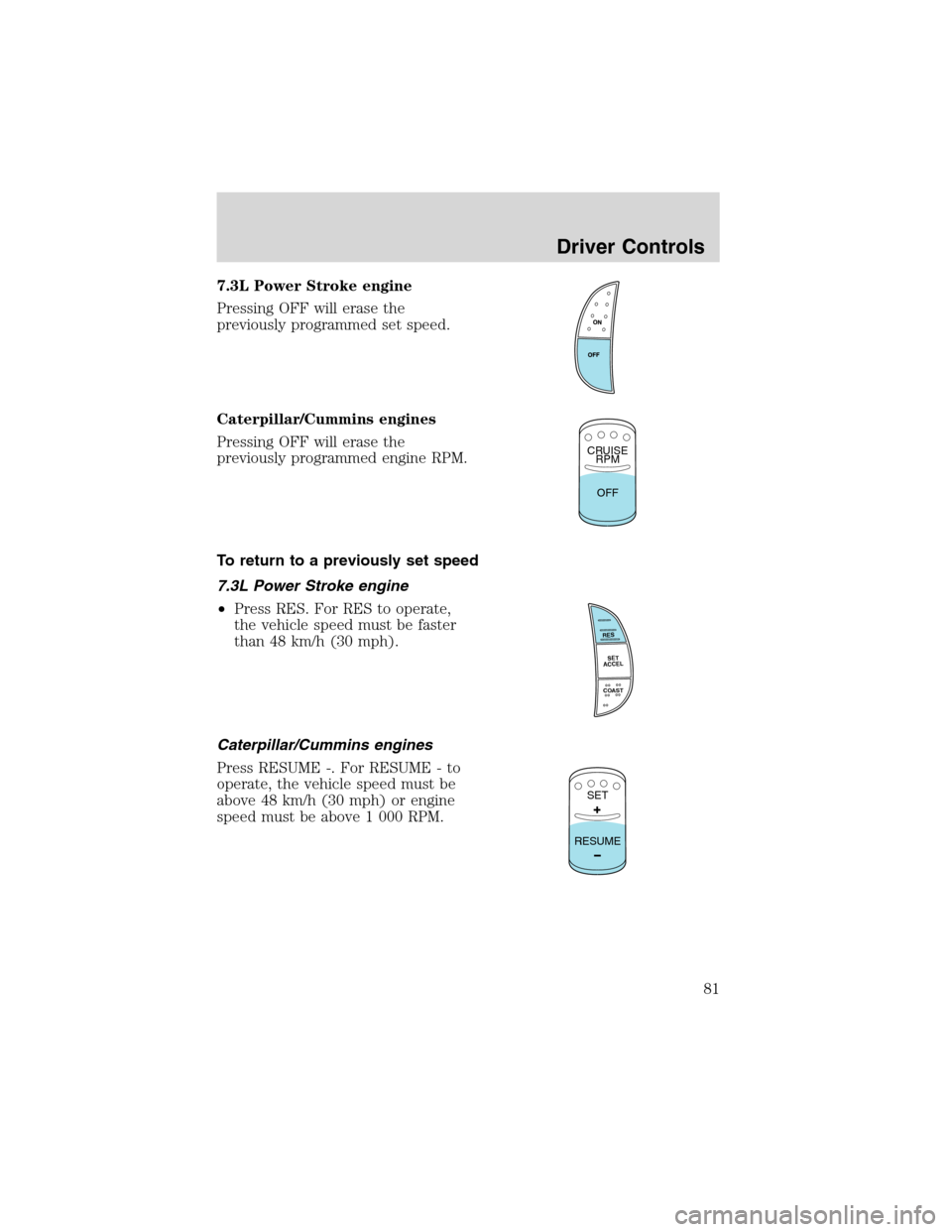
7.3L Power Stroke engine
Pressing OFF will erase the
previously programmed set speed.
Caterpillar/Cummins engines
Pressing OFF will erase the
previously programmed engine RPM.
To return to a previously set speed
7.3L Power Stroke engine
•Press RES. For RES to operate,
the vehicle speed must be faster
than 48 km/h (30 mph).
Caterpillar/Cummins engines
Press RESUME -. For RESUME - to
operate, the vehicle speed must be
above 48 km/h (30 mph) or engine
speed must be above 1 000 RPM.
CRUISE
RPM
OFF
RES
SET
ACCEL
COAST
SET
RESUME
Driver Controls
81
Page 99 of 248
The BeltMinder feature can be deactivated/activated by performing the
following procedure:
Before following the procedure, make sure that:
•The parking brake is set.
•The gearshift is in P (Park) (automatic transmission) or the neutral
position (manual transmission).
•The ignition switch is in the OFF position.
•All vehicle doors are closed.
•The driver’s safety belt is unbuckled.
•The parklamps/headlamps are in OFF position (If vehicle is equipped
with Autolamps, this will not affect the procedure).
To reduce the risk of injury, do not deactivate/activate the Belt
Minder feature while driving the vehicle.
BeltMinder activation and deactivation procedure
1. Turn the ignition switch to the RUN (or ON) position. (DO NOT
START THE ENGINE.)
2. Wait until the safety belt warning light turns off. (Approximately 1–2
minutes.)
•Steps 3–5 must be completed within 60 seconds or the procedure will
have to be repeated.
3. Buckle then unbuckle the safety belt three times, ending with the
safety belt unbuckled. This can be done before or during BeltMinder
warning activation.
4. Turn on the parklamps/headlamps, turn off the parklamps/headlamps.
5. Buckle then unbuckle the safety belt three times, ending with the
safety belt unbuckled.
•After step 5 the safety belt warning light will be turned on for three
seconds.
6. Within seven seconds of the safety belt warning light turning off,
buckle then unbuckle the safety belt.
•This will disable BeltMinder if it is currently enabled, or enable
BeltMinder if it is currently disabled.
7. Confirmation of disabling BeltMinder is provided by the safety belt
warning light flashing four times per second for three seconds.
Seating and Safety Restraints
99
Page 109 of 248
STARTING PROCEDURES
Operating precautions
•Always shift to a lower gear at high altitudes to prevent engine
smoking.
•Avoid extended and unnecessary idling.
Diesel engine vapors are combustible. Do not operate the engine
in an enclosed area. These vapors can be sucked through the air
intake system and cause engine acceleration and overspeeding, which
may result in bodily injury and extensive property damage. The
equipment owner and operator are responsible for safe operation in a
hostile environment.
Starting the engine
1. Ensure headlamps and all accessories are turned off, the parking
brake is applied and the transmission is in the neutral position (or P
[Park] for Allison 2400 transmissions).
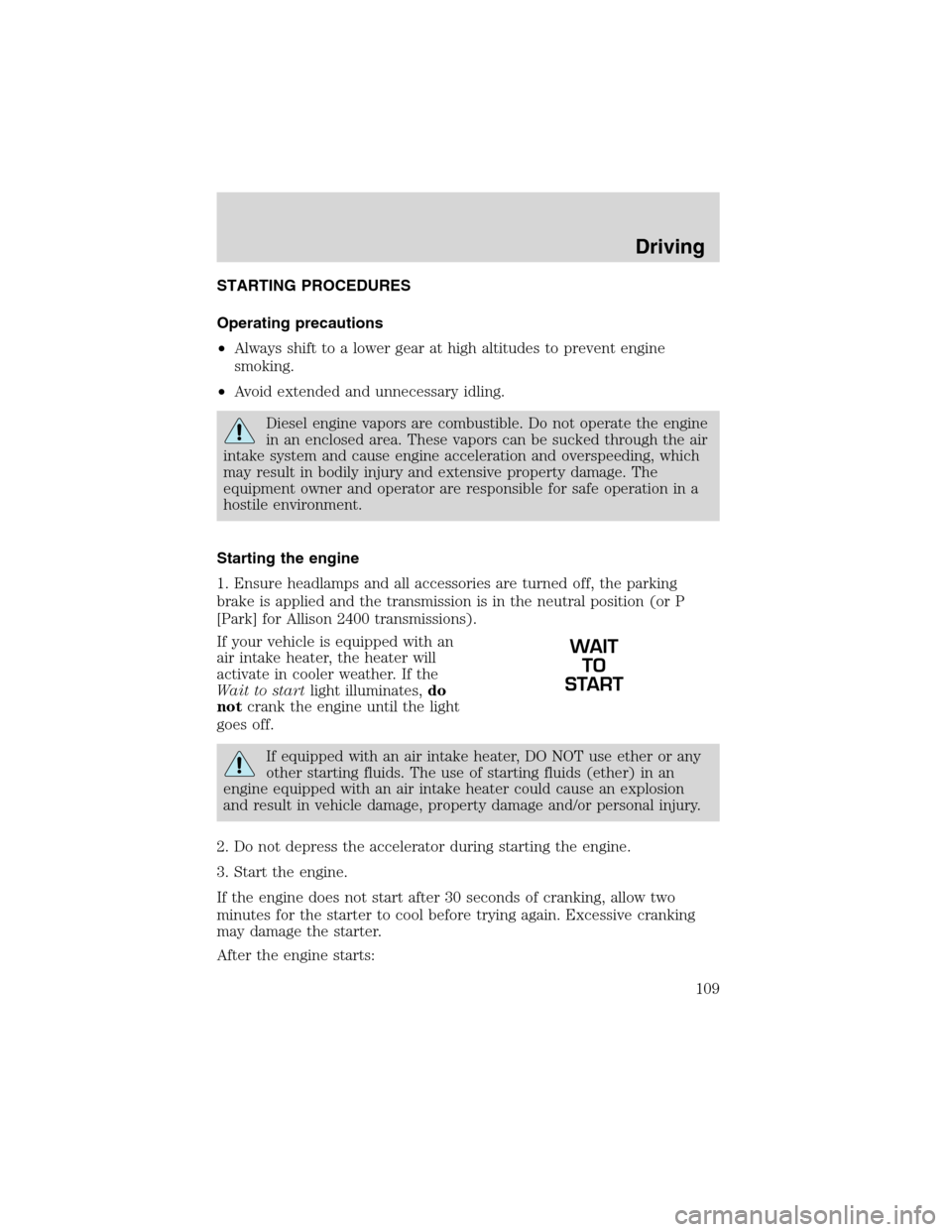
If your vehicle is equipped with an
air intake heater, the heater will
activate in cooler weather. If the
Wait to startlight illuminates,do
notcrank the engine until the light
goes off.
If equipped with an air intake heater, DO NOT use ether or any
other starting fluids. The use of starting fluids (ether) in an
engine equipped with an air intake heater could cause an explosion
and result in vehicle damage, property damage and/or personal injury.
2. Do not depress the accelerator during starting the engine.
3. Start the engine.
If the engine does not start after 30 seconds of cranking, allow two
minutes for the starter to cool before trying again. Excessive cranking
may damage the starter.
After the engine starts:
WAIT
TO
START
Driving
109
Page 110 of 248
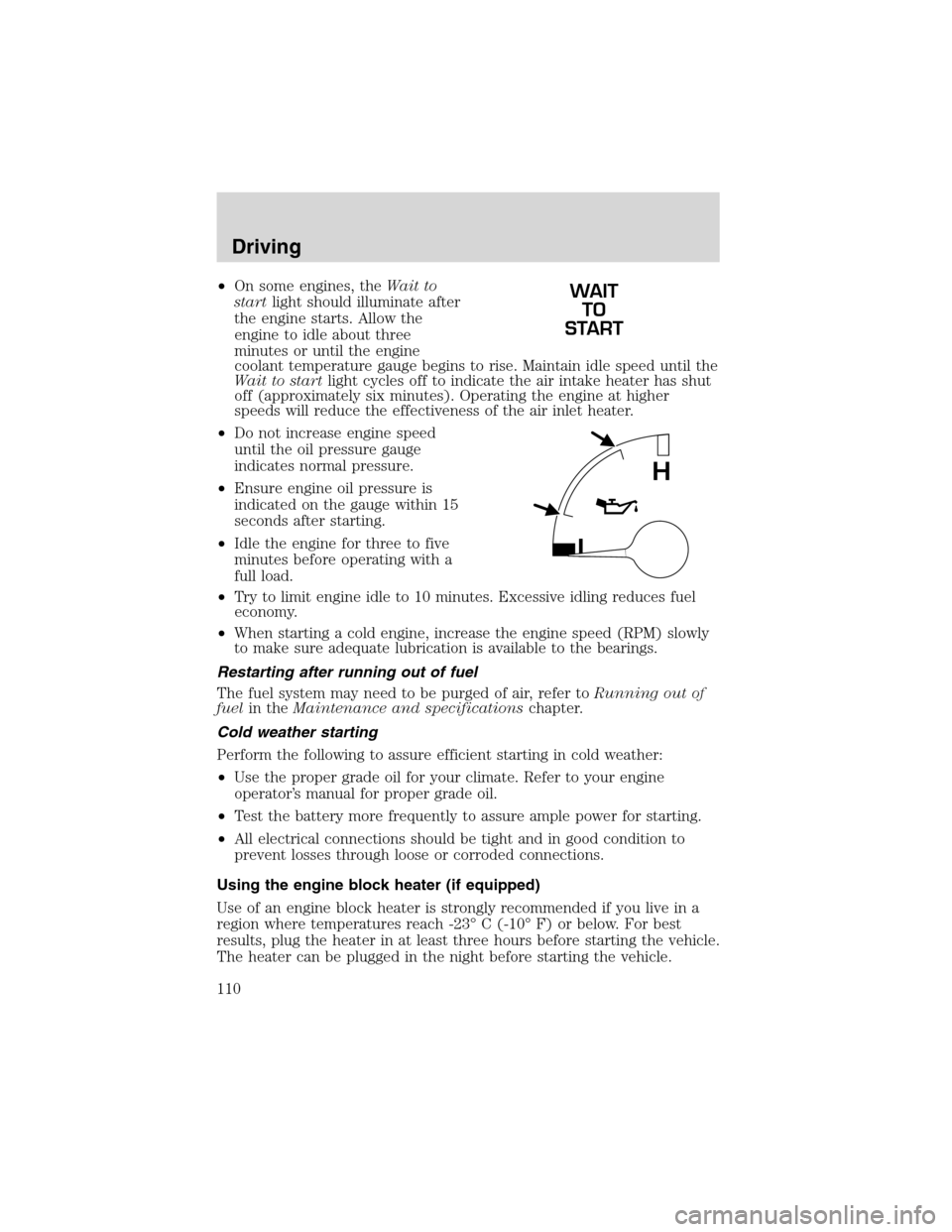
•On some engines, theWait to
startlight should illuminate after
the engine starts. Allow the
engine to idle about three
minutes or until the engine
coolant temperature gauge begins to rise. Maintain idle speed until the
Wait to startlight cycles off to indicate the air intake heater has shut
off (approximately six minutes). Operating the engine at higher
speeds will reduce the effectiveness of the air inlet heater.
•Do not increase engine speed
until the oil pressure gauge
indicates normal pressure.
•Ensure engine oil pressure is
indicated on the gauge within 15
seconds after starting.
•Idle the engine for three to five
minutes before operating with a
full load.
•Try to limit engine idle to 10 minutes. Excessive idling reduces fuel
economy.
•When starting a cold engine, increase the engine speed (RPM) slowly
to make sure adequate lubrication is available to the bearings.
Restarting after running out of fuel
The fuel system may need to be purged of air, refer toRunning out of
fuelin theMaintenance and specificationschapter.
Cold weather starting
Perform the following to assure efficient starting in cold weather:
•Use the proper grade oil for your climate. Refer to your engine
operator’s manual for proper grade oil.
•Test the battery more frequently to assure ample power for starting.
•All electrical connections should be tight and in good condition to
prevent losses through loose or corroded connections.
Using the engine block heater (if equipped)
Use of an engine block heater is strongly recommended if you live in a
region where temperatures reach -23°C (-10°F) or below. For best
results, plug the heater in at least three hours before starting the vehicle.
The heater can be plugged in the night before starting the vehicle.WAIT
TO
START
L
H
Driving
110