engine FORD F650 2003 10.G Workshop Manual
[x] Cancel search | Manufacturer: FORD, Model Year: 2003, Model line: F650, Model: FORD F650 2003 10.GPages: 248, PDF Size: 2.54 MB
Page 171 of 248
Ford Motor Company
Customer Relationship Center
16800 Executive Plaza Drive
P.O. Box 6248
Dearborn, Michigan 48121
GETTING ASSISTANCE OUTSIDE THE U.S. AND CANADA
Before exporting your vehicle to a foreign country, contact the
appropriate foreign embassy or consulate. These officials can inform you
of local vehicle registration regulations and where to find unleaded fuel.
If you cannot find unleaded fuel or can only get fuel with an anti-knock
index lower than is recommended for your vehicle, contact a district or
owner relations/customer relationship office.
The use of leaded fuel in your vehicle without proper conversion may
damage the effectiveness of your emission control system and may cause
engine knocking or serious engine damage. Ford Motor Company/Ford of
Canada is not responsible for any damage caused by use of improper
fuel.
In the United States, using leaded fuel may also result in difficulty
importing your vehicle back into the U.S.
If your vehicle must be serviced while you are traveling or living in
Central or South America, the Caribbean, or the Middle East, contact the
nearest Ford dealership. If the dealership cannot help you, write or call:
FORD MOTOR COMPANY
WORLDWIDE DIRECT MARKET OPERATIONS
1555 Fairlane Drive
Fairlane Business Park #3
Allen Park, Michigan 48101
U.S.A.
Telephone: (313) 594-4857
FAX: (313) 390-0804
If you are in another foreign country, contact the nearest Ford
dealership. If the dealership employees cannot help you, they can direct
you to the nearest Ford affiliate office.
If you buy your vehicle in North America and then relocate outside of
the U.S. or Canada, register your vehicle identification number (VIN) and
new address with Ford Motor Company Worldwide Direct Market
Operations.
Customer Assistance
171
Page 175 of 248
PAINT CHIPS
Your dealer has touch-up paint and sprays to match your vehicle’s color.
Take your color code (printed on a sticker in the driver’s door jam) to
your dealer to ensure you get the correct color.
•Remove particles such as bird droppings, tree sap, insect deposits, tar
spots, road salt and industrial fallout before repairing paint chips.
•Always read the instructions before using the products.
ALUMINUM WHEELS AND COVERS
Aluminum wheel rims or covers are coated with a clearcoat paint finish.
In order to maintain their shine:
•Clean with Detail Wash (ZC-3–A), which is available from your dealer.
•Never apply any cleaning chemical to hot or warm wheel rims or
covers.
•Some automatic car washes may cause damage to the finish on your
wheel rims or covers. Chemical-strength cleaners, or cleaning
chemicals, in combination with brush agitation to remove brake dust
and dirt, could wear away the clearcoat finish over time.
•Do not use hydrofluoric acid-based or high caustic-based wheel
cleaners, steel wool, fuels or strong household detergent.
•To remove tar and grease, use Ford Extra Strength Tar and Road Oil
Removal (B7A-19520–AA), available from your dealer.
ENGINE
Engines are more efficient when they are clean because grease and dirt
buildup keep the engine warmer than normal. When washing:
•Take care when using a power washer to clean the engine. The
high-pressure fluid could penetrate the sealed parts and cause
damage.
•Do not spray a hot engine with cold water to avoid cracking the
engine block or other engine components.
•Spray Motorcraft Engine Shampoo and Degreaser (ZC-20) on all parts
that require cleaning and pressure rinse clean.
•Never wash or rinse the engine while it is running; water in the
running engine may cause internal damage.
Cleaning
175
Page 178 of 248
OPENING THE HOOD
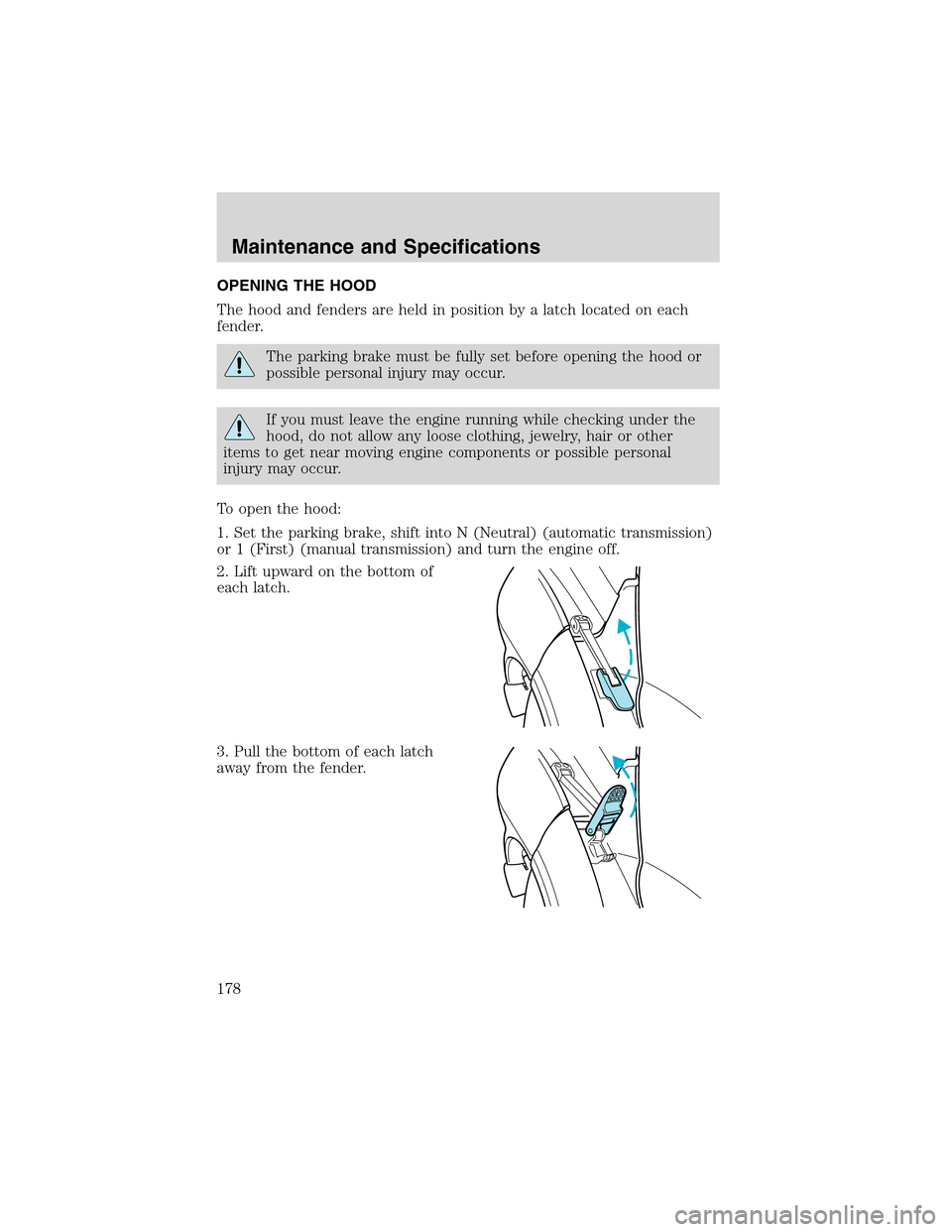
The hood and fenders are held in position by a latch located on each
fender.
The parking brake must be fully set before opening the hood or
possible personal injury may occur.
If you must leave the engine running while checking under the
hood, do not allow any loose clothing, jewelry, hair or other
items to get near moving engine components or possible personal
injury may occur.
To open the hood:
1. Set the parking brake, shift into N (Neutral) (automatic transmission)
or 1 (First) (manual transmission) and turn the engine off.
2. Lift upward on the bottom of
each latch.
3. Pull the bottom of each latch
away from the fender.
Maintenance and Specifications
178
Page 180 of 248
WINDSHIELD WASHER FLUID
Checking and adding washer fluid
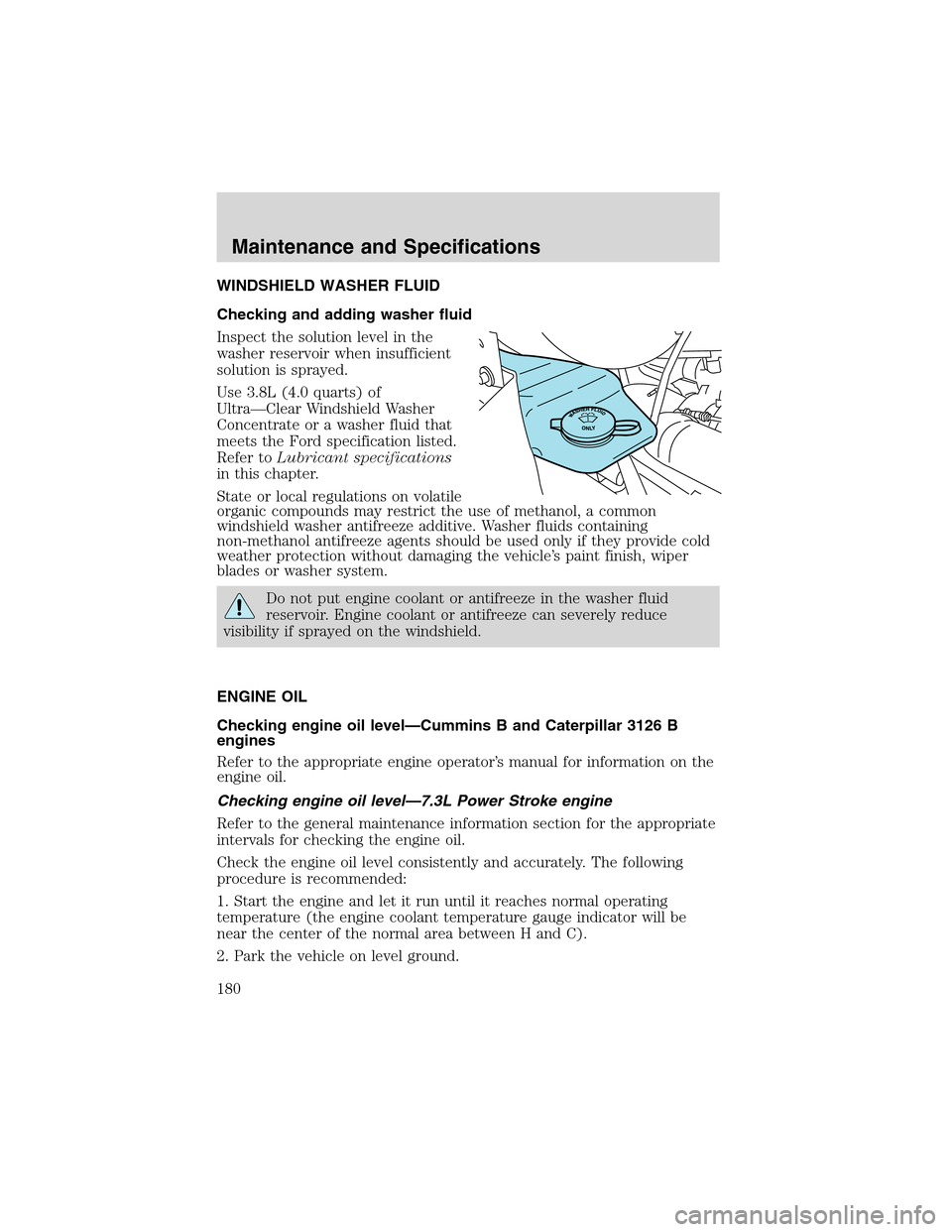
Inspect the solution level in the
washer reservoir when insufficient
solution is sprayed.
Use 3.8L (4.0 quarts) of
Ultra—Clear Windshield Washer
Concentrate or a washer fluid that
meets the Ford specification listed.
Refer toLubricant specifications
in this chapter.
State or local regulations on volatile
organic compounds may restrict the use of methanol, a common
windshield washer antifreeze additive. Washer fluids containing
non-methanol antifreeze agents should be used only if they provide cold
weather protection without damaging the vehicle’s paint finish, wiper
blades or washer system.
Do not put engine coolant or antifreeze in the washer fluid
reservoir. Engine coolant or antifreeze can severely reduce
visibility if sprayed on the windshield.
ENGINE OIL
Checking engine oil level—Cummins B and Caterpillar 3126 B
engines
Refer to the appropriate engine operator’s manual for information on the
engine oil.
Checking engine oil level—7.3L Power Stroke engine
Refer to the general maintenance information section for the appropriate
intervals for checking the engine oil.
Check the engine oil level consistently and accurately. The following
procedure is recommended:
1. Start the engine and let it run until it reaches normal operating
temperature (the engine coolant temperature gauge indicator will be
near the center of the normal area between H and C).
2. Park the vehicle on level ground.
Maintenance and Specifications
180
Page 181 of 248
3. Set the parking brake and shift into N (Neutral) (automatic
transmission) or 1 (First) (manual transmission).
4. Turn off the engine and wait a few minutes for the oil to drain
completely into the oil pan.
5. Open the hood. Protect yourself from engine heat.
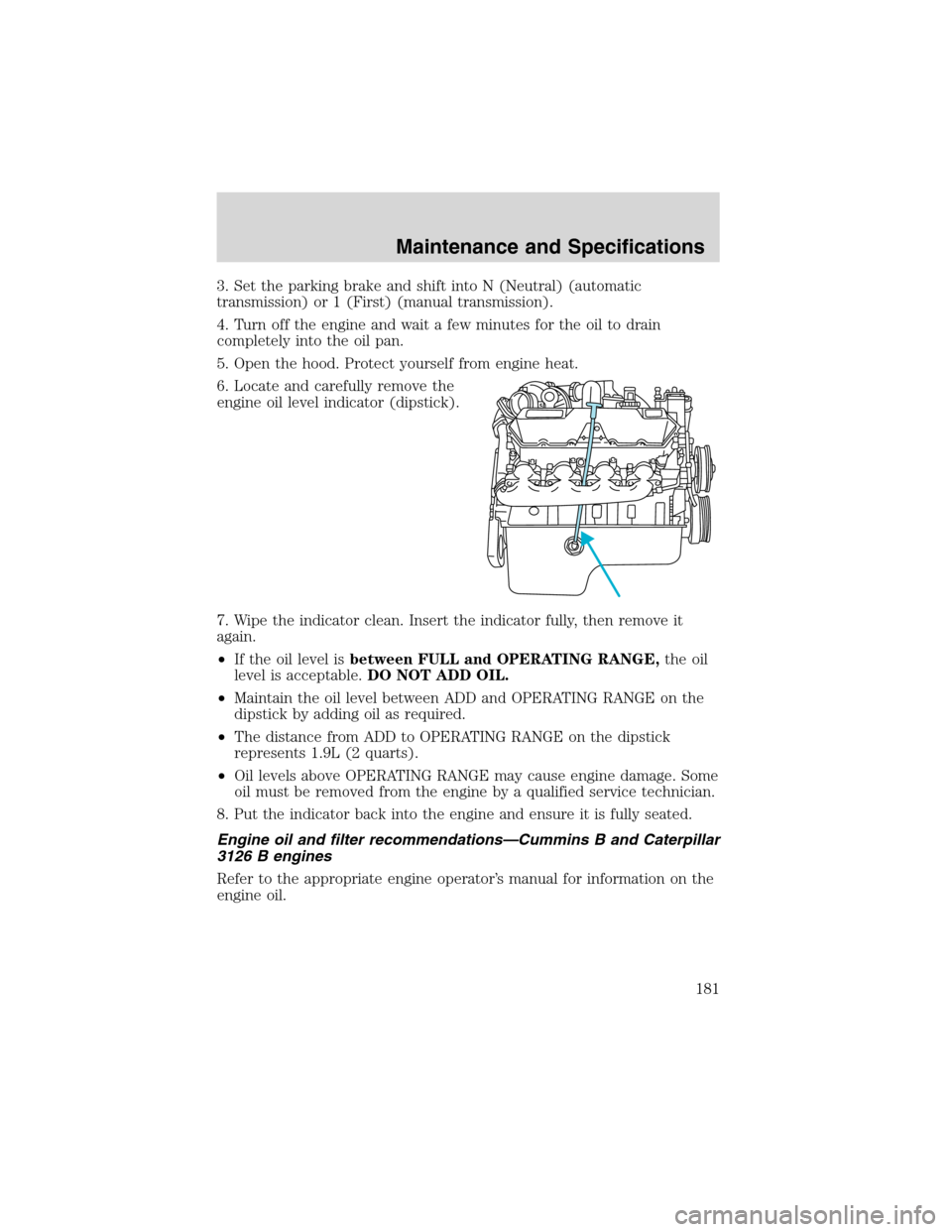
6. Locate and carefully remove the
engine oil level indicator (dipstick).
7. Wipe the indicator clean. Insert the indicator fully, then remove it
again.
•If the oil level isbetween FULL and OPERATING RANGE,the oil
level is acceptable.DO NOT ADD OIL.
•Maintain the oil level between ADD and OPERATING RANGE on the
dipstick by adding oil as required.
•The distance from ADD to OPERATING RANGE on the dipstick
represents 1.9L (2 quarts).
•Oil levels above OPERATING RANGE may cause engine damage. Some
oil must be removed from the engine by a qualified service technician.
8. Put the indicator back into the engine and ensure it is fully seated.
Engine oil and filter recommendations—Cummins B and Caterpillar
3126 B engines
Refer to the appropriate engine operator’s manual for information on the
engine oil.
Maintenance and Specifications
181
Page 182 of 248
Engine oil and filter recommendations—7.3L Power Stroke engine
To help achieve proper engine performance and durability, it is important
that you:
•Use only engine lubricating oils and oil filters of the proper quality.
•Change the engine oil and filterno laterthan the recommended
service interval. Refer to the general maintenance information section
for the appropriate intervals for changing the engine oil and filter.
•Change your engine oil and filter more frequently if your vehicle
operation includes extended periods of idling or low-speed operation,
driving for a long time in cold temperatures or short driving distances.
Diesel engines require specially formulated oil to resist contamination.
Proper quality oils also provide maximum efficiency of the crankcase
ventilation system which reduces air pollution.
For normal or severe service, use Motorcraft oil or an equivalent oil
conforming to Ford Specification WSS-M2C171–C or API Service
categories CH-4, CH-4/SJ or CH-4/SL. If CH-4 oil is not available, CG-4 is
acceptable.
Diesel engine oils with improved fuel economy properties (energy
conserving) are currently available. If you use an energy conserving oil,
be sure it meets Ford specification WSS-M2C171–C or API service
category designation CH-4/SL and is of the proper viscosity grade for the
temperature range in which you expect to operate your vehicle. Some
energy conserving oils do not meet the requirements necessary for your
diesel engine.
Maintenance and Specifications
182
Page 183 of 248
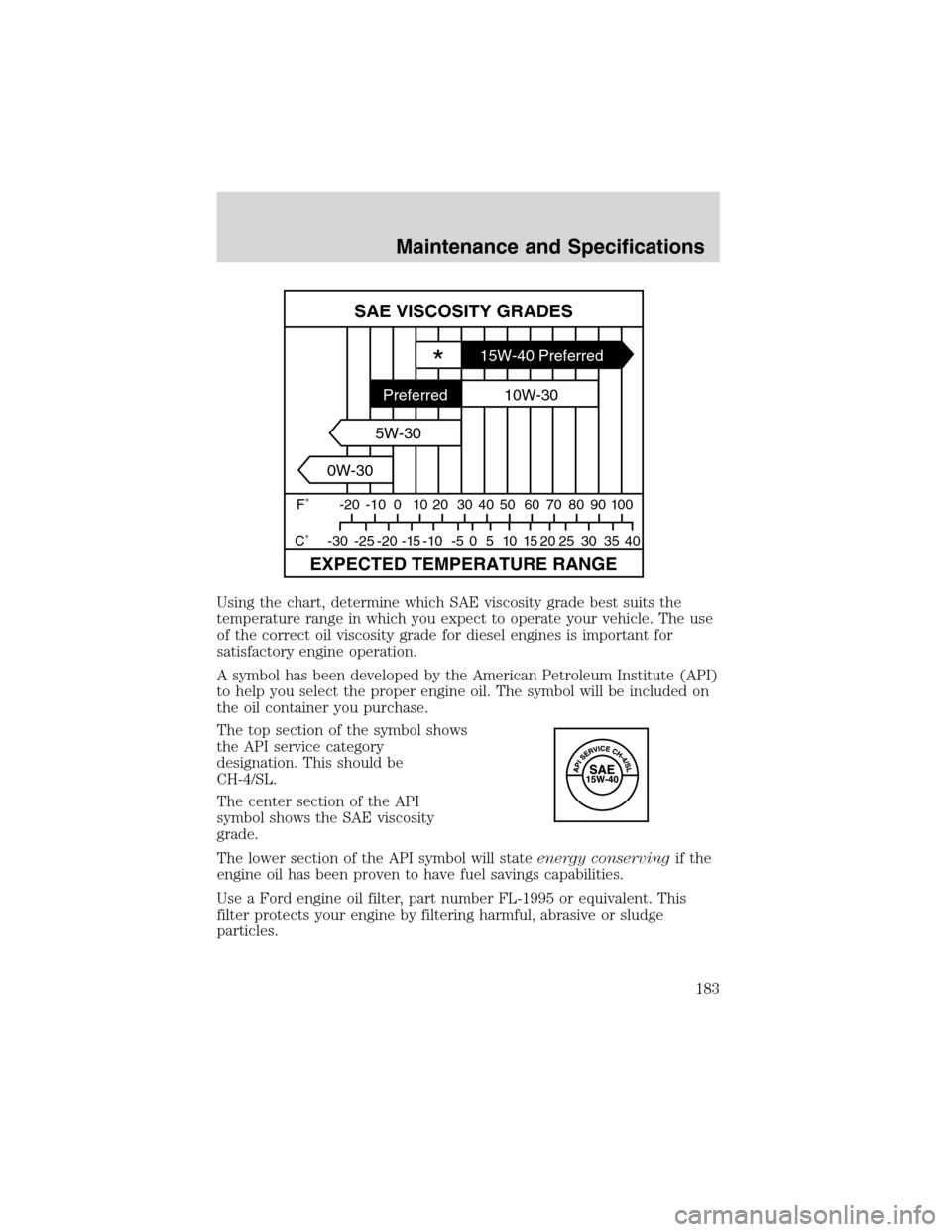
Using the chart, determine which SAE viscosity grade best suits the
temperature range in which you expect to operate your vehicle. The use
of the correct oil viscosity grade for diesel engines is important for
satisfactory engine operation.
A symbol has been developed by the American Petroleum Institute (API)
to help you select the proper engine oil. The symbol will be included on
the oil container you purchase.
The top section of the symbol shows
the API service category
designation. This should be
CH-4/SL.
The center section of the API
symbol shows the SAE viscosity
grade.
The lower section of the API symbol will stateenergy conservingif the
engine oil has been proven to have fuel savings capabilities.
Use a Ford engine oil filter, part number FL-1995 or equivalent. This
filter protects your engine by filtering harmful, abrasive or sludge
particles.
SAE VISCOSITY GRADES
EXPECTED TEMPERATURE RANGE
F˚ -20 -10 0 10 20 30 40
40 35 30 25 20 15 10 5 0 -5 -10 -15 -20 -25 -30 C˚50 60 70 80 90 100
*15W-40 Preferred
10W-30
5W-30
0W-30Preferred
Maintenance and Specifications
183
Page 186 of 248
Battery posts, terminals and related accessories contain lead and
lead compounds. Wash hands after handling.
ENGINE COOLANT
Checking engine coolant
The concentration and level of engine coolant should be checked at the
mileage intervals listed in the general maintenance information section.
The coolant concentration should be maintained at 50/50 coolant and
water, which equates to a freeze point of -36°C (-34°F). Coolant
concentration testing is possible with a hydrometer or antifreeze tester
(such as the Rotunda Battery and Antifreeze Tester, 014–R1060). The
level of coolant should be maintained at the“cold full”of“cold fill range”
level in the coolant reservoir. If the level falls below, add coolant per the
instructions in theAdding Engine Coolantsection.
Your vehicle was factory-filled with a 50/50 engine coolant and water
concentration. If the concentration of coolant falls below 40% or above
60%, the engine parts could become damaged or not work properly.A
50–50 mixture of coolant and water provides the following:
•freeze protection down to -36°C (-34°F).
•boiling protection up to 129°C (265°F).
•protection against rust and other forms of corrosion.
•enables calibrated guages to work properly.
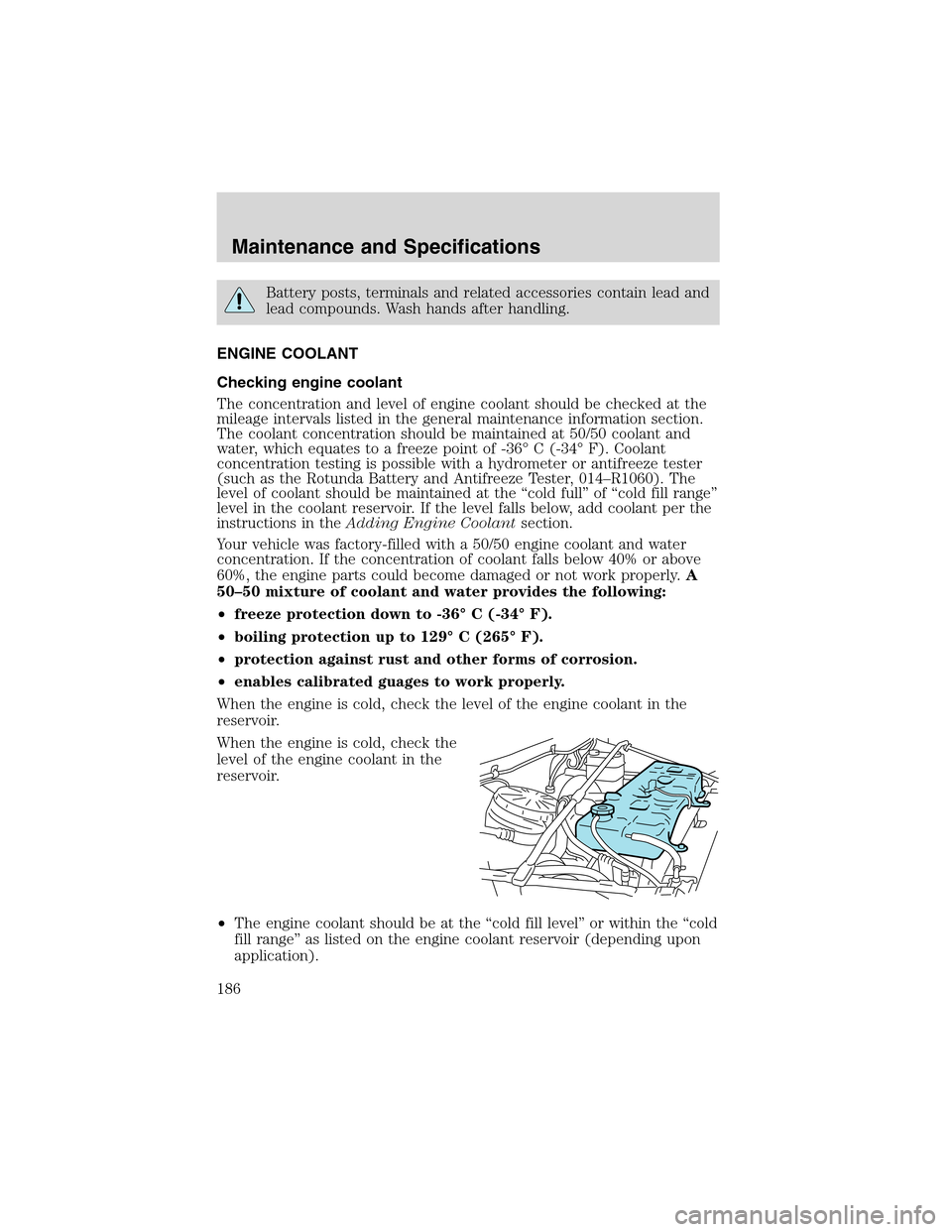
When the engine is cold, check the level of the engine coolant in the
reservoir.
When the engine is cold, check the
level of the engine coolant in the
reservoir.
•The engine coolant should be at the“cold fill level”or within the“cold
fill range”as listed on the engine coolant reservoir (depending upon
application).
Maintenance and Specifications
186
Page 187 of 248
•Refer to the general maintenance information section for service
interval schedules.
•Be sure to read and understandPrecautions when servicing your
vehiclein this chapter.
If the engine coolant has not been checked at the recommended interval,
the engine coolant reservoir may become low or empty. If the reservoir is
low or empty, add engine coolant to the reservoir. Refer toAdding
engine coolantin this chapter.
Note:Automotive fluids are not interchangeable; do not use engine
coolant, antifreeze or windshield washer fluid outside of its specified
function and vehicle location.
Vehicles with diesel engines typically are used to carry heavy loads and
accumulate mileage rapidly. These two factors cause the additives in the
coolant to“wear out”in a shorter time. Ford recommends an interim
service interval performed at 12 months or 24 000 km (15 000 miles),
whichever occurs first. Add 237–295 ml (8–10 oz.) of supplemental
coolant additive FW-16 to the cooling system. For vehicles with extensive
idling time, add 237–295 ml (8–10 oz.) of coolant additive FW-16 after
every 500 hours of operation. (see general maintenance information
section)
Adding engine coolant—7.3L Power Stroke
When adding coolant, make sure it is a 50/50 mixture of engine coolant
and distilled water. Add the mixture to the coolant reservoir,when the
engine is cool, until the appropriate fill level is obtained.
Do not add engine coolant when the engine is hot. Steam and
scalding liquids released from a hot cooling system can burn you
badly. Also, you can be burned if you spill coolant on hot engine parts.
Do not put engine coolant in the windshield washer fluid
container. If sprayed on the windshield, engine coolant could
make it difficult to see through the windshield.
The cooling system in your vehicle is filled with either green-colored
Motorcraft Premium Engine Coolant meeting Ford specification
ESE-M97B44–A or yellow-colored Motorcraft Premium Gold Engine
Coolant meeting Ford Specification WSS-M97B51–A1. To determine your
vehicle’s coolant type (color), check your coolant reservoir.
•Add Motorcraft Premium Engine Coolant (green-colored),
VC-4–A (U.S.) or CXC-10 (Canada) or Motorcraft Premium
Maintenance and Specifications
187
Page 188 of 248
Gold Engine Coolant (yellow-colored), VC-7–A (VC-7–Bin
Oregon), depending on the type of coolant originally equipped
in your vehicle.If you are unsure which type of coolant your vehicle
requires, check your coolant reservoir or contact your local dealer.
Note:Use of Motorcraft Cooling System Stop Leak Pellets, VC-6,
darkens the color of Motorcraft Premium Gold Engine Coolant from
yellow to golden tan.
•Do not add/mix an orange-colored, extended life coolant such
as Motorcraft Speciality Orange Engine Coolant, VC-2 (US) or
CXC-209 (Canada), meeting Ford specification WSS-M97B44–D
with the factory-filled coolant.Mixing Motorcraft Speciality Orange
Engine Coolant or any orange-colored extended life product with your
factory filled coolant can result in degraded corrosion protection.
•A large amount of water without engine coolant may be added, in case
of emergency, to reach a vehicle service location. In this instance, the
cooling system must be drained and refilled with a 50/50 mixture of
engine coolant and distilled water as soon as possible. Water alone
(without engine coolant) can cause engine damage from corrosion,
overheating or freezing.
•Do not use alcohol, methanol or brine or any engine coolants
mixed with alcohol or methanol antifreeze (coolant).Alcohol
and other liquids can cause engine damage from overheating or
freezing.
•Do not add extra inhibitors or additives to the coolant.These
can be harmful and compromise the corrosion protection of the engine
coolant.
•Do not mix with recycled coolant unless from a Ford-approved
recycling process (seeUse of Recycled Engine Coolantsection).
For vehicles with overflow coolant systems with a non-pressurized cap
on the coolant recovery system, add coolant to the coolant recovery
reservoir when the engine is cool. Add the proper mixture of coolant and
water to the“cold full”level. For all other vehicles, which have a coolant
degas system with a pressurized cap, or if it is necessary to remove the
coolant pressure relief cap on the radiator of a vehicle with an overflow
system, follow these steps to add engine coolant.
To reduce the risk of personal injury, make sure the engine is
cool before unscrewing the coolant pressure relief cap. The
cooling system is under pressure; steam and hot liquid can come out
forcefully when the cap is loosened slightly.
Maintenance and Specifications
188