engine FORD F650 2004 11.G Owner's Manual
[x] Cancel search | Manufacturer: FORD, Model Year: 2004, Model line: F650, Model: FORD F650 2004 11.GPages: 264, PDF Size: 1.47 MB
Page 60 of 264
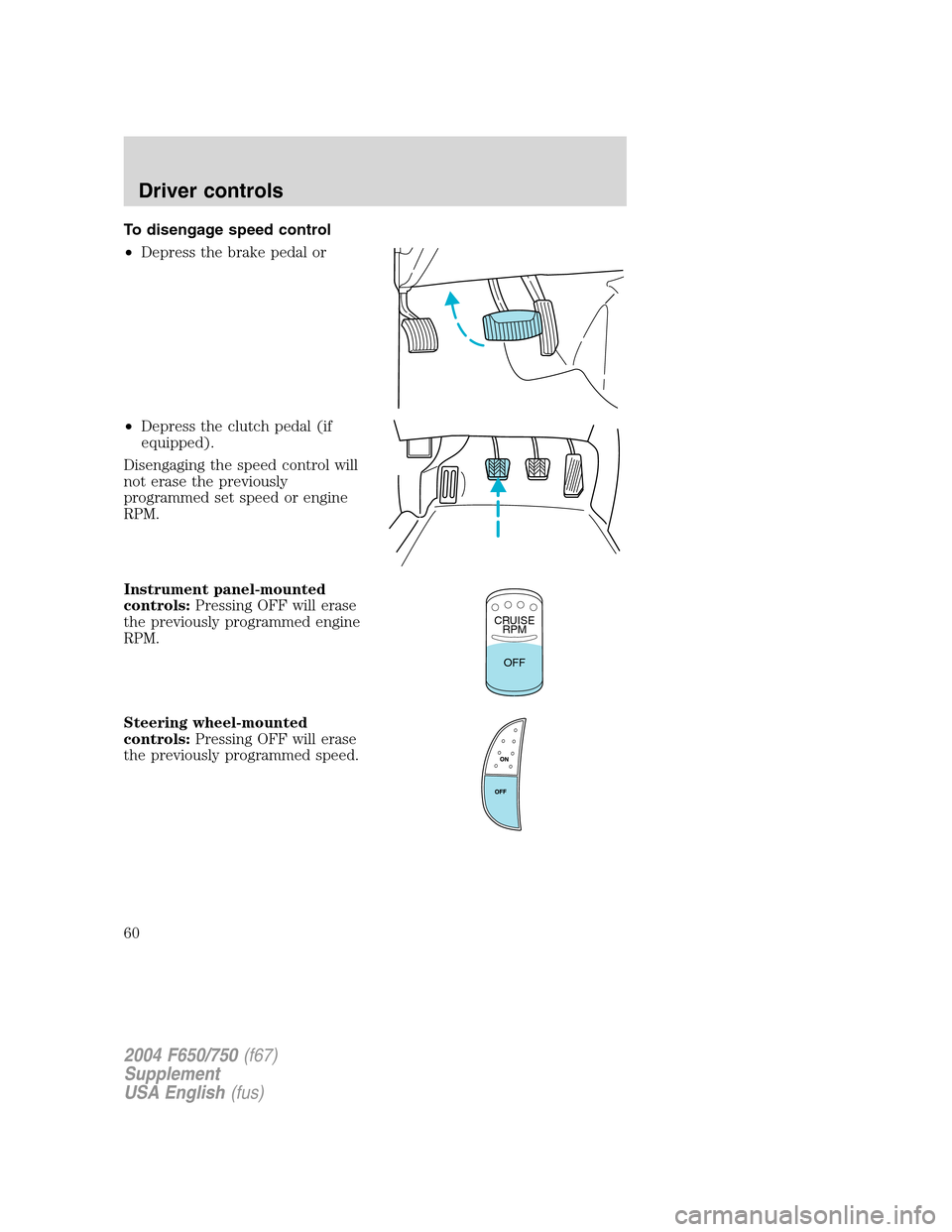
To disengage speed control
•Depress the brake pedal or
•Depress the clutch pedal (if
equipped).
Disengaging the speed control will
not erase the previously
programmed set speed or engine
RPM.
Instrument panel-mounted
controls:Pressing OFF will erase
the previously programmed engine
RPM.
Steering wheel-mounted
controls:Pressing OFF will erase
the previously programmed speed.
CRUISE
RPM
OFF
2004 F650/750(f67)
Supplement
USA English(fus)
Driver controls
60
Page 61 of 264
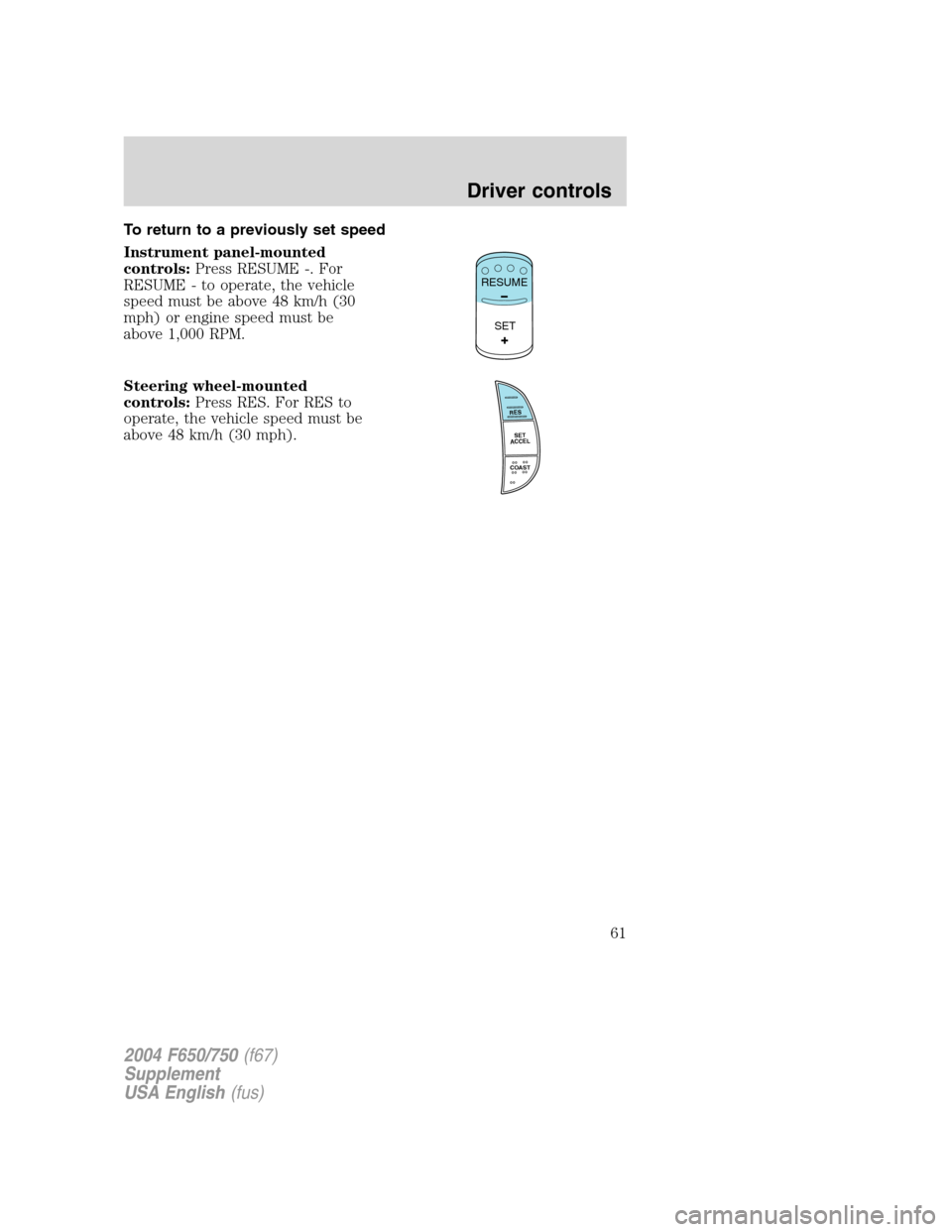
To return to a previously set speed
Instrument panel-mounted
controls:Press RESUME -. For
RESUME - to operate, the vehicle
speed must be above 48 km/h (30
mph) or engine speed must be
above 1,000 RPM.
Steering wheel-mounted
controls:Press RES. For RES to
operate, the vehicle speed must be
above 48 km/h (30 mph).
SET RESUME
RES
SET
ACCEL
COAST
2004 F650/750(f67)
Supplement
USA English(fus)
Driver controls
61
Page 76 of 264
•The parklamps/headlamps are in OFF position (If vehicle is equipped
with Autolamps, this will not affect the procedure).
To reduce the risk of injury, do not deactivate/activate the Belt
Minder feature while driving the vehicle.
BeltMinder activation and deactivation procedure
1. Turn the ignition switch to the RUN (or ON) position. (DO NOT
START THE ENGINE.)
2. Wait until the safety belt warning light turns off. (Approximately 1–2
minutes.)
•Steps 3–5 must be completed within 60 seconds or the procedure will
have to be repeated.
3. Buckle then unbuckle the safety belt three times, ending with the
safety belt unbuckled. This can be done before or during BeltMinder
warning activation.
4. Turn on the parklamps/headlamps, turn off the parklamps/headlamps.
5. Buckle then unbuckle the safety belt three times, ending with the
safety belt unbuckled.
•After step 5 the safety belt warning light will be turned on for three
seconds.
6. Within seven seconds of the safety belt warning light turning off,
buckle then unbuckle the safety belt.
•This will disable BeltMinder if it is currently enabled, or enable
BeltMinder if it is currently disabled.
7. Confirmation of disabling BeltMinder is provided by the safety belt
warning light flashing four times per second for three seconds.
8. Confirmation of enabling BeltMinder is provided by:
•The safety belt warning light flashing four times per second for three
seconds.
•Followed by three seconds with the safety belt warning light off.
•Once again, the safety belt warning light will flash four times per
second for three seconds.
9. After receiving confirmation, the deactivation/activation procedure is
complete.
2004 F650/750(f67)
Supplement
USA English(fus)
Seating and safety restraints
76
Page 86 of 264
STARTING PROCEDURES
Operating precautions
•Always shift to a lower gear at high altitudes to prevent engine
smoking.
•Avoid extended and unnecessary idling.
Diesel engine vapors are combustible. Do not operate the engine
in an enclosed area. These vapors can be sucked through the air
intake system and cause an explosion which may result in severe
bodily injury and extensive property damage.
Starting the engine
1. Ensure headlamps and all accessories are turned off, the parking
brake is applied and the transmission is in the neutral position (or P
[Park] for Allison 2400 transmissions).
If your vehicle is equipped with an
air intake heater, the heater will
activate in cooler weather. If the
Wait to startlight illuminates,do
notcrank the engine until the light
goes off.
If equipped with an air intake heater, DO NOT use ether or any
other starting fluids. The use of starting fluids (ether) in an
engine equipped with an air intake heater could cause an explosion
and result in property damage and/or personal injury.
2. Do not depress the accelerator during starting the engine.
3. Start the engine.
If the engine does not start after 30 seconds of cranking, allow two
minutes for the starter to cool before trying again. Excessive cranking
may damage the starter.
WAIT
TO
START
2004 F650/750(f67)
Supplement
USA English(fus)
Driving
Driving
86
Page 87 of 264
After the engine starts:
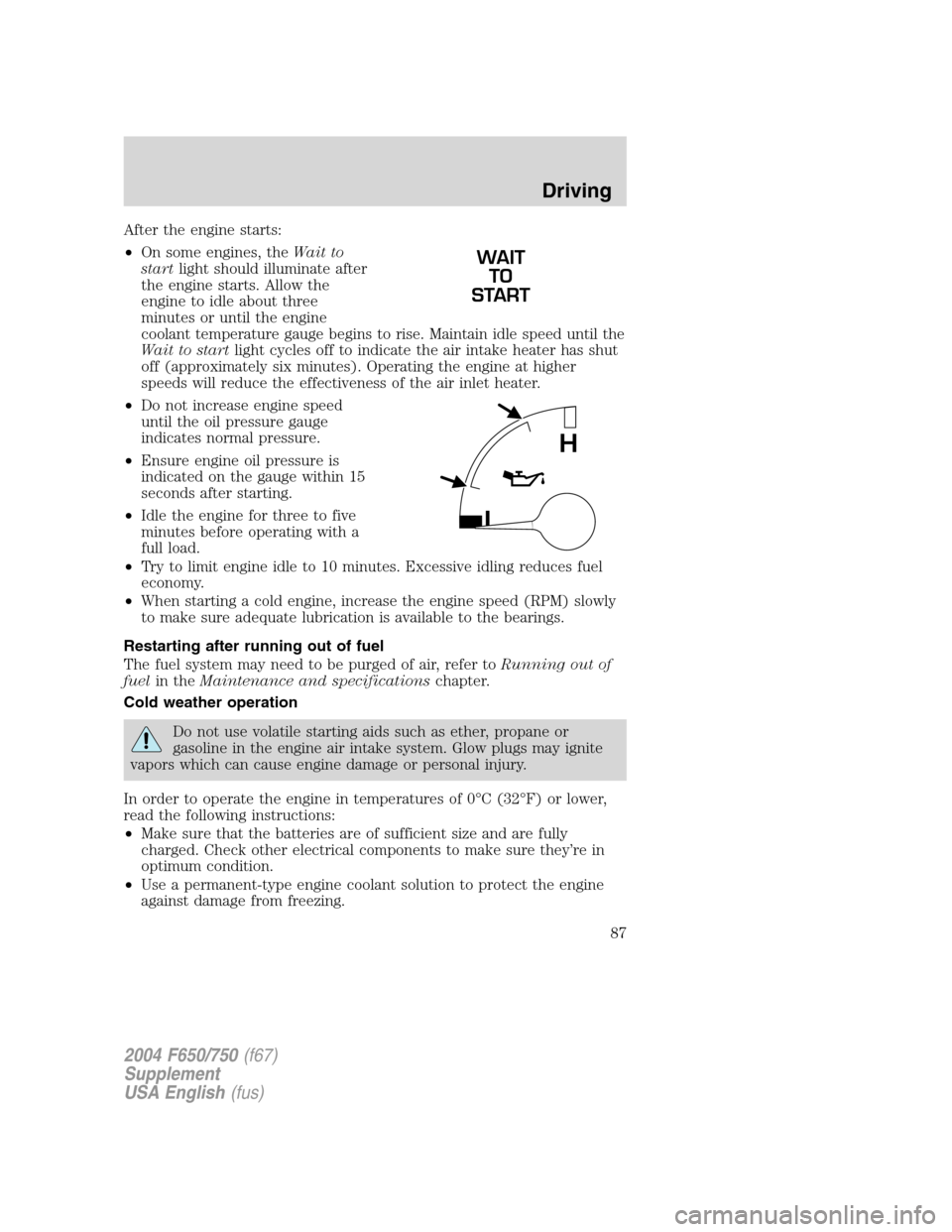
•On some engines, theWait to
startlight should illuminate after
the engine starts. Allow the
engine to idle about three
minutes or until the engine
coolant temperature gauge begins to rise. Maintain idle speed until the
Wait to startlight cycles off to indicate the air intake heater has shut
off (approximately six minutes). Operating the engine at higher
speeds will reduce the effectiveness of the air inlet heater.
•Do not increase engine speed
until the oil pressure gauge
indicates normal pressure.
•Ensure engine oil pressure is
indicated on the gauge within 15
seconds after starting.
•Idle the engine for three to five
minutes before operating with a
full load.
•Try to limit engine idle to 10 minutes. Excessive idling reduces fuel
economy.
•When starting a cold engine, increase the engine speed (RPM) slowly
to make sure adequate lubrication is available to the bearings.
Restarting after running out of fuel
The fuel system may need to be purged of air, refer toRunning out of
fuelin theMaintenance and specificationschapter.
Cold weather operation
Do not use volatile starting aids such as ether, propane or
gasoline in the engine air intake system. Glow plugs may ignite
vapors which can cause engine damage or personal injury.
In order to operate the engine in temperatures of 0°C (32°F) or lower,
read the following instructions:
•Make sure that the batteries are of sufficient size and are fully
charged. Check other electrical components to make sure they’re in
optimum condition.
•Use a permanent-type engine coolant solution to protect the engine
against damage from freezing.
WAIT
TO
START
L
H
2004 F650/750(f67)
Supplement
USA English(fus)
Driving
87
Page 88 of 264
•If your vehicle is equipped with a water-fuel separator, drain it daily.
Fill the fuel tank at the end of daily operation to prevent condensation
in the fuel system.
•Make sure you use proper cold weather engine oil and that it is at its
proper level.
•At temperatures of–20°C(–4°F) or below, it is recommended that you
use a crankcase-mounted coolant heater to improve cold engine
starting.
•If operating in arctic temperatures of–29°C (-20°F) or lower, consult
your truck dealer for information about special cold weather
equipment and precautions.
Note:Idling in cold weather will not heat the engine to its normal
operating temperature. Long periods of idling in cold weather can cause
a buildup of heavy deposits of carbon and rust on valve stems causing
them to stick which, in turn, can cause valvetrain damage.
The following cold weather idling guidelines must be followed:
•Avoid idling the engine for more than 10 minutes at a time.
•Use a minimum of 45 Cetane Diesel fuel or use Cetane Index
improvers from a reputable manufacturer.
•Maintain a minimum idle of 1250 RPM by using the hand throttle.
Always make sure that the parking brake is applied and the
transmission is in neutral before applying the hand throttle.
•Maintain the engine cooling system properly.
•Do not shut the engine down after an extensive idling period (10
minutes or more). Drive the vehicle under load for several miles at
normal operating temperatures to burn off any accumulated carbon
and varnish.
•Consider using an engine block heater, approved winter fronts and/or
radiator shutters where conditions warrant.
Winter fronts
The use of winter fronts, or other air-restrictive devices mounted in front
of the radiator on vehicles with chassis-mounted charge air coolers, are
not recommended unless extremely cold weather conditions exist. Air
flow restriction can cause high exhaust temperatures, power loss,
excessive fan usage and a reduction in fuel economy. If you insist on
using a winter front, the device should have a permanent opening of at
least 774 sq. cm (120 sq in.) directly in line with the fan hub.
2004 F650/750(f67)
Supplement
USA English(fus)
Driving
88
Page 89 of 264
Hot weather operation
•Keep the engine cooling system filled with a clean, permanent coolant
solution to protect against damage from overheating.
•Fill the fuel tank at the end of daily operation to prevent condensation
in the fuel system.
•Keep external surfaces of the engine, radiator, charge air cooler, A/C
condenser and accessories clean to avoid dirt build-up.
Above normal coolant temperatures could be experienced while driving
in a transmission gear ratio which lugs the engine. To correct this
problem, engine speed should be increased by downshifting in to the
next lower gear to increase engine RPM.
Starting a turbocharged engine with the vehicle on a steep grade
When starting a naturally aspirated Diesel engine when the loaded
vehicle is on a grade, the engine RPM will start to fall slightly when the
clutch is engaged, but quickly recovers as the vehicle begins moving.
Turbocharged Diesel engines act differently; once the clutch is engaged,
the engine RPM will fall significantly. When the engine RPM first falls, do
not disengage the clutch and try to increase engine RPM as this may
damage driveline components. After the initial drop in engine RPM, the
engine will recover by itself and accelerate in a normal manner.
GENERAL OPERATING INSTRUCTIONS
•Start the vehicle in motion by using the highest gear speed in the
transmission that will let the engine easily start the load without
slipping the clutch.
•Accelerate smoothly and evenly; rapid acceleration increases fuel
consumption without increasing engine performance.
•When approaching a hill, depress the accelerator smoothly to start the
incline at full power, then shift down as needed to maintain vehicle
speed.
•When going down a hill, or long steep grades, prevent over-speeding
of the engine. The engine governor has no control over engine speed
when it is being pushed by a loaded vehicle.
2004 F650/750(f67)
Supplement
USA English(fus)
Driving
89
Page 90 of 264
•Operate in a gear that will permit an engine speed not in excess of the
maximum governed speed or high-idle RPM (no load).
All vehicles have blind spots. To reduce the risk of severe injury
or property damage, never move your vehicle to the side or rear
or change lanes without being sure your way is clear on both sides and
to your rear.
Backing up
To reduce the risk of the possibility of personal injury while
backing the vehicle, always be sure your vehicle’s path is clear.
Before backing your vehicle, be sure you can do so safely. If anything
behind the cab limits your view, do not rely on mirrors alone to assure
that your intended path is clear. If other people are in the vicinity, have
someone standing well behind your vehicle and outside of your intended
path (visible through an exterior mirror) guide you as you back up.
Although OSHA or some governmental regulations may require the use
of an electrical or mechanical back-up alarm to warn bystanders, such an
alarm does not assure that the intended path is clear.
If an electrical back-up alarm is installed, it should be connected to the
back-up lamp circuit.
Parking your vehicle
Always use the parking brake. When parking on a grade, block the
wheels and turn the front wheels to one side.
When parking your vehicle, do not leave the transmission in
gear; if the key is in the ON position and the vehicle rolls, then
engine could start. Failure to follow these instructions could result in
an unattended vehicle moving, possibly causing personal injury or
property damage.
2004 F650/750(f67)
Supplement
USA English(fus)
Driving
90
Page 91 of 264
Driving through water
If driving through deep or standing water is unavoidable, proceed very
slowly especially if the depth is not known. Never drive through water
that is higher than the bottom of the hubs (for trucks) or the bottom of
the wheel rims (for cars). Traction or brake capability may be limited
and your vehicle may stall. Water may also enter your engine’s air intake
and severely damage your engine.
Once through the water, always dry the brakes by moving your vehicle
slowly while applying light pressure on the brake pedal. Wet brakes do
not stop the vehicle as quickly as dry brakes.Driving through deep
water where the transmission vent tube is submerged may allow
water into the transmission and cause internal transmission
damage.
HYDRAULIC BRAKES (IF EQUIPPED)
Your service brakes are self-adjusting. Refer to theGeneral
Maintenance Informationfor scheduled maintenance.
Occasional brake noise is normal and often does not indicate a performance
concern with the vehicle’s brake system. In normal operation, automotive
brake systems may emit occasional or intermittent squeal or groan noises
when the brakes are applied. Such noises are usually heard during the first
few brake applications in the morning; however, they may be heard at any
time while braking and can be aggravated by environmental conditions
such as cold, heat, moisture, road dust, salt or mud. If a“metal-to-metal,”
“continuous grinding”or“continuous squeal”sound is present while
braking, the brake linings may be worn-out and should be inspected by a
qualified service technician.
If you are driving down a long or steep hill, shift to a lower gear.
Do not apply your brakes continuously, as they may overheat
and become less effective.
IF BRAKES DO NOT GRIP WELL
•If you have been driving through deep water, gently apply the brakes
several times while the vehicle is moving slowly.
•Let the brakes cool if you have been using them excessively, as in
mountain driving or after several fast, high speed stops.
•Check brake adjustment.
•Check brake linings for excessive wear.
2004 F650/750(f67)
Supplement
USA English(fus)
Driving
91
Page 92 of 264
Hydraulic brake booster system (Hydromax)
The Hydromax systems receive fluid pressure from the power steering
pump to provide power assist during braking.
The Hydromax booster receives backup pressure from the reserve
system electric pump whenever the fluid in the power steering system is
not flowing. When the engine is OFF, the pump will turn on if the brake
pedal is applied, or if the ignition is turned to the ON position.
The sound of the pump operating may be heard by the driver, but this is
a normal characteristic of the system.
The reserve system provides reduced braking power, so the vehicle
should be operated under these conditions with caution, and only to seek
service repair and remove the vehicle from the roadway.
For Hydromax, under normal operating conditions noise of the fluid
flowing through the booster may be heard whenever the brake is applied.
This condition is normal. Vehicle service is not required.
If braking performance or pedal response becomes very poor, even when
the pedal is strongly applied, this may indicate the presence of air in the
hydraulic system or fluid leakage. Stop the vehicle safely as soon as
possible and seek service immediately.
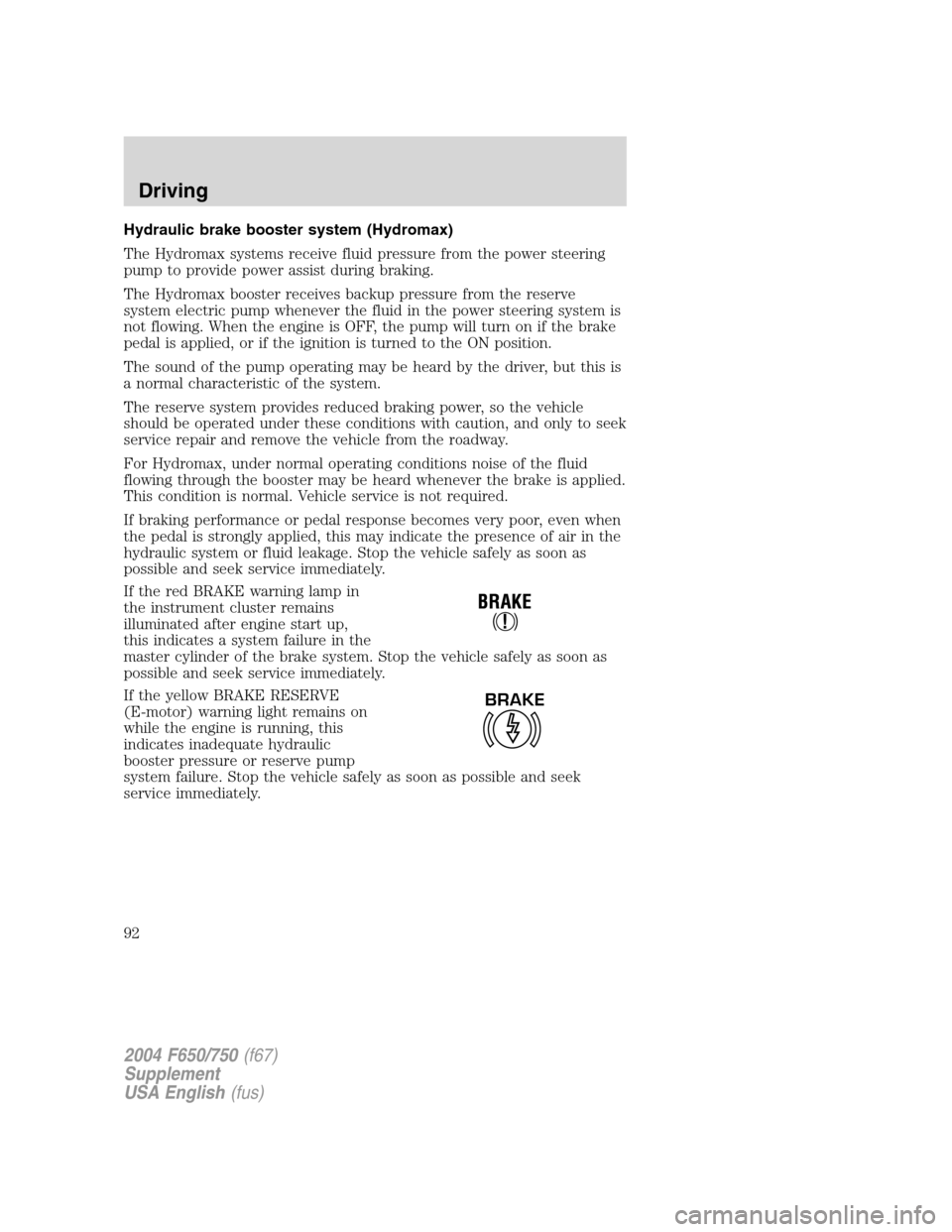
If the red BRAKE warning lamp in
the instrument cluster remains
illuminated after engine start up,
this indicates a system failure in the
master cylinder of the brake system. Stop the vehicle safely as soon as
possible and seek service immediately.
If the yellow BRAKE RESERVE
(E-motor) warning light remains on
while the engine is running, this
indicates inadequate hydraulic
booster pressure or reserve pump
system failure. Stop the vehicle safely as soon as possible and seek
service immediately.
BRAKE
2004 F650/750(f67)
Supplement
USA English(fus)
Driving
92