oil FORD F650 2004 11.G Owners Manual
[x] Cancel search | Manufacturer: FORD, Model Year: 2004, Model line: F650, Model: FORD F650 2004 11.GPages: 264, PDF Size: 1.47 MB
Page 3 of 264
Maintenance and specifications 158
Hood 165
Engine oil 166
Battery 176
Fuel information 184
Lubricant specifications 207
Refill capacities 217
General maintenance information 222
Index 258
All rights reserved. Reproduction by any means, electronic or mechanical
including photocopying, recording or by any information storage and retrieval
system or translation in whole or part is not permitted without written
authorization from Ford Motor Company. Ford may change the contents without
notice and without incurring obligation.
Copyright © 2003 Ford Motor Company
2004 F650/750(f67)
Supplement
USA English(fus)
Table of contents
3
Page 7 of 264
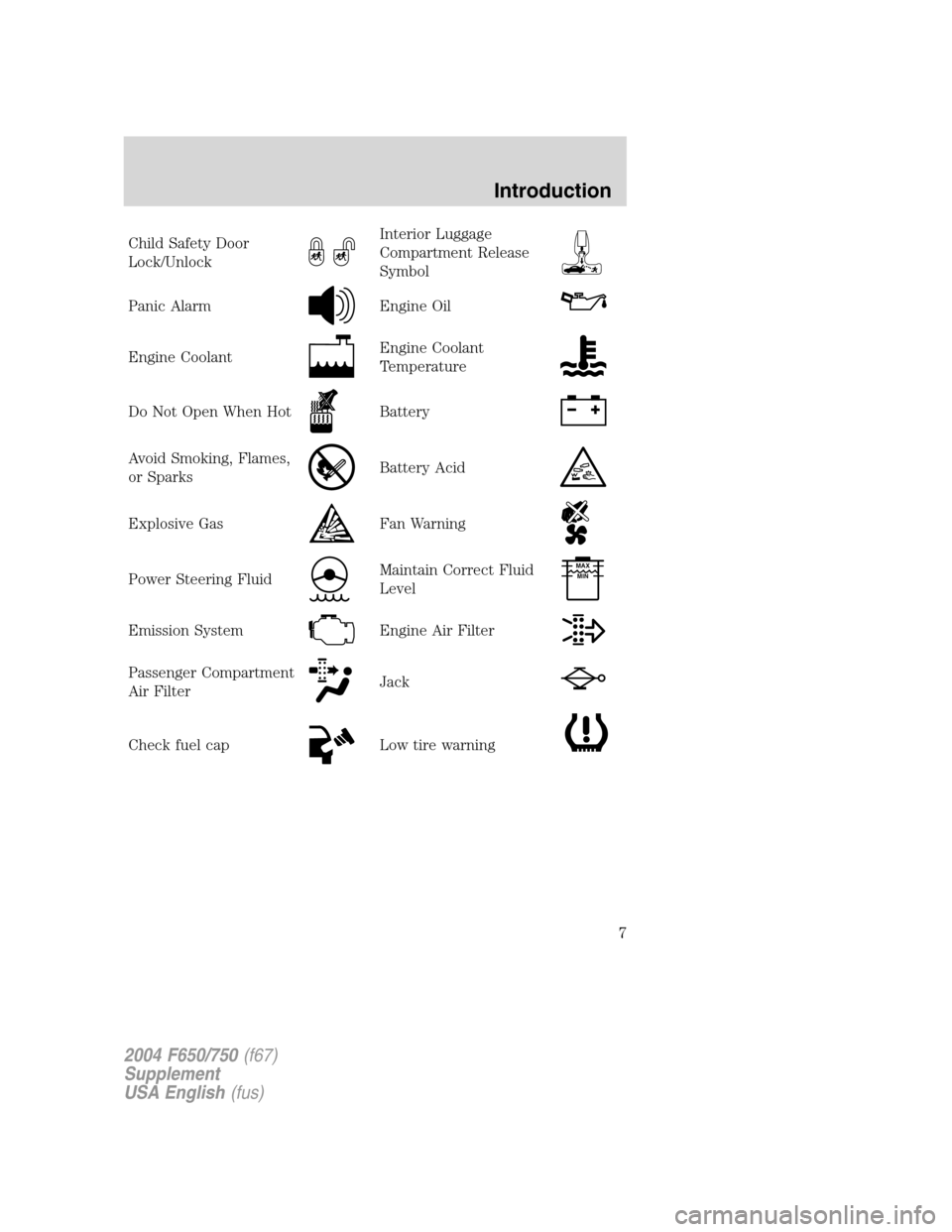
Child Safety Door
Lock/UnlockInterior Luggage
Compartment Release
Symbol
Panic AlarmEngine Oil
Engine CoolantEngine Coolant
Temperature
Do Not Open When HotBattery
Avoid Smoking, Flames,
or SparksBattery Acid
Explosive GasFan Warning
Power Steering FluidMaintain Correct Fluid
LevelMAX
MIN
Emission SystemEngine Air Filter
Passenger Compartment
Air FilterJack
Check fuel capLow tire warning
2004 F650/750(f67)
Supplement
USA English(fus)
Introduction
7
Page 8 of 264
FEDERAL HIGHWAY ADMINISTRATION REGULATION
Regulations such as those issued by the Federal Highway Administration
or issued pursuant to the Occupational Safety and Health Act (OSHA),
and/or state and local laws and regulations may require additional
equipment for the way you intend to use the vehicle. It is the
responsibility of the registered owner to determine the applicability of
such laws and regulations to your intended use for the vehicle, and to
arrange for the installation of required equipment. Your dealer has
information about the availability of equipment which may be ordered for
your vehicle.
ENTERING, EXITING AND/OR CLIMBING ON THIS VEHICLE
You must be careful and deliberate to minimize the possibility of personal
injury from a slip and fall when entering, exiting and/or climbing on this
vehicle. Always use the steps and assist handles before climbing. Do not
skip any steps or assist handles. Use three point contact at all times with
at least two feet and one hand or two hands and one foot firmly placed
during all phases of entering, exiting and/or climbing. Always keep your
shoe soles and hands clean. Keep the steps and assist handles free of
snow, ice, oil, grease, substances or debris. Be sure to use extra care in
bad weather. Avoid wearing thick gloves. Always perform trailer hook-up
while standing on the ground.
Do not carry items while entering, exiting, and/or climbing. Make
sure you keep a firm grip. Always FACE the VEHICLE STEP and
HANDLE SYSTEM while climbing up and down. Do not climb behind
the cab unless you have three point contact with a step and handle
system at all times.
2004 F650/750(f67)
Supplement
USA English(fus)
Introduction
8
Page 9 of 264
To be sure your vehicle is ready to operate, conduct a pre-trip inspection
at the beginning of each work period. Follow the steps listed in this
section to assure a proper vehicle inspection procedure. The pages in
this section may be produced locally and used on a regular basis.
VEHICLE INSPECTION INFORMATION
Note:Always make sure the parking brake is applied before starting the
engine.
Engine compartment (with engine stopped)
Engine oil level:Use the engine oil dipstick to verify that the
engine oil level is between the FULL and ADD
marks.
Engine coolant
level:Look through the plastic reservoir or the clear
sight glass on the reservoir, depending upon
vehicle equipment, and make sure the fluid is
within the minimum and maximum fluid level
range as marked on the reservoir.Do not
remove pressure cap until the coolant has
cooled.
Power steering fluid:Verify that the fluid level is between the full
and refill marks.
Brake fluid (master
cylinder):Remove the master cylinder caps and inspect
the fluid level. The full mark is at the bottom
of the opening of the port ring.
Hydraulic clutch
fluid:Check for adequate amount of hydraulic clutch
fluid. Fluid level should be at the step of the
reservoir; refer toClutch fluid/linkage
adjustmentsin theMaintenance and
specificationschapter.
Fan, alternator,
water pump/drive
belt:Press belt to test that it is snug. Check for
frays, cracks, loose fibers or visible signs of
wear. If it deflects more than 1.25 cm–2cm
(1/2–3/4 inch), slippage is probably excessive.
Air compressor:Check belts (if equipped). Same for water
pump.
Refrigerant
compressor:Check belts (if equipped). Same for water
pump.
2004 F650/750(f67)
Supplement
USA English(fus)
Vehicle inspection guide
Vehicle inspection guide
9
Page 10 of 264
Engine compartment (with engine stopped)
Any leaks:Check for signs of fluid puddles, dripping fluid
on the ground under the engine or the
underside of the engine.
HVAC air inlet:Check for debris, leaves, etc. that may have
collected on the HVAC air inlet grille or inside
the exterior module as this may cause reduced
system performance.
HVAC fresh air filter
(if equipped):Periodically check the HVAC fresh air filter for
cleanliness.
Exercise great caution when working on vehicle equipped with
an automatic fan clutch. The fan starts in motion only after the
engine coolant reaches a predetermined temperature or the refrigerant
pressure (if equipped with air conditioning) reaches a predetermined
setting. The fan will start at these point with no advance warning.
Never reach near, or permit objects to protrude into, the fan blade
radius while the engine is running as this could result in vehicle
damage, personal injury or death.
Engine starting (with parking brake applied)
Safety/Emergency
equipment:Prior to entering the cab, verify that the
vehicle is equipped with spare electrical fuses
(if used), three red reflective triangles, a
properly charged and rated fire extinguisher
and wheel chocks. Walk around the vehicle
and check that all steps and grab handles,
inside and out as well as behind, are tight and
clean. Use extreme caution and a three-point
stance at all times. Check door latches for
positive closing, latching and locking.
Clutch/Gearshift:Depress the clutch (if equipped with a manual
transmission) and verify the transmission is in
neutral before turning on the starter. Keep the
pedal depressed until the engine reaches idling
speed.
Oil pressure builds:Make sure engine oil pressure is building to
normal operating range.
2004 F650/750(f67)
Supplement
USA English(fus)
Vehicle inspection guide
10
Page 14 of 264
Front brakes
Hoses:Checked for cracked, worn or frayed hoses.
Make sure all couplings are secured.
Chambers:Make sure brake chambers are not cracked or
dented and that they are securely mounted.
Slack adjuster:Check for broken, loose or missing parts; the
angle between the push rod and adjuster arm
should be approximately 90 degrees when the
brakes are applied. When pulled by hand, the
push rod should not move more than
approximately 2.5 cm (one inch).
Drum:Make sure there are no cracks, dents or holes
and no loose or missing bolts. Make sure brake
linings are not worn or dangerously thin or
contaminated by lubricant.
Front wheels
Rims:Check for damaged or bent rims. Rims should
not have welding repairs and no rust trails that
indicate it is loose on the wheel.
Lug nuts:Make sure all lug nuts are present and not
loose (look for rust trails around the lug nuts).
There should be no cracks radiating from the
lug bolt holes or distortion of the bolt holes.
Hub oil seal:Check wheel hub oil seal for leaks, and if sight
glass if present, check to see that the oil level
is adequate.
Oil-lubricated front
wheel bearing:If the hubcap has a transparent window, check
for proper lubrication level. If the hubcap does
not have a transparent window, remove the
rubber fill-plug and check for proper level.
If a wheel must be changed, obtain expert tire service help.
Mounting and un-mounting of tires should only be performed by
a qualified technician using necessary safety procedures and
equipment, otherwise the result could be property damage, personal
injury or death.
2004 F650/750(f67)
Supplement
USA English(fus)
Vehicle inspection guide
14
Page 26 of 264
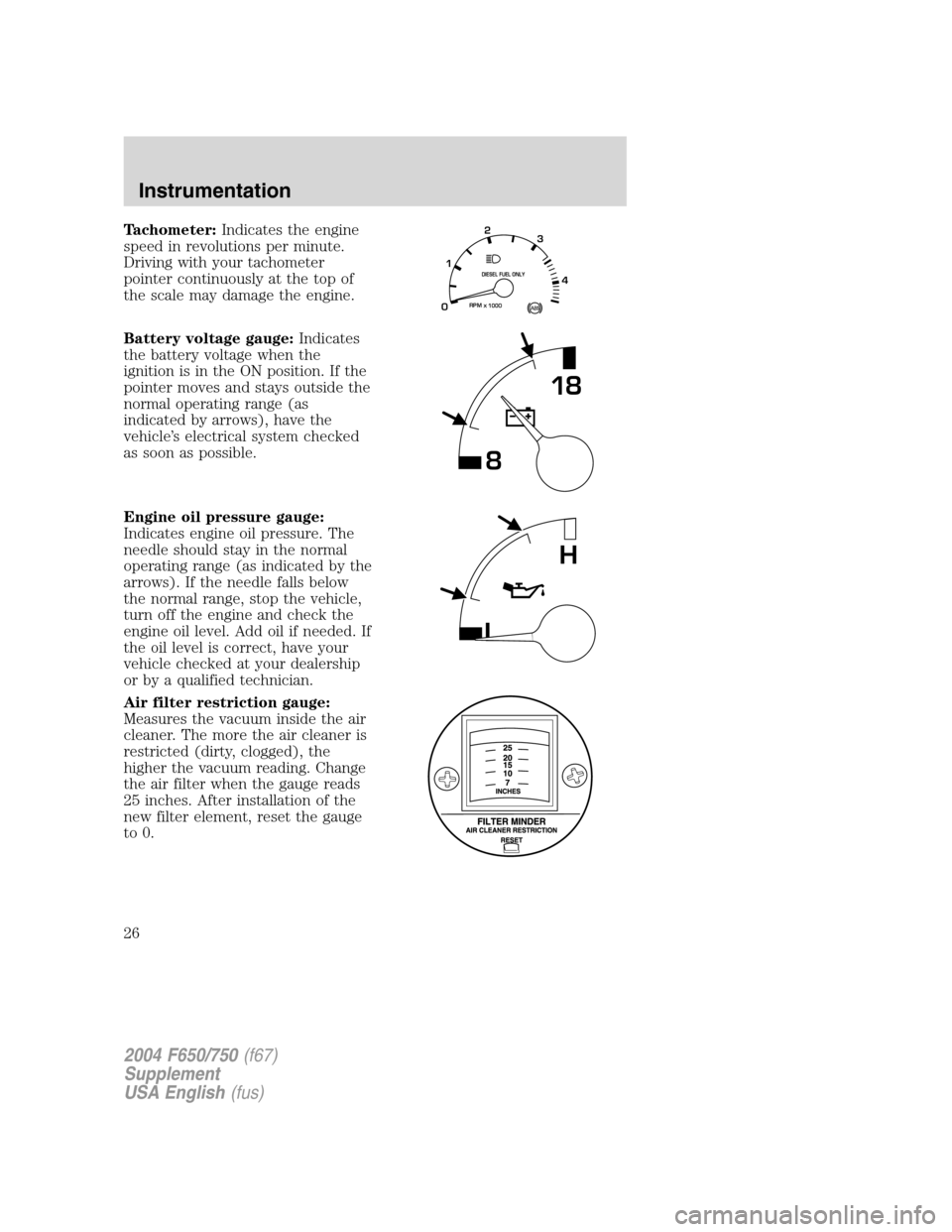
Tachometer:Indicates the engine
speed in revolutions per minute.
Driving with your tachometer
pointer continuously at the top of
the scale may damage the engine.
Battery voltage gauge:Indicates
the battery voltage when the
ignition is in the ON position. If the
pointer moves and stays outside the
normal operating range (as
indicated by arrows), have the
vehicle’s electrical system checked
as soon as possible.
Engine oil pressure gauge:
Indicates engine oil pressure. The
needle should stay in the normal
operating range (as indicated by the
arrows). If the needle falls below
the normal range, stop the vehicle,
turn off the engine and check the
engine oil level. Add oil if needed. If
the oil level is correct, have your
vehicle checked at your dealership
or by a qualified technician.
Air filter restriction gauge:
Measures the vacuum inside the air
cleaner. The more the air cleaner is
restricted (dirty, clogged), the
higher the vacuum reading. Change
the air filter when the gauge reads
25 inches. After installation of the
new filter element, reset the gauge
to 0.
RPM1000
DIESEL FUEL ONLY
X012
3
4
818
L
H
2004 F650/750(f67)
Supplement
USA English(fus)
Instrumentation
26
Page 87 of 264
After the engine starts:
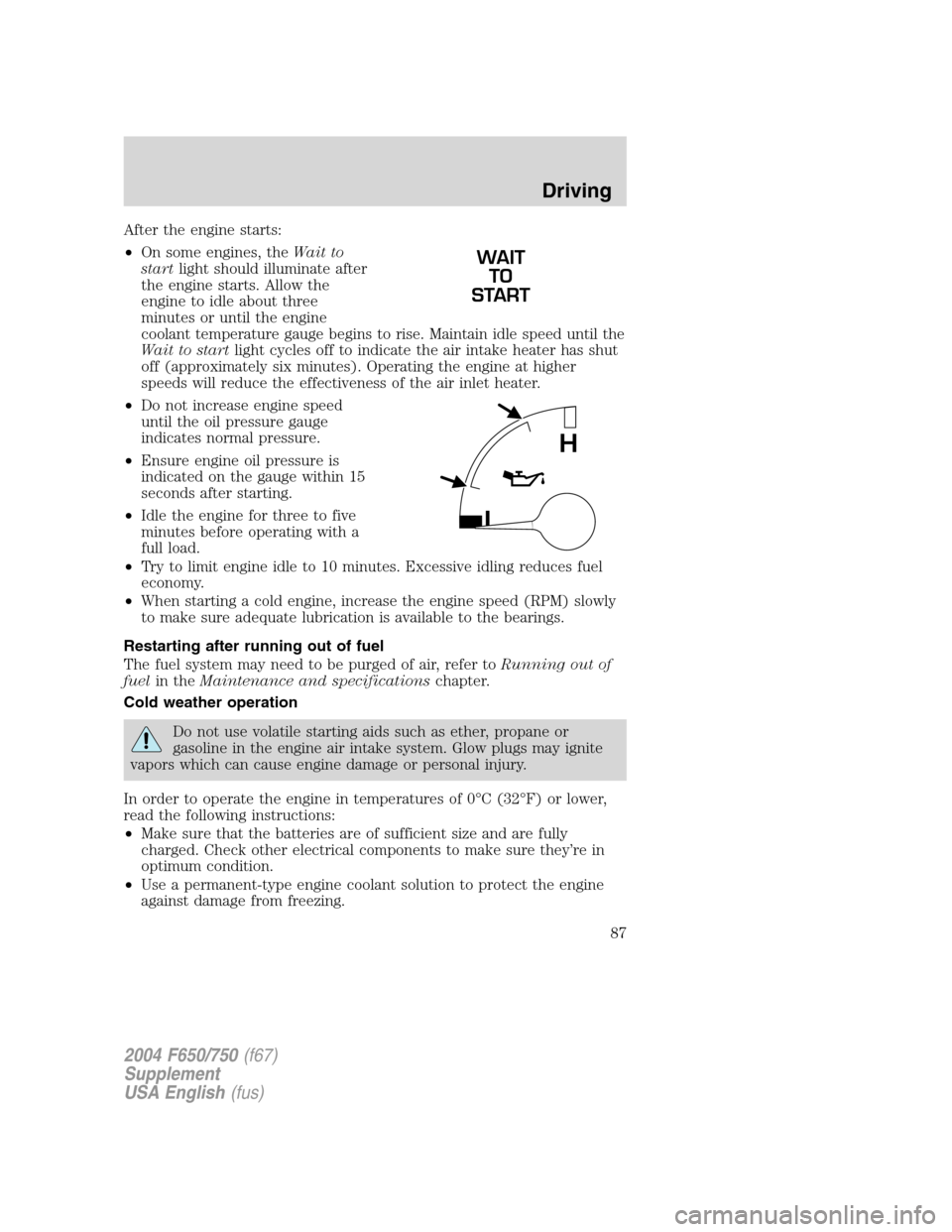
•On some engines, theWait to
startlight should illuminate after
the engine starts. Allow the
engine to idle about three
minutes or until the engine
coolant temperature gauge begins to rise. Maintain idle speed until the
Wait to startlight cycles off to indicate the air intake heater has shut
off (approximately six minutes). Operating the engine at higher
speeds will reduce the effectiveness of the air inlet heater.
•Do not increase engine speed
until the oil pressure gauge
indicates normal pressure.
•Ensure engine oil pressure is
indicated on the gauge within 15
seconds after starting.
•Idle the engine for three to five
minutes before operating with a
full load.
•Try to limit engine idle to 10 minutes. Excessive idling reduces fuel
economy.
•When starting a cold engine, increase the engine speed (RPM) slowly
to make sure adequate lubrication is available to the bearings.
Restarting after running out of fuel
The fuel system may need to be purged of air, refer toRunning out of
fuelin theMaintenance and specificationschapter.
Cold weather operation
Do not use volatile starting aids such as ether, propane or
gasoline in the engine air intake system. Glow plugs may ignite
vapors which can cause engine damage or personal injury.
In order to operate the engine in temperatures of 0°C (32°F) or lower,
read the following instructions:
•Make sure that the batteries are of sufficient size and are fully
charged. Check other electrical components to make sure they’re in
optimum condition.
•Use a permanent-type engine coolant solution to protect the engine
against damage from freezing.
WAIT
TO
START
L
H
2004 F650/750(f67)
Supplement
USA English(fus)
Driving
87
Page 88 of 264
•If your vehicle is equipped with a water-fuel separator, drain it daily.
Fill the fuel tank at the end of daily operation to prevent condensation
in the fuel system.
•Make sure you use proper cold weather engine oil and that it is at its
proper level.
•At temperatures of–20°C(–4°F) or below, it is recommended that you
use a crankcase-mounted coolant heater to improve cold engine
starting.
•If operating in arctic temperatures of–29°C (-20°F) or lower, consult
your truck dealer for information about special cold weather
equipment and precautions.
Note:Idling in cold weather will not heat the engine to its normal
operating temperature. Long periods of idling in cold weather can cause
a buildup of heavy deposits of carbon and rust on valve stems causing
them to stick which, in turn, can cause valvetrain damage.
The following cold weather idling guidelines must be followed:
•Avoid idling the engine for more than 10 minutes at a time.
•Use a minimum of 45 Cetane Diesel fuel or use Cetane Index
improvers from a reputable manufacturer.
•Maintain a minimum idle of 1250 RPM by using the hand throttle.
Always make sure that the parking brake is applied and the
transmission is in neutral before applying the hand throttle.
•Maintain the engine cooling system properly.
•Do not shut the engine down after an extensive idling period (10
minutes or more). Drive the vehicle under load for several miles at
normal operating temperatures to burn off any accumulated carbon
and varnish.
•Consider using an engine block heater, approved winter fronts and/or
radiator shutters where conditions warrant.
Winter fronts
The use of winter fronts, or other air-restrictive devices mounted in front
of the radiator on vehicles with chassis-mounted charge air coolers, are
not recommended unless extremely cold weather conditions exist. Air
flow restriction can cause high exhaust temperatures, power loss,
excessive fan usage and a reduction in fuel economy. If you insist on
using a winter front, the device should have a permanent opening of at
least 774 sq. cm (120 sq in.) directly in line with the fan hub.
2004 F650/750(f67)
Supplement
USA English(fus)
Driving
88
Page 148 of 264
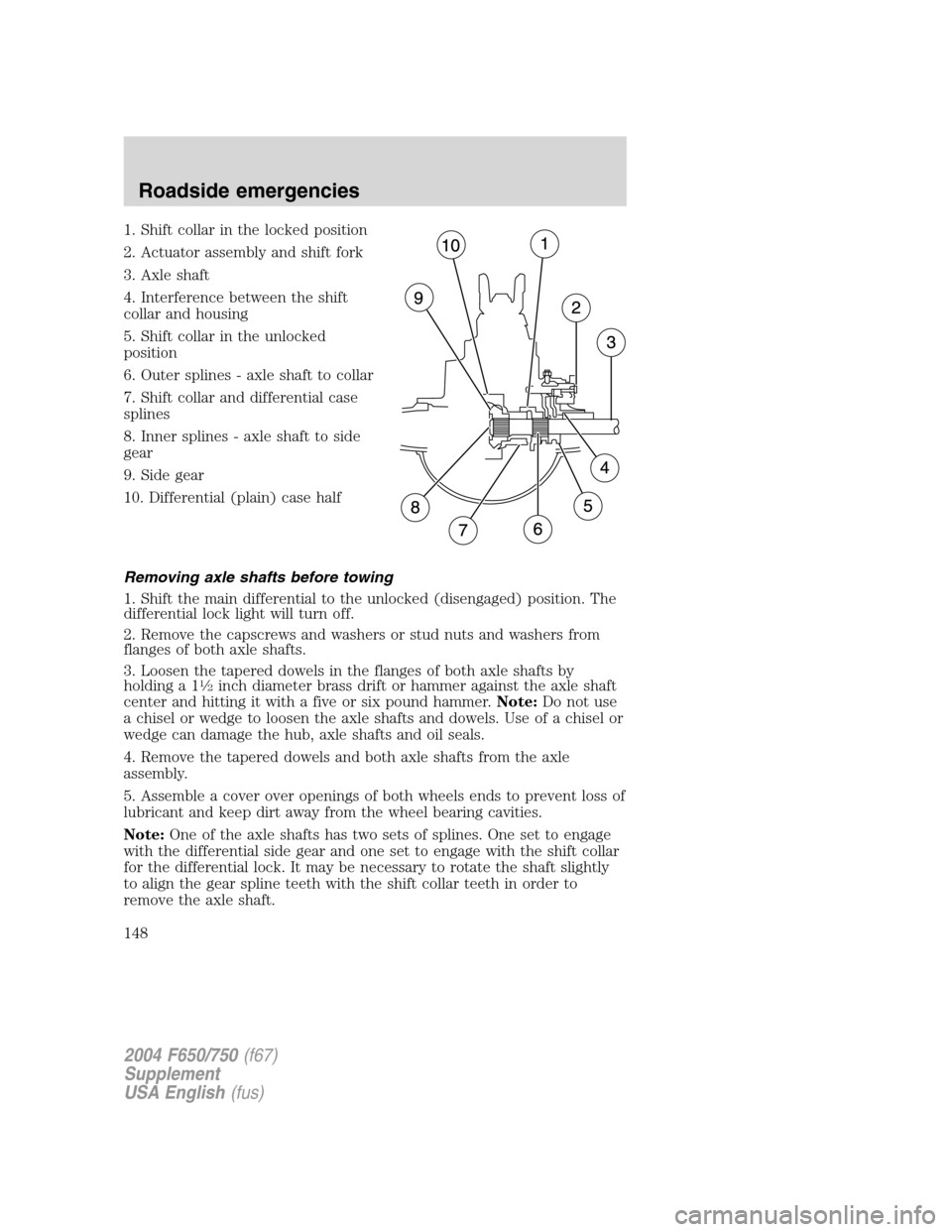
1. Shift collar in the locked position
2. Actuator assembly and shift fork
3. Axle shaft
4. Interference between the shift
collar and housing
5. Shift collar in the unlocked
position
6. Outer splines - axle shaft to collar
7. Shift collar and differential case
splines
8. Inner splines - axle shaft to side
gear
9. Side gear
10. Differential (plain) case half
Removing axle shafts before towing
1. Shift the main differential to the unlocked (disengaged) position. The
differential lock light will turn off.
2. Remove the capscrews and washers or stud nuts and washers from
flanges of both axle shafts.
3. Loosen the tapered dowels in the flanges of both axle shafts by
holding a 1
1⁄2inch diameter brass drift or hammer against the axle shaft
center and hitting it with a five or six pound hammer.Note:Do not use
a chisel or wedge to loosen the axle shafts and dowels. Use of a chisel or
wedge can damage the hub, axle shafts and oil seals.
4. Remove the tapered dowels and both axle shafts from the axle
assembly.
5. Assemble a cover over openings of both wheels ends to prevent loss of
lubricant and keep dirt away from the wheel bearing cavities.
Note:One of the axle shafts has two sets of splines. One set to engage
with the differential side gear and one set to engage with the shift collar
for the differential lock. It may be necessary to rotate the shaft slightly
to align the gear spline teeth with the shift collar teeth in order to
remove the axle shaft.
2004 F650/750(f67)
Supplement
USA English(fus)
Roadside emergencies
148