engine FORD F650 2005 11.G Owners Manual
[x] Cancel search | Manufacturer: FORD, Model Year: 2005, Model line: F650, Model: FORD F650 2005 11.GPages: 272, PDF Size: 1.5 MB
Page 227 of 272
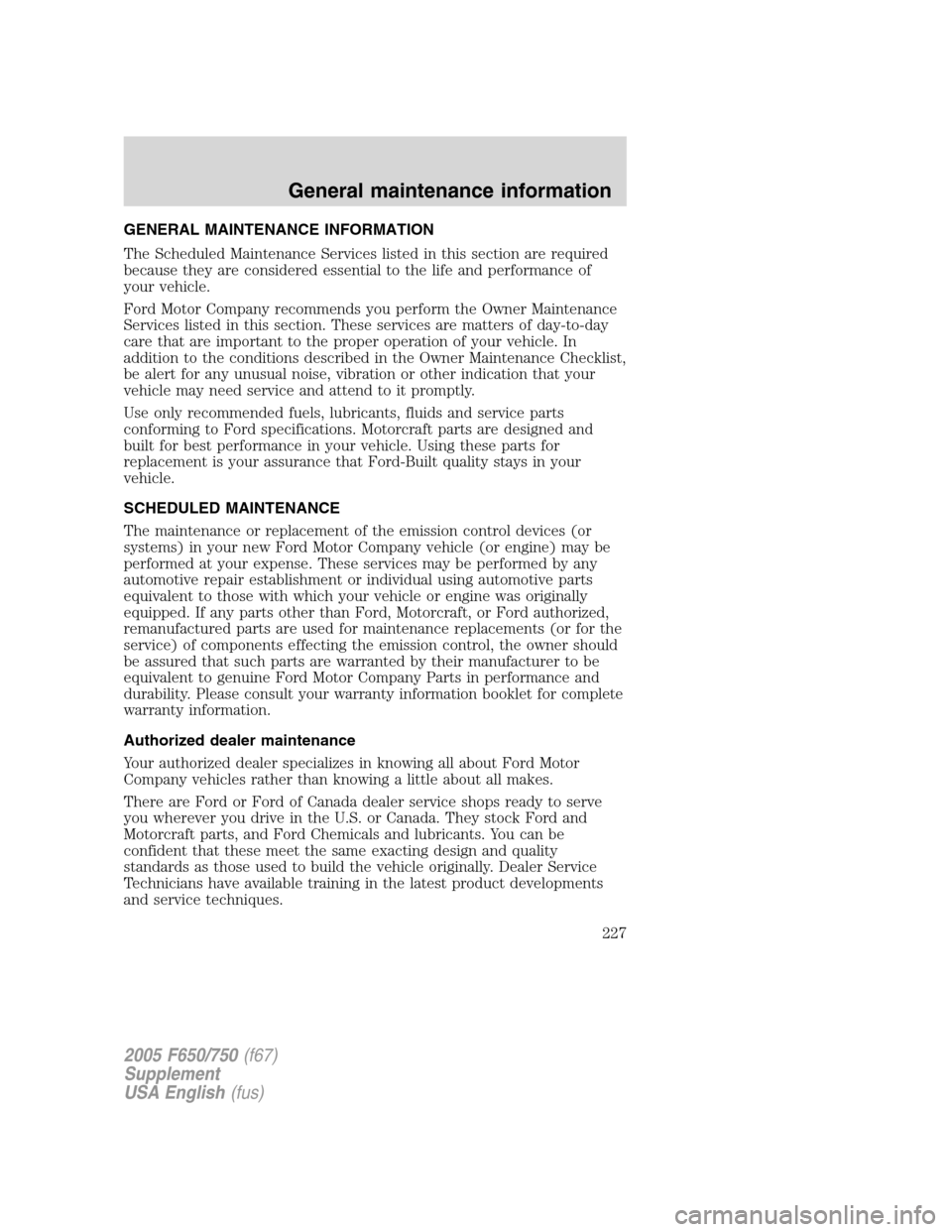
GENERAL MAINTENANCE INFORMATION
The Scheduled Maintenance Services listed in this section are required
because they are considered essential to the life and performance of
your vehicle.
Ford Motor Company recommends you perform the Owner Maintenance
Services listed in this section. These services are matters of day-to-day
care that are important to the proper operation of your vehicle. In
addition to the conditions described in the Owner Maintenance Checklist,
be alert for any unusual noise, vibration or other indication that your
vehicle may need service and attend to it promptly.
Use only recommended fuels, lubricants, fluids and service parts
conforming to Ford specifications. Motorcraft parts are designed and
built for best performance in your vehicle. Using these parts for
replacement is your assurance that Ford-Built quality stays in your
vehicle.
SCHEDULED MAINTENANCE
The maintenance or replacement of the emission control devices (or
systems) in your new Ford Motor Company vehicle (or engine) may be
performed at your expense. These services may be performed by any
automotive repair establishment or individual using automotive parts
equivalent to those with which your vehicle or engine was originally
equipped. If any parts other than Ford, Motorcraft, or Ford authorized,
remanufactured parts are used for maintenance replacements (or for the
service) of components effecting the emission control, the owner should
be assured that such parts are warranted by their manufacturer to be
equivalent to genuine Ford Motor Company Parts in performance and
durability. Please consult your warranty information booklet for complete
warranty information.
Authorized dealer maintenance
Your authorized dealer specializes in knowing all about Ford Motor
Company vehicles rather than knowing a little about all makes.
There are Ford or Ford of Canada dealer service shops ready to serve
you wherever you drive in the U.S. or Canada. They stock Ford and
Motorcraft parts, and Ford Chemicals and lubricants. You can be
confident that these meet the same exacting design and quality
standards as those used to build the vehicle originally. Dealer Service
Technicians have available training in the latest product developments
and service techniques.
2005 F650/750(f67)
Supplement
USA English(fus)
General maintenance information
General maintenance information
227
Page 228 of 272
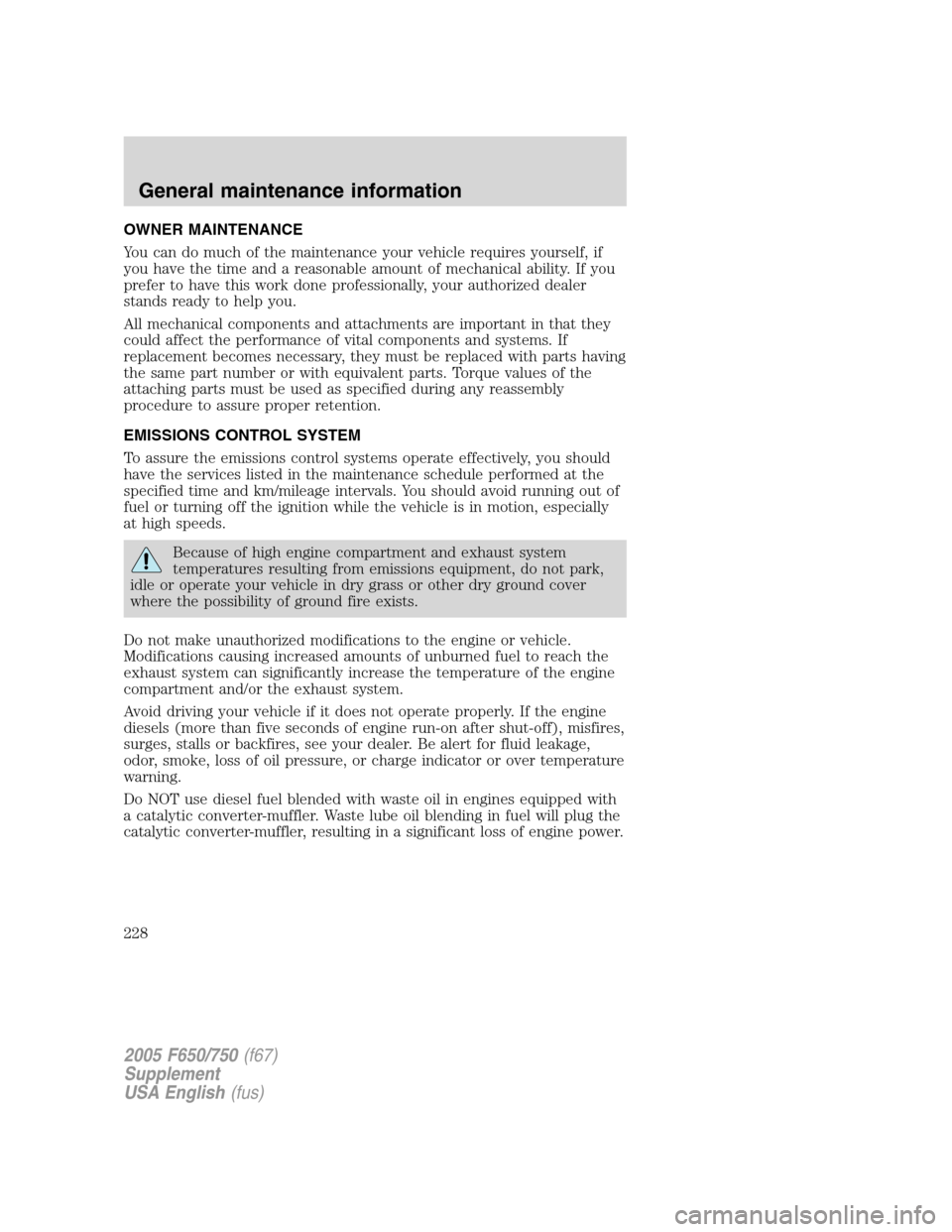
OWNER MAINTENANCE
You can do much of the maintenance your vehicle requires yourself, if
you have the time and a reasonable amount of mechanical ability. If you
prefer to have this work done professionally, your authorized dealer
stands ready to help you.
All mechanical components and attachments are important in that they
could affect the performance of vital components and systems. If
replacement becomes necessary, they must be replaced with parts having
the same part number or with equivalent parts. Torque values of the
attaching parts must be used as specified during any reassembly
procedure to assure proper retention.
EMISSIONS CONTROL SYSTEM
To assure the emissions control systems operate effectively, you should
have the services listed in the maintenance schedule performed at the
specified time and km/mileage intervals. You should avoid running out of
fuel or turning off the ignition while the vehicle is in motion, especially
at high speeds.
Because of high engine compartment and exhaust system
temperatures resulting from emissions equipment, do not park,
idle or operate your vehicle in dry grass or other dry ground cover
where the possibility of ground fire exists.
Do not make unauthorized modifications to the engine or vehicle.
Modifications causing increased amounts of unburned fuel to reach the
exhaust system can significantly increase the temperature of the engine
compartment and/or the exhaust system.
Avoid driving your vehicle if it does not operate properly. If the engine
diesels (more than five seconds of engine run-on after shut-off), misfires,
surges, stalls or backfires, see your dealer. Be alert for fluid leakage,
odor, smoke, loss of oil pressure, or charge indicator or over temperature
warning.
Do NOT use diesel fuel blended with waste oil in engines equipped with
a catalytic converter-muffler. Waste lube oil blending in fuel will plug the
catalytic converter-muffler, resulting in a significant loss of engine power.
2005 F650/750(f67)
Supplement
USA English(fus)
General maintenance information
228
Page 229 of 272
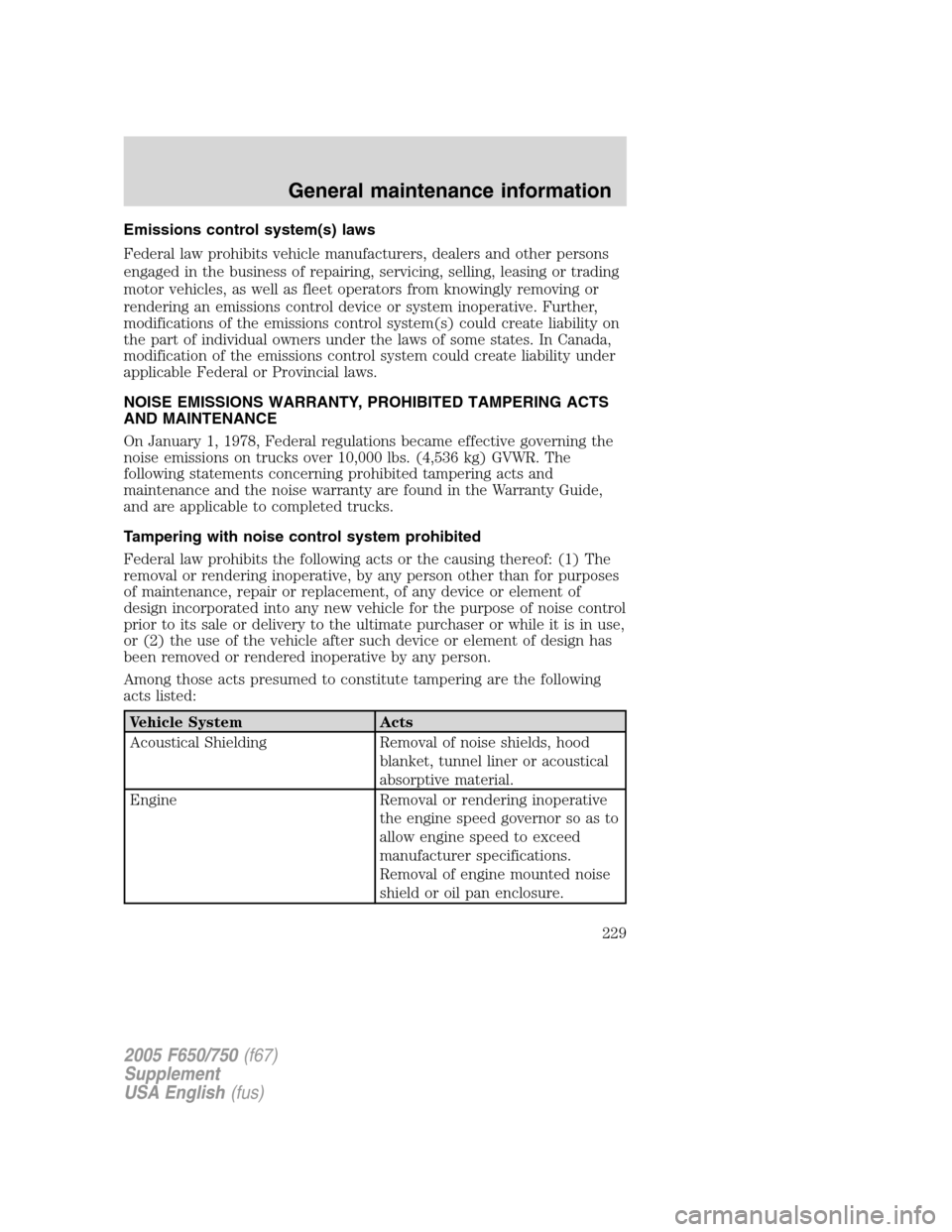
Emissions control system(s) laws
Federal law prohibits vehicle manufacturers, dealers and other persons
engaged in the business of repairing, servicing, selling, leasing or trading
motor vehicles, as well as fleet operators from knowingly removing or
rendering an emissions control device or system inoperative. Further,
modifications of the emissions control system(s) could create liability on
the part of individual owners under the laws of some states. In Canada,
modification of the emissions control system could create liability under
applicable Federal or Provincial laws.
NOISE EMISSIONS WARRANTY, PROHIBITED TAMPERING ACTS
AND MAINTENANCE
On January 1, 1978, Federal regulations became effective governing the
noise emissions on trucks over 10,000 lbs. (4,536 kg) GVWR. The
following statements concerning prohibited tampering acts and
maintenance and the noise warranty are found in the Warranty Guide,
and are applicable to completed trucks.
Tampering with noise control system prohibited
Federal law prohibits the following acts or the causing thereof: (1) The
removal or rendering inoperative, by any person other than for purposes
of maintenance, repair or replacement, of any device or element of
design incorporated into any new vehicle for the purpose of noise control
prior to its sale or delivery to the ultimate purchaser or while it is in use,
or (2) the use of the vehicle after such device or element of design has
been removed or rendered inoperative by any person.
Among those acts presumed to constitute tampering are the following
acts listed:
Vehicle System Acts
Acoustical Shielding Removal of noise shields, hood
blanket, tunnel liner or acoustical
absorptive material.
Engine Removal or rendering inoperative
the engine speed governor so as to
allow engine speed to exceed
manufacturer specifications.
Removal of engine mounted noise
shield or oil pan enclosure.
2005 F650/750(f67)
Supplement
USA English(fus)
General maintenance information
229
Page 230 of 272
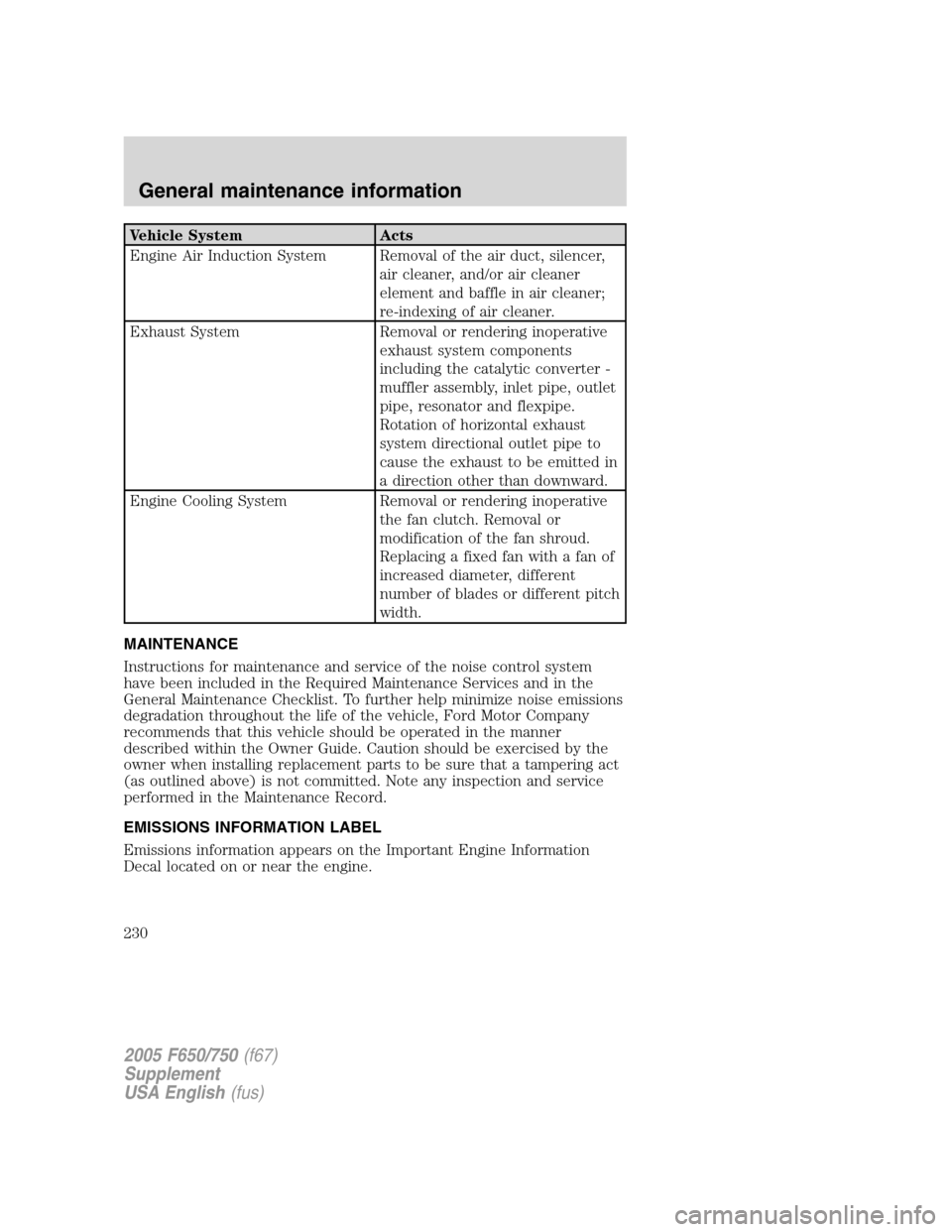
Vehicle System Acts
Engine Air Induction System Removal of the air duct, silencer,
air cleaner, and/or air cleaner
element and baffle in air cleaner;
re-indexing of air cleaner.
Exhaust System Removal or rendering inoperative
exhaust system components
including the catalytic converter -
muffler assembly, inlet pipe, outlet
pipe, resonator and flexpipe.
Rotation of horizontal exhaust
system directional outlet pipe to
cause the exhaust to be emitted in
a direction other than downward.
Engine Cooling System Removal or rendering inoperative
the fan clutch. Removal or
modification of the fan shroud.
Replacing a fixed fan with a fan of
increased diameter, different
number of blades or different pitch
width.
MAINTENANCE
Instructions for maintenance and service of the noise control system
have been included in the Required Maintenance Services and in the
General Maintenance Checklist. To further help minimize noise emissions
degradation throughout the life of the vehicle, Ford Motor Company
recommends that this vehicle should be operated in the manner
described within the Owner Guide. Caution should be exercised by the
owner when installing replacement parts to be sure that a tampering act
(as outlined above) is not committed. Note any inspection and service
performed in the Maintenance Record.
EMISSIONS INFORMATION LABEL
Emissions information appears on the Important Engine Information
Decal located on or near the engine.
2005 F650/750(f67)
Supplement
USA English(fus)
General maintenance information
230
Page 231 of 272
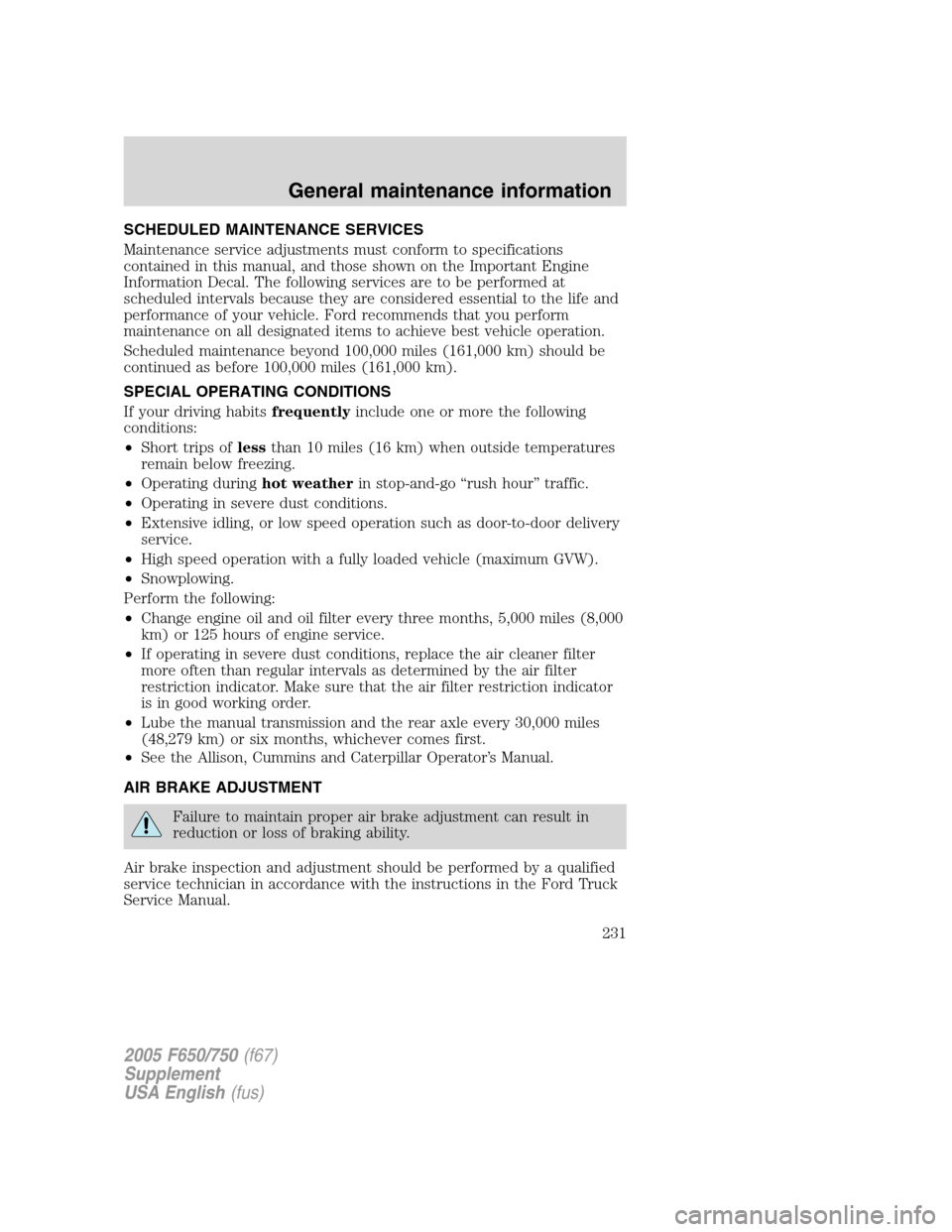
SCHEDULED MAINTENANCE SERVICES
Maintenance service adjustments must conform to specifications
contained in this manual, and those shown on the Important Engine
Information Decal. The following services are to be performed at
scheduled intervals because they are considered essential to the life and
performance of your vehicle. Ford recommends that you perform
maintenance on all designated items to achieve best vehicle operation.
Scheduled maintenance beyond 100,000 miles (161,000 km) should be
continued as before 100,000 miles (161,000 km).
SPECIAL OPERATING CONDITIONS
If your driving habitsfrequentlyinclude one or more the following
conditions:
•Short trips oflessthan 10 miles (16 km) when outside temperatures
remain below freezing.
•Operating duringhot weatherin stop-and-go“rush hour”traffic.
•Operating in severe dust conditions.
•Extensive idling, or low speed operation such as door-to-door delivery
service.
•High speed operation with a fully loaded vehicle (maximum GVW).
•Snowplowing.
Perform the following:
•Change engine oil and oil filter every three months, 5,000 miles (8,000
km) or 125 hours of engine service.
•If operating in severe dust conditions, replace the air cleaner filter
more often than regular intervals as determined by the air filter
restriction indicator. Make sure that the air filter restriction indicator
is in good working order.
•Lube the manual transmission and the rear axle every 30,000 miles
(48,279 km) or six months, whichever comes first.
•See the Allison, Cummins and Caterpillar Operator’s Manual.
AIR BRAKE ADJUSTMENT
Failure to maintain proper air brake adjustment can result in
reduction or loss of braking ability.
Air brake inspection and adjustment should be performed by a qualified
service technician in accordance with the instructions in the Ford Truck
Service Manual.
2005 F650/750(f67)
Supplement
USA English(fus)
General maintenance information
231
Page 233 of 272
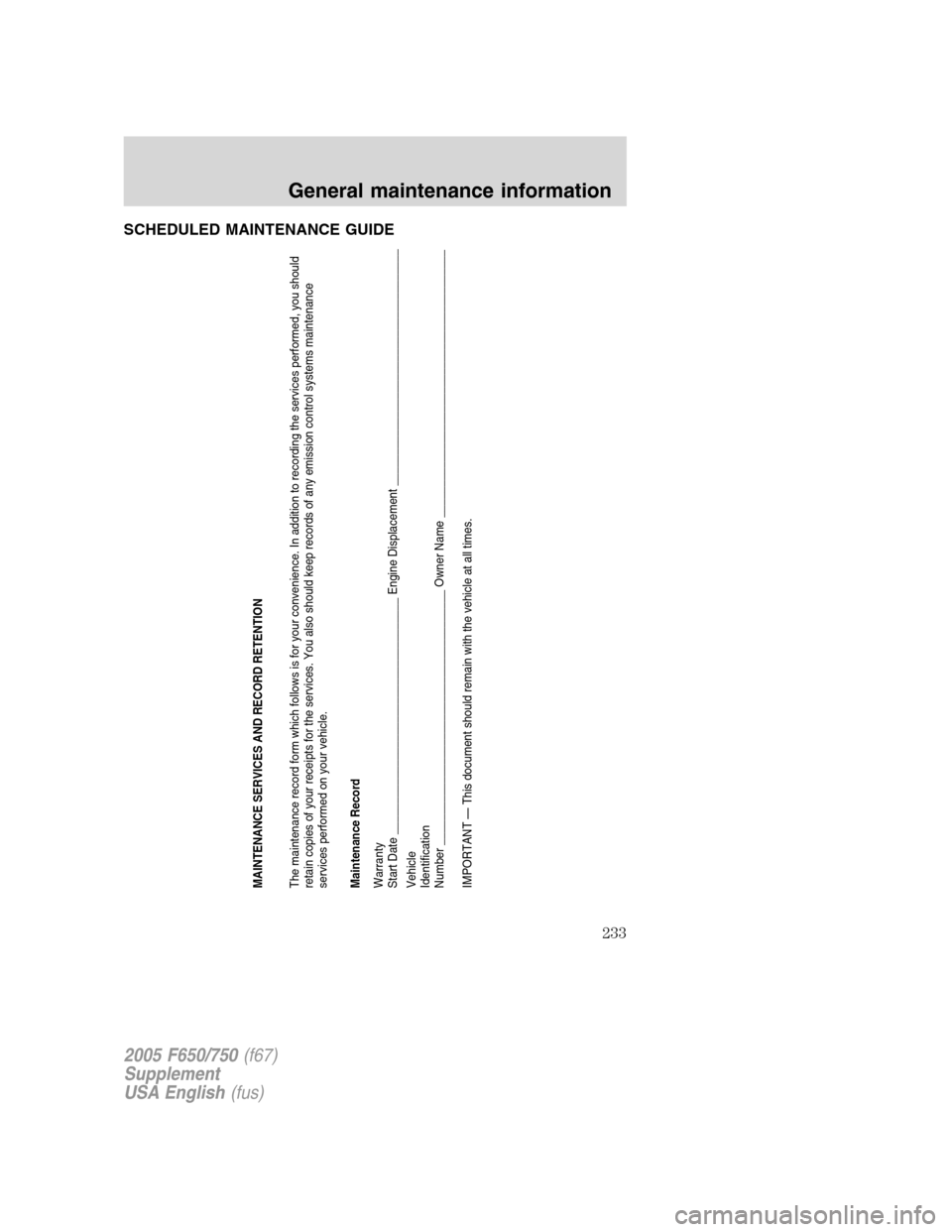
SCHEDULED MAINTENANCE GUIDE
MAINTENANCE SERVICES AND RECORD RETENTION
The maintenance record form which follows is for your convenience. In addition to recording the services performed, you should
retain copies of your receipts for the services. You also should keep records of any emission control systems maintenance
services performed on your vehicle.
Maintenance Record
Warranty
Start Date ______________________________________ Engine Displacement ______________________________________
Vehicle
Identification
Number _________________________________________ Owner Name ___________________________________________
IMPORTANT — This document should remain with the vehicle at all times.
2005 F650/750(f67)
Supplement
USA English(fus)
General maintenance information
233
Page 234 of 272
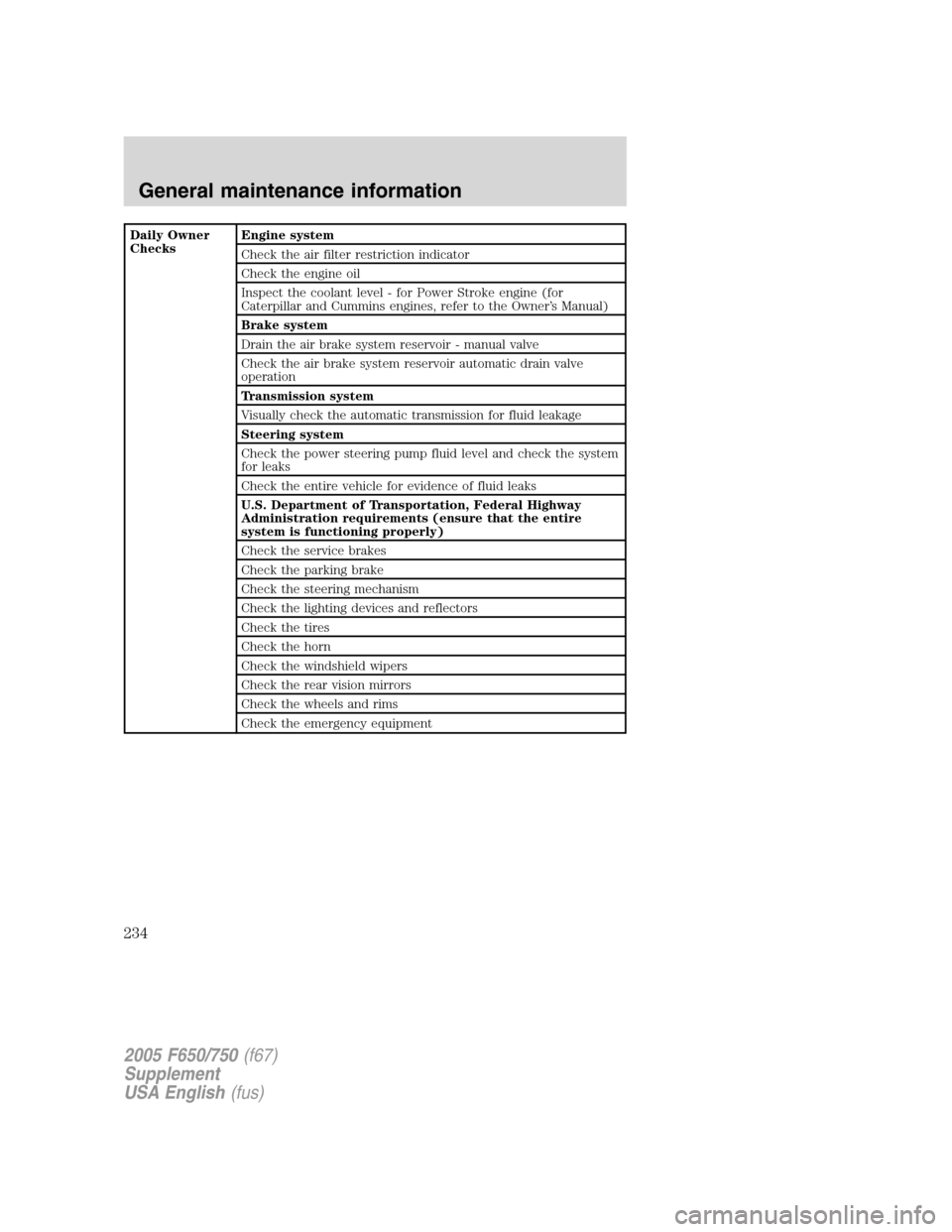
Daily Owner
ChecksEngine system
Check the air filter restriction indicator
Check the engine oil
Inspect the coolant level - for Power Stroke engine (for
Caterpillar and Cummins engines, refer to the Owner’s Manual)
Brake system
Drain the air brake system reservoir - manual valve
Check the air brake system reservoir automatic drain valve
operation
Transmission system
Visually check the automatic transmission for fluid leakage
Steering system
Check the power steering pump fluid level and check the system
for leaks
Check the entire vehicle for evidence of fluid leaks
U.S. Department of Transportation, Federal Highway
Administration requirements (ensure that the entire
system is functioning properly)
Check the service brakes
Check the parking brake
Check the steering mechanism
Check the lighting devices and reflectors
Check the tires
Check the horn
Check the windshield wipers
Check the rear vision mirrors
Check the wheels and rims
Check the emergency equipment
2005 F650/750(f67)
Supplement
USA English(fus)
General maintenance information
234
Page 235 of 272
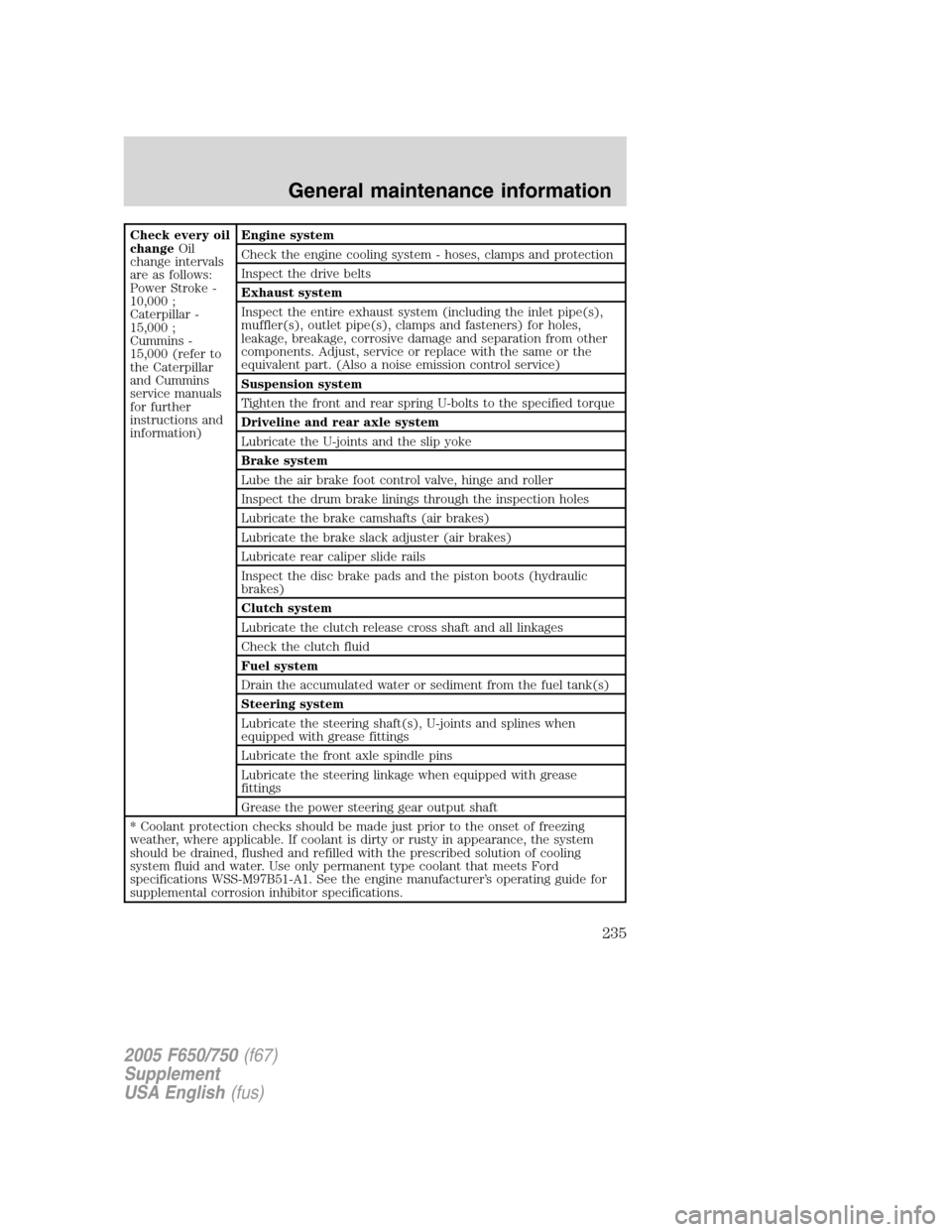
Check every oil
changeOil
change intervals
are as follows:
Power Stroke -
10,000 ;
Caterpillar -
15,000 ;
Cummins -
15,000 (refer to
the Caterpillar
and Cummins
service manuals
for further
instructions and
information)Engine system
Check the engine cooling system - hoses, clamps and protection
Inspect the drive belts
Exhaust system
Inspect the entire exhaust system (including the inlet pipe(s),
muffler(s), outlet pipe(s), clamps and fasteners) for holes,
leakage, breakage, corrosive damage and separation from other
components. Adjust, service or replace with the same or the
equivalent part. (Also a noise emission control service)
Suspension system
Tighten the front and rear spring U-bolts to the specified torque
Driveline and rear axle system
Lubricate the U-joints and the slip yoke
Brake system
Lube the air brake foot control valve, hinge and roller
Inspect the drum brake linings through the inspection holes
Lubricate the brake camshafts (air brakes)
Lubricate the brake slack adjuster (air brakes)
Lubricate rear caliper slide rails
Inspect the disc brake pads and the piston boots (hydraulic
brakes)
Clutch system
Lubricate the clutch release cross shaft and all linkages
Check the clutch fluid
Fuel system
Drain the accumulated water or sediment from the fuel tank(s)
Steering system
Lubricate the steering shaft(s), U-joints and splines when
equipped with grease fittings
Lubricate the front axle spindle pins
Lubricate the steering linkage when equipped with grease
fittings
Grease the power steering gear output shaft
* Coolant protection checks should be made just prior to the onset of freezing
weather, where applicable. If coolant is dirty or rusty in appearance, the system
should be drained, flushed and refilled with the prescribed solution of cooling
system fluid and water. Use only permanent type coolant that meets Ford
specifications WSS-M97B51-A1. See the engine manufacturer’s operating guide for
supplemental corrosion inhibitor specifications.
2005 F650/750(f67)
Supplement
USA English(fus)
General maintenance information
235
Page 237 of 272
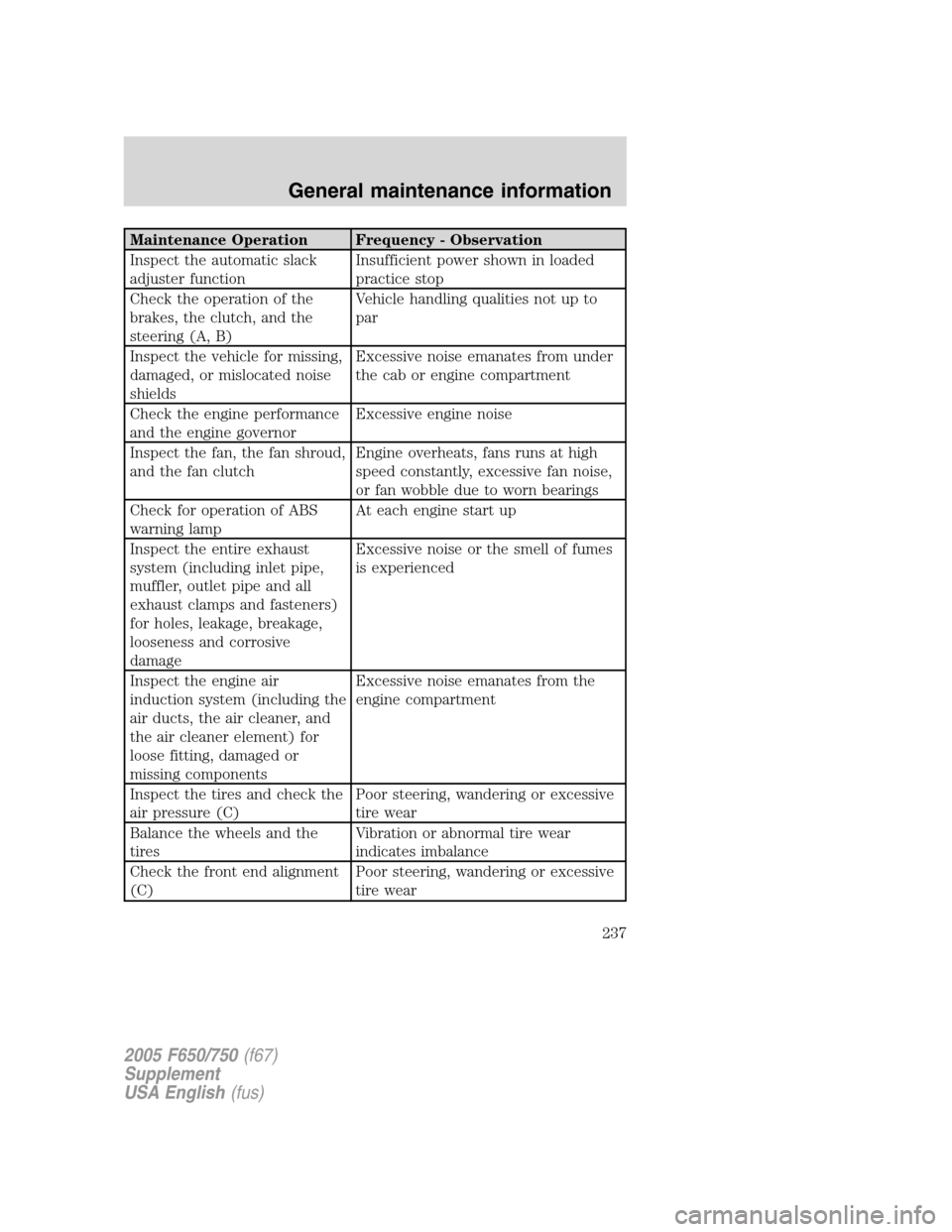
Maintenance Operation Frequency - Observation
Inspect the automatic slack
adjuster functionInsufficient power shown in loaded
practice stop
Check the operation of the
brakes, the clutch, and the
steering (A, B)Vehicle handling qualities not up to
par
Inspect the vehicle for missing,
damaged, or mislocated noise
shieldsExcessive noise emanates from under
the cab or engine compartment
Check the engine performance
and the engine governorExcessive engine noise
Inspect the fan, the fan shroud,
and the fan clutchEngine overheats, fans runs at high
speed constantly, excessive fan noise,
or fan wobble due to worn bearings
Check for operation of ABS
warning lampAt each engine start up
Inspect the entire exhaust
system (including inlet pipe,
muffler, outlet pipe and all
exhaust clamps and fasteners)
for holes, leakage, breakage,
looseness and corrosive
damageExcessive noise or the smell of fumes
is experienced
Inspect the engine air
induction system (including the
air ducts, the air cleaner, and
the air cleaner element) for
loose fitting, damaged or
missing componentsExcessive noise emanates from the
engine compartment
Inspect the tires and check the
air pressure (C)Poor steering, wandering or excessive
tire wear
Balance the wheels and the
tiresVibration or abnormal tire wear
indicates imbalance
Check the front end alignment
(C)Poor steering, wandering or excessive
tire wear
2005 F650/750(f67)
Supplement
USA English(fus)
General maintenance information
237
Page 238 of 272
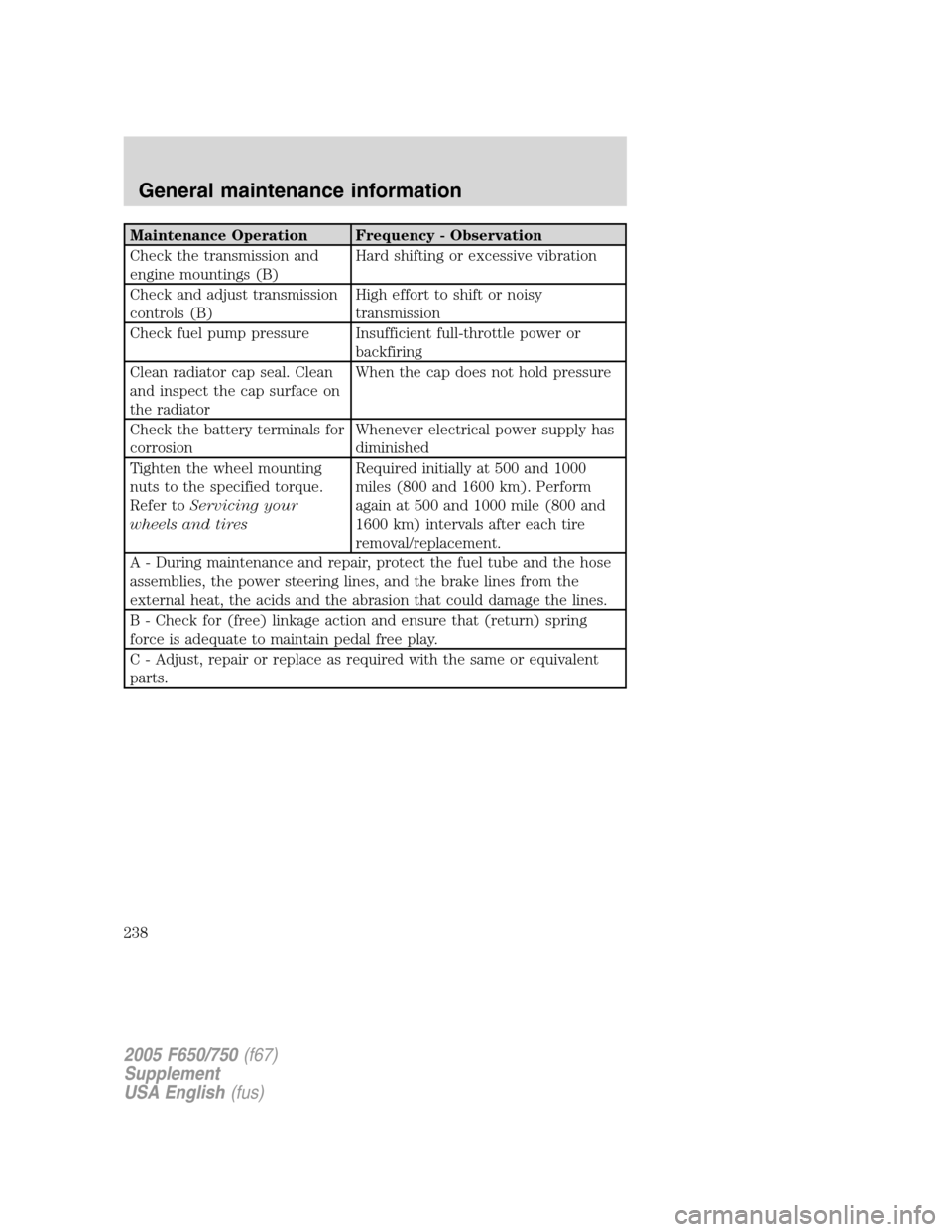
Maintenance Operation Frequency - Observation
Check the transmission and
engine mountings (B)Hard shifting or excessive vibration
Check and adjust transmission
controls (B)High effort to shift or noisy
transmission
Check fuel pump pressure Insufficient full-throttle power or
backfiring
Clean radiator cap seal. Clean
and inspect the cap surface on
the radiatorWhen the cap does not hold pressure
Check the battery terminals for
corrosionWhenever electrical power supply has
diminished
Tighten the wheel mounting
nuts to the specified torque.
Refer toServicing your
wheels and tiresRequired initially at 500 and 1000
miles (800 and 1600 km). Perform
again at 500 and 1000 mile (800 and
1600 km) intervals after each tire
removal/replacement.
A - During maintenance and repair, protect the fuel tube and the hose
assemblies, the power steering lines, and the brake lines from the
external heat, the acids and the abrasion that could damage the lines.
B - Check for (free) linkage action and ensure that (return) spring
force is adequate to maintain pedal free play.
C - Adjust, repair or replace as required with the same or equivalent
parts.
2005 F650/750(f67)
Supplement
USA English(fus)
General maintenance information
238