engine FORD F650 2005 11.G Manual Online
[x] Cancel search | Manufacturer: FORD, Model Year: 2005, Model line: F650, Model: FORD F650 2005 11.GPages: 272, PDF Size: 1.5 MB
Page 187 of 272
Drain and refill your transmission fluid using the following procedure:
1. Drain the transmission while the fluid is warm.
2. Park the vehicle on level ground.
3. Set the parking brake and shift into 1 (First) and turn the engine off.
4. Clean any dirt from around the filler and drain plugs.
5. Remove the filler and drain plugs and drain the fluid into a suitable
container. Dispose all used automotive fluids in a responsible manner
following your local authorized standards.
6. Clean and install the drain plug securely.
7. Add enough fluid through the filler plug opening so that the fluid level
is up to the bottom of the opening.
8. Clean and install the filler plug securely.
ENGINE AND SUBSYSTEM MAINTENANCE
Note:Information in this section pertains to the 6.0L Power Stroke
engine only. For information pertaining to other engines, see the
respective engine operator manual.
Note:To prevent damage to the engine control module, never
spray-wash it directly. Never spray any connector.
For effective emissions control and low operating cost, it is important
that maintenance operations listed in this section be performed at the
specified periods or mileage intervals indicated (kilometers, miles, hours,
or months, whichever comes first).
Service intervals are based upon average operating conditions. Where
dusty, frequent start and stop or heavily laden operations are
encountered, more frequent servicing will be required.
As the vehicle (engine) owner, you are responsible for the performance
of all scheduled maintenance. The required maintenance operations may
be performed by the owner at a service establishment of the owner’s
choosing. Any replacement parts used for required maintenance services
or repairs should be genuine manufacturer service parts or equivalent in
quality and performance to genuine manufacturer service parts. Use of
inferior parts hinders operations of the engine and emissions controls
and can reduce engine life and/or jeopardize the warranty.
Receipts covering the performance of regular maintenance should be
retained in the event questions arise concerning maintenance. The
receipts should be transferred to each subsequent owner of the vehicle
(engine).
2005 F650/750(f67)
Supplement
USA English(fus)
Maintenance and specifications
187
Page 188 of 272
Catalytic converter
If your Diesel engine is equipped with a catalytic converter, it is
important to review the maintenance schedule to insure proper
functioning of the catalytic converter. Also, take precautions not to
damage the catalytic converter when servicing your engine or storing
your vehicle.
Note:If your vehicle is equipped with a catalytic converter/muffler,do
notblend waste oil with Diesel fuel. Operate only on low sulfur (less
than 500 parts per million sulfur) Diesel fuel with a cetane value of 45 or
higher.
Note:If your vehicle is equipped with a vertical exhaust pipe, it is very
important to have and maintain a rain cap on the exhaust pipe to
prevent water from entering the exhaust system and catalytic converter.
Any water entering the catalytic converter may damage the catalyst and
affect the function of the converter.
Air induction system
Once each year, perform a complete inspection of the air induction
system. In areas where road salt is used, the inspection consists of
disassembling the joints of each aluminum component and inspecting for
salt build-up, presence of chlorine that can cause aluminum particles to
flake off and enter the engine combustion chambers.
If evidence of corrosion is found (usually at the pipe connections), use a
wire brush to clean the inside of the pipes and inside the rubber hoses.
If the intake pipes are pitted at the joint ends, use RTV silicone to seal
the joints. Be certain that no excess material is on the inside of the pipes
that can be pulled into the engine. If the service condition of the pipes,
hoses or clamps is questionable, replace the defective part(s).
Be sure that prior to reassembly all dust and debris has been cleaned out
of the pipes and couplings with a clean, damp rag.
To reduce the risk of personal injury or death when performing
maintenance to any turbocharged engine with engine air inlet
piping disconnected, a turbocharger compressor air inlet protective
shield should be installed over the turbocharger air inlet.
Cummins B and Caterpillar engines
Refer to the respective engine operator manual for air filter replacement
procedure.
2005 F650/750(f67)
Supplement
USA English(fus)
Maintenance and specifications
188
Page 190 of 272
any damage to the fuel tank or fuel system if a genuine Ford or
Motorcraft fuel filler cap is not used.
If you do not use the proper fuel filler cap, excessive pressure or
vacuum in the fuel tank may damage the fuel system or cause
the fuel system to work improperly in a collision, which may result in
possible personal injury.
Choosing the right fuel
The engine is designed to use low sulfur number 1D or 2D diesel fuel
only. At temperatures below–20
oF(–7oC), number 1D or winter blend
number 2D fuel is recommended. (SeeCold weather operationin the
Drivingsection.) Diesel fuel containing no more than 5% of biodiesel
may be used. Biodiesel fuel is a product derived from renewable fuel
sources such as vegetable oil, animal fat and cooking oil.
Do not use home heating oil or any diesel fuel not intended for
highway use. Red dye is used to identify fuels intended for
agricultural and non-highway use. Damage to the fuel injection
system, engine and exhaust catalyst can occur if an improper fuel
is used. Do not add gasoline, gasohol or alcohol to diesel fuel.
This practice creates a serious fire hazard and engine
performance problems.
Use low sulfur (less than 0.05% by weight) fuel as required by the EPA
for emission compliance.
Do not mix diesel fuel with gasoline, gasohol or alcohol. This
could cause an explosion resulting in personal injury.
Do not use starting fluid such as ether or gasoline. Such fluids
can cause immediate explosive damage to the engine and
possible personal injury.
Fuel quality
It should not be necessary to add any aftermarket additives to your fuel
tank if you use a properly formulated diesel fuel that meets ASTM D 975
specification. Aftermarket additives can damage the injector system or
engine. Repairs to correct the effects of using an aftermarket product in
your fuel may not be covered by your warranty.
2005 F650/750(f67)
Supplement
USA English(fus)
Maintenance and specifications
190
Page 191 of 272
Do not blend used engine oil with diesel fuel under any
circumstances.Blending used oil with the fuel will significantly increase
your vehicle’s exhaust emissions and reduce engine life due to increased
internal wear.
Many of the world’s automakers approved the World-wide Fuel Charter
that recommends diesel fuel specifications to provide improved
performance and emission control system protection for your vehicle.
Diesel fuel that meet the World-wide Fuel Charter should be used when
available. Ask your fuel supplier about fuel that meet the World-Wide
Fuel Charter.
Running out of fuel
Avoid running out of fuel as this will allow air to enter the fuel system,
which will make restarting the vehicle difficult.
If you have run out of fuel:
•If your vehicle is equipped with dual fuel tanks,add at least 4–5
gallons (15–19 liters) of fuel to each tank before attempting to restart
the engine.
•If your vehicle is equipped with a Caterpillar engine,the fuel
system must be primed before attempting to restart the engine. Refer
to the engine operator’s manual for instructions on priming the engine.
•Use caution not to overheat and damage the starterby cranking
the engine for an excessive period of time. You may need to crank the
engine for a longer time than normal. If the engine fails to start in 30
seconds, turn the ignition to the OFF position and wait for two
minutes before cranking the engine again.
•Any remaining trapped air will self-purge from the fuel system once
the engine starts running.
•
The engine may run rough and produce white smoke while air is in the
fuel system. This is normal and should stop after a short period of time.
Fuel filter/water separator
Do not drain water separator while engine is running. Fuel may
ignite if separator is drained while engine is running or vehicle is
moving.
The fuel filter/water separator removes any contaminated particles
and/or water from the fuel before the fuel enters the engine.
The fuel filter/water separator should be drained as recommended in the
general maintenance information section.
2005 F650/750(f67)
Supplement
USA English(fus)
Maintenance and specifications
191
Page 192 of 272
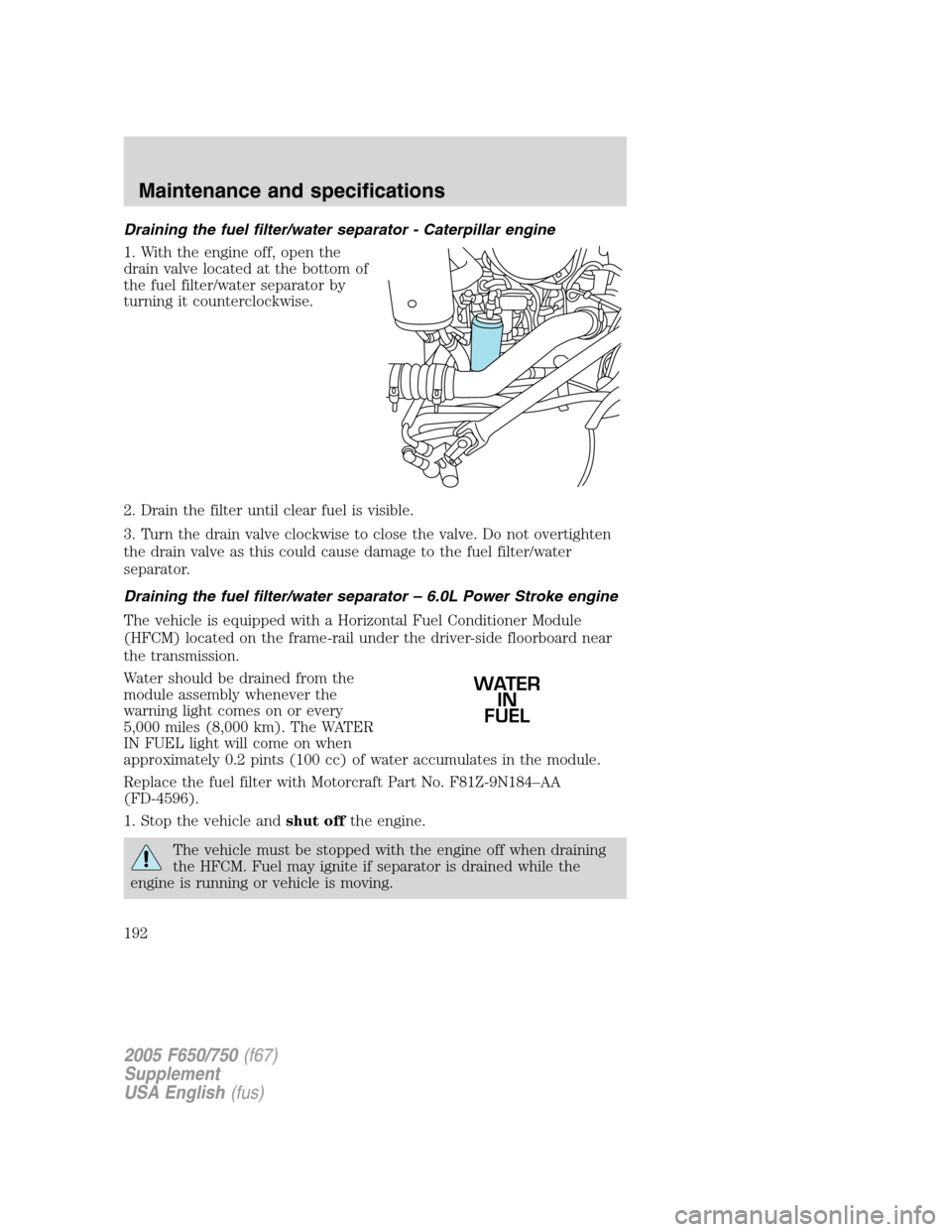
Draining the fuel filter/water separator - Caterpillar engine
1. With the engine off, open the
drain valve located at the bottom of
the fuel filter/water separator by
turning it counterclockwise.
2. Drain the filter until clear fuel is visible.
3. Turn the drain valve clockwise to close the valve. Do not overtighten
the drain valve as this could cause damage to the fuel filter/water
separator.
Draining the fuel filter/water separator–6.0L Power Stroke engine
The vehicle is equipped with a Horizontal Fuel Conditioner Module
(HFCM) located on the frame-rail under the driver-side floorboard near
the transmission.
Water should be drained from the
module assembly whenever the
warning light comes on or every
5,000 miles (8,000 km). The WATER
IN FUEL light will come on when
approximately 0.2 pints (100 cc) of water accumulates in the module.
Replace the fuel filter with Motorcraft Part No. F81Z-9N184–AA
(FD-4596).
1. Stop the vehicle andshut offthe engine.
The vehicle must be stopped with the engine off when draining
the HFCM. Fuel may ignite if separator is drained while the
engine is running or vehicle is moving.
WATER
IN
FUEL
2005 F650/750(f67)
Supplement
USA English(fus)
Maintenance and specifications
192
Page 193 of 272
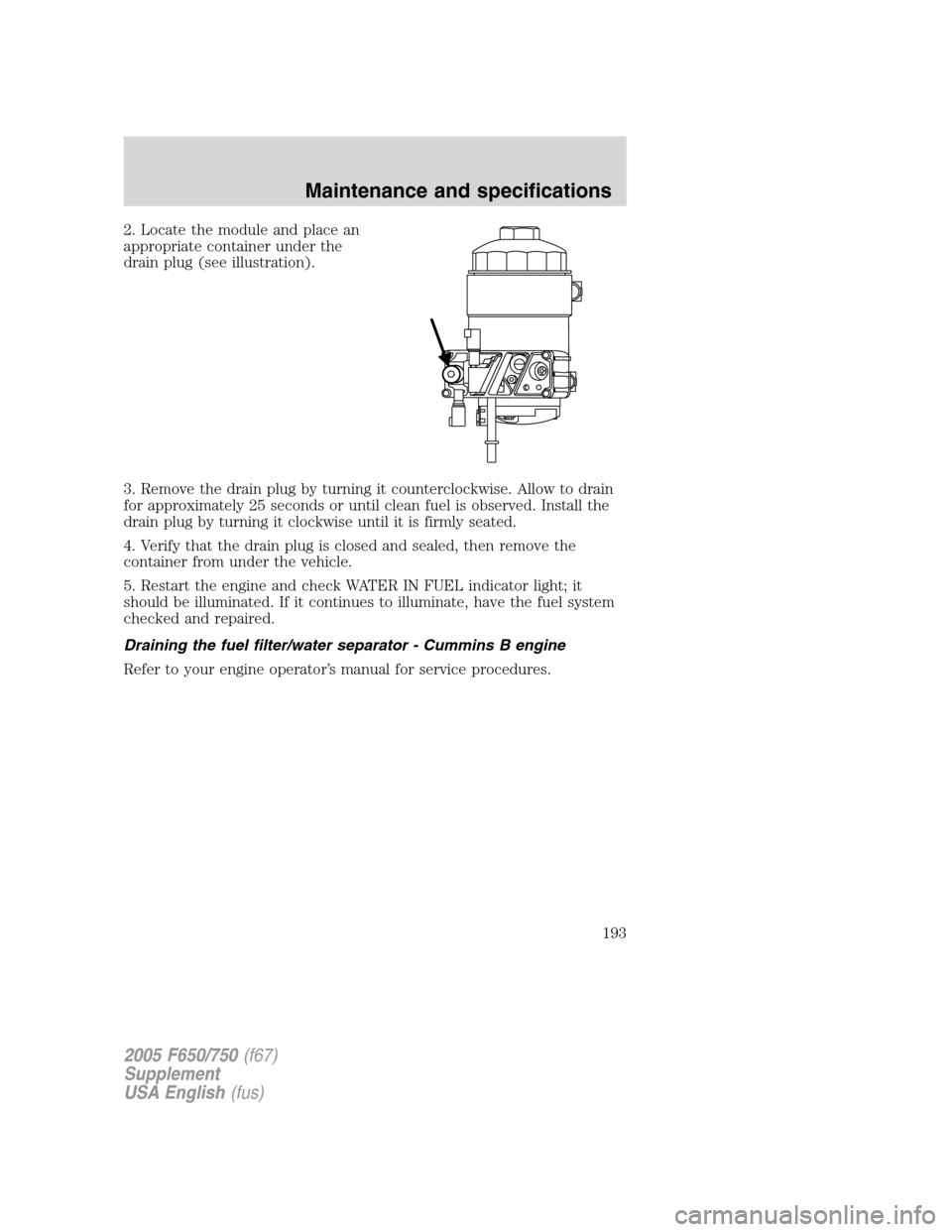
2. Locate the module and place an
appropriate container under the
drain plug (see illustration).
3. Remove the drain plug by turning it counterclockwise. Allow to drain
for approximately 25 seconds or until clean fuel is observed. Install the
drain plug by turning it clockwise until it is firmly seated.
4. Verify that the drain plug is closed and sealed, then remove the
container from under the vehicle.
5. Restart the engine and check WATER IN FUEL indicator light; it
should be illuminated. If it continues to illuminate, have the fuel system
checked and repaired.
Draining the fuel filter/water separator - Cummins B engine
Refer to your engine operator’s manual for service procedures.
2005 F650/750(f67)
Supplement
USA English(fus)
Maintenance and specifications
193
Page 194 of 272
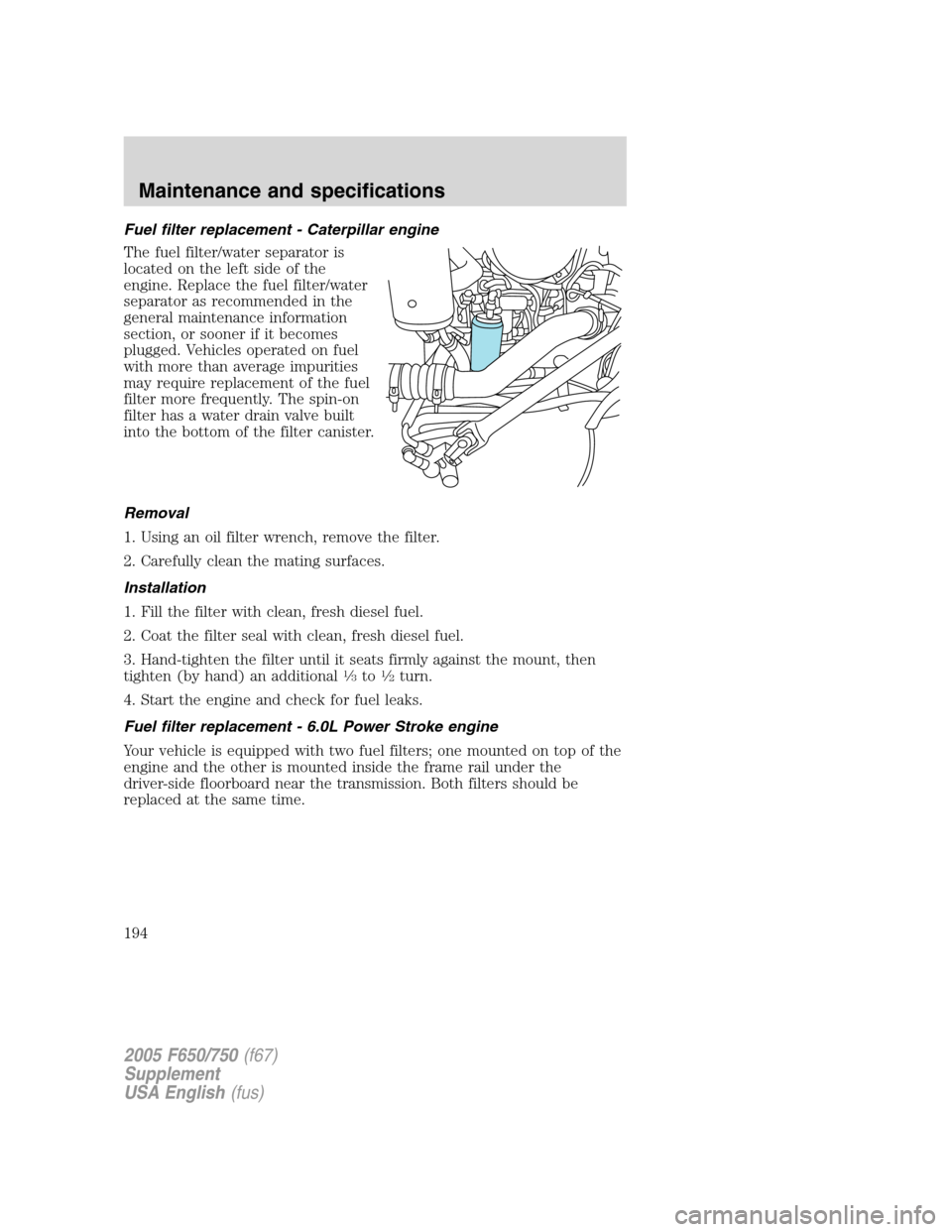
Fuel filter replacement - Caterpillar engine
The fuel filter/water separator is
located on the left side of the
engine. Replace the fuel filter/water
separator as recommended in the
general maintenance information
section, or sooner if it becomes
plugged. Vehicles operated on fuel
with more than average impurities
may require replacement of the fuel
filter more frequently. The spin-on
filter has a water drain valve built
into the bottom of the filter canister.
Removal
1. Using an oil filter wrench, remove the filter.
2. Carefully clean the mating surfaces.
Installation
1. Fill the filter with clean, fresh diesel fuel.
2. Coat the filter seal with clean, fresh diesel fuel.
3. Hand-tighten the filter until it seats firmly against the mount, then
tighten (by hand) an additional
1⁄3to1⁄2turn.
4. Start the engine and check for fuel leaks.
Fuel filter replacement - 6.0L Power Stroke engine
Your vehicle is equipped with two fuel filters; one mounted on top of the
engine and the other is mounted inside the frame rail under the
driver-side floorboard near the transmission. Both filters should be
replaced at the same time.
2005 F650/750(f67)
Supplement
USA English(fus)
Maintenance and specifications
194
Page 195 of 272
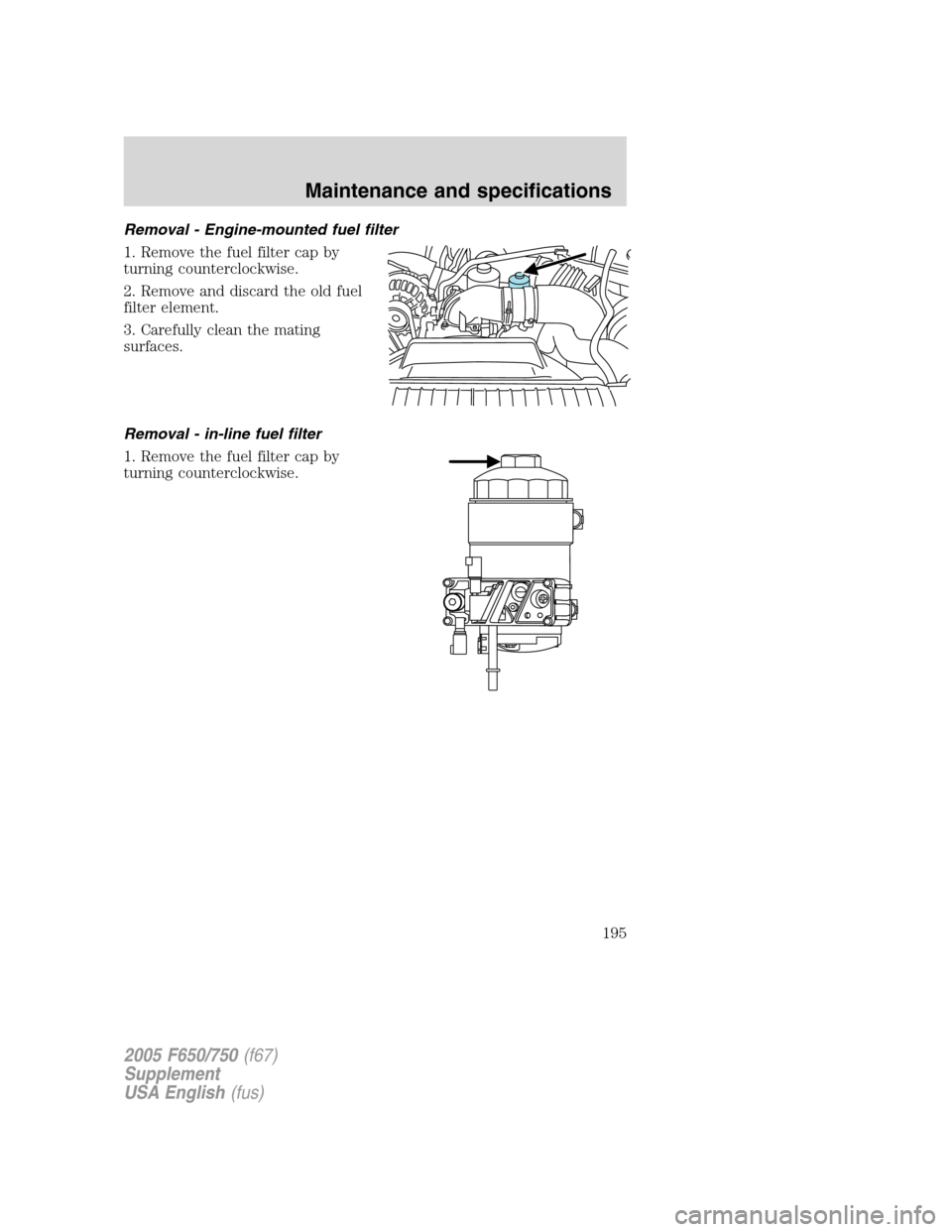
Removal - Engine-mounted fuel filter
1. Remove the fuel filter cap by
turning counterclockwise.
2. Remove and discard the old fuel
filter element.
3. Carefully clean the mating
surfaces.
Removal - in-line fuel filter
1. Remove the fuel filter cap by
turning counterclockwise.
2005 F650/750(f67)
Supplement
USA English(fus)
Maintenance and specifications
195
Page 196 of 272
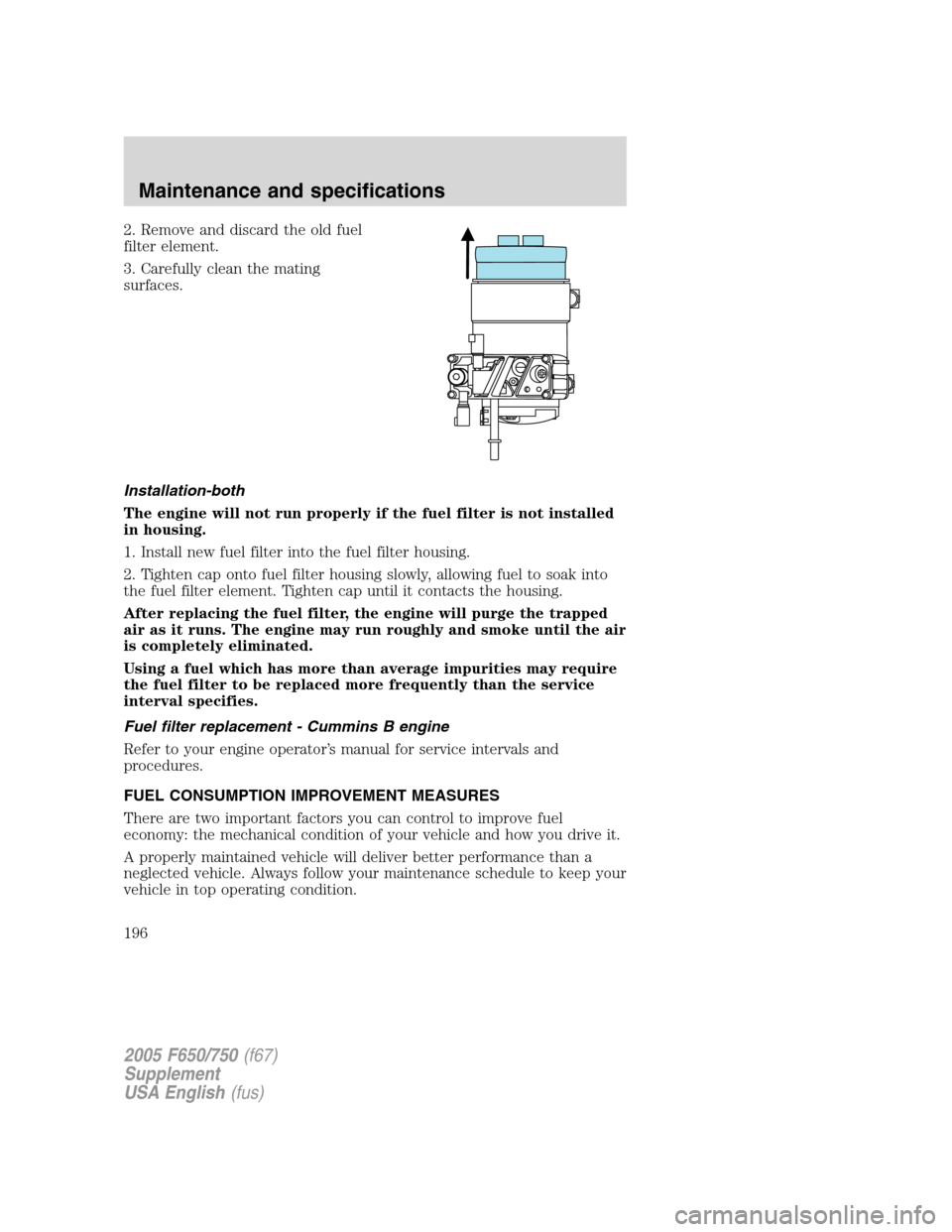
2. Remove and discard the old fuel
filter element.
3. Carefully clean the mating
surfaces.
Installation-both
The engine will not run properly if the fuel filter is not installed
in housing.
1. Install new fuel filter into the fuel filter housing.
2. Tighten cap onto fuel filter housing slowly, allowing fuel to soak into
the fuel filter element. Tighten cap until it contacts the housing.
After replacing the fuel filter, the engine will purge the trapped
air as it runs. The engine may run roughly and smoke until the air
is completely eliminated.
Using a fuel which has more than average impurities may require
the fuel filter to be replaced more frequently than the service
interval specifies.
Fuel filter replacement - Cummins B engine
Refer to your engine operator’s manual for service intervals and
procedures.
FUEL CONSUMPTION IMPROVEMENT MEASURES
There are two important factors you can control to improve fuel
economy: the mechanical condition of your vehicle and how you drive it.
A properly maintained vehicle will deliver better performance than a
neglected vehicle. Always follow your maintenance schedule to keep your
vehicle in top operating condition.
2005 F650/750(f67)
Supplement
USA English(fus)
Maintenance and specifications
196
Page 197 of 272
Also, your driving habits have a significant influence on use of fuel. By
following these suggestions, you can stretch your fuel use:
•Avoid changes in speed as much as possible.
•Anticipate changing traffic conditions. Sudden stops and fast
acceleration waste fuel.
•Avoid extensive idling.
•Do not drive with your foot resting on the brake pedal.
Essentials of good fuel economy
Measuring techniques
Your best source of information about actual fuel economy is you, the
driver. You must gather information as accurately and consistently as
possible. Fuel expense, frequency of fill-ups or fuel gauge readings are
NOT accurate as a measure of fuel economy. We do not recommend
taking fuel economy measurements during the first 1,000 miles
(1,600 km) of driving (engine break-in period). You will get a more
accurate measurement after 2,000–3,000 miles (3,000 km–5,000 km).
The advertised fuel capacity of the fuel tank(s) on your vehicle is equal
to the rated refill capacity of the fuel tank(s) as listed inFuel tanksin
this chapter. The advertised capacity is the amount of the Indicated
Capacity and the Empty Reserve combined. Indicated Capacity is the
difference in the amount of fuel in a full tank and a tank when the fuel
gauge indicates empty. Empty Reserve is the small amount of usable fuel
remaining in the fuel tank after the fuel gauge indicates empty.
The amount of Empty Reserve varies and should not be relied
upon to increase driving range. When refueling your vehicle after
the fuel gauge indicates empty, you might not be able to refuel
the full amount of the advertised capacity of the fuel tank due to
the empty reserve still present in the tank.
Filling the tank
For consistent results:
•Use the same fill rate setting (low - medium - high) each time during
filling.
•Allow three automatic click-offs when filling.
•Always use fuel of a known quality, preferably a national brand.
•Have the vehicle loading and distribution the same every time.
2005 F650/750(f67)
Supplement
USA English(fus)
Maintenance and specifications
197