brake FORD F650 2005 11.G Repair Manual
[x] Cancel search | Manufacturer: FORD, Model Year: 2005, Model line: F650, Model: FORD F650 2005 11.GPages: 272, PDF Size: 1.5 MB
Page 137 of 272
Safety chains
Always connect the trailer’s safety chains to the frame or hook retainers
of the vehicle hitch. To connect the trailer’s safety chains, cross the
chains under the trailer tongue and allow slack for turning corners.
If you use a rental trailer, follow the instructions that the rental agency
gives to you.
Do not attach safety chains to the bumper.
Trailer brakes
Electric brakes and manual, automatic or surge-type trailer brakes are
safe if installed properly and adjusted to the manufacturer’s
specifications. The trailer brakes must meet local and Federal
regulations.
Do not connect a trailer’s hydraulic brake system directly to your
vehicle’s brake system. Your vehicle may not have enough
braking power and your chances of having a collision greatly increase.
Trailer lamps
Trailer lamps are required on most towed vehicles. Your vehicle may be
equipped with one of two possible trailer wiring designs. Make sure all
running lights, brake lights, turn signals and hazard lights are working.
See your dealer or trailer rental agency for proper instructions and
equipment for hooking up trailer lamps.
Driving while you tow
When towing a trailer:
•Turn off the speed control. The speed control may shut off
automatically when you are towing on long, steep grades.
•Consult your local motor vehicle speed regulations for towing a trailer.
•To eliminate excessive transmission shifting, use a lower gear. This will
also assist in transmission cooling.
•Anticipate stops and brake gradually.
•Do not exceed the GCWR rating or transmission damage may occur.
Servicing after towing
If you tow a trailer for long distances, your vehicle will require more
frequent service intervals. Refer to your scheduled maintenance guide for
more information.
Driving
137
Page 141 of 272
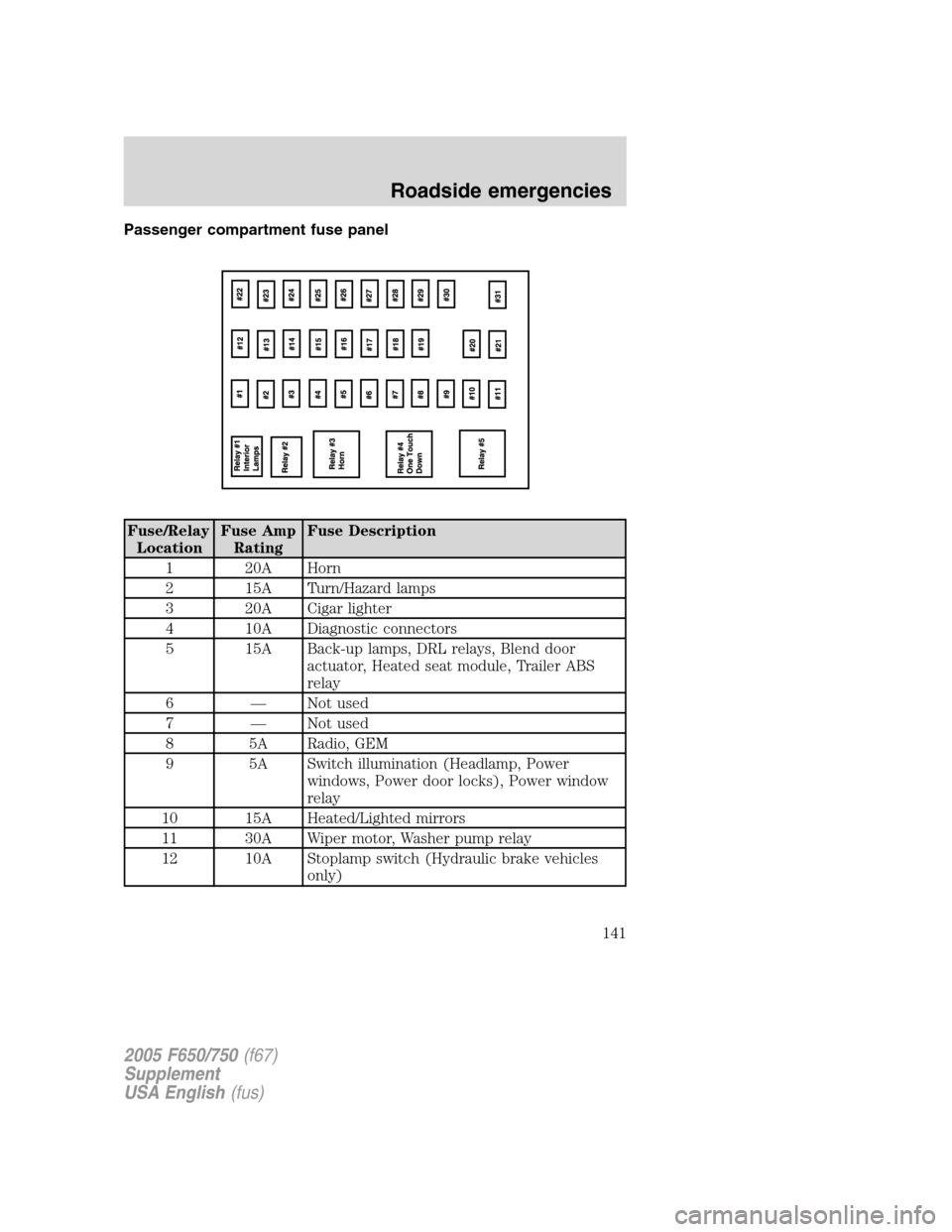
Passenger compartment fuse panel
Fuse/Relay
LocationFuse Amp
RatingFuse Description
1 20A Horn
2 15A Turn/Hazard lamps
3 20A Cigar lighter
4 10A Diagnostic connectors
5 15A Back-up lamps, DRL relays, Blend door
actuator, Heated seat module, Trailer ABS
relay
6—Not used
7—Not used
8 5A Radio, GEM
9 5A Switch illumination (Headlamp, Power
windows, Power door locks), Power window
relay
10 15A Heated/Lighted mirrors
11 30A Wiper motor, Washer pump relay
12 10A Stoplamp switch (Hydraulic brake vehicles
only)
2005 F650/750(f67)
Supplement
USA English(fus)
Roadside emergencies
141
Page 143 of 272
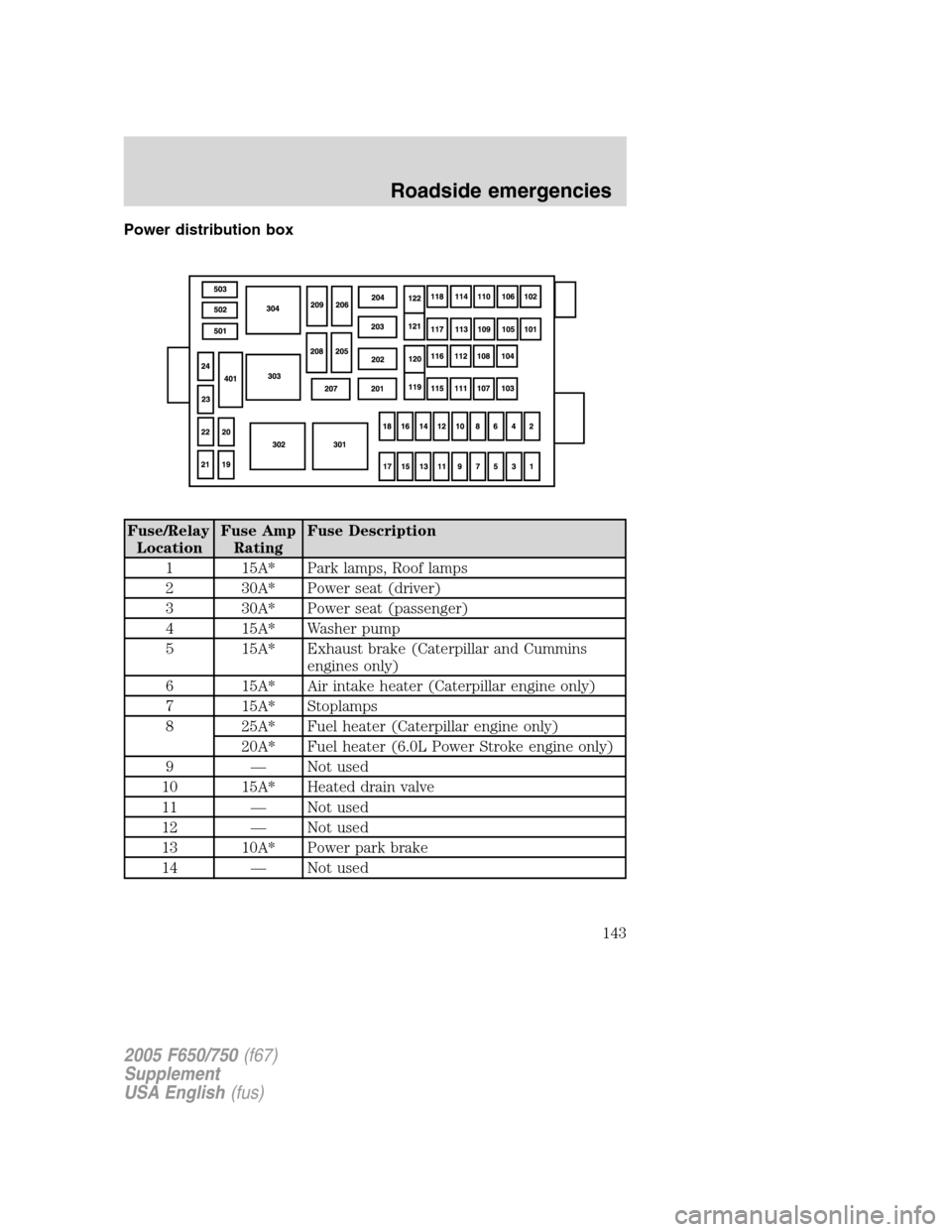
Power distribution box
Fuse/Relay
LocationFuse Amp
RatingFuse Description
1 15A* Park lamps, Roof lamps
2 30A* Power seat (driver)
3 30A* Power seat (passenger)
4 15A* Washer pump
5 15A* Exhaust brake (Caterpillar and Cummins
engines only)
6 15A* Air intake heater (Caterpillar engine only)
7 15A* Stoplamps
8 25A* Fuel heater (Caterpillar engine only)
20A* Fuel heater (6.0L Power Stroke engine only)
9—Not used
10 15A* Heated drain valve
11—Not used
12—Not used
13 10A* Power park brake
14—Not used
2005 F650/750(f67)
Supplement
USA English(fus)
Roadside emergencies
143
Page 144 of 272
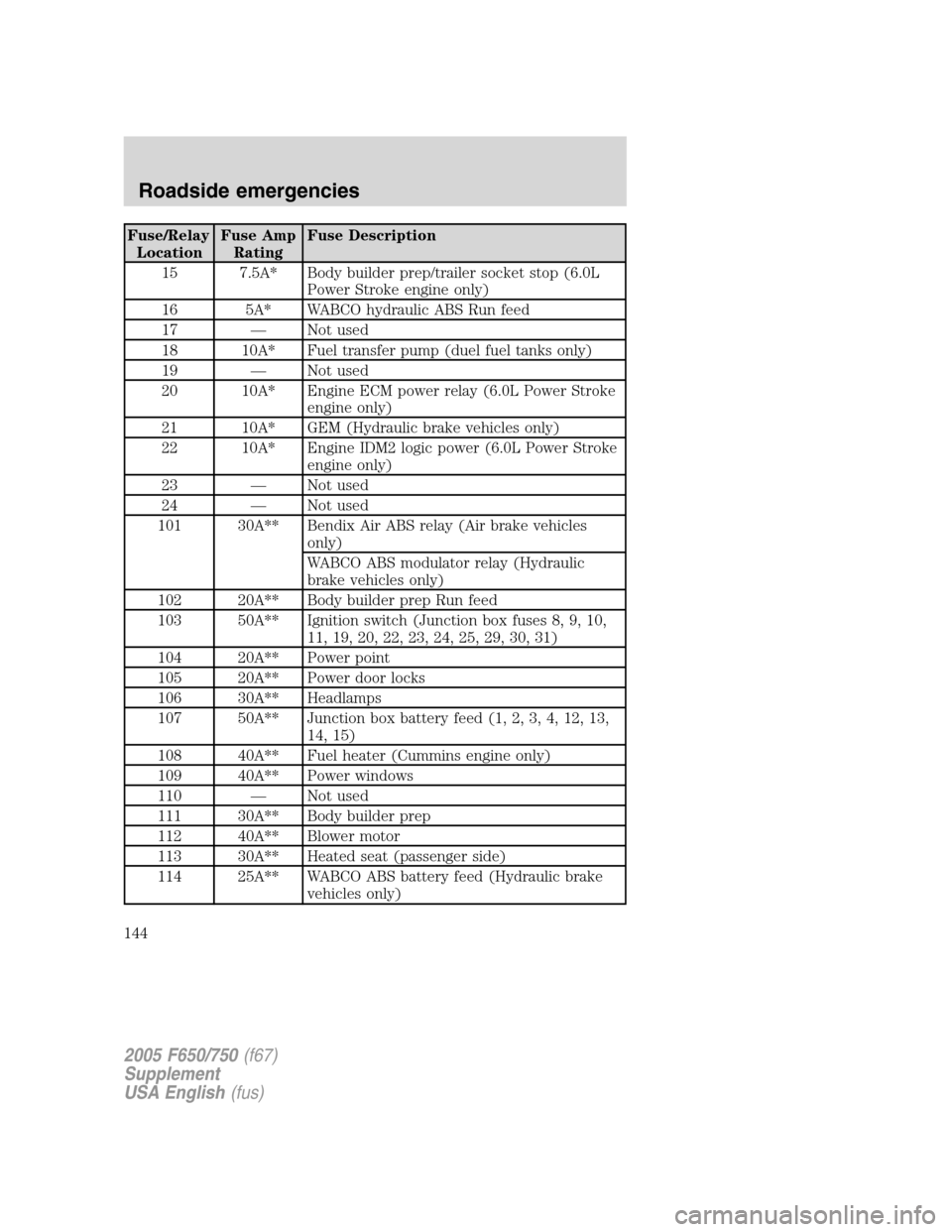
Fuse/Relay
LocationFuse Amp
RatingFuse Description
15 7.5A* Body builder prep/trailer socket stop (6.0L
Power Stroke engine only)
16 5A* WABCO hydraulic ABS Run feed
17—Not used
18 10A* Fuel transfer pump (duel fuel tanks only)
19—Not used
20 10A* Engine ECM power relay (6.0L Power Stroke
engine only)
21 10A* GEM (Hydraulic brake vehicles only)
22 10A* Engine IDM2 logic power (6.0L Power Stroke
engine only)
23—Not used
24—Not used
101 30A** Bendix Air ABS relay (Air brake vehicles
only)
WABCO ABS modulator relay (Hydraulic
brake vehicles only)
102 20A** Body builder prep Run feed
103 50A** Ignition switch (Junction box fuses 8, 9, 10,
11, 19, 20, 22, 23, 24, 25, 29, 30, 31)
104 20A** Power point
105 20A** Power door locks
106 30A** Headlamps
107 50A** Junction box battery feed (1, 2, 3, 4, 12, 13,
14, 15)
108 40A** Fuel heater (Cummins engine only)
109 40A** Power windows
110—Not used
111 30A** Body builder prep
112 40A** Blower motor
113 30A** Heated seat (passenger side)
114 25A** WABCO ABS battery feed (Hydraulic brake
vehicles only)
2005 F650/750(f67)
Supplement
USA English(fus)
Roadside emergencies
144
Page 145 of 272
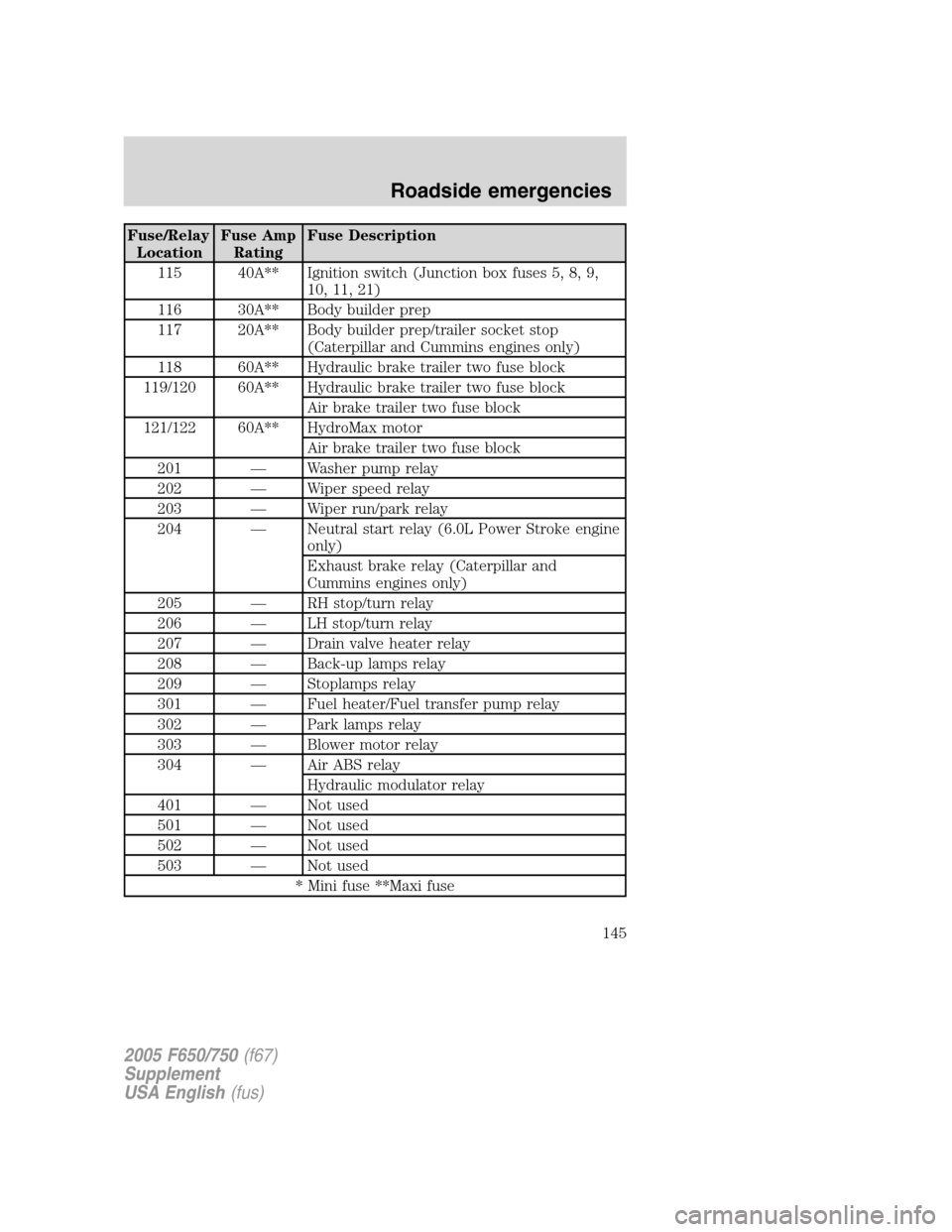
Fuse/Relay
LocationFuse Amp
RatingFuse Description
115 40A** Ignition switch (Junction box fuses 5, 8, 9,
10, 11, 21)
116 30A** Body builder prep
117 20A** Body builder prep/trailer socket stop
(Caterpillar and Cummins engines only)
118 60A** Hydraulic brake trailer two fuse block
119/120 60A** Hydraulic brake trailer two fuse block
Air brake trailer two fuse block
121/122 60A** HydroMax motor
Air brake trailer two fuse block
201—Washer pump relay
202—Wiper speed relay
203—Wiper run/park relay
204—Neutral start relay (6.0L Power Stroke engine
only)
Exhaust brake relay (Caterpillar and
Cummins engines only)
205—RH stop/turn relay
206—LH stop/turn relay
207—Drain valve heater relay
208—Back-up lamps relay
209—Stoplamps relay
301—Fuel heater/Fuel transfer pump relay
302—Park lamps relay
303—Blower motor relay
304—Air ABS relay
Hydraulic modulator relay
401—Not used
501—Not used
502—Not used
503—Not used
* Mini fuse **Maxi fuse
2005 F650/750(f67)
Supplement
USA English(fus)
Roadside emergencies
145
Page 146 of 272
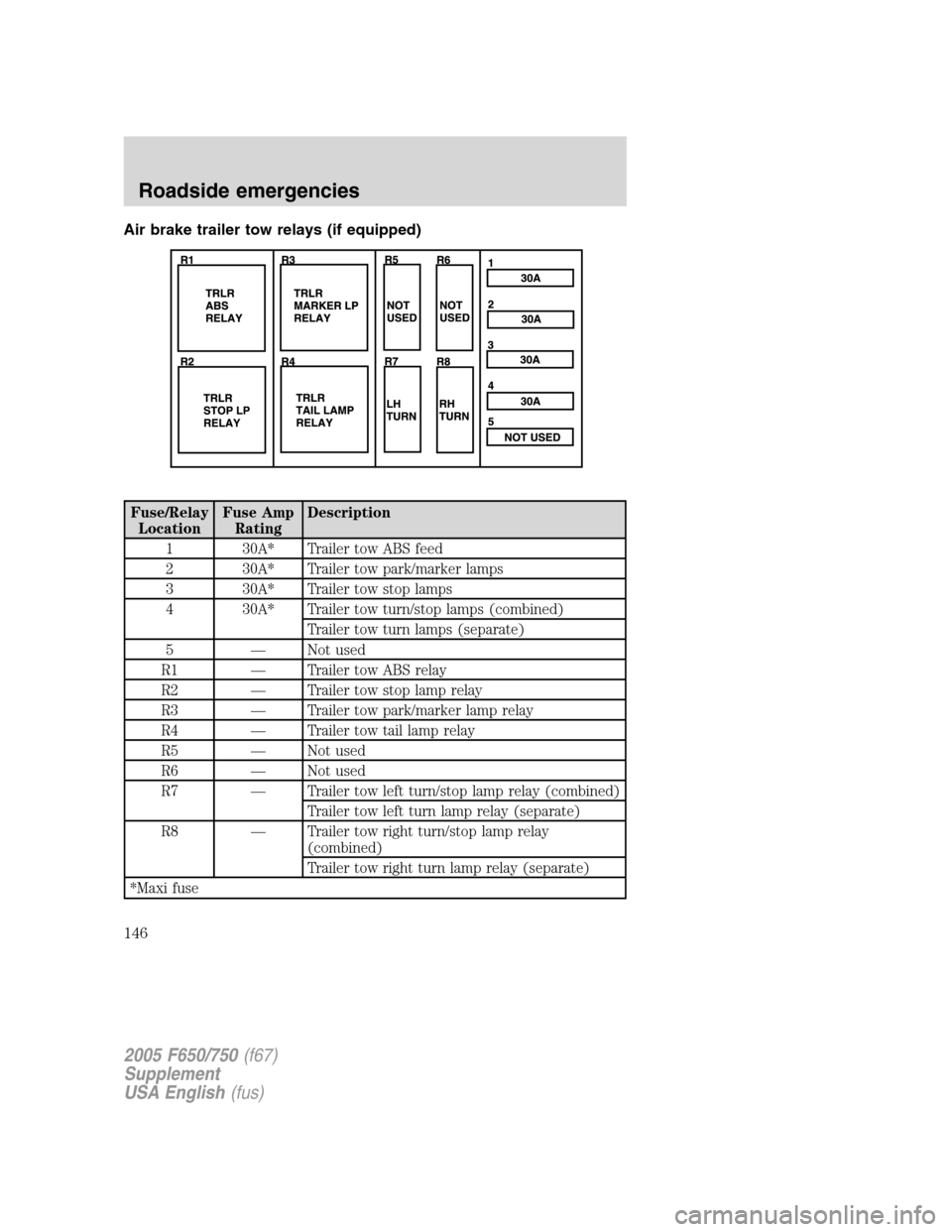
Air brake trailer tow relays (if equipped)
Fuse/Relay
LocationFuse Amp
RatingDescription
1 30A* Trailer tow ABS feed
2 30A* Trailer tow park/marker lamps
3 30A* Trailer tow stop lamps
4 30A* Trailer tow turn/stop lamps (combined)
Trailer tow turn lamps (separate)
5—Not used
R1—Trailer tow ABS relay
R2—Trailer tow stop lamp relay
R3—Trailer tow park/marker lamp relay
R4—Trailer tow tail lamp relay
R5—Not used
R6—Not used
R7—Trailer tow left turn/stop lamp relay (combined)
Trailer tow left turn lamp relay (separate)
R8—Trailer tow right turn/stop lamp relay
(combined)
Trailer tow right turn lamp relay (separate)
*Maxi fuse
2005 F650/750(f67)
Supplement
USA English(fus)
Roadside emergencies
146
Page 150 of 272
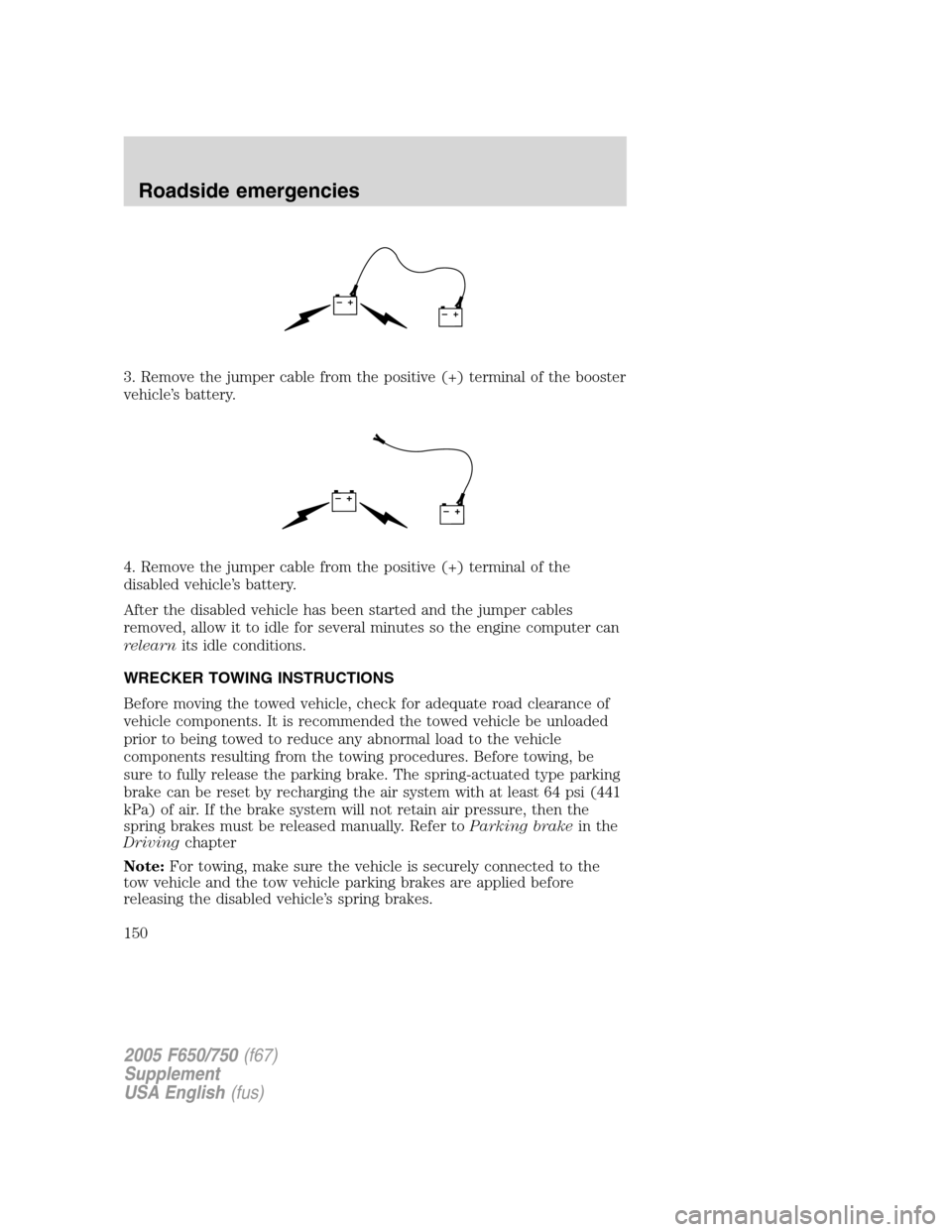
3. Remove the jumper cable from the positive (+) terminal of the booster
vehicle’s battery.
4. Remove the jumper cable from the positive (+) terminal of the
disabled vehicle’s battery.
After the disabled vehicle has been started and the jumper cables
removed, allow it to idle for several minutes so the engine computer can
relearnits idle conditions.
WRECKER TOWING INSTRUCTIONS
Before moving the towed vehicle, check for adequate road clearance of
vehicle components. It is recommended the towed vehicle be unloaded
prior to being towed to reduce any abnormal load to the vehicle
components resulting from the towing procedures. Before towing, be
sure to fully release the parking brake. The spring-actuated type parking
brake can be reset by recharging the air system with at least 64 psi (441
kPa) of air. If the brake system will not retain air pressure, then the
spring brakes must be released manually. Refer toParking brakein the
Drivingchapter
Note:For towing, make sure the vehicle is securely connected to the
tow vehicle and the tow vehicle parking brakes are applied before
releasing the disabled vehicle’s spring brakes.
+–+–
+–+–
2005 F650/750(f67)
Supplement
USA English(fus)
Roadside emergencies
150
Page 151 of 272
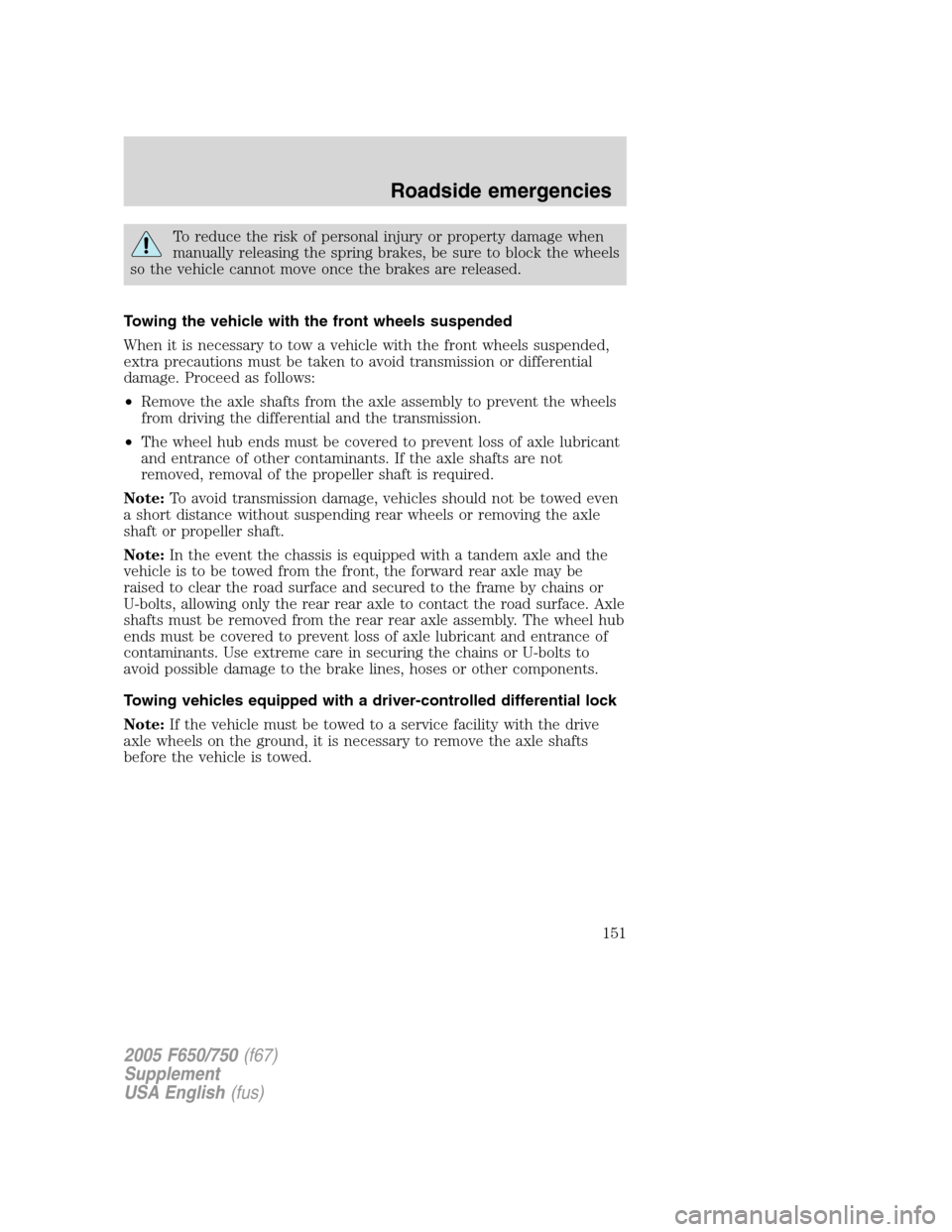
To reduce the risk of personal injury or property damage when
manually releasing the spring brakes, be sure to block the wheels
so the vehicle cannot move once the brakes are released.
Towing the vehicle with the front wheels suspended
When it is necessary to tow a vehicle with the front wheels suspended,
extra precautions must be taken to avoid transmission or differential
damage. Proceed as follows:
•Remove the axle shafts from the axle assembly to prevent the wheels
from driving the differential and the transmission.
•The wheel hub ends must be covered to prevent loss of axle lubricant
and entrance of other contaminants. If the axle shafts are not
removed, removal of the propeller shaft is required.
Note:To avoid transmission damage, vehicles should not be towed even
a short distance without suspending rear wheels or removing the axle
shaft or propeller shaft.
Note:In the event the chassis is equipped with a tandem axle and the
vehicle is to be towed from the front, the forward rear axle may be
raised to clear the road surface and secured to the frame by chains or
U-bolts, allowing only the rear rear axle to contact the road surface. Axle
shafts must be removed from the rear rear axle assembly. The wheel hub
ends must be covered to prevent loss of axle lubricant and entrance of
contaminants. Use extreme care in securing the chains or U-bolts to
avoid possible damage to the brake lines, hoses or other components.
Towing vehicles equipped with a driver-controlled differential lock
Note:If the vehicle must be towed to a service facility with the drive
axle wheels on the ground, it is necessary to remove the axle shafts
before the vehicle is towed.
2005 F650/750(f67)
Supplement
USA English(fus)
Roadside emergencies
151
Page 159 of 272
PAINT CHIPS
Your dealer has touch-up paint and sprays to match your vehicle’s color.
Take your color code (printed on a sticker in the driver’s door jam) to
your dealer to ensure you get the correct color.
•Remove particles such as bird droppings, tree sap, insect deposits, tar
spots, road salt and industrial fallout before repairing paint chips.
•Always read the instructions before using the products.
ALUMINUM WHEELS AND COVERS
•Clean with Motorcraft Wheel and Tire Cleaner (ZC-37–A), which is
available from your dealer.
•Never apply any cleaning chemical to hot or warm wheel rims or
covers.
•Some automatic car washes may cause damage to the finish on your
wheel rims or covers. Chemical-strength cleaners, or cleaning
chemicals, in combination with brush agitation to remove brake dust
and dirt, could wear away the clearcoat finish over time.
•Do not use hydrofluoric acid-based or high caustic-based wheel
cleaners, steel wool, fuels or strong household detergent.
•To remove tar and grease, use Motorcraft Bug and Tar Remover
(ZC-42), available from your dealer.
ENGINE
Engines are more efficient when they are clean because grease and dirt
buildup keep the engine warmer than normal. When washing:
•Take care when using a power washer to clean the engine. The
high-pressure fluid could penetrate the sealed parts and cause
damage.
•Do not spray a hot engine with cold water to avoid cracking the
engine block or other engine components.
•Spray Motorcraft Engine Shampoo and Degreaser (ZC-20) on all parts
that require cleaning and pressure rinse clean.
•Never wash or rinse the engine while it is running; water in the
running engine may cause internal damage.
2005 F650/750(f67)
Supplement
USA English(fus)
Cleaning
159
Page 162 of 272
GENERAL SERVICING GUIDELINES AND PRECAUTIONS
As with any machine, care should be taken to avoid being injured when
performing maintenance, repairs or system checks. Improper or
incomplete service could result in the vehicle not working properly
which, in turn, may result in personal injury or damage to the vehicle or
equipment. It is the operator’s responsibility to see that the vehicle
receives proper care and maintenance. If you have any questions about
performing some service, have the service done by a qualified technician.
Servicing guidelines
When servicing your vehicle, always:
•turn off the ignition unless the particular procedure calls for the
engine to be running.
•set the parking brake or chock the wheels.
•use support stands, not a jack, whenever you must be under a raised
vehicle.
•do not smoke.
•wear safety glasses for eye protection.
•operate the engine in a well-ventilated area
•do not work on the brakes or the clutch unless the proper precautions
are taken to avoid inhaling friction material dust.
•do not wear loose-fitting clothing, hanging jewelry, watches or rings.
•avoid contact with hot metal parts. Allow the hot components to cool
before working with, or around them.
Quality service parts are available through your dealer. If dealer parts are
not used, the owner must make sure that the parts that are being used
are equivalent quality to dealer parts.
The use of inferior parts can adversely affect the quality and
reliability of your vehicle which, in turn, can result in property
damage, personal injury or death.
Note:To avoid damage to the vehicle’s electrical components, disconnect
the positive (+) and negative (-) battery cables prior to electric welding.
Attach the welder ground cable as close as possible to the part being
welded. If it is necessary to weld close to an electrical component, it is
recommended that the electronic component be temporarily removed.
Follow the periodic lubrication procedures and regular inspection
intervals as outlined. Have your dealer or service center inspect your
2005 F650/750(f67)
Supplement
USA English(fus)
Maintenance and specifications
Maintenance and specifications
162