brake FORD F650 2005 11.G Owner's Guide
[x] Cancel search | Manufacturer: FORD, Model Year: 2005, Model line: F650, Model: FORD F650 2005 11.GPages: 272, PDF Size: 1.5 MB
Page 97 of 272
Releasing the parking brake
Note:Read and understand the following steps and perform them
whenever you prepare to drive the vehicle.
Note:The parking brake will not disengage unless sufficient system air
pressure is available.
For vehicles with automatic transmissions - dash-mounted push
button (Allison MD) and steering column-mounted (Allison 2000
and 2400) gear selection:
1. With the engine running, depress and hold the service brake pedal.
2. Wait until system air pressure is above 100 psi.
3. Select the appropriate drive gear.
4. Push the yellow, dash-mounted parking brake knob.
For vehicles with manual transmissions - (TTC 7–speed,
Eaton/Fuller 5–speed, 6–speed and 10–speed):
1. With the engine running, depress and hold the service brake pedal.
2. Wait until system air pressure is above 100 psi.
3. Depress and hold the clutch pedal.
4. Select the appropriate drive gear.
5. Push the yellow, dash-mounted parking brake knob.
Hold the brake pedal down while moving the gearshift lever from
position to position. If the brake pedal is not held down, the
vehicle may move unexpectedly resulting in property damage, personal
injury or death.
Parking brake light illumination due to low air pressure
If at any time during vehicle operation air pressure is too low, the
parking brake may apply and the parking brake light will turn on.
If the parking brake is applied due to low air pressure, immediate service
is required to the parking brake system.
Parking brake warning system
If the park brake light blinks and a chime sounds when pulling the yellow
control knob out, this indicates the parking brake is not functioning
properly; seek service for the parking brake immediately.
The light will blink and the chime will sound until the yellow control
knob is pushed in or approximately eight minutes have passed. If the
Driving
97
Page 98 of 272
yellow control knob is pulled out again, the light will blink and the chime
will sound as a reminder that immediate service is required to the
parking brake system.
Releasing spring manually
Do not attempt to disassemble the parking brake chamber under
any circumstances. The high spring load may cause serious
injury.
If air pressure is released from the spring brake chamber the power
spring applies the brake and, unless air pressure can be re-established,
the spring brake must be released as follows in order to move the
vehicle.
Block the wheels to help prevent the vehicle from moving.
Unexpected and possibly sudden vehicle movement may occur if
these precautions are not taken.
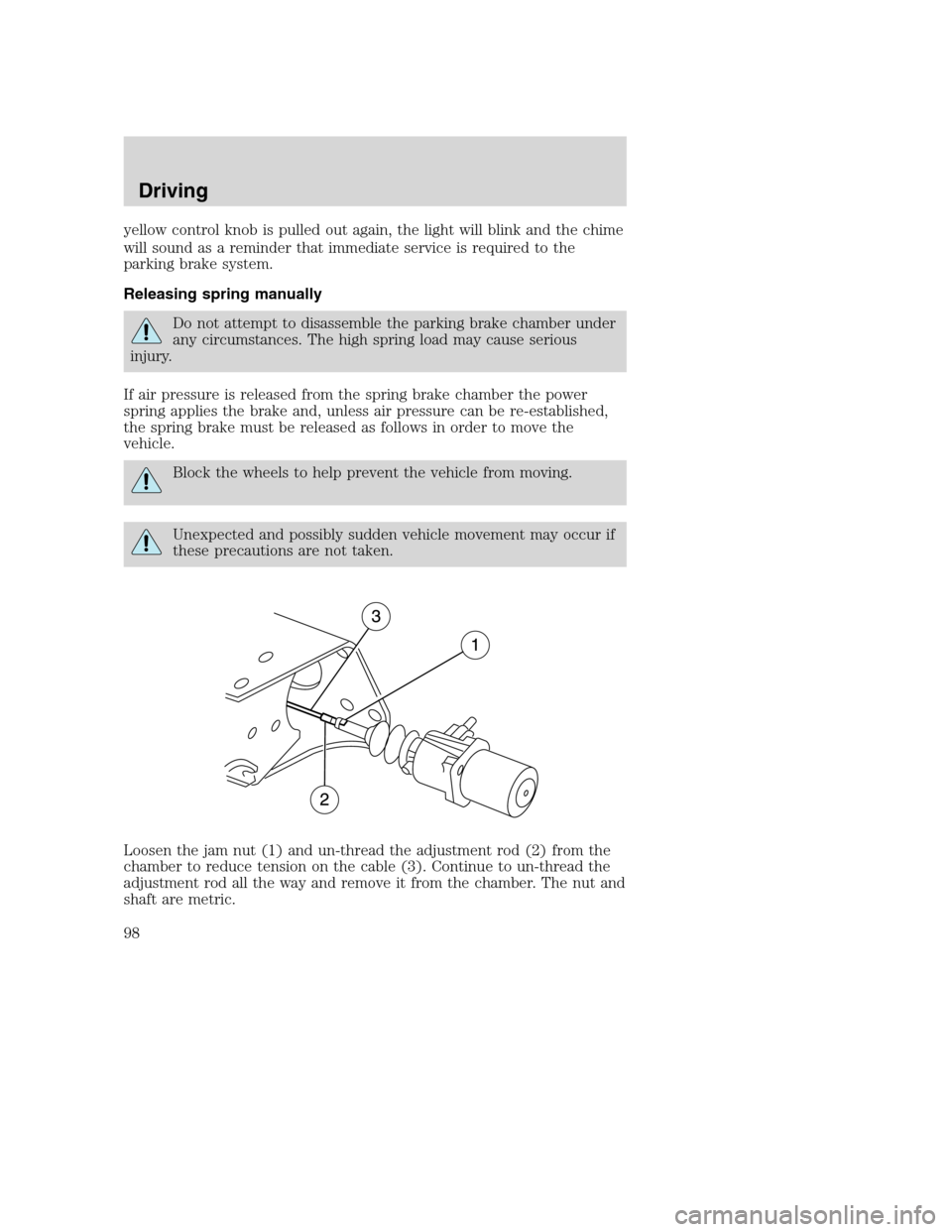
Loosen the jam nut (1) and un-thread the adjustment rod (2) from the
chamber to reduce tension on the cable (3). Continue to un-thread the
adjustment rod all the way and remove it from the chamber. The nut and
shaft are metric.
Driving
98
Page 99 of 272
AIR BRAKES (IF EQUIPPED)
Foot service brakes
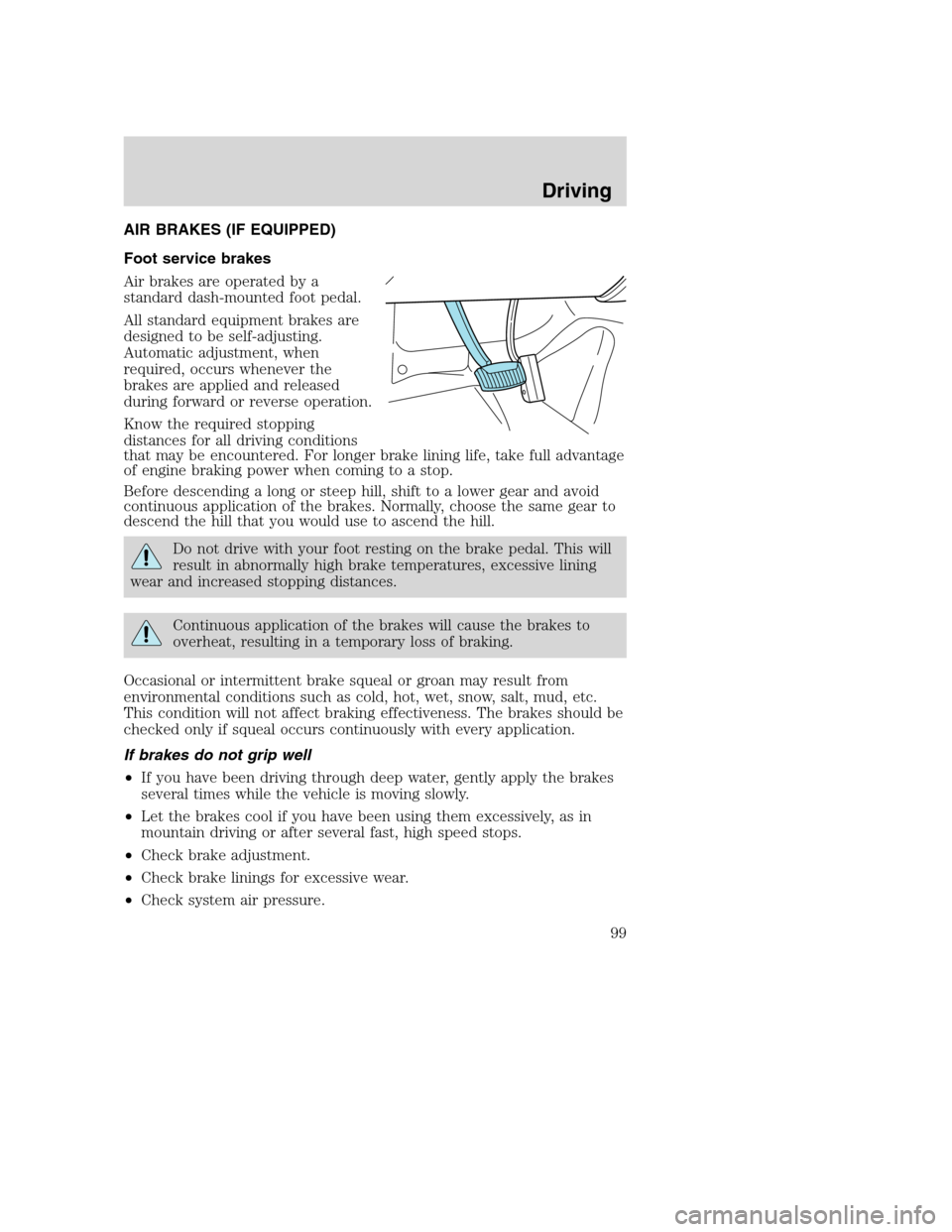
Air brakes are operated by a
standard dash-mounted foot pedal.
All standard equipment brakes are
designed to be self-adjusting.
Automatic adjustment, when
required, occurs whenever the
brakes are applied and released
during forward or reverse operation.
Know the required stopping
distances for all driving conditions
that may be encountered. For longer brake lining life, take full advantage
of engine braking power when coming to a stop.
Before descending a long or steep hill, shift to a lower gear and avoid
continuous application of the brakes. Normally, choose the same gear to
descend the hill that you would use to ascend the hill.
Do not drive with your foot resting on the brake pedal. This will
result in abnormally high brake temperatures, excessive lining
wear and increased stopping distances.
Continuous application of the brakes will cause the brakes to
overheat, resulting in a temporary loss of braking.
Occasional or intermittent brake squeal or groan may result from
environmental conditions such as cold, hot, wet, snow, salt, mud, etc.
This condition will not affect braking effectiveness. The brakes should be
checked only if squeal occurs continuously with every application.
If brakes do not grip well
•If you have been driving through deep water, gently apply the brakes
several times while the vehicle is moving slowly.
•Let the brakes cool if you have been using them excessively, as in
mountain driving or after several fast, high speed stops.
•Check brake adjustment.
•Check brake linings for excessive wear.
•Check system air pressure.
Driving
99
Page 100 of 272
Air brake reservoir draining
Failure to drain air brake reservoirs can result in a reduction or
loss of braking ability due to fluid accumulation in the reservoir
and/or possible freeze-up during cold weather.
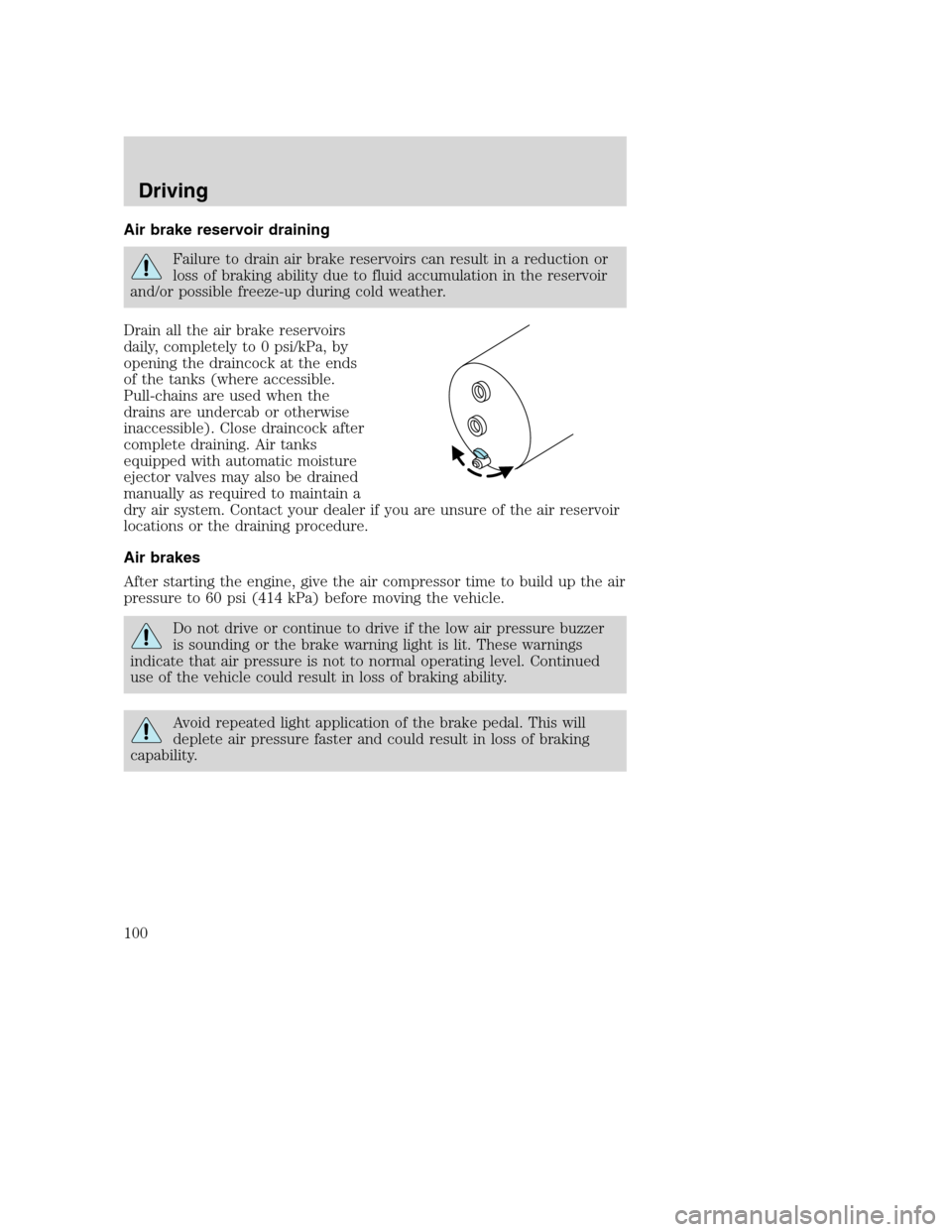
Drain all the air brake reservoirs
daily, completely to 0 psi/kPa, by
opening the draincock at the ends
of the tanks (where accessible.
Pull-chains are used when the
drains are undercab or otherwise
inaccessible). Close draincock after
complete draining. Air tanks
equipped with automatic moisture
ejector valves may also be drained
manually as required to maintain a
dry air system. Contact your dealer if you are unsure of the air reservoir
locations or the draining procedure.
Air brakes
After starting the engine, give the air compressor time to build up the air
pressure to 60 psi (414 kPa) before moving the vehicle.
Do not drive or continue to drive if the low air pressure buzzer
is sounding or the brake warning light is lit. These warnings
indicate that air pressure is not to normal operating level. Continued
use of the vehicle could result in loss of braking ability.
Avoid repeated light application of the brake pedal. This will
deplete air pressure faster and could result in loss of braking
capability.
Driving
100
Page 101 of 272
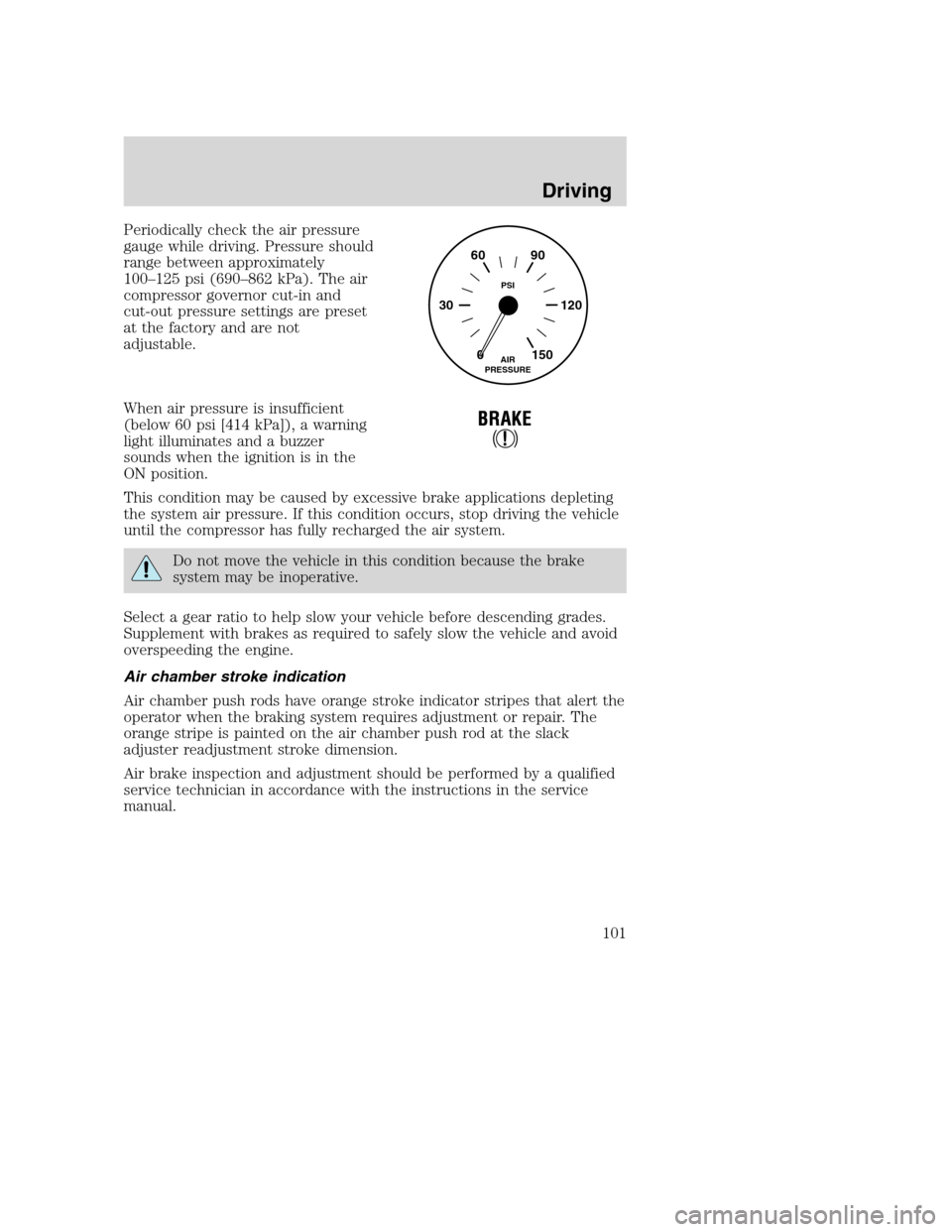
Periodically check the air pressure
gauge while driving. Pressure should
range between approximately
100–125 psi (690–862 kPa). The air
compressor governor cut-in and
cut-out pressure settings are preset
at the factory and are not
adjustable.
When air pressure is insufficient
(below 60 psi [414 kPa]), a warning
light illuminates and a buzzer
sounds when the ignition is in the
ON position.
This condition may be caused by excessive brake applications depleting
the system air pressure. If this condition occurs, stop driving the vehicle
until the compressor has fully recharged the air system.
Do not move the vehicle in this condition because the brake
system may be inoperative.
Select a gear ratio to help slow your vehicle before descending grades.
Supplement with brakes as required to safely slow the vehicle and avoid
overspeeding the engine.
Air chamber stroke indication
Air chamber push rods have orange stroke indicator stripes that alert the
operator when the braking system requires adjustment or repair. The
orange stripe is painted on the air chamber push rod at the slack
adjuster readjustment stroke dimension.
Air brake inspection and adjustment should be performed by a qualified
service technician in accordance with the instructions in the service
manual.
0 30 12090 60
150AIR
PRESSUREPSI
Driving
101
Page 102 of 272
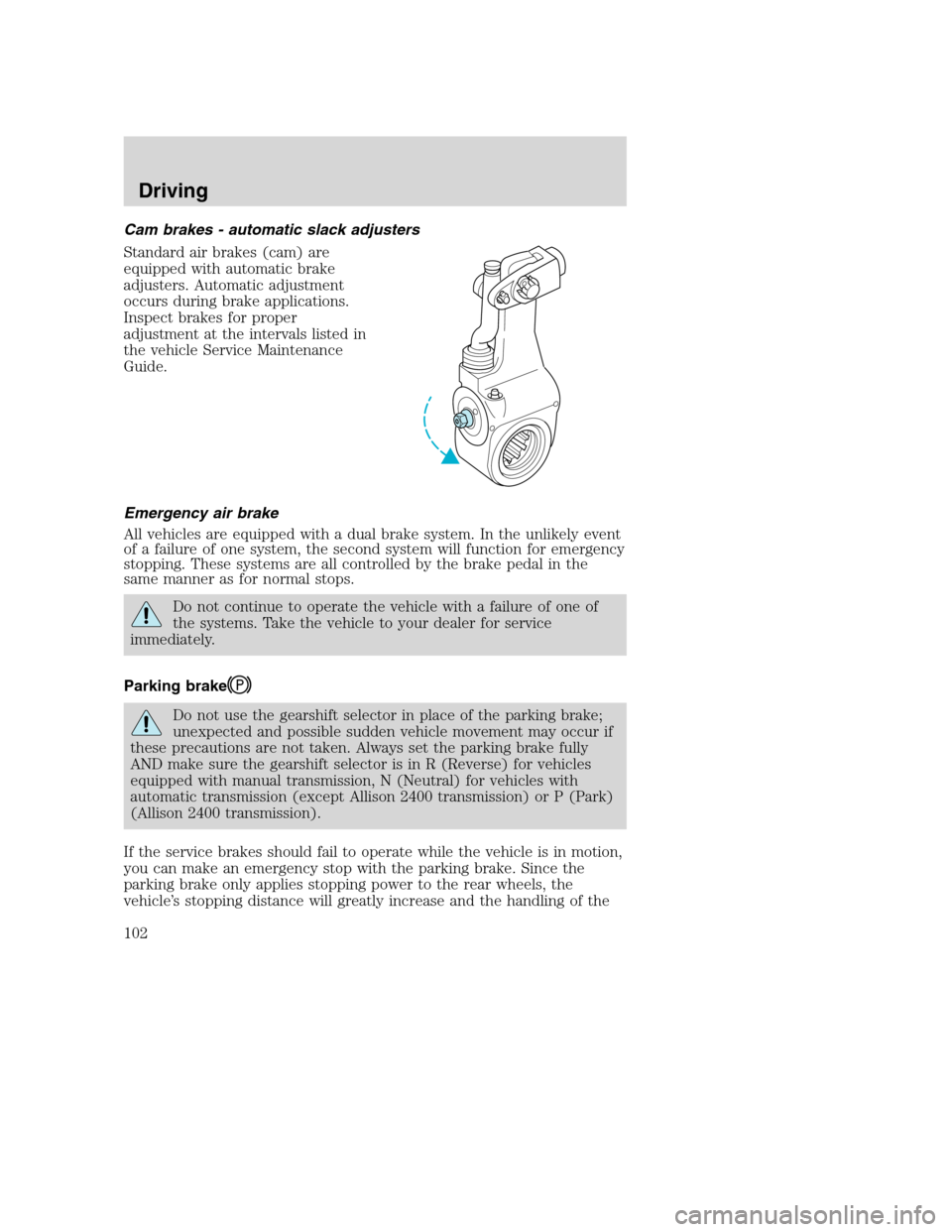
Cam brakes - automatic slack adjusters
Standard air brakes (cam) are
equipped with automatic brake
adjusters. Automatic adjustment
occurs during brake applications.
Inspect brakes for proper
adjustment at the intervals listed in
the vehicle Service Maintenance
Guide.
Emergency air brake
All vehicles are equipped with a dual brake system. In the unlikely event
of a failure of one system, the second system will function for emergency
stopping. These systems are all controlled by the brake pedal in the
same manner as for normal stops.
Do not continue to operate the vehicle with a failure of one of
the systems. Take the vehicle to your dealer for service
immediately.
Parking brake
Do not use the gearshift selector in place of the parking brake;
unexpected and possible sudden vehicle movement may occur if
these precautions are not taken. Always set the parking brake fully
AND make sure the gearshift selector is in R (Reverse) for vehicles
equipped with manual transmission, N (Neutral) for vehicles with
automatic transmission (except Allison 2400 transmission) or P (Park)
(Allison 2400 transmission).
If the service brakes should fail to operate while the vehicle is in motion,
you can make an emergency stop with the parking brake. Since the
parking brake only applies stopping power to the rear wheels, the
vehicle’s stopping distance will greatly increase and the handling of the
Driving
102
Page 103 of 272
vehicle will be adversely affected. Repairs should be made immediately
to an inoperative air brake system circuit.
Parking brake control (knob)
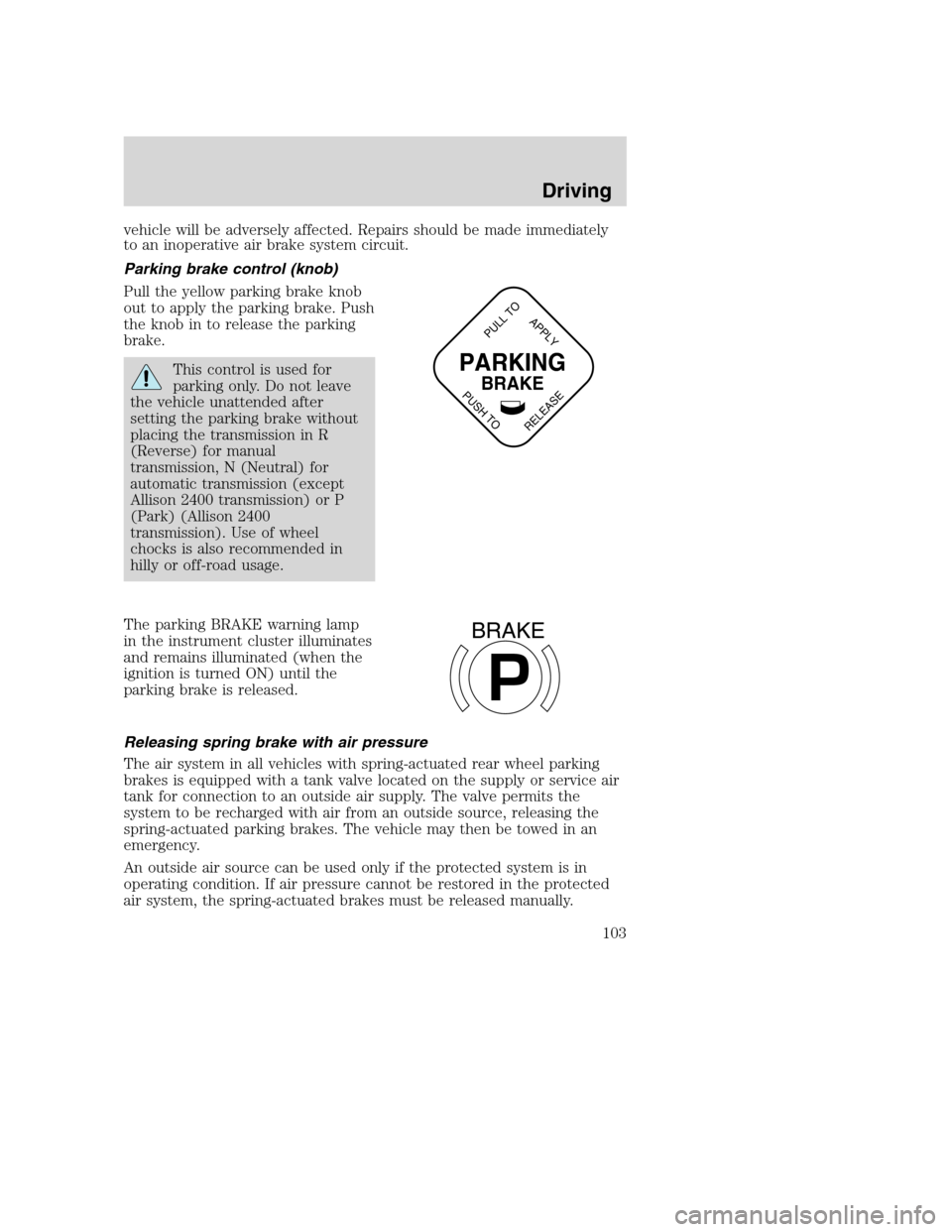
Pull the yellow parking brake knob
out to apply the parking brake. Push
the knob in to release the parking
brake.
This control is used for
parking only. Do not leave
the vehicle unattended after
setting the parking brake without
placing the transmission in R
(Reverse) for manual
transmission, N (Neutral) for
automatic transmission (except
Allison 2400 transmission) or P
(Park) (Allison 2400
transmission). Use of wheel
chocks is also recommended in
hilly or off-road usage.
The parking BRAKE warning lamp
in the instrument cluster illuminates
and remains illuminated (when the
ignition is turned ON) until the
parking brake is released.
Releasing spring brake with air pressure
The air system in all vehicles with spring-actuated rear wheel parking
brakes is equipped with a tank valve located on the supply or service air
tank for connection to an outside air supply. The valve permits the
system to be recharged with air from an outside source, releasing the
spring-actuated parking brakes. The vehicle may then be towed in an
emergency.
An outside air source can be used only if the protected system is in
operating condition. If air pressure cannot be restored in the protected
air system, the spring-actuated brakes must be released manually.PARKING
BRAKE
PULL TO
RELEASE
APPLY
PUSH TO
P
BRAKE
Driving
103
Page 104 of 272

Releasing spring brake manually
Do not attempt to disassemble the parking brake chamber under
any circumstances. The high spring load may cause serious
injury if the chamber clamps are removed.
If air pressure is released from the spring brake chamber the power
spring applies the brake and, unless air pressure can be re-established,
the spring brake must be released as follows in order to move the
vehicle.
Block the wheels to help prevent the vehicle from moving.
Unexpected and possibly sudden vehicle movement may occur if
these precautions are not taken.
Impact wrenches should not be used as they may damage the piston and
prevent proper caging of the spring. Do not apply more than 50 lbs. ft.
(68 N•m) torque to the release bolt nut.
1. Remove the stud tool and nut
from the carrying pocket on the
brake chamber assembly.
2. Remove the access plug from the
end of the spring chamber.
3. Insert the release stud through
the opening in the chamber and into
the spring pressure plate.
Driving
104
Page 105 of 272
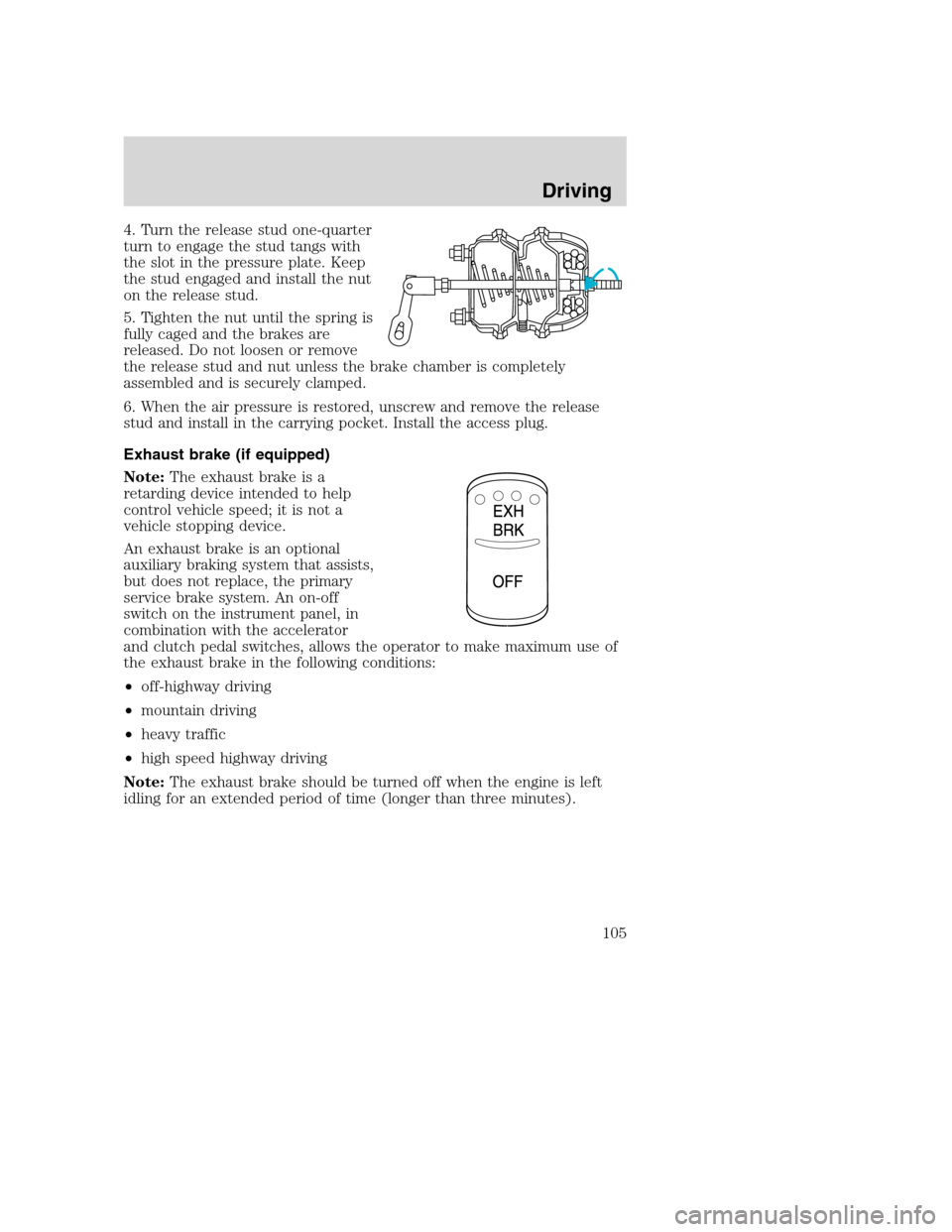
4. Turn the release stud one-quarter
turn to engage the stud tangs with
the slot in the pressure plate. Keep
the stud engaged and install the nut
on the release stud.
5. Tighten the nut until the spring is
fully caged and the brakes are
released. Do not loosen or remove
the release stud and nut unless the brake chamber is completely
assembled and is securely clamped.
6. When the air pressure is restored, unscrew and remove the release
stud and install in the carrying pocket. Install the access plug.
Exhaust brake (if equipped)
Note:The exhaust brake is a
retarding device intended to help
control vehicle speed; it is not a
vehicle stopping device.
An exhaust brake is an optional
auxiliary braking system that assists,
but does not replace, the primary
service brake system. An on-off
switch on the instrument panel, in
combination with the accelerator
and clutch pedal switches, allows the operator to make maximum use of
the exhaust brake in the following conditions:
•off-highway driving
•mountain driving
•heavy traffic
•high speed highway driving
Note:The exhaust brake should be turned off when the engine is left
idling for an extended period of time (longer than three minutes).
Driving
105
Page 106 of 272

The exhaust brake is a butterfly
type valve mounted in the exhaust
pipe. When the operator’s foot is not
on the accelerator pedal and the
exhaust brake switch is in the ON
position, an air cylinder shuts the
butterfly valve, restricting the flow
of exhaust gases and retarding the
engine. This retarding action is
carried through the engine and drivetrain, slowing the vehicle and
reducing the need for frequent service brake applications.
Exhaust brakes are not intended for use as the primary braking system
during vehicle operation.
Operation
Push the rocker switch up to turn
the exhaust brake on. The switch
will illuminate in the ON position.
Push the switch down to turn the
brake off.
Starting engine
Before starting the engine, make sure that the exhaust brake switch is in
the OFF position. Do not turn the exhaust brake on until the engine has
reached normal operating temperatures.
Driving downhill
While approaching a steep grade, make sure that the exhaust brake
switch is in the ON position. The exhaust brake actuates as soon as you
remove your foot from the accelerator pedal. While going down the
grade, use a low enough gear to descend safely with a minimum
application of the service brakes. As a general guideline, use the same
gear as you would to ascend the hill.
Before descending a hill or steep grade always select the proper gear. If
the transmission is taken out of gear while descending it is possible that
you will not be able to select another gear because of maximum RPM
being governed.
Driving
106