ESP FORD F650 2006 11.G Owner's Manual
[x] Cancel search | Manufacturer: FORD, Model Year: 2006, Model line: F650, Model: FORD F650 2006 11.GPages: 272, PDF Size: 1.86 MB
Page 171 of 272
non-asbestos, fiberglass, mineral wool, aramid or carbon) may be a
potentially serious health hazard.
Avoid breathing brake lining fiber dust as it may be extremely
hazardous to your health. Always use a respirator during brake
maintenance.
Note:Persons handling brake linings should follow all precautions listed
below:
1. Always wear a respirator approved by the National Institute of
Occupational Studies of Health (NIOSH) or Mine Safety and Appliance
(MSA) during all brake service procedures. Wear the respirator from
removal of the wheels through assembly.
2.Neveruse compressed air or dry brushing to clean brake parts or
assemblies.
3. Clean brake parts and assemblies in open air. During assembly,
carefully place all parts on the floor to avoid getting dust in the air. Use
an industrial vacuum cleaner with a HEPA filter system to clean dust
from the brake drums, backing plates and other brake parts. After using
the vacuum, remove any remaining dust with a rag soaked in water and
wrung until nearly dry.
4.Neveruse compressed air or dry sweeping to clean the work area.
Use an industrial vacuum cleaner with a HEPA filter system and rags
soaked in water until wrung until nearly dry. Dispose of used rags with
care to avoid getting dust in the air. Use an approved respirator when
emptying vacuum cleaners and handling used rags.
5.Worker clean-up:Wash your hands before eating, drinking or
smoking. Vacuum your work clothes after use and then launder them
separately, without shaking them, to prevent fiber dust getting into the
air.
Air brakes - inspection and adjustment
A regular schedule for periodic cleaning, lubrication, adjustment and
inspection should be established based on the type of vehicle operation.
It is difficult to predetermine an exact maintenance interval (time or
mileage), since vehicles will be used in a wide variety of applications and
conditions. If you are uncertain of the proper schedule and procedures
for your vehicle, contact your dealer.
Periodic checking of push rod travel or brake adjustment is essential for
effective braking. Push rod travel should be checked every service
2006 F-650/750(f67)
Supplement
USA(fus)
Maintenance and Specifications
171
Page 175 of 272
Note:If your vehicle is equipped with a vertical exhaust pipe, it is very
important to have and maintain a rain cap on the exhaust pipe to
prevent water from entering the exhaust system and catalytic converter.
Any water entering the catalytic converter may damage the catalyst and
affect the function of the converter.
Air induction system
Once each year, perform a complete inspection of the air induction
system. In areas where road salt is used, the inspection consists of
disassembling the joints of each aluminum component and inspecting for
salt build-up, presence of chlorine that can cause aluminum particles to
flake off and enter the engine combustion chambers.
If evidence of corrosion is found (usually at the pipe connections), use a
wire brush to clean the inside of the pipes and inside the rubber hoses.
If the intake pipes are pitted at the joint ends, use Motorcraft Silicone
Gasket and Sealant TA-30 to seal the joints. Be certain that no excess
material is on the inside of the pipes that can be pulled into the engine.
If the service condition of the pipes, hoses or clamps is questionable,
replace the defective part(s).
Be sure that prior to reassembly all dust and debris has been cleaned out
of the pipes and couplings with a clean, damp rag.
To reduce the risk of personal injury or death when performing
maintenance to any turbocharged engine with engine air inlet
piping disconnected, a turbocharger compressor air inlet protective
shield should be installed over the turbocharger air inlet.
Cummins B and Caterpillar engines
Refer to the respective engine operator manual for air filter replacement
procedure.
OPENING THE HOOD
The hood and fenders are held in position by a latch located on each
fender.
The parking brake must be fully set before opening the hood or
possible personal injury may occur.
To reduce the risk of the possibility of personal injury, never
stand beneath the hood when it is being raised or lowered.
2006 F-650/750(f67)
Supplement
USA(fus)
Maintenance and Specifications
175
Page 188 of 272
If the engine cranks but does not start, remove the battery box cover
and check the 40A inline fuse loacted on the battery cable above the
battery.
Batteries normally produce explosive gases which can cause
personal injury. Therefore, do not allow flames, sparks or lighted
substances to come near the battery. When working near the battery,
always shield your face and protect your eyes. Always provide proper
ventilation.
When lifting a plastic-cased battery, excessive pressure on the
end walls could cause acid to flow through the vent caps,
resulting in personal injury and/or damage to the vehicle or battery.
Lift the battery with a battery carrier or with your hands on opposite
corners.
Keep batteries out of reach of children. Batteries contain sulfuric
acid. Avoid contact with skin, eyes or clothing. Shield your eyes
when working near the battery to protect against possible splashing of
acid solution. In case of acid contact with skin or eyes, flush
immediately with water for a minimum of 15 minutes and get prompt
medical attention. If acid is swallowed, call a physician immediately.
Battery posts, terminals and related accessories contain lead and
lead compounds.Wash hands after handling.
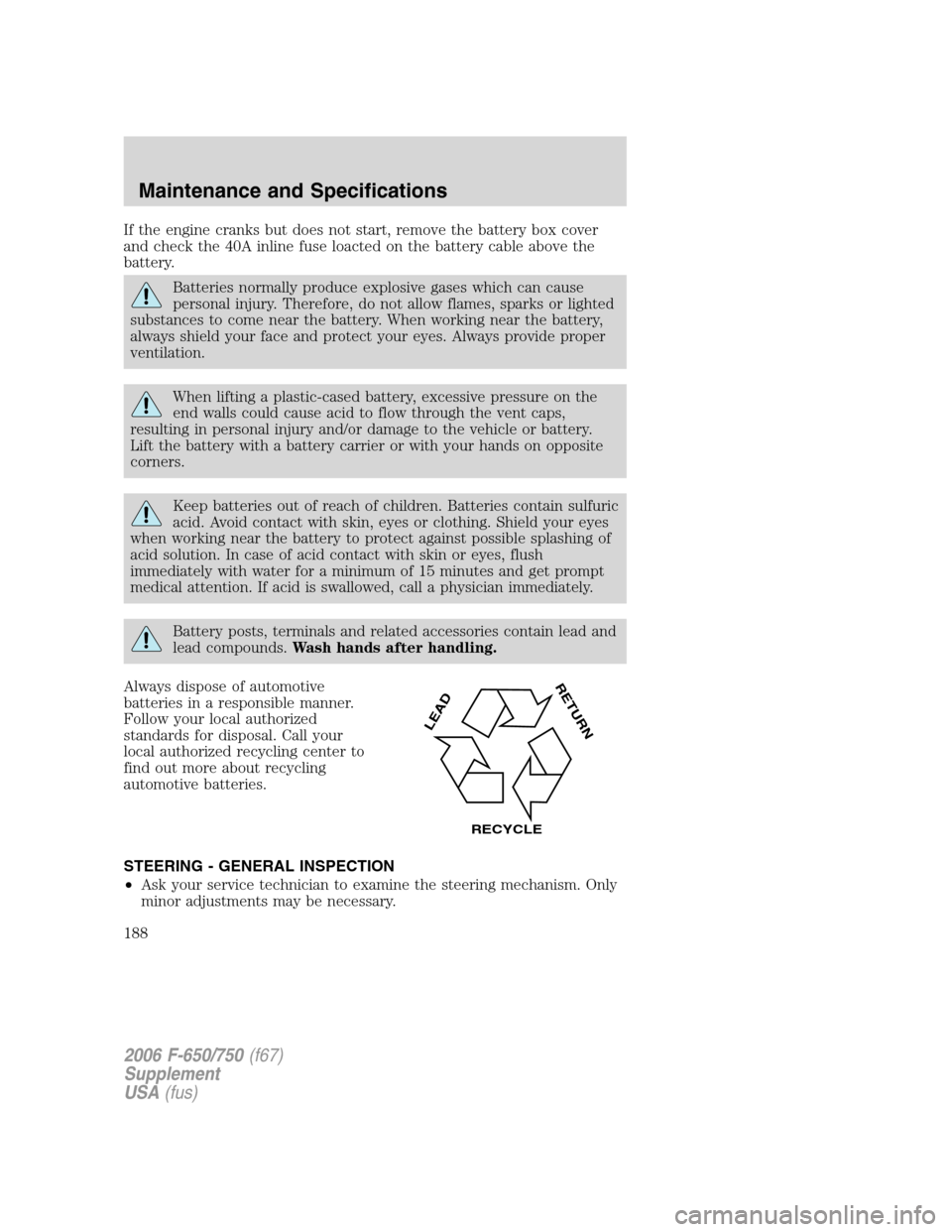
Always dispose of automotive
batteries in a responsible manner.
Follow your local authorized
standards for disposal. Call your
local authorized recycling center to
find out more about recycling
automotive batteries.
STEERING - GENERAL INSPECTION
•Ask your service technician to examine the steering mechanism. Only
minor adjustments may be necessary.
L
E
A
D
RETURN
RECYCLE
2006 F-650/750(f67)
Supplement
USA(fus)
Maintenance and Specifications
188
Page 192 of 272
4. Lubricate clutch release wear pads at the two locations where they
contact the clutch release bearing using a brush or similar tool.
5. Install the inspection cover onto the clutch housing.
TRANSMISSION FLUID
Always dispose of used automotive fluids in a responsible manner.
Follow your community’s standards for disposing of these types of fluids.
Call your recycling center to find out about recycling automotive fluids.
Automatic transmission fluid
Refer to your Allison Automatic Transmission Operator’s Manual for
scheduled intervals for transmission fluid checks and changes. Your
transmission does not consume fluid. However, the fluid level should be
checked if the transmission is not working properly, i.e., if the
transmission slips or shifts slowly or if you notice some sign of fluid
leakage.
Automatic transmission fluid expands when warmed. To obtain an
accurate fluid check, drive the vehicle until it is warmed up
(approximately 20 miles [30 km]). If your vehicle has been operated for
an extended period at high speeds, in city traffic or during hot weather,
the vehicle should be turned off for about 30 minutes to allow fluid to
cool before checking.
1. Drive the vehicle 20 miles (30 km) or until it reaches normal operating
temperature.
2. Park the vehicle on a level surface and engage the parking brake.
3. With the parking brake engaged and your foot on the brake pedal,
start the engine and move the gearshift lever through all of the gear
ranges. Allow sufficient time for each gear to engage.
4. Place the gearshift lever in N (Neutral) or P (Park) and leave the
engine running.
5. Remove the dipstick, wiping it clean with a clean, dry lint free rag.
6. Install the dipstick making sure it is fully seated in the filler tube.
7. Remove the dipstick and inspect the fluid level.
If you must add transmission fluid, make sure the correct type of fluid is
being used. The type of fluid used is indicated in your Allison Automatic
Transmission Operator’s Manual.
Fluid levels above the safe range may result in transmission failure; an
overfill condition of transmission fluid may cause shift and/or
engagement concerns and/or possible damage.
2006 F-650/750(f67)
Supplement
USA(fus)
Maintenance and Specifications
192
Page 193 of 272
Use of a non-approved automatic transmission fluid may cause
internal transmission component damage.
Manual transmission fluid
Refer to theScheduled Maintenance Guidechapter for transmission
fluid level checks and fluid change intervals.
Your manual transmission may be filled with an optional synthetic fluid
which allows the use of extended service intervals. A tag on the filler
plug will identify the use of the synthetic fluid.
Use only fluid that meets manufacturer specifications (refer to
Lubricant specificationsin this chapter.
Use of a non-approved transmission fluid may cause internal
transmission component damage.
Check your transmission fluid level using the following procedure:
1. Park the vehicle on level ground.
2. Set the parking brake and shift into 1 (First) and turn the engine off.
3. Clean any dirt from around the filler plug.
4. Remove the filler plug and inspect the fluid level.
5. The fluid level should be up to the bottom of the filler plug opening.
6. If necessary, add enough fluid through the filler plug opening so that
the fluid level is at the bottom of the opening.
7. Clean and install the filler plug securely.
Drain and refill your transmission fluid using the following procedure:
1. Drain the transmission while the fluid is warm.
2. Park the vehicle on level ground.
3. Set the parking brake and shift into 1 (First) and turn the engine off.
4. Clean any dirt from around the filler and drain plugs.
5. Remove the filler and drain plugs and drain the fluid into a suitable
container. Dispose all used automotive fluids in a responsible manner
following your local authorized standards.
6. Clean and install the drain plug securely.
7. Add enough fluid through the filler plug opening so that the fluid level
is up to the bottom of the opening.
8. Clean and install the filler plug securely.
2006 F-650/750(f67)
Supplement
USA(fus)
Maintenance and Specifications
193
Page 198 of 272
•Extinguish all smoking materials
and any open flames before
fueling your vehicle.
•Always turn off the vehicle before
fueling.
•Automotive fuels can be harmful
or fatal if swallowed. If fuel is swallowed, call a physician immediately,
even if no symptoms are immediately apparent. The toxic effects of
fuel may not be visible for hours.
•Avoid inhaling fuel vapors. Inhaling too much fuel vapor of any kind
can lead to eye and respiratory tract irritation. In severe cases,
excessive or prolonged breathing of fuel vapor can cause serious
illness and permanent injury.
•Avoid getting fuel liquid in your eyes. If fuel is splashed in the eyes,
remove contact lenses (if worn), flush with water for 15 minutes and
seek medical attention. Failure to seek proper medical attention could
lead to permanent injury.
•Fuels can also be harmful if absorbed through the skin. If fuel is
splashed on the skin and/or clothing, promptly remove contaminated
clothing and wash skin thoroughly with soap and water. Repeated or
prolonged skin contact with fuel liquid or vapor causes skin irritation.
If you must replace the fuel filler cap, replace it with a genuine
Ford or Motorcraft part. The customer warranty may be void for
any damage to the fuel tank or fuel system if a genuine Ford or
Motorcraft fuel filler cap is not used.
If you do not use the proper fuel filler cap, excessive pressure or
vacuum in the fuel tank may damage the fuel system or cause
the fuel cap to disengage in a collision, which may result in possible
personal injury.
Choosing the right fuel
The engine is designed to use low sulfur number 1D or 2D diesel fuel
only. At temperatures below –20°F (–7°C), number 1D or winter blend
number 2D fuel is recommended. (SeeCold weather operationin the
Drivingsection.) Diesel fuel containing no more than 5% of biodiesel
may be used. Biodiesel fuel is a product derived from renewable fuel
sources such as vegetable oil, animal fat and cooking oil.
Do not use home heating oil or any diesel fuel not intended for
highway use. Red dye is used to identify fuels intended for
2006 F-650/750(f67)
Supplement
USA(fus)
Maintenance and Specifications
198
Page 208 of 272
Draining and refilling the rear axle lubricant
1. Drain the rear axle while the lubricant is warm.
2. Park the vehicle on level ground.
3. Set the parking brake and shift into N (Neutral) (automatic
transmission) or 1 (First) (manual transmission) and turn the engine off.
4. Clean any dirt from around the rear axle filler and drain plugs.
5. Remove the filler and drain plugs and drain the lubricant into a
suitable container. Dispose of all used automotive fluids in a responsible
manner following your local authorized standards.
6. Clean and install the drain plug securely.
7. Add enough lubricant through the filler plug opening so that the
lubricant level is up to the bottom of the opening.
8. Clean and install the filler plug securely.
WHEELS
General
Wheel bearings should be inspected, lubricated and adjusted at regular
intervals. This is especially important if operating in deep sand, mud, or
water. Refer toLubricant specificationsin this chapter.
When installing wheel balance weights, they must be mounted on the
dome-side of the wheel only. Failure to do so may result in loss of wheel
weight and/or damage to brakes or wheels.
Important:Remember to replace the wheel air valves when the road
tires are replaced at the end of their useful life.
Oil lubricated front wheel bearings
During normal vehicle duty cycle, the lube and air inside the hub/wheel
cavity expands and if not vented, causes pressure build-up that could
cause accelerated seal wear.
There are two venting methods:
•a slit or small hole in the rubber check vent or
•the window
You can use either of these methods to prevent pressure build-up.
2006 F-650/750(f67)
Supplement
USA(fus)
Maintenance and Specifications
208
Page 236 of 272
OWNER MAINTENANCE
You can do much of the maintenance your vehicle requires yourself, if
you have the time and a reasonable amount of mechanical ability. If you
prefer to have this work done professionally, your authorized dealer
stands ready to help you.
All mechanical components and attachments are important in that they
could affect the performance of vital components and systems. If
replacement becomes necessary, they must be replaced with parts having
the same part number or with equivalent parts. Torque values of the
attaching parts must be used as specified during any reassembly
procedure to ensure proper retention.
EMISSIONS CONTROL SYSTEM
To ensure the emissions control systems operate effectively, you should
have the services listed in the maintenance schedule performed at the
specified time and mileage/km intervals. You should avoid running out of
fuel or turning off the ignition while the vehicle is in motion, especially
at high speeds.
Because of high engine compartment and exhaust system
temperatures resulting from emissions equipment, do not park,
idle or operate your vehicle in dry grass or other dry ground cover
where the possibility of ground fire exists.
Do not make unauthorized modifications to the engine or vehicle.
Modifications causing increased amounts of unburned fuel to reach the
exhaust system can significantly increase the temperature of the engine
compartment and/or the exhaust system.
Avoid driving your vehicle if it does not operate properly. If the engine
diesels (more than five seconds of engine run-on after shut-off), misfires,
surges, stalls or backfires, see your dealer. Be alert for fluid leakage,
odor, smoke, loss of oil pressure, or charge indicator or over temperature
warning.
Do NOT use diesel fuel blended with waste oil in engines equipped with
a catalytic converter-muffler. Waste lube oil blending in fuel will plug the
catalytic converter-muffler, resulting in a significant loss of engine power.
2006 F-650/750(f67)
Supplement
USA(fus)
Scheduled Maintenance Guide
236
Page 265 of 272
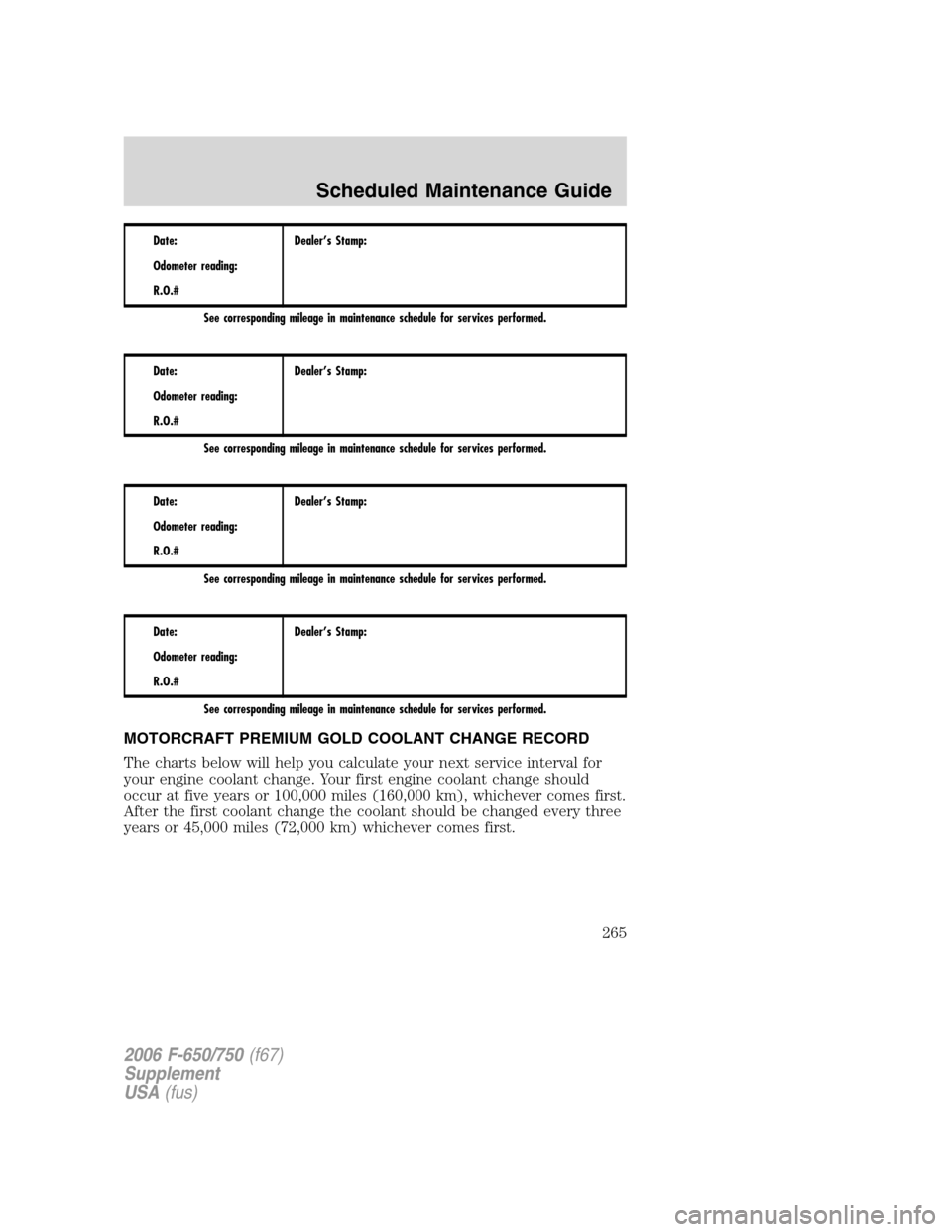
Date:
Odometer reading:
R.O.#Dealer’s Stamp:
See corresponding mileage in maintenance schedule for services performed.
Date:
Odometer reading:
R.O.#Dealer’s Stamp:
See corresponding mileage in maintenance schedule for services performed.
Date:
Odometer reading:
R.O.#Dealer’s Stamp:
See corresponding mileage in maintenance schedule for services performed.
Date:
Odometer reading:
R.O.#Dealer’s Stamp:
See corresponding mileage in maintenance schedule for services performed.
MOTORCRAFT PREMIUM GOLD COOLANT CHANGE RECORD
The charts below will help you calculate your next service interval for
your engine coolant change. Your first engine coolant change should
occur at five years or 100,000 miles (160,000 km), whichever comes first.
After the first coolant change the coolant should be changed every three
years or 45,000 miles (72,000 km) whichever comes first.
2006 F-650/750(f67)
Supplement
USA(fus)
Scheduled Maintenance Guide
265