fuel pressure FORD F650 2006 11.G Owners Manual
[x] Cancel search | Manufacturer: FORD, Model Year: 2006, Model line: F650, Model: FORD F650 2006 11.GPages: 272, PDF Size: 1.86 MB
Page 9 of 272
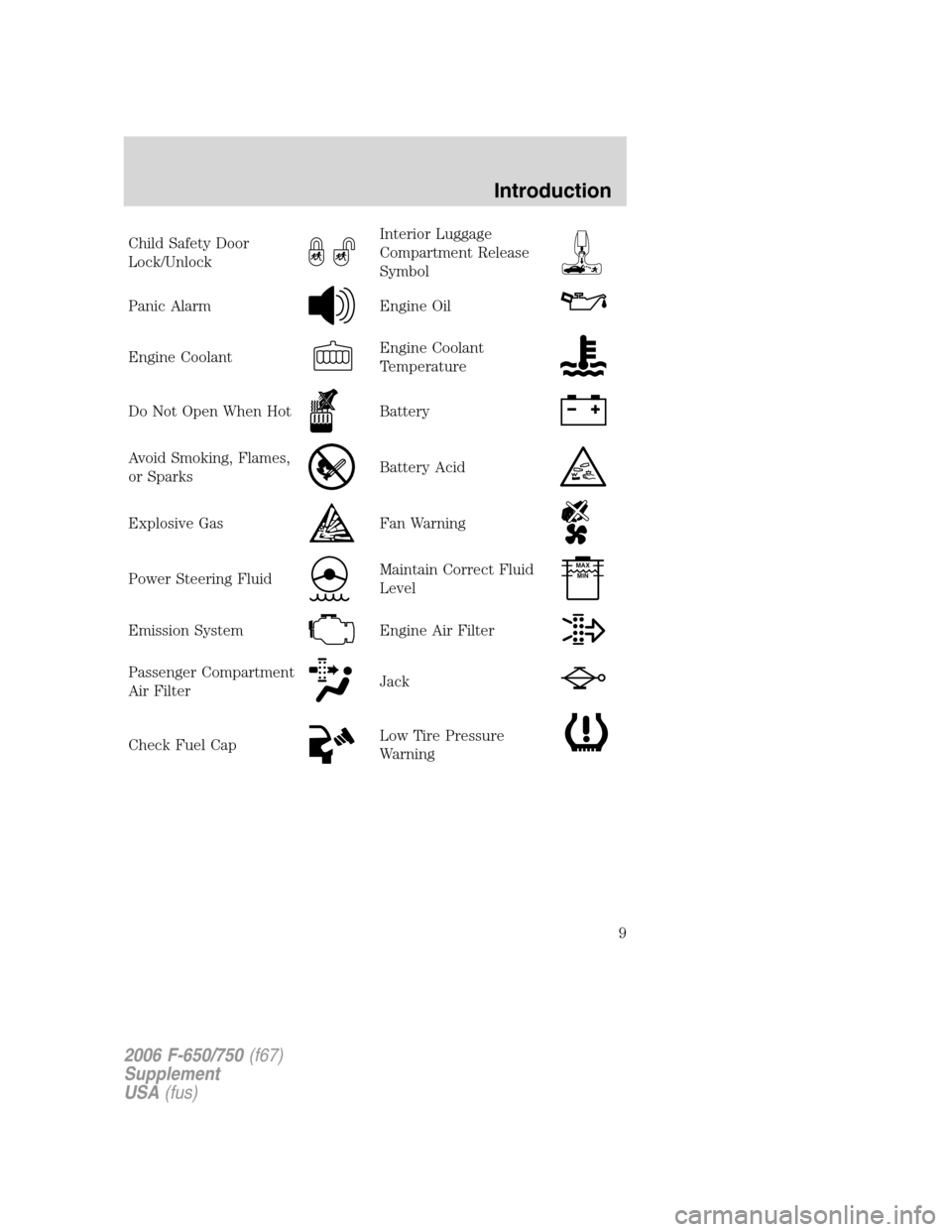
Child Safety Door
Lock/UnlockInterior Luggage
Compartment Release
Symbol
Panic AlarmEngine Oil
Engine CoolantEngine Coolant
Temperature
Do Not Open When HotBattery
Avoid Smoking, Flames,
or SparksBattery Acid
Explosive GasFan Warning
Power Steering FluidMaintain Correct Fluid
LevelMAX
MIN
Emission SystemEngine Air Filter
Passenger Compartment
Air FilterJack
Check Fuel CapLow Tire Pressure
Warning
2006 F-650/750(f67)
Supplement
USA(fus)
Introduction
9
Page 31 of 272
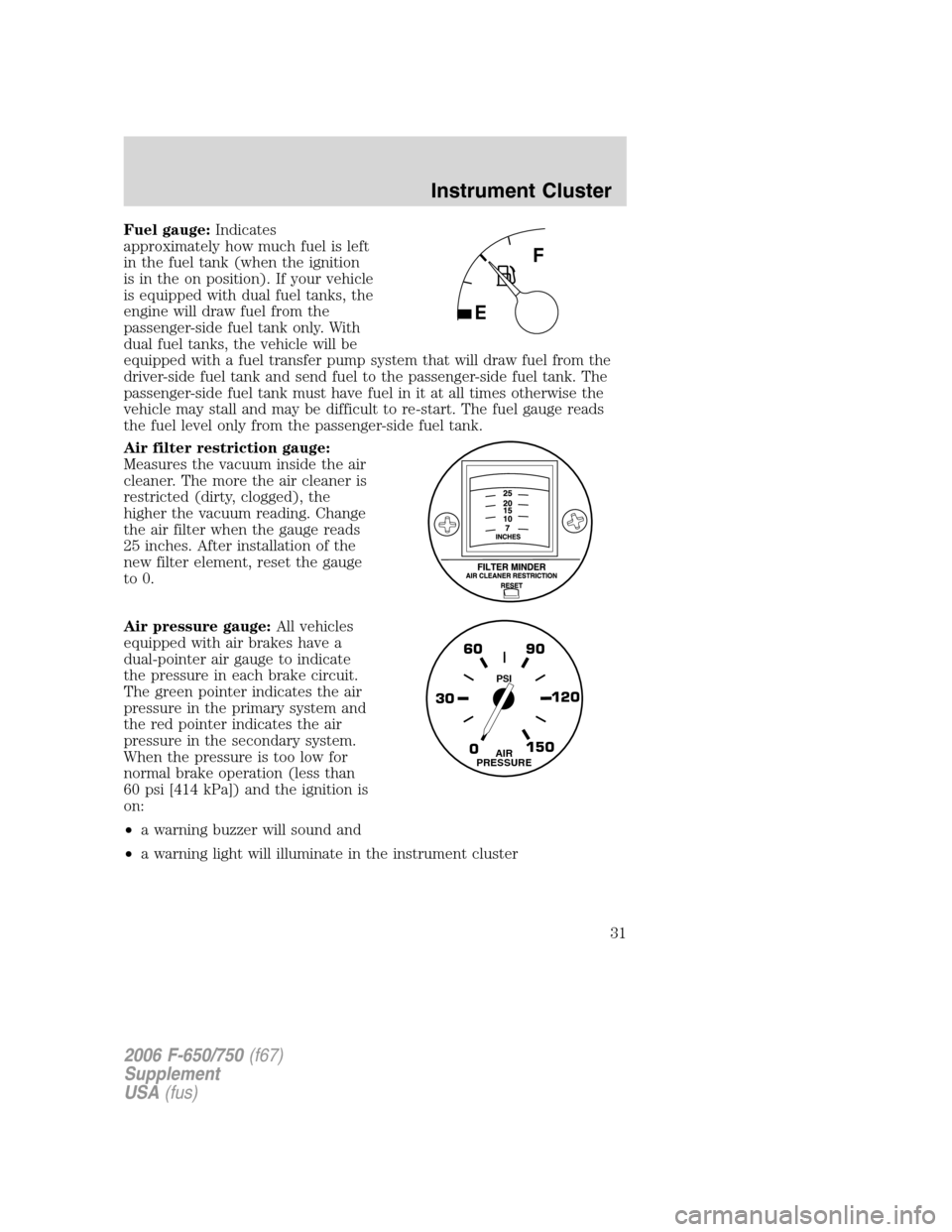
Fuel gauge:Indicates
approximately how much fuel is left
in the fuel tank (when the ignition
is in the on position). If your vehicle
is equipped with dual fuel tanks, the
engine will draw fuel from the
passenger-side fuel tank only. With
dual fuel tanks, the vehicle will be
equipped with a fuel transfer pump system that will draw fuel from the
driver-side fuel tank and send fuel to the passenger-side fuel tank. The
passenger-side fuel tank must have fuel in it at all times otherwise the
vehicle may stall and may be difficult to re-start. The fuel gauge reads
the fuel level only from the passenger-side fuel tank.
Air filter restriction gauge:
Measures the vacuum inside the air
cleaner. The more the air cleaner is
restricted (dirty, clogged), the
higher the vacuum reading. Change
the air filter when the gauge reads
25 inches. After installation of the
new filter element, reset the gauge
to 0.
Air pressure gauge:All vehicles
equipped with air brakes have a
dual-pointer air gauge to indicate
the pressure in each brake circuit.
The green pointer indicates the air
pressure in the primary system and
the red pointer indicates the air
pressure in the secondary system.
When the pressure is too low for
normal brake operation (less than
60 psi [414 kPa]) and the ignition is
on:
•a warning buzzer will sound and
•a warning light will illuminate in the instrument cluster
0 30120 90 60
150AIR
PRESSURE
PSI
2006 F-650/750(f67)
Supplement
USA(fus)
Instrument Cluster
31
Page 93 of 272
•Do not increase engine speed
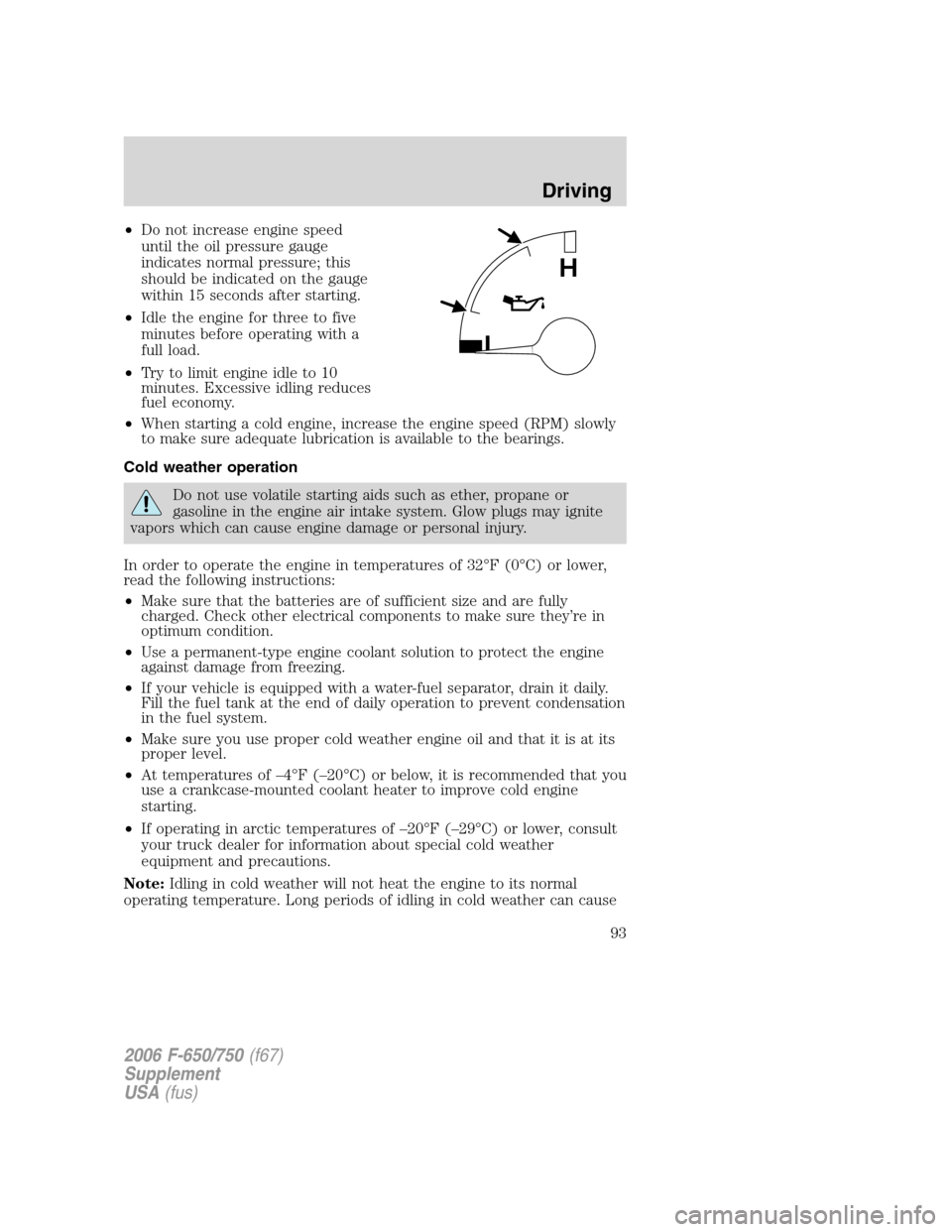
until the oil pressure gauge
indicates normal pressure; this
should be indicated on the gauge
within 15 seconds after starting.
•Idle the engine for three to five
minutes before operating with a
full load.
•Try to limit engine idle to 10
minutes. Excessive idling reduces
fuel economy.
•When starting a cold engine, increase the engine speed (RPM) slowly
to make sure adequate lubrication is available to the bearings.
Cold weather operation
Do not use volatile starting aids such as ether, propane or
gasoline in the engine air intake system. Glow plugs may ignite
vapors which can cause engine damage or personal injury.
In order to operate the engine in temperatures of 32°F (0°C) or lower,
read the following instructions:
•Make sure that the batteries are of sufficient size and are fully
charged. Check other electrical components to make sure they’re in
optimum condition.
•Use a permanent-type engine coolant solution to protect the engine
against damage from freezing.
•If your vehicle is equipped with a water-fuel separator, drain it daily.
Fill the fuel tank at the end of daily operation to prevent condensation
in the fuel system.
•Make sure you use proper cold weather engine oil and that it is at its
proper level.
•At temperatures of –4°F (–20°C) or below, it is recommended that you
use a crankcase-mounted coolant heater to improve cold engine
starting.
•If operating in arctic temperatures of –20°F (–29°C) or lower, consult
your truck dealer for information about special cold weather
equipment and precautions.
Note:Idling in cold weather will not heat the engine to its normal
operating temperature. Long periods of idling in cold weather can cause
L
H
2006 F-650/750(f67)
Supplement
USA(fus)
Driving
93
Page 164 of 272
•Remove particles such as bird droppings, tree sap, insect deposits, tar
spots, road salt and industrial fallout before repairing paint chips.
•Always read the instructions before using the products.
ALUMINUM WHEELS AND COVERS
•Clean with Motorcraft Wheel and Tire Cleaner (ZC-37–A), which is
available from your dealer.
•Never apply any cleaning chemical to hot or warm wheel rims or
covers.
•Some automatic car washes may cause damage to the finish on your
wheel rims or covers. Chemical-strength cleaners, or cleaning
chemicals, in combination with brush agitation to remove brake dust
and dirt, could wear away the clearcoat finish over time.
•Do not use hydrofluoric acid-based or high caustic-based wheel
cleaners, steel wool, fuels or strong household detergent.
•To remove tar and grease, use Motorcraft Bug and Tar Remover
(ZC-42), available from your dealer.
ENGINE
Engines are more efficient when they are clean because grease and dirt
buildup keep the engine warmer than normal. When washing:
•Take care when using a power washer to clean the engine. The
high-pressure fluid could penetrate the sealed parts and cause
damage.
Note:To prevent damage to the engine control module, never
spray-wash it directly. Never spray any connector.
•Do not spray a hot engine with cold water to avoid cracking the
engine block or other engine components.
•Spray Motorcraft Engine Shampoo and Degreaser (ZC-20) on all parts
that require cleaning and pressure rinse clean.
•Never wash or rinse the engine while it is running; water in the
running engine may cause internal damage.
PLASTIC (NON-PAINTED) EXTERIOR PARTS
Use only approved products to clean plastic parts. These products are
available from your dealer.
•For routine cleaning, use Motorcraft Detail Wash (ZC-3–A).
•If tar or grease spots are present, use Motorcraft Bug and Tar
Remover (ZC-42).
2006 F-650/750(f67)
Supplement
USA(fus)
Cleaning
164
Page 197 of 272
REMOVAL
1. Using an oil filter wrench, remove the filter.
2. Carefully clean the mating surfaces.
INSTALLATION
1. Fill the filter with clean, fresh diesel fuel.
2. Coat the filter seal with clean, fresh diesel fuel.
3. Hand-tighten the filter until it seats firmly against the mount, then
tighten (by hand) an additional
13to12turn.
4. Start the engine and check for fuel leaks.
FUEL INFORMATION
Important safety precautions
Do not overfill the fuel tank. The pressure in an overfilled tank
may cause leakage and lead to fuel spray and fire.
The fuel system may be under pressure. If the fuel cap is venting
vapor or if you hear a hissing sound, wait until it stops before
completely removing the cap.
Automotive fuels can cause serious injury or death if misused or
mishandled.
Observe the following guidelines when handling fuel:
2006 F-650/750(f67)
Supplement
USA(fus)
Maintenance and Specifications
197
Page 198 of 272
•Extinguish all smoking materials
and any open flames before
fueling your vehicle.
•Always turn off the vehicle before
fueling.
•Automotive fuels can be harmful
or fatal if swallowed. If fuel is swallowed, call a physician immediately,
even if no symptoms are immediately apparent. The toxic effects of
fuel may not be visible for hours.
•Avoid inhaling fuel vapors. Inhaling too much fuel vapor of any kind
can lead to eye and respiratory tract irritation. In severe cases,
excessive or prolonged breathing of fuel vapor can cause serious
illness and permanent injury.
•Avoid getting fuel liquid in your eyes. If fuel is splashed in the eyes,
remove contact lenses (if worn), flush with water for 15 minutes and
seek medical attention. Failure to seek proper medical attention could
lead to permanent injury.
•Fuels can also be harmful if absorbed through the skin. If fuel is
splashed on the skin and/or clothing, promptly remove contaminated
clothing and wash skin thoroughly with soap and water. Repeated or
prolonged skin contact with fuel liquid or vapor causes skin irritation.
If you must replace the fuel filler cap, replace it with a genuine
Ford or Motorcraft part. The customer warranty may be void for
any damage to the fuel tank or fuel system if a genuine Ford or
Motorcraft fuel filler cap is not used.
If you do not use the proper fuel filler cap, excessive pressure or
vacuum in the fuel tank may damage the fuel system or cause
the fuel cap to disengage in a collision, which may result in possible
personal injury.
Choosing the right fuel
The engine is designed to use low sulfur number 1D or 2D diesel fuel
only. At temperatures below –20°F (–7°C), number 1D or winter blend
number 2D fuel is recommended. (SeeCold weather operationin the
Drivingsection.) Diesel fuel containing no more than 5% of biodiesel
may be used. Biodiesel fuel is a product derived from renewable fuel
sources such as vegetable oil, animal fat and cooking oil.
Do not use home heating oil or any diesel fuel not intended for
highway use. Red dye is used to identify fuels intended for
2006 F-650/750(f67)
Supplement
USA(fus)
Maintenance and Specifications
198
Page 202 of 272
•Multiply liters used by 100, then divide by total kilometers traveled.
Keep a record for at least one month and record the type of driving (city
or highway). This will provide an accurate estimate of the vehicle’s fuel
economy under current driving conditions. Additionally, keeping records
during summer and winter will show how temperature impacts fuel
economy. In general, lower temperatures give lower fuel economy.
Driving style - good driving and fuel economy habits
Give consideration to the lists that follow and you may be able to change
a number of variables and improve your fuel economy.
Habits
•Smooth, moderate operation can yield up to 10% savings in fuel.
•Steady speeds without stopping will usually give the best fuel
economy.
•Anticipate stopping; slowing down may eliminate the need to stop.
•Sudden or hard accelerations may reduce fuel economy.
•Slow down gradually.
•Driving at reasonable speeds (traveling at 55 mph [88 km/h] uses 15%
less fuel than traveling at 65 mph [105 km/h]).
•Using the air conditioner or defroster may reduce fuel economy.
•Resting your foot on the brake pedal while driving may reduce fuel
economy.
Conditions
•Carrying unnecessary weight may reduce fuel economy.
•Fuel economy may decrease with lower temperatures during the first
8–10 miles (12–16 km) of driving.
•Flat terrain driving improves fuel economy over hilly roads.
•Transmissions give their best fuel economy when operated in the top
cruise gear and with steady pressure on the accelerator.
•Close windows for highway driving.
NOISE EMISSIONS – EXTERIOR
In order to comply with the federal exterior noise regulations, your
vehicle may be equipped with noise emission items. Depending on the
vehicle configuration, it may have all or some of the following items:
2006 F-650/750(f67)
Supplement
USA(fus)
Maintenance and Specifications
202
Page 236 of 272
OWNER MAINTENANCE
You can do much of the maintenance your vehicle requires yourself, if
you have the time and a reasonable amount of mechanical ability. If you
prefer to have this work done professionally, your authorized dealer
stands ready to help you.
All mechanical components and attachments are important in that they
could affect the performance of vital components and systems. If
replacement becomes necessary, they must be replaced with parts having
the same part number or with equivalent parts. Torque values of the
attaching parts must be used as specified during any reassembly
procedure to ensure proper retention.
EMISSIONS CONTROL SYSTEM
To ensure the emissions control systems operate effectively, you should
have the services listed in the maintenance schedule performed at the
specified time and mileage/km intervals. You should avoid running out of
fuel or turning off the ignition while the vehicle is in motion, especially
at high speeds.
Because of high engine compartment and exhaust system
temperatures resulting from emissions equipment, do not park,
idle or operate your vehicle in dry grass or other dry ground cover
where the possibility of ground fire exists.
Do not make unauthorized modifications to the engine or vehicle.
Modifications causing increased amounts of unburned fuel to reach the
exhaust system can significantly increase the temperature of the engine
compartment and/or the exhaust system.
Avoid driving your vehicle if it does not operate properly. If the engine
diesels (more than five seconds of engine run-on after shut-off), misfires,
surges, stalls or backfires, see your dealer. Be alert for fluid leakage,
odor, smoke, loss of oil pressure, or charge indicator or over temperature
warning.
Do NOT use diesel fuel blended with waste oil in engines equipped with
a catalytic converter-muffler. Waste lube oil blending in fuel will plug the
catalytic converter-muffler, resulting in a significant loss of engine power.
2006 F-650/750(f67)
Supplement
USA(fus)
Scheduled Maintenance Guide
236
Page 245 of 272

Maintenance Operation Frequency - Observation
Check fuel pump pressure Insufficient full-throttle power or
backfiring.
Clean radiator cap seal. Clean
and inspect the cap surface on
the radiatorWhen the cap does not hold pressure.
Check the battery terminals for
corrosionWhenever electrical power supply has
diminished.
Tighten the wheel mounting
nuts to the specified torque.
Refer toServicing your
wheels and tiresin the
Maintenance and
SpecificationschapterRequired initially at 500 and 1000
miles (800 and 1600 km). Perform
again at 500 and 1000 mile (800 and
1600 km) intervals after each tire
removal/replacement.
Clean body/door drain holes At least twice annually.
Clean windshield wiper blades As required.
Replace windshield wiper
bladesIf wiping the blades with a clean cloth
and mild detergent and washing with
a cleaner does not restore a clean
wipe.
Lubricate body lock cylinders Noisy or difficult to operate.
Check headlamp alignment Lamp beams in wrong position when
vehicle operating loaded.
Check windshield washer fluid
level; add fluid if requiredIf washes do not spray when operated.
1- During maintenance and repair, protect the fuel tube and the hose
assemblies, the power steering lines, and the brake lines from the
external heat, the acids and the abrasion that could damage the lines.
2- Check for (free) linkage action and ensure that (return) spring
force is adequate to maintain pedal free play.
3- Adjust, repair or replace as required with the same or equivalent
parts.
2006 F-650/750(f67)
Supplement
USA(fus)
Scheduled Maintenance Guide
245
Page 268 of 272

specifications ..........................218
temperature gauge ...................28
Cruise control
(see Speed control) ....................63
Customer Assistance ........143, 159
Ford accessories for your
vehicle .....................................166
Getting assistance outside the
U.S. and Canada .............159, 161
Getting roadside assistance ...143
Getting the service you
need .........................................159
Ordering additional owner’s
literature .................................162
D
Daytime running lamps
(see Lamps) ................................53
Defects, reporting .....................162
Defrost ...................................50–51
windshield ...........................50–51
with heating and air
conditioning system .................51
with standard heating
system .......................................50
Doors
lubricant specifications ..........218
Driving under special
conditions
through water ...........................96
E
Emergencies, roadside
jump-starting ..........................151
Emission control system ..202, 236
catalytic converter ..................174
Engine
cleaning ...................................164lubrication specifications .......218
Engine fan .................................184
Engine oil ..................................177
checking and adding ..............177
oil pressure gauge ....................28
recommendations ...................178
refill capacities ........................232
specifications ..........................218
F
Flashers, hazard ........................144
Fuel ............................................197
calculating fuel economy .......200
capacity ...................................233
choosing the right fuel ...........198
filling your vehicle with fuel ..197
filter, specifications ........194–196
gauge .........................................28
improving fuel economy ........200
running out of fuel ...........95, 199
safety information relating to
automotive fuels .....................197
Fuses ..................................144, 151
G
Gas mileage
(see Fuel economy) .................200
Gauges .........................................28
battery voltage gauge ...............28
engine coolant temperature
gauge .........................................28
engine oil pressure gauge ........28
fuel gauge ..................................28
odometer ...................................28
speedometer .............................28
tachometer ................................28
trip odometer ............................28
H
Hazard flashers .........................144
2006 F-650/750(f67)
Supplement
USA(fus)
Index
268