ESP FORD F650 2008 11.G Owner's Manual
[x] Cancel search | Manufacturer: FORD, Model Year: 2008, Model line: F650, Model: FORD F650 2008 11.GPages: 273, PDF Size: 1.71 MB
Page 164 of 273
non-asbestos, fiberglass, mineral wool, aramid or carbon) may be a
potentially serious health hazard.
Note:Persons handling brake linings should follow all precautions listed
below:
1. Always wear a respirator approved by the National Institute of
Occupational Studies of Health (NIOSH) or Mine Safety and Appliance
(MSA) during all brake service procedures. Wear the respirator from
removal of the wheels through assembly.
2.Neveruse compressed air or dry brushing to clean brake parts or
assemblies.
3. Clean brake parts and assemblies in open air. During assembly,
carefully place all parts on the floor to avoid getting dust in the air. Use
an industrial vacuum cleaner with a HEPA filter system to clean dust
from the brake drums, backing plates and other brake parts. After using
the vacuum, remove any remaining dust with a rag soaked in water and
wrung until nearly dry.
4.Neveruse compressed air or dry sweeping to clean the work area.
Use an industrial vacuum cleaner with a HEPA filter system and rags
soaked in water until wrung until nearly dry. Dispose of used rags with
care to avoid getting dust in the air. Use an approved respirator when
emptying vacuum cleaners and handling used rags.
5.Worker clean-up:Wash your hands before eating, drinking or
smoking. Vacuum your work clothes after use and then launder them
separately, without shaking them, to prevent fiber dust getting into the
air.
Air brakes - inspection and adjustment
A regular schedule for periodic cleaning, lubrication and adjustment
inspection should be established based on the type of vehicle operation.
It is difficult to predetermine an exact maintenance interval (time or
mileage), since vehicles will be used in a wide variety of applications and
conditions. If you are uncertain of the proper schedule and procedures
for your vehicle, contact your dealer.
Periodic checking of push rod travel or brake adjustment is essential for
effective braking. Push rod travel should be checked every service
interval to determine if adjustment is correct. Brake chamber push rods
2008 F-650/750(f67)
Supplement
USA(fus)
Maintenance and Specifications
163
Page 174 of 273
Keep batteries out of reach of children. Batteries contain sulfuric
acid. Avoid contact with skin, eyes or clothing. Shield your eyes
when working near the battery to protect against possible splashing of
acid solution. In case of acid contact with skin or eyes, flush
immediately with water for a minimum of 15 minutes and get prompt
medical attention. If acid is swallowed, call a physician immediately.
Battery posts, terminals and related accessories contain lead and
lead compounds.Wash hands after handling.
Always dispose of automotive
batteries in a responsible manner.
Follow your local authorized
standards for disposal. Call your
local authorized recycling center to
find out more about recycling
automotive batteries.
ENGINE COOLANT
Refer to your engine operator’s manual for engine coolant checking and
adding instructions as well as engine coolant specifications and
capacities.
Severe climates
If you drive in extremely cold climates (less than –34°F [–36°C]):
•It may be necessary to increase the coolant concentration
above 50%.
•NEVER increase the coolant concentration above 60%.
•Engine coolant concentrations above 60% will decrease the
overheat protection characteristics of the engine coolant and
may cause engine damage.
•If available, refer to the chart on the coolant container to
ensure the coolant concentration in your vehicle will provide
adequate freeze protection at the temperatures in which you
drive in the winter months.
L
E
A
D
RETURN
RECYCLE
2008 F-650/750(f67)
Supplement
USA(fus)
Maintenance and Specifications
173
Page 176 of 273
FUEL INFORMATION
Important safety precautions
Do not overfill the fuel tank. The pressure in an overfilled tank
may cause leakage and lead to fuel spray and fire.
The fuel system may be under pressure. If the fuel cap is venting
vapor or if you hear a hissing sound, wait until it stops before
completely removing the cap.
Automotive fuels can cause serious injury or death if misused or
mishandled.
Observe the following guidelines when handling fuel:
•Extinguish all smoking materials
and any open flames before
fueling your vehicle.
•Always turn off the vehicle before
fueling.
•Automotive fuels can be harmful
or fatal if swallowed. If fuel is swallowed, call a physician immediately,
even if no symptoms are immediately apparent. The toxic effects of
fuel may not be visible for hours.
•Avoid inhaling fuel vapors. Inhaling too much fuel vapor of any kind
can lead to eye and respiratory tract irritation. In severe cases,
excessive or prolonged breathing of fuel vapor can cause serious
illness and permanent injury.
•Avoid getting fuel liquid in your eyes. If fuel is splashed in the eyes,
remove contact lenses (if worn), flush with water for 15 minutes and
seek medical attention. Failure to seek proper medical attention could
lead to permanent injury.
•Fuels can also be harmful if absorbed through the skin. If fuel is
splashed on the skin and/or clothing, promptly remove contaminated
clothing and wash skin thoroughly with soap and water. Repeated or
prolonged skin contact with fuel liquid or vapor causes skin irritation.
2008 F-650/750(f67)
Supplement
USA(fus)
Maintenance and Specifications
175
Page 191 of 273
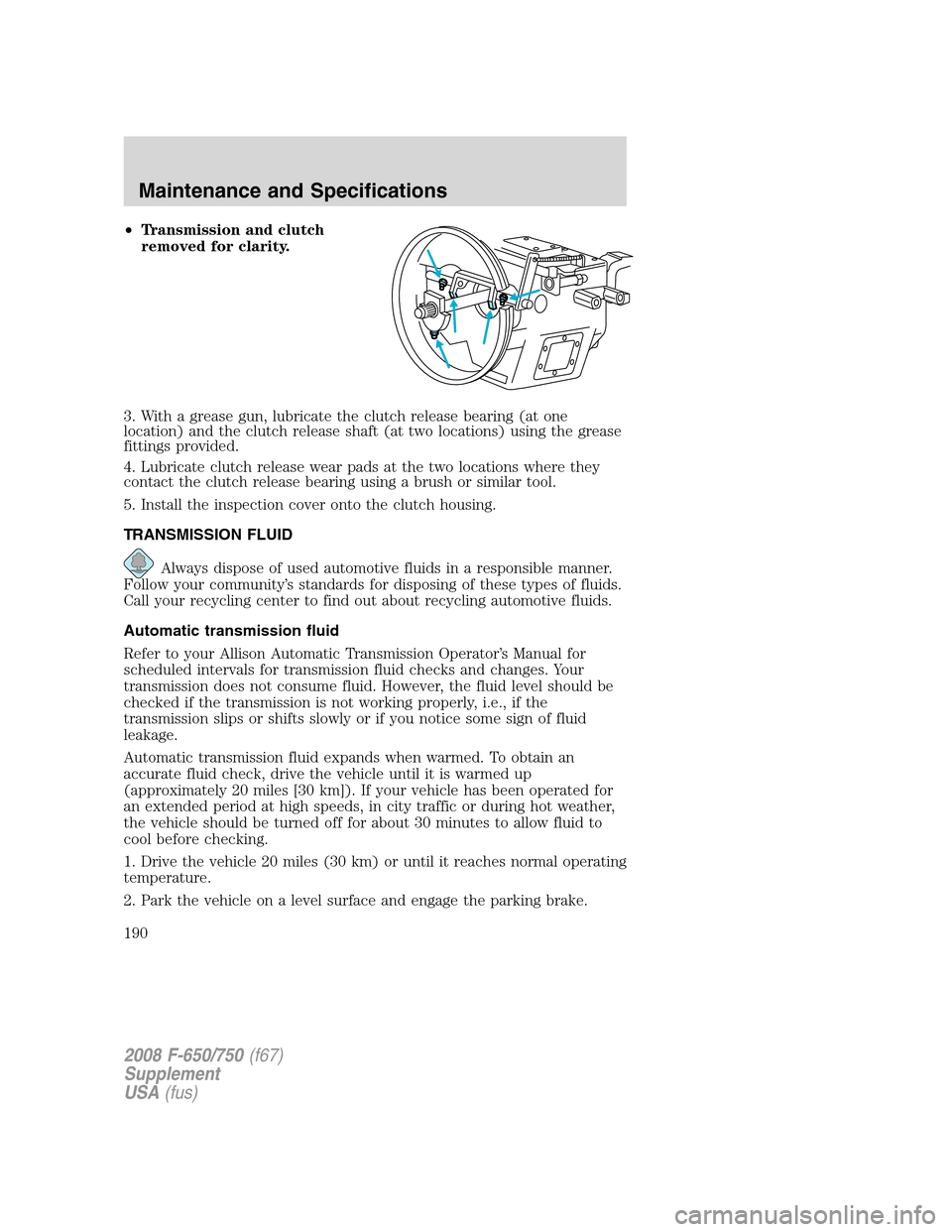
•Transmission and clutch
removed for clarity.
3. With a grease gun, lubricate the clutch release bearing (at one
location) and the clutch release shaft (at two locations) using the grease
fittings provided.
4. Lubricate clutch release wear pads at the two locations where they
contact the clutch release bearing using a brush or similar tool.
5. Install the inspection cover onto the clutch housing.
TRANSMISSION FLUID
Always dispose of used automotive fluids in a responsible manner.
Follow your community’s standards for disposing of these types of fluids.
Call your recycling center to find out about recycling automotive fluids.
Automatic transmission fluid
Refer to your Allison Automatic Transmission Operator’s Manual for
scheduled intervals for transmission fluid checks and changes. Your
transmission does not consume fluid. However, the fluid level should be
checked if the transmission is not working properly, i.e., if the
transmission slips or shifts slowly or if you notice some sign of fluid
leakage.
Automatic transmission fluid expands when warmed. To obtain an
accurate fluid check, drive the vehicle until it is warmed up
(approximately 20 miles [30 km]). If your vehicle has been operated for
an extended period at high speeds, in city traffic or during hot weather,
the vehicle should be turned off for about 30 minutes to allow fluid to
cool before checking.
1. Drive the vehicle 20 miles (30 km) or until it reaches normal operating
temperature.
2. Park the vehicle on a level surface and engage the parking brake.
2008 F-650/750(f67)
Supplement
USA(fus)
Maintenance and Specifications
190
Page 193 of 273
Drain and refill your transmission fluid using the following procedure:
1. Drain the transmission while the fluid is warm.
2. Park the vehicle on level ground.
3. Set the parking brake and shift into 1 (First) and turn the engine off.
4. Clean any dirt from around the filler and drain plugs.
5. Remove the filler and drain plugs and drain the fluid into a suitable
container. Dispose all used automotive fluids in a responsible manner
following your local authorized standards.
6. Clean and install the drain plug securely.
7. Add enough fluid through the filler plug opening so that the fluid level
is up to the bottom of the opening.
8. Clean and install the filler plug securely.
CHASSIS-MOUNTED CHARGE AIR COOLER
Inspect charge air cooler daily
With the engine off, visually inspect the charge air cooler core assembly
for debris and clogging of external fins. Prior to engine operation,
remove any debris blocking the core.
•Turbocharger-to-charge air cooler
•Charge air cooler-to-intake manifold pipe
•Mounting bracket
•Chassis-mounted charge air cooler core
Inspect air intake piping
•Check for accumulation of salt deposits (where applicable). If present,
disassemble and clean the complete air intake piping system. If the
intake piping is pitted, use Motorcraft Silicone Gasket and Sealant
TA-30 to seal joints against leakage.
•Check for loose hoses and clamps.
•Check for ruptured or collapsed hoses.
•Check air cleaner housing for cracks.
ELECTRICAL SYSTEM INSPECTIONS
Periodically inspect electrical connectors on the outside of the cab, on
the engine and frame for corrosion and tightness. Exposed terminals
2008 F-650/750(f67)
Supplement
USA(fus)
Maintenance and Specifications
192
Page 197 of 273
Your rear axle may be filled with an optional synthetic lubricant which
allows the use of extended service intervals. A tag on the filler plug will
identify the use of the synthetic lubricant.
Use only a lubricant that meets manufacturer specifications (refer to
Lubricant specificationsin this chapter).
Use of a non-approved rear axle lubricant may cause internal axle
component damage.
Checking the rear axle lubricant level
1. Park the vehicle on level ground.
2. Set the parking brake and shift into N (Neutral) (automatic
transmission) or 1 (First) (manual transmission) and turn the engine off.
3. Clean any dirt from around the rear axle filler plug.
4. Remove the filler plug and inspect the lubricant level.
5. The lubricant level should be up to the bottom of the filler plug
opening.
6. If necessary, add enough lubricant through the filler plug opening so
that the lubricant level is at the bottom of the opening.
7. Clean and install the filler plug securely.
Draining and refilling the rear axle lubricant
1. Drain the rear axle while the lubricant is warm.
2. Park the vehicle on level ground.
3. Set the parking brake and shift into N (Neutral) (automatic
transmission) or 1 (First) (manual transmission) and turn the engine off.
4. Clean any dirt from around the rear axle filler and drain plugs.
5. Remove the filler and drain plugs and drain the lubricant into a
suitable container. Dispose of all used automotive fluids in a responsible
manner following your local authorized standards.
6. Clean and install the drain plug securely.
7. Add enough lubricant through the filler plug opening so that the
lubricant level is up to the bottom of the opening.
8. Clean and install the filler plug securely.
WHEELS
General
Wheel bearings should be inspected, lubricated and adjusted at regular
intervals. This is especially important if operating in deep sand, mud, or
water. Refer toLubricant specificationsin this chapter.
2008 F-650/750(f67)
Supplement
USA(fus)
Maintenance and Specifications
196
Page 209 of 273
Rotating tires from one wheel position to another is a way often used to
even out many types of irregular wear or to avoid it altogether. Some of
the more effective tire rotation programs are:
•Steer tires that have developed some type of irregular wear pattern
can be rotated to drive axles if rib tires are being used on all wheel
positions. Applying steer tires to a drive position will often clean them
and they can be moved back to the steer axles or run out to re-tread
stage on the rear axle.
•Another rotation possibility for fleets with rib tires in all wheel
positions is to break in the new steer tires in the drive axle positions,
then move them to steer axles. This will wear away tread rubber
relatively quickly in the early life of a tire when it is most likely to
develop an unusual wear pattern.
•Drive axle tires may be placed on the other end of the same axle so
that direction of rotation is reversed. This is often helpful if a heel and
toe or alternate lug wear pattern has developed.
Irregular wear can be minimized by:
•Using the right inflation pressure for the load being carried.
•Maintaining proper front wheel alignment -especially toe-in-to
specifications.
•Maintaining proper tire and wheel balance.
•Maintaining shock absorbers and suspension components.
Use of tire chains
Refer to chain manufacturer’s recommendation for correct tire chain
usage, installation and removal.
2008 F-650/750(f67)
Supplement
USA(fus)
Maintenance and Specifications
208
Page 230 of 273
FACTORY AUTHORIZED SYSTEMS CHECKS
In the event that your vehicle experiences a component related concern,
please contact your Ford dealership. The Ford Motor Company Trained
Technicians who work at Ford dealerships are specifically trained to
understand your vehicle.
A proper repair begins with a thorough system check. A Factory
Authorized Systems Check can ONLY be found at a Ford dealership. In
some circumstances, the technician may need to request your
authorization to perform additional operations to determine the final
diagnosis. The technician’s goal is to ensure that your vehicle is fixed
right the first time, at the best value to you.
The following list represents several of the Factory Authorized Systems
Checks available at a participating Ford dealers:
•Air Conditioning
•Check Engine Light
•All Wheel Drive and 4x4
•Automatic Transmission
•Engine Cooling and Cabin Heating
•Steering and Suspension
•Charge/Start/Battery
•Wheel Alignment
•Anti-Lock Brake System
EMISSIONS CONTROL SYSTEM
To ensure the emissions control systems operate effectively, you should
have the services listed in the maintenance schedule performed at the
specified time and mileage/km intervals. You should avoid running out of
fuel or turning off the ignition while the vehicle is in motion, especially
at high speeds.
Because of high engine compartment and exhaust system
temperatures resulting from emissions equipment, do not park,
idle or operate your vehicle in dry grass or other dry ground cover
where the possibility of ground fire exists.
Do not make unauthorized modifications to the engine or vehicle.
Modifications causing increased amounts of unburned fuel to reach the
exhaust system can significantly increase the temperature of the engine
compartment and/or the exhaust system.
2008 F-650/750(f67)
Supplement
USA(fus)
Scheduled Maintenance Guide
229