warning FORD F650 2010 12.G User Guide
[x] Cancel search | Manufacturer: FORD, Model Year: 2010, Model line: F650, Model: FORD F650 2010 12.GPages: 274, PDF Size: 1.51 MB
Page 16 of 274
Front of vehicle
Lights:Make sure all lights illuminate and are clean.
Make sure headlights function on both high
and low beams. Make sure reflectors are clean
and unbroken and of proper color (red on
rear, amber elsewhere). Make sure the running
lights are also clean and unbroken.
Steering gear:Look for missing or loose fasteners, power
steering fluid leaks and damage to power
steering hoses.
Steering linkage:Make sure connecting links, arms and rods are
not worn or cracked; joints, sockets and boot
seals are not worn or loose and that there are
no loose or missing cotter keys, nuts or bolts.
Tow hooks:Front and rear tow hooks should be inspected
for damage or loose mounting. This is
particularly important on vehicles where tow
hooks are frequently used.
Front suspension
Spring:Inspect for missing, broken or shifted leaves or
leaves that are in contact, or nearly contacting
a tire, rim, brake drum, frame or body
component.
Spring mount:Inspect spring hangers, bolts, bushings, axle
mounting bolts and nuts for cracks, breaks,
wear, damage and tightness.
Shock absorber:Inspect for cracks, leaks and missing or broken
bolts or bushings.
Note:Never apply grease to spring pads.
WARNING:Do not operate the vehicle if any suspension
conditions listed in theFront suspensionchart are evident.
Loss of steering or suspension could result in property damage,
personal injury or death.
Vehicle Inspection Guide
16
2010 F-650/750(f67)
Supplement(supplement), 1st Printing
USA(fus)
Page 17 of 274
Front brakes
Hoses:Check for cracked, worn or frayed hoses. Make
sure all couplings are secured.
Chambers:Make sure brake chambers are not cracked or
dented and that they are securely mounted.
Slack adjuster:Check for broken, loose or missing parts. The
angle between the push rod and adjuster arm
should be approximately 90° when the brakes
are applied. When pulled by hand, the push
rod should not move more than approximately
one inch (2.5 cm).
Drum:Make sure there are no cracks, dents or holes
and no loose or missing bolts. Make sure brake
linings are not worn, dangerously thin or
contaminated by lubricant.
Front wheels
Rims:Check for damaged or bent rims. Rims should
not have welding repairs and no rust trails that
indicate it is loose on the wheel.
Lug nuts:Make sure all lug nuts are present and not
loose (look for rust trails around the lug nuts).
There should be no cracks radiating from the
lug bolt holes or distortion of the bolt holes.
Hub oil seal:Check wheel hub oil seal for leaks, and if sight
glass if present, check to see that the oil level
is adequate.
Oil-lubricated front
wheel bearing:If the hubcap has a transparent window, check
for proper lubrication level. If the hubcap does
not have a transparent window, remove the
rubber fill-plug and check for proper level.
WARNING:If a wheel must be changed, obtain expert tire
service help. Mounting and un-mounting of tires should only be
performed by a qualified technician using necessary safety procedures
and equipment, otherwise the result could be property damage,
personal injury or death.
Vehicle Inspection Guide
17
2010 F-650/750(f67)
Supplement(supplement), 1st Printing
USA(fus)
Page 18 of 274
Driver/Fuel area
Fuel tank(s):Make sure the fuel tank(s) and cap(s) are
secure. Make sure there is no damage to the
tank(s).
Leaks:Check for any leaks from the fuel tank(s).
Underbody of vehicle
Driveshaft:Make sure that the driveshaft is not bent or
cracked. Ensure all driveshaft couplings are
secure.
Exhaust system:Make sure the outside visible parts are
securely mounted. Make sure there are no
cracks, holes or severe dents.
Frame:Check for cracks or bends in longitudinal
frame members. Make sure there are no loose,
cracked, bent, broken or missing
crossmembers or crossmember fasteners.
WARNING:Maintain adequate clearance between all parts of
the exhaust system and all hoses, wires and lines for engine
cooling, brake system, fuel system, power steering system and
electrical system, Heat damage to hoses, wires or lines may cause
vehicle malfunction that could result in property damage, personal
injury or death.
Vehicle Inspection Guide
18
2010 F-650/750(f67)
Supplement(supplement), 1st Printing
USA(fus)
Page 21 of 274
Rear wheels
Spacers:Make sure dual wheels are evenly separated
and that tires are not touching one another.
Rims:Check for damaged or bent rims. Rims should
not have welding repairs and no rust trails that
indicate it is loose on the wheel.
Lug nuts:Make sure all lug nuts are present and not
loose (look for rust trails around the lug nuts).
There should be no cracks radiating from the
lug bolt holes or distortion of the bolt holes.
Trailer
If you are pulling a trailer, an inspection of the trailer similar to that of
the tractor should be done. Such an inspection should follow trailer
manufacturer recommendations and should include at a minimum:
general condition, landing gear, doors, sides, lights, reflectors,
suspension, brakes, tires, wheels, cargo placement, stability and
tie-downs.
Transmission
If your vehicle is equipped with an automatic transmission, regularly
check the transmission’s neutral start switch. The engine should only
start in the N (Neutral) or P (Park) positions.
WARNING:If the unit starts in gear and/or the neutral start
switch is not functioning correctly, the vehicle may inadvertently
move which could result in property damage, personal injury or death.
Check the transmission fluid level and shift linkage for proper operation.
Vehicle Inspection Guide
21
2010 F-650/750(f67)
Supplement(supplement), 1st Printing
USA(fus)
Page 22 of 274
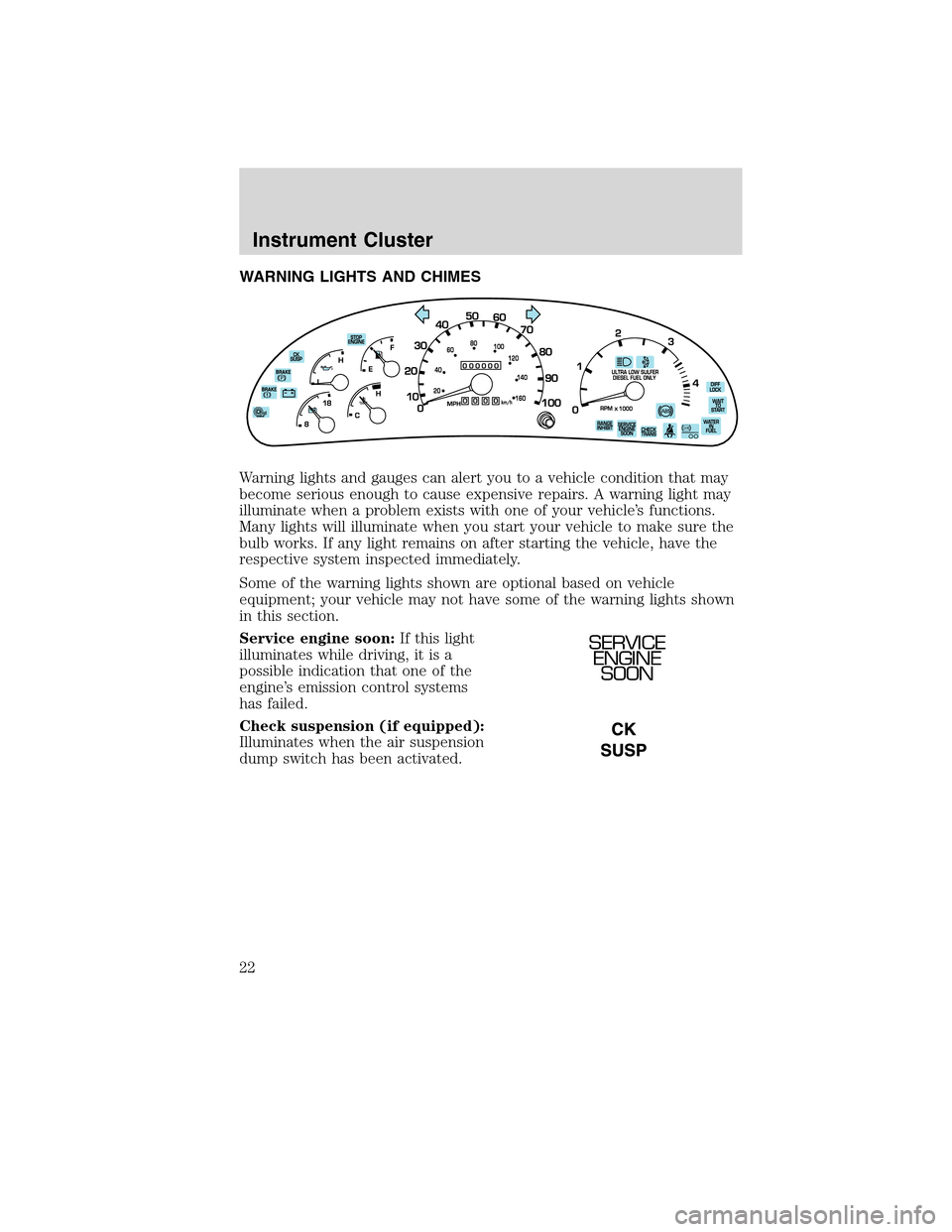
WARNING LIGHTS AND CHIMES
Warning lights and gauges can alert you to a vehicle condition that may
become serious enough to cause expensive repairs. A warning light may
illuminate when a problem exists with one of your vehicle’s functions.
Many lights will illuminate when you start your vehicle to make sure the
bulb works. If any light remains on after starting the vehicle, have the
respective system inspected immediately.
Some of the warning lights shown are optional based on vehicle
equipment; your vehicle may not have some of the warning lights shown
in this section.
Service engine soon:If this light
illuminates while driving, it is a
possible indication that one of the
engine’s emission control systems
has failed.
Check suspension (if equipped):
Illuminates when the air suspension
dump switch has been activated.
SERVICE
ENGINE
SOON
Instrument Cluster
22
2010 F-650/750(f67)
Supplement(supplement), 1st Printing
USA(fus)
Page 23 of 274
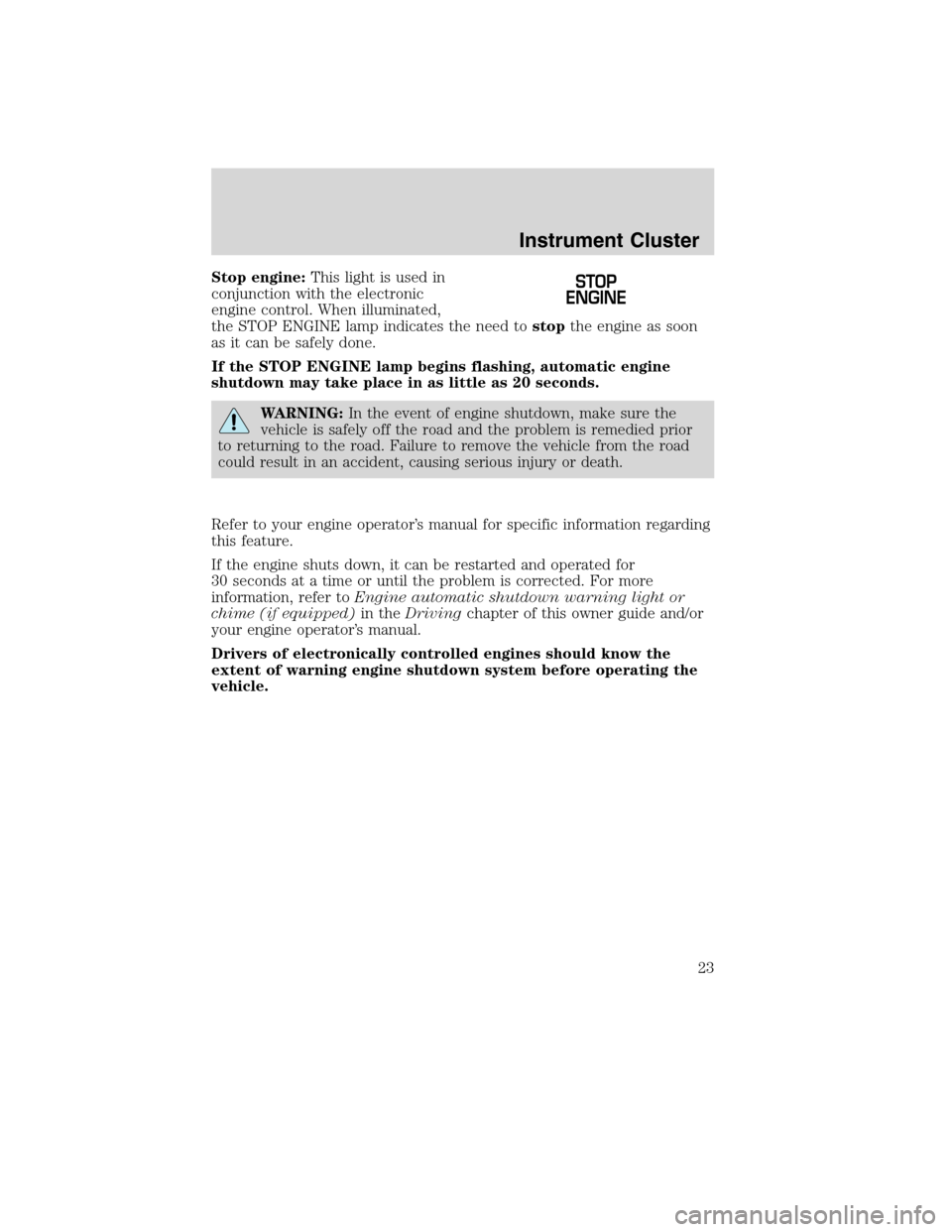
Stop engine:This light is used in
conjunction with the electronic
engine control. When illuminated,
the STOP ENGINE lamp indicates the need tostopthe engine as soon
as it can be safely done.
If the STOP ENGINE lamp begins flashing, automatic engine
shutdown may take place in as little as 20 seconds.
WARNING:In the event of engine shutdown, make sure the
vehicle is safely off the road and the problem is remedied prior
to returning to the road. Failure to remove the vehicle from the road
could result in an accident, causing serious injury or death.
Refer to your engine operator’s manual for specific information regarding
this feature.
If the engine shuts down, it can be restarted and operated for
30 seconds at a time or until the problem is corrected. For more
information, refer toEngine automatic shutdown warning light or
chime (if equipped)in theDrivingchapter of this owner guide and/or
your engine operator’s manual.
Drivers of electronically controlled engines should know the
extent of warning engine shutdown system before operating the
vehicle.
STOP
ENGINE
Instrument Cluster
23
2010 F-650/750(f67)
Supplement(supplement), 1st Printing
USA(fus)
Page 24 of 274
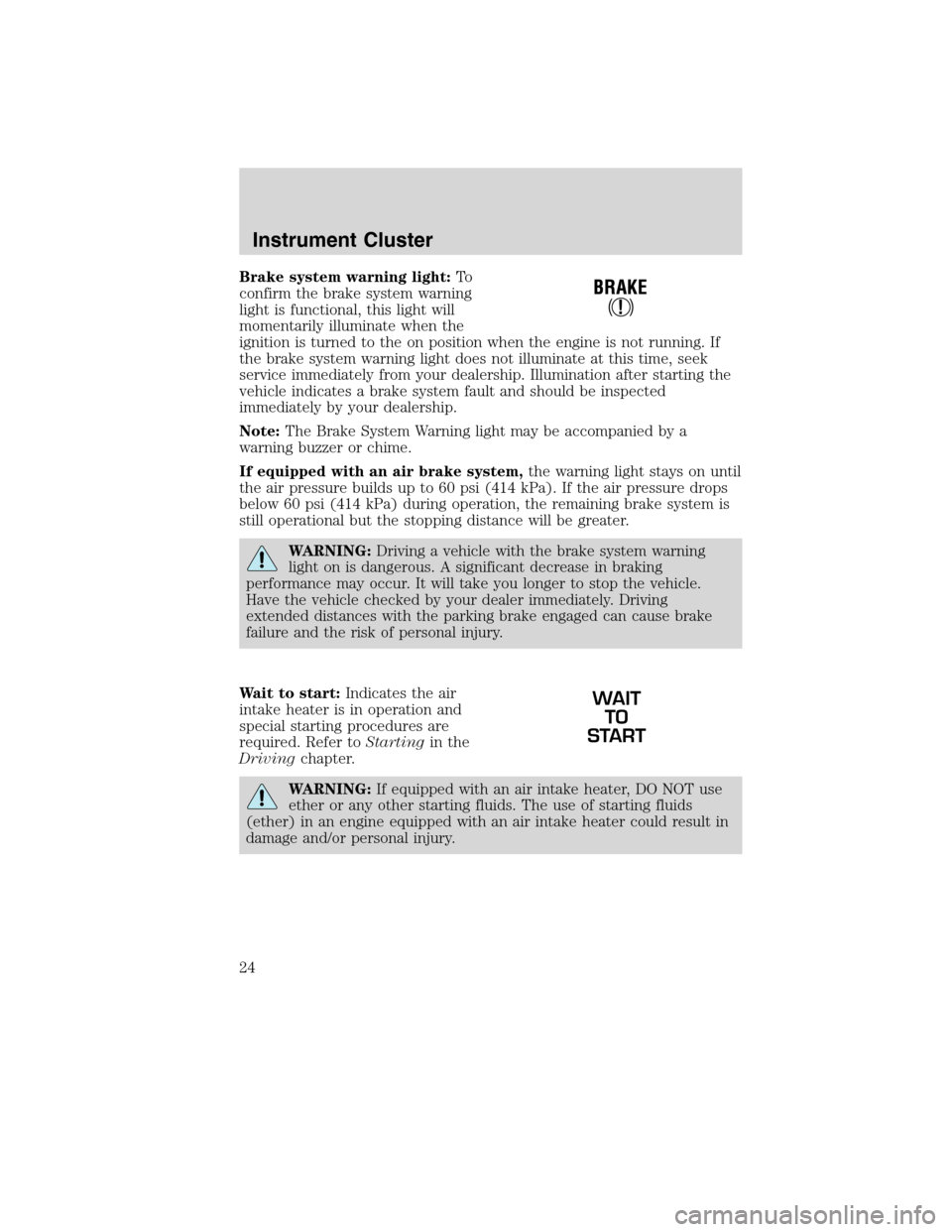
Brake system warning light:To
confirm the brake system warning
light is functional, this light will
momentarily illuminate when the
ignition is turned to the on position when the engine is not running. If
the brake system warning light does not illuminate at this time, seek
service immediately from your dealership. Illumination after starting the
vehicle indicates a brake system fault and should be inspected
immediately by your dealership.
Note:The Brake System Warning light may be accompanied by a
warning buzzer or chime.
If equipped with an air brake system,the warning light stays on until
the air pressure builds up to 60 psi (414 kPa). If the air pressure drops
below 60 psi (414 kPa) during operation, the remaining brake system is
still operational but the stopping distance will be greater.
WARNING:Driving a vehicle with the brake system warning
light on is dangerous. A significant decrease in braking
performance may occur. It will take you longer to stop the vehicle.
Have the vehicle checked by your dealer immediately. Driving
extended distances with the parking brake engaged can cause brake
failure and the risk of personal injury.
Wait to start:Indicates the air
intake heater is in operation and
special starting procedures are
required. Refer toStartingin the
Drivingchapter.
WARNING:If equipped with an air intake heater, DO NOT use
ether or any other starting fluids. The use of starting fluids
(ether) in an engine equipped with an air intake heater could result in
damage and/or personal injury.
WAIT
TO
START
Instrument Cluster
24
2010 F-650/750(f67)
Supplement(supplement), 1st Printing
USA(fus)
Page 25 of 274
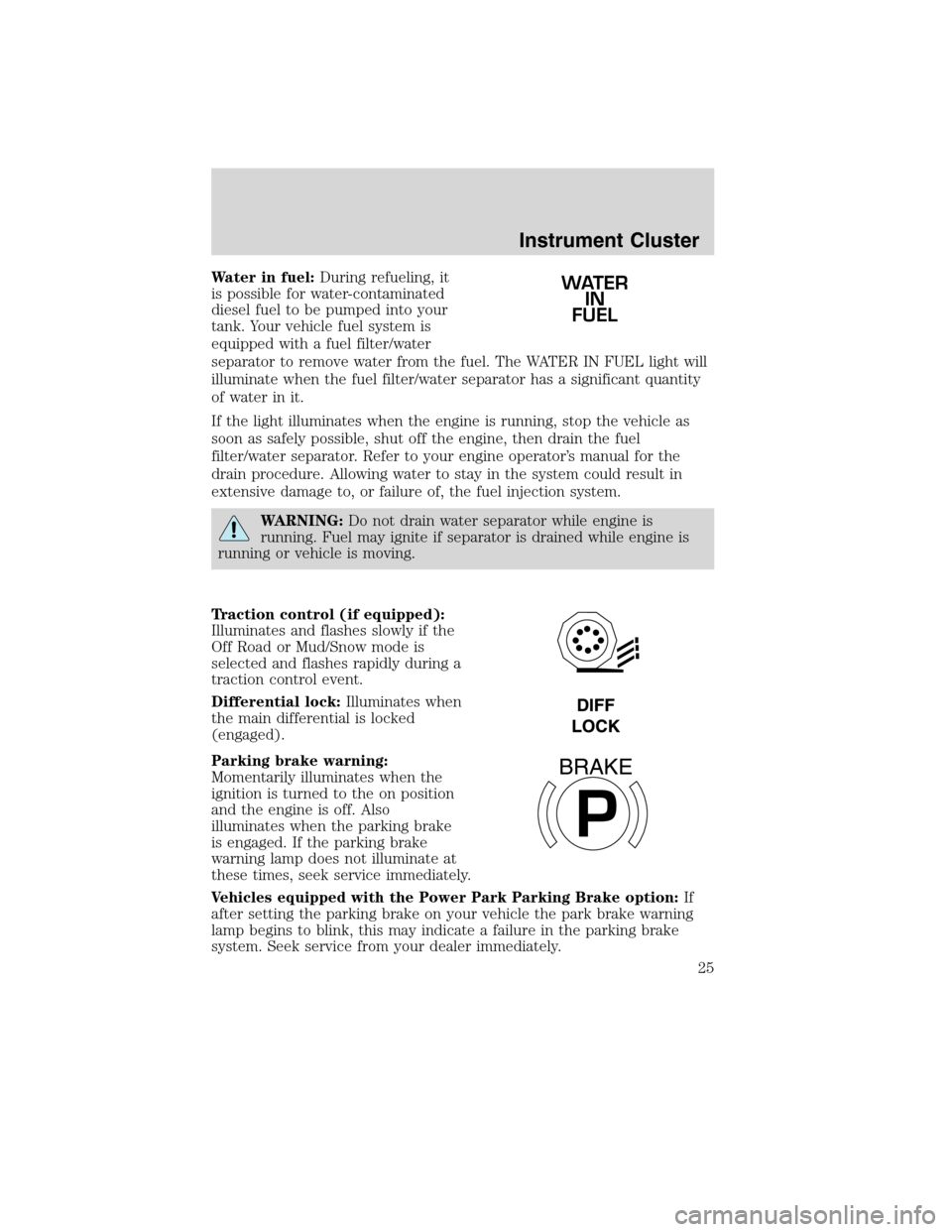
Water in fuel:During refueling, it
is possible for water-contaminated
diesel fuel to be pumped into your
tank. Your vehicle fuel system is
equipped with a fuel filter/water
separator to remove water from the fuel. The WATER IN FUEL light will
illuminate when the fuel filter/water separator has a significant quantity
of water in it.
If the light illuminates when the engine is running, stop the vehicle as
soon as safely possible, shut off the engine, then drain the fuel
filter/water separator. Refer to your engine operator’s manual for the
drain procedure. Allowing water to stay in the system could result in
extensive damage to, or failure of, the fuel injection system.
WARNING:Do not drain water separator while engine is
running. Fuel may ignite if separator is drained while engine is
running or vehicle is moving.
Traction control (if equipped):
Illuminates and flashes slowly if the
Off Road or Mud/Snow mode is
selected and flashes rapidly during a
traction control event.
Differential lock:Illuminates when
the main differential is locked
(engaged).
Parking brake warning:
Momentarily illuminates when the
ignition is turned to the on position
and the engine is off. Also
illuminates when the parking brake
is engaged. If the parking brake
warning lamp does not illuminate at
these times, seek service immediately.
Vehicles equipped with the Power Park Parking Brake option:If
after setting the parking brake on your vehicle the park brake warning
lamp begins to blink, this may indicate a failure in the parking brake
system. Seek service from your dealer immediately.
WATER
IN
FUEL
P
BRAKE
Instrument Cluster
25
2010 F-650/750(f67)
Supplement(supplement), 1st Printing
USA(fus)
Page 26 of 274
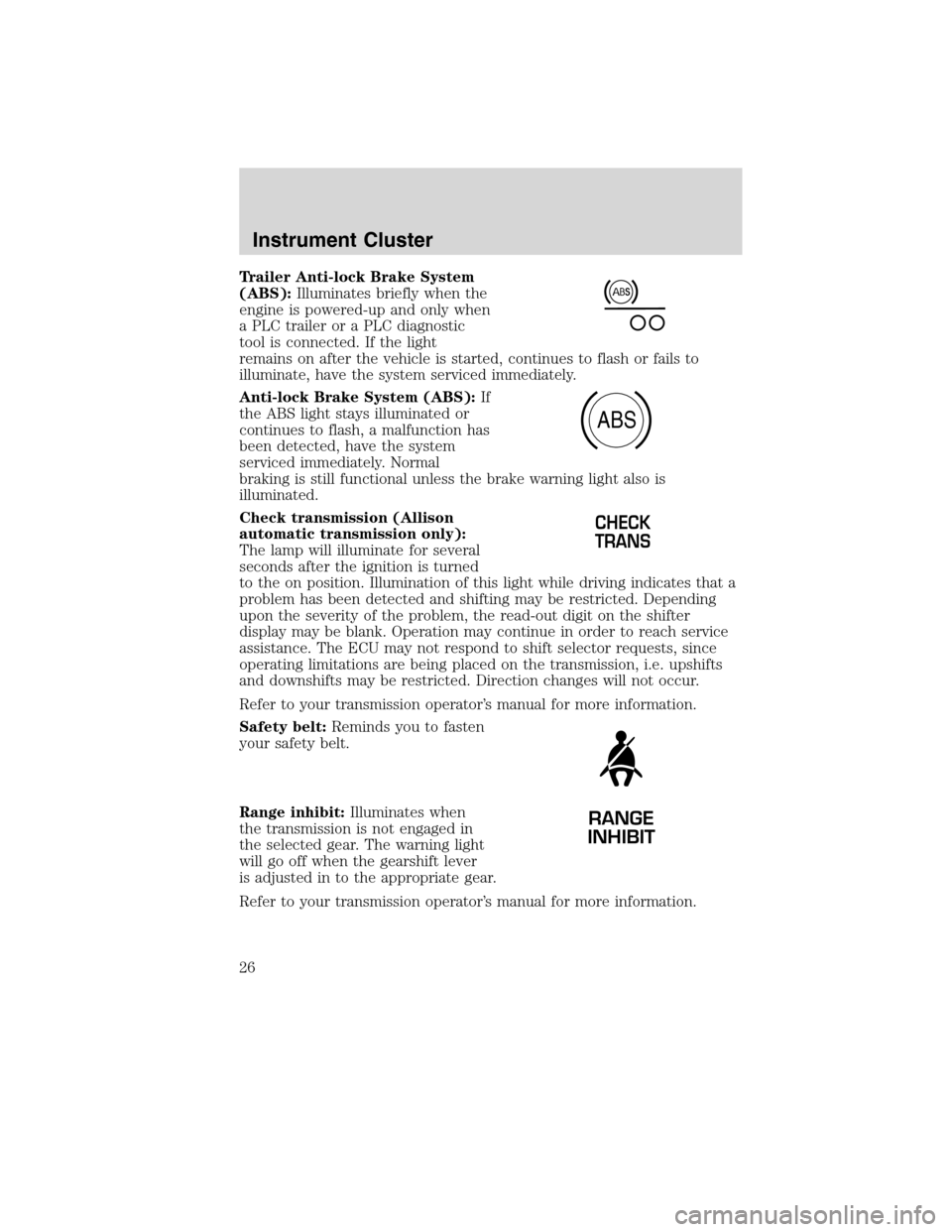
Trailer Anti-lock Brake System
(ABS):Illuminates briefly when the
engine is powered-up and only when
a PLC trailer or a PLC diagnostic
tool is connected. If the light
remains on after the vehicle is started, continues to flash or fails to
illuminate, have the system serviced immediately.
Anti-lock Brake System (ABS):If
the ABS light stays illuminated or
continues to flash, a malfunction has
been detected, have the system
serviced immediately. Normal
braking is still functional unless the brake warning light also is
illuminated.
Check transmission (Allison
automatic transmission only):
The lamp will illuminate for several
seconds after the ignition is turned
to the on position. Illumination of this light while driving indicates that a
problem has been detected and shifting may be restricted. Depending
upon the severity of the problem, the read-out digit on the shifter
display may be blank. Operation may continue in order to reach service
assistance. The ECU may not respond to shift selector requests, since
operating limitations are being placed on the transmission, i.e. upshifts
and downshifts may be restricted. Direction changes will not occur.
Refer to your transmission operator’s manual for more information.
Safety belt:Reminds you to fasten
your safety belt.
Range inhibit:Illuminates when
the transmission is not engaged in
the selected gear. The warning light
will go off when the gearshift lever
is adjusted in to the appropriate gear.
Refer to your transmission operator’s manual for more information.
ABS
CHECK
TRANS
RANGE
INHIBIT
Instrument Cluster
26
2010 F-650/750(f67)
Supplement(supplement), 1st Printing
USA(fus)
Page 27 of 274
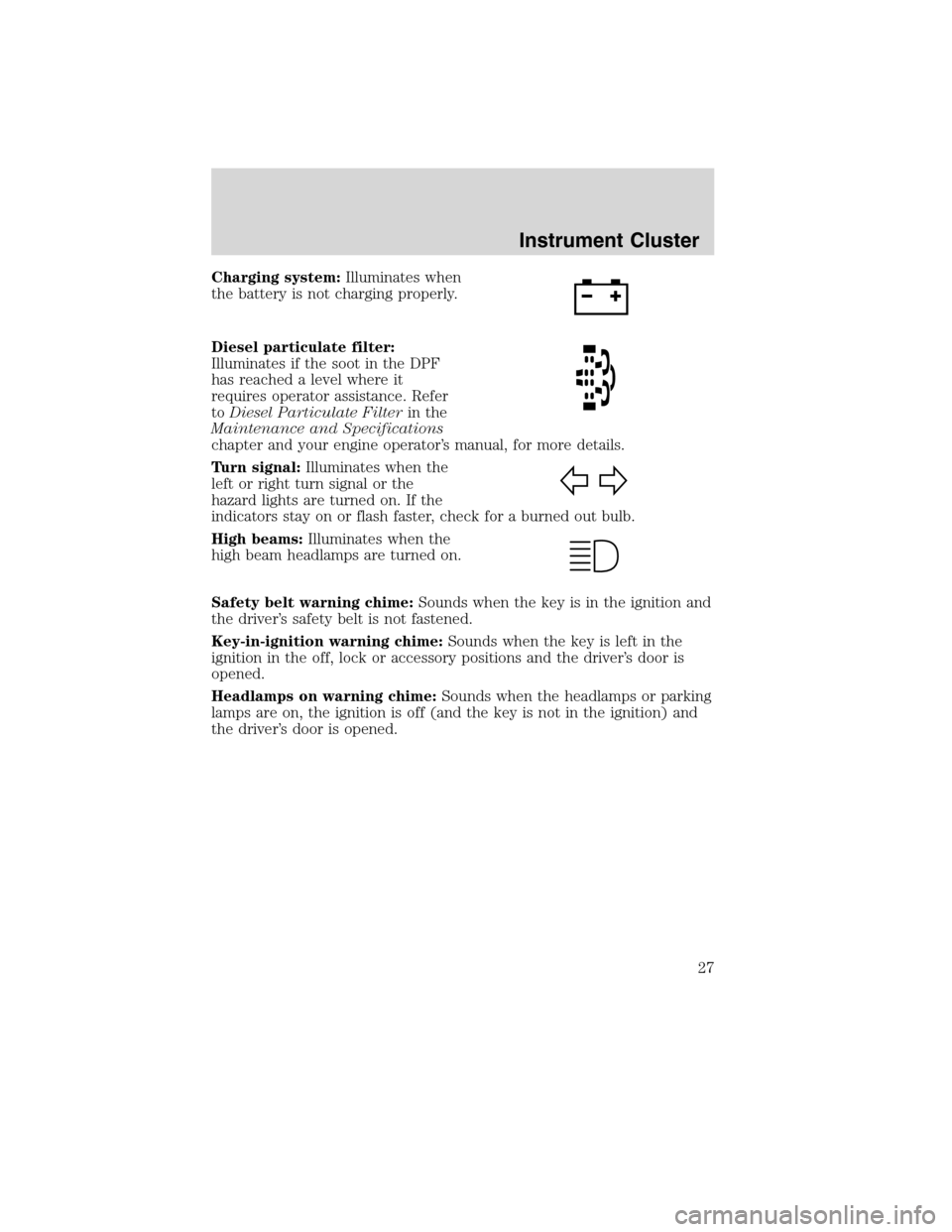
Charging system:Illuminates when
the battery is not charging properly.
Diesel particulate filter:
Illuminates if the soot in the DPF
has reached a level where it
requires operator assistance. Refer
toDiesel Particulate Filterin the
Maintenance and Specifications
chapter and your engine operator’s manual, for more details.
Turn signal:Illuminates when the
left or right turn signal or the
hazard lights are turned on. If the
indicators stay on or flash faster, check for a burned out bulb.
High beams:Illuminates when the
high beam headlamps are turned on.
Safety belt warning chime:Sounds when the key is in the ignition and
the driver’s safety belt is not fastened.
Key-in-ignition warning chime:Sounds when the key is left in the
ignition in the off, lock or accessory positions and the driver’s door is
opened.
Headlamps on warning chime:Sounds when the headlamps or parking
lamps are on, the ignition is off (and the key is not in the ignition) and
the driver’s door is opened.
Instrument Cluster
27
2010 F-650/750(f67)
Supplement(supplement), 1st Printing
USA(fus)