warning FORD F650 2011 12.G Workshop Manual
[x] Cancel search | Manufacturer: FORD, Model Year: 2011, Model line: F650, Model: FORD F650 2011 12.GPages: 290, PDF Size: 1.96 MB
Page 92 of 290
SAFETY SEATS FOR CHILDREN
Child and infant or child safety seats
Use a safety seat that is recommended for the size and weight of the
child. Carefully follow all of the manufacturer’s instructions with the
safety seat you put in your vehicle. If you do not install and use the
safety seat properly, the child may be injured in a sudden stop or
collision.
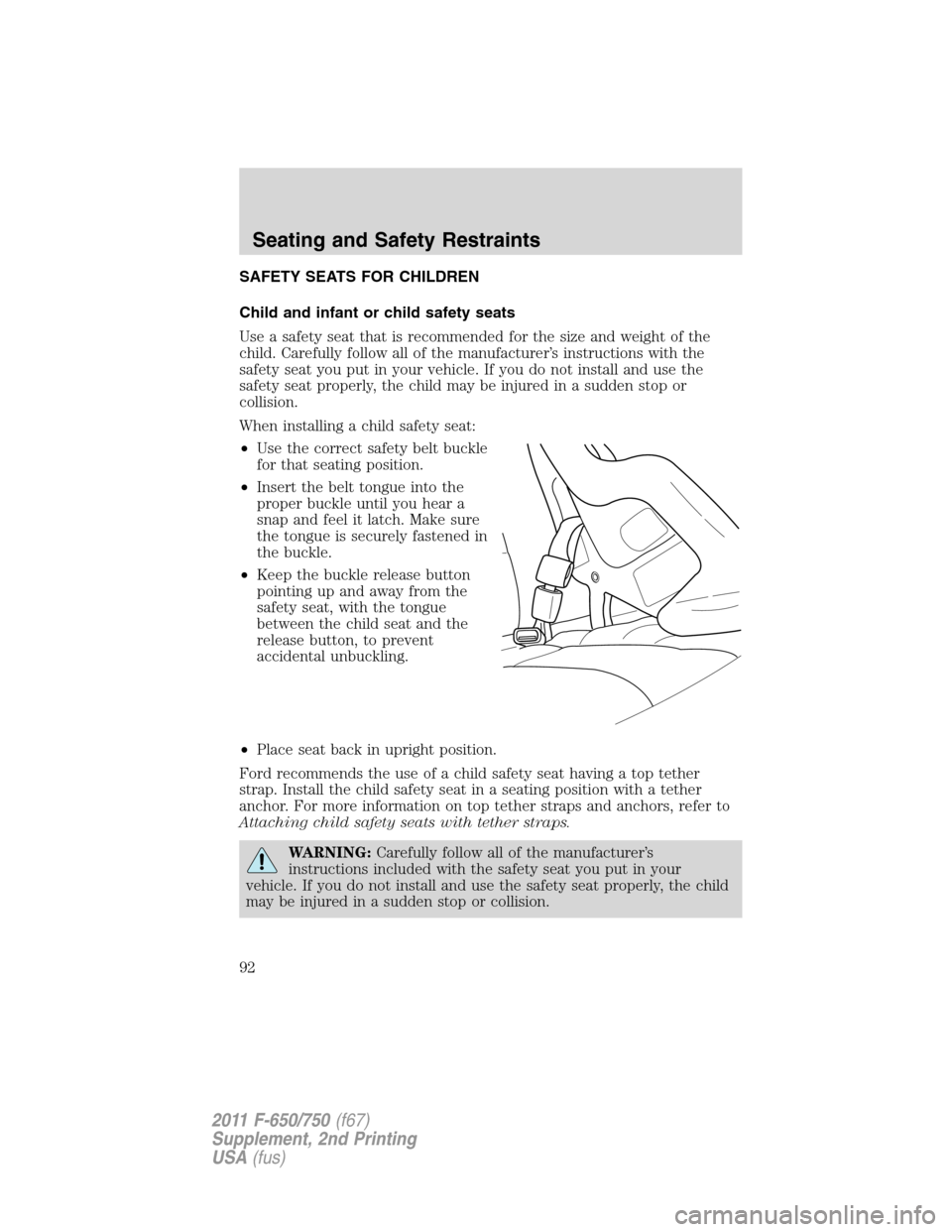
When installing a child safety seat:
•Use the correct safety belt buckle
for that seating position.
•Insert the belt tongue into the
proper buckle until you hear a
snap and feel it latch. Make sure
the tongue is securely fastened in
the buckle.
•Keep the buckle release button
pointing up and away from the
safety seat, with the tongue
between the child seat and the
release button, to prevent
accidental unbuckling.
•Place seat back in upright position.
Ford recommends the use of a child safety seat having a top tether
strap. Install the child safety seat in a seating position with a tether
anchor. For more information on top tether straps and anchors, refer to
Attaching child safety seats with tether straps.
WARNING:Carefully follow all of the manufacturer’s
instructions included with the safety seat you put in your
vehicle. If you do not install and use the safety seat properly, the child
may be injured in a sudden stop or collision.
Seating and Safety Restraints
92
2011 F-650/750(f67)
Supplement, 2nd Printing
USA(fus)
Page 93 of 290
Installing child safety seats with combination lap and shoulder
belts
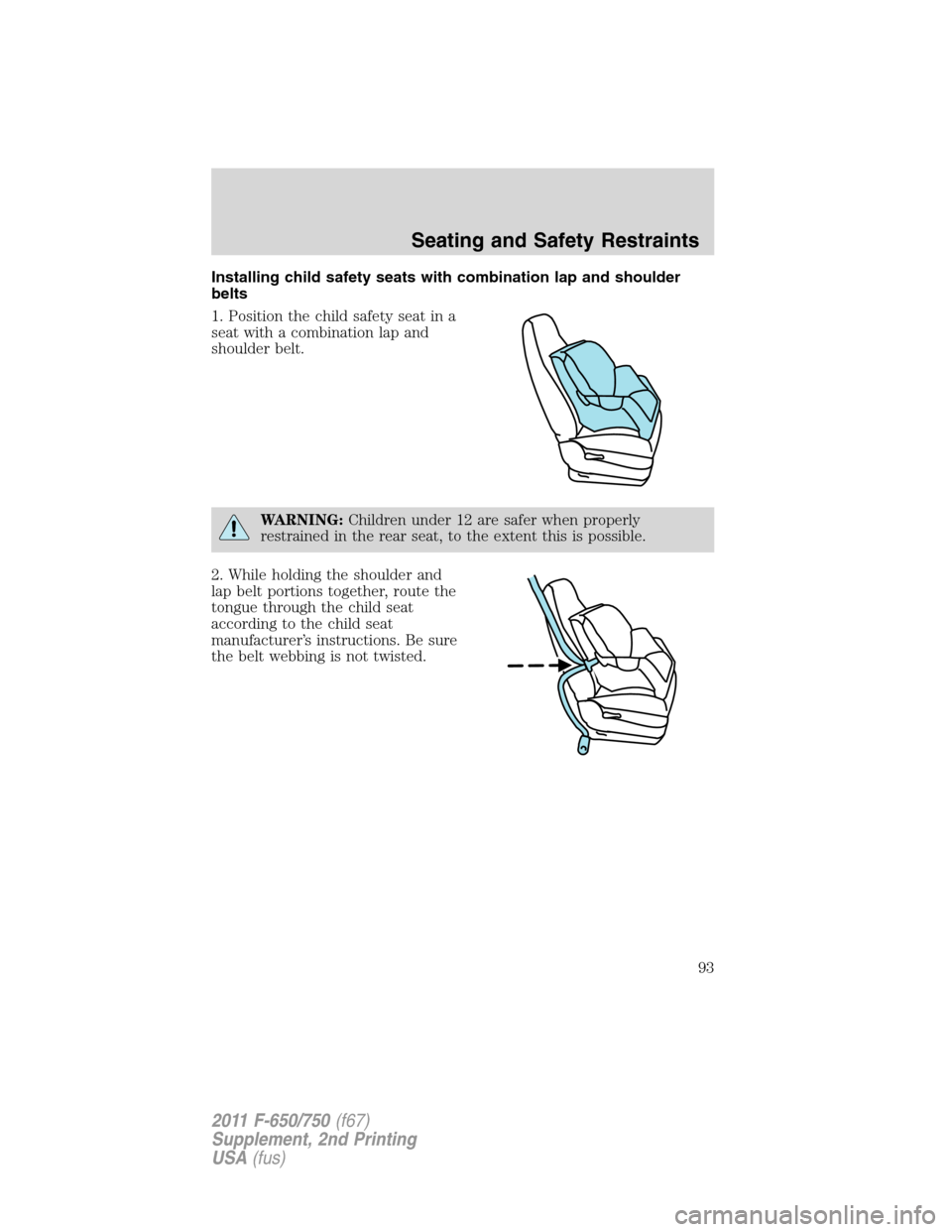
1. Position the child safety seat in a
seat with a combination lap and
shoulder belt.
WARNING:Children under 12 are safer when properly
restrained in the rear seat, to the extent this is possible.
2. While holding the shoulder and
lap belt portions together, route the
tongue through the child seat
according to the child seat
manufacturer’s instructions. Be sure
the belt webbing is not twisted.
Seating and Safety Restraints
93
2011 F-650/750(f67)
Supplement, 2nd Printing
USA(fus)
Page 96 of 290
Tether anchorage hardware
A tethered seat can be installed in the front seat. Put the tether strap
over the seatback and attach it to an anchor bracket.
An anchor bracket can be installed to the inside of the back panel of
your vehicle.
The anchor bracket must be installed using the instructions provided
with the tether anchorage hardware kit.
Tether anchorage hardware kits (part number 613D74) including
instructions, may be obtained at no charge from any Ford or Lincoln
Mercury dealer.
If you have a Crew Cab, Ford recommends you attach tether safety seats
in the rear seating position (if possible) with the tether strap attached to
the tether anchorage bracket as shown in the instructions provided with
the tether anchor kit.
WARNING:Tighten the anchor according to specifications.
Otherwise, the safety seat may not be properly secured and the
child may be injured in a sudden stop or collision.
Attaching child safety seats with tether straps
Many forward-facing child safety seats include a tether strap which
extends from the back of the child safety seat and hooks to an anchoring
point called the top tether anchor. Tether straps are available as an
accessory for many older safety seats. Contact the manufacturer of your
child seat for information about ordering a tether strap, or to obtain a
longer tether strap if the tether strap on your safety seat does not reach
the appropriate top tether anchor in the vehicle.
The passenger seats of your vehicle may be equipped with built-in tether
strap anchors located behind the seats as described below.
The tether anchors in your vehicle may be straps on the seatback or an
anchor bracket mounted to the body shell on the back panel.
Seating and Safety Restraints
96
2011 F-650/750(f67)
Supplement, 2nd Printing
USA(fus)
Page 102 of 290
If the booster seat slides on the vehicle seat, placing a rubberized mesh
sold as shelf or carpet liner under the booster seat may improve this
condition. Do not introduce any item thicker than this under the booster
seat. Check with the booster seat manufacturer’s instructions.
The importance of shoulder belts
Using a booster without a shoulder belt increases the risk of a child’s
head hitting a hard surface in a collision. For this reason, you should
never use a booster seat with a lap belt only. It is generally best to use a
booster seat with lap/shoulder belts in the back seat.
Move a child to a different seating location if the shoulder belt does not
stay positioned on the shoulder during use.
Follow all instructions provided by the manufacturer of the booster seat.
WARNING:Never place, or allow a child to place, the shoulder
belt under a child’s arm or behind the back because it reduces
the protection for the upper part of the body and may increase the risk
of injury or death in a collision.
Safety belt maintenance
Inspect the vehicle safety belts and child safety seat systems periodically
to make sure they work properly and are not damaged. Inspect the
vehicle and child seat safety belts to make sure there are no nicks, tears
or cuts. Replace if necessary. All vehicle safety belt assemblies, including
retractors, buckles, front safety belt buckle assemblies, buckle support
assemblies (slide bar-if equipped), shoulder belt height adjusters (if
equipped), shoulder belt guide on seatback (if equipped), child safety
seat LATCH and tether anchors, and attaching hardware, should be
inspected after a collision. Refer to the child restraint manufacturer’s
instructions for additional inspection and maintenance information
specific to the child restraint. Ford Motor Company recommends that all
safety belt assemblies in use in vehicles involved in a collision be
replaced. However, if the collision was minor and an authorized dealer
finds that the belts do not show damage and continue to operate
properly, they do not need to be replaced. Safety belt assemblies not in
use during a collision should also be inspected and replaced if either
damage or improper operation is noted.
For proper care of soiled safety belts, refer toInteriorin theCleaning
chapter.
Seating and Safety Restraints
102
2011 F-650/750(f67)
Supplement, 2nd Printing
USA(fus)
Page 103 of 290
WARNING:Ford Motor Company recommends that all safety
belt assemblies used in vehicles involved in a collision be
inspected for proper function and replaced, if necessary. Safety belt
assemblies not in use during a collision should also be inspected and
replaced if either damage or improper operation is noted.
WARNING:Failure to inspect and if necessary replace the
safety belt assembly under the above conditions could result in
severe personal injuries in the event of a collision.
Seating and Safety Restraints
103
2011 F-650/750(f67)
Supplement, 2nd Printing
USA(fus)
Page 104 of 290
STARTING
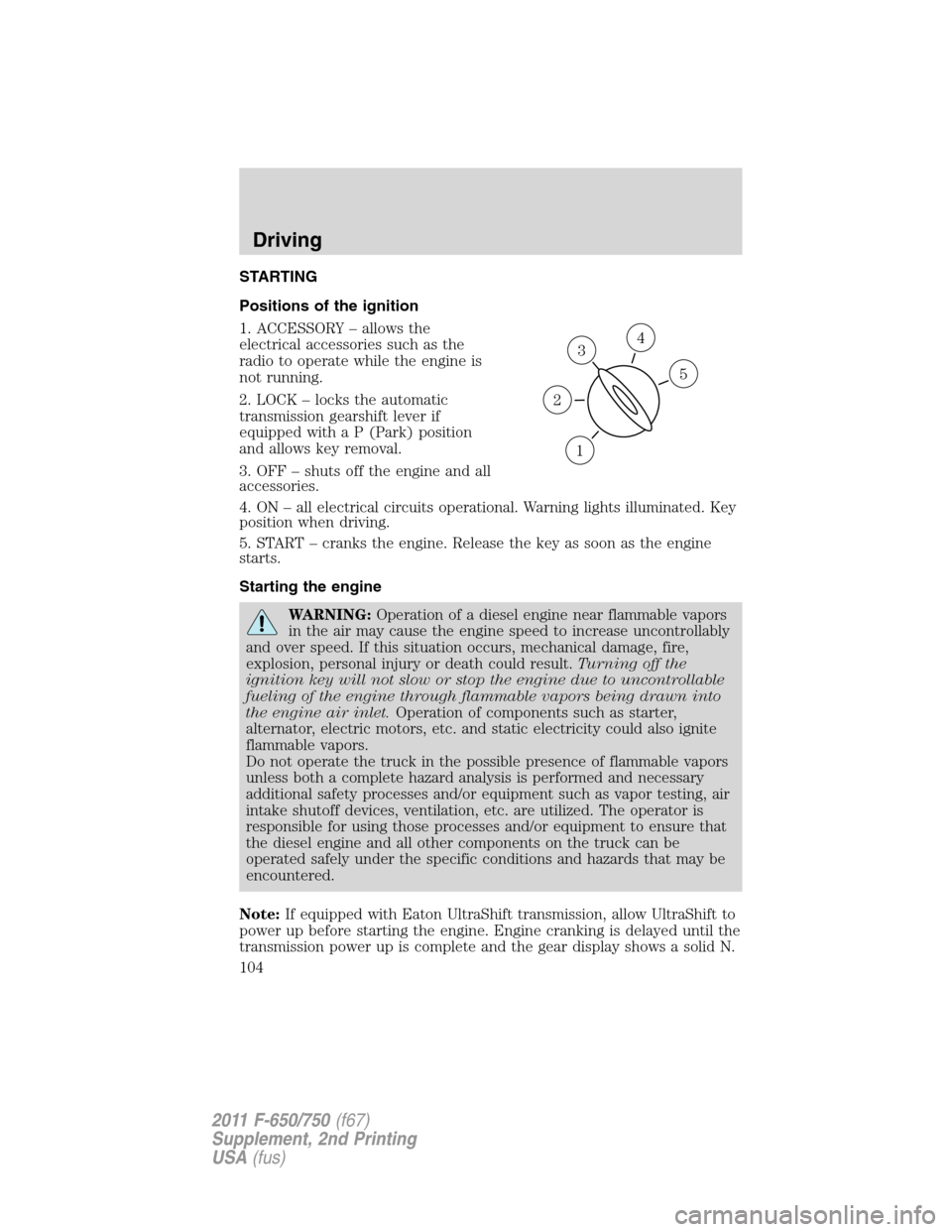
Positions of the ignition
1. ACCESSORY – allows the
electrical accessories such as the
radio to operate while the engine is
not running.
2. LOCK – locks the automatic
transmission gearshift lever if
equipped with a P (Park) position
and allows key removal.
3. OFF – shuts off the engine and all
accessories.
4. ON – all electrical circuits operational. Warning lights illuminated. Key
position when driving.
5. START – cranks the engine. Release the key as soon as the engine
starts.
Starting the engine
WARNING:Operation of a diesel engine near flammable vapors
in the air may cause the engine speed to increase uncontrollably
and over speed. If this situation occurs, mechanical damage, fire,
explosion, personal injury or death could result.Turning off the
ignition key will not slow or stop the engine due to uncontrollable
fueling of the engine through flammable vapors being drawn into
the engine air inlet.Operation of components such as starter,
alternator, electric motors, etc. and static electricity could also ignite
flammable vapors.
Do not operate the truck in the possible presence of flammable vapors
unless both a complete hazard analysis is performed and necessary
additional safety processes and/or equipment such as vapor testing, air
intake shutoff devices, ventilation, etc. are utilized. The operator is
responsible for using those processes and/or equipment to ensure that
the diesel engine and all other components on the truck can be
operated safely under the specific conditions and hazards that may be
encountered.
Note:If equipped with Eaton UltraShift transmission, allow UltraShift to
power up before starting the engine. Engine cranking is delayed until the
transmission power up is complete and the gear display shows a solid N.
3
1
2
5
4
Driving
104
2011 F-650/750(f67)
Supplement, 2nd Printing
USA(fus)
Page 105 of 290
Note:When starting the engine, do not press the accelerator as engine
damage may result.
1. Ensure headlamps and all accessories are turned off, the parking
brake is applied and the transmission is in the neutral position (or P
[Park] for Allison 2200 transmissions).
2. Turn the key to the on position, but do not start the engine.
In cooler weather, the air intake
heater may activate the WAIT TO
START light in the instrument
cluster. If the WAIT TO START light
illuminates,do notcrank the engine until the light goes off.
WARNING:If equipped with an air intake heater, DO NOT use
ether or any other starting fluids. The use of starting fluids
(ether) in an engine equipped with an air intake heater could cause an
explosion and result in property damage and/or personal injury.
3. When the WAIT TO START light turns off, turn the key to the start
position; when the engine starts, release the key.
If the engine does not start after 30 seconds of cranking, allow two
minutes for the starter to cool before trying again. Excessive cranking
may damage the starter.
After the engine starts:
•On some engines, the WAIT TO
START light should illuminate
after the engine starts. Allow the
engine to idle about three
minutes or until the engine coolant temperature gauge begins to rise.
Maintain idle speed until the WAIT TO START light cycles off to
indicate the air intake heater has shut off (approximately six
minutes). Operating the engine at higher speeds will reduce the
effectiveness of the air inlet heater.
•Do not increase engine speed until the oil pressure gauge indicates
normal pressure (as indicated by the arrows); this should be indicated
on the gauge within 15 seconds after starting.
•Idle the engine for three to five minutes before operating with a full
load.
•Try to limit engine idle to 10 minutes. Excessive idling reduces fuel
economy.
Driving
105
2011 F-650/750(f67)
Supplement, 2nd Printing
USA(fus)
Page 106 of 290
•When starting a cold engine, increase the engine RPM slowly to make
sure adequate lubrication is available to the bearings.
Cold weather operation
WARNING:Do not use volatile starting aids such as ether,
propane or gasoline in the engine air intake system. Glow plugs
may ignite vapors which can cause engine damage or personal injury.
In order to operate the engine in temperatures of 32°F (0°C) or lower,
read the following instructions:
•Make sure that the batteries are of sufficient size and are fully
charged. Check other electrical components to make sure they’re in
optimum condition.
•Use a permanent-type engine coolant solution to protect the engine
against damage from freezing.
•If your vehicle is equipped with a water-fuel separator, drain it daily.
Fill the fuel tank at the end of daily operation to prevent condensation
in the fuel system.
•Make sure you use proper cold weather engine oil and that it is at its
proper level.
•At temperatures of –4°F (–20°C) or below, it is recommended that you
use a crankcase-mounted coolant heater to improve cold engine
starting.
•If operating in arctic temperatures of –20°F (–29°C) or lower, consult
your truck dealer for information about special cold weather
equipment and precautions.
Note:Idling in cold weather will not heat the engine to its normal
operating temperature. Long periods of idling in cold weather can cause
a build-up of heavy deposits of carbon and rust on valve stems causing
them to stick which, in turn, can cause valvetrain damage.
Winter fronts
The use of winter fronts, or other air-restrictive devices mounted in front
of the radiator on vehicles with chassis-mounted charge air coolers, are
not recommended unless extremely cold weather conditions exist. Air
flow restriction can cause high exhaust temperatures, power loss,
excessive fan usage and a reduction in fuel economy. If you must use a
winter front, the device should have a permanent opening of at least 120
sq in. (774 sq. cm) directly in line with the fan hub.
Driving
106
2011 F-650/750(f67)
Supplement, 2nd Printing
USA(fus)
Page 108 of 290
•Always shift to a lower gear at high altitudes to prevent engine
smoking.
•Operate in a gear that will permit an engine speed not in excess of the
maximum governed speed or high-idle RPM (no load).
•Normally, choose the same gear to descend the hill that you would use
to ascend the hill.
WARNING:All vehicles have blind spots. To reduce the risk of
severe injury or property damage, never move your vehicle to
the side or rear or change lanes without being sure your way is clear
on both sides and to your rear.
Backing up
WARNING:To reduce the risk of the possibility of personal
injury while backing the vehicle, always be sure your vehicle’s
path is clear.
Before backing your vehicle, be sure you can do so safely. If anything
behind the cab limits your view, do not rely on mirrors alone to ensure
that your intended path is clear. If other people are in the vicinity, have
someone standing well behind your vehicle and outside of your intended
path (visible through an exterior mirror) guide you as you back up.
Although OSHA or some governmental regulations may require the use
of an electrical or mechanical back-up alarm to warn bystanders, such an
alarm does not ensure that the intended path is clear. When in doubt,
get out of the vehicle and visually check the intended path is clear;
back-up slowly as to allow others time to move, if necessary.
If an electrical back-up alarm is installed, it should be connected to the
back-up lamp circuit.
Parking your vehicle
Always use the parking brake. When parking on a grade, block the
wheels and turn the front wheels to one side so that if the vehicle rolls,
the front tires will act against the curb to stop the vehicle. The front
wheels will be more effective at stopping a rolling vehicle than the rear
wheels.
Driving
108
2011 F-650/750(f67)
Supplement, 2nd Printing
USA(fus)
Page 109 of 290
WARNING:When parking your vehicle, do not leave the
transmission in gear; if the key is in the on position and the
vehicle rolls, the engine could start. Failure to follow these instructions
could result in an unattended vehicle moving, possibly causing personal
injury or property damage.
Driving through water
If driving through deep or standing water is unavoidable, proceed very
slowly especially if the depth is not known. Never drive through water
that is higher than the bottom of the hubs. Traction or brake capability
may be limited and your vehicle may stall. Water may also enter your
engine’s air intake and severely damage your engine, drive axles or the
transmission (through the breather ports).
Once through the water, always dry the brakes by moving your vehicle
slowly while applying light pressure on the brake pedal. Wet brakes do
not stop the vehicle as quickly as dry brakes.
ENGINE IDLE SHUTDOWN (IF EQUIPPED)
Your vehicle may be equipped with an Engine Idle Shutdown system.
This system will automatically shut down your engine when it has been
idling in P (Park) or N (Neutral) for five minutes (parking brake set) or
15 minutes (parking brake not set). During the engine idle shutdown
process:
•TheService Engine Soonlight will flash, once per second, for the
final 30 seconds just prior to shutdown.
•Within the final 30 seconds, the timer can be reset by:
1. changing the position of the accelerator pedal, or
2. engaging or disengaging the brake pedal, clutch pedal or parking
brake.
•When the timer reaches zero, the engine will shut down.
•In this event, the key remains in the on position, and power
continues to be supplied to the accessories.
Battery power may be drained if the key is left in the on position
without the engine running.
Note:The engine idle shutdown timer will not start if:
•The engine is operating in power take-off (PTO) mode.
•The engine coolant temperature is below 60°F (16°C).
•The exhaust emission control system is regenerating the diesel
particulate filter (DPF).
Driving
109
2011 F-650/750(f67)
Supplement, 2nd Printing
USA(fus)