engine coolant FORD F650 2013 12.G User Guide
[x] Cancel search | Manufacturer: FORD, Model Year: 2013, Model line: F650, Model: FORD F650 2013 12.GPages: 378, PDF Size: 3.82 MB
Page 112 of 378
ENGINE BLOCK HEATER (IF EQUIPPED)
WARNING:Failure to follow engine block heater instructions
could result in property damage or physical injury.
WARNING:Do not use your heater with ungrounded electrical
systems or two-pronged (cheater) adapters. There is a risk of
electrical shock.
Note:The heater is most effective when outdoor temperatures are below
0°F (-18°C).
The heater acts as a starting aid by warming the engine coolant. This
allows the climate control system to respond quickly. The equipment
includes a heater element (installed in the engine block) and a wire
harness. You can connect the system to a grounded 120–volt A/C
electrical source.
We recommend that you do the following for safe and correct operation:
•Use a 16-gauge outdoor extension cord that is product certified by
Underwriter’s Laboratory or Canadian Standards Association. This
extension cord must be suitable for use outdoors, in cold
temperatures, and be clearly markedSuitable for Use with Outdoor
Appliances.Never use an indoor extension cord outdoors; it could
result in an electric shock or become a fire hazard.
•Use as short an extension cord as possible.
•Do not use multiple extension cords.
•Make sure that when in operation, the extension cord plug and the
heater cord plug connections are free and clear of water. This could
cause an electric shock or fire.
•Make sure your vehicle is parked in a clean area, clear of
combustibles.
•Make sure the heater, heater cord and extension cord are firmly
connected.
•Check for heat anywhere in the electrical hookup once the system has
been operating for approximately 30 minutes.
•Make sure the system is unplugged and properly stowed before driving
your vehicle. Make sure the protective cover seals the prongs of the
block heater cord plug when not in use.
Starting and Stopping the Engine111
2013 F-650/750(f67)
Owners Guide gf, 2nd Printing, March 2013
USA(fus)
Page 170 of 378
Parking
WARNING:When parking your vehicle, do not leave the
transmission in gear; if the key is in the on position and the
vehicle rolls, the engine could start. Failure to follow these instructions
could result in an unattended vehicle moving, possibly causing personal
injury or property damage.
Always use the parking brake. When parking on a grade, block the
wheels and turn the front wheels to one side so that if the vehicle rolls,
the front tires act against the curb to stop the vehicle. The front wheels
are more effective at stopping a rolling vehicle than the rear wheels.
Cold Weather
Note:Idling in cold weather does not heat the engine to its normal
operating temperature. Long periods of idling in cold weather can cause
a build-up of heavy deposits of carbon and rust on valve stems causing
them to stick which, in turn, can cause valvetrain damage.
Note:The use of winter fronts, or other air-restrictive devices mounted
in front of the radiator on vehicles with chassis-mounted charge air
coolers, are not recommended unless extremely cold weather conditions
exist. Airflow restriction can cause high exhaust temperatures, power
loss, excessive fan usage and a reduction in fuel economy. If you must
use a winter front, the device should have a permanent opening of at
least 120 square inches (774 square centimeters) directly in line with the
fan hub.
For best engine operation in temperatures of 32°F (0°C) or lower:
•Make sure the batteries are the correct type and are fully charged.
Check other electrical components to make sure they are in optimum
condition.
•Use a permanent-type engine coolant to protect the engine against
damage from freezing.
•If your vehicle is equipped with a water-fuel separator, drain it daily.
Fill the fuel tank at the end of daily operation to prevent
condensation in the fuel system.
•Use the proper engine oil and maintain it at its proper level.
•At temperatures of –4°F (–20°C) or below, it is recommended that
you use a crankcase-mounted coolant heater to improve cold engine
starting.
•If operating in arctic temperatures of –20°F (–29°C) or lower, consult
your truck dealer for information about special cold weather
equipment and precautions.
Driving Aids169
2013 F-650/750(f67)
Owners Guide gf, 2nd Printing, March 2013
USA(fus)
Page 171 of 378
Hot Weather
•Use a permanent-type engine coolant to protect the engine against
damage from overheating.
•Fill the fuel tank at the end of daily operation to prevent
condensation in the fuel system.
•Keep external surfaces of the engine, radiator, charge air cooler, A/C
condenser and accessories clean to avoid dirt build-up.
•Above normal coolant temperatures could be experienced while
driving in a transmission gear ratio which lugs the engine. To correct
this problem, engine speed should be increased by downshifting into
the next lower gear.
STEERING
Your vehicle is equipped with power steering. Power steering uses energy
from the engine to decrease the driver’s effort in steering the vehicle.
To help prevent damage to the power steering pump:
•Never hold the steering wheel to the extreme right or the extreme
left for more than a few seconds when the engine is running.
•Do not operate the vehicle with the power steering pump fluid level
below the ADD mark on the MAX. COLD side of the power steering
reservoir dipstick.
•Some noise is normal during operation. If the noise is excessive,
check for low power steering pump fluid level before seeking service
by your authorized dealer.
•Heavy or uneven steering efforts may be caused by low power
steering pump fluid level. Check for low power steering pump fluid
level before seeking service by your authorized dealer.
•Do not fill the power steering pump reservoir above the FULL mark
on the MAX. HOT side of the power steering reservoir dipstick, as
this may result in leaks from the reservoir.
If the power steering system breaks down (or if the engine is turned
off), you can steer the vehicle manually, but it takes more effort.
If the steering wanders or pulls, check for:
•underinflated tire(s) on any wheel(s)
•uneven vehicle loading
•high crown in center of road
•high crosswinds
•wheels out of alignment
•loose or worn suspension components.
170Driving Aids
2013 F-650/750(f67)
Owners Guide gf, 2nd Printing, March 2013
USA(fus)
Page 220 of 378
2. If the engine oil level is not within the normal range, add engine oil
that meets Ford specifications. SeeCapacities and Specifications
for more information. Remove the engine oil filler cap and use a
funnel to pour the engine oil into the opening.
3. Recheck the engine oil level. Make sure the oil level is not above the
normal operating range on the engine oil level dipstick.
4. Install the dipstick and make sure it is fully seated.
5. Fully install the engine oil filler cap by turning the filler cap
clockwise until three clicks are heard or until the cap is fully seated.
ENGINE COOLANT CHECK
Diesel Engine
See your engine operator’s manual for information on checking and
adding engine coolant.
Fan Clutches
WARNING:Stay clear of the fan and fan area while the engine is
running or possible personal injury may occur.
Your vehicle’s cooling system is equipped with a viscous fan clutch
which:
•Helps control cooling, increases performance, improves fuel economy
and reduces noise.
•Is controlled by bimetallic spring sensors. Do not tamper with these
sensors as this may change their calibration or keep the fan clutch
from operating at all.
Gasoline Engine
Checking the Engine Coolant
The concentration and level of engine coolant should be checked at the
intervals listed in theScheduled Maintenancechapter.
Note:Make sure that the level is between the MIN and MAX marks on
the coolant reservoir.
Note:Coolant expands when it is hot. The level may extend beyond the
MAX mark.
If the level is at the MIN mark, add coolant immediately. SeeAdding
engine coolantin this section.
Maintenance219
2013 F-650/750(f67)
Owners Guide gf, 2nd Printing, March 2013
USA(fus)
Page 221 of 378
Note:For best results, coolant concentration should be tested with a
refractometer such as Rotunda tool 300-ROB75240E available from your
dealer. Ford does not recommend the use of hydrometers or coolant test
strips for measuring coolant concentrations.
Note:Automotive fluids are not interchangeable; do not use engine
coolant, antifreeze or windshield washer fluid outside of its specified
function and vehicle location.
Adding Engine Coolant
WARNING:Do not add engine coolant when the engine is hot.
Steam and scalding liquids released from a hot cooling system
can burn you badly. Also, you can be burned if you spill coolant on hot
engine parts.
WARNING:Do not put engine coolant in the windshield washer
fluid container. If sprayed on the windshield, engine coolant
could make it difficult to see through the windshield.
WARNING:To reduce the risk of personal injury, make sure the
engine is cool before unscrewing the coolant pressure relief cap.
The cooling system is under pressure; steam and hot liquid can come
out forcefully when the cap is loosened slightly.
WARNING:Do not add coolant further than the MAX mark.
Note:
Do not use stop leak pellets or cooling system sealants or additives
as they can cause damage to the engine cooling and heating systems. This
damage would not be covered under your vehicle’s warranty.
Note:During normal vehicle operation, the engine coolant may change
color from orange to pink or light red. As long as the engine coolant is
clear and uncontaminated, this color change does not indicate the engine
coolant has degraded nor does it require the engine coolant to be
drained, the system to be flushed, or the engine coolant to be replaced.
•DO NOT MIX different colors or types of coolant in your vehicle.
Make sure the correct coolant is used. Mixing of engine coolants may
harm your engine’s cooling system. The use of an improper coolant
may harm engine and cooling system components and may void the
warranty.
220Maintenance
2013 F-650/750(f67)
Owners Guide gf, 2nd Printing, March 2013
USA(fus)
Page 222 of 378
•In case of emergency, a large amount of water without engine coolant
may be added in order to reach a vehicle service location. In this
instance, the cooling system must be drained, chemically cleaned with
Motorcraft® Premium Cooling System Flush, and refilled with prediluted
engine coolant as soon as possible. Water alone (without engine coolant)
can cause engine damage from corrosion, overheating or freezing.
•Do not use alcohol, methanol, brine or any engine coolants mixed with
alcohol or methanol antifreeze (coolant). Alcohol and other liquids can
cause engine damage from overheating or freezing.
•Do not add extra inhibitors or additives to the coolant. These can be
harmful and compromise the corrosion protection of the engine coolant.
Unscrew the cap slowly. Any pressure escapes as you unscrew the cap.
Add prediluted engine coolant meeting the Ford specification.
SeeCapacities and Specificationsfor more information.
Whenever coolant has been added, the coolant level in the coolant
reservoir should be checked the next few times you drive the vehicle.
If necessary, add enough prediluted engine coolant to bring the coolant
level to the proper level.
Recycled Engine Coolant
Ford Motor Company does not recommend the use of recycled engine
coolant since a Ford-approved recycling process is not yet available.
Always dispose of used automotive fluids in a responsible manner. Follow
your community’s regulations and standards for recycling and disposing
of automotive fluids.
Severe Climates
If you drive in extremely cold climates:
•It may be necessary to have a Ford authorized dealer increase the
coolant concentration above 50%.
•A coolant concentration of 60% provides improved freeze point
protection. Engine coolant concentrations above 60% decrease the
overheat protection characteristics of the engine coolant and may
cause engine damage.
If you drive in extremely hot climates:
•It may be necessary to have a Ford authorized dealer decrease the
coolant concentration to 40%.
•A coolant concentration of 40% provides improved overheat
protection. Engine coolant concentrations below 40% decrease the
corrosion and freeze protection characteristics of the engine coolant
and may cause engine damage.
Maintenance221
2013 F-650/750(f67)
Owners Guide gf, 2nd Printing, March 2013
USA(fus)
Page 223 of 378
Vehicles driven year-round in non-extreme climates should use
prediluted engine coolant for optimum cooling system and engine
protection.
What You Should Know About Fail-Safe Cooling (If Equipped)
(Gasoline Engine Only)
WARNING:If fail-safe cooling activates, pull off the road as soon
as safely possible and turn the engine off. The engine may
automatically shut off while driving without further indication.
If the engine coolant supply is depleted, this feature allows the vehicle to
be driven temporarily before incremental component damage is incurred.
The fail-safe distance depends on ambient temperatures, vehicle load and
terrain.
How Fail-Safe Cooling Works
If the engine begins to overheat:
•The engine coolant temperature gauge moves to the red (hot) area.
•The information display indicates the engine is overheating.
•The service engine soon indicator illuminates.
If the engine reaches a preset over-temperature condition, the engine
automatically switches to alternating cylinder operation. Each disabled
cylinder acts as an air pump and cools the engine.
When Fail-Safe Mode Is Activated
WARNING:Never remove the coolant reservoir cap while the
engine is running or hot.
Note:Driving the vehicle without repairing the engine problem increases
the chance of engine damage. Take your vehicle to an authorized dealer
as soon as possible.
You have limited engine power when in the fail-safe mode, so drive the
vehicle with caution. The vehicle is not able to maintain high-speed
operation and the engine runs rough. Remember that the engine is
capable of completely shutting down automatically to prevent engine
damage; therefore:
1. Pull off the road as soon as safely possible and turn off the engine.
2. Arrange for the vehicle to be taken to an authorized dealer.
3. If this is not possible, wait a short period for the engine to cool.
4. Check the coolant level and replenish if low.
5. Restart the engine and take your vehicle to an authorized dealer.
222Maintenance
2013 F-650/750(f67)
Owners Guide gf, 2nd Printing, March 2013
USA(fus)
Page 252 of 378
Removing Your Vehicle from Storage
When your vehicle is ready to come out of storage, do the following:
•Wash your vehicle to remove any dirt or grease film build-up on
window surfaces.
•Check windshield wipers for any deterioration.
•Check under the hood for any foreign material that may have
collected during storage (mice or squirrel nests).
•Check the exhaust for any foreign material that may have collected
during storage.
•Check tire pressures and set tire inflation per the Tire Label.
•Check brake pedal operation. Drive the vehicle 15 feet (4.5 meters)
back and forth to remove rust build-up.
•Check fluid levels (including engine coolant, engine oil and fuel) to
make sure there are no leaks and fluids are at recommended levels.
•If the battery was removed, clean the battery cable ends and inspect.
Contact your authorized dealer if you have any concerns or issues.
Vehicle Care251
2013 F-650/750(f67)
Owners Guide gf, 2nd Printing, March 2013
USA(fus)
Page 268 of 378
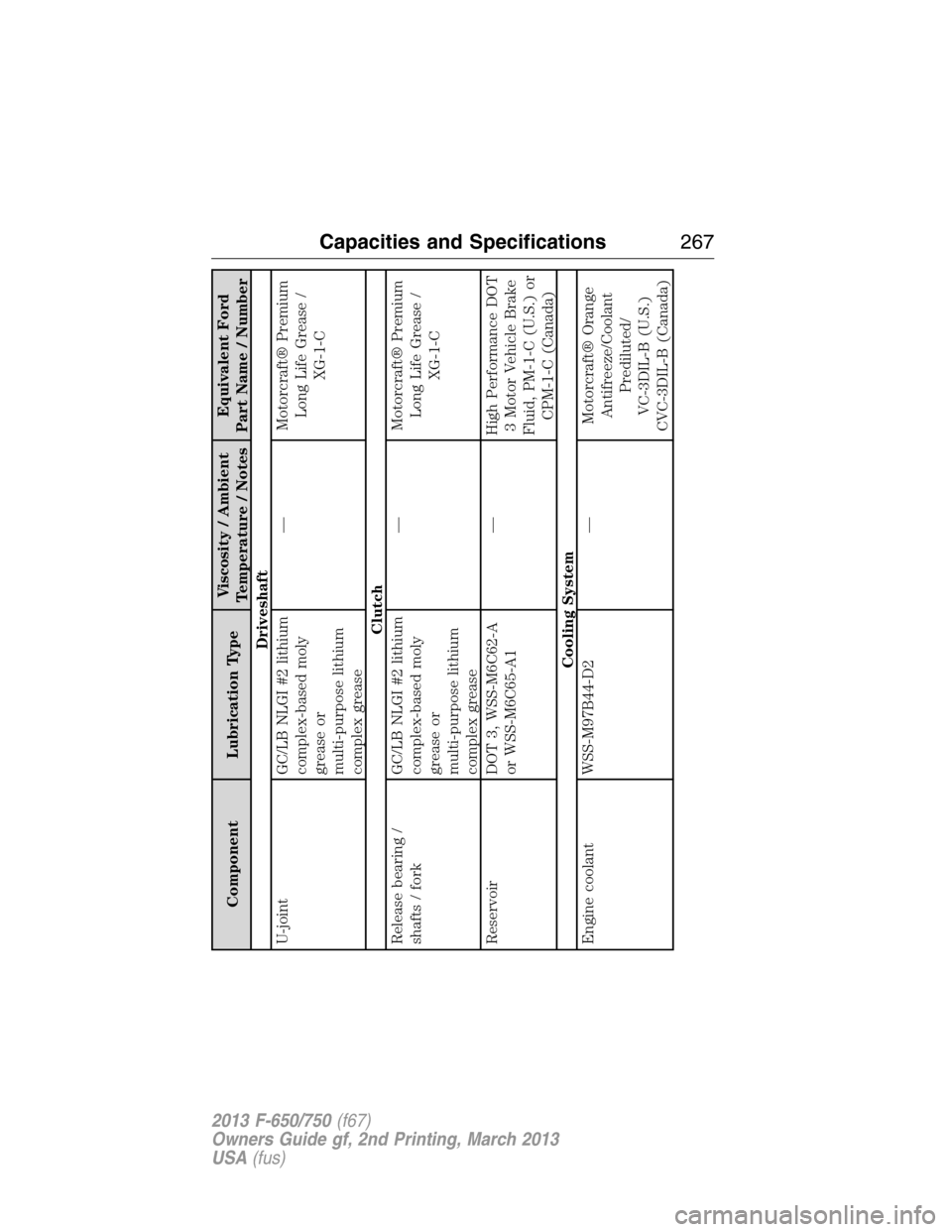
Component Lubrication TypeViscosity / Ambient
Temperature / NotesEquivalent Ford
Part Name / Number
Driveshaft
U-joint GC/LB NLGI #2 lithium
complex-based moly
grease or
multi-purpose lithium
complex grease— Motorcraft® Premium
Long Life Grease /
XG-1-C
Clutch
Release bearing /
shafts / forkGC/LB NLGI #2 lithium
complex-based moly
grease or
multi-purpose lithium
complex grease— Motorcraft® Premium
Long Life Grease /
XG-1-C
Reservoir DOT 3, WSS-M6C62-A
or WSS-M6C65-A1— High Performance DOT
3 Motor Vehicle Brake
Fluid, PM-1-C (U.S.) or
CPM-1-C (Canada)
Cooling System
Engine coolant WSS-M97B44-D2 — Motorcraft® Orange
Antifreeze/Coolant
Prediluted/
VC-3DIL-B (U.S.)
CVC-3DIL-B (Canada)
Capacities and Specifications267
2013 F-650/750(f67)
Owners Guide gf, 2nd Printing, March 2013
USA(fus)
Page 278 of 378
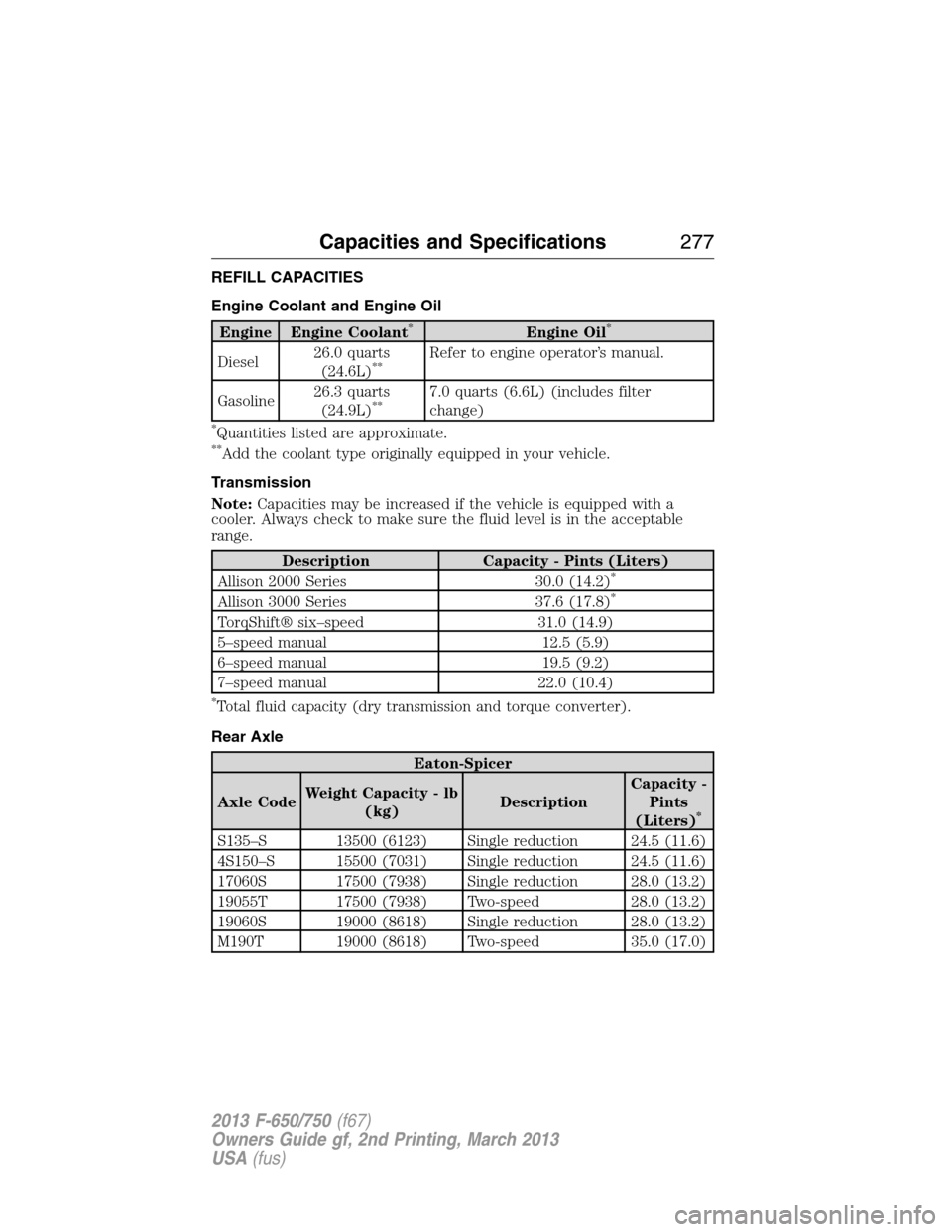
REFILL CAPACITIES
Engine Coolant and Engine Oil
Engine Engine Coolant*Engine Oil*
Diesel26.0 quarts
(24.6L)**Refer to engine operator’s manual.
Gasoline26.3 quarts
(24.9L)
**7.0 quarts (6.6L) (includes filter
change)
*Quantities listed are approximate.**Add the coolant type originally equipped in your vehicle.
Transmission
Note:Capacities may be increased if the vehicle is equipped with a
cooler. Always check to make sure the fluid level is in the acceptable
range.
Description Capacity - Pints (Liters)
Allison 2000 Series 30.0 (14.2)*
Allison 3000 Series 37.6 (17.8)*
TorqShift® six–speed 31.0 (14.9)
5–speed manual 12.5 (5.9)
6–speed manual 19.5 (9.2)
7–speed manual 22.0 (10.4)
*Total fluid capacity (dry transmission and torque converter).
Rear Axle
Eaton-Spicer
Axle CodeWeight Capacity - lb
(kg)DescriptionCapacity -
Pints
(Liters)
*
S135–S 13500 (6123) Single reduction 24.5 (11.6)
4S150–S 15500 (7031) Single reduction 24.5 (11.6)
17060S 17500 (7938) Single reduction 28.0 (13.2)
19055T 17500 (7938) Two-speed 28.0 (13.2)
19060S 19000 (8618) Single reduction 28.0 (13.2)
M190T 19000 (8618) Two-speed 35.0 (17.0)
Capacities and Specifications277
2013 F-650/750(f67)
Owners Guide gf, 2nd Printing, March 2013
USA(fus)