instrument cluster FORD F650 2013 12.G User Guide
[x] Cancel search | Manufacturer: FORD, Model Year: 2013, Model line: F650, Model: FORD F650 2013 12.GPages: 378, PDF Size: 3.82 MB
Page 72 of 378
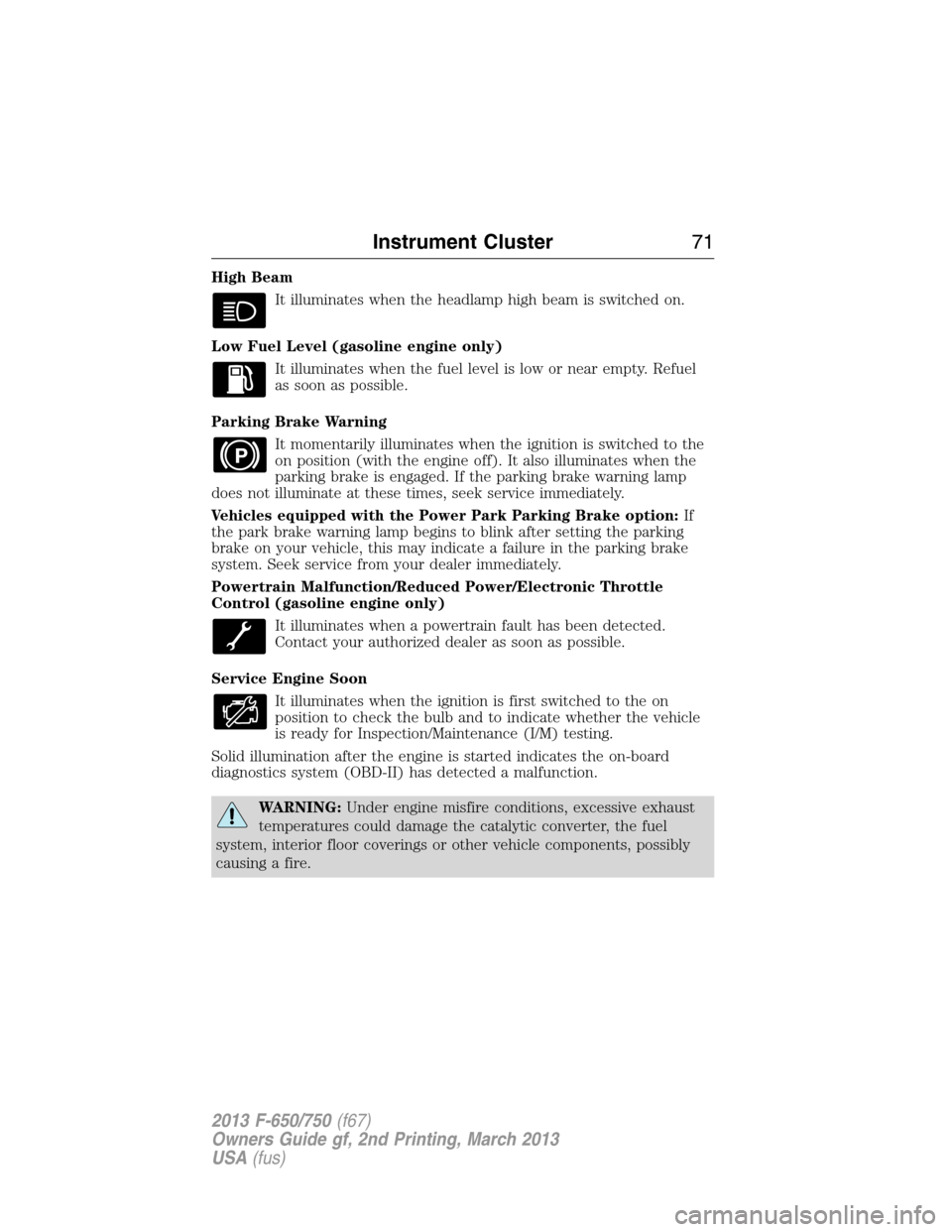
High Beam
It illuminates when the headlamp high beam is switched on.
Low Fuel Level (gasoline engine only)
It illuminates when the fuel level is low or near empty. Refuel
as soon as possible.
Parking Brake Warning
It momentarily illuminates when the ignition is switched to the
on position (with the engine off). It also illuminates when the
parking brake is engaged. If the parking brake warning lamp
does not illuminate at these times, seek service immediately.
Vehicles equipped with the Power Park Parking Brake option:If
the park brake warning lamp begins to blink after setting the parking
brake on your vehicle, this may indicate a failure in the parking brake
system. Seek service from your dealer immediately.
Powertrain Malfunction/Reduced Power/Electronic Throttle
Control (gasoline engine only)
It illuminates when a powertrain fault has been detected.
Contact your authorized dealer as soon as possible.
Service Engine Soon
It illuminates when the ignition is first switched to the on
position to check the bulb and to indicate whether the vehicle
is ready for Inspection/Maintenance (I/M) testing.
Solid illumination after the engine is started indicates the on-board
diagnostics system (OBD-II) has detected a malfunction.
WARNING:Under engine misfire conditions, excessive exhaust
temperatures could damage the catalytic converter, the fuel
system, interior floor coverings or other vehicle components, possibly
causing a fire.
P
Instrument Cluster71
2013 F-650/750(f67)
Owners Guide gf, 2nd Printing, March 2013
USA(fus)
Page 73 of 378
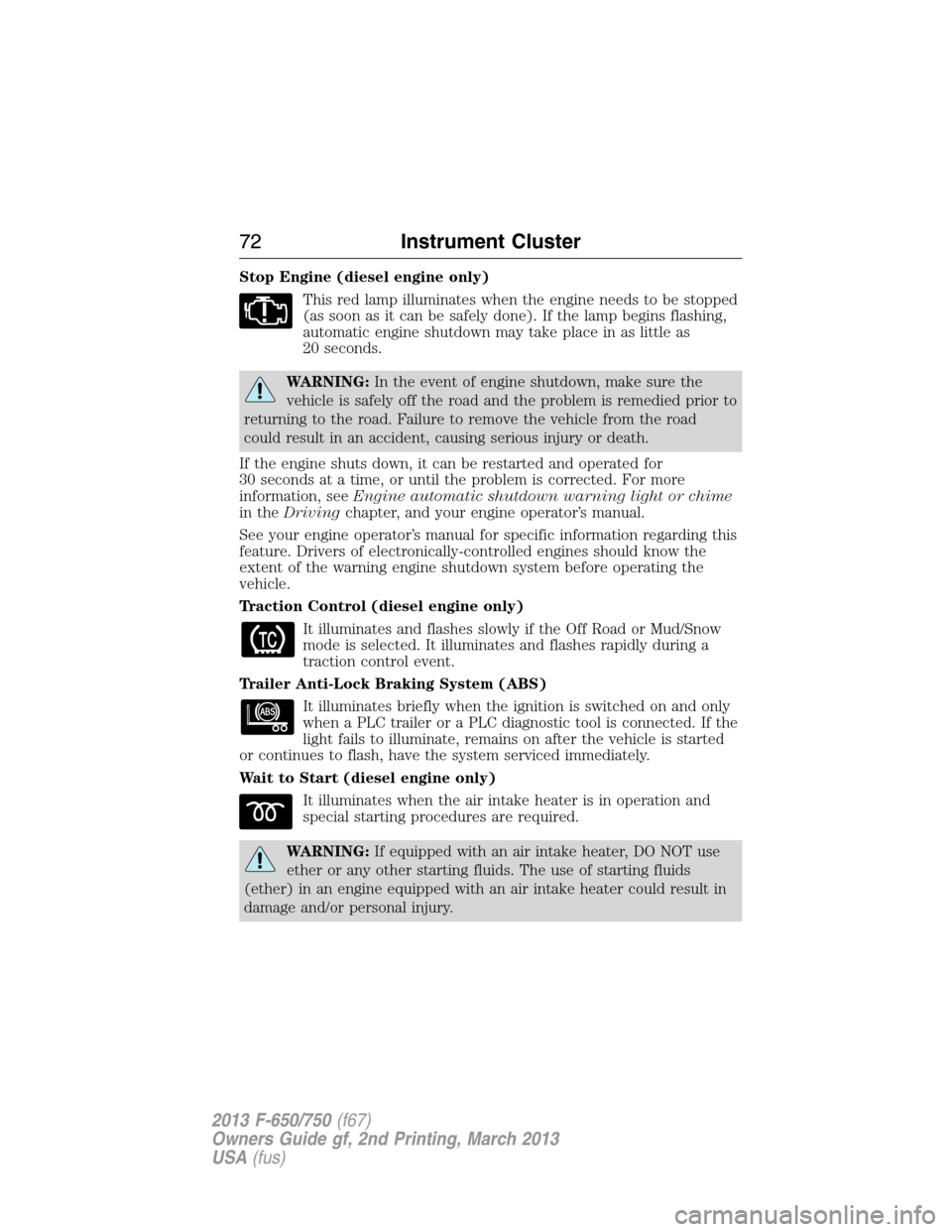
Stop Engine (diesel engine only)
This red lamp illuminates when the engine needs to be stopped
(as soon as it can be safely done). If the lamp begins flashing,
automatic engine shutdown may take place in as little as
20 seconds.
WARNING:In the event of engine shutdown, make sure the
vehicle is safely off the road and the problem is remedied prior to
returning to the road. Failure to remove the vehicle from the road
could result in an accident, causing serious injury or death.
If the engine shuts down, it can be restarted and operated for
30 seconds at a time, or until the problem is corrected. For more
information, seeEngine automatic shutdown warning light or chime
in theDrivingchapter, and your engine operator’s manual.
See your engine operator’s manual for specific information regarding this
feature. Drivers of electronically-controlled engines should know the
extent of the warning engine shutdown system before operating the
vehicle.
Traction Control (diesel engine only)
It illuminates and flashes slowly if the Off Road or Mud/Snow
mode is selected. It illuminates and flashes rapidly during a
traction control event.
Trailer Anti-Lock Braking System (ABS)
It illuminates briefly when the ignition is switched on and only
when a PLC trailer or a PLC diagnostic tool is connected. If the
light fails to illuminate, remains on after the vehicle is started
or continues to flash, have the system serviced immediately.
Wait to Start (diesel engine only)
It illuminates when the air intake heater is in operation and
special starting procedures are required.
WARNING:If equipped with an air intake heater, DO NOT use
ether or any other starting fluids. The use of starting fluids
(ether) in an engine equipped with an air intake heater could result in
damage and/or personal injury.
72Instrument Cluster
2013 F-650/750(f67)
Owners Guide gf, 2nd Printing, March 2013
USA(fus)
Page 74 of 378
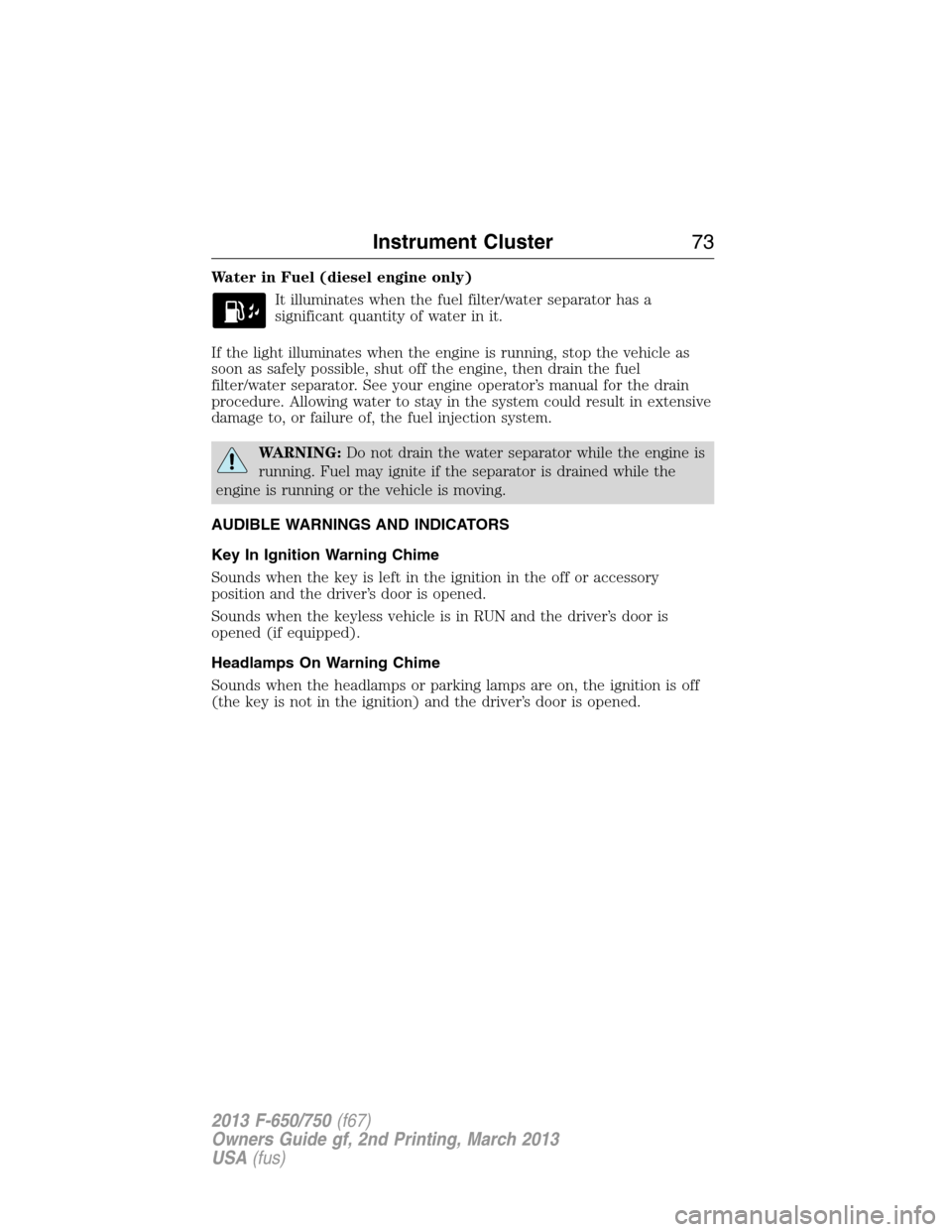
Water in Fuel (diesel engine only)
It illuminates when the fuel filter/water separator has a
significant quantity of water in it.
If the light illuminates when the engine is running, stop the vehicle as
soon as safely possible, shut off the engine, then drain the fuel
filter/water separator. See your engine operator’s manual for the drain
procedure. Allowing water to stay in the system could result in extensive
damage to, or failure of, the fuel injection system.
WARNING:Do not drain the water separator while the engine is
running. Fuel may ignite if the separator is drained while the
engine is running or the vehicle is moving.
AUDIBLE WARNINGS AND INDICATORS
Key In Ignition Warning Chime
Sounds when the key is left in the ignition in the off or accessory
position and the driver’s door is opened.
Sounds when the keyless vehicle is in RUN and the driver’s door is
opened (if equipped).
Headlamps On Warning Chime
Sounds when the headlamps or parking lamps are on, the ignition is off
(the key is not in the ignition) and the driver’s door is opened.
Instrument Cluster73
2013 F-650/750(f67)
Owners Guide gf, 2nd Printing, March 2013
USA(fus)
Page 109 of 378
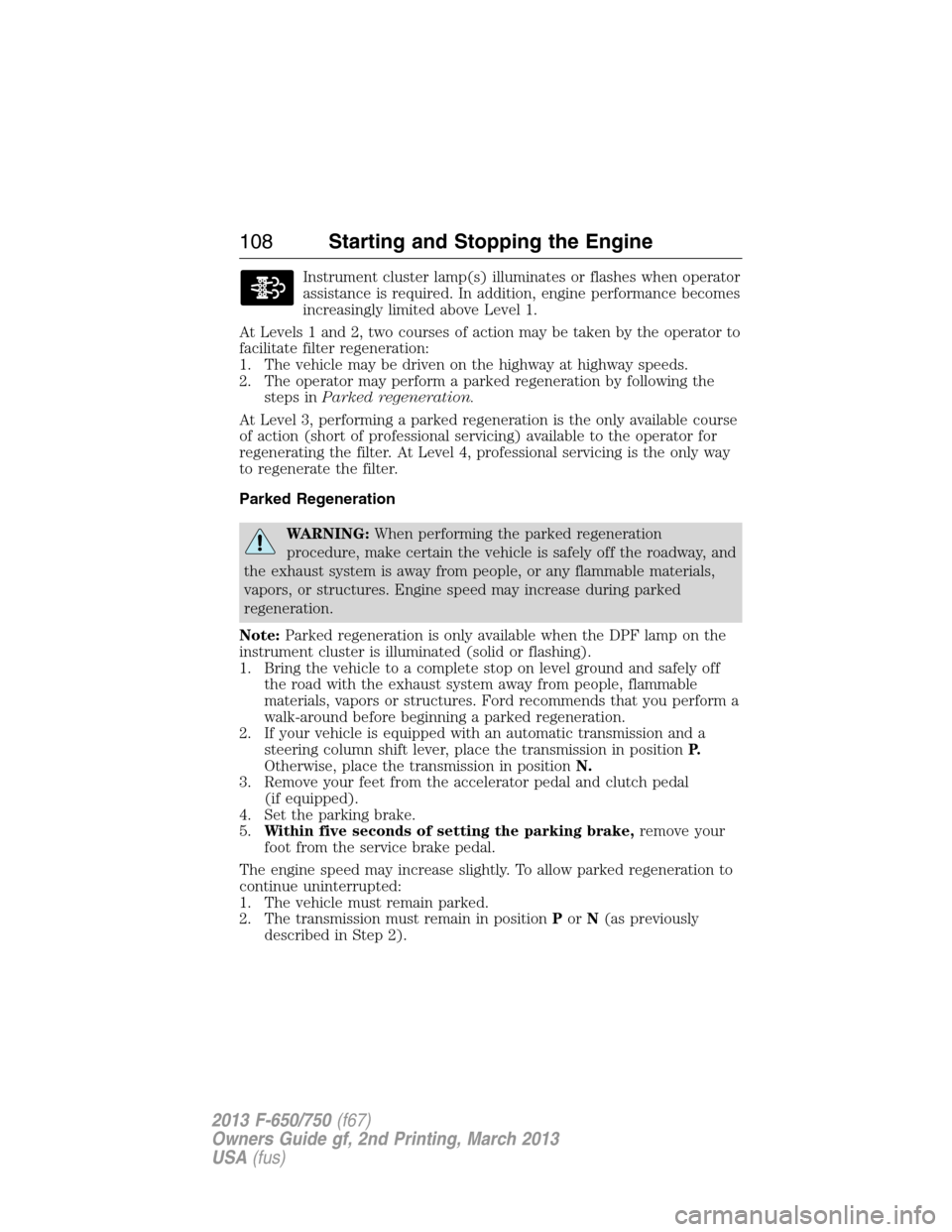
Instrument cluster lamp(s) illuminates or flashes when operator
assistance is required. In addition, engine performance becomes
increasingly limited above Level 1.
At Levels 1 and 2, two courses of action may be taken by the operator to
facilitate filter regeneration:
1. The vehicle may be driven on the highway at highway speeds.
2. The operator may perform a parked regeneration by following the
steps inParked regeneration.
At Level 3, performing a parked regeneration is the only available course
of action (short of professional servicing) available to the operator for
regenerating the filter. At Level 4, professional servicing is the only way
to regenerate the filter.
Parked Regeneration
WARNING:When performing the parked regeneration
procedure, make certain the vehicle is safely off the roadway, and
the exhaust system is away from people, or any flammable materials,
vapors, or structures. Engine speed may increase during parked
regeneration.
Note:Parked regeneration is only available when the DPF lamp on the
instrument cluster is illuminated (solid or flashing).
1. Bring the vehicle to a complete stop on level ground and safely off
the road with the exhaust system away from people, flammable
materials, vapors or structures. Ford recommends that you perform a
walk-around before beginning a parked regeneration.
2. If your vehicle is equipped with an automatic transmission and a
steering column shift lever, place the transmission in positionP.
Otherwise, place the transmission in positionN.
3. Remove your feet from the accelerator pedal and clutch pedal
(if equipped).
4. Set the parking brake.
5.Within five seconds of setting the parking brake,remove your
foot from the service brake pedal.
The engine speed may increase slightly. To allow parked regeneration to
continue uninterrupted:
1. The vehicle must remain parked.
2. The transmission must remain in positionPorN(as previously
described in Step 2).
108Starting and Stopping the Engine
2013 F-650/750(f67)
Owners Guide gf, 2nd Printing, March 2013
USA(fus)
Page 111 of 378
The exhaust outlet assembly on your vehicle is a uniquely functioning
device that accompanies the DPF assembly. It is designed to help control
the temperature of the exhaust during the DPF regeneration process.
The inlet holes in the side of the assembly are functional. These holes
allow outside air to be drawn into the outlet assembly. The holes need to
be kept clear of mud and other foreign material to maintain proper
functionality of the system. One way to keep the holes clear is to spray
the outlet assembly with a hose when washing the vehicle. Failure to
keep the functional holes clear of foreign material may result in the holes
becoming blocked or plugged.
SWITCHING OFF A DIESEL ENGINE
Allow the engine to idle for three to five minutes before shutting it
down; the larger the engine, the greater the need for this idling period.
Note:Try to limit engine idle to 10 minutes. Excessive idling reduces
fuel economy.
ENGINE AUTOMATIC SHUTDOWN (IF EQUIPPED)
WARNING:In the event of engine shutdown, make sure the
vehicle is safely off the road and the problem is remedied prior to
returning to the road. Failure to remove the vehicle from the road
could result in an accident, causing serious injury or death.
This feature either illuminates a light in the instrument cluster or sounds
a chime (or both) indicating that the engine is being shut down in the
event of high coolant temperature, low engine oil pressure, high diesel
particulate filter soot loading or low engine coolant level. In the event
any of these conditions exist, the engine automatically shuts down.
If the engine shuts down, it can be restarted and operated for
30 seconds at a time or until the problem is corrected. Do not attempt to
use this restarting feature to drive the vehicle very far as serious engine
damage could result.
11 0Starting and Stopping the Engine
2013 F-650/750(f67)
Owners Guide gf, 2nd Printing, March 2013
USA(fus)
Page 117 of 378
Octane Recommendations - Gasoline Engines
Regular unleaded gasoline with a
pump (R+M)/2 octane rating of 87 is
recommended. Some stations offer
fuels posted as Regular with an
octane rating below 87, particularly in
high altitude areas. Do not use fuels with a posted octane rating below 87.
Do not be concerned if your engine sometimes knocks lightly. However, if
it knocks heavily under most driving conditions while you are using fuel
with the recommended octane rating, see your authorized dealer to
prevent any engine damage.
RUNNING OUT OF FUEL
Gasoline Engine
Avoid running out of fuel because this situation may have an adverse
effect on powertrain components.
If you have run out of fuel:
•You may need to cycle the ignition from off to on several times after
refueling to allow the fuel system to pump the fuel from the tank to
the engine. On restarting, cranking time takes a few seconds longer
than normal.
•If your vehicle is equipped with dual fuel tanks,adding
four–five gallons (15–19 liters) of fuel is enough to restart the
engine. If the vehicle is out of fuel and on a steep grade, more than
four–five gallons (15–19 liters) may be required.
•The service engine soon indicator may come on. For more
information on the service engine soon indicator, see theInstrument
Clusterchapter.
SeeGeneral informationin theInformation Displayschapter for
information on Miles to Empty.
Diesel Engine
Avoid running out of fuel as this allows air to enter the fuel system,
which makes restarting the vehicle difficult.
If you have run out of fuel:
•If your vehicle is equipped with dual fuel tanks,adding
four–five gallons (15–19 liters) of fuel is enough to restart the
engine. If the vehicle is out of fuel and on a steep grade, more than
four–five gallons (15–19 liters) may be required.
87(R+M)/2 METHOD
11 6Fuel and Refueling
2013 F-650/750(f67)
Owners Guide gf, 2nd Printing, March 2013
USA(fus)
Page 119 of 378
Fuel Filler Cap
WARNING:The fuel system may be under pressure. If the fuel
filler cap is venting vapor or if you hear a hissing sound, wait
until it stops before completely removing the fuel filler cap. Otherwise,
fuel may spray out and injure you or others.
WARNING:If you do not use the proper fuel filler cap, excessive
pressure or vacuum in the fuel tank may damage the fuel system
or cause the fuel cap to disengage in a crash, which may result in
possible personal injury.
Note:If you must replace the fuel filler cap, replace it with a fuel filler
cap that is designed for your vehicle. The customer warranty may be
void for any damage to the fuel tank or fuel system if the correct
genuine Ford, Motorcraft® or other certified fuel filler cap is not used.
Your fuel tank filler cap has an indexed design with a
14–turn on and off
feature. When fueling your vehicle:
1. Turn the engine off.
2. Carefully turn the filler cap counterclockwise until it spins off.
3. Pull to remove the cap from the fuel filler pipe.
4. To install the cap, align the tabs on the cap with the notches on the
filler pipe.
5. Turn the filler cap clockwise a
14–turn until it clicks at least once.
If the check fuel cap light appears in the instrument cluster and stays on
after you start the engine, the fuel filler cap may not be properly
installed.
If the fuel cap light remains on, at the next opportunity, safely pull off of
the road, remove the fuel filler cap, align the cap properly and reinstall
it. The check fuel cap light may not reset immediately; it may take
several driving cycles for the indicators to turn off. A driving cycle
consists of an engine start-up (after four or more hours with the engine
off) followed by normal city and highway driving.
FUEL CONSUMPTION
Filling the Tank
The advertised capacity is the indicated capacity and the empty reserve
combined. Indicated capacity is the difference in the amount of fuel in a
full tank and a tank when the fuel gauge indicates empty. Empty reserve
is the amount of fuel in the tank after the fuel gauge indicates empty.
11 8Fuel and Refueling
2013 F-650/750(f67)
Owners Guide gf, 2nd Printing, March 2013
USA(fus)
Page 121 of 378
SELECTIVE CATALYTIC REDUCTION (SCR) SYSTEM (DIESEL
ENGINE ONLY)
Your vehicle is equipped with a selective catalytic reduction (SCR)
system to help reduce emission levels of oxides of nitrogen from the
exhaust of the diesel engine. The system automatically injects diesel
exhaust fluid (DEF) into the exhaust system to enable proper SCR
function.
Importance of Maintaining the DEF Level
In order for the SCR system to operate properly, the DEF level must be
maintained. Generally, the DEF tank should be filled before the DEF
gauge in the instrument cluster reaches the first low level warning
(seeWarning messages and vehicle operations).
The engine control unit monitors the amount of fluid available in the
DEF tank. Failure to maintain an adequate amount of DEF in the system
generates warning messages that appear in the information display and,
unless the DEF tank is refilled, leads to a forced reduction of engine
operations.
Warning Messages and Vehicle Operations
The instrument cluster contains a DEF gauge and indicator lights to alert
you to any low DEF level conditions. The indicator lights illuminate if the
DEF gauge level drops below 0.5 gallons (1.9 liters) in the 5 gallon
(19.0 liters) DEF tank or 1 gallon (3.8 liters) in the 9 gallon (34.0 liters)
DEF tank.
Upon filling the DEF tank after a low level warning, normal operation
resumes when the vehicle is restarted.
120Fuel and Refueling
2013 F-650/750(f67)
Owners Guide gf, 2nd Printing, March 2013
USA(fus)
Page 141 of 378
Allison 2500
WARNING: To avoid sudden, unexpected vehicle movement
and possible personal injury or death:
1. Bring the vehicle to a complete stop.
2. Shift the transmission into positionN.
3. Apply the parking brake and make sure it is holding properly.
4. Turn the engine off when you leave the vehicle.Never leave the
vehicle unattended when the engine is running.
This transmission is available with a column-mounted gearshift lever. The
gear positions are displayed on the RNDL in the instrument cluster.
Allison 3000
Note:For more information regarding this transmission, see the separate
Allison 3000 Series Operator’s Manual.
The Allison 3000 series offers two shift modes: Performance and
Economy.
Performance mode gives the best all-around transmission operation. The
transmission defaults to this mode when you start the engine. Pressing
MODE on the shifter switches to Economy mode and illuminates the
Mode ON lamp.
Economy mode provides operation at lower engine RPM while
maintaining adequate performance.
If the engine speed is above idle when a gear is selected using the
shifter, the vehicle does not move; the shifter must be moved to re-select
a gear after the engine speed returns to idle.
Torque Lock
If your vehicle is parked on an incline and positionPis not properly
engaged (the parking brake is not applied before the transmission is
shifted into positionP),the weight of the vehicle may generate an
excessive amount of torque on the parking pawl, making it difficult to
shift the transmission out of positionP.Hold the brake pedal down while
shifting out of positionP,then release the parking brake.
140Transmission
2013 F-650/750(f67)
Owners Guide gf, 2nd Printing, March 2013
USA(fus)
Page 148 of 378
GENERAL INFORMATION
All standard equipment brakes are designed to be self-adjusting.
Automatic adjustment, when required, occurs whenever the brakes are
applied and released during forward or reverse operation.
Note:Occasional brake noise is normal. If a metal-to-metal, continuous
grinding or continuous squeal sound is present, the brake linings may be
worn out and should be inspected by an authorized dealer. If the vehicle
has continuous vibration or shudder in the steering wheel while braking,
the vehicle should be inspected by an authorized dealer.
Know the required stopping distances for all driving conditions that may
be encountered. For longer brake lining life, take full advantage of engine
braking power when coming to a stop.
WARNING:Do not drive with your foot resting on the brake
pedal. This results in abnormally high brake temperatures,
excessive lining wear and increased stopping distances.
Before descending a long or steep hill, shift to a lower gear and avoid
continuous application of the brakes. Normally, choose the same gear to
descend the hill that you use to ascend the hill.
WARNING:Continuous application of the brakes causes the
brakes to overheat, resulting in a temporary loss of braking.
See theInstrument Clusterchapter for information on the
brake system warning light.
Wet brakes result in reduced braking efficiency. Gently press the brake
pedal a few times when driving from a car wash or standing water to dry
the brakes.
If Brakes Do Not Grip Well
•If you have been driving through deep water, gently apply the brakes
several times while the vehicle is moving slowly.
•Let the brakes cool if you have been using them excessively, as in
mountain driving or after several fast, high-speed stops.
•Check brake adjustment.
•Check brake linings for excessive wear.
•Check system air pressure on vehicles equipped with air brakes.
Brakes147
2013 F-650/750(f67)
Owners Guide gf, 2nd Printing, March 2013
USA(fus)