transmission fluid FORD F650 2013 12.G User Guide
[x] Cancel search | Manufacturer: FORD, Model Year: 2013, Model line: F650, Model: FORD F650 2013 12.GPages: 378, PDF Size: 3.82 MB
Page 181 of 378
Towing the Vehicle with the Rear Wheels Suspended
Note:To avoid damage to the cab roof or air deflector when towing the
vehicle backward (rear wheels suspended), the air deflector must be
removed.
Whenever possible, it is preferable to tow a disabled vehicle from the
rear by raising the rear of the chassis. When towing a vehicle with the
rear of the chassis suspended, the front wheels must be locked in the
straight-ahead position.
Vehicles equipped with a manual transmission must have at least 1.0 pint
(0.5 liter) of transmission fluid drained from the case. This prevents the
transmission fluid from entering the clutch housing and saturating the
clutch discs. Make sure that the transmission fluid is replaced before the
vehicle is returned to service.
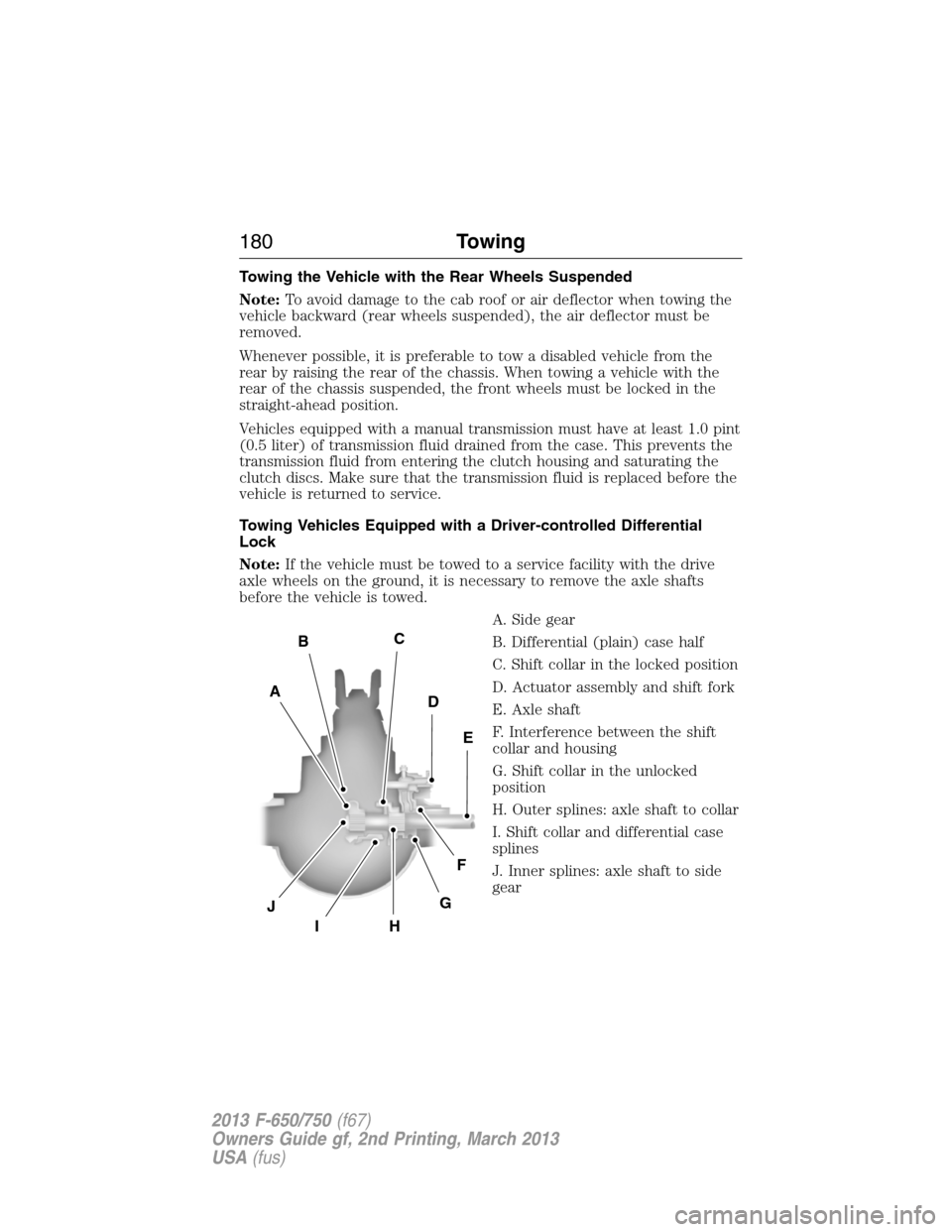
Towing Vehicles Equipped with a Driver-controlled Differential
Lock
Note:If the vehicle must be towed to a service facility with the drive
axle wheels on the ground, it is necessary to remove the axle shafts
before the vehicle is towed.
A. Side gear
B. Differential (plain) case half
C. Shift collar in the locked position
D. Actuator assembly and shift fork
E. Axle shaft
F. Interference between the shift
collar and housing
G. Shift collar in the unlocked
position
H. Outer splines: axle shaft to collar
I. Shift collar and differential case
splines
J. Inner splines: axle shaft to side
gear
E
D
CB
A
J
IH
G
F
180Towing
2013 F-650/750(f67)
Owners Guide gf, 2nd Printing, March 2013
USA(fus)
Page 224 of 378
TRANSMISSION FLUID CHECK
Allison Automatic Transmissions
See yourAllison Automatic Transmission Operator’s Manualfor
scheduled transmission fluid checks and change intervals. Your
transmission does not consume fluid. However, the fluid level should be
checked if the transmission is not working properly, i.e., if the
transmission slips or shifts slowly or if you notice some sign of fluid
leakage.
Automatic transmission fluid expands when warmed. To obtain an
accurate fluid check, drive the vehicle until it is at normal operating
temperature (approximately 20 miles [30 kilometers]). Verify that the
transmission fluid temperature gauge, located on the instrument cluster,
is within the normal range.
1. Drive the vehicle 20 miles (30 kilometers) or until it reaches normal
operating temperature.
2. Park the vehicle on a level surface and engage the parking brake.
3. With the engine running, parking brake engaged and your foot on the
brake pedal, move the gearshift lever through all of the gear ranges.
Allow sufficient time for each gear to engage.
4. Latch the gearshift lever in positionNorPand leave the engine
running.
5. Remove the dipstick, wiping it clean with a clean, dry, lint-free rag.
6. Install the dipstick making sure it is fully seated in the filler tube.
7. Remove the dipstick and inspect the fluid level. The fluid should be
in the designated area for normal operating temperature or ambient
temperature.
If you must add transmission fluid, see yourAllison Automatic
Transmission Operator’s Manualfor the correct fluid type.Use of a
non-approved automatic transmission fluid may cause internal
transmission component damage.
Fluid levels above the safe range may result in transmission failure. An
overfill condition of transmission fluid may cause shift or engagement
concerns or possible damage.
TorqShift® Automatic Transmission
See theScheduled Maintenancechapter for scheduled intervals for
fluid checks and changes. Your transmission does not consume fluid.
However, the fluid level should be checked if the transmission is not
working properly, i.e., if the transmission slips or shifts slowly or if you
notice some sign of fluid leakage.
Maintenance223
2013 F-650/750(f67)
Owners Guide gf, 2nd Printing, March 2013
USA(fus)
Page 225 of 378
![FORD F650 2013 12.G User Guide Automatic transmission fluid expands when warmed. To obtain an
accurate fluid check, drive the vehicle until it is at normal operating
temperature (approximately 20 miles [30 kilometers]). Verify that](/img/11/5079/w960_5079-224.png "FORD F650 2013 12.G User Guide Automatic transmission fluid expands when warmed. To obtain an
accurate fluid check, drive the vehicle until it is at normal operating
temperature (approximately 20 miles [30 kilometers]). Verify that")
Automatic transmission fluid expands when warmed. To obtain an
accurate fluid check, drive the vehicle until it is at normal operating
temperature (approximately 20 miles [30 kilometers]). Verify that the
transmission fluid temperature gauge, located on the instrument cluster,
is within the normal range.
1. Drive the vehicle 20 miles (30 kilometers) or until it reaches normal
operating temperature.
2. Park the vehicle on a level surface and engage the parking brake.
3. With the engine running, parking brake engaged and your foot on the
brake pedal, move the gearshift lever through all of the gear ranges.
Allow sufficient time for each gear to engage.
4. Latch the gearshift lever in positionPand leave the engine running.
5. Remove the dipstick, wiping it clean with a clean, dry, lint-free rag.
6. Install the dipstick making sure it is fully seated in the filler tube.
7. Remove the dipstick and inspect the fluid level. The fluid should be
in the designated area for normal operating temperature or ambient
temperature.
Low Fluid Level
Do not drive the vehicle if there is
no indication of fluid on the dipstick
and the ambient temperature is
above 50°F (10°C).
Correct Fluid Level
The fluid should be checked at
normal operating temperature
196°F-216°F (91°C-102°C) on a
level surface. The normal operating
temperature can be reached after approximately 20 miles (30 kilometers)
of driving.
224Maintenance
2013 F-650/750(f67)
Owners Guide gf, 2nd Printing, March 2013
USA(fus)
Page 226 of 378
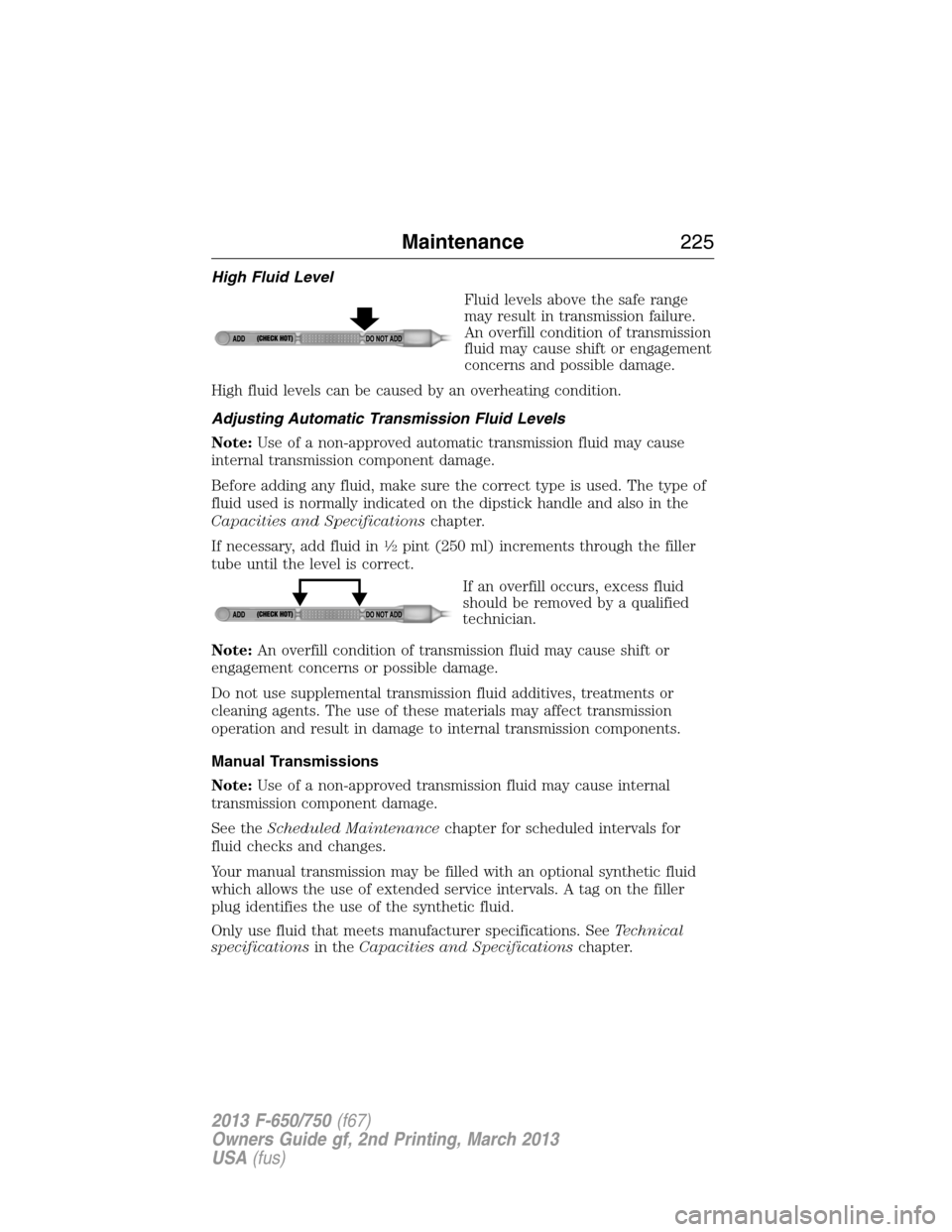
High Fluid Level
Fluid levels above the safe range
may result in transmission failure.
An overfill condition of transmission
fluid may cause shift or engagement
concerns and possible damage.
High fluid levels can be caused by an overheating condition.
Adjusting Automatic Transmission Fluid Levels
Note:Use of a non-approved automatic transmission fluid may cause
internal transmission component damage.
Before adding any fluid, make sure the correct type is used. The type of
fluid used is normally indicated on the dipstick handle and also in the
Capacities and Specificationschapter.
If necessary, add fluid in
12pint (250 ml) increments through the filler
tube until the level is correct.
If an overfill occurs, excess fluid
should be removed by a qualified
technician.
Note:An overfill condition of transmission fluid may cause shift or
engagement concerns or possible damage.
Do not use supplemental transmission fluid additives, treatments or
cleaning agents. The use of these materials may affect transmission
operation and result in damage to internal transmission components.
Manual Transmissions
Note:Use of a non-approved transmission fluid may cause internal
transmission component damage.
See theScheduled Maintenancechapter for scheduled intervals for
fluid checks and changes.
Your manual transmission may be filled with an optional synthetic fluid
which allows the use of extended service intervals. A tag on the filler
plug identifies the use of the synthetic fluid.
Only use fluid that meets manufacturer specifications. SeeTechnical
specificationsin theCapacities and Specificationschapter.
Maintenance225
2013 F-650/750(f67)
Owners Guide gf, 2nd Printing, March 2013
USA(fus)
Page 227 of 378
Checking Fluid Level
1. Park the vehicle on level ground.
2. Set the parking brake, shift into first gear and turn the engine off.
3. Clean any dirt from around the filler plug.
4. Remove the filler plug and inspect the fluid level. The fluid level
should be at the bottom of the filler plug opening.
5. Add fluid, if necessary, through the filler plug opening.
6. Clean and install the filler plug securely.
Changing Fluid
Drain and refill your transmission fluid while it is warm.
1. Park the vehicle on level ground.
2. Set the parking brake, shift into first gear and turn the engine off.
3. Clean any dirt from around the filler and drain plugs.
4. Remove the filler and drain plugs and drain the fluid into a suitable
container. Dispose of all used automotive fluids in a responsible
manner following your local authorized standards.
5. Clean and install the drain plug securely.
6. Add fluid through the filler plug opening.
7. Clean and install the filler plug securely.
DRIVESHAFT
Check the universal joints for any evidence of wear or looseness at the
regular lubrication interval. Stop the vehicle immediately, should
driveshaft vibrations occur, to avoid possible hazardous consequences or
damage to other components.
REAR AXLE FLUID
Your rear axle may be filled with an optional synthetic lubricant which
allows the use of extended service intervals. A tag on the filler plug
identifies the use of the synthetic lubricant.
Only use a lubricant that meets manufacturer specifications. See the
Capacities and Specificationschapter.Use of a non-approved rear
axle lubricant may cause internal axle component damage.
226Maintenance
2013 F-650/750(f67)
Owners Guide gf, 2nd Printing, March 2013
USA(fus)
Page 228 of 378
Checking the Fluid Level
See theScheduled Maintenancechapter for rear axle lubricant level
check intervals.
1. Park the vehicle on level ground.
2. Set the parking brake and shift into positionNorP(automatic
transmission), or first gear (manual transmission). Turn the engine
off.
3. Clean any dirt from around the rear axle filler plug.
4. Remove the filler plug and inspect the lubricant level. It should be at
the bottom of the filler plug opening.
5. Add lubricant, if necessary, through the filler plug opening.
6. Clean and install the filler plug securely.
Changing the Fluid
See theScheduled Maintenancechapter for rear axle lubricant change
intervals.
1. Drain the rear axle while the lubricant is warm.
2. Park the vehicle on level ground.
3. Set the parking brake and shift into positionNorP(automatic
transmission), or first gear (manual transmission). Turn the engine
off.
4. Clean any dirt from around the rear axle filler and drain plugs.
5. Remove the filler and drain plugs. Drain the lubricant into a suitable
container. Dispose of all used automotive fluids in a responsible
manner following your local authorized standards.
6. Clean and install the drain plug securely.
7. Add lubricant through the filler plug opening.
8. Clean and install the filler plug securely.
Maintenance227
2013 F-650/750(f67)
Owners Guide gf, 2nd Printing, March 2013
USA(fus)
Page 231 of 378
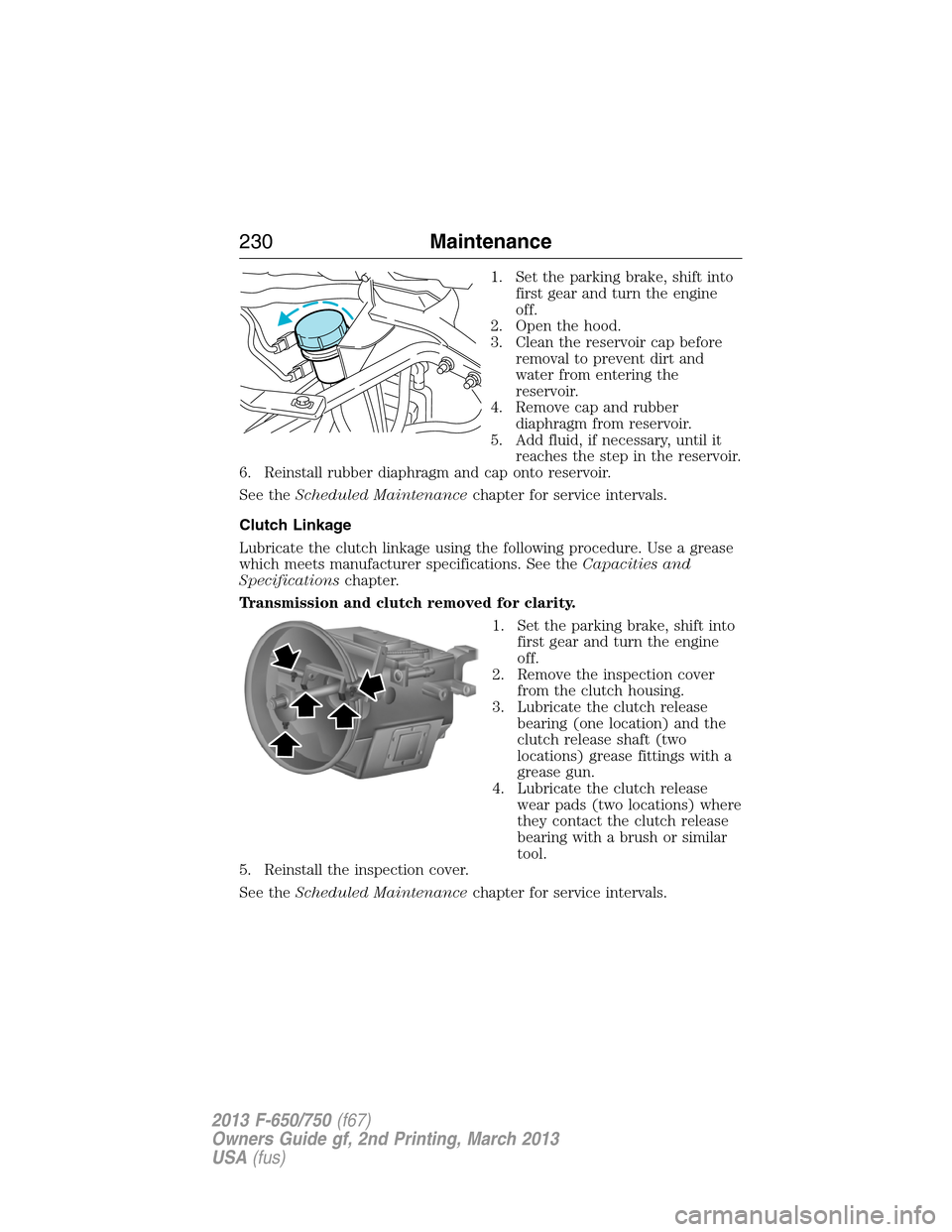
1. Set the parking brake, shift into
first gear and turn the engine
off.
2. Open the hood.
3. Clean the reservoir cap before
removal to prevent dirt and
water from entering the
reservoir.
4. Remove cap and rubber
diaphragm from reservoir.
5. Add fluid, if necessary, until it
reaches the step in the reservoir.
6. Reinstall rubber diaphragm and cap onto reservoir.
See theScheduled Maintenancechapter for service intervals.
Clutch Linkage
Lubricate the clutch linkage using the following procedure. Use a grease
which meets manufacturer specifications. See theCapacities and
Specificationschapter.
Transmission and clutch removed for clarity.
1. Set the parking brake, shift into
first gear and turn the engine
off.
2. Remove the inspection cover
from the clutch housing.
3. Lubricate the clutch release
bearing (one location) and the
clutch release shaft (two
locations) grease fittings with a
grease gun.
4. Lubricate the clutch release
wear pads (two locations) where
they contact the clutch release
bearing with a brush or similar
tool.
5. Reinstall the inspection cover.
See theScheduled Maintenancechapter for service intervals.
230Maintenance
2013 F-650/750(f67)
Owners Guide gf, 2nd Printing, March 2013
USA(fus)
Page 232 of 378
POWER STEERING FLUID CHECK
Note:To avoid damage to the power steering system, do not operate the
vehicle with a low power steering fluid level.
Note:If adding fluid is necessary, use only the appropriate fluid. See the
Capacities and Specificationschapter. A low fluid level may indicate a
leak in the power steering system. Inspect the power steering system
and repair the leak or see your dealer or a qualified technician for
service. See theScheduled Maintenancechapter for the recommended
service intervals.
Check the fluid level when it is at ambient temperature, 20°F–80°F
(-7°C–25°C):
1. Set the parking brake, then start the engine.
2. Shift into positionNorP(if equipped) (automatic transmission) or
first gear (manual transmission) and turn the engine off.
3. Open the hood.
4. Clean the top of the power steering fluid reservoir.
5. Remove the dipstick from the reservoir and wipe the dipstick clean.
6. Reinstall the dipstick. Remove it again and check the fluid level.
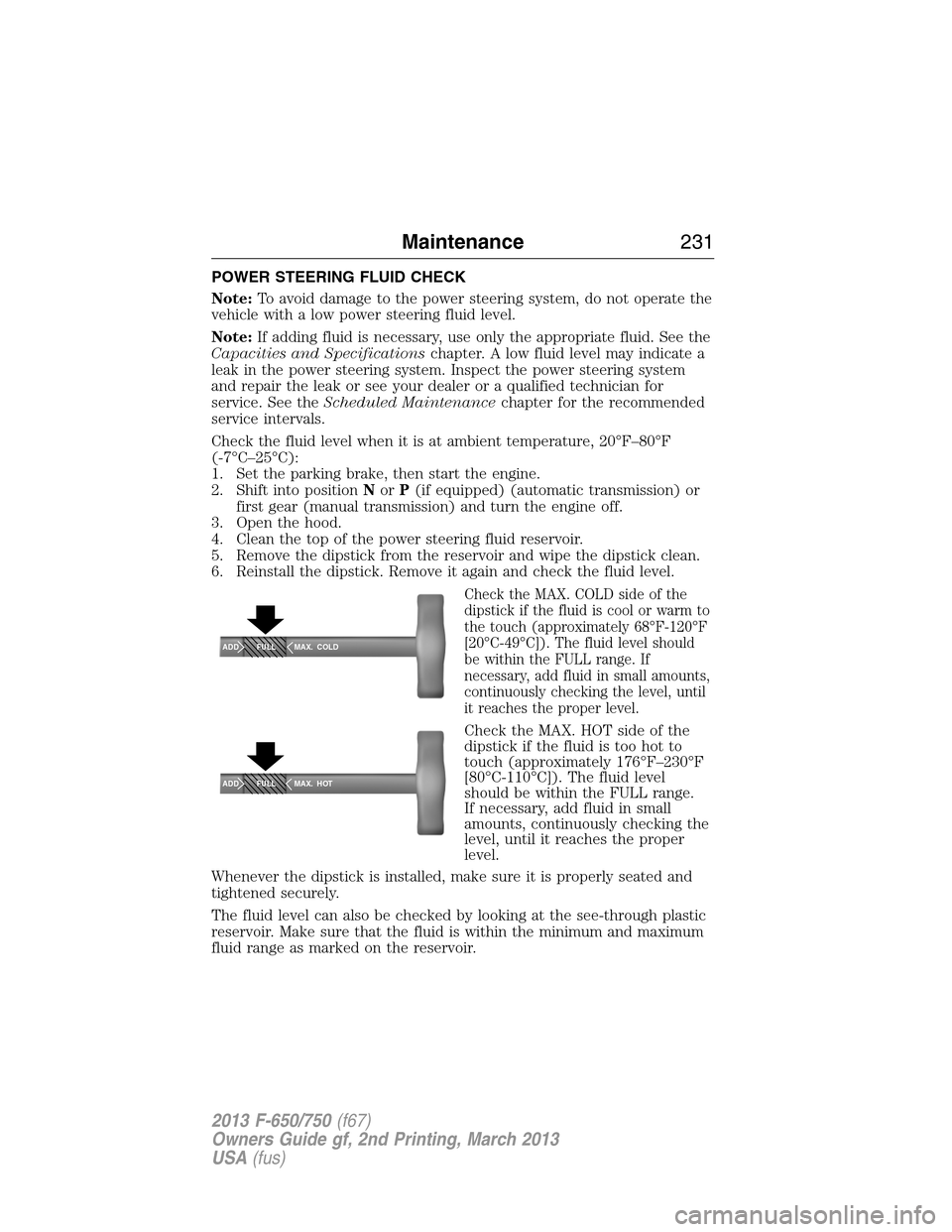
Check the MAX. COLD side of the
dipstick if the fluid is cool or warm to
the touch (approximately 68°F-120°F
[20°C-49°C]). The fluid level should
be within the FULL range. If
necessary, add fluid in small amounts,
continuously checking the level, until
it reaches the proper level.
Check the MAX. HOT side of the
dipstick if the fluid is too hot to
touch (approximately 176°F–230°F
[80°C-110°C]). The fluid level
should be within the FULL range.
If necessary, add fluid in small
amounts, continuously checking the
level, until it reaches the proper
level.
Whenever the dipstick is installed, make sure it is properly seated and
tightened securely.
The fluid level can also be checked by looking at the see-through plastic
reservoir. Make sure that the fluid is within the minimum and maximum
fluid range as marked on the reservoir.
ADD MAX. COLD
FULL
ADD MAX. HOT
FULL
Maintenance231
2013 F-650/750(f67)
Owners Guide gf, 2nd Printing, March 2013
USA(fus)
Page 236 of 378
6. Release the parking brake. With your foot on the brake pedal and
with the A/C on, put the vehicle in positionP(automatic
transmission) or neutral (manual transmission) and allow the engine
to idle for at least one minute.Note:If you do not allow the engine
to relearn its idle trim, the idle quality of your vehicle may be
adversely affected until the idle trim is eventually relearned.
7. Drive the vehicle to complete the relearning process.
If the battery has been disconnected or a new battery has been installed,
the clock and radio settings must be reset once the battery is
reconnected.
Always dispose of automotive
batteries in a responsible manner.
Follow your local authorized
standards for disposal. Call your
local authorized recycling center to
find out more about recycling
automotive batteries.
CHECKING THE WIPER BLADES
Run the tip of your fingers over the edge of the blade
to check for roughness.
Clean the wiper blades with washer fluid or water
applied with a soft sponge or cloth.
L
E
A
D
RETURN
RECYCLE
Maintenance235
2013 F-650/750(f67)
Owners Guide gf, 2nd Printing, March 2013
USA(fus)
Page 269 of 378
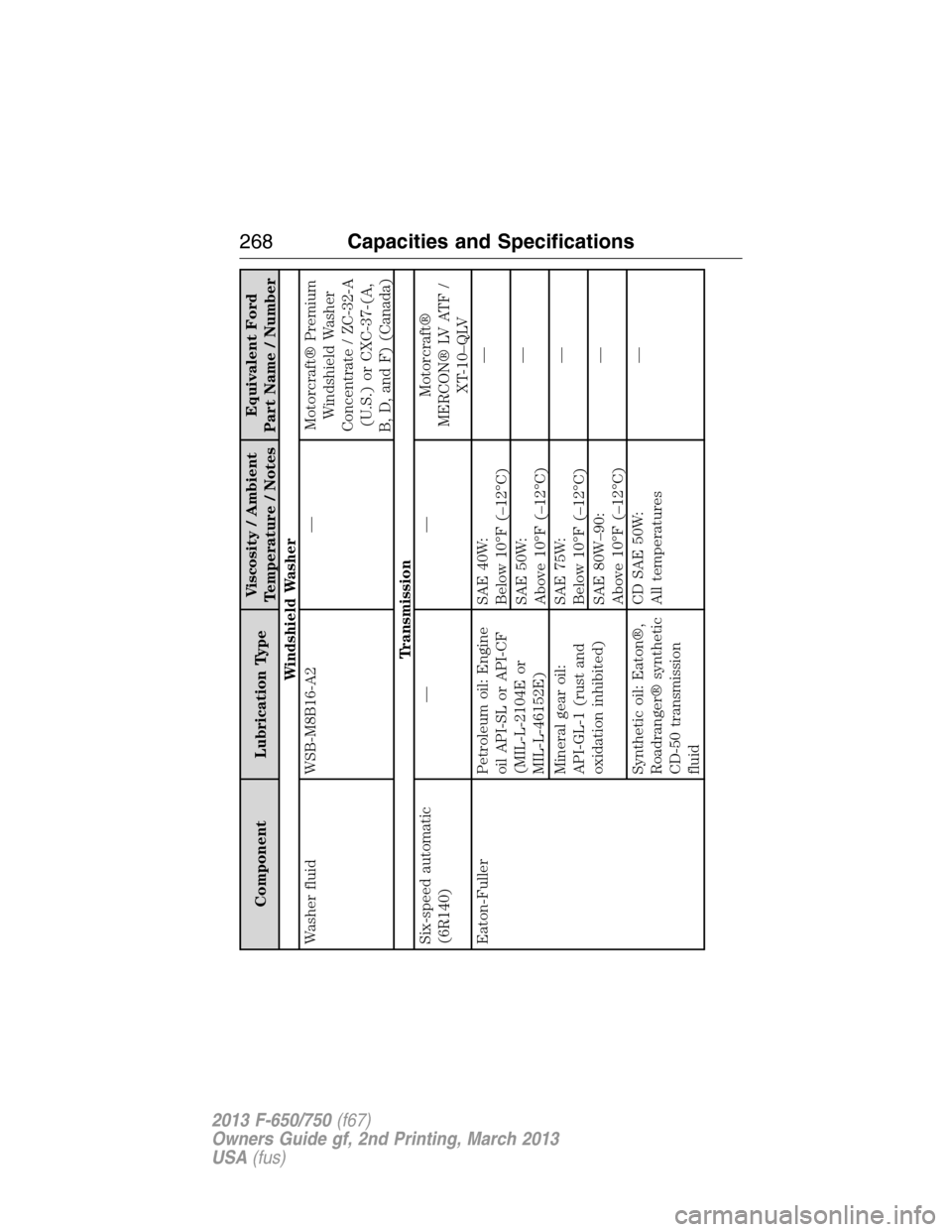
Component Lubrication TypeViscosity / Ambient
Temperature / NotesEquivalent Ford
Part Name / Number
Windshield Washer
Washer fluid WSB-M8B16-A2 — Motorcraft® Premium
Windshield Washer
Concentrate / ZC-32-A
(U.S.) or CXC-37-(A,
B, D, and F) (Canada)
Transmission
Six-speed automatic
(6R140)— — Motorcraft®
MERCON® LV ATF /
XT-10–QLV
Eaton-Fuller Petroleum oil: Engine
oil API-SL or API-CF
(MIL-L-2104E or
MIL-L-46152E)SAE 40W:
Below 10°F (–12°C)—
SAE 50W:
Above 10°F (–12°C)—
Mineral gear oil:
API-GL-1 (rust and
oxidation inhibited)SAE 75W:
Below 10°F (–12°C)—
SAE 80W–90:
Above 10°F (–12°C)—
Synthetic oil: Eaton®,
Roadranger® synthetic
CD-50 transmission
fluidCD SAE 50W:
All temperatures—
268Capacities and Specifications
2013 F-650/750(f67)
Owners Guide gf, 2nd Printing, March 2013
USA(fus)