automatic transmission fluid FORD F650 2013 12.G Owners Manual
[x] Cancel search | Manufacturer: FORD, Model Year: 2013, Model line: F650, Model: FORD F650 2013 12.GPages: 378, PDF Size: 3.82 MB
Page 5 of 378
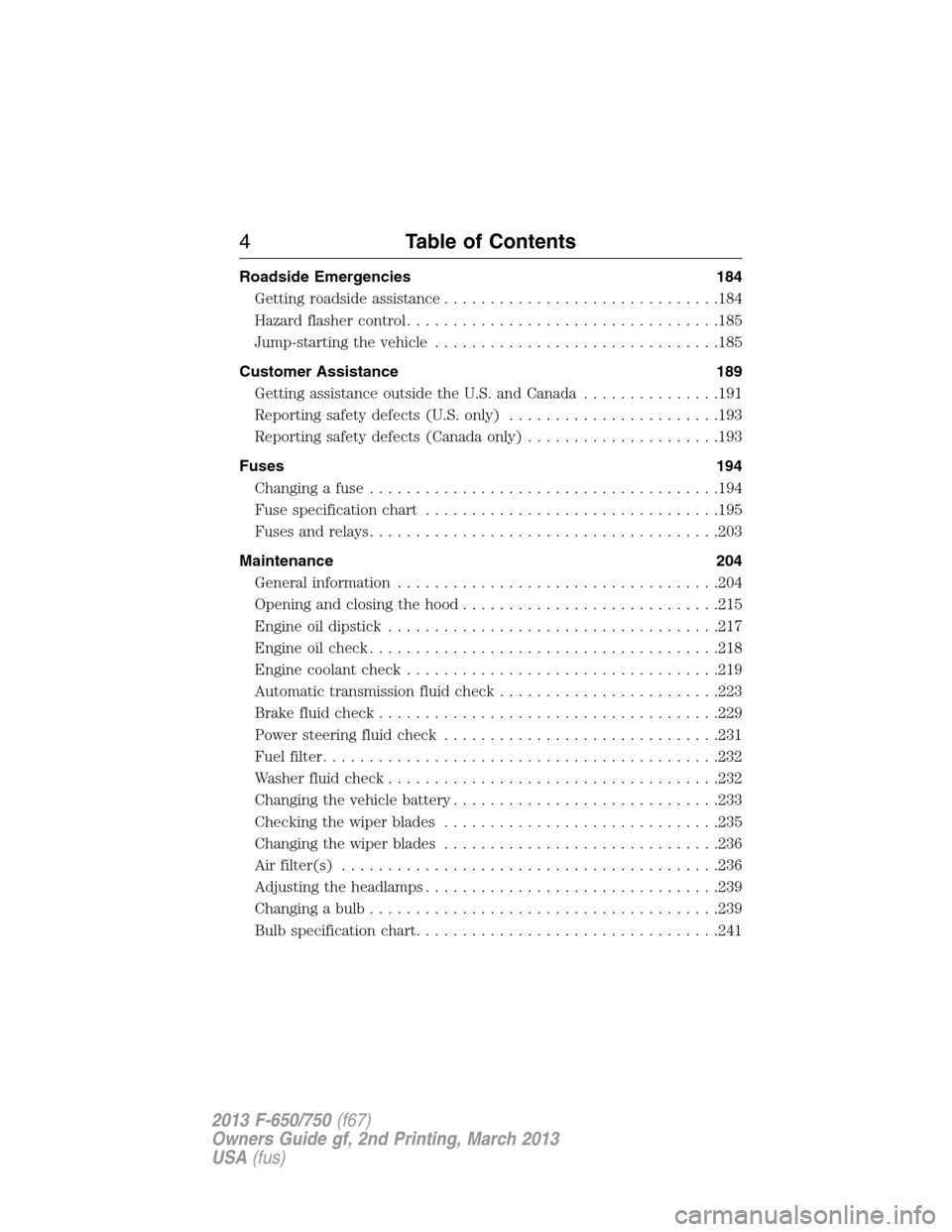
Roadside Emergencies 184
Getting roadside assistance..............................184
Hazard flasher control..................................185
Jump-starting the vehicle...............................185
Customer Assistance 189
Getting assistance outside the U.S. and Canada...............191
Reporting safety defects (U.S. only).......................193
Reporting safety defects (Canada only).....................193
Fuses 194
Changing a fuse......................................194
Fuse specification chart................................195
Fuses and relays......................................203
Maintenance 204
General information...................................204
Opening and closing the hood............................215
Engine oil dipstick....................................217
Engine oil check......................................218
Engine coolant check..................................219
Automatic transmission fluid check........................223
Brake fluid check.....................................229
Power steering fluid check..............................231
Fuel filter...........................................232
Washer fluid check....................................232
Changing the vehicle battery.............................233
Checking the wiper blades..............................235
Changing the wiper blades..............................236
Air filter(s).........................................236
Adjusting the headlamps................................239
Changing a bulb......................................239
Bulb specification chart.................................241
4Table of Contents
2013 F-650/750(f67)
Owners Guide gf, 2nd Printing, March 2013
USA(fus)
Page 19 of 378
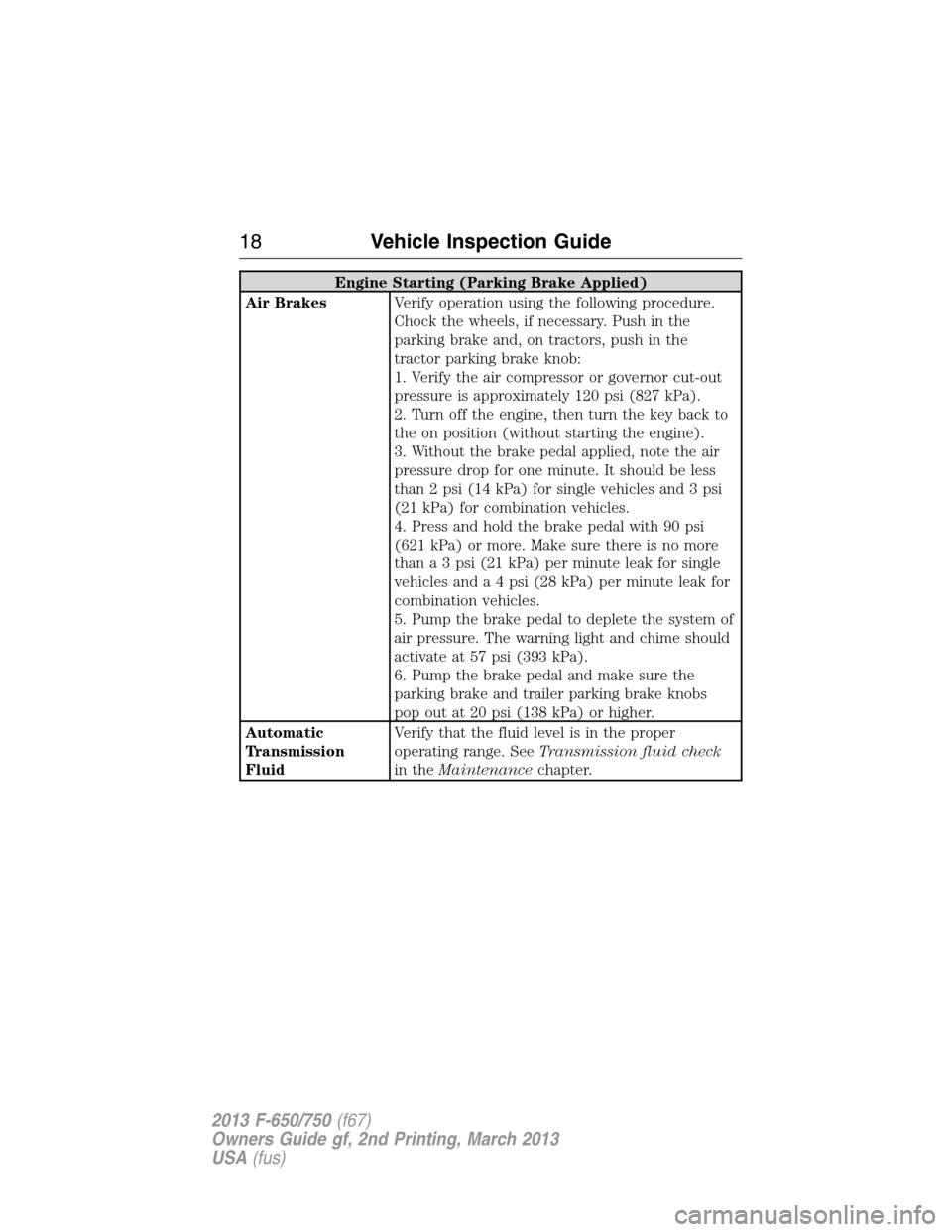
Engine Starting (Parking Brake Applied)
Air BrakesVerify operation using the following procedure.
Chock the wheels, if necessary. Push in the
parking brake and, on tractors, push in the
tractor parking brake knob:
1. Verify the air compressor or governor cut-out
pressure is approximately 120 psi (827 kPa).
2. Turn off the engine, then turn the key back to
the on position (without starting the engine).
3. Without the brake pedal applied, note the air
pressure drop for one minute. It should be less
than 2 psi (14 kPa) for single vehicles and 3 psi
(21 kPa) for combination vehicles.
4. Press and hold the brake pedal with 90 psi
(621 kPa) or more. Make sure there is no more
than a 3 psi (21 kPa) per minute leak for single
vehicles and a 4 psi (28 kPa) per minute leak for
combination vehicles.
5. Pump the brake pedal to deplete the system of
air pressure. The warning light and chime should
activate at 57 psi (393 kPa).
6. Pump the brake pedal and make sure the
parking brake and trailer parking brake knobs
pop out at 20 psi (138 kPa) or higher.
Automatic
Transmission
FluidVerify that the fluid level is in the proper
operating range. SeeTransmission fluid check
in theMaintenancechapter.
18Vehicle Inspection Guide
2013 F-650/750(f67)
Owners Guide gf, 2nd Printing, March 2013
USA(fus)
Page 26 of 378
Trailer
If you are pulling a trailer, an inspection of the trailer similar to that of
the tractor should be done. The inspection should follow trailer
manufacturer recommendations and should include at a minimum:
general condition, landing gear, doors, sides, lights, reflectors,
suspension, brakes, tires, wheels, cargo placement, stability and
tie-downs.
Transmission
WARNING:If the unit starts in gear and/or the neutral start
switch is not functioning correctly, the vehicle may inadvertently
move which could result in property damage, personal injury or death.
If your vehicle is equipped with an automatic transmission, regularly
inspect the transmission’s neutral start switch. The engine should only
start in positionNorP.
Inspect the transmission fluid level and shift linkage for proper
operation.
Vehicle Inspection Guide25
2013 F-650/750(f67)
Owners Guide gf, 2nd Printing, March 2013
USA(fus)
Page 71 of 378
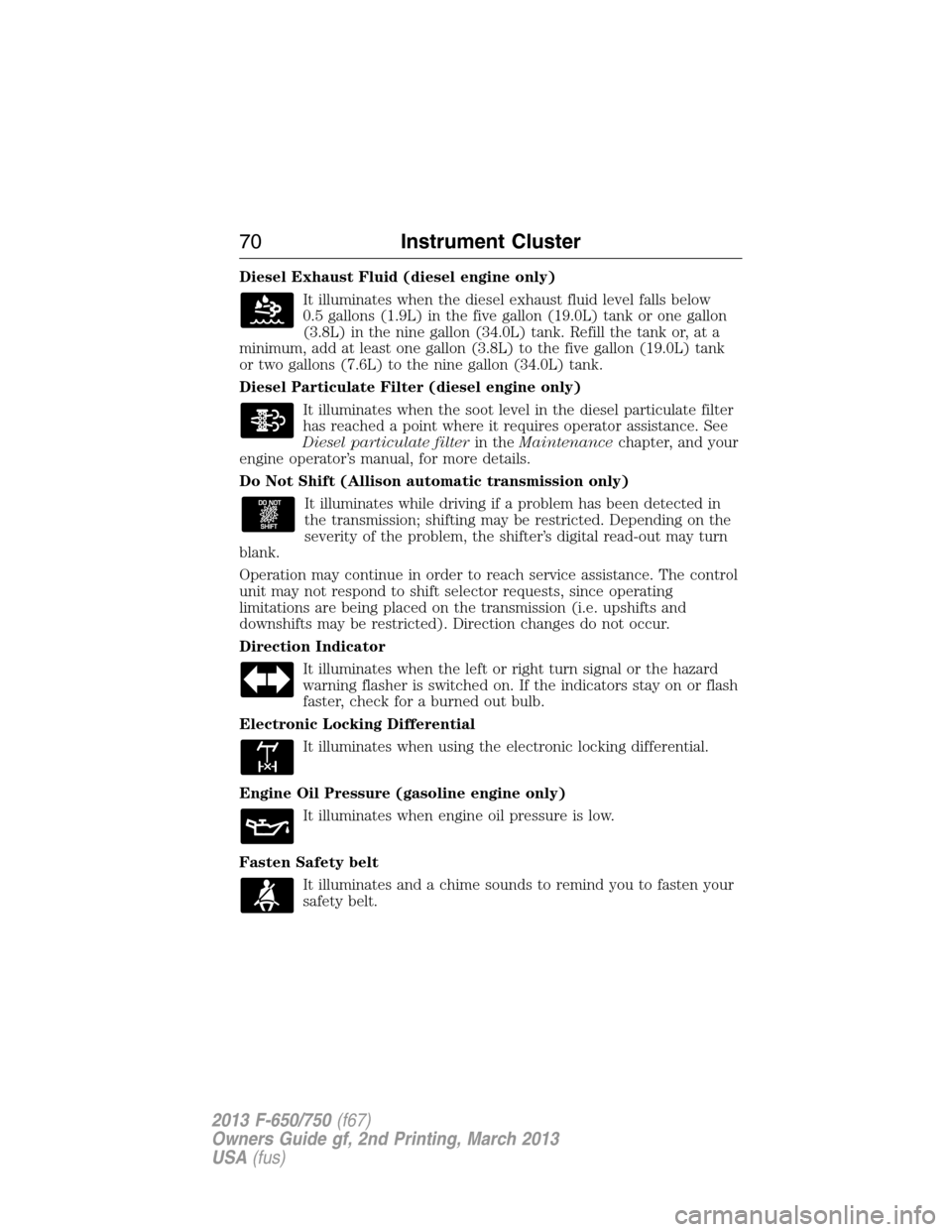
Diesel Exhaust Fluid (diesel engine only)
It illuminates when the diesel exhaust fluid level falls below
0.5 gallons (1.9L) in the five gallon (19.0L) tank or one gallon
(3.8L) in the nine gallon (34.0L) tank. Refill the tank or, at a
minimum, add at least one gallon (3.8L) to the five gallon (19.0L) tank
or two gallons (7.6L) to the nine gallon (34.0L) tank.
Diesel Particulate Filter (diesel engine only)
It illuminates when the soot level in the diesel particulate filter
has reached a point where it requires operator assistance. See
Diesel particulate filterin theMaintenancechapter, and your
engine operator’s manual, for more details.
Do Not Shift (Allison automatic transmission only)
It illuminates while driving if a problem has been detected in
the transmission; shifting may be restricted. Depending on the
severity of the problem, the shifter’s digital read-out may turn
blank.
Operation may continue in order to reach service assistance. The control
unit may not respond to shift selector requests, since operating
limitations are being placed on the transmission (i.e. upshifts and
downshifts may be restricted). Direction changes do not occur.
Direction Indicator
It illuminates when the left or right turn signal or the hazard
warning flasher is switched on. If the indicators stay on or flash
faster, check for a burned out bulb.
Electronic Locking Differential
It illuminates when using the electronic locking differential.
Engine Oil Pressure (gasoline engine only)
It illuminates when engine oil pressure is low.
Fasten Safety belt
It illuminates and a chime sounds to remind you to fasten your
safety belt.
70Instrument Cluster
2013 F-650/750(f67)
Owners Guide gf, 2nd Printing, March 2013
USA(fus)
Page 142 of 378
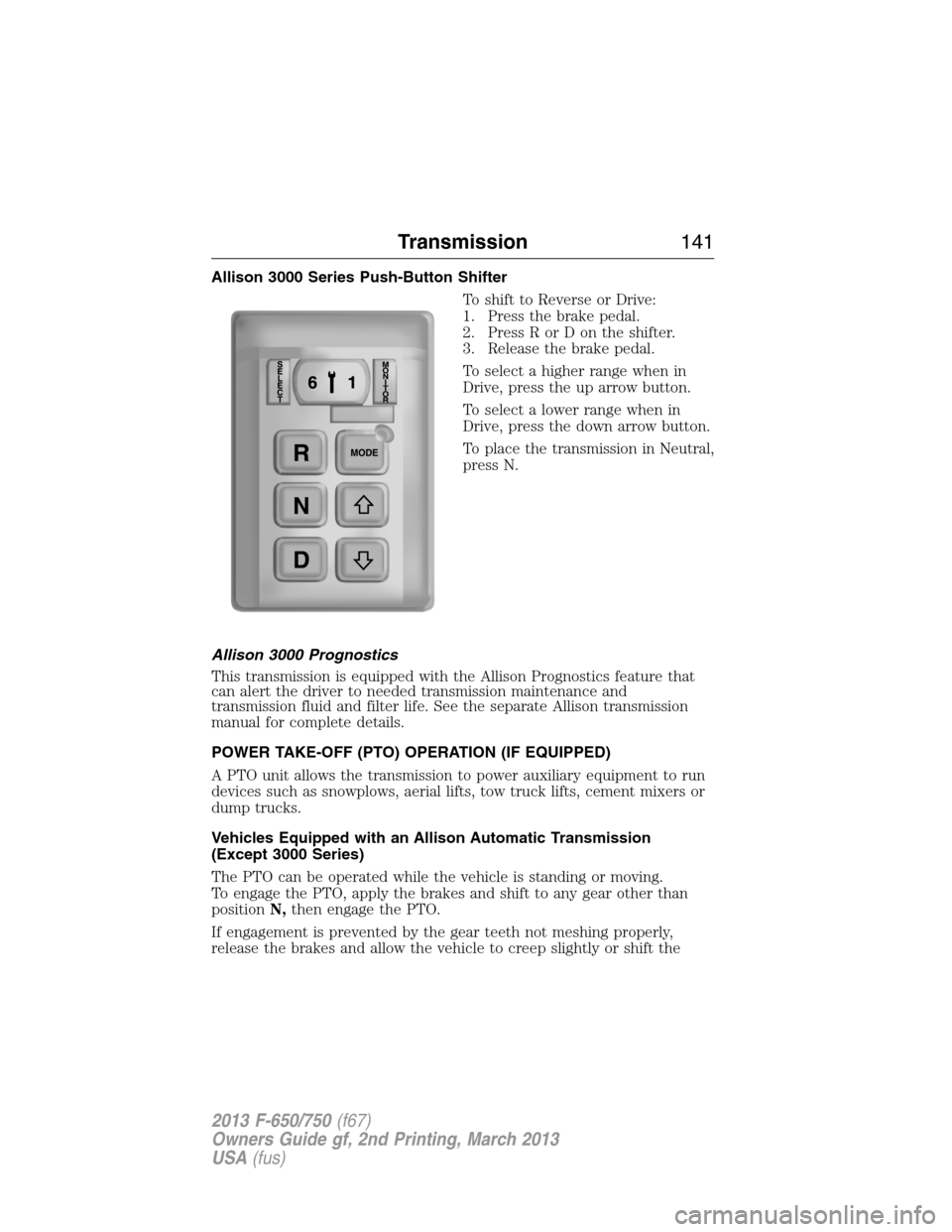
Allison 3000 Series Push-Button Shifter
To shift to Reverse or Drive:
1. Press the brake pedal.
2. Press R or D on the shifter.
3. Release the brake pedal.
To select a higher range when in
Drive, press the up arrow button.
To select a lower range when in
Drive, press the down arrow button.
To place the transmission in Neutral,
press N.
Allison 3000 Prognostics
This transmission is equipped with the Allison Prognostics feature that
can alert the driver to needed transmission maintenance and
transmission fluid and filter life. See the separate Allison transmission
manual for complete details.
POWER TAKE-OFF (PTO) OPERATION (IF EQUIPPED)
A PTO unit allows the transmission to power auxiliary equipment to run
devices such as snowplows, aerial lifts, tow truck lifts, cement mixers or
dump trucks.
Vehicles Equipped with an Allison Automatic Transmission
(Except 3000 Series)
The PTO can be operated while the vehicle is standing or moving.
To engage the PTO, apply the brakes and shift to any gear other than
positionN,then engage the PTO.
If engagement is prevented by the gear teeth not meshing properly,
release the brakes and allow the vehicle to creep slightly or shift the
Transmission141
2013 F-650/750(f67)
Owners Guide gf, 2nd Printing, March 2013
USA(fus)
Page 145 of 378
The differential can be locked or unlocked when the vehicle is moving at
a constant speed of under 25 mph (40 km/h) and while the wheels are
not slipping. The differential must not be locked when the vehicle is
traveling down steep grades and traction is minimal.
The differential lock and differential lock light automatically disengage at
speeds above 25 mph (40 km/h). The differential lock remains off until
either the vehicle is restarted or the differential lock switch is turned off
then back on.
Turn the engine off and raise all drive wheels of the locker differential
axle in order to prevent the vehicle from moving when servicing the
wheels, tires or brakes. Axles equipped with a NoSPIN Detroit Locker
differential deliver power to both wheels even when only one wheel is on
the ground.
WARNING:Failure to raise all drive wheels with this type of
differential could cause the vehicle to move unexpectedly,
resulting in property damage, personal injury or death.
Care should be taken to avoid sudden accelerations when both drive
wheels are on a slippery surface.
WARNING:Sudden accelerations on slippery surfaces could
cause the wheels to spin, the vehicle to turn sideways on a
crowned road surface or in a turn, possibly resulting in loss of vehicle
control and personal injury.
Fluid Temperature
Axle operating temperatures normally do not exceed 100°F (38°C).
If the operating temperature exceeds 230°F (110°C), the rate of axle
lubrication oxidation increases and shortens the life of the lubricant and
seals, requiring axle lubrication changes to become more frequent to
preserve the axle. Extreme Pressure (EP) lubricants should not be run
consistently above 230°F (110°C).
Axle Conversions
WARNING:When operating a loaded vehicle, the driver must
keep all adjustable axles on the ground at all times, supporting
their share of the vehicle’s load. Failure to do so can overload other
axles, tires, wheels, springs, steering components, brakes and frames,
resulting in early component failure, loss of vehicle control, possible
property damage and personal injury.
144Transmission
2013 F-650/750(f67)
Owners Guide gf, 2nd Printing, March 2013
USA(fus)
Page 224 of 378
TRANSMISSION FLUID CHECK
Allison Automatic Transmissions
See yourAllison Automatic Transmission Operator’s Manualfor
scheduled transmission fluid checks and change intervals. Your
transmission does not consume fluid. However, the fluid level should be
checked if the transmission is not working properly, i.e., if the
transmission slips or shifts slowly or if you notice some sign of fluid
leakage.
Automatic transmission fluid expands when warmed. To obtain an
accurate fluid check, drive the vehicle until it is at normal operating
temperature (approximately 20 miles [30 kilometers]). Verify that the
transmission fluid temperature gauge, located on the instrument cluster,
is within the normal range.
1. Drive the vehicle 20 miles (30 kilometers) or until it reaches normal
operating temperature.
2. Park the vehicle on a level surface and engage the parking brake.
3. With the engine running, parking brake engaged and your foot on the
brake pedal, move the gearshift lever through all of the gear ranges.
Allow sufficient time for each gear to engage.
4. Latch the gearshift lever in positionNorPand leave the engine
running.
5. Remove the dipstick, wiping it clean with a clean, dry, lint-free rag.
6. Install the dipstick making sure it is fully seated in the filler tube.
7. Remove the dipstick and inspect the fluid level. The fluid should be
in the designated area for normal operating temperature or ambient
temperature.
If you must add transmission fluid, see yourAllison Automatic
Transmission Operator’s Manualfor the correct fluid type.Use of a
non-approved automatic transmission fluid may cause internal
transmission component damage.
Fluid levels above the safe range may result in transmission failure. An
overfill condition of transmission fluid may cause shift or engagement
concerns or possible damage.
TorqShift® Automatic Transmission
See theScheduled Maintenancechapter for scheduled intervals for
fluid checks and changes. Your transmission does not consume fluid.
However, the fluid level should be checked if the transmission is not
working properly, i.e., if the transmission slips or shifts slowly or if you
notice some sign of fluid leakage.
Maintenance223
2013 F-650/750(f67)
Owners Guide gf, 2nd Printing, March 2013
USA(fus)
Page 225 of 378
![FORD F650 2013 12.G Owners Manual Automatic transmission fluid expands when warmed. To obtain an
accurate fluid check, drive the vehicle until it is at normal operating
temperature (approximately 20 miles [30 kilometers]). Verify that](/img/11/5079/w960_5079-224.png "FORD F650 2013 12.G Owners Manual Automatic transmission fluid expands when warmed. To obtain an
accurate fluid check, drive the vehicle until it is at normal operating
temperature (approximately 20 miles [30 kilometers]). Verify that")
Automatic transmission fluid expands when warmed. To obtain an
accurate fluid check, drive the vehicle until it is at normal operating
temperature (approximately 20 miles [30 kilometers]). Verify that the
transmission fluid temperature gauge, located on the instrument cluster,
is within the normal range.
1. Drive the vehicle 20 miles (30 kilometers) or until it reaches normal
operating temperature.
2. Park the vehicle on a level surface and engage the parking brake.
3. With the engine running, parking brake engaged and your foot on the
brake pedal, move the gearshift lever through all of the gear ranges.
Allow sufficient time for each gear to engage.
4. Latch the gearshift lever in positionPand leave the engine running.
5. Remove the dipstick, wiping it clean with a clean, dry, lint-free rag.
6. Install the dipstick making sure it is fully seated in the filler tube.
7. Remove the dipstick and inspect the fluid level. The fluid should be
in the designated area for normal operating temperature or ambient
temperature.
Low Fluid Level
Do not drive the vehicle if there is
no indication of fluid on the dipstick
and the ambient temperature is
above 50°F (10°C).
Correct Fluid Level
The fluid should be checked at
normal operating temperature
196°F-216°F (91°C-102°C) on a
level surface. The normal operating
temperature can be reached after approximately 20 miles (30 kilometers)
of driving.
224Maintenance
2013 F-650/750(f67)
Owners Guide gf, 2nd Printing, March 2013
USA(fus)
Page 226 of 378
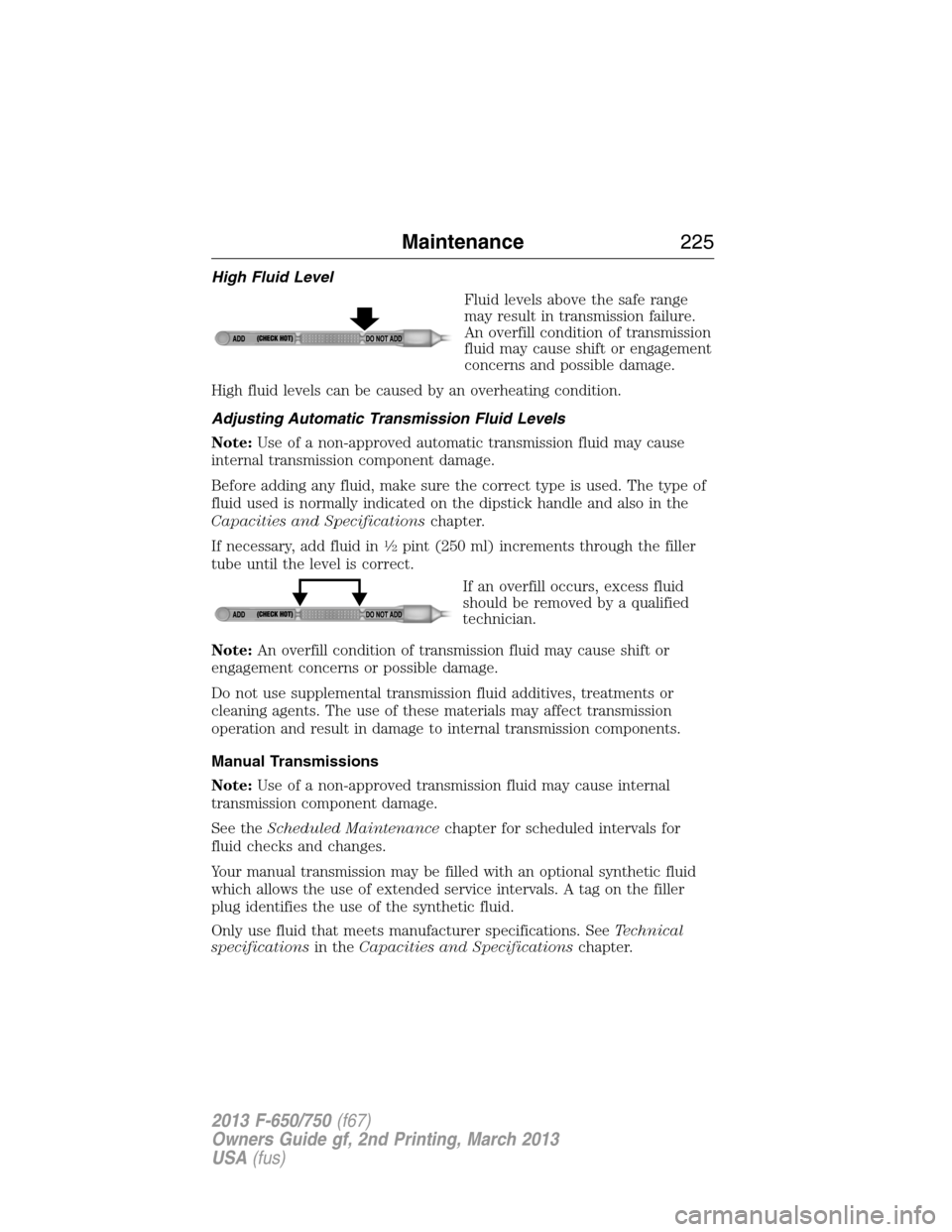
High Fluid Level
Fluid levels above the safe range
may result in transmission failure.
An overfill condition of transmission
fluid may cause shift or engagement
concerns and possible damage.
High fluid levels can be caused by an overheating condition.
Adjusting Automatic Transmission Fluid Levels
Note:Use of a non-approved automatic transmission fluid may cause
internal transmission component damage.
Before adding any fluid, make sure the correct type is used. The type of
fluid used is normally indicated on the dipstick handle and also in the
Capacities and Specificationschapter.
If necessary, add fluid in
12pint (250 ml) increments through the filler
tube until the level is correct.
If an overfill occurs, excess fluid
should be removed by a qualified
technician.
Note:An overfill condition of transmission fluid may cause shift or
engagement concerns or possible damage.
Do not use supplemental transmission fluid additives, treatments or
cleaning agents. The use of these materials may affect transmission
operation and result in damage to internal transmission components.
Manual Transmissions
Note:Use of a non-approved transmission fluid may cause internal
transmission component damage.
See theScheduled Maintenancechapter for scheduled intervals for
fluid checks and changes.
Your manual transmission may be filled with an optional synthetic fluid
which allows the use of extended service intervals. A tag on the filler
plug identifies the use of the synthetic fluid.
Only use fluid that meets manufacturer specifications. SeeTechnical
specificationsin theCapacities and Specificationschapter.
Maintenance225
2013 F-650/750(f67)
Owners Guide gf, 2nd Printing, March 2013
USA(fus)
Page 228 of 378
Checking the Fluid Level
See theScheduled Maintenancechapter for rear axle lubricant level
check intervals.
1. Park the vehicle on level ground.
2. Set the parking brake and shift into positionNorP(automatic
transmission), or first gear (manual transmission). Turn the engine
off.
3. Clean any dirt from around the rear axle filler plug.
4. Remove the filler plug and inspect the lubricant level. It should be at
the bottom of the filler plug opening.
5. Add lubricant, if necessary, through the filler plug opening.
6. Clean and install the filler plug securely.
Changing the Fluid
See theScheduled Maintenancechapter for rear axle lubricant change
intervals.
1. Drain the rear axle while the lubricant is warm.
2. Park the vehicle on level ground.
3. Set the parking brake and shift into positionNorP(automatic
transmission), or first gear (manual transmission). Turn the engine
off.
4. Clean any dirt from around the rear axle filler and drain plugs.
5. Remove the filler and drain plugs. Drain the lubricant into a suitable
container. Dispose of all used automotive fluids in a responsible
manner following your local authorized standards.
6. Clean and install the drain plug securely.
7. Add lubricant through the filler plug opening.
8. Clean and install the filler plug securely.
Maintenance227
2013 F-650/750(f67)
Owners Guide gf, 2nd Printing, March 2013
USA(fus)