ECU FORD F650 2015 13.G User Guide
[x] Cancel search | Manufacturer: FORD, Model Year: 2015, Model line: F650, Model: FORD F650 2015 13.GPages: 384, PDF Size: 4.95 MB
Page 39 of 384
3. You may need to pull the seat back forward to access the tether
anchors. Make sure the seat is locked in the upright position before
installing the child seat.
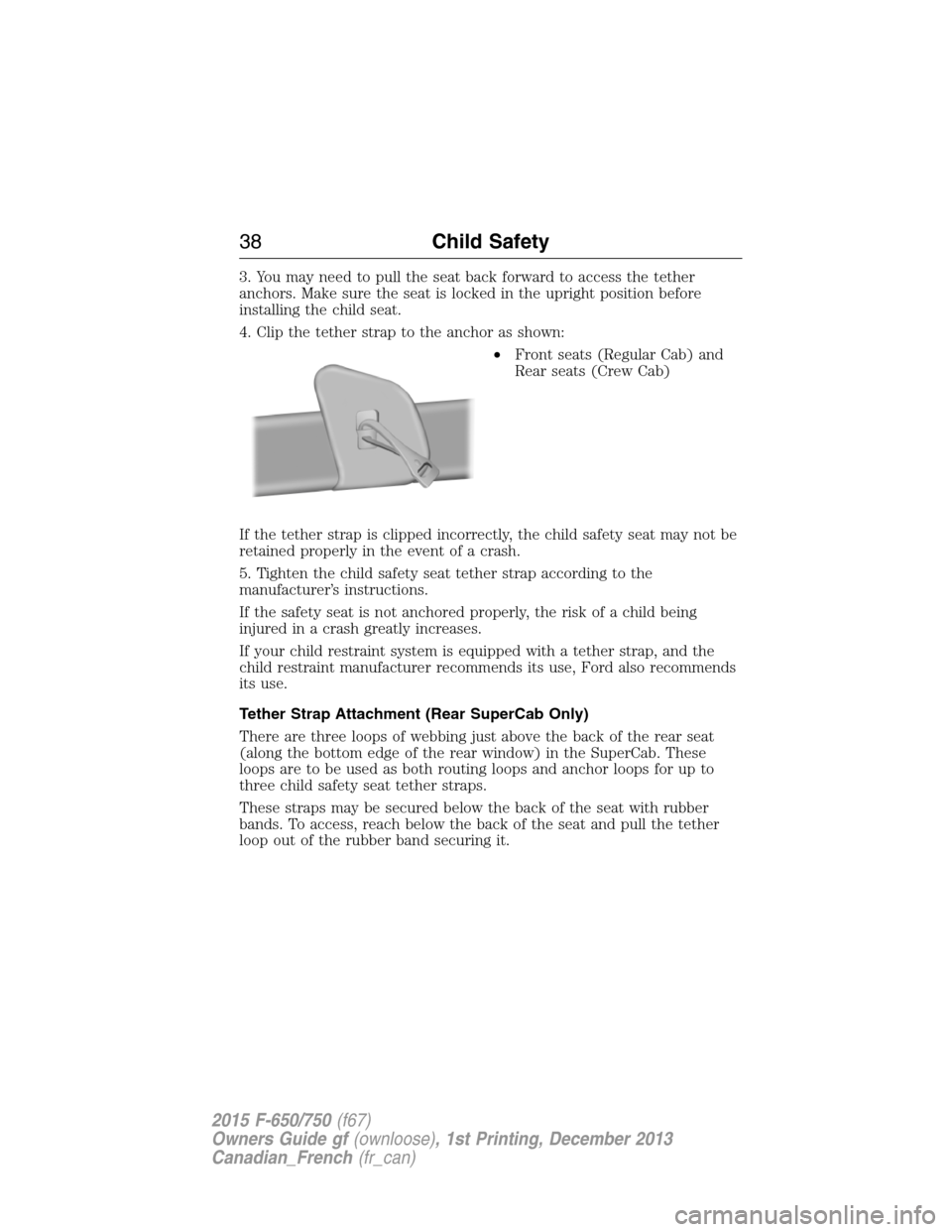
4. Clip the tether strap to the anchor as shown:
•Front seats (Regular Cab) and
Rear seats (Crew Cab)
If the tether strap is clipped incorrectly, the child safety seat may not be
retained properly in the event of a crash.
5. Tighten the child safety seat tether strap according to the
manufacturer’s instructions.
If the safety seat is not anchored properly, the risk of a child being
injured in a crash greatly increases.
If your child restraint system is equipped with a tether strap, and the
child restraint manufacturer recommends its use, Ford also recommends
its use.
Tether Strap Attachment (Rear SuperCab Only)
There are three loops of webbing just above the back of the rear seat
(along the bottom edge of the rear window) in the SuperCab. These
loops are to be used as both routing loops and anchor loops for up to
three child safety seat tether straps.
These straps may be secured below the back of the seat with rubber
bands. To access, reach below the back of the seat and pull the tether
loop out of the rubber band securing it.
38Child Safety
2015 F-650/750(f67)
Owners Guide gf(ownloose), 1st Printing, December 2013
Canadian_French(fr_can)
Page 43 of 384
WARNING:Front and rear seat occupants, including pregnant
women, should wear safety belts for optimum protection in an
accident.
The front and rear outboard safety restraints in the vehicle are
combination lap and shoulder belts. The front and rear seat passenger
outboard safety belts have vehicle sensitive emergency locking retractors
and automatic locking retractors.
The safety belt system consists of:
•Lap and shoulder safety belts.
•Shoulder safety belt with automatic locking mode (except driver
safety belt).
•Height adjuster at the front outboard seating positions.
•Safety belt warning light and chime. SeeSafety belt
warning light and indicator chimelater in this chapter.
FASTENING THE SAFETY BELTS
The front and rear outboard safety restraints in the vehicle are
combination lap and shoulder belts.
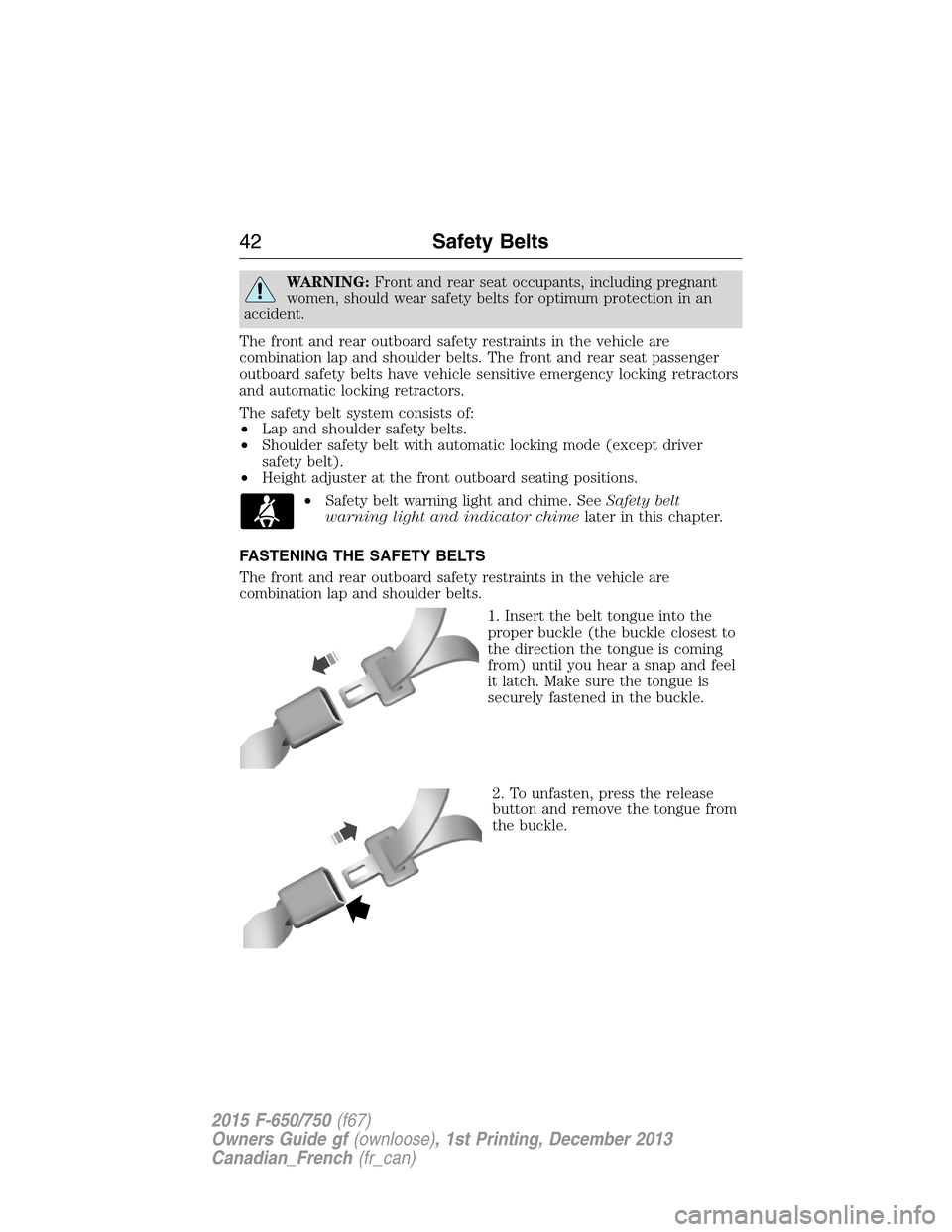
1. Insert the belt tongue into the
proper buckle (the buckle closest to
the direction the tongue is coming
from) until you hear a snap and feel
it latch. Make sure the tongue is
securely fastened in the buckle.
2. To unfasten, press the release
button and remove the tongue from
the buckle.
42Safety Belts
2015 F-650/750(f67)
Owners Guide gf(ownloose), 1st Printing, December 2013
Canadian_French(fr_can)
Page 44 of 384
Using the Safety Belt with Cinch Tongue (Front and Rear Center Seat)
The cinch tongue slides up and down the belt webbing when the belt is
stowed or while putting safety belts on. When the lap and shoulder
safety belt is buckled, the cinch tongue allows the lap portion to be
shortened, but pinches the webbing to keep the lap portion from getting
longer. The cinch tongue is designed to slip during a crash, so always
wear the shoulder belt properly and do not allow any slack in either the
lap or shoulder portions.
Before you can reach and latch a lap and shoulder belt having a cinch
tongue into the buckle, you may have to lengthen the lap belt portion of it.
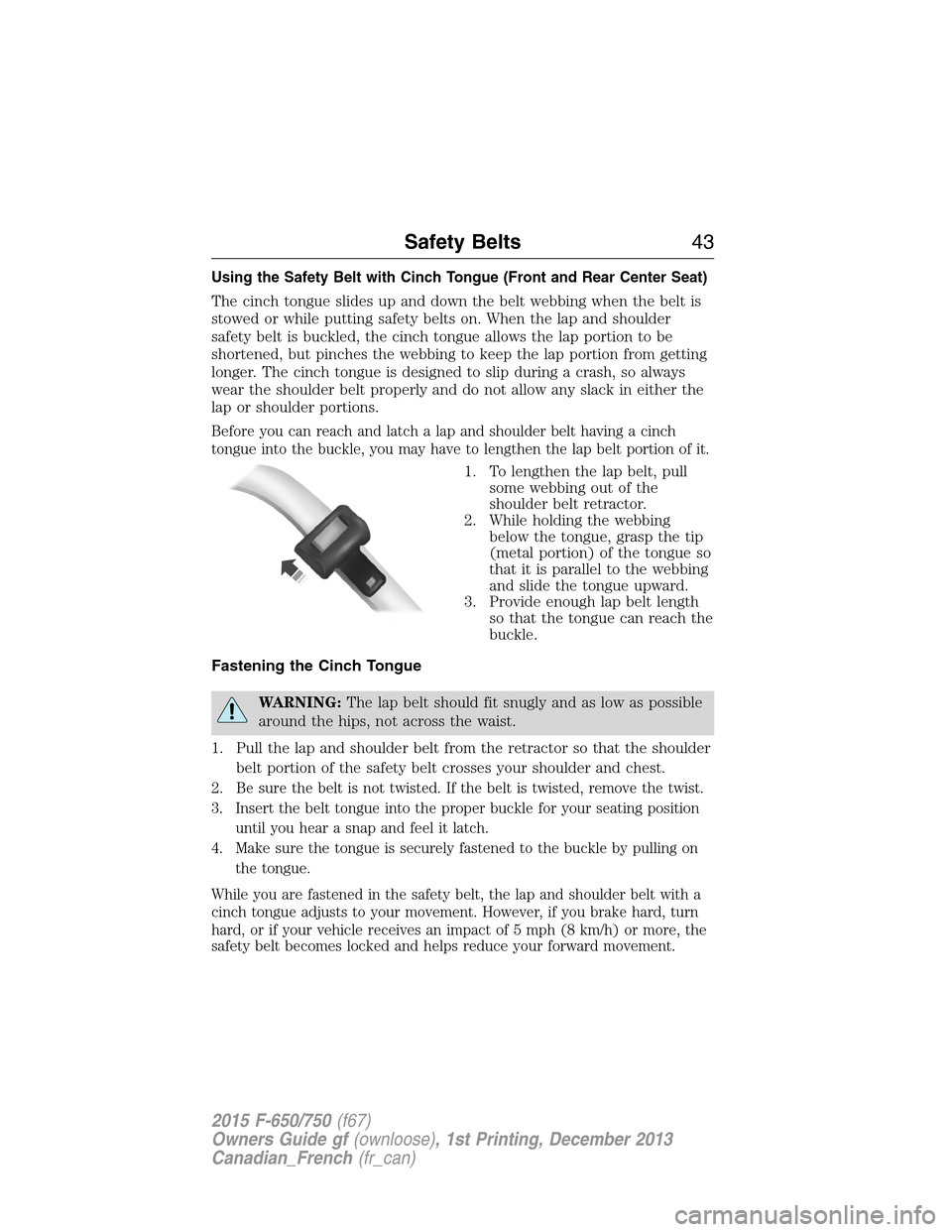
1. To lengthen the lap belt, pull
some webbing out of the
shoulder belt retractor.
2. While holding the webbing
below the tongue, grasp the tip
(metal portion) of the tongue so
that it is parallel to the webbing
and slide the tongue upward.
3. Provide enough lap belt length
so that the tongue can reach the
buckle.
Fastening the Cinch Tongue
WARNING:The lap belt should fit snugly and as low as possible
around the hips, not across the waist.
1. Pull the lap and shoulder belt from the retractor so that the shoulder
belt portion of the safety belt crosses your shoulder and chest.
2.
Be sure the belt is not twisted. If the belt is twisted, remove the twist.
3. Insert the belt tongue into the proper buckle for your seating position
until you hear a snap and feel it latch.
4. Make sure the tongue is securely fastened to the buckle by pulling on
the tongue.
While you are fastened in the safety belt, the lap and shoulder belt with a
cinch tongue adjusts to your movement. However, if you brake hard, turn
hard, or if your vehicle receives an impact of 5 mph (8 km/h) or more, the
safety belt becomes locked and helps reduce your forward movement.
Safety Belts43
2015 F-650/750(f67)
Owners Guide gf(ownloose), 1st Printing, December 2013
Canadian_French(fr_can)
Page 118 of 384
Note:Do not put DEF in the fuel tank or any other tank on your
vehicle. This can cause damage to components not covered by your
vehicle’s warranty.
Your vehicle is equipped with a DEF tank with a blue-capped filler port.
The 5-gallon (19.0L) DEF tank is located on the left side of your vehicle
under the cab. The 9-gallon (34.0L) DEF tank is located on the right
side of your vehicle behind the cab (Regular Cab and Super Cab) or
under the cab (Crew Cab). The tank can be filled using a nozzle at a
DEF filling station (similar to fuel fill) or using a DEF bottle with a
spout. We recommend using Motorcraft brand DEF bottles. You can use
other aftermarket bottles, but the bottles should have a seal on the spout
and an internal vent tube to achieve best fill performance and prevent
overfilling.
You can buy DEF at an authorized dealer, most highway truck stops or
you can contact roadside assistance for help in finding a retailer that
sells DEF. See theCustomer Assistancechapter for more information. In
addition, a government website locator is available for diesel exhaust
fluid supplies. Use the following web address to find the nearest location
to buy DEF: http://www.afdc.energy.gov/afdc/locator/def.
Use Motorcraft DEF or equivalent meeting Ford
specification WSS-M2C130-A or ISO 22241. Use only
DEF certified by the American Petroleum Institute.
Look for this certification trademark. Your warranty
may not cover repairs resulting from the use of
non-certified DEF products.
Maintaining the purity of DEF is important to avoid malfunctions in the
SCR system.
If you remove DEF from the tank for any reason (such as repair work),
do not use the same DEF to refill the tank as may not have kept its
purity.
Fuel and Refueling11 7
2015 F-650/750(f67)
Owners Guide gf(ownloose), 1st Printing, December 2013
Canadian_French(fr_can)
Page 130 of 384
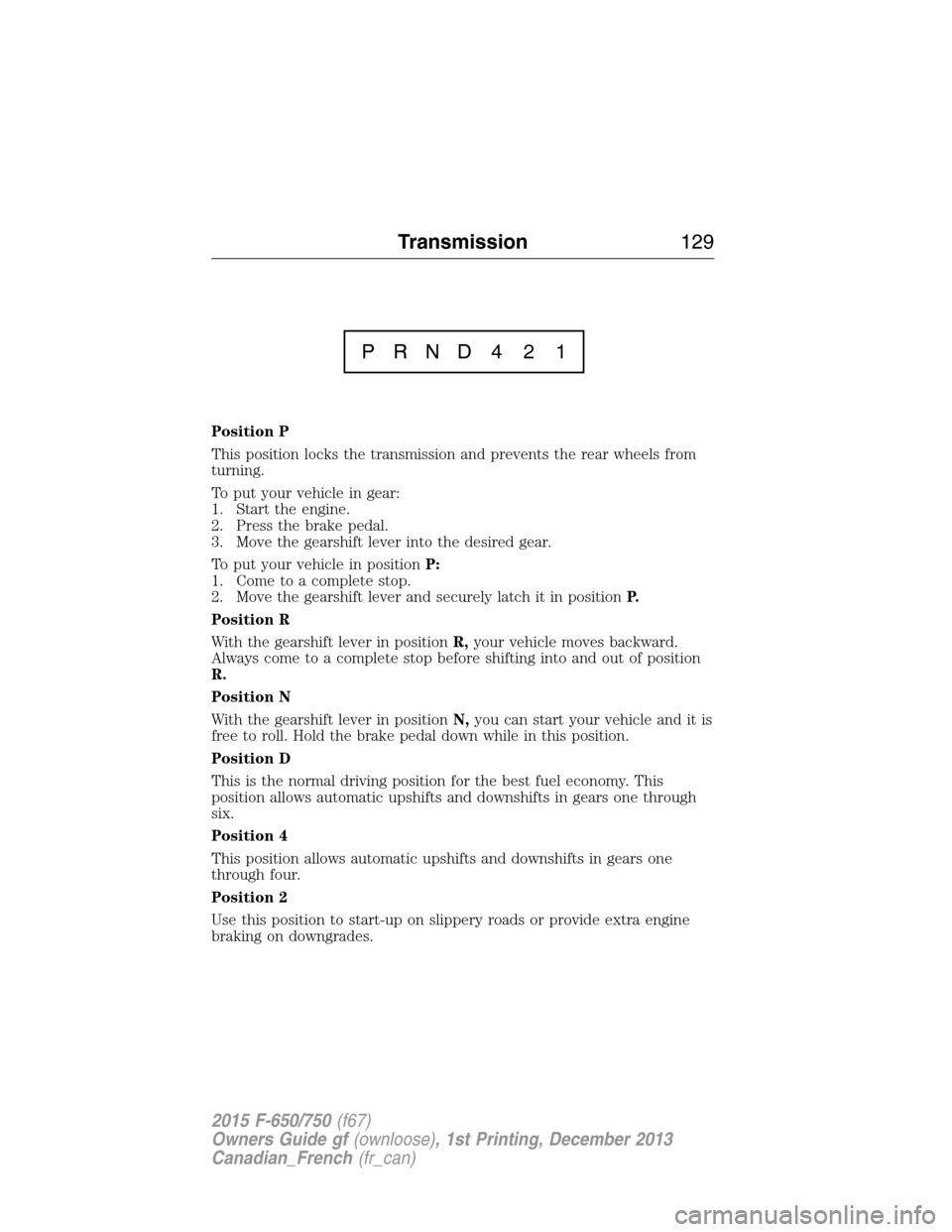
Position P
This position locks the transmission and prevents the rear wheels from
turning.
To put your vehicle in gear:
1. Start the engine.
2. Press the brake pedal.
3. Move the gearshift lever into the desired gear.
To put your vehicle in positionP:
1. Come to a complete stop.
2. Move the gearshift lever and securely latch it in positionP.
Position R
With the gearshift lever in positionR,your vehicle moves backward.
Always come to a complete stop before shifting into and out of position
R.
Position N
With the gearshift lever in positionN,you can start your vehicle and it is
free to roll. Hold the brake pedal down while in this position.
Position D
This is the normal driving position for the best fuel economy. This
position allows automatic upshifts and downshifts in gears one through
six.
Position 4
This position allows automatic upshifts and downshifts in gears one
through four.
Position 2
Use this position to start-up on slippery roads or provide extra engine
braking on downgrades.
PRND 4 2 1
Transmission129
2015 F-650/750(f67)
Owners Guide gf(ownloose), 1st Printing, December 2013
Canadian_French(fr_can)
Page 155 of 384
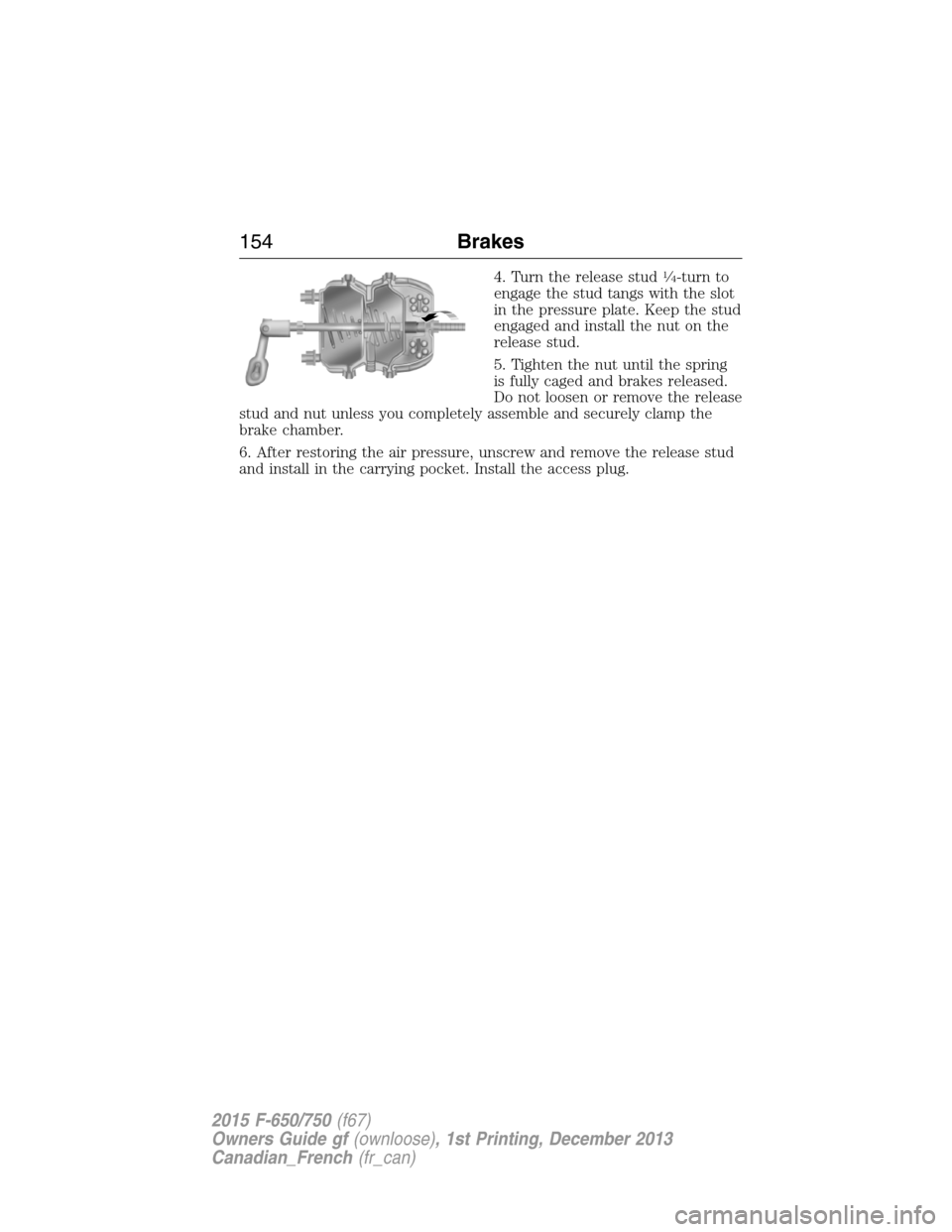
4. Turn the release stud14-turn to
engage the stud tangs with the slot
in the pressure plate. Keep the stud
engaged and install the nut on the
release stud.
5. Tighten the nut until the spring
is fully caged and brakes released.
Do not loosen or remove the release
stud and nut unless you completely assemble and securely clamp the
brake chamber.
6. After restoring the air pressure, unscrew and remove the release stud
and install in the carrying pocket. Install the access plug.
154Brakes
2015 F-650/750(f67)
Owners Guide gf(ownloose), 1st Printing, December 2013
Canadian_French(fr_can)
Page 171 of 384
•Place the gearshift lever in positionP(if equipped) or neutral to aid
in engine and transmission cooling and air conditioning efficiency
during hot weather while stopped in traffic.
•Turn off the speed control. The speed control may turn off
automatically when you are towing on long, steep grades.
•Shift to a lower gear when driving down a long or steep hill. Do not
apply the brakes continuously, as they may overheat and become less
effective.
•Allow more distance for stopping with a trailer attached. Anticipate
stops and brake gradually.
FIFTH WHEEL OPERATION
WARNING:Failure to follow the fifth wheel manufacturer’s
instructions for hooking and unhooking as well as sliding the fifth
wheel could result in an accident, personal injury or death.
WARNING:When the tractor and trailer are parked unattended,
the trailer brake hand control should never be used to apply the
brake, since air may leak from the system, allowing vehicle movement,
resulting in possible property damage, personal injury or death.
Before hook-up, make sure:
•The fifth wheel jaws are fully open.
•The fifth wheel is fully tilted back to prevent body damage when the
tractor is backed under a trailer.
•You block the trailer wheels and adjust and apply the trailer spring
brakes. Never chase a trailer.
•The brake hoses and light cords are clear of the fifth wheel.
Hook-up
1. Back the tractor squarely under the trailer, engaging the fifth-wheel
jaws on the kingpin. Always back up slowly; make sure the trailer is
neither too high nor too low. Avoid backing under the trailer from an
angle.
2. Connect the service and emergency brake hoses and trailer light
connector.
3. Inspect the jaws of the fifth wheel to be sure they have fully closed
on the trailer kingpin and the trailer plate is resting securely on the
fifth wheel.
170Towing
2015 F-650/750(f67)
Owners Guide gf(ownloose), 1st Printing, December 2013
Canadian_French(fr_can)
Page 172 of 384
4. Make sure the coupler release lever is in the locked position.
5. Charge the trailer brake system. Set the trailer brakes, with either
the hand valve or tractor protection valve. Pull against the trailer for
an extra check of proper hook-up. Do not pull hard enough to
damage or strain the equipment.
6. Set the tractor parking brakes and fully raise the trailer landing gear.
See theBrakeschapter for proper operation of the parking brake
and trailer brakes.
7. Check the operation of all trailer lights and correct any lights that
may be faulty.
Un-hook
1. Try to keep the tractor and trailer in a straight line.
2. Apply the parking brakes.
3. Lower the trailer landing gear, making sure it is on solid, level
ground. The weight of the trailer is to be on the landing gear.
4. Block the trailer wheels.
5. Disconnect the brake hoses and light cords. Be sure hoses and cords
are clear.
6. Pull coupler release lever to disengage the fifth wheel jaws.
7. Release the tractor parking brakes.
8. Pull out from the trailer slowly, allowing the landing gear to take the
load gradually.
WRECKER TOWING
WARNING:To reduce the risk of personal injury or property
damage when manually releasing the spring brakes, be sure to
block the wheels so the vehicle cannot move once the brakes are
released.
Note:Make sure to connect your vehicle securely to the tow vehicle and
that the tow vehicle’s parking brakes are set before releasing the disabled
vehicle’s spring brakes.
Before moving the disabled vehicle, check for adequate road clearance of
vehicle components. If possible, unload the disabled vehicle before
towing. This reduces any abnormal load to the vehicle components
resulting from the towing procedures. Before towing, make sure to
release the parking brake fully. You can reset the spring-actuated type
parking brake by recharging the air system with at least 64 psi (441 kPa)
of air. If the brake system does not retain air pressure, then you must
release the spring brakes manually. SeeParking brakein theBrakes
chapter.
Towing171
2015 F-650/750(f67)
Owners Guide gf(ownloose), 1st Printing, December 2013
Canadian_French(fr_can)
Page 173 of 384
Towing the Vehicle with the Front Wheels Suspended
Note:To avoid transmission damage, do not tow your vehicle even a
short distance without suspending rear wheels or removing the axle
shafts or driveshaft.
Note:When towing a vehicle equipped with a tandem axle from the
front, raise the forward rear axle so it can clear the road surface and
secure it to the frame with chains or U-bolts, allowing only the rear rear
axle to contact the road surface. Remove axle shafts from the rear rear
axle assembly. Cover the wheel hub ends to prevent loss of axle lubricant
and entrance of contaminants. Use extreme care in securing the chains
or U-bolts to avoid possible damage to the brake lines, hoses or other
components.
When it is necessary to tow a vehicle with the front wheels suspended,
take extra precautions to avoid transmission or differential damage:
•Remove the axle shafts from the axle assembly to prevent the wheels
from driving the differential and the transmission.
•Cover the wheel hub ends to prevent loss of axle lubricant and
entrance of other contaminants. If you do not remove the axle shafts,
removal of the driveshaft is required.
Towing the Vehicle with the Rear Wheels Suspended
Note:To avoid damage to the cab roof or air deflector when towing your
vehicle backward (rear wheels suspended), remove the air deflector.
Whenever possible, it is preferable to tow a disabled vehicle from the
rear by raising the rear of the chassis. When towing a vehicle with the
rear of the chassis suspended, you must lock the front wheels in the
straight-ahead position.
Vehicles equipped with a manual transmission must have at least 1.0 pint
(0.5 liter) of transmission fluid drained from the case. This prevents the
transmission fluid from entering the clutch housing and saturating the
clutch discs. Make sure to replace the transmission fluid before returning
your vehicle to service.
Towing Vehicles Equipped with a Driver-controlled Differential
Lock
Note:If you have to tow your vehicle to a service facility with the drive
axle wheels on the ground, it is necessary to remove the axle shafts
before towing your vehicle.
172Towing
2015 F-650/750(f67)
Owners Guide gf(ownloose), 1st Printing, December 2013
Canadian_French(fr_can)
Page 185 of 384
In the case of 1 or 2 above, the consumer must also notify the
manufacturer of the need for the repair of the nonconformity at the
following address:
Ford Motor Company
16800 Executive Plaza Drive
Mail Drop 3NE-B
Dearborn, MI 48126
UTILIZING THE MEDIATION/ARBITRATION PROGRAM (CANADA
ONLY)
For vehicles delivered to authorized Canadian dealers. In those cases
where you continue to feel that the efforts by Ford of Canada and the
authorized dealer to resolve a factory-related vehicle service concern
have been unsatisfactory, Ford of Canada participates in an impartial
third party mediation/arbitration program administered by the Canadian
Motor Vehicle Arbitration Plan (CAMVAP).
The CAMVAP program is a straightforward and relatively speedy
alternative to resolve a disagreement when all other efforts to produce a
settlement have failed. This procedure is without cost to you and is
designed to eliminate the need for lengthy and expensive legal
proceedings.
In the CAMVAP program, impartial third-party arbitrators conduct
hearings at mutually convenient times and places in an informal
environment. These impartial arbitrators review the positions of the
parties, make decisions and, when appropriate, render awards to resolve
disputes. CAMVAP decisions are fast, fair, and final as the arbitrator’s
award is binding on both you and Ford of Canada.
CAMVAP services are available in all Canadian territories and provinces.
For more information, without charge or obligation, call your CAMVAP
Provincial Administrator directly at 1-800-207-0685 or visit
www.camvap.ca.
GETTING ASSISTANCE OUTSIDE THE U.S AND CANADA
Before exporting your vehicle to a foreign country, contact the
appropriate foreign embassy or consulate. These officials can inform you
of local vehicle registration regulations and where to find diesel fuel.
If you cannot find diesel fuel or can only get fuel with an anti-knock
index lower than is recommended for your vehicle, contact a regional
office or owner relations/customer relationship office.
The use of low quality diesel fuel may affect your emissions control
system and may cause engine damage. Ford Motor Company/Ford of
184Customer Assistance
2015 F-650/750(f67)
Owners Guide gf(ownloose), 1st Printing, December 2013
Canadian_French(fr_can)