ESP FORD F650 2015 13.G User Guide
[x] Cancel search | Manufacturer: FORD, Model Year: 2015, Model line: F650, Model: FORD F650 2015 13.GPages: 384, PDF Size: 4.95 MB
Page 102 of 384
Note:The heater is most effective when outdoor temperatures are below
0°F (-18°C).
The heater acts as a starting aid by warming the engine coolant. This
allows the climate control system to respond quickly. The equipment
includes a heater element (installed in the engine block) and a wire
harness. You can connect the system to a grounded 120–volt A/C
electrical source.
We recommend that you do the following for safe and correct operation:
•Use a 16-gauge outdoor extension cord that is product certified by
Underwriter’s Laboratory or Canadian Standards Association. This
extension cord must be suitable for use outdoors, in cold
temperatures, and be clearly markedSuitable for Use with Outdoor
Appliances.Never use an indoor extension cord outdoors; it could
result in an electric shock or become a fire hazard.
•Use as short an extension cord as possible.
•Do not use multiple extension cords.
•Make sure that when in operation, the extension cord plug and the
heater cord plug connections are free and clear of water. This could
cause an electric shock or fire.
•Make sure your vehicle is parked in a clean area, clear of
combustibles.
•Make sure the heater, heater cord and extension cord are firmly
connected.
•Check for heat anywhere in the electrical hookup once the system has
been operating for approximately 30 minutes.
•Make sure the system is unplugged and properly stowed before driving
your vehicle. Make sure the protective cover seals the prongs of the
block heater cord plug when not in use.
•Keep plug terminals clean and free of dirt and corrosion.
•Make sure the heater system is checked for proper operation before
winter.
Starting and Stopping the Engine101
2015 F-650/750(f67)
Owners Guide gf(ownloose), 1st Printing, December 2013
Canadian_French(fr_can)
Page 104 of 384
SAFETY PRECAUTIONS
WARNING:Do not overfill the fuel tank. The pressure in an
overfilled tank may cause leakage and lead to fuel spray and fire.
WARNING:The fuel system may be under pressure. If you hear
a hissing sound near the fuel filler inlet, do not refuel until the
sound stops. Otherwise, fuel may spray out, which could cause serious
personal injury.
WARNING:Automotive fuels can cause serious injury or death if
misused or mishandled.
WARNING:The flow of fuel through a fuel pump nozzle can
produce static electricity, which can cause a fire if fuel is pumped
into an ungrounded fuel container.
WARNING:Fuel ethanol and gasoline may contain benzene,
which is a cancer-causing agent.
WARNING:When refueling always shut the engine off and never
allow sparks or open flames near the filler neck. Never smoke
while refueling. Fuel vapor is extremely hazardous under certain
conditions. Care should be taken to avoid inhaling excess fumes.
Observe the following guidelines when handling automotive fuel:
•Extinguish all smoking materials and any open flames before refueling
your vehicle.
•Always turn off the vehicle before refueling.
•Automotive fuels can be harmful or fatal if swallowed. Fuel, such as
gasoline, is highly toxic and if swallowed can cause death or
permanent injury. If fuel is swallowed, call a physician immediately,
even if no symptoms are immediately apparent. The toxic effects of
fuel may not be visible for hours.
•Avoid inhaling fuel vapors. Inhaling too much fuel vapor of any kind
can lead to eye and respiratory tract irritation. In severe cases,
excessive or prolonged breathing of fuel vapor can cause serious
illness and permanent injury.
Fuel and Refueling103
2015 F-650/750(f67)
Owners Guide gf(ownloose), 1st Printing, December 2013
Canadian_French(fr_can)
Page 140 of 384
Anti-lock Brake System (ABS)
This system helps you maintain steering control during emergency stops
by keeping the brakes from locking.
The ABS lamp momentarily illuminates when you switch on the
ignition. If the light does not illuminate during start-up, if it
remains on or flashes, the ABS may not be working and
requires servicing.
If the ABS is disabled, normal braking is still effective. If the
brake warning lamp illuminates, have your brake system
serviced immediately.
If you connect a PLC trailer with the ignition on, the trailer
ABS light also illuminates. If the light fails to illuminate, if it
remains on after you start the vehicle or continues to flash,
have the system serviced immediately.
FULL POWER BRAKE SYSTEM
WARNING:If the red BRAKE warning lamp in the instrument
cluster remains illuminated after engine start up, this indicates a
system failure in the Full Power Brake System. Stop the vehicle safely
as soon as possible and seek service immediately.
This system incorporates standard braking, an anti-lock braking system
(ABS) and optional Power Park Brake into one fully integrated hydraulic
brake system. With the Full Power Brake System, braking energy is
stored, similar to an air brake system, resulting in faster response times
and shorter stopping distances. This is accomplished using motor and
pump assemblies that pressurize the system by pumping brake fluid into
accumulators. This is similar to the air compressor of an air brake system
pressurizing the air tanks. The system includes a master cylinder that
provides the normal pedal feel and transfers the pedal force, via brake
fluid, to the main components of the system.
Note:The motor and pumps run momentarily with the ignition switch in
the on or run position, or in the off position with the brake pedal
pressed.
Note:During normal driving, you may hear the pump and motors
replenishing the accumulators. This is a normal function of the system.
AIR BRAKES
After starting the engine, give the air compressor time to build up the air
pressure to 60 psi (414 kPa) before moving your vehicle.
Brakes139
2015 F-650/750(f67)
Owners Guide gf(ownloose), 1st Printing, December 2013
Canadian_French(fr_can)
Page 166 of 384
LOAD LIMIT
WARNING:Do not exceed the GVWR or the GAWR specified on
the Safety Compliance Certification Label.
WARNING:Do not use replacement tires with lower load
carrying capacities than the originals because they may lower the
vehicle’s GVWR and GAWR limitations. Replacement tires with a higher
limit than the originals do not increase the GVWR and GAWR
limitations.
WARNING:Exceeding any vehicle weight rating limitation could
result in serious damage to the vehicle and/or personal injury.
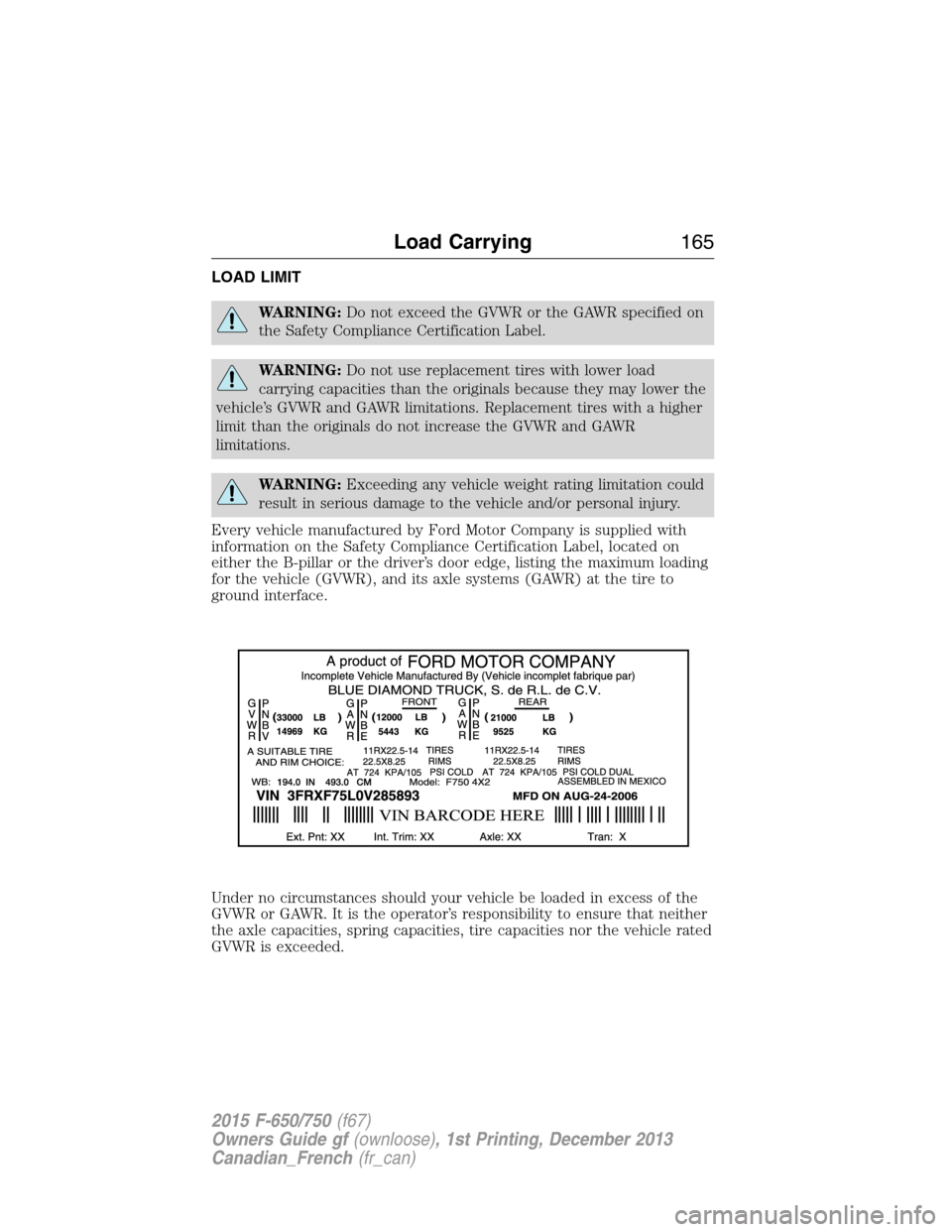
Every vehicle manufactured by Ford Motor Company is supplied with
information on the Safety Compliance Certification Label, located on
either the B-pillar or the driver’s door edge, listing the maximum loading
for the vehicle (GVWR), and its axle systems (GAWR) at the tire to
ground interface.
Under no circumstances should your vehicle be loaded in excess of the
GVWR or GAWR. It is the operator’s responsibility to ensure that neither
the axle capacities, spring capacities, tire capacities nor the vehicle rated
GVWR is exceeded.
Load Carrying165
2015 F-650/750(f67)
Owners Guide gf(ownloose), 1st Printing, December 2013
Canadian_French(fr_can)
Page 167 of 384
Unloaded or Lightly Loaded Vehicles
WARNING:When operating empty or lightly loaded, sudden or
hard braking may induce wheel lockup with loss of vehicle
control and the possibility of accident and serious injury, especially on
wet or slippery road surfaces.
The braking system has been designed to safely stop your vehicle when
fully loaded to its GVWR.
166Load Carrying
2015 F-650/750(f67)
Owners Guide gf(ownloose), 1st Printing, December 2013
Canadian_French(fr_can)
Page 177 of 384
DRIVING THROUGH WATER
If driving through deep or standing water is unavoidable, proceed very
slowly especially if you do not know the depth. Never drive through
water that is higher than the bottom of the hubs. Traction or brake
capability may be limited and your vehicle may stall. Water may also
enter your engine’s air intake and severely damage your engine, drive
axles or the transmission (through the breather ports).
Once through the water, always dry the brakes by moving your vehicle
slowly while applying light pressure on the brake pedal. Wet brakes do
not stop the vehicle as quickly as dry brakes.
176Driving Hints
2015 F-650/750(f67)
Owners Guide gf(ownloose), 1st Printing, December 2013
Canadian_French(fr_can)
Page 178 of 384
ROADSIDE ASSISTANCE
Vehicles Sold in the U.S.: Getting Roadside Assistance
To fully assist you should you have a vehicle concern, Ford Motor
Company offers a complimentary roadside assistance program. This
program is separate from the New Vehicle Limited Warranty and is not
applicable to vehicles sold in Canada. The services are available:
•24-hours, seven days a week
•for the New Vehicle Limited Warranty period (U.S.) of two years
(unlimited miles).
Roadside assistance covers:
•battery jump start
•lock-out assistance (Key replacement cost is the customer’s
responsibility.)
•towing – Ford eligible vehicles towed to an authorized dealer within
35 miles (56 kilometers) of the disablement location or to the nearest
authorized dealer. If a member requests to be towed to an authorized
dealer more than 35 miles (56 kilometers) from the disablement
location, the member shall be responsible for any mileage costs in
excess of 35 miles (56 kilometers).
Trailers shall be covered up to $200 if the disabled eligible vehicle
requires service at the nearest authorized dealer. If the trailer is disabled,
but the towing vehicle is operational, the trailer does not qualify for any
roadside services.
Vehicles Sold in the U.S.: Using Roadside Assistance
Complete the roadside assistance identification card and place it in your
wallet for quick reference. This card is found in the owner’s information
portfolio in the glove compartment.
U.S. Ford vehicle customers who require Roadside Assistance, call
1-800-241-3673.
If you need to arrange roadside assistance for yourself, Ford Motor
Company reimburses a reasonable amount for towing to the nearest
dealership within 35 miles (56 kilometers). To obtain reimbursement
information, U.S. Ford vehicle customers call 1-800-241-3673. Customers
are asked to submit their original receipts.
Roadside Emergencies177
2015 F-650/750(f67)
Owners Guide gf(ownloose), 1st Printing, December 2013
Canadian_French(fr_can)
Page 186 of 384
Canada is not responsible for any damage caused by use of improper
fuel. In the United States, using leaded fuel may also result in difficulty
importing your vehicle back into the U.S.
Ford dealerships outside of the U.S. and Canada may be unable to
support the F–650/750 due to the specialized training and servicing
requirements of these vehicles. If your vehicle must be serviced while
you are traveling or living in Central or South America, the Caribbean, or
the Middle East, contact the nearest Ford dealership. If the dealership
cannot help you, write or call:
FORD MOTOR COMPANY
FORD EXPORT OPERATIONS
1555 Fairlane Drive
Fairlane Business Park #3
Allen Park, Michigan 48101
U.S.A.
Telephone: (313) 594-4857
FAX: (313) 390-0804
If you are in another foreign country, contact the nearest Ford
dealership. If the dealership employees cannot help you, they can direct
you to the nearest Ford affiliate office.
If you buy your vehicle in North America and then relocate outside of
the U.S. or Canada, register your vehicle identification number (VIN) and
new address with Ford Motor Company Export Operations.
ORDERING ADDITIONAL OWNER’S LITERATURE
To order the publications in this portfolio, contact Helm, Incorporated at:
HELM, INCORPORATED
47911 Halyard Drive
Plymouth, Michigan 48170
Attention: Customer Service
Or to order a free publication catalog, call toll free: 1-800-782-4356
Monday-Friday 8:00 a.m. - 6:00 p.m. EST
Helm, Incorporated can also be reached by their website:
www.helminc.com.
(Items in this catalog may be purchased by credit card, check or
money order.)
Customer Assistance185
2015 F-650/750(f67)
Owners Guide gf(ownloose), 1st Printing, December 2013
Canadian_French(fr_can)
Page 198 of 384
GENERAL INFORMATION
WARNING:Making modifications to various parts, components
and systems of the vehicle, such as brake and steering systems,
can adversely affect the quality, reliability and operation of your vehicle
and could result in property damage, personal injury or death. Such
modifications must be avoided.
WARNING:Failure to properly perform maintenance and
servicing procedures could result in vehicle damage, personal
injury or death.
WARNING:Take care when performing any maintenance,
system check or service on your vehicle. Some of the materials
may also be hazardous if used, serviced or handled improperly and
could result in property damage, personal injury or death.
Always use care when performing vehicle maintenance, repairs or system
checks. Improper or incomplete service could result in your vehicle not
working properly which may result in personal injury or damage to your
vehicle or equipment. It is the operator’s responsibility to see that your
vehicle receives proper care and maintenance. If you have any questions
about performing service, have the service done by a qualified
technician.
Servicing Guidelines
When servicing your vehicle:
•Always wear safety glasses for eye protection.
•Always set the parking brake or chock the wheels.
•Always use support stands, not a jack, when working under a raised
vehicle.
•Always turn off the ignition unless a procedure requires the engine to
be running.
•Always avoid contact with hot metal parts. Allow the components to
cool before working with, or around, them.
•Always operate the engine in a well-ventilated area.
•Do not wear loose-fitting clothing, hanging jewelry, watches or rings.
•Do not smoke.
•Do not work on the brakes or the clutch unless you take the proper
precautions to avoid inhaling friction material dust.
Maintenance197
2015 F-650/750(f67)
Owners Guide gf(ownloose), 1st Printing, December 2013
Canadian_French(fr_can)
Page 201 of 384
Special applications may warrant a setting based on experience with the
type of tire operating loads and conditions. Radial tires are more
sensitive to toe-in setting than bias ply tires. Fine tuning school bus
alignment to line-haul truck standards does not drastically improve tire
tread life.
Rear Axle
Regular inspections should include:
•Checking for proper tightness of axle mounting U-bolt nuts, attaching
or mounting bolts and nuts. SeeSpring U-bolt checkslater in this
chapter.
•Checking the axle for damage, binding, worn parts and adequate
lubrication.
NoSpin Detroit Locker Positive Locking Differential
Vehicles equipped with this type differential have the operator’s manual
supplied with the vehicle. See that manual for maintenance inspections.
Brake System
Note:People handling brake linings should follow all precautions listed
below:
200Maintenance
2015 F-650/750(f67)
Owners Guide gf(ownloose), 1st Printing, December 2013
Canadian_French(fr_can)