maintenance schedule FORD F650 2015 13.G Owner's Manual
[x] Cancel search | Manufacturer: FORD, Model Year: 2015, Model line: F650, Model: FORD F650 2015 13.GPages: 384, PDF Size: 4.95 MB
Page 224 of 384
Note:If adding fluid is necessary, use only the appropriate fluid. See the
Capacities and Specificationschapter. A low fluid level may indicate a
leak in the power steering system. Inspect the power steering system
and repair the leak or see an authorized dealer or a qualified technician
for service. See theScheduled Maintenancechapter for the
recommended service intervals.
Check the fluid level when it is at ambient temperature, 20°F–80°F
(-7°C–25°C):
1. Set the parking brake, and then start the engine.
2. Shift into positionNorP(if equipped) (automatic transmission) or
first gear (manual transmission) and turn the engine off.
3. Open the hood.
4. Clean the top of the power steering fluid reservoir.
5. Remove the dipstick from the reservoir and wipe the dipstick clean.
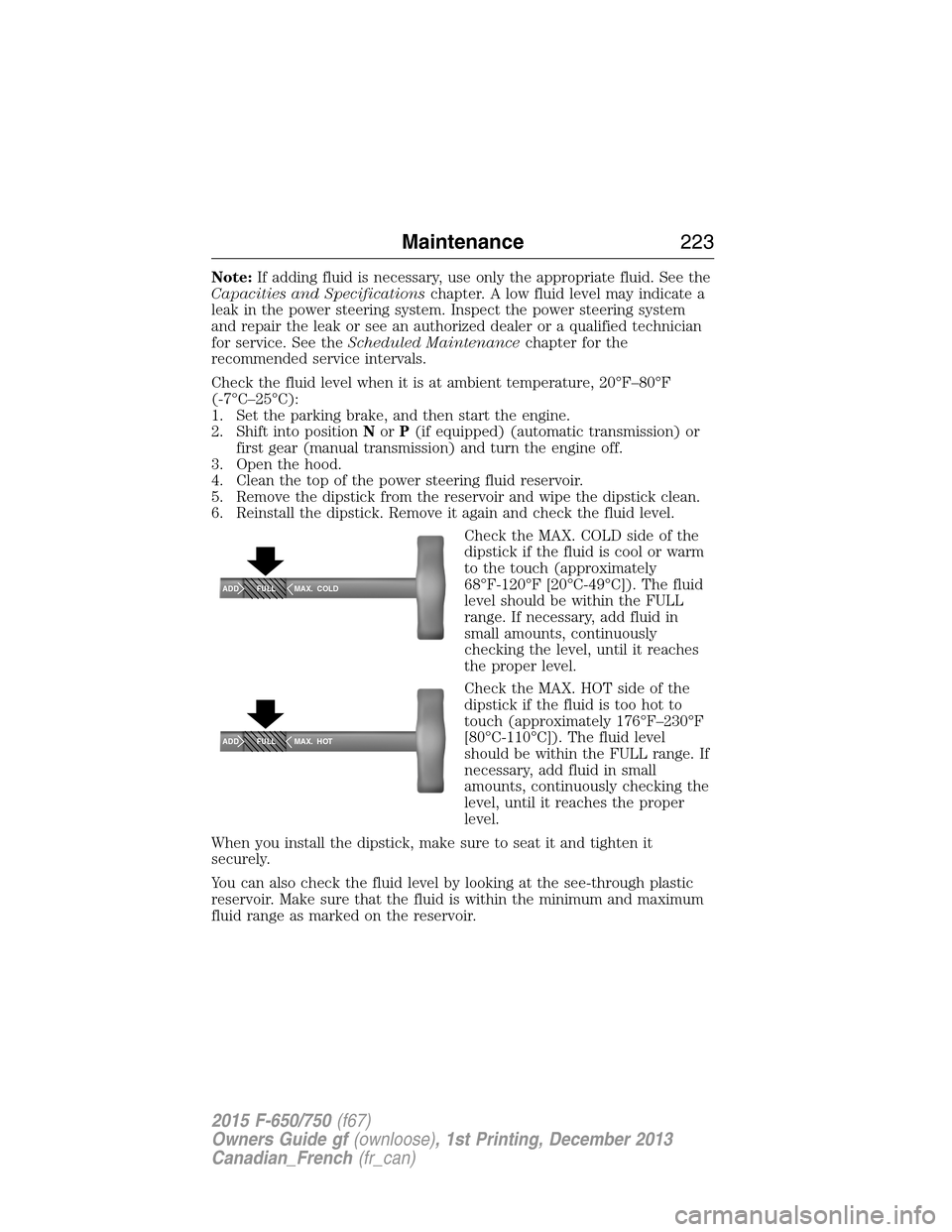
6. Reinstall the dipstick. Remove it again and check the fluid level.
Check the MAX. COLD side of the
dipstick if the fluid is cool or warm
to the touch (approximately
68°F-120°F [20°C-49°C]). The fluid
level should be within the FULL
range. If necessary, add fluid in
small amounts, continuously
checking the level, until it reaches
the proper level.
Check the MAX. HOT side of the
dipstick if the fluid is too hot to
touch (approximately 176°F–230°F
[80°C-110°C]). The fluid level
should be within the FULL range. If
necessary, add fluid in small
amounts, continuously checking the
level, until it reaches the proper
level.
When you install the dipstick, make sure to seat it and tighten it
securely.
You can also check the fluid level by looking at the see-through plastic
reservoir. Make sure that the fluid is within the minimum and maximum
fluid range as marked on the reservoir.
ADD MAX. COLD
FULL
ADD MAX. HOT
FULL
Maintenance223
2015 F-650/750(f67)
Owners Guide gf(ownloose), 1st Printing, December 2013
Canadian_French(fr_can)
Page 230 of 384
Note:Failure to use the correct air filter element may result in severe
engine damage. The customer warranty may be void for any damage to
the engine if the correct air filter element is not used.
See theScheduled Maintenancechapter for the appropriate intervals
for changing the air filter element.
When changing the air filter element, use only the Motorcraft air filter
element listed. SeeMotorcraft part numbersin theCapacities and
Specificationschapter.
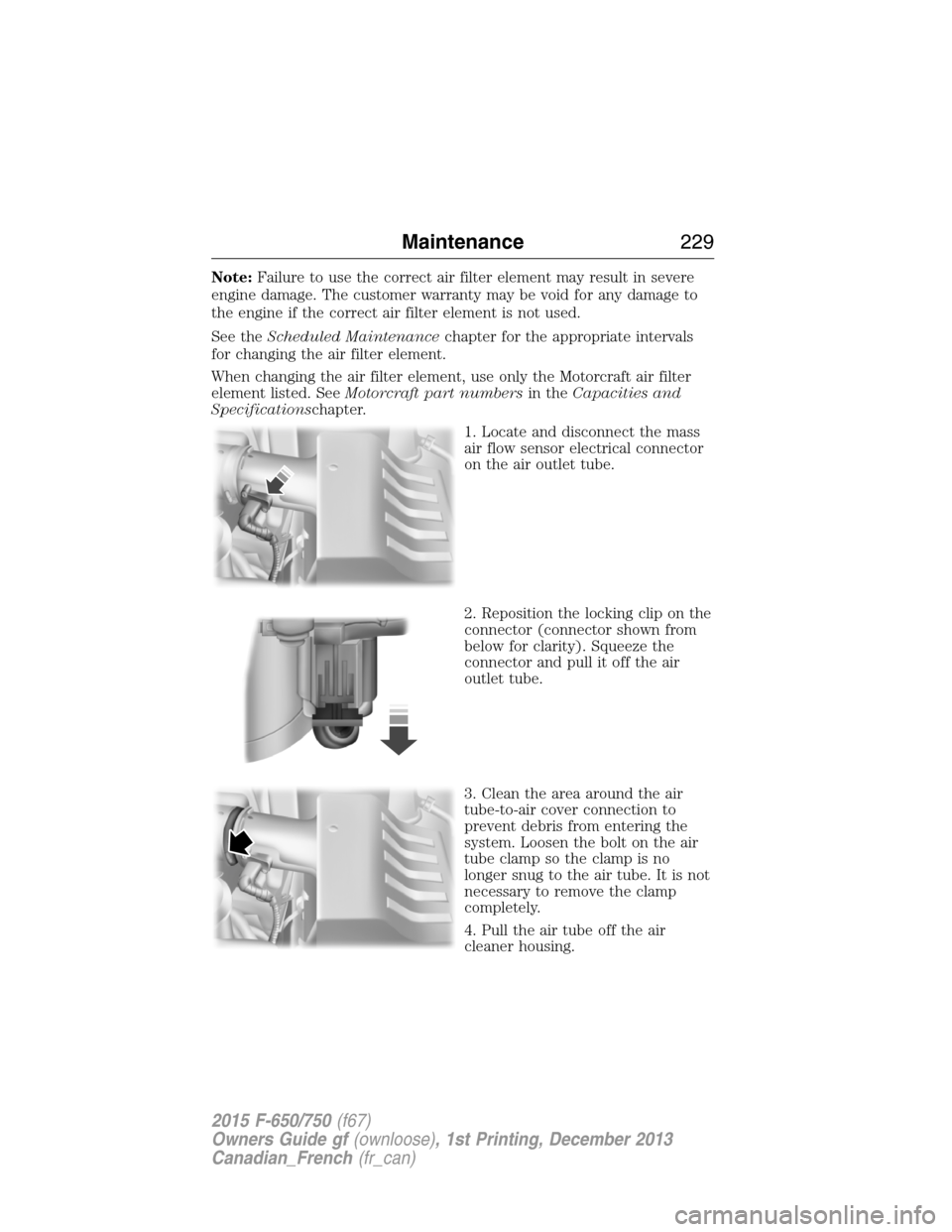
1. Locate and disconnect the mass
air flow sensor electrical connector
on the air outlet tube.
2. Reposition the locking clip on the
connector (connector shown from
below for clarity). Squeeze the
connector and pull it off the air
outlet tube.
3. Clean the area around the air
tube-to-air cover connection to
prevent debris from entering the
system. Loosen the bolt on the air
tube clamp so the clamp is no
longer snug to the air tube. It is not
necessary to remove the clamp
completely.
4. Pull the air tube off the air
cleaner housing.
Maintenance229
2015 F-650/750(f67)
Owners Guide gf(ownloose), 1st Printing, December 2013
Canadian_French(fr_can)
Page 273 of 384
![FORD F650 2015 13.G Owners Manual Diesel engine
Tank Type Capacity - Gallons (Liters)
Dual, steel rectangular 35 (RH)/45 (LH)
(132 [RH]/170 [LH])
Dual, steel rectangular 45/45 (170/170)
Dual, steel D-style 50/50 (189/189)
Dual, steel](/img/11/5080/w960_5080-272.png "FORD F650 2015 13.G Owners Manual Diesel engine
Tank Type Capacity - Gallons (Liters)
Dual, steel rectangular 35 (RH)/45 (LH)
(132 [RH]/170 [LH])
Dual, steel rectangular 45/45 (170/170)
Dual, steel D-style 50/50 (189/189)
Dual, steel")
Diesel engine
Tank Type Capacity - Gallons (Liters)
Dual, steel rectangular 35 (RH)/45 (LH)
(132 [RH]/170 [LH])
Dual, steel rectangular 45/45 (170/170)
Dual, steel D-style 50/50 (189/189)
Dual, steel D-style 65 (RH)/45 (LH)
(246 [RH]/170 [LH])
Dual, steel rectangular 65/65 (246/246)
Dual, steel D-style 80/65 (303/246)
MOTORCRAFT® PART NUMBERS
Component 6.8L V10 Engine
Air filter element FA-1889
Oil filter FL-820-S
Battery BH-31-DC (700 CCA)
BH-31-XT (950 CCA)
Spark plugs-platinum
*HJFS–24P/SP–509
Wiper blade WW–2236
*For spark plug replacement, see an authorized dealer. See the
Scheduled Maintenancechapter for the appropriate intervals for
changing the spark plugs.
Note:Replace the spark plugs with ones that meet Ford material and
design specifications for your vehicle, such as Motorcraft or equivalent
replacement parts. The customer warranty may be void for any damage
to the engine if such spark plugs are not used.
VEHICLE IDENTIFICATION NUMBER
The VIN is on the Vehicle Rating Decal attached to the vehicle on the
edge of the driver’s door or B-Pillar. The VIN also serves as the warranty
number. If you ever find it necessary to communicate with Ford Motor
Company about your vehicle, always include the VIN in your
communication.
272Capacities and Specifications
2015 F-650/750(f67)
Owners Guide gf(ownloose), 1st Printing, December 2013
Canadian_French(fr_can)
Page 312 of 384
•The phone(s) paired and connected to the system was thrown from
the vehicle.
911 Assist Privacy Notice
Once 911 Assist is set on, it may disclose to emergency services that the
vehicle has been in a crash involving the deployment of an airbag or
activation of the fuel pump shut-off. Certain versions or updates to 911
Assist may also be capable of electronically or verbally disclosing to 911
operators the vehicle location, and/or other details about the vehicle or
crash to assist 911 operators to provide the most appropriate emergency
services. If you do not want to disclose this information, do not turn the
feature on.
Vehicle Health Report (If Equipped)
WARNING:Always follow scheduled maintenance instructions,
regularly inspect your vehicle, and seek repair for any damage or
problem you suspect. Vehicle Health Report supplements, but cannot
replace normal maintenance and vehicle inspection. Vehicle Health
Report only monitors certain systems that are electronically monitored
by the vehicle and will not monitor or report the status of any other
system, (i.e., brake lining wear). Failure to perform scheduled
maintenance and regularly inspect your vehicle may result in vehicle
damage and serious injury.
Note:Your Vehicle Health Report feature requires activation prior to
use. Visit www.SYNCMyRide.com to register. There is no fee or
subscription associated with Vehicle Health Report, but you must register
to use this feature.
Note:This feature may not function properly if you have enabled caller
ID blocking on your mobile phone. Before running a report, review the
Vehicle Health Report privacy notice.
Note:In order to allow a break-in period for your vehicle, you may not
be able to create a Vehicle Health Report until your vehicle odometer has
reached 200 miles.
Register for Vehicle Health Report and set your report preferences at
www.SYNCMyRide.com. After registering, you can request a Vehicle
Health Report (inside your vehicle). Return to your account at
www.SYNCMyRide.com to view your report. You can also choose for
SYNC to automatically remind you to run reports at specific mileage
intervals. Cellular phone airtime usage may apply when reporting.
SYNC®311
2015 F-650/750(f67)
Owners Guide gf(ownloose), 1st Printing, December 2013
Canadian_French(fr_can)
Page 313 of 384
The system allows you to check your vehicle’s overall health in the form
of a diagnostic report card. The vehicle health report contains valuable
information such as:
•Vehicle Diagnostic Information
•Scheduled maintenance
•Open Recalls and Field Service Actions
•Unserviced items from vehicle inspections by your authorized dealer.
You can run a report (after the vehicle has been running a minimum of
60 seconds) by pressing the voice button and saying “Vehicle health
report”, or pressing the phone button.
To run a report using the phone button:
1. Press the phone button to enter Phone Menu.
2. Scroll until Vehicle Health is selected and press OK.
3. Scroll to select from the following options:
Vehicle Health Report options
User Preferences:
Press OK to select
and enter the menu.
Scroll to select from:Automatic Reports:Press OK and select on
or off. Select On to have SYNC automatically
prompt you to run a health report at certain
mileage intervals.Note:You must first turn
this feature on before you can select the
mileage intervals at which you would like to
be prompted.
Mileage Intervals:Press OK. Scroll to select
between 5000, 7500 or 10000 mile intervals
and press OK to make your selection.
Return:Press OK to exit the menu.
Run Report?Press OK for SYNC to run a health report of
your vehicle’s diagnostic systems and send the
results to Ford where it is combined with
scheduled maintenance information, open
recalls and other field service actions and
unserviced vehicle inspection items from your
authorized dealer.
Vehicle Health Report Privacy Notice
When you run a Vehicle Health Report, Ford Motor Company may collect
your cellular phone number (to process your report request) and
312SYNC®
2015 F-650/750(f67)
Owners Guide gf(ownloose), 1st Printing, December 2013
Canadian_French(fr_can)
Page 341 of 384
GENERAL MAINTENANCE INFORMATION
Why Maintain Your Vehicle?
Carefully following the maintenance schedule helps protect against major
repair expenses resulting from neglect or inadequate maintenance and
may help to increase the value of your vehicle when you sell or trade it.
Keep all receipts for completed maintenance with your vehicle.
We have established regular maintenance intervals for your vehicle based
upon rigorous testing. It is important that you have your vehicle serviced
at the proper times. These intervals serve two purposes; one is to
maintain the reliability of your vehicle and the second is to keep your
cost of owning your vehicle down.
It is your responsibility to have all scheduled maintenance performed and
to make sure that the materials used meet the specifications identified in
theCapacities and Specificationschapter of this owner’s manual.
Failure to perform scheduled maintenance invalidates warranty coverage
on parts affected by the lack of maintenance.
Protecting Your Investment
Maintenance is an investment that pays dividends in the form of
improved reliability, durability and resale value. To maintain the proper
performance of your vehicle and its emission control systems, make sure
you have scheduled maintenance performed at the designated intervals.
Your vehicle is very sophisticated and built with multiple, complex,
performance systems. Every manufacturer develops these systems using
different specifications and performance features. That is why it is
important to rely upon your dealership to properly diagnose and repair
your vehicle.
Ford Motor Company has recommended maintenance intervals for
various parts and component systems based upon engineering testing.
Ford Motor Company relies upon this testing to determine the most
appropriate mileage for replacement of oils and fluids to protect your
vehicle at the lowest overall cost to you and recommends against
maintenance schedules that deviate from the scheduled maintenance
information.
We strongly recommend the use of only genuine Ford, Motorcraft or
Ford-authorized re-manufactured replacement parts engineered for your
vehicle.
340Scheduled Maintenance
2015 F-650/750(f67)
Owners Guide gf(ownloose), 1st Printing, December 2013
Canadian_French(fr_can)
Page 342 of 384
Additives and Chemicals
This owner’s manual and the Ford Workshop Manual list the
recommended additives and chemicals for your vehicle. We do not
recommend using chemicals or additives not approved by us as part of
your vehicle’s normal maintenance. Please consult your warranty
information.
Oils, Fluids and Flushing
In many cases, fluid discoloration is a normal operating characteristic
and, by itself, does not necessarily indicate a concern or that the fluid
needs to be changed. However, a qualified expert, such as the
factory-trained technicians at your dealership, should inspect discolored
fluids that also show signs of overheating or foreign material
contamination immediately.
Make sure to change your vehicle’s oils and fluids at the specified
intervals or in conjunction with a repair. Flushing is a viable way to
change fluid for many vehicle sub-systems during scheduled
maintenance. It is critical that systems are flushed only with new fluid
that is the same as that required to fill and operate the system or using a
Ford-approved flushing chemical.
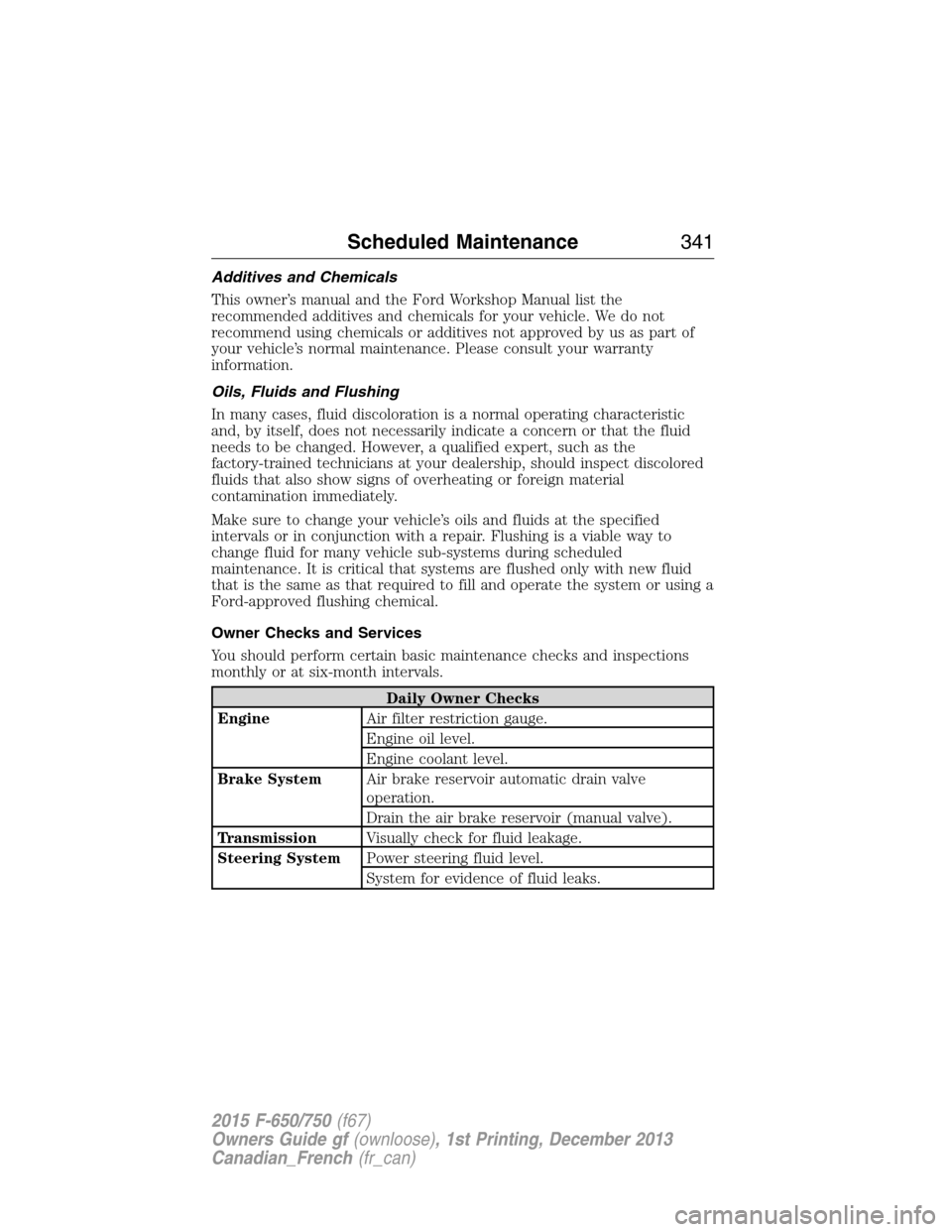
Owner Checks and Services
You should perform certain basic maintenance checks and inspections
monthly or at six-month intervals.
Daily Owner Checks
EngineAir filter restriction gauge.
Engine oil level.
Engine coolant level.
Brake SystemAir brake reservoir automatic drain valve
operation.
Drain the air brake reservoir (manual valve).
TransmissionVisually check for fluid leakage.
Steering SystemPower steering fluid level.
System for evidence of fluid leaks.
Scheduled Maintenance341
2015 F-650/750(f67)
Owners Guide gf(ownloose), 1st Printing, December 2013
Canadian_French(fr_can)
Page 343 of 384
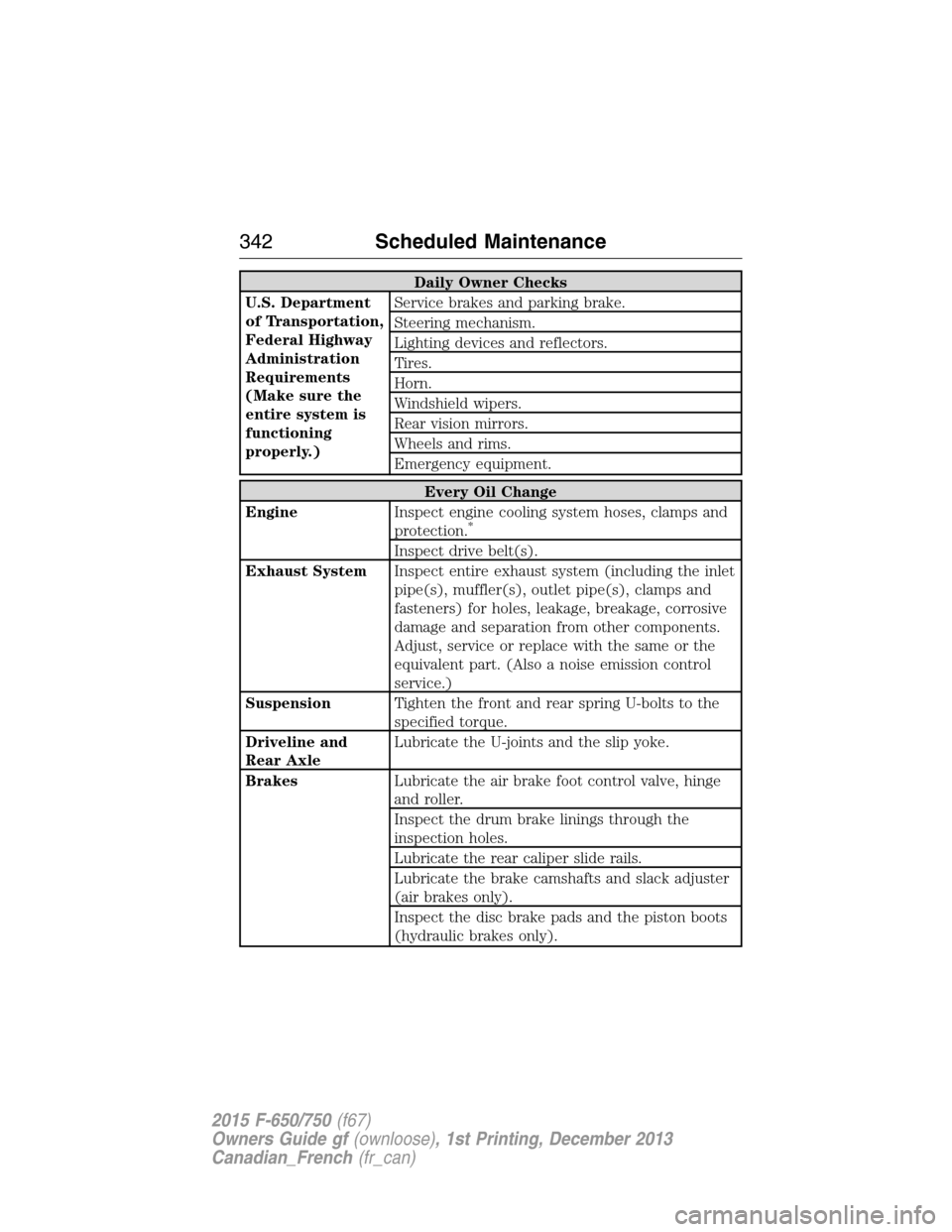
Daily Owner Checks
U.S. Department
of Transportation,
Federal Highway
Administration
Requirements
(Make sure the
entire system is
functioning
properly.)Service brakes and parking brake.
Steering mechanism.
Lighting devices and reflectors.
Tires.
Horn.
Windshield wipers.
Rear vision mirrors.
Wheels and rims.
Emergency equipment.
Every Oil Change
EngineInspect engine cooling system hoses, clamps and
protection.
*
Inspect drive belt(s).
Exhaust SystemInspect entire exhaust system (including the inlet
pipe(s), muffler(s), outlet pipe(s), clamps and
fasteners) for holes, leakage, breakage, corrosive
damage and separation from other components.
Adjust, service or replace with the same or the
equivalent part. (Also a noise emission control
service.)
SuspensionTighten the front and rear spring U-bolts to the
specified torque.
Driveline and
Rear AxleLubricate the U-joints and the slip yoke.
BrakesLubricate the air brake foot control valve, hinge
and roller.
Inspect the drum brake linings through the
inspection holes.
Lubricate the rear caliper slide rails.
Lubricate the brake camshafts and slack adjuster
(air brakes only).
Inspect the disc brake pads and the piston boots
(hydraulic brakes only).
342Scheduled Maintenance
2015 F-650/750(f67)
Owners Guide gf(ownloose), 1st Printing, December 2013
Canadian_French(fr_can)
Page 344 of 384
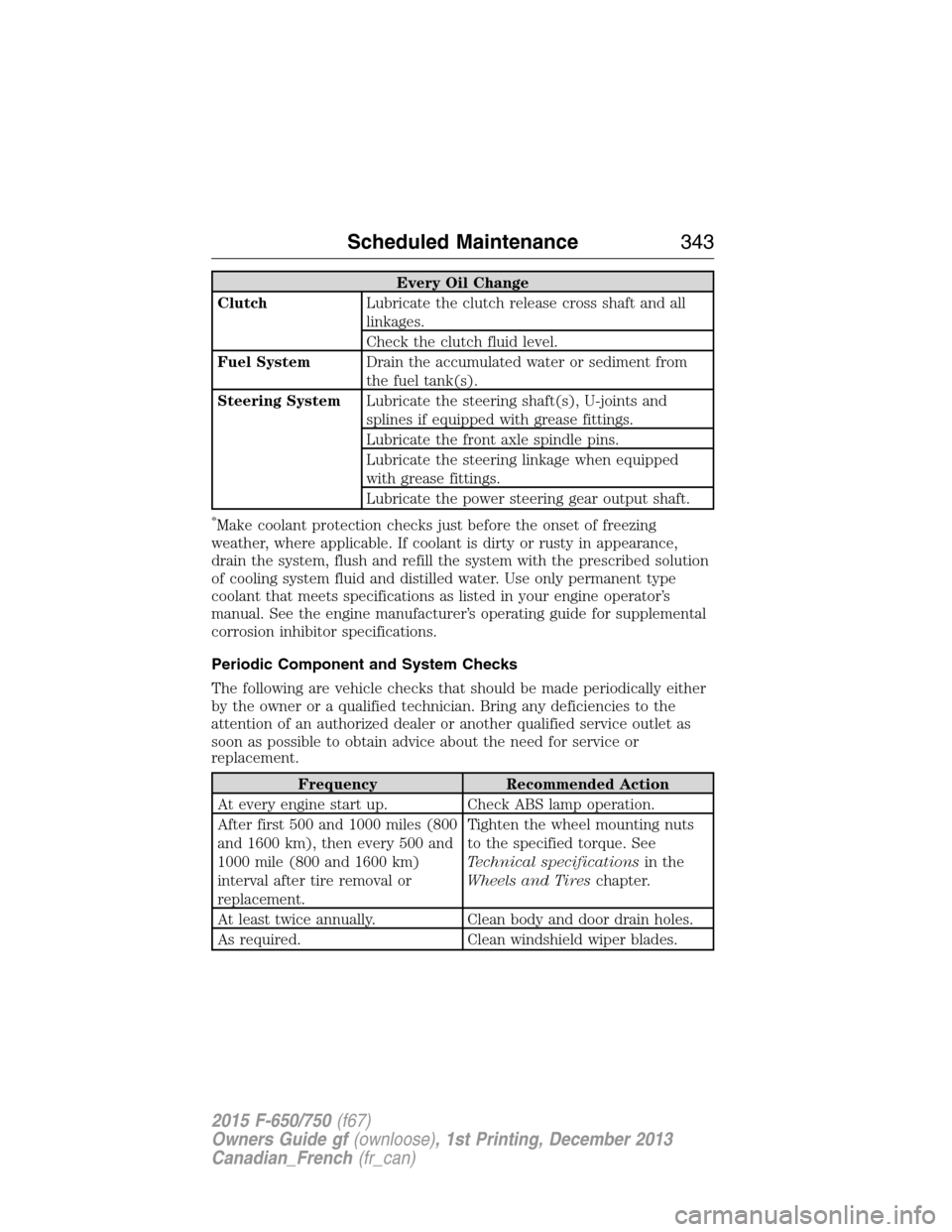
Every Oil Change
ClutchLubricate the clutch release cross shaft and all
linkages.
Check the clutch fluid level.
Fuel SystemDrain the accumulated water or sediment from
the fuel tank(s).
Steering SystemLubricate the steering shaft(s), U-joints and
splines if equipped with grease fittings.
Lubricate the front axle spindle pins.
Lubricate the steering linkage when equipped
with grease fittings.
Lubricate the power steering gear output shaft.
*Make coolant protection checks just before the onset of freezing
weather, where applicable. If coolant is dirty or rusty in appearance,
drain the system, flush and refill the system with the prescribed solution
of cooling system fluid and distilled water. Use only permanent type
coolant that meets specifications as listed in your engine operator’s
manual. See the engine manufacturer’s operating guide for supplemental
corrosion inhibitor specifications.
Periodic Component and System Checks
The following are vehicle checks that should be made periodically either
by the owner or a qualified technician. Bring any deficiencies to the
attention of an authorized dealer or another qualified service outlet as
soon as possible to obtain advice about the need for service or
replacement.
Frequency Recommended Action
At every engine start up. Check ABS lamp operation.
After first 500 and 1000 miles (800
and 1600 km), then every 500 and
1000 mile (800 and 1600 km)
interval after tire removal or
replacement.Tighten the wheel mounting nuts
to the specified torque. See
Technical specificationsin the
Wheels and Tireschapter.
At least twice annually. Clean body and door drain holes.
As required. Clean windshield wiper blades.
Scheduled Maintenance343
2015 F-650/750(f67)
Owners Guide gf(ownloose), 1st Printing, December 2013
Canadian_French(fr_can)
Page 345 of 384
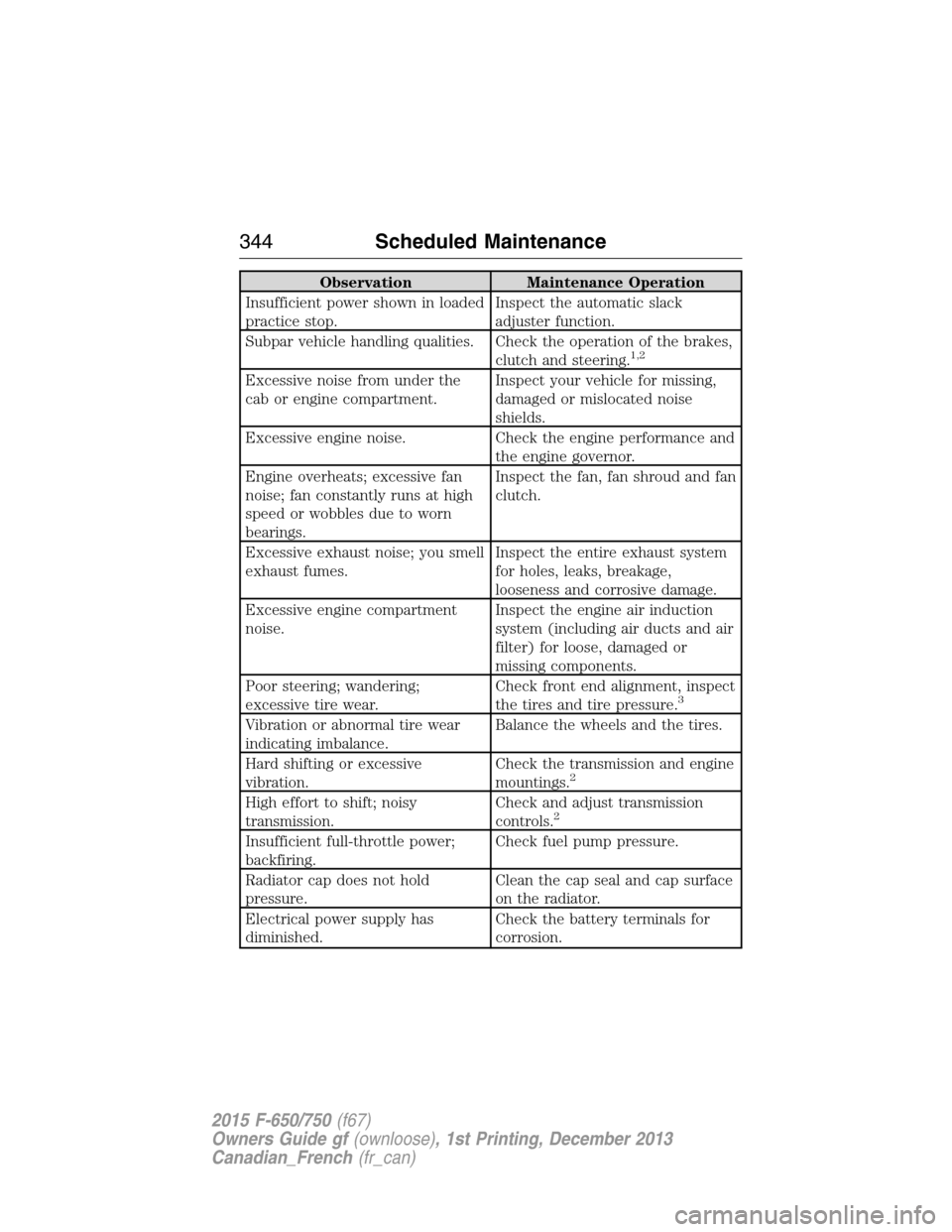
Observation Maintenance Operation
Insufficient power shown in loaded
practice stop.Inspect the automatic slack
adjuster function.
Subpar vehicle handling qualities. Check the operation of the brakes,
clutch and steering.
1,2
Excessive noise from under the
cab or engine compartment.Inspect your vehicle for missing,
damaged or mislocated noise
shields.
Excessive engine noise. Check the engine performance and
the engine governor.
Engine overheats; excessive fan
noise; fan constantly runs at high
speed or wobbles due to worn
bearings.Inspect the fan, fan shroud and fan
clutch.
Excessive exhaust noise; you smell
exhaust fumes.Inspect the entire exhaust system
for holes, leaks, breakage,
looseness and corrosive damage.
Excessive engine compartment
noise.Inspect the engine air induction
system (including air ducts and air
filter) for loose, damaged or
missing components.
Poor steering; wandering;
excessive tire wear.Check front end alignment, inspect
the tires and tire pressure.
3
Vibration or abnormal tire wear
indicating imbalance.Balance the wheels and the tires.
Hard shifting or excessive
vibration.Check the transmission and engine
mountings.
2
High effort to shift; noisy
transmission.Check and adjust transmission
controls.2
Insufficient full-throttle power;
backfiring.Check fuel pump pressure.
Radiator cap does not hold
pressure.Clean the cap seal and cap surface
on the radiator.
Electrical power supply has
diminished.Check the battery terminals for
corrosion.
344Scheduled Maintenance
2015 F-650/750(f67)
Owners Guide gf(ownloose), 1st Printing, December 2013
Canadian_French(fr_can)