air condition FORD F650 2017 13.G Workshop Manual
[x] Cancel search | Manufacturer: FORD, Model Year: 2017, Model line: F650, Model: FORD F650 2017 13.GPages: 382, PDF Size: 5.18 MB
Page 245 of 382

WARNING
Stay out of the trajectory (1)
as indicated in the illustration.
Inspecting Your Tires and
Wheel Valve Stems
Periodically inspect the tire treads
for uneven or excessive wear and
remove objects such as stones,
nails or glass that may be wedged
in the tread grooves. Check the tire
and valve stems for holes, cracks,
or cuts that may permit air
leakage and repair or replace the
tire and replace the valve stem.
Inspect the tire sidewalls for
cracking, cuts, bruises and other signs of damage or excessive
wear. If internal damage to the tire
is suspected, have the tire
demounted and inspected in case
it needs to be repaired or replaced.
For your safety, tires that are
damaged or show signs of
excessive wear should not be used
because they are more likely to
blow out or fail.
Improper or inadequate vehicle
maintenance can cause tires to
wear abnormally. Inspect all your
tires, including the spare,
frequently, and replace them if
one or more of the following
conditions exist:
242
F-650/750 (TBC) , enUSA, First Printing Wheels and TiresE161438
1
Page 256 of 382

Single Alternator
Single Alternator With Air Brake
Compressor
Drivebelt closest to the engine.
A
Drivebelt furthest from the
engine.
B Dual Alternator
Dual Alternator With Air Brake
Compressor
Drivebelt closest to the engine.
A
Drivebelt furthest from the
engine.
B
Note: The belt routings show vehicles
equipped with air conditioning. When not
equipped with air conditioning a idler pulley
is in place of the A/C compressor.
253
F-650/750 (TBC) , enUSA, First Printing Capacities and SpecificationsE224819 E224825 E224820 E224826
Page 261 of 382
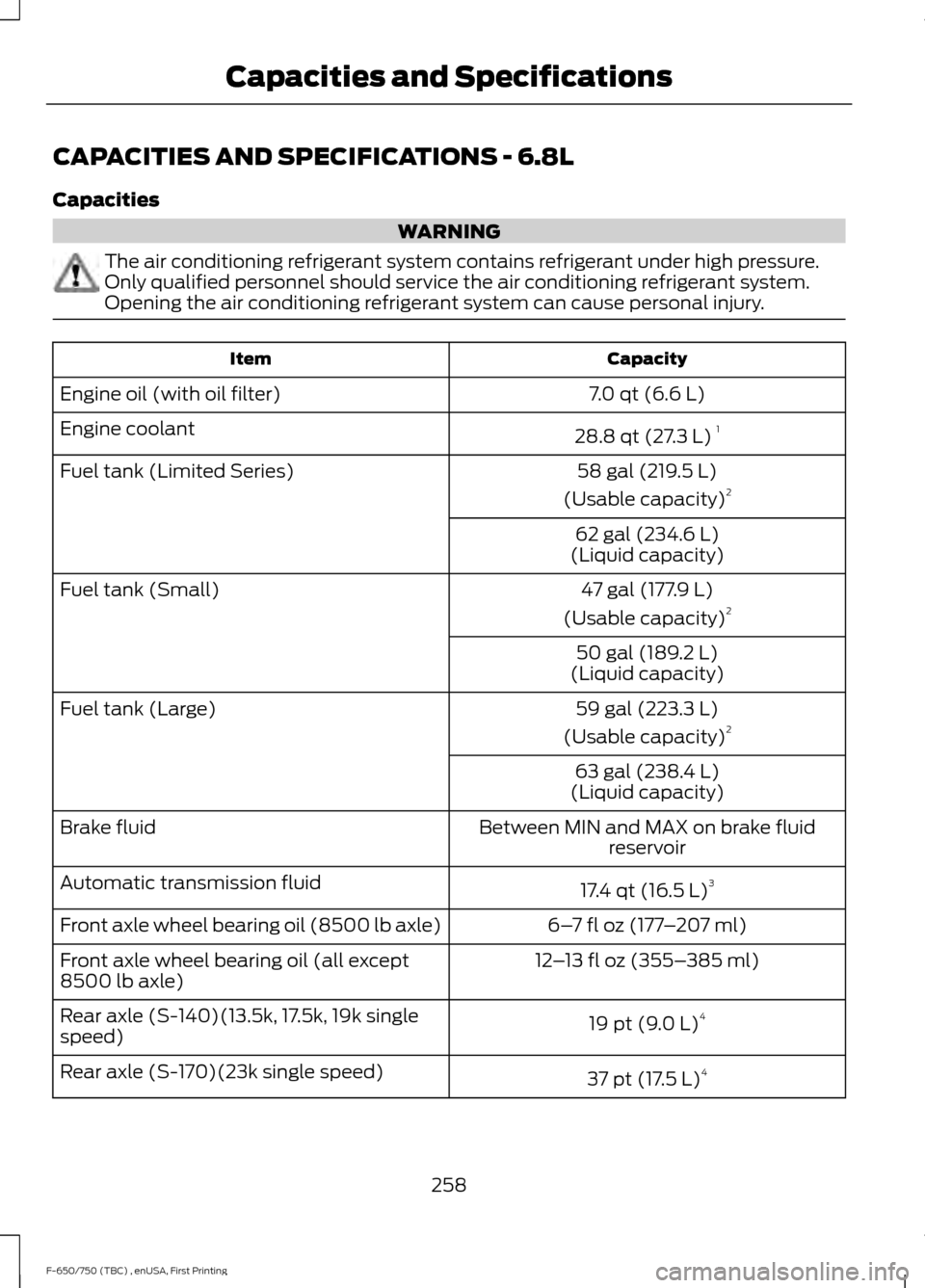
CAPACITIES AND SPECIFICATIONS - 6.8L
Capacities
WARNING
The air conditioning refrigerant system contains refrigerant under high pressure.
Only qualified personnel should service the air conditioning refrigerant system.
Opening the air conditioning refrigerant system can cause personal injury.
Capacity
Item
7.0 qt (6.6 L)
Engine oil (with oil filter)
28.8 qt (27.3 L)1
Engine coolant
58 gal (219.5 L)
Fuel tank (Limited Series)
(Usable capacity)2
62 gal (234.6 L)
(Liquid capacity)
47 gal (177.9 L)
Fuel tank (Small)
(Usable capacity)2
50 gal (189.2 L)
(Liquid capacity)
59 gal (223.3 L)
Fuel tank (Large)
(Usable capacity)2
63 gal (238.4 L)
(Liquid capacity)
Between MIN and MAX on brake fluid reservoir
Brake fluid
17.4 qt (16.5 L)3
Automatic transmission fluid
6–7 fl oz (177 –207 ml)
Front axle wheel bearing oil (8500 lb axle)
12–13 fl oz (355– 385 ml)
Front axle wheel bearing oil (all except
8500 lb axle)
19 pt (9.0 L)4
Rear axle (S-140)(13.5k, 17.5k, 19k single
speed)
37 pt (17.5 L)4
Rear axle (S-170)(23k single speed)
258
F-650/750 (TBC) , enUSA, First Printing Capacities and Specifications
Page 266 of 382

•
Increased emission levels.
• Reduced engine performance.
• Reduced fuel economy.
• Degraded brake performance.
We recommend Motorcraft® motor oil for
your vehicle. If Motorcraft® oil is not
available, use motor oils of the
recommended viscosity grade that meet
API SN requirements and display the API
Certification Mark for gasoline engines. Do
not use oil labeled with API SN service
category unless the label also displays the
API certification mark. An oil that displays this symbol conforms
to current engine, emission system and
fuel economy performance standards of
the International Lubricants Specification
Advisory Committee (ILSAC).
Do not use supplemental engine oil
additives because they are unnecessary
and could lead to engine damage that may
not be covered by your vehicle warranty.
Note:
Ford recommends using DOT 4 Low
Viscosity (LV) High Performance Brake Fluid
or equivalent meeting WSS-M6C65-A2. Use
of any fluid other than the recommended
fluid may cause degraded brake
performance and not meet the Ford
performance standards. Keep brake fluid
clean and dry. Contamination with dirt,
water, petroleum products or other
materials may result in brake system
damage and possible failure.
Note: Automatic transmissions that require
MERCON LV transmission fluid should only
use MERCON LV transmission fluid. The
use of any other fluid may cause
transmission damage.
CAPACITIES AND SPECIFICATIONS - 6.7L DIESEL
Capacities WARNING
The air conditioning refrigerant system contains refrigerant under high pressure.
Only qualified personnel should service the air conditioning refrigerant system.
Opening the air conditioning refrigerant system can cause personal injury.
Capacity
Item
15.0 qt (14.2 L)
Engine oil (with oil filter)
35.1 qt (33.2 L)1
Engine coolant (primary high-temperature
cooling system loop)
48 fl oz (1.41 L)2
Engine coolant additive (primary high-
temperature cooling system loop)
263
F-650/750 (TBC) , enUSA, First Printing Capacities and SpecificationsE142732
Page 285 of 382
SYNC Owner Account
Why do I need a SYNC owner account?
•
Essential for keeping up with the latest
software downloads available for
SYNC.
• Access to customer support for any
questions you may have.
Driving Restrictions
For your safety, certain features are
speed-dependent and restricted when your
vehicle is traveling over 3 mph (5 km/h).
Safety Information WARNING
Driving while distracted can result in
loss of vehicle control, crash and
injury. We strongly recommend that
you use extreme caution when using any
device that may take your focus off the
road. Your primary responsibility is the safe
operation of your vehicle. We recommend
against the use of any hand-held device
while driving and encourage the use of
voice-operated systems when possible.
Make sure you are aware of all applicable
local laws that may affect the use of
electronic devices while driving. When using SYNC:
•
Do not operate playing devices if the
power cords or cables are broken, split
or damaged. Place cords and cables
out of the way, so they do not interfere
with the operation of pedals, seats,
compartments or safe driving abilities.
• Do not leave playing devices in your
vehicle during extreme conditions as it
could cause them damage. See your
device's manual for further information.
• Do not attempt to service or repair the
system. See an authorized dealer. Privacy Information
When a cellular phone is connected to
SYNC, the system creates a profile within
your vehicle that is linked to that cellular
phone. This profile is created in order to
offer you more cellular features and to
operate more efficiently. Among other
things, this profile may contain data about
your cellular phone book, text messages
(read and unread), and call history,
including history of calls when your cellular
phone was not connected to the system.
In addition, if you connect a media device,
the system creates and retains an index of
supported media content. The system also
records a short development log of
approximately 10 minutes of all recent
system activity. The log profile and other
system data may be used to improve the
system and help diagnose any problems
that may occur.
The cellular profile, media device index,
and development log will remain in the
vehicle unless you delete them and are
generally accessible only in the vehicle
when the cellular phone or media player
is connected. If you no longer plan to use
the system or the vehicle, we recommend
you perform a Master Reset to erase all
stored information.
System data cannot be accessed without
special equipment and access to the
vehicle's SYNC module. Ford Motor
Company and Ford of Canada will not
access the system data for any purpose
other than as described absent consent, a
court order, or where required by law
enforcement, other government
authorities, or other third parties acting
with lawful authority. Other parties may
seek to access the information
independently of Ford Motor Company and
Ford of Canada.
282
F-650/750 (TBC) , enUSA, First Printing SYNC™
(If Equipped)
Page 323 of 382
There are three types of maintenance
intervals for general vehicle environments:
On-Highway, City and Severe Service. In
all applications, monitoring miles
(kilometers) and time and when the engine
is due for an oil change determine the
actual interval. When the engine oil change
is required before the truck lubrication
interval, perform the lubrication at the
same time in order to reduce your vehicle
’s
time out of service.
Air Brake Adjustment WARNING
Failure to maintain proper air brake
adjustment can result in reduction
or loss of braking ability.
A qualified service technician, keeping to
the instructions in the service manual,
should perform air brake inspection and
adjustment or repairs.
Cam Brakes - Automatic Slack
Adjusters
WARNING
Do not manually adjust the
automatic slack adjusters to correct
excessive push rod stroke as it may
result in reduced brake effectiveness and
a vehicle crash. Excessive push rod stroke
indicates that a problem exists with the
automatic adjuster, with the installation
of the adjuster, or with foundation brake
components that manual adjustment does
not remedy. Seek service from a qualified
facility for excessive push rod stroke. Inspect standard air brakes equipped with
automatic slack adjusters for proper brake
adjustment as listed in the maintenance
schedule charts.
However, inspect the brakes more
frequently when subjecting them to heavy
use or adverse operating conditions such
as:
•
Frequent brake applications while fully
loaded.
• Operation on hilly or mountainous
terrain.
• Frequent operation on dirt, gravel or
mud.
Some aftermarket brake linings also
require more frequent inspections.
Owner Checks and Services
Make sure you perform the following basic
maintenance checks and inspections every
month or at six-month intervals.
320
F-650/750 (TBC) , enUSA, First Printing Scheduled Maintenance
Page 328 of 382
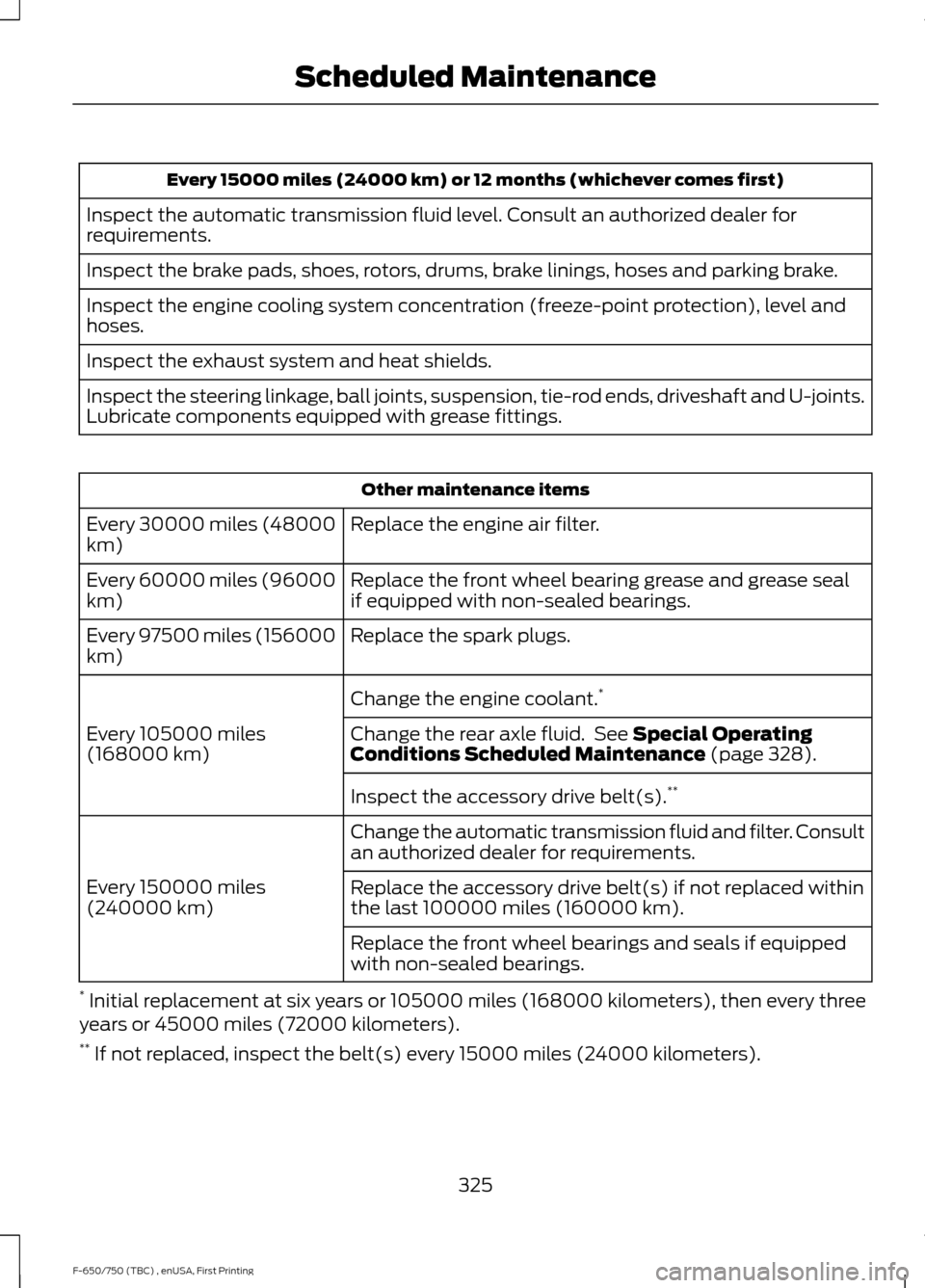
Every 15000 miles (24000 km) or 12 months (whichever comes first)
Inspect the automatic transmission fluid level. Consult an authorized dealer for
requirements.
Inspect the brake pads, shoes, rotors, drums, brake linings, hoses and parking brake.
Inspect the engine cooling system concentration (freeze-point protection), level and
hoses.
Inspect the exhaust system and heat shields.
Inspect the steering linkage, ball joints, suspension, tie-rod ends, driveshaft and U-joints.
Lubricate components equipped with grease fittings. Other maintenance items
Replace the engine air filter.
Every 30000 miles (48000
km)
Replace the front wheel bearing grease and grease seal
if equipped with non-sealed bearings.
Every 60000 miles (96000
km)
Replace the spark plugs.
Every 97500 miles (156000
km)
Change the engine coolant.*
Every 105000 miles
(168000 km) Change the rear axle fluid. See Special Operating
Conditions Scheduled Maintenance (page 328).
Inspect the accessory drive belt(s). **
Change the automatic transmission fluid and filter. Consult
an authorized dealer for requirements.
Every 150000 miles
(240000 km) Replace the accessory drive belt(s) if not replaced within
the last 100000 miles (160000 km).
Replace the front wheel bearings and seals if equipped
with non-sealed bearings.
* Initial replacement at six years or 105000 miles (168000 kilometers), then every three
years or 45000 miles (72000 kilometers).
** If not replaced, inspect the belt(s) every 15000 miles (24000 kilometers).
325
F-650/750 (TBC) , enUSA, First Printing Scheduled Maintenance
Page 330 of 382
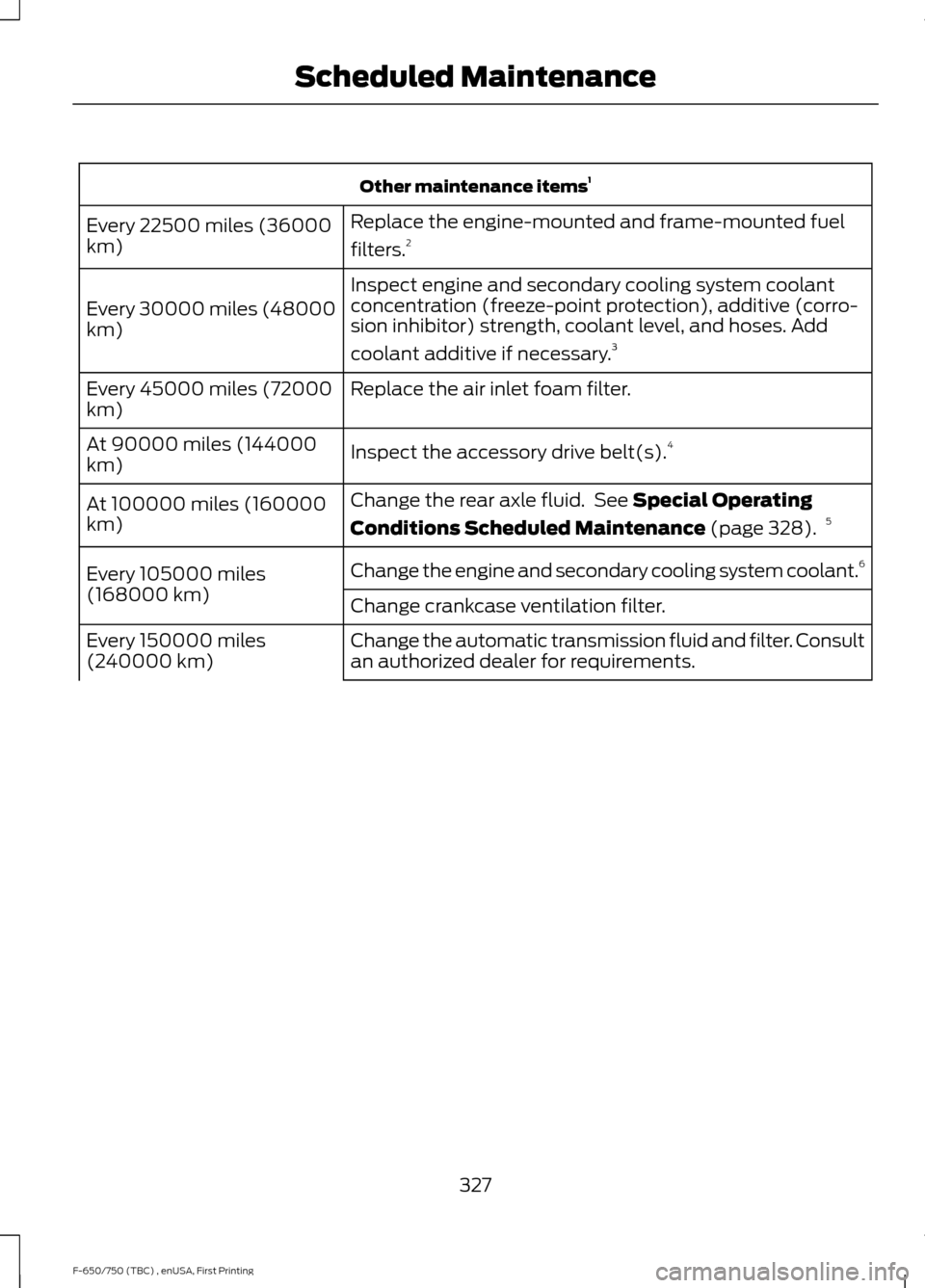
Other maintenance items
1
Replace the engine-mounted and frame-mounted fuel
filters. 2
Every 22500 miles (36000
km)
Inspect engine and secondary cooling system coolant
concentration (freeze-point protection), additive (corro-
sion inhibitor) strength, coolant level, and hoses. Add
coolant additive if necessary.3
Every 30000 miles (48000
km)
Replace the air inlet foam filter.
Every 45000 miles (72000
km)
Inspect the accessory drive belt(s). 4
At 90000 miles (144000
km)
Change the rear axle fluid. See Special Operating
Conditions Scheduled Maintenance
(page 328). 5
At 100000 miles (160000
km)
Change the engine and secondary cooling system coolant. 6
Every 105000 miles
(168000 km) Change crankcase ventilation filter.
Change the automatic transmission fluid and filter. Consult
an authorized dealer for requirements.
Every 150000 miles
(240000 km)
327
F-650/750 (TBC) , enUSA, First Printing Scheduled Maintenance
Page 333 of 382
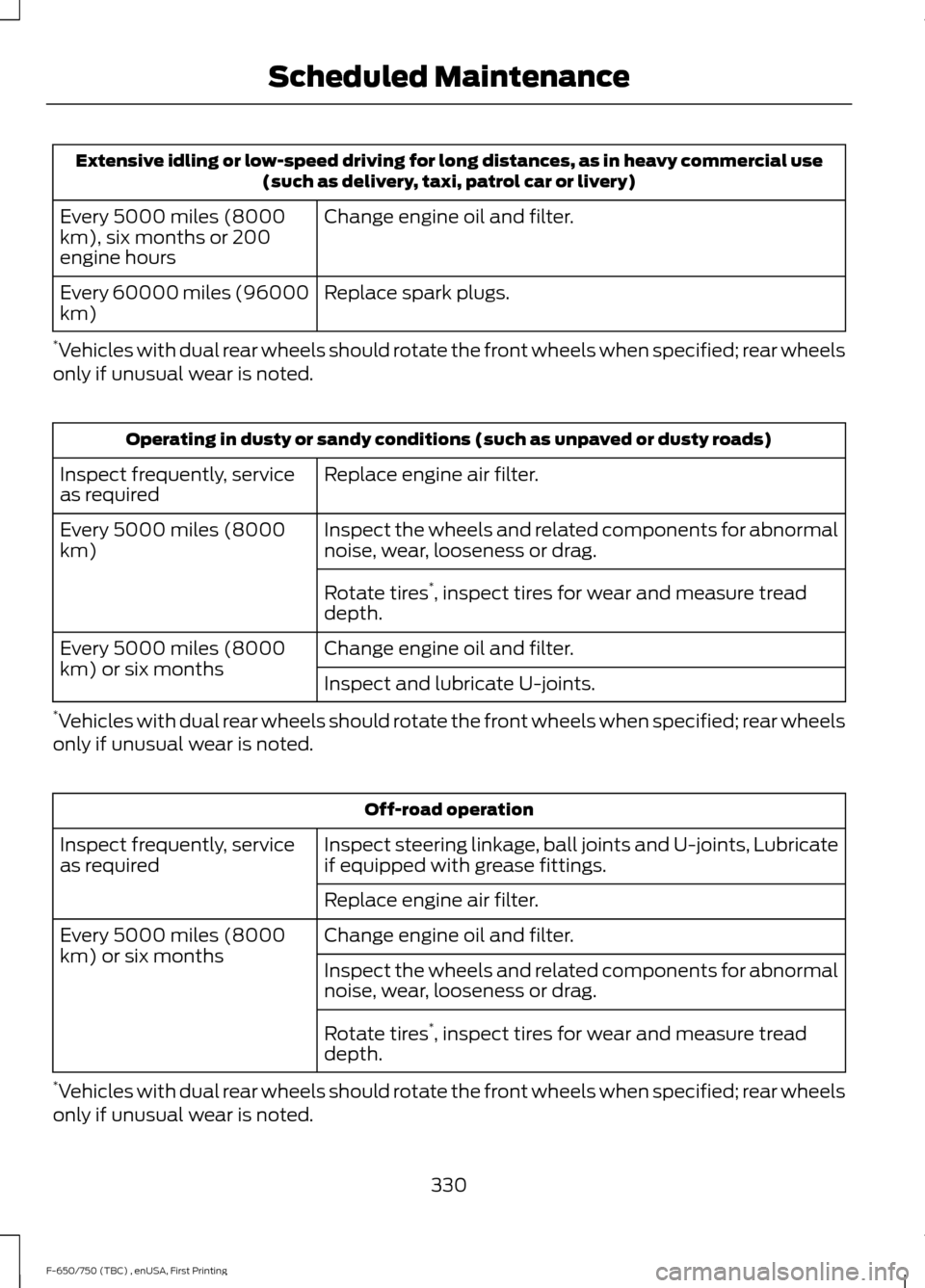
Extensive idling or low-speed driving for long distances, as in heavy commercial use
(such as delivery, taxi, patrol car or livery)
Change engine oil and filter.
Every 5000 miles (8000
km), six months or 200
engine hours
Replace spark plugs.
Every 60000 miles (96000
km)
* Vehicles with dual rear wheels should rotate the front wheels when specified; rear wheels
only if unusual wear is noted. Operating in dusty or sandy conditions (such as unpaved or dusty roads)
Replace engine air filter.
Inspect frequently, service
as required
Inspect the wheels and related components for abnormal
noise, wear, looseness or drag.
Every 5000 miles (8000
km)
Rotate tires*
, inspect tires for wear and measure tread
depth.
Change engine oil and filter.
Every 5000 miles (8000
km) or six months
Inspect and lubricate U-joints.
* Vehicles with dual rear wheels should rotate the front wheels when specified; rear wheels
only if unusual wear is noted. Off-road operation
Inspect steering linkage, ball joints and U-joints, Lubricate
if equipped with grease fittings.
Inspect frequently, service
as required
Replace engine air filter.
Change engine oil and filter.
Every 5000 miles (8000
km) or six months
Inspect the wheels and related components for abnormal
noise, wear, looseness or drag.
Rotate tires*
, inspect tires for wear and measure tread
depth.
* Vehicles with dual rear wheels should rotate the front wheels when specified; rear wheels
only if unusual wear is noted.
330
F-650/750 (TBC) , enUSA, First Printing Scheduled Maintenance
Page 338 of 382
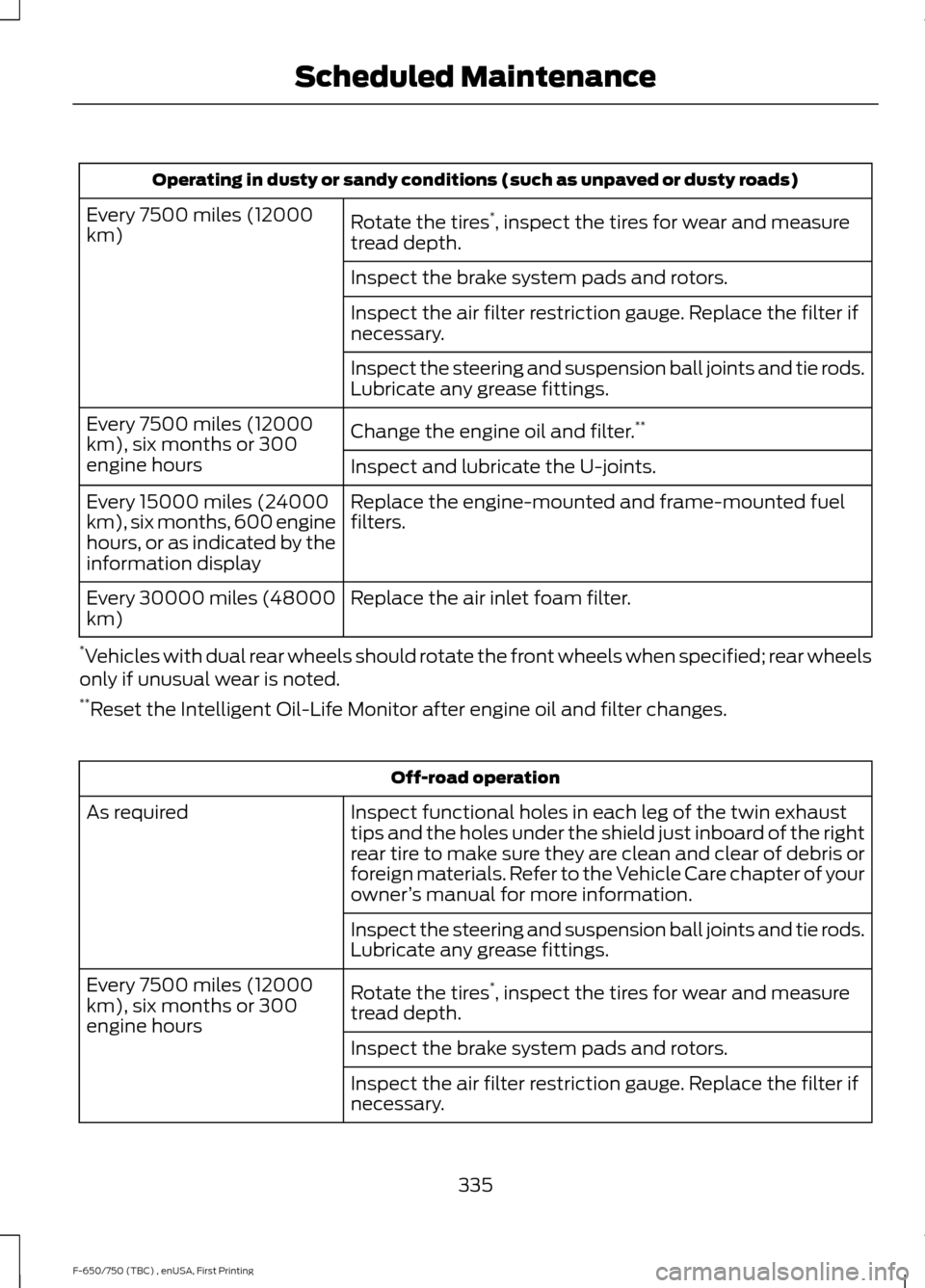
Operating in dusty or sandy conditions (such as unpaved or dusty roads)
Rotate the tires*
, inspect the tires for wear and measure
tread depth.
Every 7500 miles (12000
km)
Inspect the brake system pads and rotors.
Inspect the air filter restriction gauge. Replace the filter if
necessary.
Inspect the steering and suspension ball joints and tie rods.
Lubricate any grease fittings.
Change the engine oil and filter. **
Every 7500 miles (12000
km), six months or 300
engine hours Inspect and lubricate the U-joints.
Replace the engine-mounted and frame-mounted fuel
filters.
Every 15000 miles (24000
km), six months, 600 engine
hours, or as indicated by the
information display
Replace the air inlet foam filter.
Every 30000 miles (48000
km)
* Vehicles with dual rear wheels should rotate the front wheels when specified; rear wheels
only if unusual wear is noted.
** Reset the Intelligent Oil-Life Monitor after engine oil and filter changes. Off-road operation
Inspect functional holes in each leg of the twin exhaust
tips and the holes under the shield just inboard of the right
rear tire to make sure they are clean and clear of debris or
foreign materials. Refer to the Vehicle Care chapter of your
owner ’s manual for more information.
As required
Inspect the steering and suspension ball joints and tie rods.
Lubricate any grease fittings.
Rotate the tires*
, inspect the tires for wear and measure
tread depth.
Every 7500 miles (12000
km), six months or 300
engine hours
Inspect the brake system pads and rotors.
Inspect the air filter restriction gauge. Replace the filter if
necessary.
335
F-650/750 (TBC) , enUSA, First Printing Scheduled Maintenance