check engine light FORD F650/750 2019 Owner's Manual
[x] Cancel search | Manufacturer: FORD, Model Year: 2019, Model line: F650/750, Model: FORD F650/750 2019Pages: 387, PDF Size: 4.78 MB
Page 199 of 387
4.
Make sure that the sealing surfaces on
the filter housing and cover are clean
and free of debris.
5. Install the new filter element.
6. Install the filter cover.
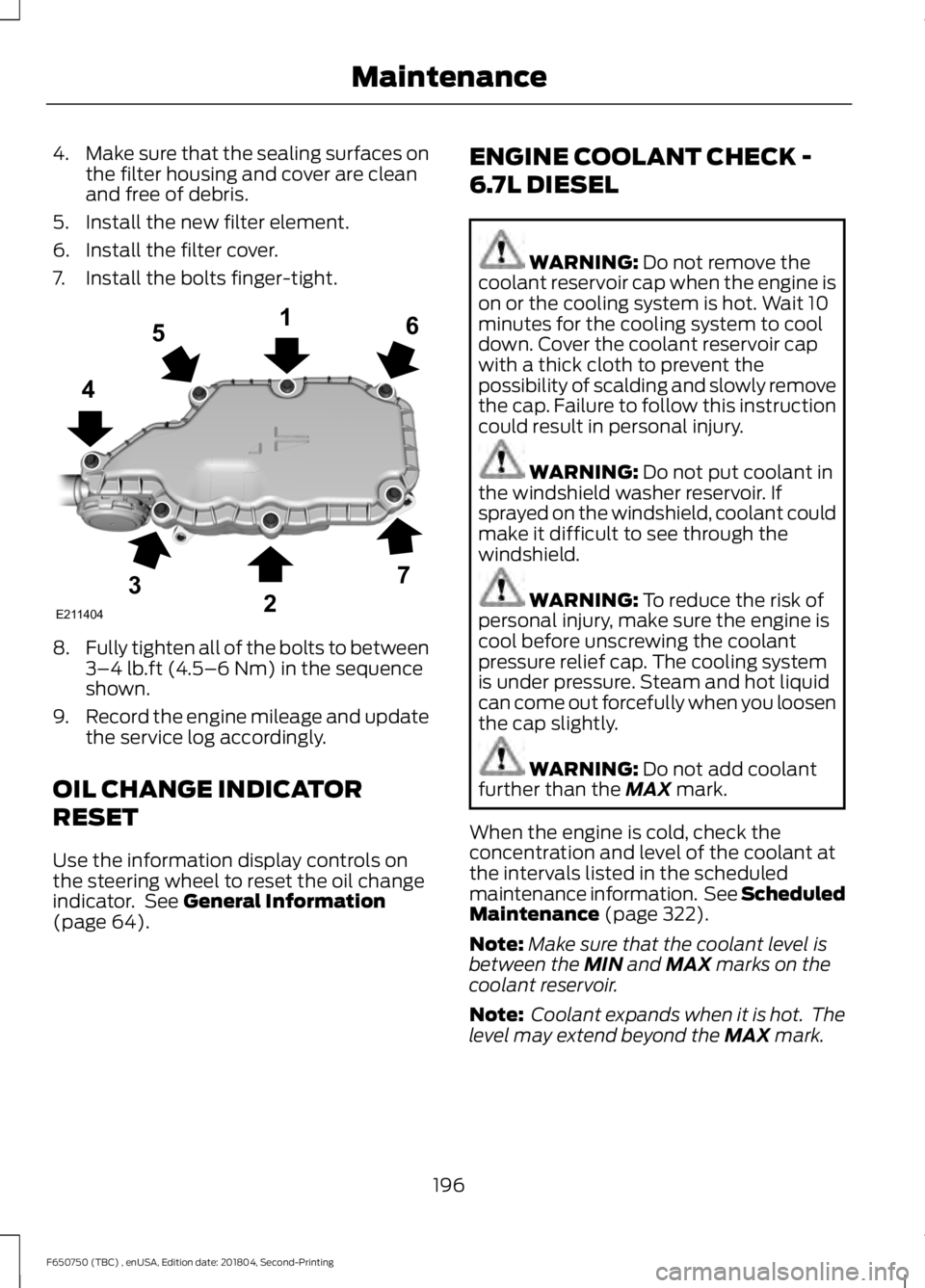
7. Install the bolts finger-tight. 8.
Fully tighten all of the bolts to between
3–4 lb.ft (4.5–6 Nm) in the sequence
shown.
9. Record the engine mileage and update
the service log accordingly.
OIL CHANGE INDICATOR
RESET
Use the information display controls on
the steering wheel to reset the oil change
indicator. See
General Information
(page 64). ENGINE COOLANT CHECK -
6.7L DIESEL WARNING:
Do not remove the
coolant reservoir cap when the engine is
on or the cooling system is hot. Wait 10
minutes for the cooling system to cool
down. Cover the coolant reservoir cap
with a thick cloth to prevent the
possibility of scalding and slowly remove
the cap. Failure to follow this instruction
could result in personal injury. WARNING:
Do not put coolant in
the windshield washer reservoir. If
sprayed on the windshield, coolant could
make it difficult to see through the
windshield. WARNING:
To reduce the risk of
personal injury, make sure the engine is
cool before unscrewing the coolant
pressure relief cap. The cooling system
is under pressure. Steam and hot liquid
can come out forcefully when you loosen
the cap slightly. WARNING:
Do not add coolant
further than the MAX mark.
When the engine is cold, check the
concentration and level of the coolant at
the intervals listed in the scheduled
maintenance information. See Scheduled
Maintenance
(page 322).
Note: Make sure that the coolant level is
between the
MIN and MAX marks on the
coolant reservoir.
Note: Coolant expands when it is hot. The
level may extend beyond the
MAX mark.
196
F650750 (TBC) , enUSA, Edition date: 201804, Second-Printing MaintenanceE211404
165
4
32
7
Page 203 of 387
Engine-driven Cooling Fan
Your vehicle may have an engine driven
cooling fan drive also called a fan clutch.
This fan drive changes the fan speed to
match the vehicle
’s changing cooling air
flow requirements. Fan speed, fan noise
level and fuel consumption all will increase
based on the driving conditions that
include trailer towing, hill climbing, heavy
loads, high speed and high ambient
temperature, individually or in combination.
The fan drive is designed to provide the
minimum fan speed and resulting
minimum fan noise and fuel consumption
required to meet the ever-changing vehicle
cooling air flow requirements. You can hear
the amount of fan noise increasing and
decreasing as the engine power
requirements and vehicle driving conditions
change as you drive. This is normal to the
operation of your vehicle. You may also
hear high levels of the fan when the engine
is first started and should normally
decrease after driving for a short time.
ENGINE COOLANT CHECK -
6.8L WARNING: Do not remove the
coolant reservoir cap when the engine is
on or the cooling system is hot. Wait 10
minutes for the cooling system to cool
down. Cover the coolant reservoir cap
with a thick cloth to prevent the
possibility of scalding and slowly remove
the cap. Failure to follow this instruction
could result in personal injury. WARNING:
Do not put coolant in
the windshield washer reservoir. If
sprayed on the windshield, coolant could
make it difficult to see through the
windshield. WARNING:
To reduce the risk of
personal injury, make sure the engine is
cool before unscrewing the coolant
pressure relief cap. The cooling system
is under pressure. Steam and hot liquid
can come out forcefully when you loosen
the cap slightly. WARNING:
Do not add coolant
further than the MAX mark.
When the engine is cold, check the
concentration and level of the coolant at
the intervals listed in the scheduled
maintenance information. See Scheduled
Maintenance
(page 322).
Note: Make sure that the coolant level is
between the
MIN and the MAX marks on
the coolant reservoir.
Note: Coolant expands when it is hot. The
level may extend beyond the
MAX mark.
Maintain coolant concentration within
48% to 50%, which equates to a freeze
point between -30°F (-34°C) and -34°F
(-37°C). Coolant concentration should be
checked using a refractometer. We
recommend Robinair® Coolant and
Battery Refractometer 75240 (Rotunda
tool part number: ROB75240). We do not
recommend the use of hydrometers or
coolant test strips for measuring coolant
concentration.
Note: Automotive fluids are not
interchangeable. Do not use coolant or
windshield washer fluid outside of its
specified function and vehicle location.
Note: Do not use stop leak pellets, cooling
system sealants, or additives as they can
cause damage to the engine cooling or
heating systems. Resulting component
damage may not be covered by the vehicle
Warranty.
200
F650750 (TBC) , enUSA, Edition date: 201804, Second-Printing Maintenance
Page 210 of 387
DRAINING THE FUEL FILTER
WATER TRAP - 6.7L DIESEL
Your vehicle is equipped with a diesel fuel
conditioner module located on the
frame-rail under the driver-side floorboard
near the transmission.
You should drain water from the
module assembly whenever the
warning light comes on and the
message center directs you to drain the
water separator. This will occur when
approximately 8.45 fl oz (250 ml) of water
accumulates in the module. If you allow
the water level to exceed this level, the
water may pass through to the engine and
may cause fuel injection equipment
damage.
Draining the Diesel Fuel
Conditioner Module (DFCM) WARNING: Do not drain the
water-in-fuel separator while the engine
is running. Failure to follow this warning
may result in fire, serious injury, death or
property damage.
Note: If you drain the diesel fuel conditioner
module while the system is running air will
enter into the fuel system. The engine will
not operate properly if air enters the system.
Note: With fuel tank levels above 3⁄4 tank
it may be necessary to loosen the bowl three
turns before opening the drain. This will
actuate an anti-siphon valve at the fuel and
water separator inlet and prevent the fuel
from siphoning out of the tank.
Note: A loose drain valve can allow air to
enter the fuel system and cause drivetrain
issues. The engine will not operate properly.
Be sure that you fully tighten the drain valve.
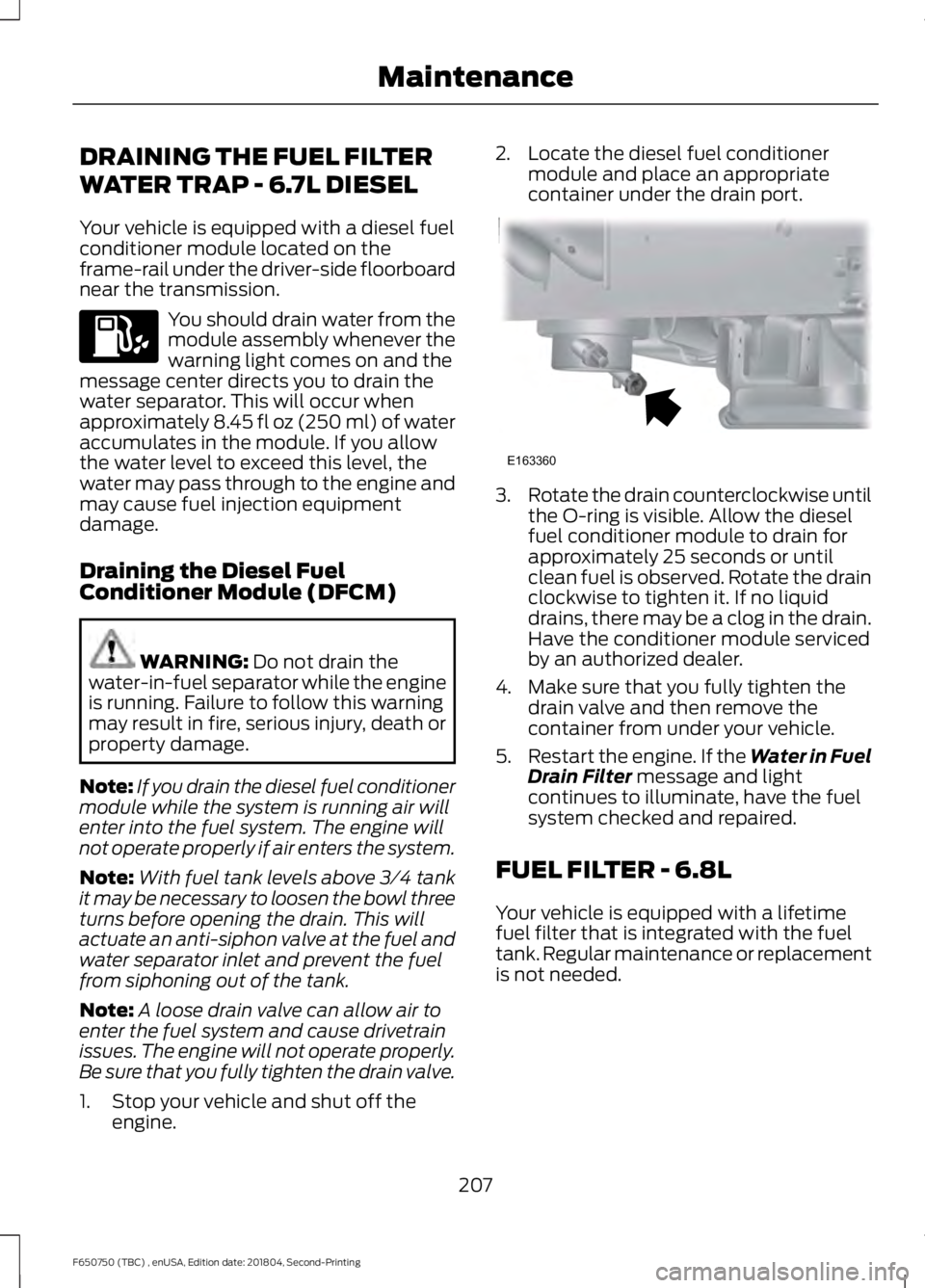
1. Stop your vehicle and shut off the engine. 2. Locate the diesel fuel conditioner
module and place an appropriate
container under the drain port. 3.
Rotate the drain counterclockwise until
the O-ring is visible. Allow the diesel
fuel conditioner module to drain for
approximately 25 seconds or until
clean fuel is observed. Rotate the drain
clockwise to tighten it. If no liquid
drains, there may be a clog in the drain.
Have the conditioner module serviced
by an authorized dealer.
4. Make sure that you fully tighten the drain valve and then remove the
container from under your vehicle.
5. Restart the engine. If the Water in Fuel
Drain Filter
message and light
continues to illuminate, have the fuel
system checked and repaired.
FUEL FILTER - 6.8L
Your vehicle is equipped with a lifetime
fuel filter that is integrated with the fuel
tank. Regular maintenance or replacement
is not needed.
207
F650750 (TBC) , enUSA, Edition date: 201804, Second-Printing Maintenance E163360
Page 327 of 387
There are three types of maintenance
intervals for general vehicle environments:
On-Highway, City and Severe Service. In
all applications, monitoring miles
(kilometers) and time and when the engine
is due for an oil change determine the
actual interval. When the engine oil change
is required before the truck lubrication
interval, perform the lubrication at the
same time in order to reduce your vehicle
’s
time out of service.
Air Brake Adjustment WARNING: Failure to maintain
proper air brake adjustment can result
in reduction or loss of braking ability.
A qualified service technician, keeping to
the instructions in the service manual,
should perform air brake inspection and
adjustment or repairs.
Cam Brakes - Automatic Slack
Adjusters WARNING:
Do not manually
adjust the automatic slack adjusters to
correct excessive push rod stroke as it
may result in reduced brake
effectiveness and a vehicle crash.
Excessive push rod stroke indicates that a problem exists with the automatic
adjuster, with the installation of the
adjuster, or with foundation brake
components that manual adjustment
does not remedy. Seek service from a
qualified facility for excessive push rod
stroke.
Inspect standard air brakes equipped with
automatic slack adjusters for proper brake
adjustment as listed in the maintenance
schedule charts.
However, inspect the brakes more
frequently when subjecting them to heavy
use or adverse operating conditions such
as:
• Frequent brake applications while fully
loaded.
• Operation on hilly or mountainous
terrain.
• Frequent operation on dirt, gravel or
mud.
Some aftermarket brake linings also
require more frequent inspections.
Owner Checks and Services
Make sure you perform the following basic
maintenance checks and inspections every
month or at six-month intervals. Check Every Month
Air filter restriction gauge. 1
Engine oil level.
Fuel and water separator. Drain if necessary, or if indicated by the information display. 1
Function of all interior and exterior lights.
Holes and slots in the tail pipe to make sure they are functional and clear of debris. 1
324
F650750 (TBC) , enUSA, Edition date: 201804, Second-Printing Scheduled Maintenance
Page 343 of 387
Rear Axle Maintenance
A rear axle fluid change or level check is
not required unless a leak is suspected or
the assembly has been submerged in
water. During long periods of trailer towing
with outside temperatures above 70°F
(21°C), and at wide-open throttle for long
periods above 45 mph (72 km/h), change
the rear axle fluid every 24,000 mi
(38,000 km) or three months, whichever
comes first.
California Fuel Filter Replacement
If you register your vehicle in California, the
California Air Resources Board has
determined that the failure to perform this
maintenance item does not nullify the
emission warranty or limit recall liability
before the completion of your vehicle's
useful life. Ford Motor Company, however,
urges you to have all recommended
maintenance services performed at the
specified intervals and to record all vehicle
service.
Hot Climate Oil Change Intervals
The normal oil change interval is 3,000 mi
(5,000 km) for gasoline vehicles operating
in the Middle East, North Africa,
Sub-Saharan Africa or locations with
similar climates using American Petroleum
Institute (API) oils Certified for Gasoline
Engines and displaying the API Certification
Mark. If API Certified Oils are not available,
then it is acceptable to use API SM or SN
oils. If API oils are not available, then the
oil change interval is 1,750 mi (3,000 km). Engine Air Filter Replacement
The life of the engine air filter is dependent
on exposure to dusty and dirty conditions.
Vehicles operated in these conditions
require frequent inspection and
replacement of the engine air filter and
cabin air filter.
Diesel Particulate Filter
Over time, a slight amount of ash builds
up in the diesel particulate filter, which is
not removed during the regeneration
process. The filter may need to be replaced
with a new or remanufactured part at
approximately 250,000 mi (400,000 km).
Actual mileage varies depending on engine
and vehicle operating conditions.
In this case, the engine control system sets
a service light (wrench icon) to inform you
to bring your vehicle to the dealer for
service. If there are any issues with the
oxidation catalyst or particulate filter
system, a service light (wrench or engine
icon) sets by the engine control system to
inform you to bring your vehicle into a
dealer for service.
SCHEDULED MAINTENANCE
RECORD
After the scheduled maintenance services
are performed, record the Repair Order #,
Distance and Engine Hours in the boxes
provided.
340
F650750 (TBC) , enUSA, Edition date: 201804, Second-Printing Scheduled Maintenance
Page 382 of 387
Engine Oil Pressure Gauge................................
57
Fuel Gauge.............................................................. 57
Gasoline Engines.................................................. 56
Gauge Package...................................................... 57
Information Display............................................. 58
Transmission Fluid Temperature Gauge................................................................... 57
Gearbox See: Transmission............................................... 115
General Driving Points................................149
Backing Up............................................................ 149
General Information.......................................... 149
Parking .................................................................... 150
General Information on Radio Frequencies..................................................40
General Maintenance Information
........322
Multi-point Inspection..................................... 326
Owner Checks and Services.......................... 324
Protecting Your Investment........................... 322
Why Maintain Your Vehicle?.......................... 322
Why Maintain Your Vehicle at Your Dealership?..................................................... 322
Getting Assistance Outside the U.S. and Canada..........................................................163
Getting the Services You Need...............160 Away From Home.............................................. 160
H
Handbrake See: Parking Brake.............................................. 123
Hazard Flashers
.............................................155
Headlamp Adjusting See: Adjusting the Headlamps...................... 210
Headlamp Removal See: Removing a Headlamp........................... 212
Headrest See: Head Restraints........................................... 75
Head Restraints...............................................75 Adjusting the Head Restraint........................... 76
Heated Exterior Mirrors.................................74
Heating See: Climate Control........................................... 72
Hints on Controlling the Interior Climate
............................................................73
Defogging the Side Windows in Cold
Weather............................................................... 74
General Hints.......................................................... 73Quickly Cooling the Interior...............................
73
Quickly Heating the Interior.............................. 73
Recommended Settings for Cooling.............73
Recommended Settings for Heating............73
Vehicle Stationary for Extended Periods During Extreme High Ambient
Temperatures.................................................... 74
Hints on Driving With Anti-Lock Brakes.............................................................123
Hood Lock See: Opening and Closing the Hood...........188
I
Ignition Switch
................................................86
In California (U.S. Only)..............................161
Information Display Control.......................47
Information Displays
....................................64
General Information........................................... 64
Information Messages
..................................67
Diesel Messages................................................... 67
Engine....................................................................... 70
Fuel........................................................................\
.... 70
Key........................................................................\
....... 71
Maintenance............................................................ 71
Park Brake................................................................. 71
Installing Child Restraints...........................20 Child Restraints..................................................... 20
Tether Strap Attachment.................................. 26
Using Cinch Tongue Lap and Shoulder Belts (All Front Center, Super Cab and Crew
Cab Rear Center Positions)......................... 23
Using Lap and Shoulder Belts.......................... 21
Using Lower Anchors and Tethers for CHildren (LATCH)............................................ 25
Using Tether Straps............................................. 25
Instrument Cluster
........................................56
Instrument Lighting Dimmer.....................50
Instrument Panel Overview.........................17
Interior Lamps
..................................................51
Interior Mirror...................................................55
Introduction.........................................................7
J
Jump Starting the Vehicle.........................156 Connecting the Jumper Cables..................... 156
Jump Starting....................................................... 157
379
F650750 (TBC) , enUSA, Edition date: 201804, Second-Printing Index
Page 383 of 387
Preparing Your Vehicle.....................................
156
Removing the Jumper Cables........................ 157
K
Keys and Remote Controls........................40
L
Lighting Control..............................................49 Flashing the Headlamp High Beam..............50
Headlamp High Beam........................................ 49
Lighting..............................................................49 General Information............................................ 49
Limited Slip Differential.............................120
Load Carrying..................................................141
Load Limit.........................................................141
Unloaded or Lightly Loaded Vehicles..........141
Locking and Unlocking
.................................42
Autolock................................................................... 42
Battery Saver......................................................... 43
Illuminated Entry.................................................. 43
Power Door Locks................................................ 42
Remote Control..................................................... 42
Smart Unlocks....................................................... 42
Lug Nuts See: Changing a Road Wheel......................... 251
M
Maintenance...................................................187 General Information.......................................... 187
Manual Climate Control
...............................72
Directing the Air..................................................... 72
Setting the Blower Motor Speed.................... 72
Setting the Temperature.................................... 72
Switching Defrost On and Off.......................... 72
Switching Maximum Air Conditioning On and Off................................................................. 73
Switching Recirculated Air On and Off.........73
Switching the Air Conditioning On and Off........................................................................\
.. 72
Switching the Climate Control On and Off........................................................................\
.. 72
Manual Seats....................................................77 Manual Lumbar .................................................... 78
Moving the Seat Backward and Forward................................................................ 77Recline Adjustment..............................................
77
Tilting the Seatback Forward (Two-Passenger Bench Seat).................... 78
Media Hub
......................................................285
Message Center See: Information Displays................................. 64
Mirrors See: Windows and Mirrors................................ 52
Mobile Communications Equipment......14
Motorcraft Parts - 6.7L Diesel..................257
Motorcraft Parts - 6.8L..............................258
N
Noise Pollution Control.................................16 Air Intake System.................................................. 16
Body........................................................................\
... 16
Cooling System...................................................... 16
Engine........................................................................\
16
Exhaust System..................................................... 16
Transmission Enclosure...................................... 16
Normal Scheduled Maintenance..........326 Intelligent Oil-Life Monitor™ (Diesel Engine
Only).................................................................. 326
Normal Maintenance Intervals..................... 328
O
Oil Change Indicator Reset.......................196
Oil Check See: Engine Oil Check - 6.7L Diesel..............192
See: Engine Oil Check - 6.8L.......................... 193
Opening and Closing the Hood..............188 Closing the Hood................................................ 189
Opening the Hood............................................. 188
Ordering Additional Owner's Literature......................................................164
Obtaining a French Owner ’s Manual..........165
Overhead Console
.........................................85
P
Parking Brake..................................................123 Air Brakes............................................................... 124
Hydraulic Brakes.................................................. 123
Passive Anti-Theft System........................44 SecuriLock®........................................................... 44
380
F650750 (TBC) , enUSA, Edition date: 201804, Second-Printing Index
Page 386 of 387
Using Cruise Control....................................138
Canceling the Set Speed................................. 138
Changing the Set Speed.................................. 138
Resuming the Set Speed................................. 139
Setting the Cruise Speed................................. 138
Switching Cruise Control Off.......................... 139
Switching Cruise Control On.......................... 138
Using Snow Chains......................................251
Using Stability Control...............................136
Using SYNC™ With Your Media Player............................................................303
Accessing Your Play Menu............................. 308
Connecting Your Digital Media Player to the USB Port.......................................................... 303
Media Menu Features...................................... 306
Media Voice Commands................................ 305
System Settings.................................................. 310
What's Playing?................................................ 304
Using SYNC™ With Your Phone
.............291
Accessing Features Through the Phone
Menu................................................................. 296
Accessing Your Phone Settings................... 299
Making a Call....................................................... 294
Pairing a Cell Phone for the First Time.................................................................... 291
Pairing Subsequent Cell Phones.................292
Phone Options during an Active Call.........294
Phone Voice Commands................................ 293
Receiving Calls................................................... 294
System Settings................................................ 300
Text Messaging................................................... 297
Using Traction Control - Vehicles With: Air Brakes
......................................................133
System Indicator Light...................................... 133
Using Traction Control - Vehicles With: Hydraulic Brakes........................................133
System Indicator Light...................................... 134
Using Voice Recognition
...........................289
Initiating a Voice Session................................ 289
System Interaction and Feedback..............290
Utilizing the Mediation/Arbitration Program (Canada Only).........................163
V
Vehicle Care
...................................................229
General Information......................................... 229
Vehicle Certification Label
.......................260 Vehicle Identification Number
................259
Vehicle Inspection Guide...........................178
Vehicle Inspection Information...............178
Trailer...................................................................... 185
Transmission........................................................ 185
Vehicle Storage
.............................................234
Battery.................................................................... 235
Body........................................................................\
234
Brakes..................................................................... 235
Cooling system................................................... 235
Engine.................................................................... 234
Fuel system.......................................................... 234
General.................................................................. 234
Miscellaneous..................................................... 235
Removing Vehicle From Storage.................. 235
Tires........................................................................\
. 235
Ventilation See: Climate Control........................................... 72
VIN See: Vehicle Identification Number............259
Voice Control....................................................47
W
Warning Lamps and Indicators................60 Anti-Lock Braking System................................ 60
Automatic Regeneration Control.................. 60
Battery..................................................................... 60
Brake System........................................................ 60
Check Fuel Cap.................................................... 60
Check Suspension............................................... 60
Cruise Control....................................................... 60
Diesel Exhaust Fluid........................................... 60
Direction Indicator................................................ 61
Door Ajar................................................................... 61
Electronic Locking Differential......................... 61
Engine Oil Pressure............................................... 61
Exhaust Brake On .................................................. 61
Fasten Seatbelt..................................................... 61
High Beam............................................................... 61
Hydromax................................................................. 61
Low Fuel Level........................................................ 61
Parking Brake Warning........................................ 61
Powertrain Malfunction/Reduced Power/Electronic Throttle Control...........62
Service Engine Soon........................................... 62
Stability Control and Traction Control Indicator.............................................................. 62
383
F650750 (TBC) , enUSA, Edition date: 201804, Second-Printing Index