check engine FORD F750 2001 10.G Owner's Manual
[x] Cancel search | Manufacturer: FORD, Model Year: 2001, Model line: F750, Model: FORD F750 2001 10.GPages: 240, PDF Size: 1.3 MB
Page 170 of 240
Transmission fluid level should be checked by your dealer or a qualified
service technician.
If you must add transmission fluid, make sure the correct type of fluid is
being used. The type of fluid used is indicated in your Allison Automatic
Transmission Operator's Manual.
Use of a non-approved automatic transmission fluid may cause
internal transmission component damage.
Manual transmission fluid
Refer to your scheduled maintenance guide for transmission fluid level
checks and fluid change intervals.
Your manual transmission may be filled with an optional synthetic fluid
which allows the use of extended service intervals. A tag on the filler
plug will identify the use of the synthetic fluid.
Use only fluid that meets Ford specifications (refer toLubricant
specificationsin theCapacities and specificationchapter).
Use of a non-approved transmission fluid may cause internal
transmission component damage.
For location of the transmission filler plug, refer to your transmission
operator's manual orTransmission Refill Capacitiesin theCapacities
and specificationschapter.
Check your transmission fluid level using the following procedure:
1. Park the vehicle on level ground.
2. Set the parking brake and shift into 1 (First) and turn the engine off.
3. Clean any dirt from around the filler plug.
4. Remove the filler plug and inspect the fluid level.
5. The fluid level should be up to the bottom of the filler plug opening.
6. If necessary, add enough fluid through the filler plug opening so that
the fluid level is at the bottom of the opening.
7. Clean and install the filler plug securely.
Drain and refill your transmission fluid using the following procedure:
1. Drain the transmission while the fluid is warm.
2. Park the vehicle on level ground.
3. Set the parking brake and shift into 1 (First) and turn the engine off.
Maintenance and care
170
Page 171 of 240
4. Clean any dirt from around the filler and drain plugs.
5. Remove the filler and drain plugs and drain the fluid into a suitable
container. Dispose all used automotive fluids in a responsible manner
following your local authorized standards.
6. Clean and install the drain plug securely.
7. Add enough fluid through the filler plug opening so that the fluid level
is up to the bottom of the opening.
8. Clean and install the filler plug securely.
REAR AXLE LUBRICANT
Refer to your Scheduled Maintenance Guide for rear axle lubricant level
checks and lubricant change intervals.
Your rear axle may be filled with an optional synthetic lubricant which
allows the use of extended service intervals. A tag on the filler plug will
identify the use of the synthetic lubricant.
Use only a lubricant that meets Ford specifications (refer toLubricant
specificationsin theCapacities and specificationchapter).
Use of a non-approved rear axle lubricant may cause internal axle
component damage.
Check your rear axle lubricant level using the following procedure:
1. Park the vehicle on level ground.
2. Set the parking brake and shift into N (Neutral) (automatic
transmission) or 1 (First) (manual transmission) and turn the engine off.
3. Clean any dirt from around the rear axle filler plug.
4. Remove the filler plug and inspect the lubricant level.
5. The lubricant level should be up to the bottom of the filler plug
opening.
6. If necessary, add enough lubricant through the filler plug opening so
that the lubricant level is at the bottom of the opening.
7. Clean and install the filler plug securely.
Drain and refill your rear axle lubricant using the following procedure:
1. Drain the rear axle while the lubricant is warm.
2. Park the vehicle on level ground.
Maintenance and care
171
Page 177 of 240
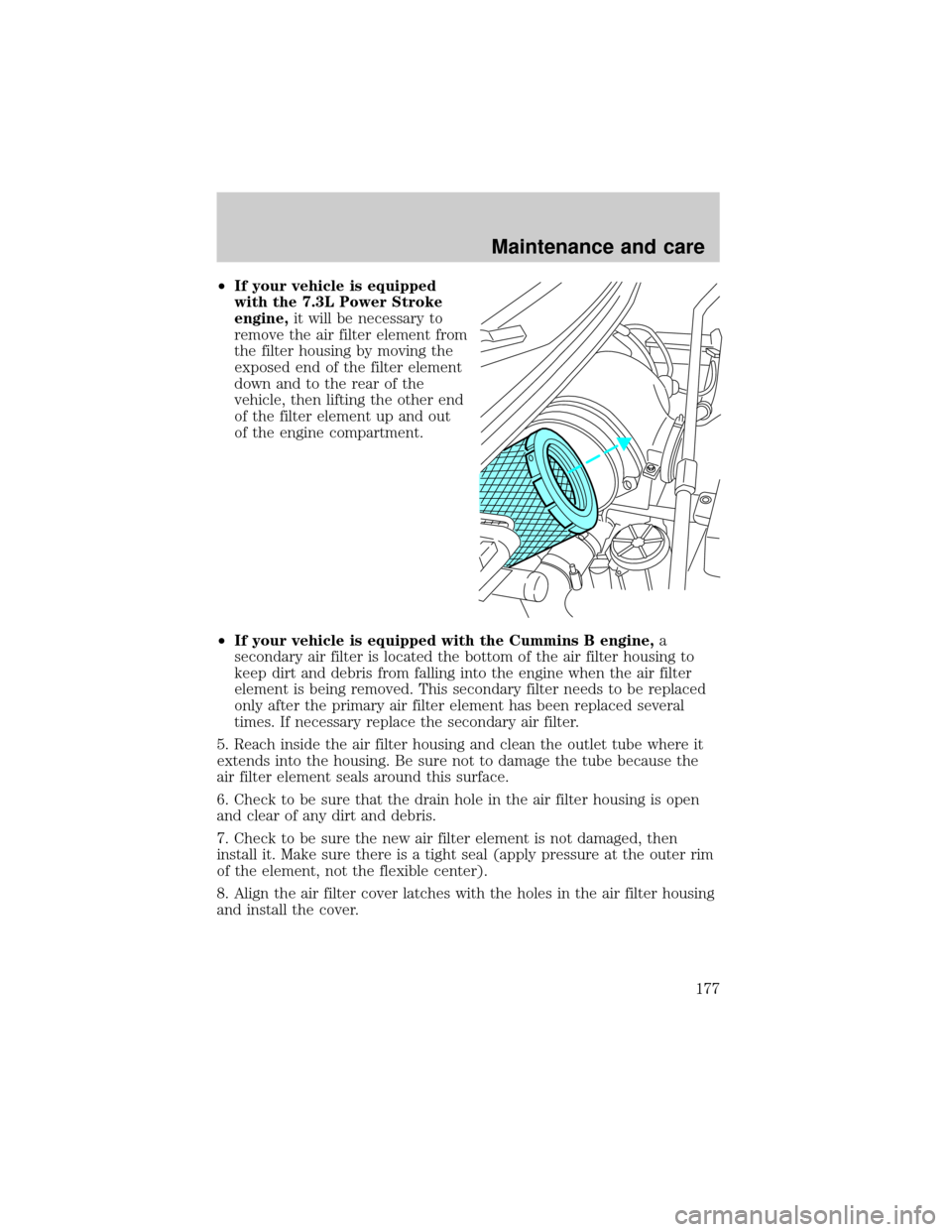
²If your vehicle is equipped
with the 7.3L Power Stroke
engine,it will be necessary to
remove the air filter element from
the filter housing by moving the
exposed end of the filter element
down and to the rear of the
vehicle, then lifting the other end
of the filter element up and out
of the engine compartment.
²If your vehicle is equipped with the Cummins B engine,a
secondary air filter is located the bottom of the air filter housing to
keep dirt and debris from falling into the engine when the air filter
element is being removed. This secondary filter needs to be replaced
only after the primary air filter element has been replaced several
times. If necessary replace the secondary air filter.
5. Reach inside the air filter housing and clean the outlet tube where it
extends into the housing. Be sure not to damage the tube because the
air filter element seals around this surface.
6. Check to be sure that the drain hole in the air filter housing is open
and clear of any dirt and debris.
7. Check to be sure the new air filter element is not damaged, then
install it. Make sure there is a tight seal (apply pressure at the outer rim
of the element, not the flexible center).
8. Align the air filter cover latches with the holes in the air filter housing
and install the cover.
Maintenance and care
177
Page 179 of 240
SERVICING YOUR WHEELS AND TIRES
Wheel assembly
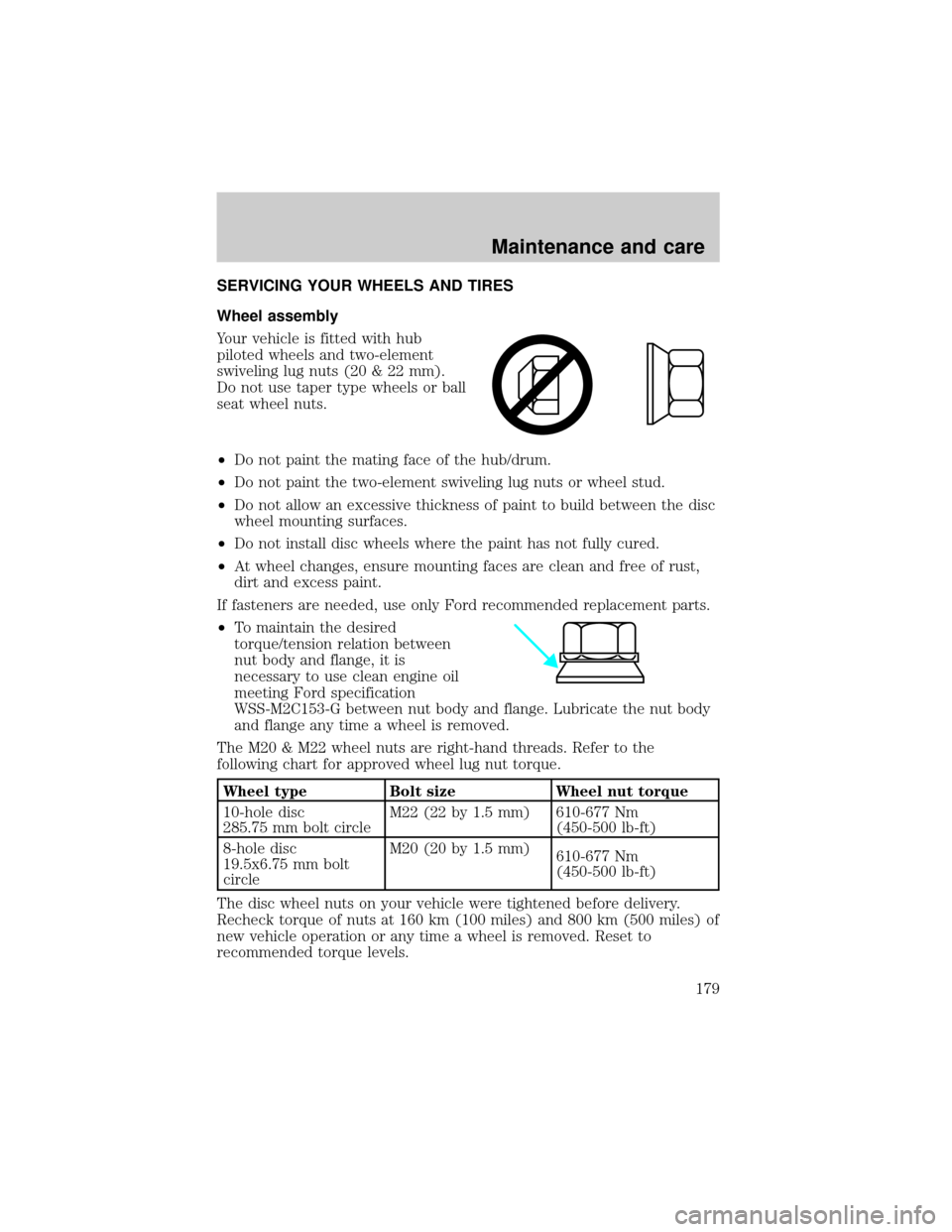
Your vehicle is fitted with hub
piloted wheels and two-element
swiveling lug nuts (20 & 22 mm).
Do not use taper type wheels or ball
seat wheel nuts.
²Do not paint the mating face of the hub/drum.
²Do not paint the two-element swiveling lug nuts or wheel stud.
²Do not allow an excessive thickness of paint to build between the disc
wheel mounting surfaces.
²Do not install disc wheels where the paint has not fully cured.
²At wheel changes, ensure mounting faces are clean and free of rust,
dirt and excess paint.
If fasteners are needed, use only Ford recommended replacement parts.
²To maintain the desired
torque/tension relation between
nut body and flange, it is
necessary to use clean engine oil
meeting Ford specification
WSS-M2C153-G between nut body and flange. Lubricate the nut body
and flange any time a wheel is removed.
The M20 & M22 wheel nuts are right-hand threads. Refer to the
following chart for approved wheel lug nut torque.
Wheel type Bolt size Wheel nut torque
10-hole disc
285.75 mm bolt circleM22 (22 by 1.5 mm) 610-677 Nm
(450-500 lb-ft)
8-hole disc
19.5x6.75 mm bolt
circleM20 (20 by 1.5 mm)
610-677 Nm
(450-500 lb-ft)
The disc wheel nuts on your vehicle were tightened before delivery.
Recheck torque of nuts at 160 km (100 miles) and 800 km (500 miles) of
new vehicle operation or any time a wheel is removed. Reset to
recommended torque levels.
Maintenance and care
179
Page 187 of 240
Draining the fuel filter/water separatorÐCummins B engine
Refer to your engine operator's manual for service procedures.
Fuel filter replacementÐCaterpillar 3126 B engine
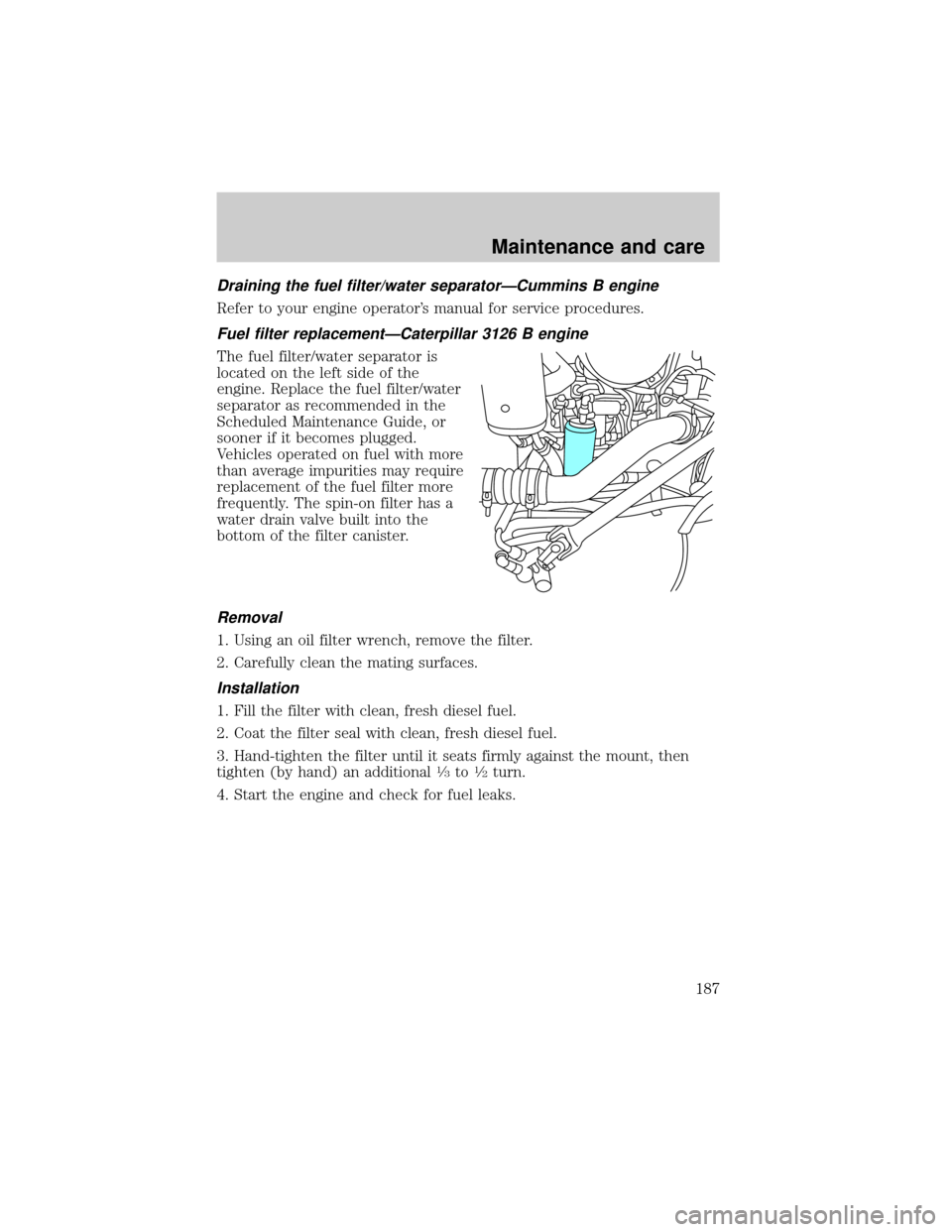
The fuel filter/water separator is
located on the left side of the
engine. Replace the fuel filter/water
separator as recommended in the
Scheduled Maintenance Guide, or
sooner if it becomes plugged.
Vehicles operated on fuel with more
than average impurities may require
replacement of the fuel filter more
frequently. The spin-on filter has a
water drain valve built into the
bottom of the filter canister.
Removal
1. Using an oil filter wrench, remove the filter.
2. Carefully clean the mating surfaces.
Installation
1. Fill the filter with clean, fresh diesel fuel.
2. Coat the filter seal with clean, fresh diesel fuel.
3. Hand-tighten the filter until it seats firmly against the mount, then
tighten (by hand) an additional
1¤3to1¤2turn.
4. Start the engine and check for fuel leaks.
Maintenance and care
187
Page 189 of 240
Installation
The engine will not run properly if the fuel filter is not installed
in housing.
1. Apply a coating of clean diesel fuel to the new bevel gasket and install
it onto the fuel filter housing.
2. Install the new fuel filter element onto the cap. Place the new fuel
filter element and cap into the fuel filter housing. Allow fuel to soak into
the fuel filter element.
3. Tighten cap onto the fuel filter housing until cap contacts the housing.
4. Start the engine and check for fuel leaks.
After changing the fuel filter, the engine will purge the trapped air as it
runs. Engine may run roughly and smoke until the air is completely
eliminated.
Fuel filter replacementÐCummins B engine
Refer to your engine operator's manual for service intervals and
procedures.
ESSENTIALS OF GOOD FUEL ECONOMY
Measuring techniques
Your best source of information about actual fuel economy is you, the
driver. You must gather information as accurately and consistently as
possible. Fuel expense, frequency of fillups or fuel gauge readings are NOT
accurate as a measure of fuel economy. We do not recommend taking fuel
economy measurements during the first 1 600 km (1 000 miles) of driving
(engine break-in period). You will get a more accurate measurement after
3 000 km±5 000 km (2 000 miles-3 000 miles).
The advertised fuel capacity of the fuel tank(s) on your vehicle is equal
to the rated refill capacity of the fuel tank(s) as listed inFuel Tank
Capacitiesin theCapacities and Specificationschapter. The
advertised capacity is the amount of the Indicated Capacity and the
Empty Reserve combined. Indicated Capacity is the difference in the
amount of fuel in a full tank and a tank when the fuel gauge indicates
empty. Empty Reserve is the small amount of usable fuel remaining in
the fuel tank after the fuel gauge indicates empty.
Maintenance and care
189
Page 195 of 240
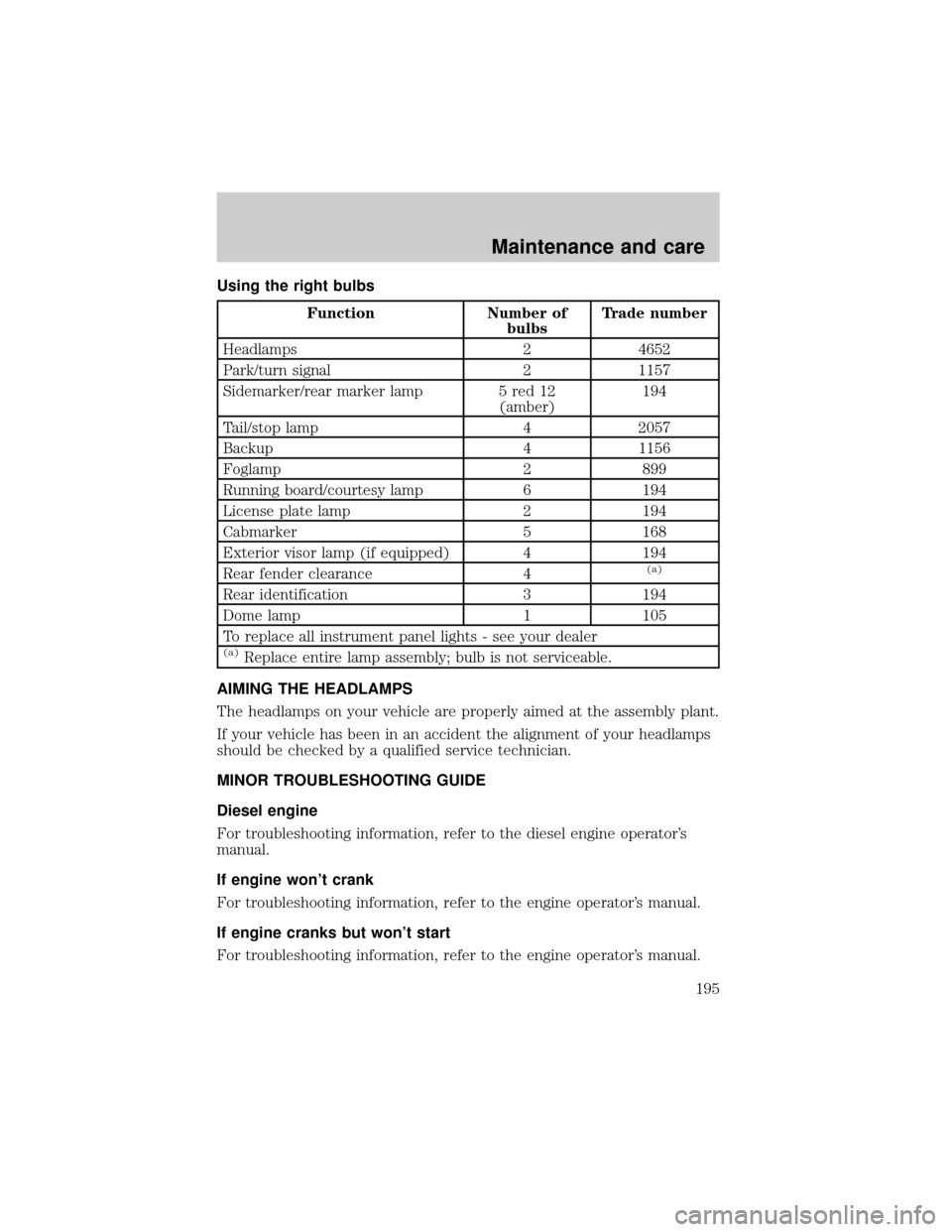
Using the right bulbs
Function Number of
bulbsTrade number
Headlamps 2 4652
Park/turn signal 2 1157
Sidemarker/rear marker lamp 5 red 12
(amber)194
Tail/stop lamp 4 2057
Backup 4 1156
Foglamp 2 899
Running board/courtesy lamp 6 194
License plate lamp 2 194
Cabmarker 5 168
Exterior visor lamp (if equipped) 4 194
Rear fender clearance 4
(a)
Rear identification 3 194
Dome lamp 1 105
To replace all instrument panel lights - see your dealer
(a)Replace entire lamp assembly; bulb is not serviceable.
AIMING THE HEADLAMPS
The headlamps on your vehicle are properly aimed at the assembly plant.
If your vehicle has been in an accident the alignment of your headlamps
should be checked by a qualified service technician.
MINOR TROUBLESHOOTING GUIDE
Diesel engine
For troubleshooting information, refer to the diesel engine operator's
manual.
If engine won't crank
For troubleshooting information, refer to the engine operator's manual.
If engine cranks but won't start
For troubleshooting information, refer to the engine operator's manual.
Maintenance and care
195
Page 196 of 240
If engine runs hot
For troubleshooting information, refer to the engine operator's manual.
If fuses burn out
Burned-out or ªblown-outº fuses or circuit breaker tripping (if equipped)
usually indicate an electrical short circuit, although a fuse may
occasionally fail from vibration. Insert a second fuse or reset the breaker
(if equipped). If this fuse immediately burns out or the breaker (if
equipped) trips and you cannot locate the fuse, return your vehicle to
your dealer for a circuit check.
If lamp bulbs burn out
Repeated lamp burn-out usually indicates a loose connection, either at
the lamp socket, the system ground or a malfunctioning voltage
regulator. If examination does not indicate the cause of the trouble,
return your vehicle to your dealer for inspection.
If headlamps flash on and off
If headlamps flash on and off at regular intervals, the system circuit
breaker (if equipped) is operating, indicating a short circuit or overload.
Take your vehicle to your dealer for a circuit check.
CLEANING AND CARING FOR YOUR VEHICLE
Refer to the Customer Assistance chapter for a list of Ford-approved
cleaners, polishes and waxes.
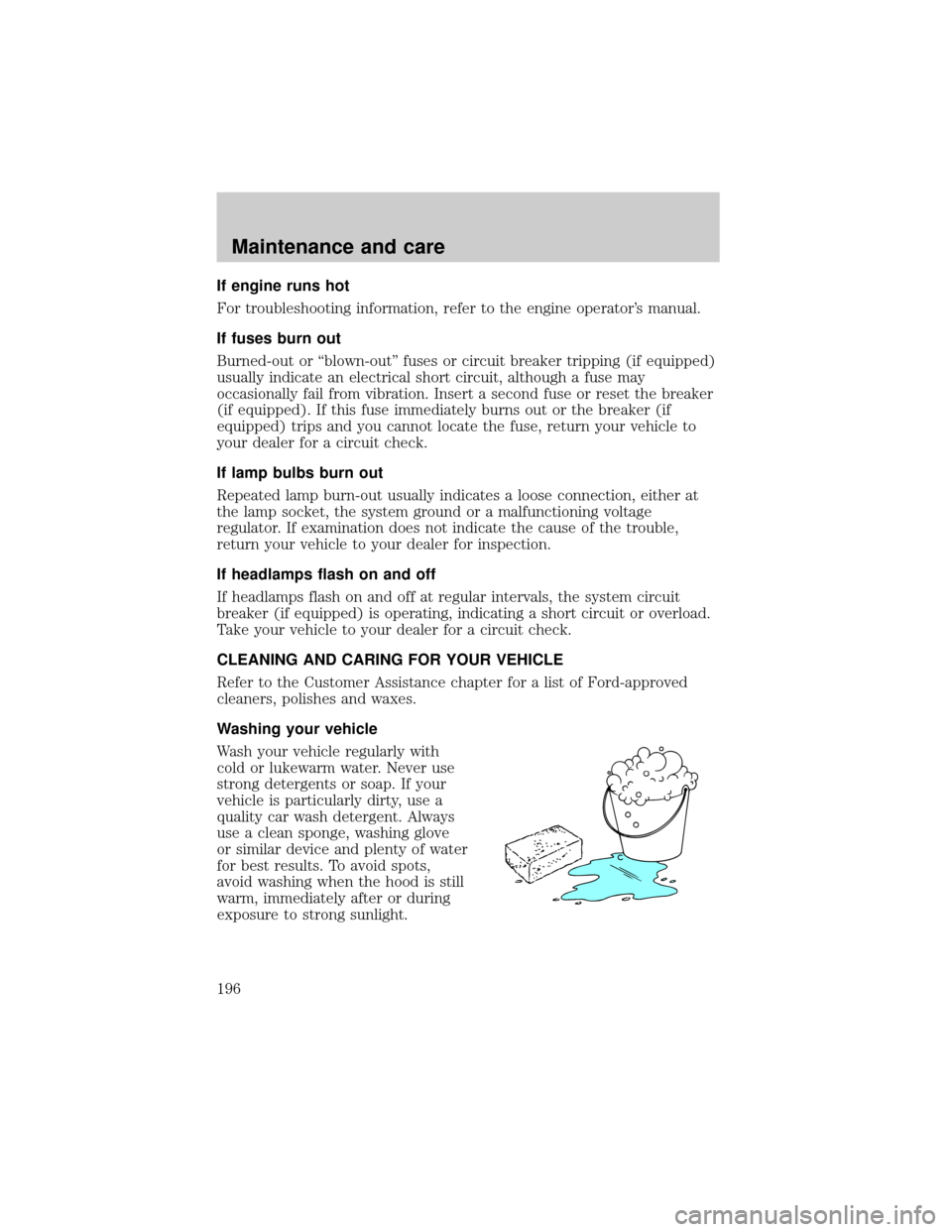
Washing your vehicle
Wash your vehicle regularly with
cold or lukewarm water. Never use
strong detergents or soap. If your
vehicle is particularly dirty, use a
quality car wash detergent. Always
use a clean sponge, washing glove
or similar device and plenty of water
for best results. To avoid spots,
avoid washing when the hood is still
warm, immediately after or during
exposure to strong sunlight.
Maintenance and care
196
Page 200 of 240
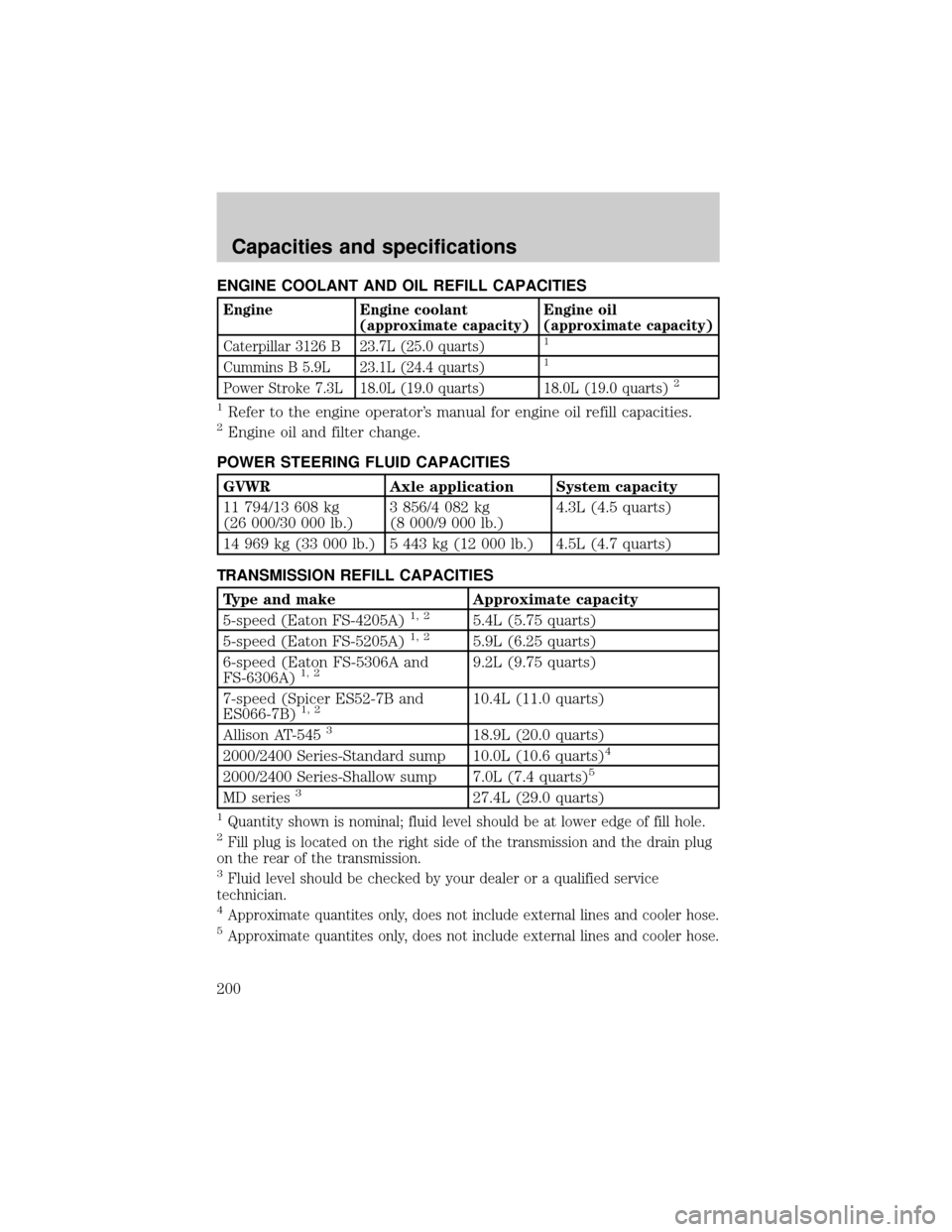
ENGINE COOLANT AND OIL REFILL CAPACITIES
Engine Engine coolant
(approximate capacity)Engine oil
(approximate capacity)
Caterpillar 3126 B 23.7L (25.0 quarts)
1
Cummins B 5.9L 23.1L (24.4 quarts)1
Power Stroke 7.3L 18.0L (19.0 quarts) 18.0L (19.0 quarts)2
1Refer to the engine operator's manual for engine oil refill capacities.2Engine oil and filter change.
POWER STEERING FLUID CAPACITIES
GVWR Axle application System capacity
11 794/13 608 kg
(26 000/30 000 lb.)3 856/4 082 kg
(8 000/9 000 lb.)4.3L (4.5 quarts)
14 969 kg (33 000 lb.) 5 443 kg (12 000 lb.) 4.5L (4.7 quarts)
TRANSMISSION REFILL CAPACITIES
Type and make Approximate capacity
5-speed (Eaton FS-4205A)1, 25.4L (5.75 quarts)
5-speed (Eaton FS-5205A)1, 25.9L (6.25 quarts)
6-speed (Eaton FS-5306A and
FS-6306A)
1, 29.2L (9.75 quarts)
7-speed (Spicer ES52-7B and
ES066-7B)
1, 210.4L (11.0 quarts)
Allison AT-545
318.9L (20.0 quarts)
2000/2400 Series-Standard sump 10.0L (10.6 quarts)4
2000/2400 Series-Shallow sump 7.0L (7.4 quarts)5
MD series327.4L (29.0 quarts)
1Quantity shown is nominal; fluid level should be at lower edge of fill hole.2Fill plug is located on the right side of the transmission and the drain plug
on the rear of the transmission.
3Fluid level should be checked by your dealer or a qualified service
technician.
4Approximate quantites only, does not include external lines and cooler hose.5Approximate quantites only, does not include external lines and cooler hose.
Capacities and specifications
200
Page 207 of 240
GENERAL MAINTENANCE INFORMATION
The Scheduled Maintenance Services listed in this section are required
because they are considered essential to the life and performance of
your vehicle.
Ford Motor Company recommends you perform the Owner Maintenance
Services listed in this section. These services are matters of day-to-day
care that are important to the proper operation of your vehicle. In
addition to the conditions described in the Owner Maintenance Checklist,
be alert for any unusual noise, vibration or other indication that your
vehicle may need service and attend to it promptly.
Use only recommended fuels, lubricants, fluids and service parts
conforming to Ford specifications. Motorcraft parts are designed and
built for best performance in your vehicle. Using these parts for
replacement is your assurance that Ford-Built quality stays in your
vehicle.
SCHEDULED MAINTENANCE
The maintenance or replacement of the emission control devices (or
systems) in your new Ford Motor Company vehicle (or engine) may be
performed at your expense. These services may be performed by any
automotive repair establishment or individual using automotive parts
equivalent to those with which your vehicle or engine was originally
equipped. If any parts other than Ford, Motorcraft, or Ford authorized,
remanufactured parts are used for maintenance replacements (or for the
service) of components effecting the emission control, the owner should
be assured that such parts are warranted by their manufacturer to be
equivalent to genuine Ford Motor Company Parts in performance and
durability. Please consult your warranty information booklet for complete
warranty information.
Authorized dealer maintenance
Your authorized dealer specializes in knowing all about Ford Motor
Company vehicles rather than knowing a little about all makes.
There are Ford or Ford of Canada dealer service shops ready to serve
you wherever you drive in the U.S. or Canada. They stock Ford and
Motorcraft parts, and Ford Chemicals and lubricants. You can be
confident that these meet the same exacting design and quality
standards as those used to build the vehicle originally. Dealer Service
Technicians have available training in the latest product developments
and service techniques.
General maintenance information
207