Compressor FORD F750 2015 13.G Owners Manual
[x] Cancel search | Manufacturer: FORD, Model Year: 2015, Model line: F750, Model: FORD F750 2015 13.GPages: 384, PDF Size: 4.95 MB
Page 15 of 384
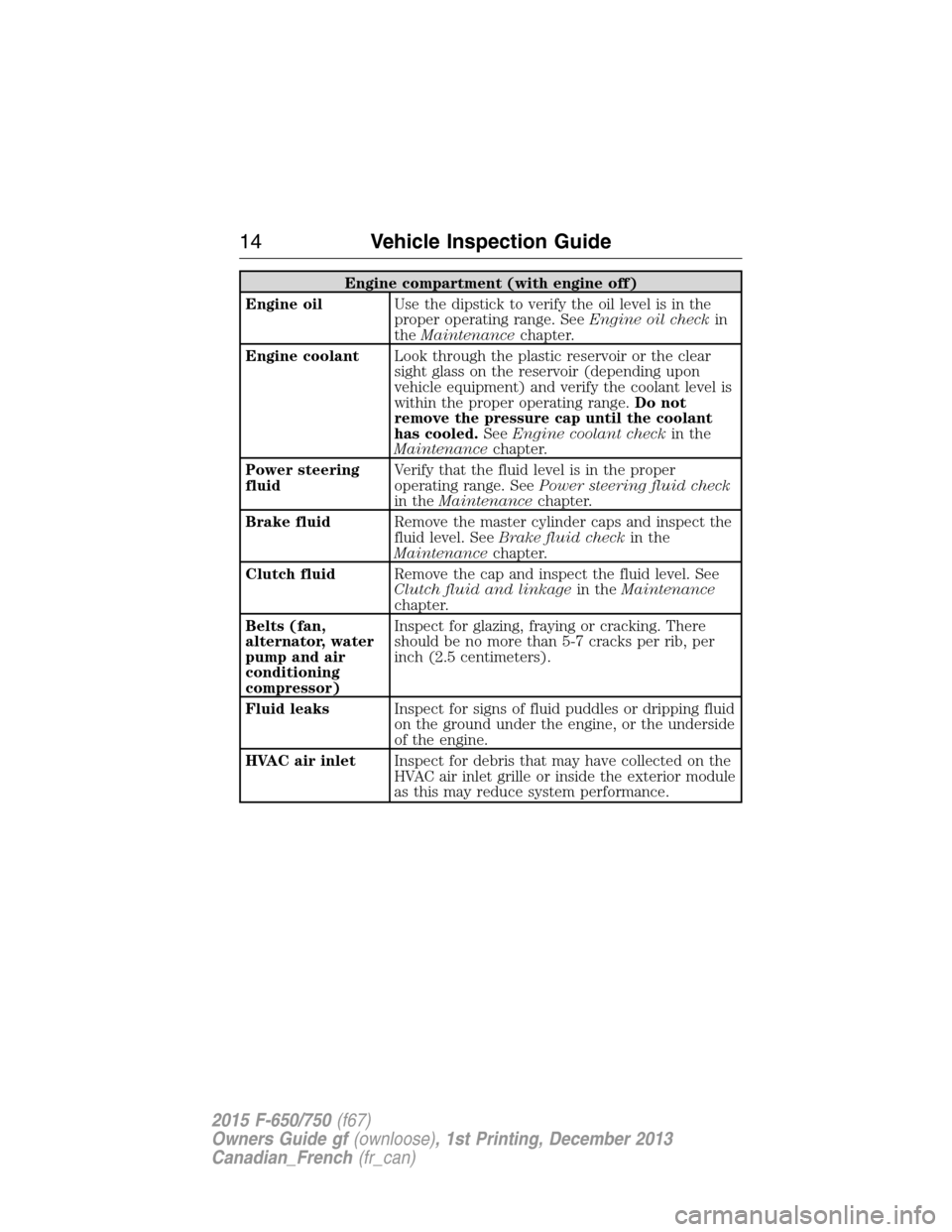
Engine compartment (with engine off)
Engine oilUse the dipstick to verify the oil level is in the
proper operating range. SeeEngine oil checkin
theMaintenancechapter.
Engine coolantLook through the plastic reservoir or the clear
sight glass on the reservoir (depending upon
vehicle equipment) and verify the coolant level is
within the proper operating range.Do not
remove the pressure cap until the coolant
has cooled.SeeEngine coolant checkin the
Maintenancechapter.
Power steering
fluidVerify that the fluid level is in the proper
operating range. SeePower steering fluid check
in theMaintenancechapter.
Brake fluidRemove the master cylinder caps and inspect the
fluid level. SeeBrake fluid checkin the
Maintenancechapter.
Clutch fluidRemove the cap and inspect the fluid level. See
Clutch fluid and linkagein theMaintenance
chapter.
Belts (fan,
alternator, water
pump and air
conditioning
compressor)Inspect for glazing, fraying or cracking. There
should be no more than 5-7 cracks per rib, per
inch (2.5 centimeters).
Fluid leaksInspect for signs of fluid puddles or dripping fluid
on the ground under the engine, or the underside
of the engine.
HVAC air inletInspect for debris that may have collected on the
HVAC air inlet grille or inside the exterior module
as this may reduce system performance.
14Vehicle Inspection Guide
2015 F-650/750(f67)
Owners Guide gf(ownloose), 1st Printing, December 2013
Canadian_French(fr_can)
Page 16 of 384
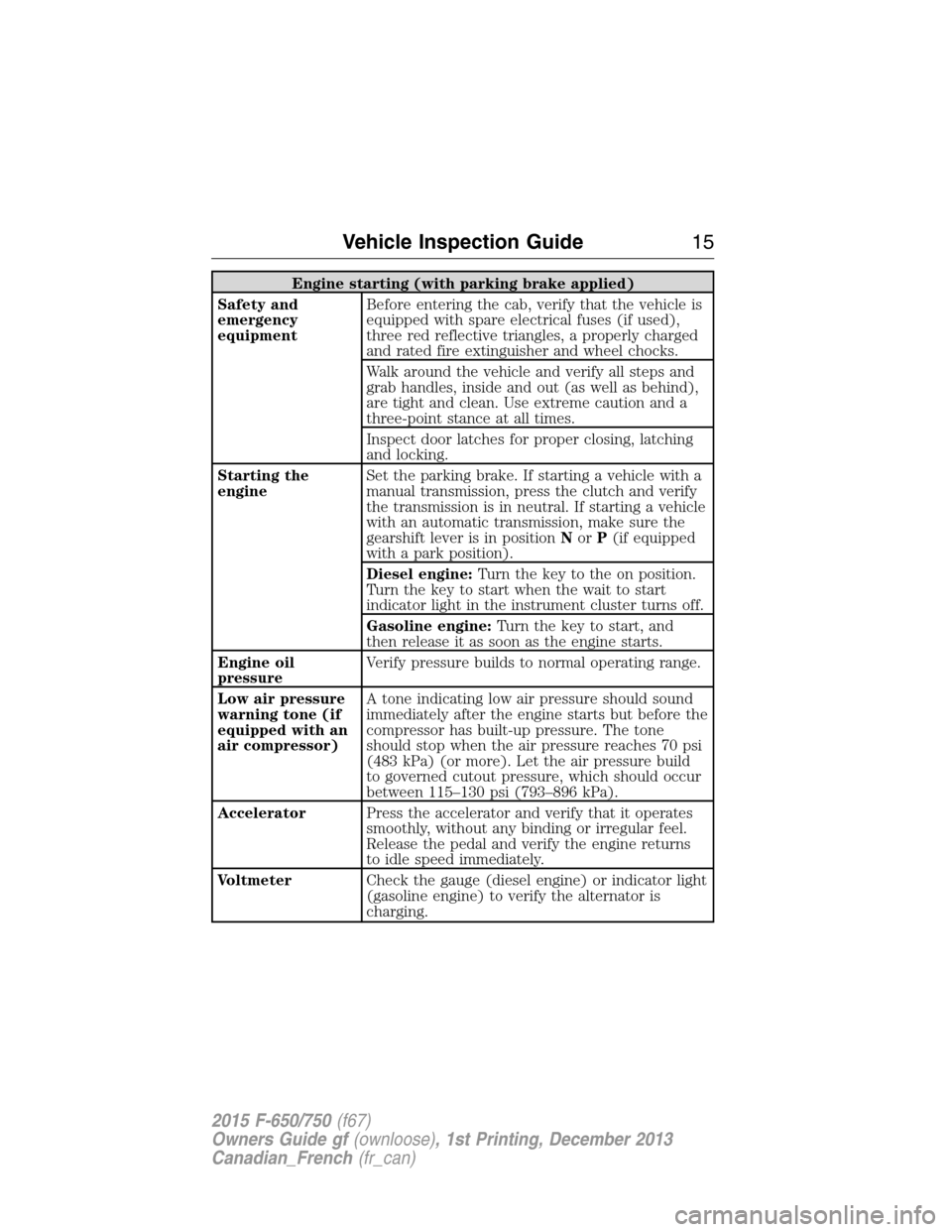
Engine starting (with parking brake applied)
Safety and
emergency
equipmentBefore entering the cab, verify that the vehicle is
equipped with spare electrical fuses (if used),
three red reflective triangles, a properly charged
and rated fire extinguisher and wheel chocks.
Walk around the vehicle and verify all steps and
grab handles, inside and out (as well as behind),
are tight and clean. Use extreme caution and a
three-point stance at all times.
Inspect door latches for proper closing, latching
and locking.
Starting the
engineSet the parking brake. If starting a vehicle with a
manual transmission, press the clutch and verify
the transmission is in neutral. If starting a vehicle
with an automatic transmission, make sure the
gearshift lever is in positionNorP(if equipped
with a park position).
Diesel engine:Turn the key to the on position.
Turn the key to start when the wait to start
indicator light in the instrument cluster turns off.
Gasoline engine:Turn the key to start, and
then release it as soon as the engine starts.
Engine oil
pressureVerify pressure builds to normal operating range.
Low air pressure
warning tone (if
equipped with an
air compressor)A tone indicating low air pressure should sound
immediately after the engine starts but before the
compressor has built-up pressure. The tone
should stop when the air pressure reaches 70 psi
(483 kPa) (or more). Let the air pressure build
to governed cutout pressure, which should occur
between 115–130 psi (793–896 kPa).
AcceleratorPress the accelerator and verify that it operates
smoothly, without any binding or irregular feel.
Release the pedal and verify the engine returns
to idle speed immediately.
VoltmeterCheck the gauge (diesel engine) or indicator light
(gasoline engine) to verify the alternator is
charging.
Vehicle Inspection Guide15
2015 F-650/750(f67)
Owners Guide gf(ownloose), 1st Printing, December 2013
Canadian_French(fr_can)
Page 17 of 384
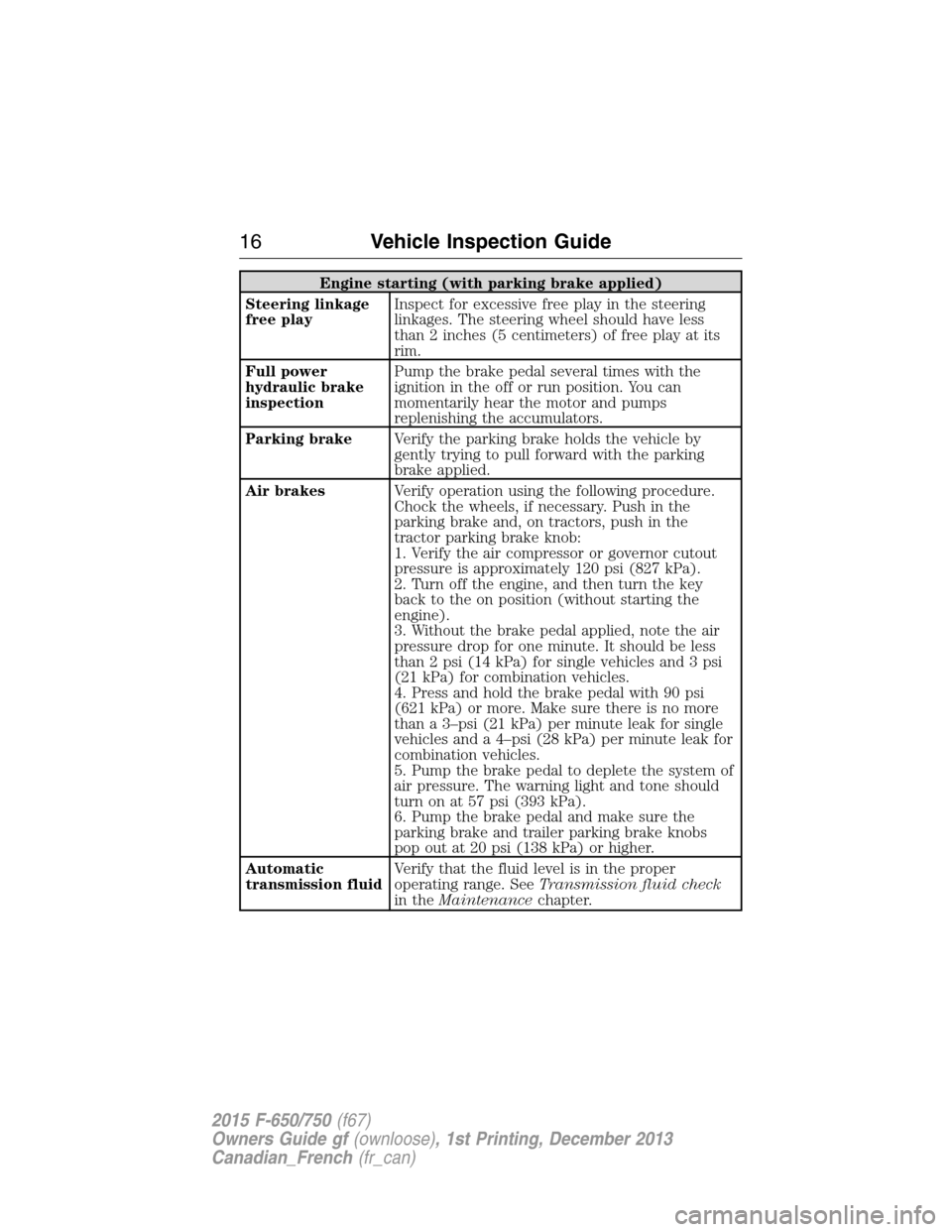
Engine starting (with parking brake applied)
Steering linkage
free playInspect for excessive free play in the steering
linkages. The steering wheel should have less
than 2 inches (5 centimeters) of free play at its
rim.
Full power
hydraulic brake
inspectionPump the brake pedal several times with the
ignition in the off or run position. You can
momentarily hear the motor and pumps
replenishing the accumulators.
Parking brakeVerify the parking brake holds the vehicle by
gently trying to pull forward with the parking
brake applied.
Air brakesVerify operation using the following procedure.
Chock the wheels, if necessary. Push in the
parking brake and, on tractors, push in the
tractor parking brake knob:
1. Verify the air compressor or governor cutout
pressure is approximately 120 psi (827 kPa).
2. Turn off the engine, and then turn the key
back to the on position (without starting the
engine).
3. Without the brake pedal applied, note the air
pressure drop for one minute. It should be less
than 2 psi (14 kPa) for single vehicles and 3 psi
(21 kPa) for combination vehicles.
4. Press and hold the brake pedal with 90 psi
(621 kPa) or more. Make sure there is no more
than a 3–psi (21 kPa) per minute leak for single
vehicles and a 4–psi (28 kPa) per minute leak for
combination vehicles.
5. Pump the brake pedal to deplete the system of
air pressure. The warning light and tone should
turn on at 57 psi (393 kPa).
6. Pump the brake pedal and make sure the
parking brake and trailer parking brake knobs
pop out at 20 psi (138 kPa) or higher.
Automatic
transmission fluidVerify that the fluid level is in the proper
operating range. SeeTransmission fluid check
in theMaintenancechapter.
16Vehicle Inspection Guide
2015 F-650/750(f67)
Owners Guide gf(ownloose), 1st Printing, December 2013
Canadian_French(fr_can)
Page 79 of 384
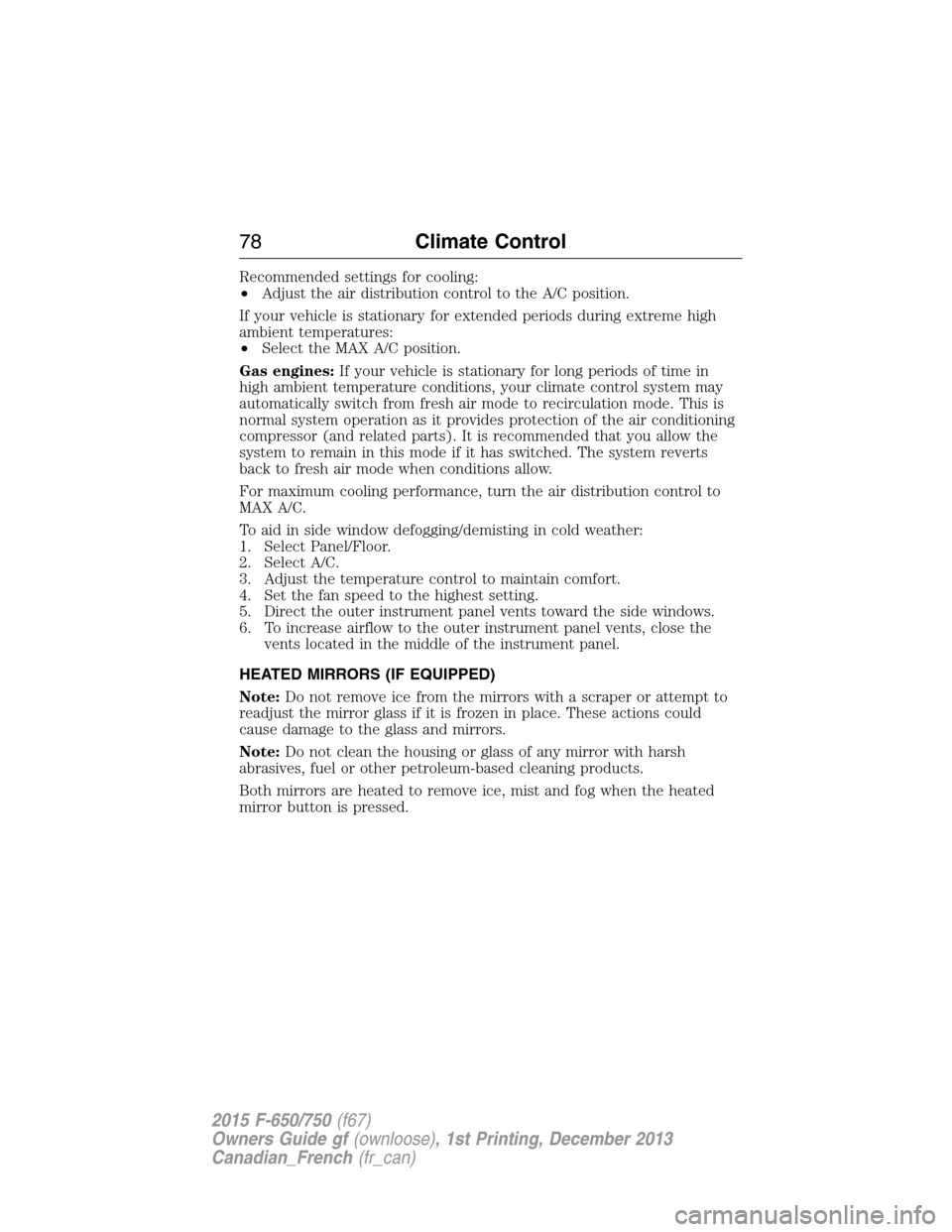
Recommended settings for cooling:
•Adjust the air distribution control to the A/C position.
If your vehicle is stationary for extended periods during extreme high
ambient temperatures:
•Select the MAX A/C position.
Gas engines:If your vehicle is stationary for long periods of time in
high ambient temperature conditions, your climate control system may
automatically switch from fresh air mode to recirculation mode. This is
normal system operation as it provides protection of the air conditioning
compressor (and related parts). It is recommended that you allow the
system to remain in this mode if it has switched. The system reverts
back to fresh air mode when conditions allow.
For maximum cooling performance, turn the air distribution control to
MAX A/C.
To aid in side window defogging/demisting in cold weather:
1. Select Panel/Floor.
2. Select A/C.
3. Adjust the temperature control to maintain comfort.
4. Set the fan speed to the highest setting.
5. Direct the outer instrument panel vents toward the side windows.
6. To increase airflow to the outer instrument panel vents, close the
vents located in the middle of the instrument panel.
HEATED MIRRORS (IF EQUIPPED)
Note:Do not remove ice from the mirrors with a scraper or attempt to
readjust the mirror glass if it is frozen in place. These actions could
cause damage to the glass and mirrors.
Note:Do not clean the housing or glass of any mirror with harsh
abrasives, fuel or other petroleum-based cleaning products.
Both mirrors are heated to remove ice, mist and fog when the heated
mirror button is pressed.
78Climate Control
2015 F-650/750(f67)
Owners Guide gf(ownloose), 1st Printing, December 2013
Canadian_French(fr_can)
Page 140 of 384
Anti-lock Brake System (ABS)
This system helps you maintain steering control during emergency stops
by keeping the brakes from locking.
The ABS lamp momentarily illuminates when you switch on the
ignition. If the light does not illuminate during start-up, if it
remains on or flashes, the ABS may not be working and
requires servicing.
If the ABS is disabled, normal braking is still effective. If the
brake warning lamp illuminates, have your brake system
serviced immediately.
If you connect a PLC trailer with the ignition on, the trailer
ABS light also illuminates. If the light fails to illuminate, if it
remains on after you start the vehicle or continues to flash,
have the system serviced immediately.
FULL POWER BRAKE SYSTEM
WARNING:If the red BRAKE warning lamp in the instrument
cluster remains illuminated after engine start up, this indicates a
system failure in the Full Power Brake System. Stop the vehicle safely
as soon as possible and seek service immediately.
This system incorporates standard braking, an anti-lock braking system
(ABS) and optional Power Park Brake into one fully integrated hydraulic
brake system. With the Full Power Brake System, braking energy is
stored, similar to an air brake system, resulting in faster response times
and shorter stopping distances. This is accomplished using motor and
pump assemblies that pressurize the system by pumping brake fluid into
accumulators. This is similar to the air compressor of an air brake system
pressurizing the air tanks. The system includes a master cylinder that
provides the normal pedal feel and transfers the pedal force, via brake
fluid, to the main components of the system.
Note:The motor and pumps run momentarily with the ignition switch in
the on or run position, or in the off position with the brake pedal
pressed.
Note:During normal driving, you may hear the pump and motors
replenishing the accumulators. This is a normal function of the system.
AIR BRAKES
After starting the engine, give the air compressor time to build up the air
pressure to 60 psi (414 kPa) before moving your vehicle.
Brakes139
2015 F-650/750(f67)
Owners Guide gf(ownloose), 1st Printing, December 2013
Canadian_French(fr_can)
Page 141 of 384
WARNING:Do not drive or continue to drive if the low air
pressure buzzer is sounding or the brake warning light is lit.
These warnings indicate that air pressure is not to normal operating
level. Continued use of the vehicle could result in loss of braking ability.
WARNING:Avoid repeated light application of the brake pedal.
This depletes air pressure faster and could result in loss of
braking capability.
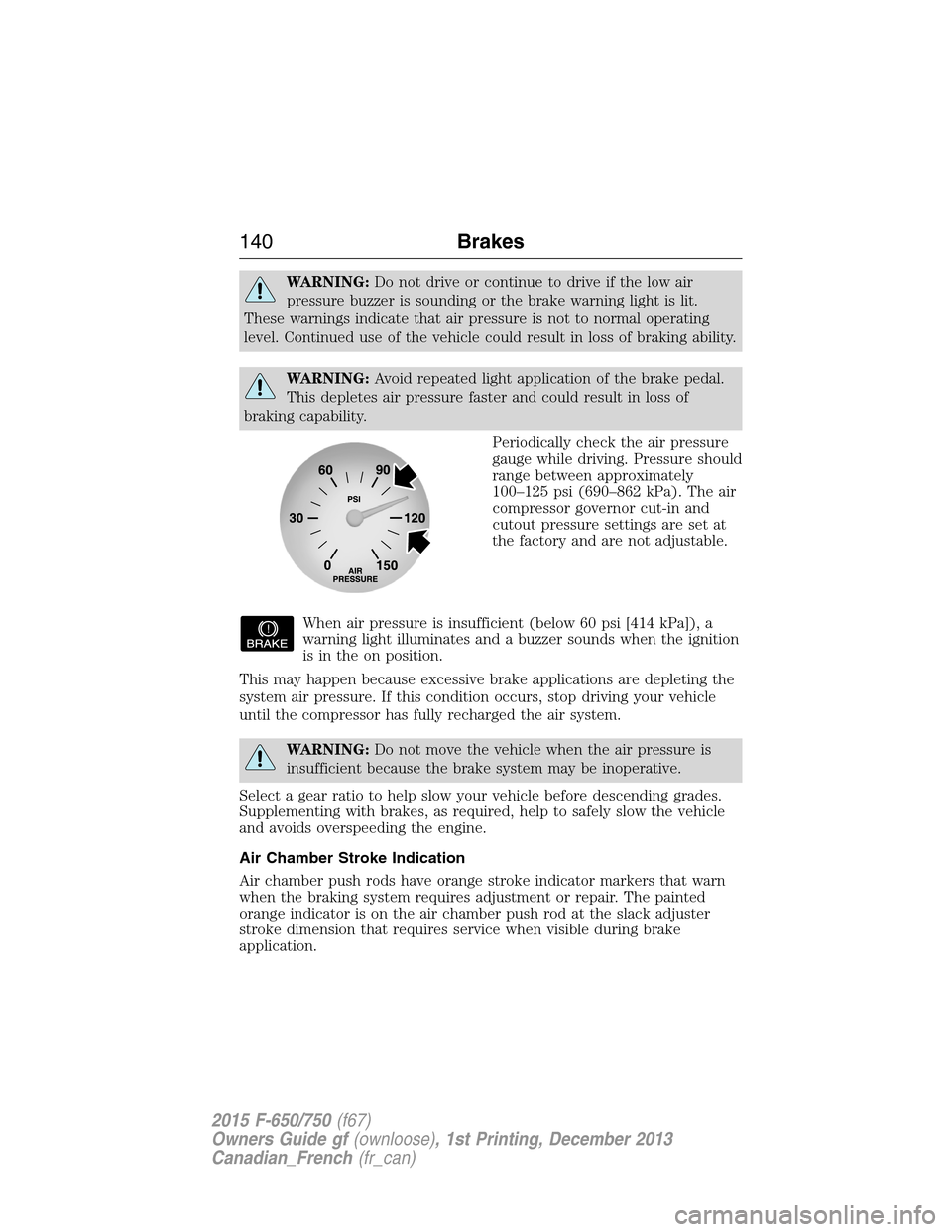
Periodically check the air pressure
gauge while driving. Pressure should
range between approximately
100–125 psi (690–862 kPa). The air
compressor governor cut-in and
cutout pressure settings are set at
the factory and are not adjustable.
When air pressure is insufficient (below 60 psi [414 kPa]), a
warning light illuminates and a buzzer sounds when the ignition
is in the on position.
This may happen because excessive brake applications are depleting the
system air pressure. If this condition occurs, stop driving your vehicle
until the compressor has fully recharged the air system.
WARNING:Do not move the vehicle when the air pressure is
insufficient because the brake system may be inoperative.
Select a gear ratio to help slow your vehicle before descending grades.
Supplementing with brakes, as required, help to safely slow the vehicle
and avoids overspeeding the engine.
Air Chamber Stroke Indication
Air chamber push rods have orange stroke indicator markers that warn
when the braking system requires adjustment or repair. The painted
orange indicator is on the air chamber push rod at the slack adjuster
stroke dimension that requires service when visible during brake
application.
140Brakes
2015 F-650/750(f67)
Owners Guide gf(ownloose), 1st Printing, December 2013
Canadian_French(fr_can)
Page 195 of 384
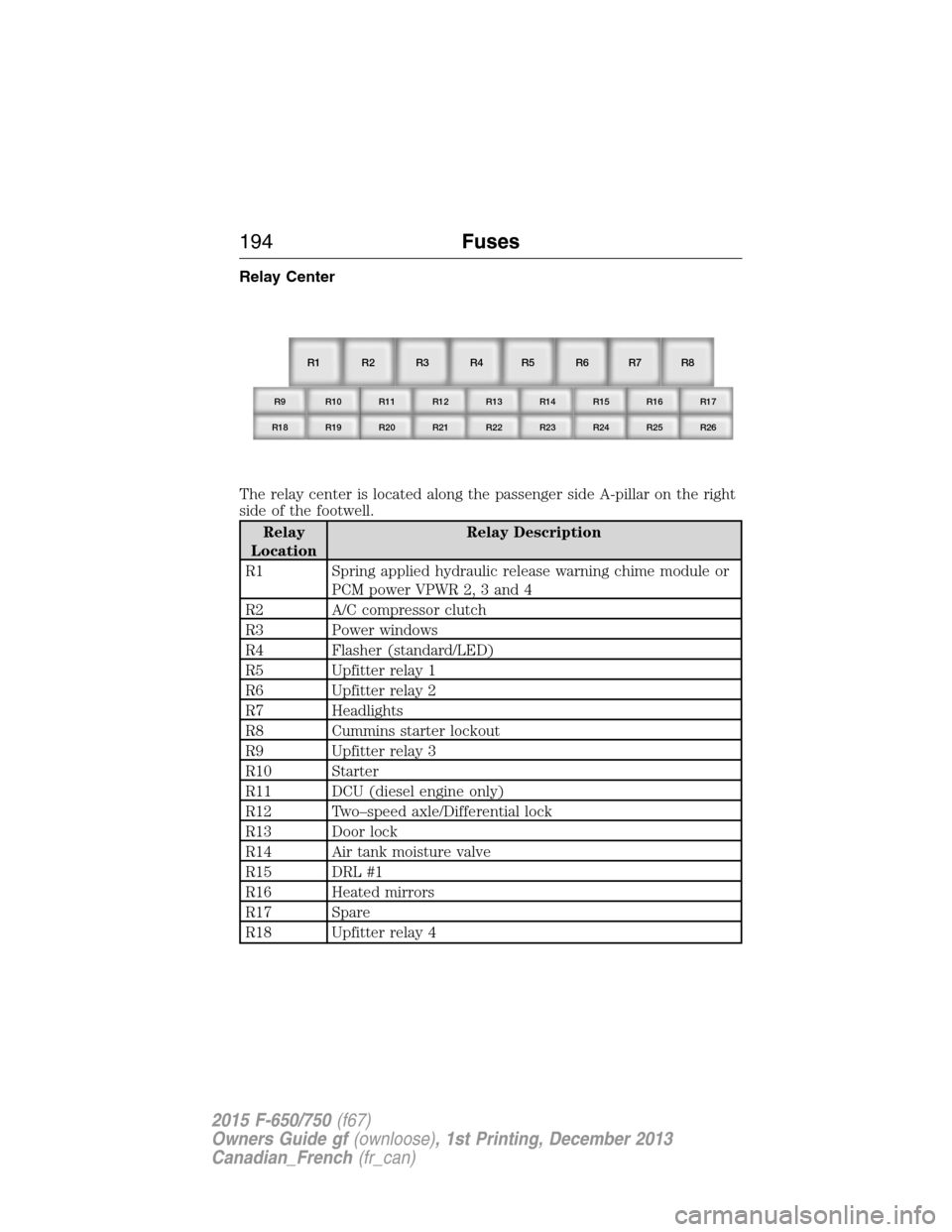
Relay Center
The relay center is located along the passenger side A-pillar on the right
side of the footwell.
Relay
LocationRelay Description
R1 Spring applied hydraulic release warning chime module or
PCM power VPWR 2, 3 and 4
R2 A/C compressor clutch
R3 Power windows
R4 Flasher (standard/LED)
R5 Upfitter relay 1
R6 Upfitter relay 2
R7 Headlights
R8 Cummins starter lockout
R9 Upfitter relay 3
R10 Starter
R11 DCU (diesel engine only)
R12 Two–speed axle/Differential lock
R13 Door lock
R14 Air tank moisture valve
R15 DRL #1
R16 Heated mirrors
R17 Spare
R18 Upfitter relay 4
R1
R9 R10 R11 R12 R13 R14 R15 R16 R17
R18 R19 R20 R21 R22 R23 R24 R25 R26
R2 R3 R4 R5 R6 R7 R8
194Fuses
2015 F-650/750(f67)
Owners Guide gf(ownloose), 1st Printing, December 2013
Canadian_French(fr_can)
Page 203 of 384
Inspection and adjustment:Establish a regular schedule for periodic
cleaning, lubrication and adjustment inspection based on vehicle use.
Exact maintenance intervals are difficult to predetermine due to vehicle
applications and operating conditions. If you are uncertain of the proper
schedule for your vehicle, contact an authorized dealer.
Regular inspections should include:
•Periodic checking (every service interval) of push rod travel or brake
adjustment. This is essential for effective braking. Brake chamber
push rods on original equipment chambers now incorporate an orange
paint marker near the base of the push rod as a stroke indicator to
aid in adjustment checks. If the push rod is clean and the brakes are
out of adjustment, you can see the orange marker protruding from
the chamber when the brakes are applied.
•Checking the brake lining (every service interval). When brake lining
or blocks wear within 1/16th inch (1.6 millimeters) of rivets, replace
the brake linings. A qualified technician should perform this
inspection and keep to instructions provided by the service manual.
Do not back off or disconnect the front brakes so that they are less
effective, letting the rear brakes do all the stopping of your vehicle. Do
not overlook the brakes on the trailer either. Brake condition on the
trailer is just as important as the tractor. Proper brake balance on trucks
and tractor-trailers is essential for effective braking.
Once a year, inspect the entire brake system:
•Rubber components for deterioration. A qualified technician should
inspect these components and replace them as necessary.
Replacement intervals vary according to the severity and length of
vehicle service.
•Condition of brake drums, brake chambers and slack adjusters.
•System for air leaks.
•Hose or pipes for rust, damage and deterioration.
•Operation of service and parking brakes.
Periodically inspect parts such as air brake chamber diaphragm, air
compressor and air cleaner. Replace any parts if you can consider them
unserviceable.
Air dryer:Climactic conditions affect performance of desiccant or
after-cooler type air dryers. You must establish a maintenance schedule
for each specific operation.
The use of an air dryer on a vehicle does not eliminate the need to drain
the air reservoirs periodically.
202Maintenance
2015 F-650/750(f67)
Owners Guide gf(ownloose), 1st Printing, December 2013
Canadian_French(fr_can)
Page 206 of 384
•Checking that the pitman arm (steering arm at steering gear)
mounting is tight and locked. Check system for leaks or hose chafing.
Repair immediately, if necessary.
•Maintaining proper steering gear and power steering pump lubricant
levels.
•Checking steering column joint bolts and steering linkage, particularly
for body-to-chassis clearance.
Steering Column Joint Bolts
As a good maintenance practice, check steering column joint bolt
tightness every 60000 miles (96000 kilometers) or annually, whichever
occurs first. Do not overtighten the bolts.
Hydraulic System
Whenever draining and refilling the power steering’s hydraulic system for
any reason, bleed air from the system before returning the vehicle to
service. Failure to bleed the hydraulic system properly can result in
degradation of power system performance.
Consult an authorized dealer who is aware of the proper procedures for
filling and bleeding the system.
Catalytic Converter (Diesel Engine)
Note:If your vehicle is equipped with a catalytic converter or muffler,
do not blend waste oil with diesel fuel. Operate only on ultra-low sulfur
(less than 15 parts per million sulfur) diesel fuel with a cetane value of
45 or higher.
If your diesel engine is equipped with a catalytic converter, it is
important to review the maintenance schedule to make sure proper
functioning of the catalytic converter. Also, take precautions not to
damage the catalytic converter when servicing your engine or storing
your vehicle.
Diesel Exhaust Fluid (DEF), Diesel Particulate Filter (DPF) and
Select Catalyst Reduction (SCR) System
See your engine operator’s manual for information about DEF, DPF and
SCR system service
Air Induction System
WARNING:When performing maintenance to any turbocharged
engine with engine air inlet piping disconnected, keep loose
clothing, jewelry and long hair away from the engine air inlet piping. A
turbocharger compressor air inlet protective shield should be installed
over the turbocharger air inlet to reduce the risk of personal injury or
death.
Maintenance205
2015 F-650/750(f67)
Owners Guide gf(ownloose), 1st Printing, December 2013
Canadian_French(fr_can)
Page 247 of 384
Checking Tire Pressure
Always check inflation pressure when tires are cold. Never bleed air from
hot tires to relieve normal pressure build-up. Normal increase in pressure
due to service conditions is 10–15 psi (69–103 kPa), which is allowable
in truck tires.
Tires should be properly inflated to manufacturers’ recommended
pressure for the size and service load in which the vehicle is being used.
See the specific tire manufacturer with which your vehicle is equipped
with for the latest information concerning service load and inflation
pressure.
It is particularly important to keep moisture from the inside of tires, and
proper selection of air compressor equipment, proper air line routing,
and the use of shop air dryers is strongly recommended to avoid
moisture in the high pressure air used for tire inflation.
Under-inflation
Do not allow tires to become under-inflated; increased flexing due to
under-inflation causes heat build-up within the tire components. This
leads to reduced strength, breakdown of the rubber compounds, and
possible separation of the tire components (such as ply and tread
separation and reduced retreadability).
Under-inflation is the primary cause of premature tire concerns including
sudden loss of air. In addition, low inflation causes an increase in rolling
resistance. This results in reduced fuel mileage, a loss in tread mileage,
and uneven wear due to increased tread movement. To determine proper
inflation, see the tire manufacturer load and inflation guide, which you
can find on the tire manufacturer website or at your local truck tire
dealer.
Tire Inspection
Check the tires for abnormal wear patterns and proper inflation
pressures. Repair or replace cut or broken tire casings.
Inspect tires for the following conditions. If any are present, remove and
repair, retread, or scrap the tire as the condition dictates.
•Any blister, bump or raised portion anywhere on the surface of the
tire tread or sidewall (other than a bump made by a repair). These
indicate the start of internal separation.
•Any cut that reaches to the belt or ply cords, or any cut that is large
enough to grow in size and depth.
•Any nail or puncturing object.
•If a tread groove is holding a stone or object that is starting to drill
into the tread base, remove the object.
246Wheels and Tires
2015 F-650/750(f67)
Owners Guide gf(ownloose), 1st Printing, December 2013
Canadian_French(fr_can)