162 FORD F750 2017 13.G Owners Manual
[x] Cancel search | Manufacturer: FORD, Model Year: 2017, Model line: F750, Model: FORD F750 2017 13.GPages: 382, PDF Size: 5.18 MB
Page 14 of 382
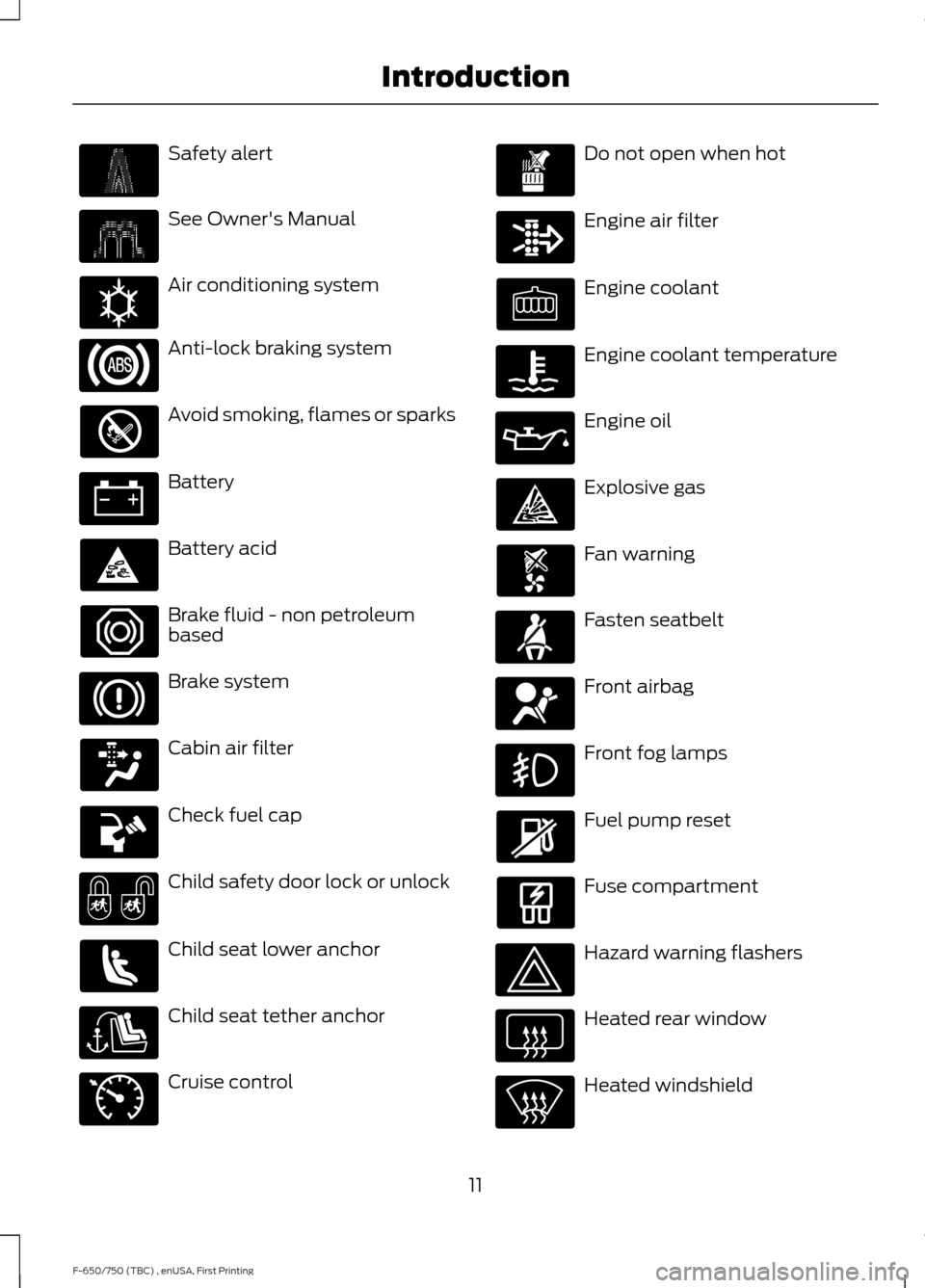
Safety alert
See Owner's Manual
Air conditioning system
Anti-lock braking system
Avoid smoking, flames or sparks
Battery
Battery acid
Brake fluid - non petroleum
based
Brake system
Cabin air filter
Check fuel cap
Child safety door lock or unlock
Child seat lower anchor
Child seat tether anchor
Cruise control Do not open when hot
Engine air filter
Engine coolant
Engine coolant temperature
Engine oil
Explosive gas
Fan warning
Fasten seatbelt
Front airbag
Front fog lamps
Fuel pump reset
Fuse compartment
Hazard warning flashers
Heated rear window
Heated windshield
11
F-650/750 (TBC) , enUSA, First Printing Introduction E162384 E71340
Page 25 of 382
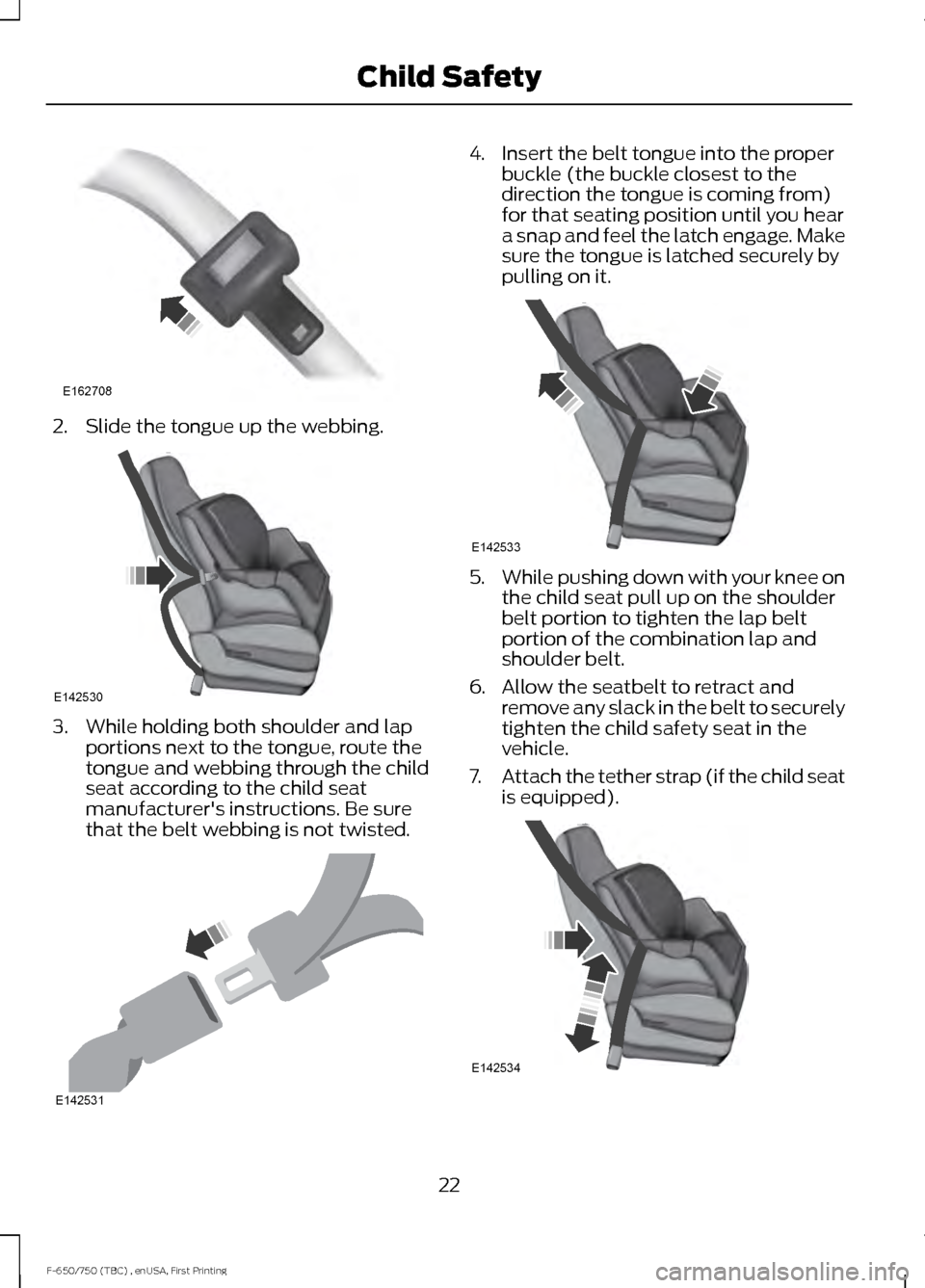
2. Slide the tongue up the webbing.
3. While holding both shoulder and lap
portions next to the tongue, route the
tongue and webbing through the child
seat according to the child seat
manufacturer's instructions. Be sure
that the belt webbing is not twisted. 4. Insert the belt tongue into the proper
buckle (the buckle closest to the
direction the tongue is coming from)
for that seating position until you hear
a snap and feel the latch engage. Make
sure the tongue is latched securely by
pulling on it. 5.
While pushing down with your knee on
the child seat pull up on the shoulder
belt portion to tighten the lap belt
portion of the combination lap and
shoulder belt.
6. Allow the seatbelt to retract and remove any slack in the belt to securely
tighten the child safety seat in the
vehicle.
7. Attach the tether strap (if the child seat
is equipped). 22
F-650/750 (TBC) , enUSA, First Printing Child SafetyE162708 E142530 E142531 E142533 E142534
Page 26 of 382
8. Before placing the child in the seat,
forcibly move the seat forward and
back to make sure the seat is securely
held in place. To check this, grab the
seat at the belt path and attempt to
move it side to side and forward and
back. There should be no more than 1
inch (2.5 centimeters) of movement
for proper installation.
9. Check from time to time to be sure that
there is no slack in the lap and shoulder
belt. The shoulder belt must be snug
to keep the lap belt tight during a crash.
We recommend checking with a NHTSA
Certified Child Passenger Safety
Technician to make certain the child
restraint is properly installed. In Canada,
check with Transport Canada for referral
to a Child Car Seat Clinic.
Using Lower Anchors and Tethers
for CHildren (LATCH)
The LATCH system is composed of three
vehicle anchor points: two lower anchors
where the vehicle seatback and seat
cushion meet (called the seat bight) and
one top tether anchor behind that seating
position. Your vehicle is not equipped with
the lower anchor points in the seat bight.
For this vehicle, use the vehicle seatbelt
and upper tether to secure a child seat. Using Tether Straps
Many forward-facing child safety seats
include a tether strap which extends from
the back of the child safety seat and hooks
to an anchoring point called the top tether
anchor. Tether straps are available as an
accessory for many older safety seats.
Contact the manufacturer of your child
seat for information about ordering a
tether strap, or to obtain a longer tether
strap if the tether strap on your safety seat
does not reach the appropriate top tether
anchor in the vehicle.
The passenger seats of your vehicle may
have built-in tether strap anchors behind
the seats as described below.
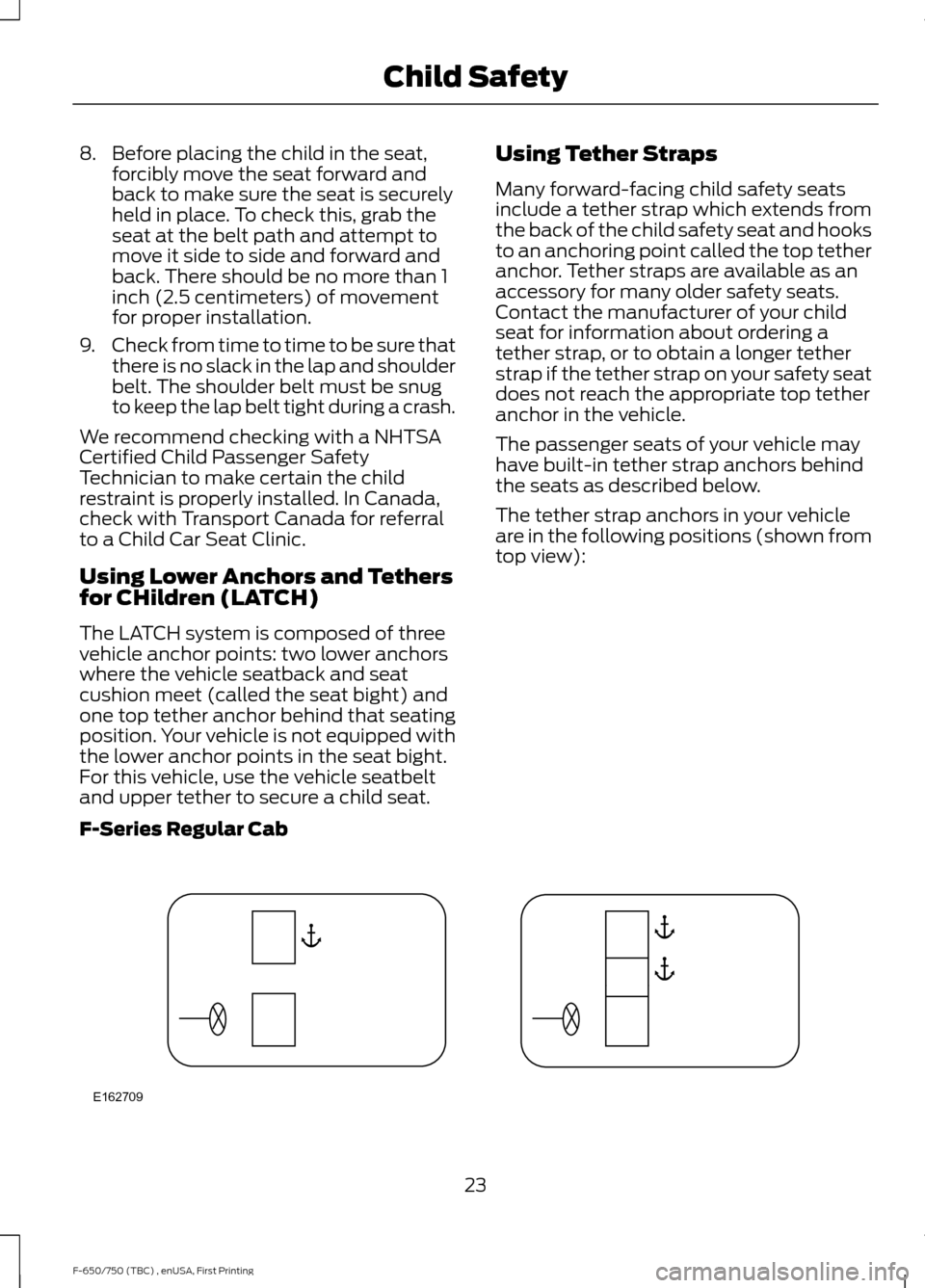
The tether strap anchors in your vehicle
are in the following positions (shown from
top view):
F-Series Regular Cab 23
F-650/750 (TBC) , enUSA, First Printing Child SafetyE162709
Page 27 of 382
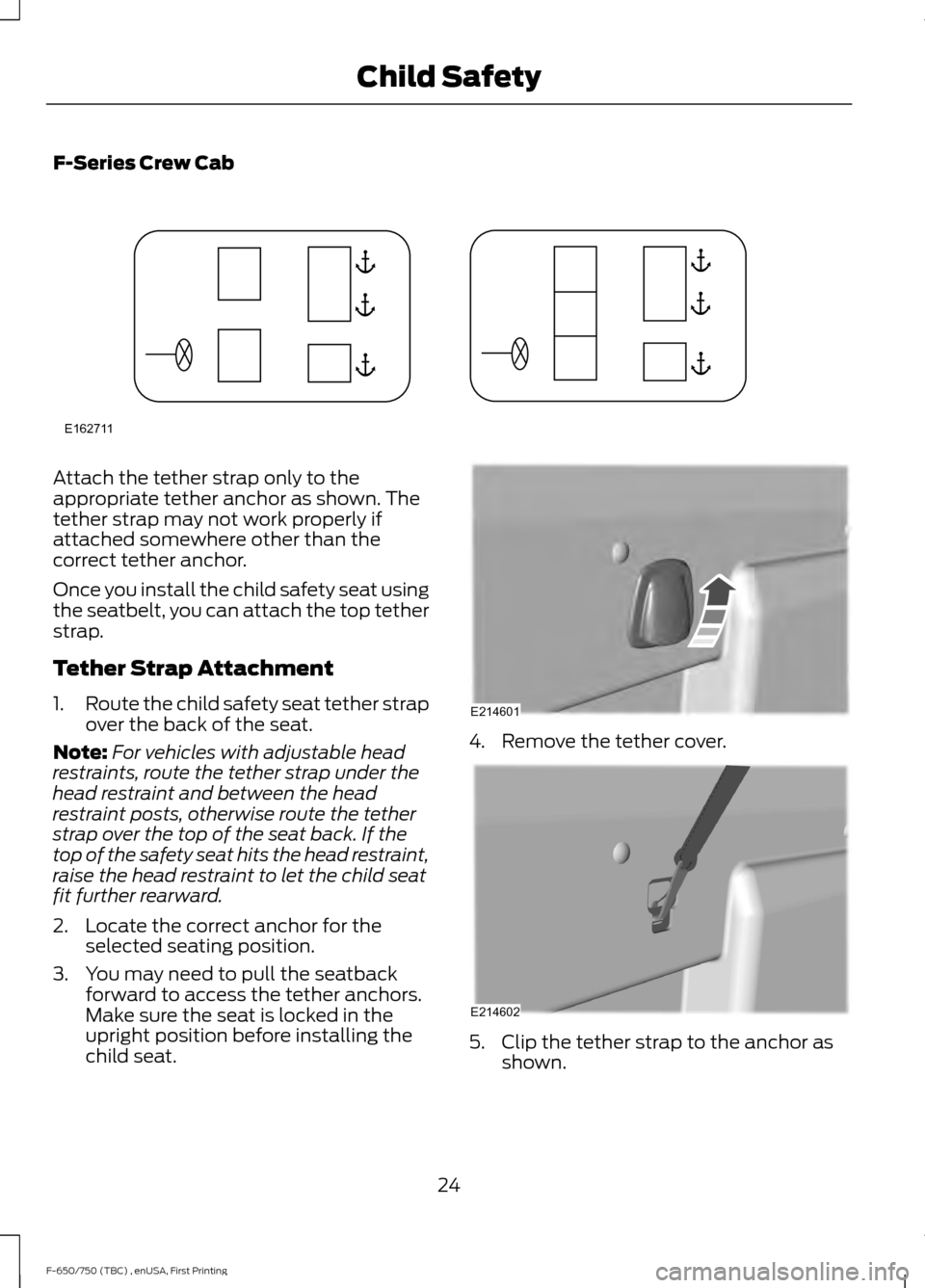
F-Series Crew Cab
Attach the tether strap only to the
appropriate tether anchor as shown. The
tether strap may not work properly if
attached somewhere other than the
correct tether anchor.
Once you install the child safety seat using
the seatbelt, you can attach the top tether
strap.
Tether Strap Attachment
1.
Route the child safety seat tether strap
over the back of the seat.
Note: For vehicles with adjustable head
restraints, route the tether strap under the
head restraint and between the head
restraint posts, otherwise route the tether
strap over the top of the seat back. If the
top of the safety seat hits the head restraint,
raise the head restraint to let the child seat
fit further rearward.
2. Locate the correct anchor for the selected seating position.
3. You may need to pull the seatback forward to access the tether anchors.
Make sure the seat is locked in the
upright position before installing the
child seat. 4. Remove the tether cover.
5. Clip the tether strap to the anchor as
shown.
24
F-650/750 (TBC) , enUSA, First Printing Child SafetyE162711 E214601 E214602
Page 31 of 382
WARNINGS
To avoid risk of injury, do not leave WARNINGS
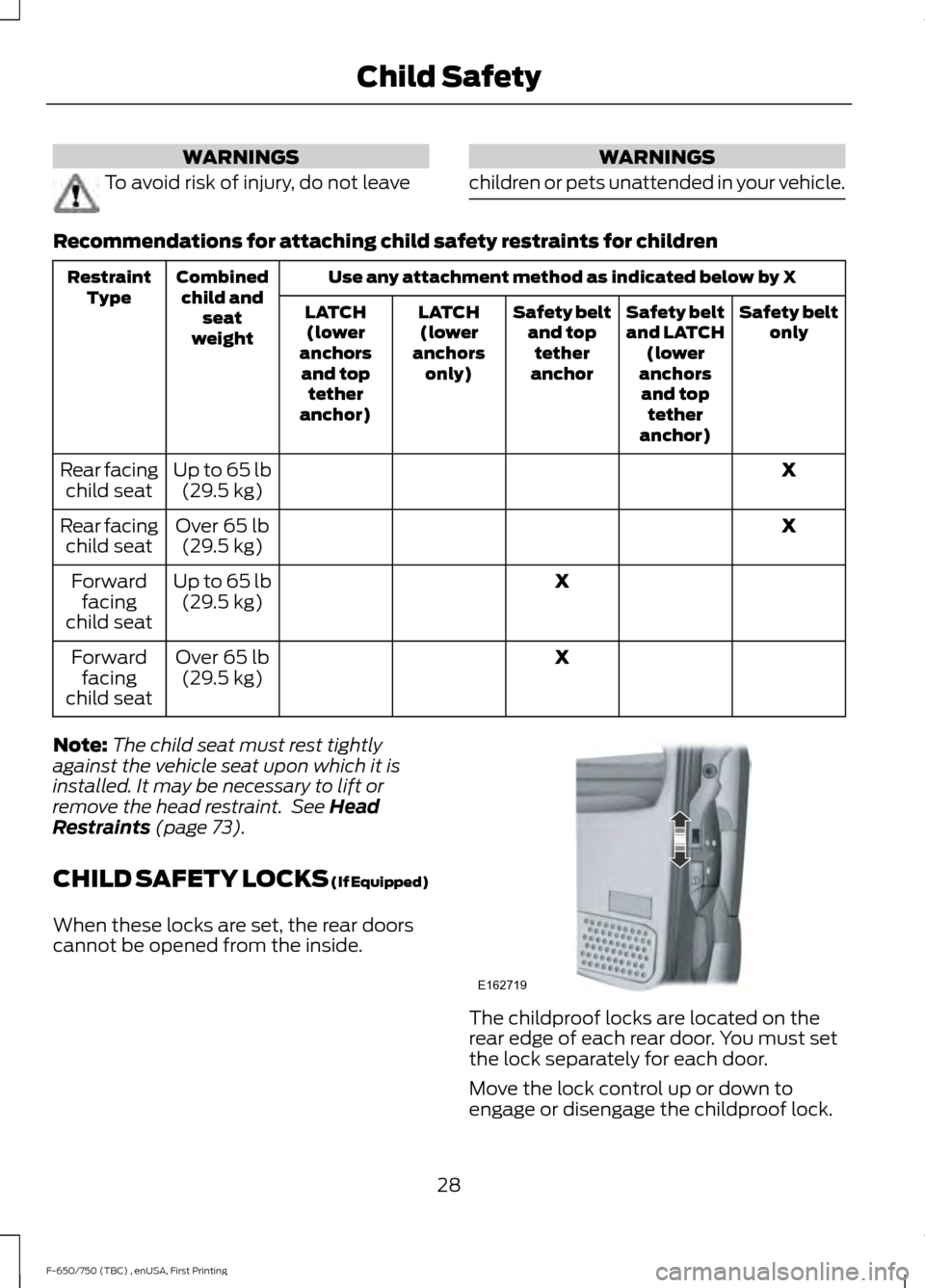
children or pets unattended in your vehicle. Recommendations for attaching child safety restraints for children
Use any attachment method as indicated below by X
Combined
child and seat
weight
Restraint
Type Safety belt
only
Safety belt
and LATCH
(lower
anchors and top tether
anchor)
Safety belt
and toptether
anchor
LATCH
(lower
anchors only)
LATCH
(lower
anchors and top tether
anchor)
X
Up to 65 lb
(29.5 kg)
Rear facing
child seat
X
Over 65 lb
(29.5 kg)
Rear facing
child seat
X
Up to 65 lb
(29.5 kg)
Forward
facing
child seat
X
Over 65 lb
(29.5 kg)
Forward
facing
child seat
Note: The child seat must rest tightly
against the vehicle seat upon which it is
installed. It may be necessary to lift or
remove the head restraint. See Head
Restraints (page 73).
CHILD SAFETY LOCKS (If Equipped)
When these locks are set, the rear doors
cannot be opened from the inside. The childproof locks are located on the
rear edge of each rear door. You must set
the lock separately for each door.
Move the lock control up or down to
engage or disengage the childproof lock.
28
F-650/750 (TBC) , enUSA, First Printing Child SafetyE162719
Page 33 of 382
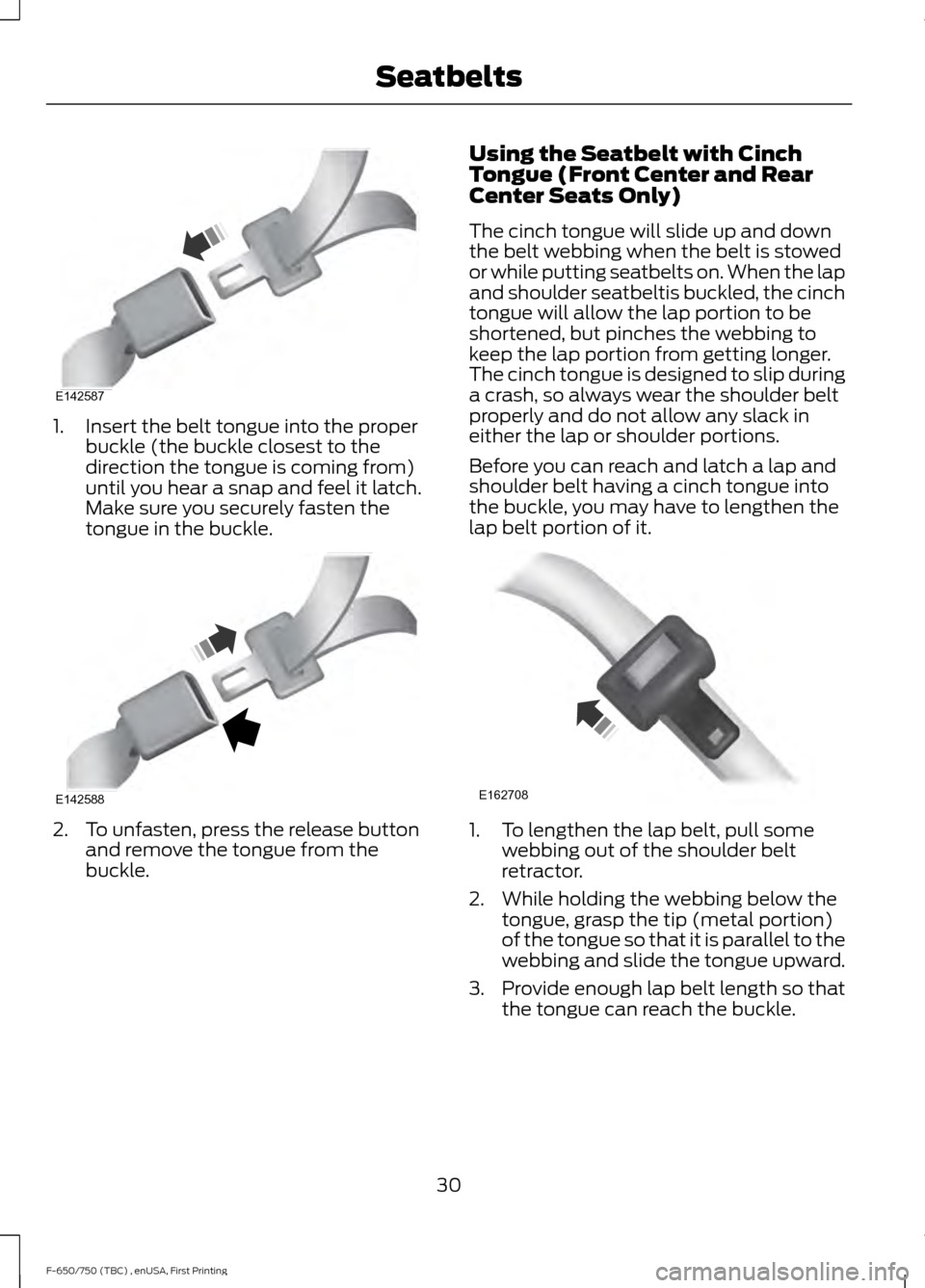
1. Insert the belt tongue into the proper
buckle (the buckle closest to the
direction the tongue is coming from)
until you hear a snap and feel it latch.
Make sure you securely fasten the
tongue in the buckle. 2. To unfasten, press the release button
and remove the tongue from the
buckle. Using the Seatbelt with Cinch
Tongue (Front Center and Rear
Center Seats Only)
The cinch tongue will slide up and down
the belt webbing when the belt is stowed
or while putting seatbelts on. When the lap
and shoulder seatbeltis buckled, the cinch
tongue will allow the lap portion to be
shortened, but pinches the webbing to
keep the lap portion from getting longer.
The cinch tongue is designed to slip during
a crash, so always wear the shoulder belt
properly and do not allow any slack in
either the lap or shoulder portions.
Before you can reach and latch a lap and
shoulder belt having a cinch tongue into
the buckle, you may have to lengthen the
lap belt portion of it.
1. To lengthen the lap belt, pull some
webbing out of the shoulder belt
retractor.
2. While holding the webbing below the tongue, grasp the tip (metal portion)
of the tongue so that it is parallel to the
webbing and slide the tongue upward.
3. Provide enough lap belt length so that
the tongue can reach the buckle.
30
F-650/750 (TBC) , enUSA, First Printing SeatbeltsE142587 E142588 E162708
Page 77 of 382
Front Seat Head Restraint
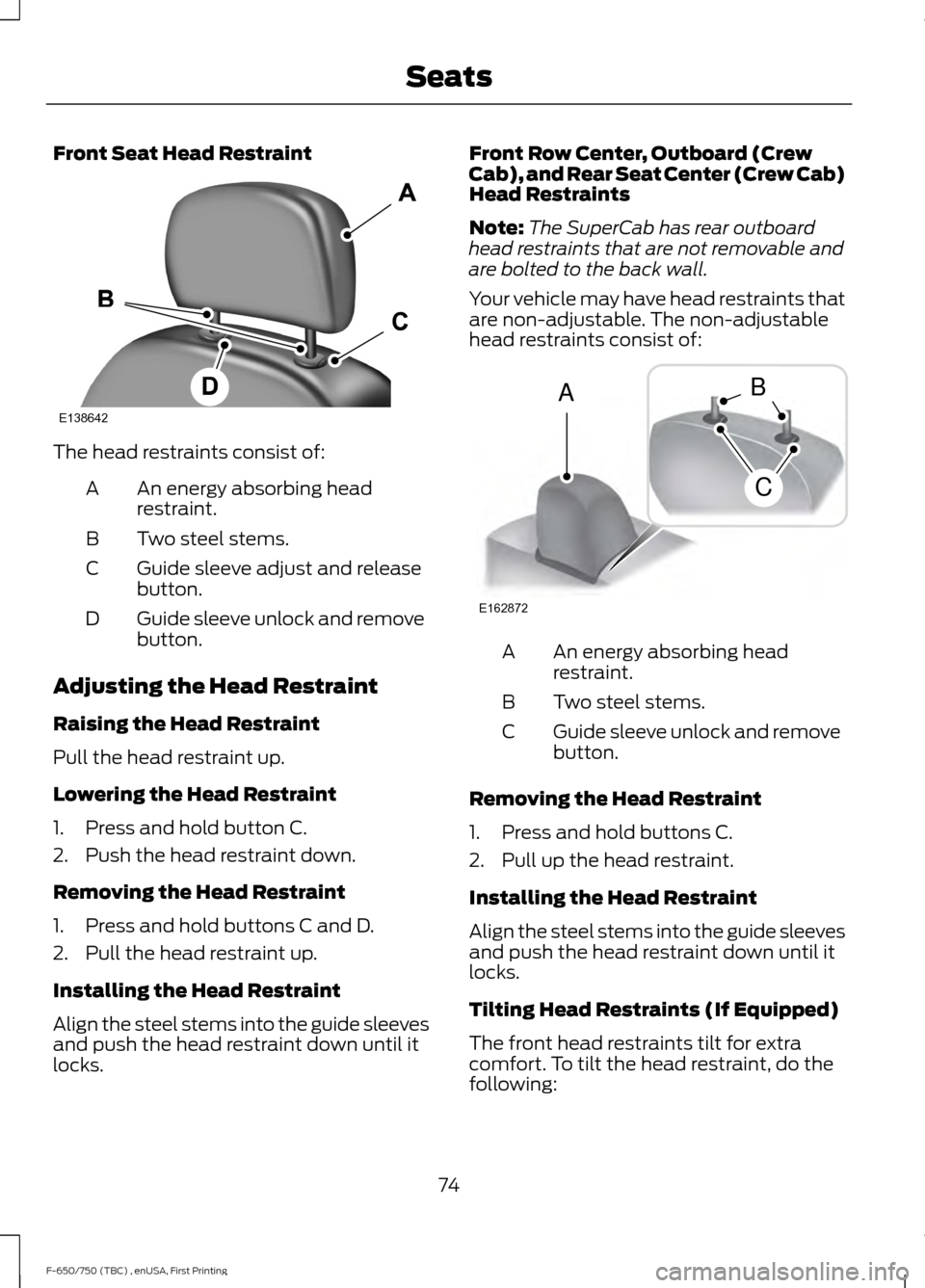
The head restraints consist of:
An energy absorbing head
restraint.
A
Two steel stems.
B
Guide sleeve adjust and release
button.
C
Guide sleeve unlock and remove
button.
D
Adjusting the Head Restraint
Raising the Head Restraint
Pull the head restraint up.
Lowering the Head Restraint
1. Press and hold button C.
2. Push the head restraint down.
Removing the Head Restraint
1. Press and hold buttons C and D.
2. Pull the head restraint up.
Installing the Head Restraint
Align the steel stems into the guide sleeves
and push the head restraint down until it
locks. Front Row Center, Outboard (Crew
Cab), and Rear Seat Center (Crew Cab)
Head Restraints
Note:
The SuperCab has rear outboard
head restraints that are not removable and
are bolted to the back wall.
Your vehicle may have head restraints that
are non-adjustable. The non-adjustable
head restraints consist of: An energy absorbing head
restraint.
A
Two steel stems.
B
Guide sleeve unlock and remove
button.
C
Removing the Head Restraint
1. Press and hold buttons C.
2. Pull up the head restraint.
Installing the Head Restraint
Align the steel stems into the guide sleeves
and push the head restraint down until it
locks.
Tilting Head Restraints (If Equipped)
The front head restraints tilt for extra
comfort. To tilt the head restraint, do the
following:
74
F-650/750 (TBC) , enUSA, First Printing SeatsE138642 E162872
A
C
B
Page 78 of 382
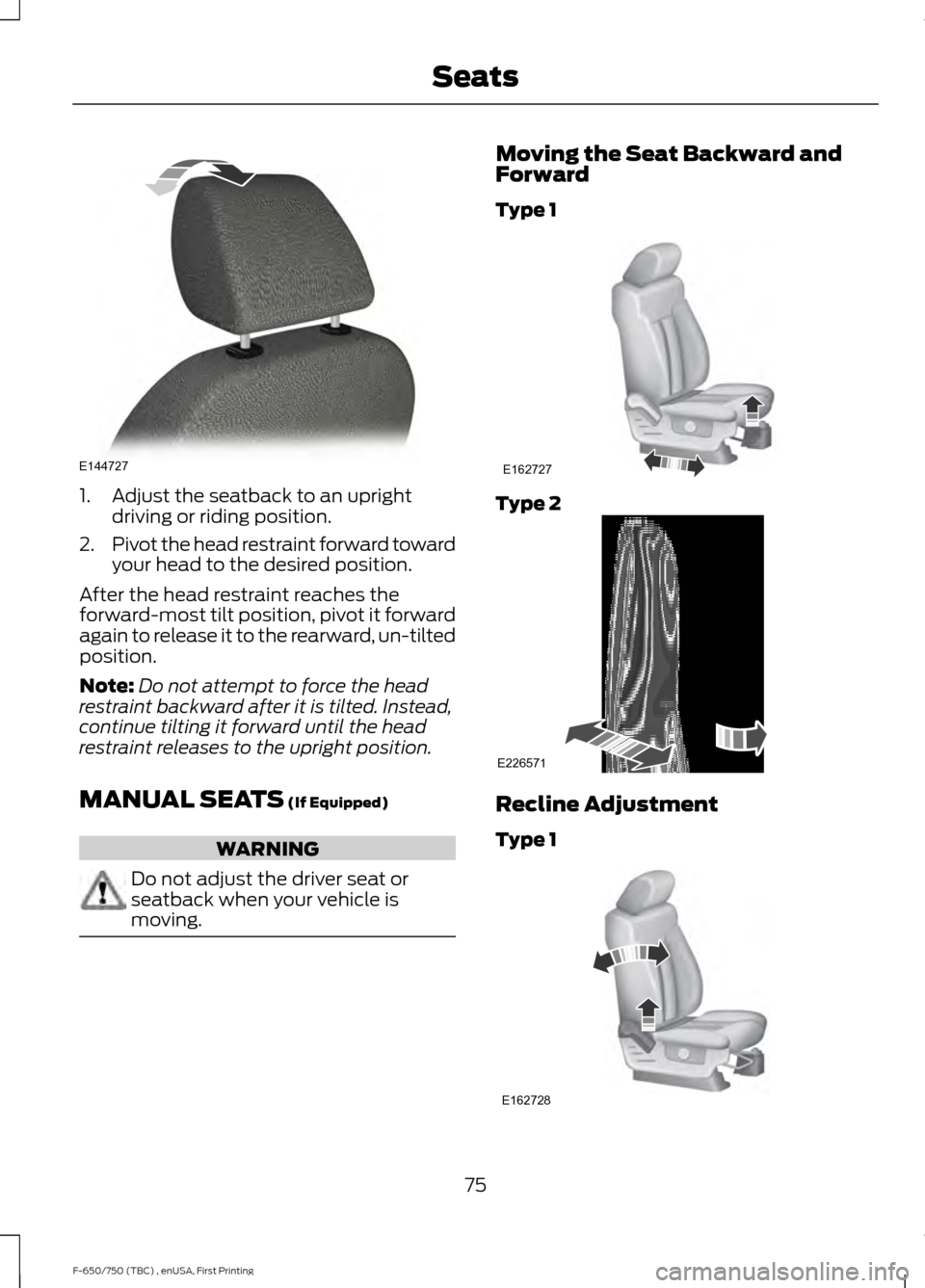
1. Adjust the seatback to an upright
driving or riding position.
2. Pivot the head restraint forward toward
your head to the desired position.
After the head restraint reaches the
forward-most tilt position, pivot it forward
again to release it to the rearward, un-tilted
position.
Note: Do not attempt to force the head
restraint backward after it is tilted. Instead,
continue tilting it forward until the head
restraint releases to the upright position.
MANUAL SEATS (If Equipped) WARNING
Do not adjust the driver seat or
seatback when your vehicle is
moving. Moving the Seat Backward and
Forward
Type 1
Type 2
Recline Adjustment
Type 1
75
F-650/750 (TBC) , enUSA, First Printing SeatsE144727 E162727 E226571 E162728
Page 79 of 382
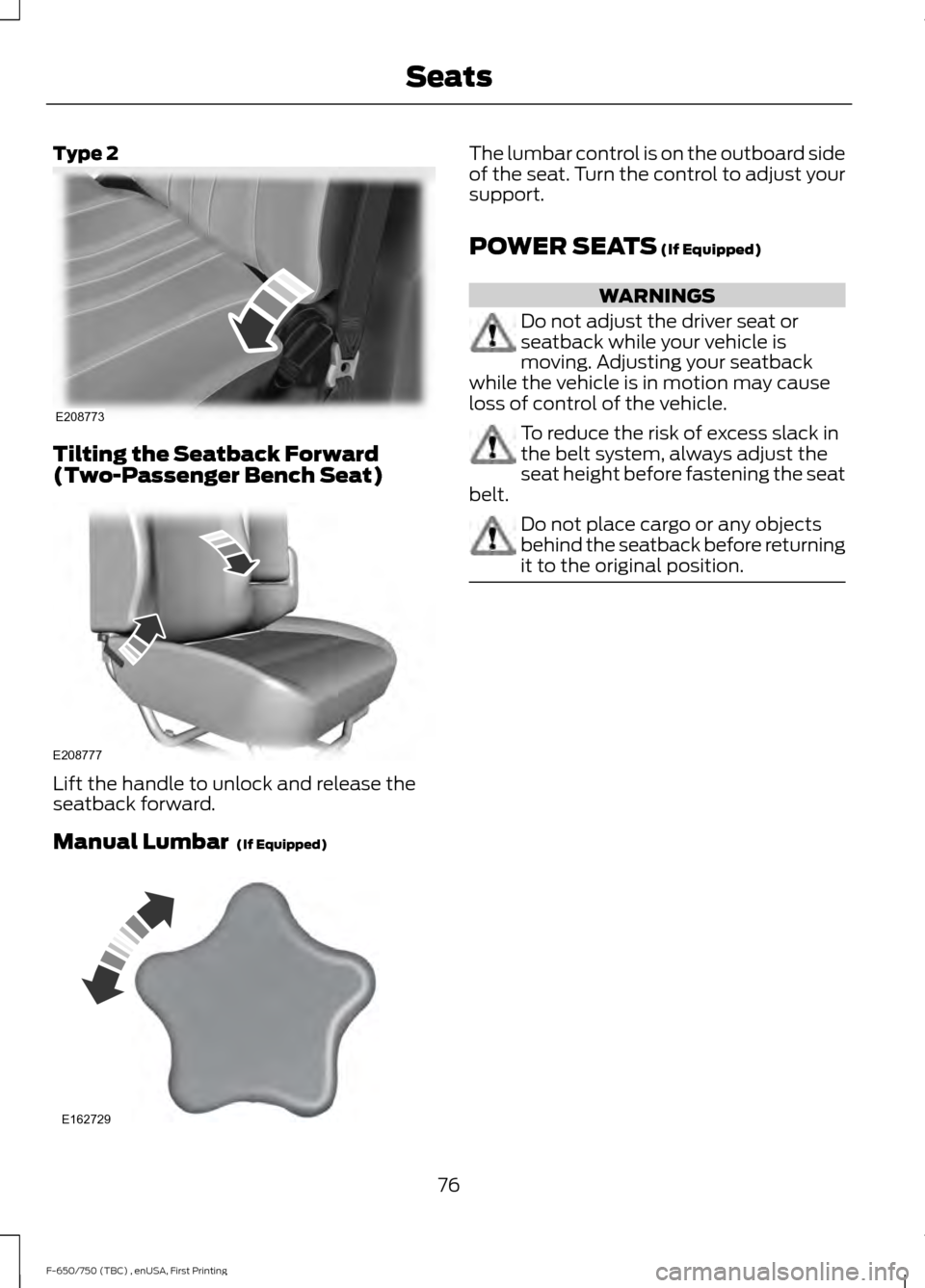
Type 2
Tilting the Seatback Forward
(Two-Passenger Bench Seat)
Lift the handle to unlock and release the
seatback forward.
Manual Lumbar (If Equipped) The lumbar control is on the outboard side
of the seat. Turn the control to adjust your
support.
POWER SEATS
(If Equipped)
WARNINGS
Do not adjust the driver seat or
seatback while your vehicle is
moving. Adjusting your seatback
while the vehicle is in motion may cause
loss of control of the vehicle. To reduce the risk of excess slack in
the belt system, always adjust the
seat height before fastening the seat
belt. Do not place cargo or any objects
behind the seatback before returning
it to the original position.
76
F-650/750 (TBC) , enUSA, First Printing SeatsE208773 E208777 E162729
Page 81 of 382
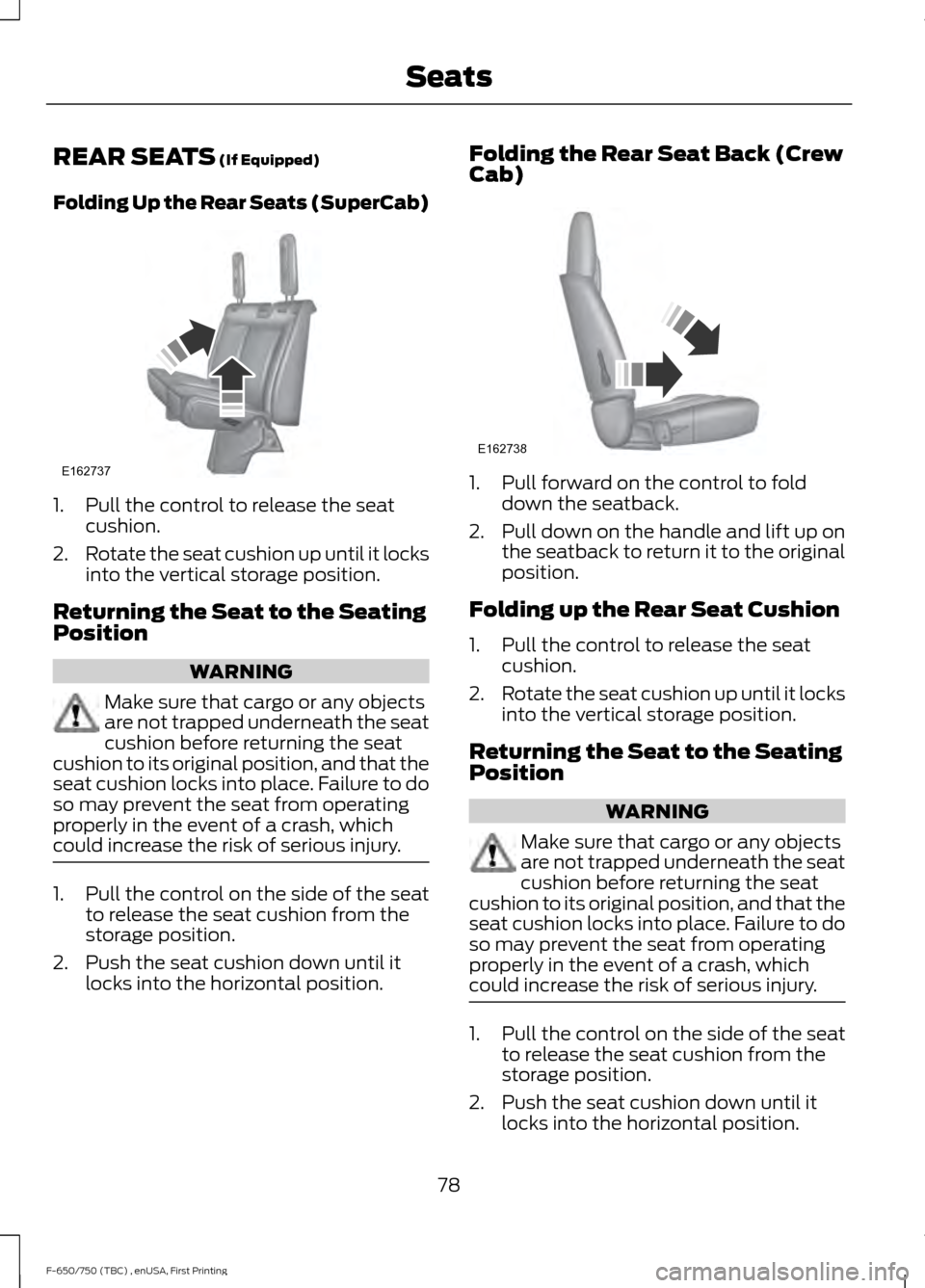
REAR SEATS (If Equipped)
Folding Up the Rear Seats (SuperCab) 1. Pull the control to release the seat
cushion.
2. Rotate the seat cushion up until it locks
into the vertical storage position.
Returning the Seat to the Seating
Position WARNING
Make sure that cargo or any objects
are not trapped underneath the seat
cushion before returning the seat
cushion to its original position, and that the
seat cushion locks into place. Failure to do
so may prevent the seat from operating
properly in the event of a crash, which
could increase the risk of serious injury. 1. Pull the control on the side of the seat
to release the seat cushion from the
storage position.
2. Push the seat cushion down until it locks into the horizontal position. Folding the Rear Seat Back (Crew
Cab)
1. Pull forward on the control to fold
down the seatback.
2. Pull down on the handle and lift up on
the seatback to return it to the original
position.
Folding up the Rear Seat Cushion
1. Pull the control to release the seat cushion.
2. Rotate the seat cushion up until it locks
into the vertical storage position.
Returning the Seat to the Seating
Position WARNING
Make sure that cargo or any objects
are not trapped underneath the seat
cushion before returning the seat
cushion to its original position, and that the
seat cushion locks into place. Failure to do
so may prevent the seat from operating
properly in the event of a crash, which
could increase the risk of serious injury. 1. Pull the control on the side of the seat
to release the seat cushion from the
storage position.
2. Push the seat cushion down until it locks into the horizontal position.
78
F-650/750 (TBC) , enUSA, First Printing SeatsE162737 E162738