lock FORD FESTIVA 1991 Service Manual
[x] Cancel search | Manufacturer: FORD, Model Year: 1991, Model line: FESTIVA, Model: FORD FESTIVA 1991Pages: 454, PDF Size: 9.53 MB
Page 392 of 454
WHEEL BEARINGS
Wheel bearing preload is maintained by a selective spacer in the steering knuckle, between the inner and outer hub bearings. For adjustment
procedures and inspection, see WHEEL BEARING under REMOVAL & INSTALLATION.
BALL JOINT CHECKING
Raise and support vehicle until tire is just off ground. Move wheel vertically and check for play. If play is noticed between steering knuckle
and control arm, control arm assembly should be replaced. If play is present but ball joint is okay, wheel bearings should be checked for wear
and replaced if necessary.
REMOVAL & INSTALLATION
STABILIZER BAR
Removal & Installation (Festiva)
1. Remove stabilizer mounting bracket nuts and brackets. Remove split bushings from stabilizer bar. Remove stabilizer bushing nuts at
lower control arms. Remove rear dished washers and bushings.
2. To loosen stabilizer bar, pull forward from control arms. Remove front bushings and washers. Install control arm bushing washers on
ends of stabilizer and install control arm front bushings. Insert ends of stabilizer bar into control arm bushings and install rear bushings
and washers on stabilizer bar ends.
3. Install retaining nuts finger tight. Install split bushings on stabilizer cross bar with split side forward. Position split bushings next to
White locating marks on bar. Install stabilizer mounting brackets. Tighten all bolts and nuts to specification.
STRUT ASSEMBLY & COIL SPRING
Removal
1. Raise and support front of vehicle so struts are fully extended. Remove front wheels. Remove brake line clip from strut lower mounting
bracket and remove brake line.
2. Remove 2 bolts retaining strut lower bracket to steering knuckle. Working inside engine compartment, remove 2 nuts retaining strut
mounting block in strut tower. Disengage strut lower bracket from steering knuckle and lower strut from vehicle.
Disassembly & Reassembly
1. Using spring compressor, compress spring to unload strut. Pry out mounting block cap and remove strut upper nut and lock washer.
2. Remove strut mounting block and spacer plate. Remove washer, bearing seal and bearing from strut rod. Remove spring upper seat, seat
insulator and coil spring. Remove jounce bumper and dust shield from strut. Reverse disassembly procedure to install coil spring a n d
reassemble strut.
Installation
1. Position strut, with spacer plate installed, in strut tower with White alignment mark facing outward. Install and tighten nuts on upper
mounting block studs.
2. Install steering knuckle in strut lower bracket. To complete installation, reverse removal procedure. Tighten all bolts and nuts to
specification.
HUB & KNUCKLE ASSEMBLY
Removal
1. Raise and support vehicle. Remove wheel. Straighten staked edge of drive axle lock nut flange. DO NOT damage groove or threads in
end of drive axle. Apply brakes to prevent hub assembly from turning. Remove and discard drive axle lock nut.
2. Remove clip which secures brake hose to strut bracket. Remove cotter pin and tie rod end attaching nut. Using Tie Rod End Separator
(T85M-3395A), remove tie rod end from steering knuckle.
3. Remove brake caliper attaching bolts and remove assembly from steering knuckle. Do not allow caliper to hang by brake hose. Remove
clamp bolt and nut where lower control arm ball joint connects to steering knuckle.
4. Using a pry bar, pull down on lower control arm and release ball joint from steering knuckle. Remove 2 bolts which attach steering
knuckle between flanges of MacPherson strut bracket. Slide hub/knuckle assembly off end of drive axle. If binding is present or drive
hub is rusted to half-shaft, use a hub puller to push axle from drive hub.
Installation
1. Apply a thin coat of SAE 30 weight oil to drive axle splines. Slide steering knuckle/rotor/hub assembly onto drive axle. Stop at area
where uppermost arm of steering knuckle seats into MacPherson strut bracket.
2. To complete installation, reverse removal procedure. Install NEW drive axle lock nut. Tighten all bolts and nuts to specification. Stake
axle lock nut into shaft groove.
WHEEL BEARING NOTE:Inform ation for stabilizer bar rem oval and installation on Capri is not available from m anufacturer.
NOTE:Always use a new drive axle lock nut when servicing drive hub or drive axle.
CAUT ION: DO NOT use a pointed tool to stake nut. If lock nut flange cracks, even slightly, during staking process,
it m ust be replaced.
Page 2 of 5 MITCHELL 1 ARTICLE - SUSPENSION - FRONT 1991-92 SUSPENSION Front
3/10/2009 http://www.eautorepair.net/app/PrintItems.asp?S0=2097152&S1=0&SG=%7B9B990D68%2D660A%2D45E9%2D8F46%2DE
...
Page 397 of 454
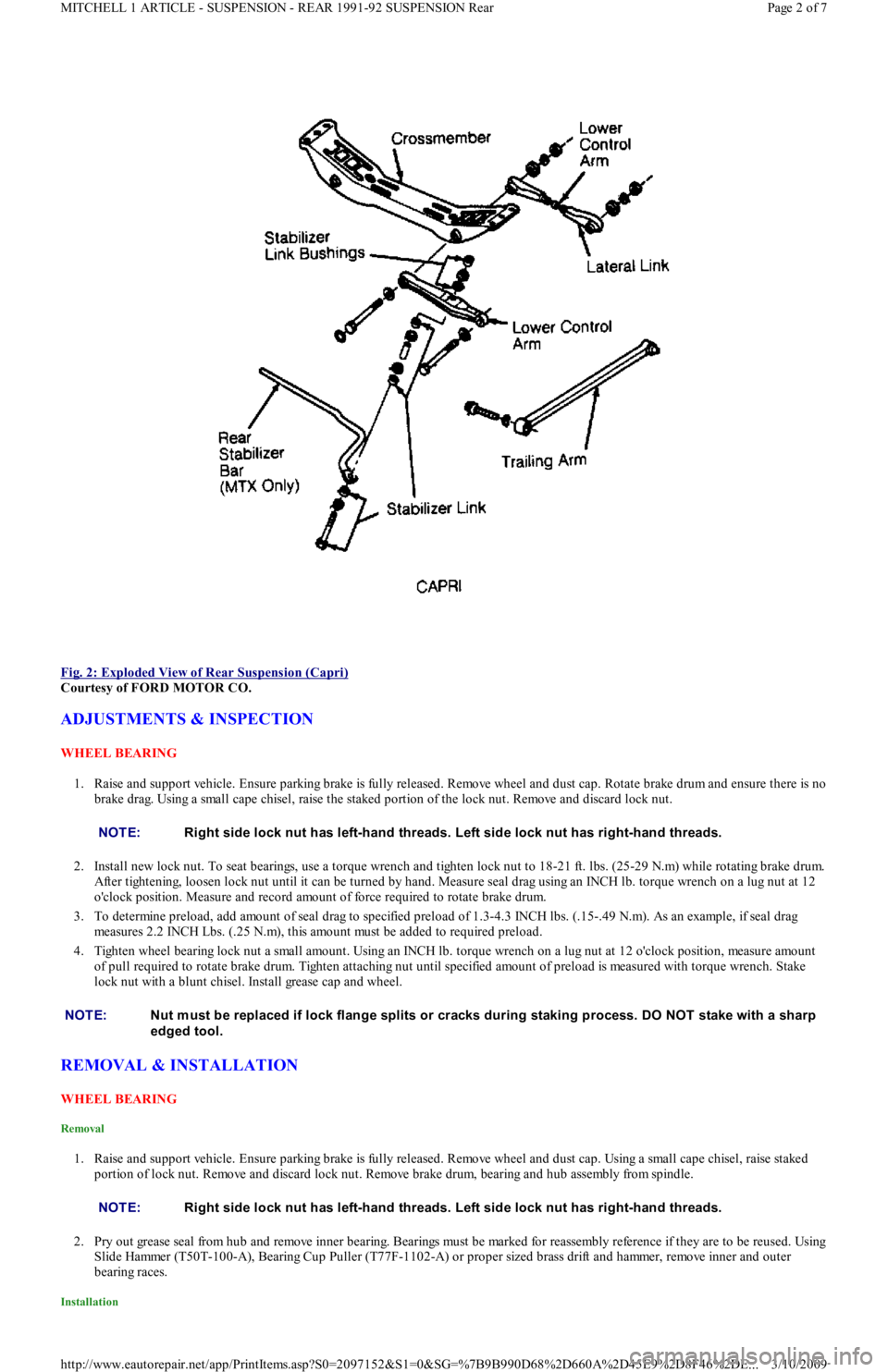
Fig. 2: Exploded View of Rear Suspension (Capri)
Courtesy of FORD MOTOR CO.
ADJUSTMENTS & INSPECTION
WHEEL BEARING
1. Raise and support vehicle. Ensure parking brake is fully released. Remove wheel and dust cap. Rotate brake drum and ensure there is no
brake drag. Using a small cape chisel, raise the staked portion of the lock nut. Remove and discard lock nut.
2. Install new lock nut. To seat bearings, use a torque wrench and tighten lock nut to 18-21 ft. lbs. (25-29 N.m) while rotating brake drum.
After tightening, loosen lock nut until it can be turned by hand. Measure seal drag using an INCH lb. torque wrench on a lug nut at 12
o'clock position. Measure and record amount of force required to rotate brake drum.
3. To determine preload, add amount of seal drag to specified preload of 1.3-4.3 INCH lbs. (.15-.49 N.m). As an example, if seal drag
measures 2.2 INCH Lbs. (.25 N.m), this amount must be added to required preload.
4. Tighten wheel bearing lock nut a small amount. Using an INCH lb. torque wrench on a lug nut at 12 o'clock position, measure amo u n t
of pull required to rotate brake drum. Tighten attaching nut until specified amount of preload is measured with torque wrench. Stake
lock nut with a blunt chisel. Install grease cap and wheel.
REMOVAL & INSTALLATION
WHEEL BEARING
Removal
1. Raise and support vehicle. Ensure parking brake is fully released. Remove wheel and dust cap. Using a small cape chisel, raise staked
portion of lock nut. Remove and discard lock nut. Remove brake drum, bearing and hub assembly from spindle.
2. Pry out grease seal from hub and remove inner bearing. Bearings must be marked for reassembly reference if they are to be reused. Using
Slide Hammer (T50T-100-A), Bearing Cup Puller (T77F-1102-A) or proper sized brass drift and hammer, remove inner and outer
bearing races.
Installation
NOTE:Right side lock nut has left-hand threads. Left side lock nut has right-hand threads.
NOTE:Nut m ust be replaced if lock flange splits or cracks during staking process. DO NOT stake with a sharp
edged tool.
NOTE:Right side lock nut has left-hand threads. Left side lock nut has right-hand threads.
Page 2 of 7 MITCHELL 1 ARTICLE - SUSPENSION - REAR 1991-92 SUSPENSION Rear
3/10/2009 http://www.eautorepair.net/app/PrintItems.asp?S0=2097152&S1=0&SG=%7B9B990D68%2D660A%2D45E9%2D8F46%2DE
...
Page 398 of 454
1. Using Installer (T77F-1217-A), Driver Handle (T80T-4000-W) or proper sized brass drift and hammer, install inner and outer bearing
races. Pack bearings and hub area with Lubricant (C1AZ-1959D-B, C, D or E).
2. Position inner bearing in bearing hub. Lubricate grease seal lips and install seal. Ensure bearings and hub have sufficient lubricant. Place
brake drum bearings and hub assembly on spindle. To prevent damage to grease seal and spindle threads, ensure hub is correctly
centered on spindle.
3. Install outer bearing, washer and new lock nut. Stake lock nut with a blunt chisel. Adjust bearing preload. See ADJUSTMENTS &
INSPECTION.
SPINDLE
Removal & Installation (Capri)
Remove wheel, caliper and brake rotor. Loosen spindle-to-strut attaching bolts. Loosen outer rear control arm common bolt and nut. Remove
spindle-to-strut mount bolts and common control arm bolt. Remove spindle from strut. To install, reverse removal procedure.
Removal & Installation (Festiva)
Remove brake drum assembly. Remove 4 spindle attaching nuts located on inboard side of torsion beam. Support backing plate with wire and
remove spindle. To install, reverse removal procedure. Tighten spindle attaching nuts to 32-45 ft. lbs. (43-61 N.m).
STRUTS
Removal & Installation (Capri)
1. Remove wheel, caliper and brake rotor. Remove trailing arm bolt and spindle-to-strut attaching bolts. Put index mark on strut rubber
mounting bracket. Remove upper strut attaching nuts from inside vehicle. Remove strut.
2. Compress strut coil spring with Spring Compressor (T18P-5310-A) or similar. Remove strut nut while spring is compressed. Remove
rubber mounting bracket, upper and lower spring seats. Slowly release coil spring and remove spring compressor. Remove coil spring,
dust boot and rebound bumpers. To install, reverse removal procedure.
Removal (Festiva)
1. Raise and support vehicle. Remove rear wheels. Using Spring Compressor (T81P-5310-A), compress spring to unload strut. Remove rear
quarter trim panel from cargo compartment.
2. Remove jam nut and flanged nut from strut rod. Remove bushing washer and upper bushing. Remove strut lower end mounting bolt
from wheel support arm. Remove strut and separate it from spring and seat insulator. Remove lower bushing and jounce bumper seat
from strut rod. Slide jounce bumper and shield off strut. See Fig. 3
. NOTE:Nut m ust be replaced if lock flange splits or cracks during staking process. DO NOT stake with a sharp-
edged tool.
Page 3 of 7 MITCHELL 1 ARTICLE - SUSPENSION - REAR 1991-92 SUSPENSION Rear
3/10/2009 http://www.eautorepair.net/app/PrintItems.asp?S0=2097152&S1=0&SG=%7B9B990D68%2D660A%2D45E9%2D8F46%2DE
...
Page 399 of 454
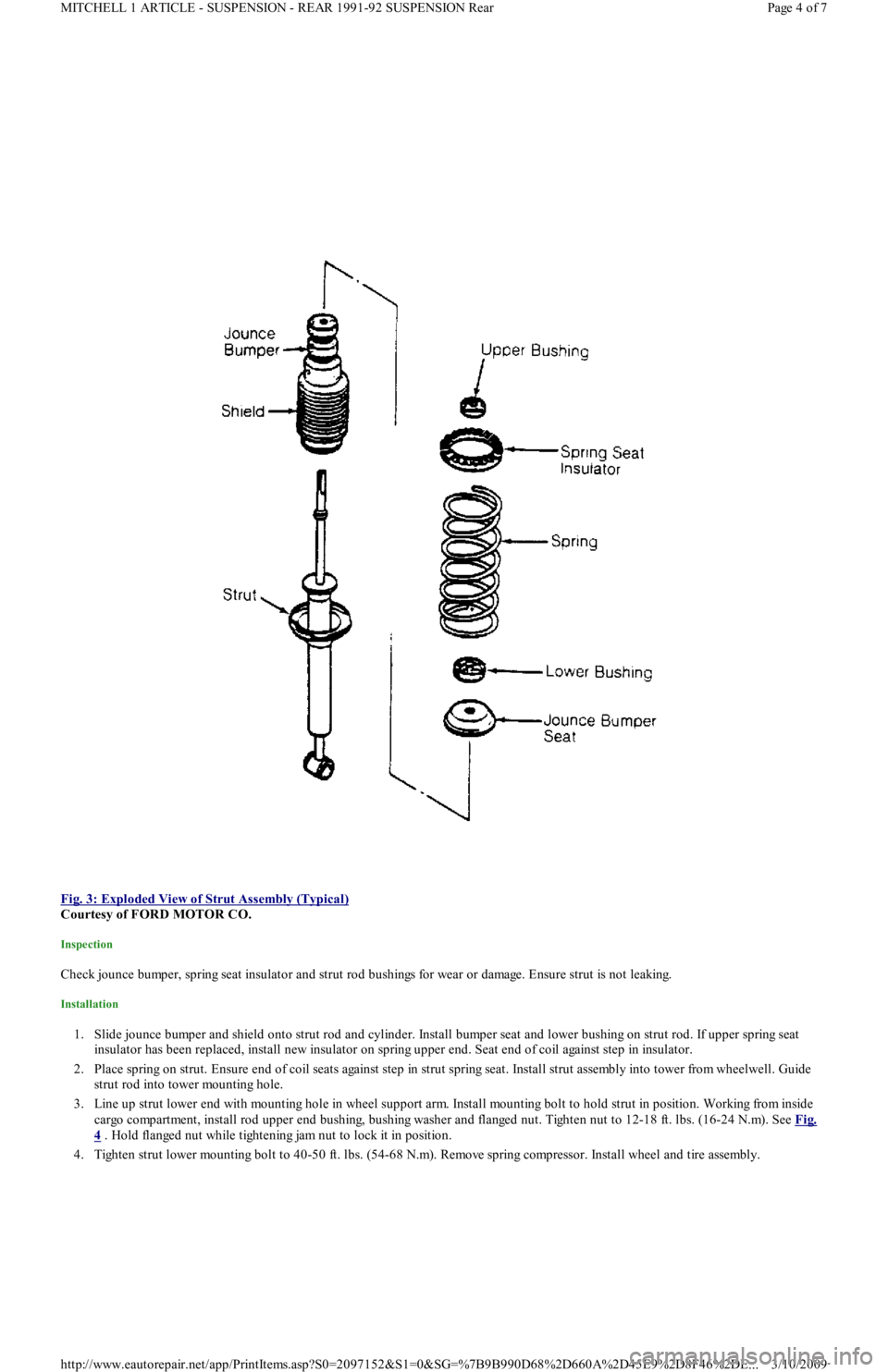
Fig. 3: Exploded View of Strut Assembly (Typical)
Courtesy of FORD MOTOR CO.
Inspection
Check jounce bumper, spring seat insulator and strut rod bushings for wear or damage. Ensure strut is not leaking.
Installation
1. Slide jounce bumper and shield onto strut rod and cylinder. Install bumper seat and lower bushing on strut rod. If upper spring seat
insulator has been replaced, install new insulator on spring upper end. Seat end of coil against step in insulator.
2. Place spring on strut. Ensure end of coil seats against step in strut spring seat. Install strut assembly into tower from wheelwell. Guide
strut rod into tower mounting hole.
3. Line up strut lower end with mounting hole in wheel support arm. Install mounting bolt to hold strut in position. Working from in sid e
cargo compartment, install rod upper end bushing, bushing washer and flanged nut. Tighten nut to 12-18 ft. lbs. (16-24 N.m). See Fig.
4 . Hold flanged nut while tightening jam nut to lock it in position.
4. Tighten strut lower mounting bolt to 40-50 ft. lbs. (54-68 N.m). Remove spring compressor. Install wheel and tire assembly.
Page 4 of 7 MITCHELL 1 ARTICLE - SUSPENSION - REAR 1991-92 SUSPENSION Rear
3/10/2009 http://www.eautorepair.net/app/PrintItems.asp?S0=2097152&S1=0&SG=%7B9B990D68%2D660A%2D45E9%2D8F46%2DE
...
Page 401 of 454
and left brake lines in place. Install rear suspension struts and wheels. Block wheels and lower vehicle to load suspension to normal ride
height. Tighten torsion beam pivot bolts at body brackets to 69-87 ft. lbs. (93-118 N.m).
4. Check rear suspension alignment. Place an alignment mark at the center of the underbody, at a point of equal distance from the right and
left body bracket inboard mounting bolts. From this alignment mark, measure distance to centers of right and left strut lower mounting
bolts.
5. Both measurements must be within .20" (5 mm) of being the same. If not, shift torsion beam body brackets from side-to-side to center
suspension. Once centered, tighten upper body bracket mounting bolts to 40-50 ft. lbs. (54-68 N.m) and lower bolt to 69-87 ft. lbs. (93-
118 N.m). Bleed brakes.
TORSION BEAM BUSHINGS
Removal
1. Raise and support vehicle to fully extended rear struts. Remove wheels. Remove retaining clip at right brake line routing bracket and
disconnect brake line. Remove clip from left brake line and disconnect at body crossmember.
2. Remove torsion beam pivot bolt bolts and nuts at right and left body brackets. Swing torsion beam trailing arm downward to clear body
brackets.
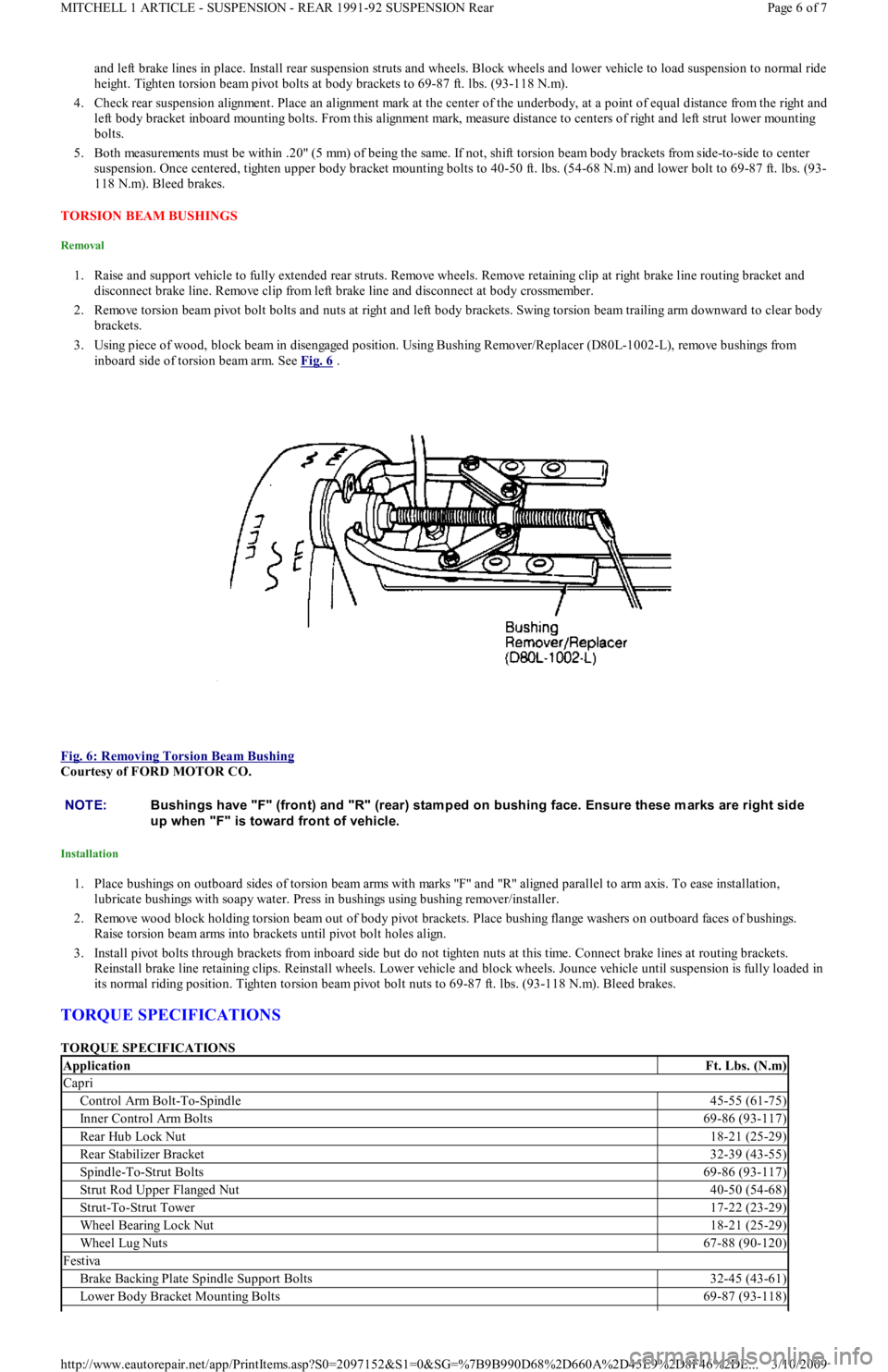
3. Using piece of wood, block beam in disengaged position. Using Bushing Remover/Replacer (D80L-1002-L), remove bushings from
inboard side of torsion beam arm. See Fig. 6
.
Fig. 6: Removing Torsion Beam Bushing
Courtesy of FORD MOTOR CO.
Installation
1. Place bushings on outboard sides of torsion beam arms with marks "F" and "R" aligned parallel to arm axis. To ease installation,
lubricate bushings with soapy water. Press in bushings using bushing remover/installer.
2. Remove wood block holding torsion beam out of body pivot brackets. Place bushing flange washers on outboard faces of bushings.
Raise torsion beam arms into brackets until pivot bolt holes align.
3. Install pivot bolts through brackets from inboard side but do not tighten nuts at this time. Connect brake lines at routing brackets.
Reinstall brake line retaining clips. Reinstall wheels. Lower vehicle and block wheels. Jounce vehicle until suspension is fully loaded in
its normal riding position. Tighten torsion beam pivot bolt nuts to 69-87 ft. lbs. (93-118 N.m). Bleed brakes.
TORQUE SPECIFICATIONS
TORQUE SPECIFICATIONS
NOTE:Bushings have "F" (front) and "R" (rear) stam ped on bushing face. Ensure these m arks are right side
up when "F" is toward front of vehicle.
ApplicationFt. Lbs. (N.m)
Capri
Control Arm Bolt-To-Spindle45-55 (61-75)
Inner Control Arm Bolts69-86 (93-117)
Rear Hub Lock Nut18-21 (25-29)
Rear Stabilizer Bracket32-39 (43-55)
Spindle-To-Strut Bolts69-86 (93-117)
Strut Rod Upper Flanged Nut40-50 (54-68)
Strut-To-Strut Tower17-22 (23-29)
Wheel Bearing Lock Nut18-21 (25-29)
Wheel Lug Nuts67-88 (90-120)
Festiva
Brake Backing Plate Spindle Support Bolts32-45 (43-61)
Lower Body Bracket Mounting Bolts69-87 (93-118)
Page 6 of 7 MITCHELL 1 ARTICLE - SUSPENSION - REAR 1991-92 SUSPENSION Rear
3/10/2009 http://www.eautorepair.net/app/PrintItems.asp?S0=2097152&S1=0&SG=%7B9B990D68%2D660A%2D45E9%2D8F46%2DE
...
Page 402 of 454
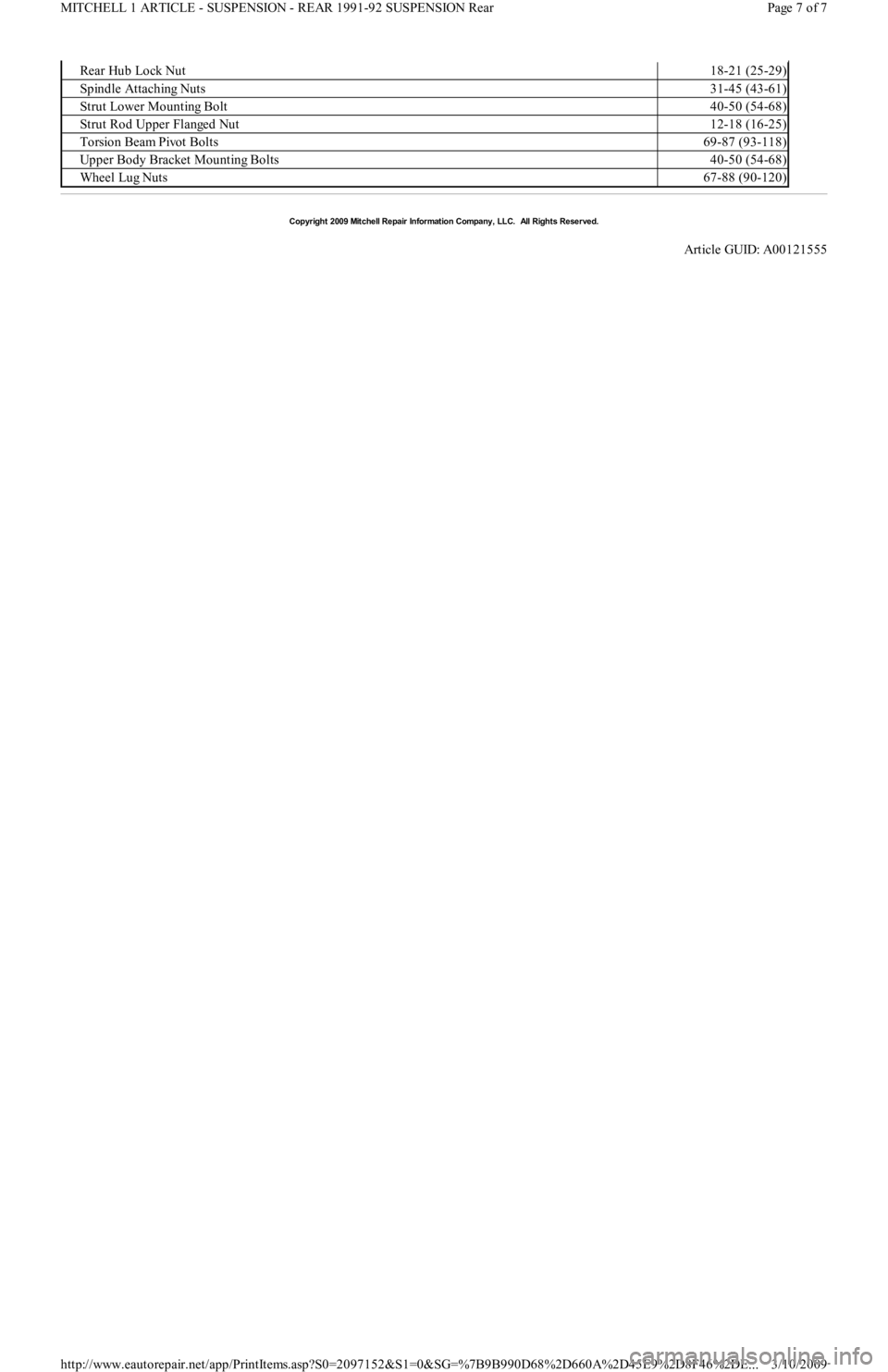
Rear Hub Lock Nut18-21 (25-29)
Spindle Attaching Nuts31-45 (43-61)
Strut Lower Mounting Bolt40-50 (54-68)
Strut Rod Upper Flanged Nut12-18 (16-25)
Torsion Beam Pivot Bolts69-87 (93-118)
Upper Body Bracket Mounting Bolts40-50 (54-68)
Wheel Lug Nuts67-88 (90-120)
Copyr ight 2009 Mitchell Repair Information Company, LLC. All Rights Reserved.
Article GUID: A00121555
Page 7 of 7 MITCHELL 1 ARTICLE - SUSPENSION - REAR 1991-92 SUSPENSION Rear
3/10/2009 http://www.eautorepair.net/app/PrintItems.asp?S0=2097152&S1=0&SG=%7B9B990D68%2D660A%2D45E9%2D8F46%2DE
...
Page 407 of 454
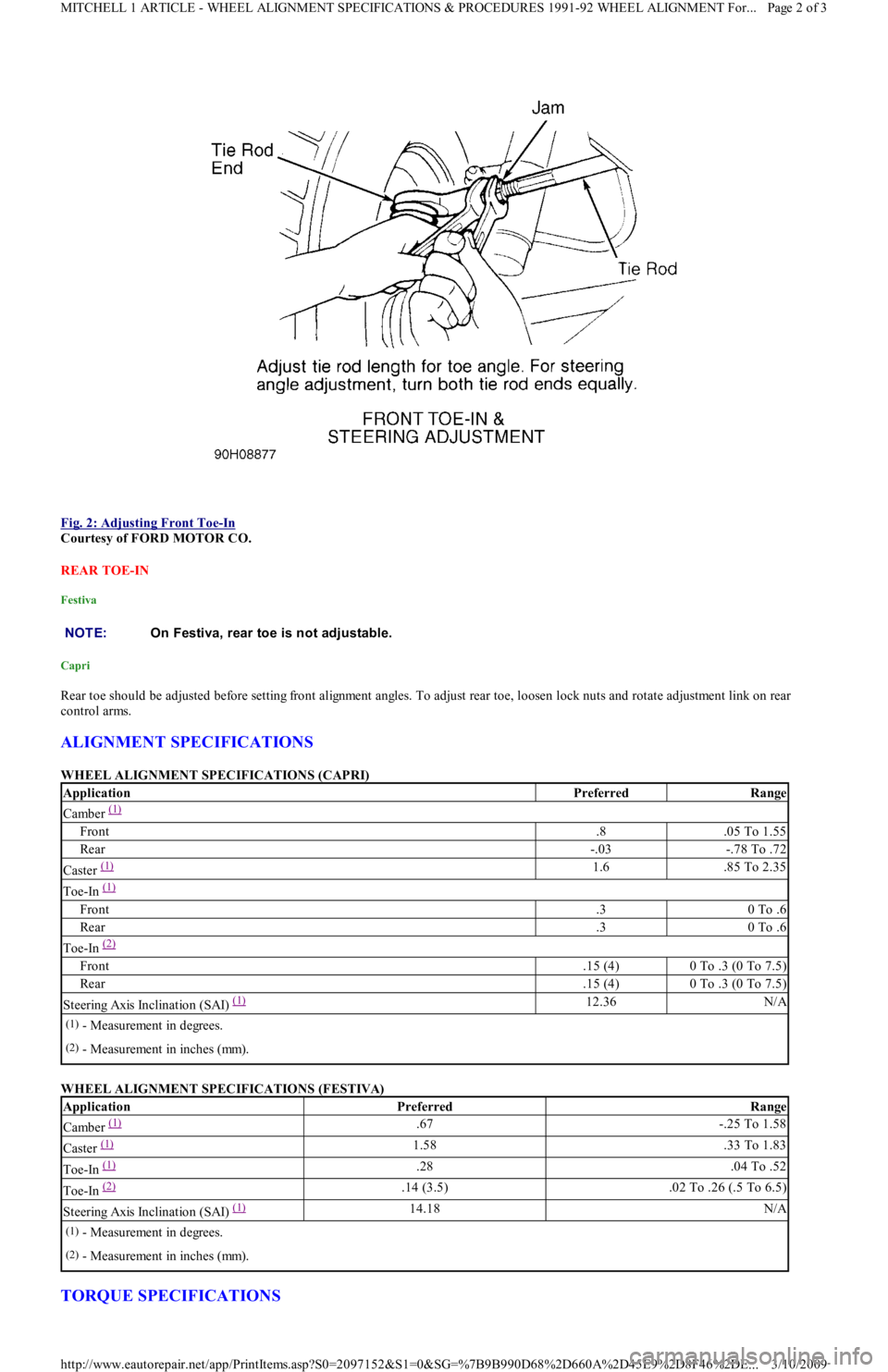
Fig. 2: Adjusting Front Toe
-In
Courtesy of FORD MOTOR CO.
REAR TOE-IN
Festiva
Capri
Rear toe should be adjusted before setting front alignment angles. To adjust rear toe, loosen lock nuts and rotate adjustment link on rear
control arms.
ALIGNMENT SPECIFICATIONS
WHEEL ALIGNMENT SPECIFICATIONS (CAPRI)
WHEEL ALIGNMENT SPECIFICATIONS (FESTIVA)
TORQUE SPECIFICATIONS
NOTE:On Festiva, rear toe is not adjustable.
ApplicationPreferredRange
Camber (1)
Front.8.05 To 1.55
Rear-.03-.78 To .72
Caster (1) 1.6.85 To 2.35
Toe-In (1)
Front.30 To .6
Rear.30 To .6
Toe-In (2)
Front.15 (4)0 To .3 (0 To 7.5)
Rear.15 (4)0 To .3 (0 To 7.5)
Steering Axis Inclination (SAI) (1) 12.36N/A
(1)- Measurement in degrees.
(2)- Measurement in inches (mm).
ApplicationPreferredRange
Camber (1) .67-.25 To 1.58
Caster (1) 1.58.33 To 1.83
Toe-In (1) .28.04 To .52
Toe-In (2) .14 (3.5).02 To .26 (.5 To 6.5)
Steering Axis Inclination (SAI) (1) 14.18N/A
(1)- Measurement in degrees.
(2)- Measurement in inches (mm).
Page 2 of 3 MITCHELL 1 ARTICLE - WHEEL ALIGNMENT SPECIFICATIONS & PROCEDURES 1991-92 WHEEL ALIGNMENT For...
3/10/2009 http://www.eautorepair.net/app/PrintItems.asp?S0=2097152&S1=0&SG=%7B9B990D68%2D660A%2D45E9%2D8F46%2DE
...
Page 410 of 454
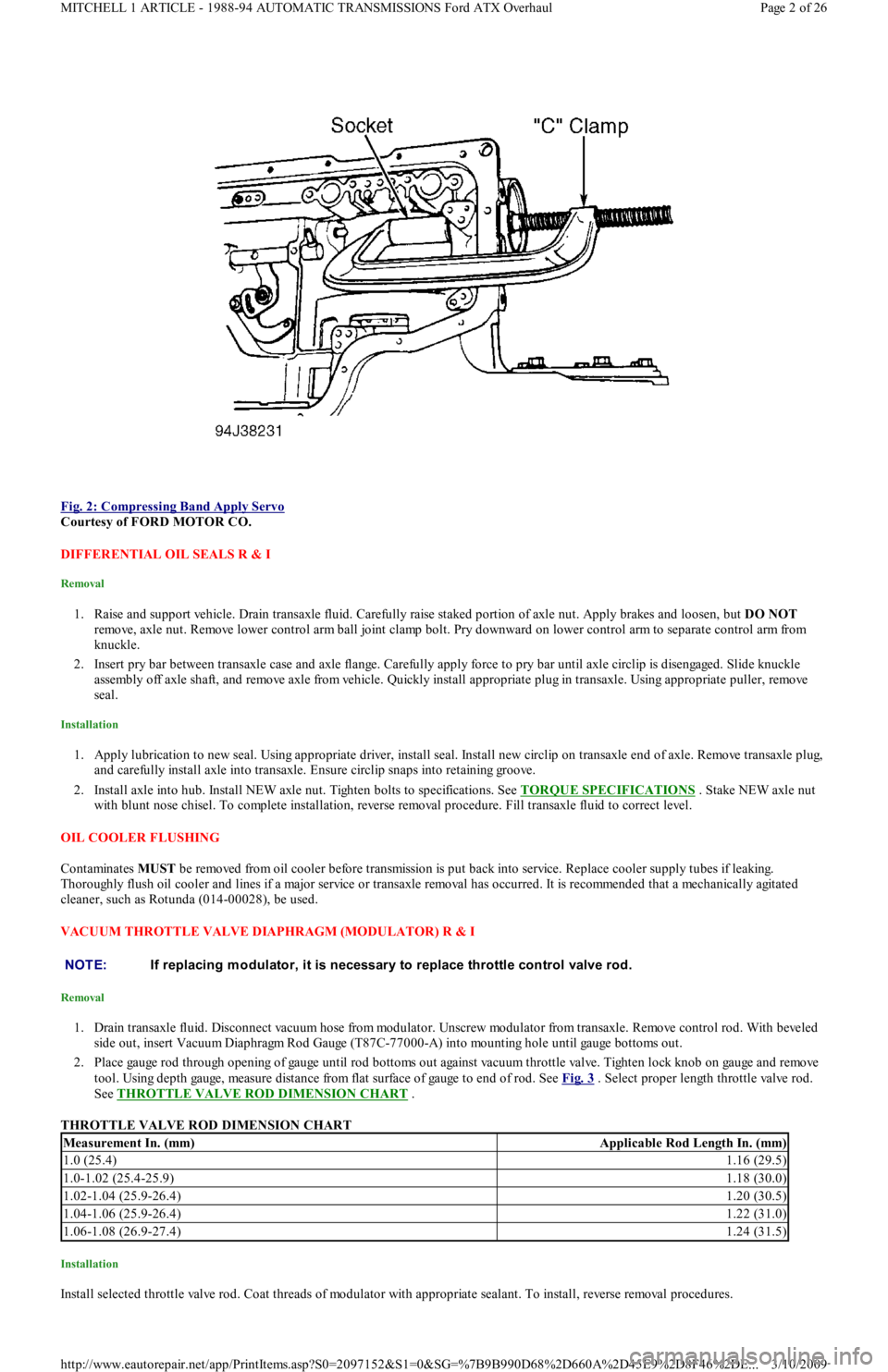
Fig. 2: Compressing Band Apply Servo
Courtesy of FORD MOTOR CO.
DIFFERENTIAL OIL SEALS R & I
Removal
1. Raise and support vehicle. Drain transaxle fluid. Carefully raise staked portion of axle nut. Apply brakes and loosen, but DO NOT
remove, axle nut. Remove lower control arm ball joint clamp bolt. Pry downward on lower control arm to separate control arm from
knuckle.
2. Insert pry bar between transaxle case and axle flange. Carefully apply force to pry bar until axle circlip is disengaged. Slide knuckle
assembly off axle shaft, and remove axle from vehicle. Quickly install appropriate plug in transaxle. Using appropriate puller, remove
seal.
Installation
1. Apply lubrication to new seal. Using appropriate driver, install seal. Install new circlip on transaxle end of axle. Remove transaxle plug,
and carefully install axle into transaxle. Ensure circlip snaps into retaining groove.
2. Install axle into hub. Install NEW axle nut. Tighten bolts to specifications. See TORQUE SPECIFICATIONS
. Stake NEW axle nut
with blunt nose chisel. To complete installation, reverse removal procedure. Fill transaxle fluid to correct level.
OIL COOLER FLUSHING
Contaminates MUST be removed from oil cooler before transmission is put back into service. Replace cooler supply tubes if leaking.
Thoroughly flush oil cooler and lines if a major service or transaxle removal has occurred. It is recommended that a mechanically agitated
cleaner, such as Rotunda (014-00028), be used.
VACUUM THROTTLE VALVE DIAPHRAGM (MODULATOR) R & I
Removal
1. Drain transaxle fluid. Disconnect vacuum hose from modulator. Unscrew modulator from transaxle. Remove control rod. With beveled
side out, insert Vacuum Diaphragm Rod Gauge (T87C-77000-A) into mounting hole until gauge bottoms out.
2. Place gauge rod through opening of gauge until rod bottoms out against vacuum throttle valve. Tighten lock knob on gauge and remove
tool. Using depth gauge, measure distance from flat surface of gauge to end of rod. See Fig. 3
. Select proper length throttle valve rod.
See THROTTLE VALVE ROD DIMENSION CHART
.
THROTTLE VALVE ROD DIMENSION CHART
Installation
Install selected throttle valve rod. Coat threads of modulator with appropriate sealant. To install, reverse removal procedures.
NOTE:If replacing m odulator, it is necessary to replace throttle control valve rod.
Measurement In. (mm)Applicable Rod Length In. (mm)
1.0 (25.4)1.16 (29.5)
1.0-1.02 (25.4-25.9)1.18 (30.0)
1.02-1.04 (25.9-26.4)1.20 (30.5)
1.04-1.06 (25.9-26.4)1.22 (31.0)
1.06-1.08 (26.9-27.4)1.24 (31.5)
Page 2 of 26 MITCHELL 1 ARTICLE - 1988-94 AUTOMATIC TRANSMISSIONS Ford ATX Overhaul
3/10/2009 http://www.eautorepair.net/app/PrintItems.asp?S0=2097152&S1=0&SG=%7B9B990D68%2D660A%2D45E9%2D8F46%2DE
...
Page 413 of 454
Leak in vacuum circuit. Oil pressure incorrect. Manual valve faulty. Band servo faulty. Contaminated fluid. Front clutch faulty. Brake band
out of adjustment or damaged. Leak in hydraulic system.
Transaxle Slips In 1st Gear
Incorrect fluid level. Shift linkage faulty, out of adjustment or incorrectly installed. Incorrect oil pressure. Manual control valve faulty.
Contaminated fluid. Incorrect idle speed. Faulty kickdown solenoid, switch or wiring.
No 1-2 Shift
Shift linkage defective, out of adjustment or incorrectly installed. Leak in vacuum circuit. Faulty kickdown solenoid, switch or wiring.
Contaminated fluid. Manual control valve faulty. Governor valve faulty. Band servo faulty. Brake band out of adjustment. Leak in hydraulic
system. Rear clutch faulty.
No 2-3 Shift
Shift linkage defective, out of adjustment or incorrectly installed. Leak in vacuum circuit. Faulty kickdown solenoid, switch or wiring.
Contaminated fluid. Manual control valve, governor valve or band servo faulty. Leak in hydraulic system. Front clutch faulty.
No Lock-Up
Faulty torque converter, wiring or solenoid.
1-3 Shift; Skips 2nd
Contaminated fluid. Brake band out of adjustment or damaged. Leak in hydraulic system.
No 3-2 Downshift
Leak in vacuum circuit. Manual control valve, governor valve or band servo faulty. Contaminated fluid. Faulty front clutch. Brake band out of
adjustment of damaged. Leak in hydraulic system.
No 2-1 or 3-1 Downshift
Leak in vacuum circuit. Manual control valve, governor valve or band servo faulty. Contaminated fluid. Brake band out of adjustmen t o r
damaged. One-way clutch faulty.
Slippage When Accelerating In 3rd Gear Above Kickdown Speed
Shift linkage damaged, out of adjustment or installed incorrectly. Leak in vacuum circuit. Oil pressure incorrect. Manual control valve or
governor valve faulty. Contaminated fluid. Front clutch faulty. Leak in hydraulic system.
No Kickdown At Normal Speeds In 3rd Gear
Leak in vacuum circuit. Kickdown solenoid, switch or wiring faulty. Manual control valve or governor valve faulty. Contaminated fluid. Brake
band out of adjustment or damaged. Leak in hydraulic system.
1-2 & 2-3 Shift Points Too High
ATF contaminated or level incorrect. Vacuum modulator faulty or leak in vacuum circuit. Line pressures incorrect. Manual valve out of
adjustment. Governor valve faulty. Hydraulic circuit leaking.
3-2 & 2-1 Shift Points Too High
Shift linkage damaged, out of adjustment or incorrectly installed. Kickdown solenoid, switch or wiring faulty. Leak in vacuum circuit.
Incorrect oil pressure. Manual control valve or governor valve faulty. Leak in hydraulic system.
1-2 Or 2-3 Shifts With Shift Lever In "1" Position
Shift linkage damaged, out of adjustment or installed incorrectly. Manual control valve faulty. Leak in hydraulic system.
2-1 or 2-3 Shifts With Shift Lever In "2" Position
Shift linkage damaged, out of adjustment or installed incorrectly. Incorrect oil pressure. Manual control valve faulty.
Vehicle Moves In "P" Or Parking Gear Remains Engaged When
Shifted Out Of "P" Position
Shift linkage damaged, out of adjustment or incorrectly installed. Parking linkage out of adjustment or damaged.
Transaxle Noisy In "P" Or "N" Position
Incorrect fluid level. Incorrect oil pressure. Faulty rear clutch, oil pump, one-way clutch or planetary gear.
Transaxle Noisy In "D", "1", "2" or "R"
Oil pressure incorrect. Rear clutch, oil pump, one-way clutch or planetary gears faulty.
Transmission Overheats
ATF level incorrect. Engine stall speed and/or line pressure incorrect. Faulty band servo, front clutch, rear clutch, brake band, low-reverse
brake, oil pump, torque converter or planetary gear. Leak in hydraulic circuit.
Page 5 of 26 MITCHELL 1 ARTICLE - 1988-94 AUTOMATIC TRANSMISSIONS Ford ATX Overhaul
3/10/2009 http://www.eautorepair.net/app/PrintItems.asp?S0=2097152&S1=0&SG=%7B9B990D68%2D660A%2D45E9%2D8F46%2DE
...
Page 419 of 454
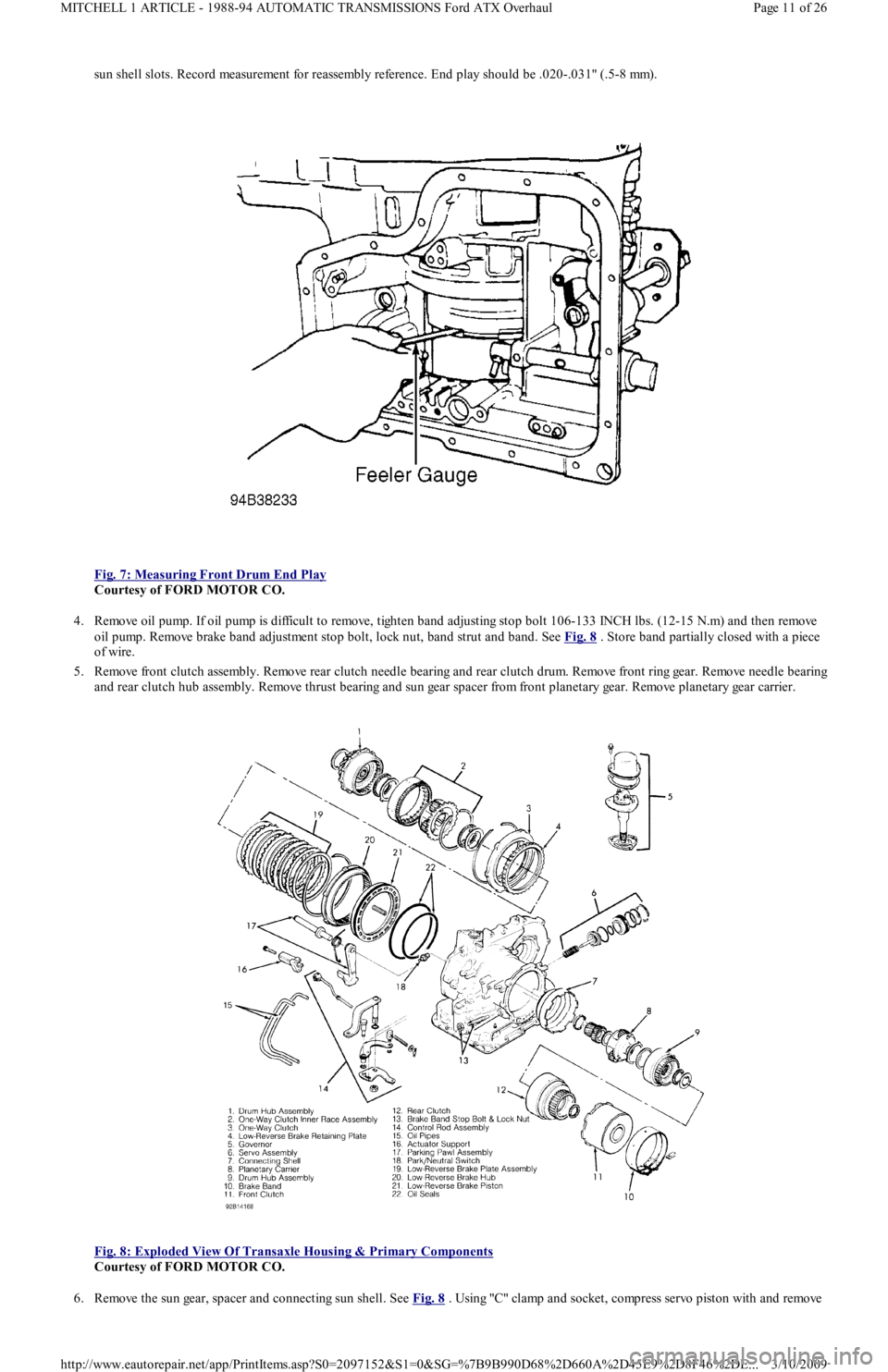
sun shell slots. Record measurement for reassembly reference. End play should be .020-.031" (.5-8 mm).
Fig. 7: Measuring Front Drum End Play
Courtesy of FORD MOTOR CO.
4. Remove oil pump. If oil pump is difficult to remove, tighten band adjusting stop bolt 106-133 INCH lbs. (12-15 N.m) and then remove
oil pump. Remove brake band adjustment stop bolt, lock nut, band strut and band. See Fig. 8
. Store band partially closed with a piece
of wire.
5. Remove front clutch assembly. Remove rear clutch needle bearing and rear clutch drum. Remove front ring gear. Remove needle bearing
and rear clutch hub assembly. Remove thrust bearing and sun gear spacer from front planetary gear. Remove planetary gear carrier.
Fig. 8: Exploded View Of Transaxle Housing & Primary Components
Courtesy of FORD MOTOR CO.
6. Remove the sun gear, spacer and connecting sun shell. See Fig. 8
. Using "C" clamp and socket, compress servo piston with and remove
Page 11 of 26 MITCHELL 1 ARTICLE - 1988-94 AUTOMATIC TRANSMISSIONS Ford ATX Overhaul
3/10/2009 http://www.eautorepair.net/app/PrintItems.asp?S0=2097152&S1=0&SG=%7B9B990D68%2D660A%2D45E9%2D8F46%2DE
...