clutch FORD FESTIVA 1991 User Guide
[x] Cancel search | Manufacturer: FORD, Model Year: 1991, Model line: FESTIVA, Model: FORD FESTIVA 1991Pages: 454, PDF Size: 9.53 MB
Page 110 of 454
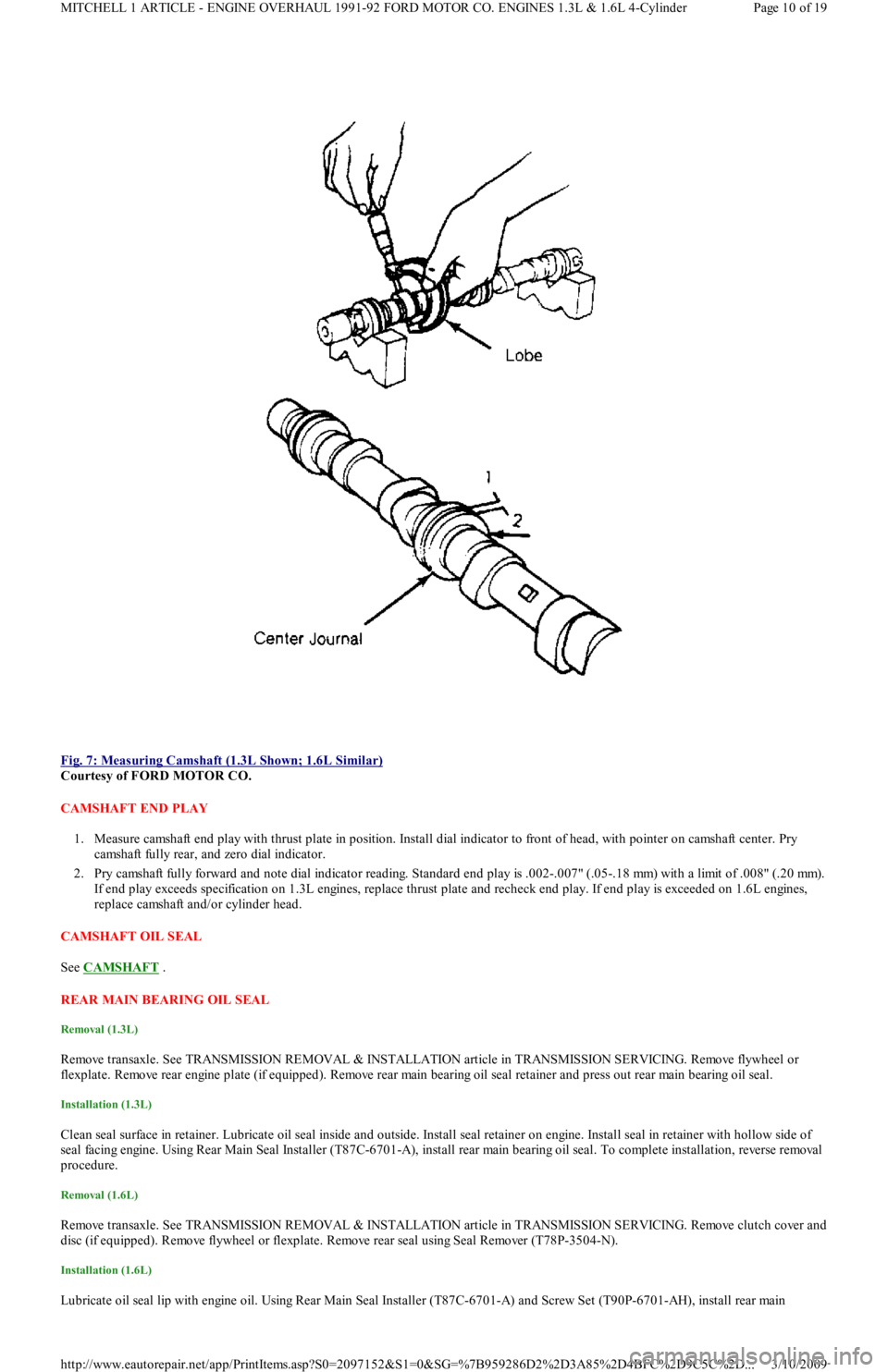
Fig. 7: Measuring Camshaft (1.3L Shown; 1.6L Similar)
Courtesy of FORD MOTOR CO.
CAMSHAFT END PLAY
1. Measure camshaft end play with thrust plate in position. Install dial indicator to front of head, with pointer on camshaft center. Pry
camshaft fully rear, and zero dial indicator.
2. Pry camshaft fully forward and note dial indicator reading. Standard end play is .002-.007" (.05-.18 mm) with a limit of .008" (.2 0 mm).
If end play exceeds specification on 1.3L engines, replace thrust plate and recheck end play. If end play is exceeded on 1.6L engines,
replace camshaft and/or cylinder head.
CAMSHAFT OIL SEAL
See CAMSHAFT
.
REAR MAIN BEARING OIL SEAL
Removal (1.3L)
Remove transaxle. See TRANSMISSION REMOVAL & INSTALLATION article in TRANSMISSION SERVICING. Remove flywheel or
flexplate. Remove rear engine plate (if equipped). Remove rear main bearing oil seal retainer and press out rear main bearing oil seal.
Installation (1.3L)
Clean seal surface in retainer. Lubricate oil seal inside and outside. Install seal retainer on engine. Install seal in retainer with hollow side of
seal facing engine. Using Rear Main Seal Installer (T87C-6701-A), install rear main bearing oil seal. To complete installation, reverse removal
procedure.
Removal (1.6L)
Remove transaxle. See TRANSMISSION REMOVAL & INSTALLATION article in TRANSMISSION SERVICING. Remove clutch cover and
disc (if equipped). Remove flywheel or flexplate. Remove rear seal using Seal Remover (T78P-3504-N).
Installation (1.6L)
Lubricate oil seal lip with engine oil. Using Rear Main Seal Installer (T87C-6701-A) and Screw Set (T90P-6701-AH), install rear main
Page 10 of 19 MITCHELL 1 ARTICLE - ENGINE OVERHAUL 1991-92 FORD MOTOR CO. ENGINES 1.3L & 1.6L 4-Cylinder
3/10/2009 http://www.eautorepair.net/app/PrintItems.asp?S0=2097152&S1=0&SG=%7B959286D2%2D3A85%2D4BFC%2D9C5C%2D
...
Page 120 of 454
Back To Article
ST ART ER
1991 ELECT RICAL Starters
DESCRIPTION
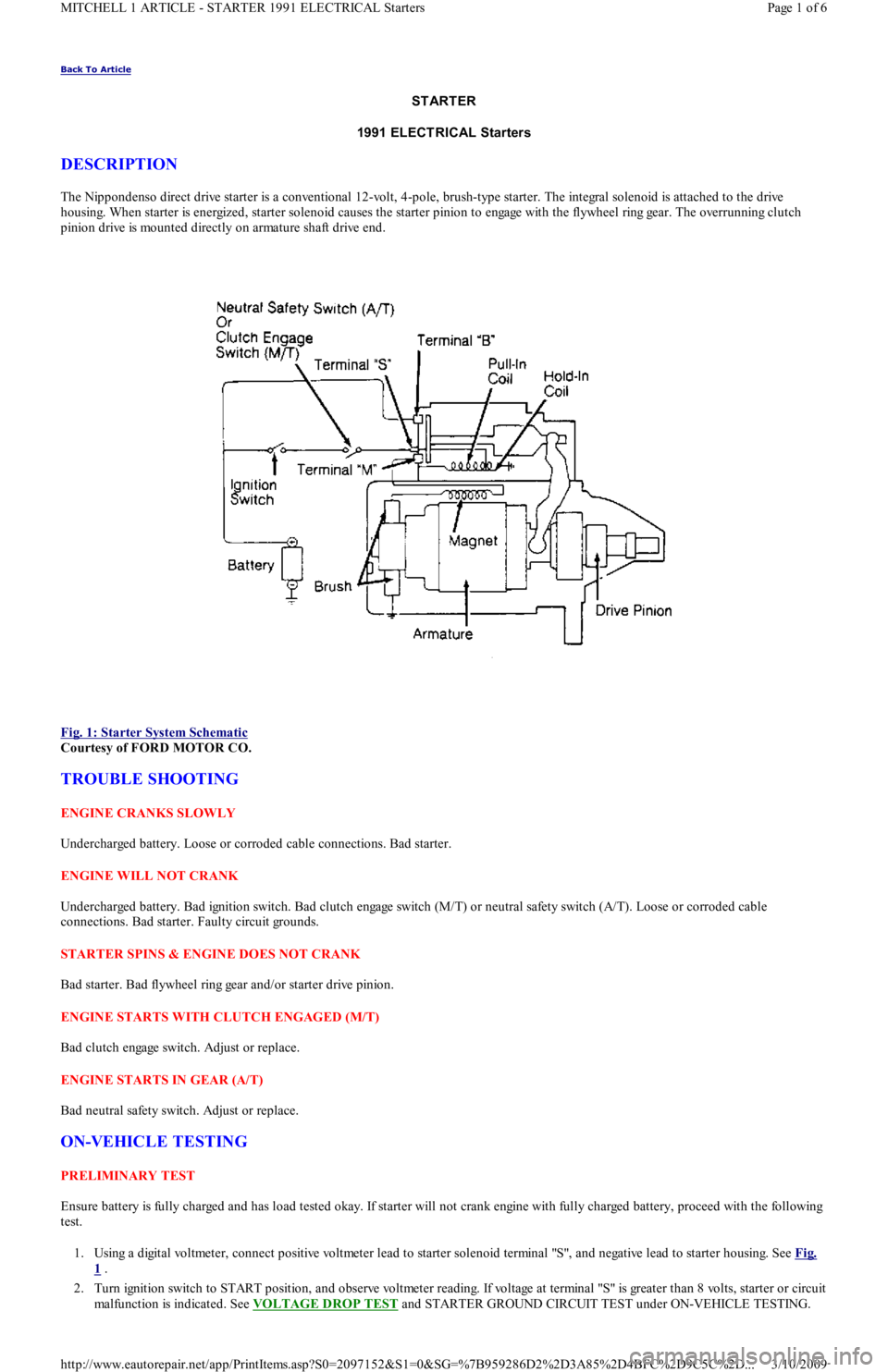
The Nippondenso direct drive starter is a conventional 12-volt, 4-pole, brush-type starter. The integral solenoid is attached to the drive
housing. When starter is energized, starter solenoid causes the starter pinion to engage with the flywheel ring gear. The overrunning clutch
pinion drive is mounted directly on armature shaft drive end.
Fig. 1: Starter System Schematic
Courtesy of FORD MOTOR CO.
TROUBLE SHOOTING
ENGINE CRANKS SLOWLY
Undercharged battery. Loose or corroded cable connections. Bad starter.
ENGINE WILL NOT CRANK
Undercharged battery. Bad ignition switch. Bad clutch engage switch (M/T) or neutral safety switch (A/T). Loose or corroded cable
connections. Bad starter. Faulty circuit grounds.
STARTER SPINS & ENGINE DOES NOT CRANK
Bad starter. Bad flywheel ring gear and/or starter drive pinion.
ENGINE STARTS WITH CLUTCH ENGAGED (M/T)
Bad clutch engage switch. Adjust or replace.
ENGINE STARTS IN GEAR (A/T)
Bad neutral safety switch. Adjust or replace.
ON-VEHICLE TESTING
PRELIMINARY TEST
Ensure battery is fully charged and has load tested okay. If starter will not crank engine with fully charged battery, proceed with the following
test.
1. Using a digital voltmeter, connect positive voltmeter lead to starter solenoid terminal "S", and negative lead to starter housing. See Fig.
1 .
2. Turn ignition switch to START position, and observe voltmeter reading. If voltage at terminal "S" is greater than 8 volts, starter or circuit
malfunction is indicated. See VOLTAGE DROP TEST
and STARTER GROUND CIRCUIT TEST under ON-VEHICLE TESTING.
Page 1 of 6 MITCHELL 1 ARTICLE - STARTER 1991 ELECTRICAL Starters
3/10/2009 http://www.eautorepair.net/app/PrintItems.asp?S0=2097152&S1=0&SG=%7B959286D2%2D3A85%2D4BFC%2D9C5C%2D
...
Page 121 of 454
3. If voltage is not present or is less than 8 volts at starter solenoid terminal "S", malfunction in circuit to terminal "S" is indicated. Proceed
to the following tests.
IGNITION SWITCH TEST
1. Locate ignition switch connector under dash. Using a 12-volt test light or voltmeter, ensure voltage is present on Black/Yellow wire
when ignition switch is turned to RUN or ON position. This will verify proper operation of ignition switch.
2. If there is no voltage on Black/Yellow wire, the problem is either ignition switch or circuit between battery and ignition switch.
CLUTCH ENGAGE SWITCH (M/T) TEST
Unplug clutch engage switch from main wiring harness. Using an ohmmeter, check for continuity across switch terminals. Continuity should
exist when switch plunger is pushed in and should not exist when switch plunger is released. If clutch engage switch does not operate as
specified, replace switch.
NEUTRAL SAFETY SWITCH (A/T) TEST
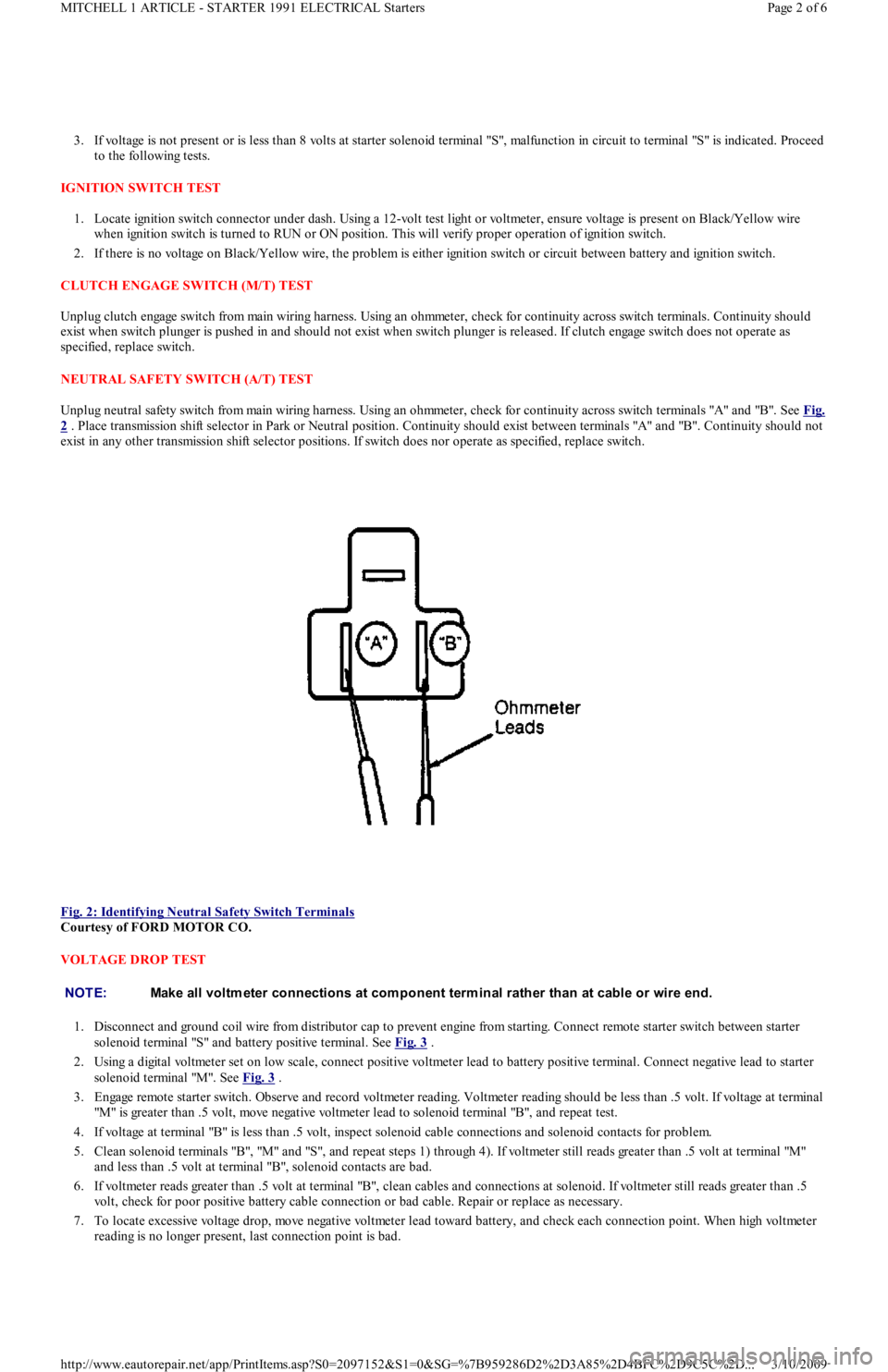
Unplug neutral safety switch from main wiring harness. Using an ohmmeter, check for continuity across switch terminals "A" and "B". See Fig.
2 . Place transmission shift selector in Park or Neutral position. Continuity should exist between terminals "A" and "B". Continuity should not
exist in any other transmission shift selector positions. If switch does nor operate as specified, replace switch.
Fig. 2: Identifying Neutral Safety Switch Terminals
Courtesy of FORD MOTOR CO.
VOLTAGE DROP TEST
1. Disconnect and ground coil wire from distributor cap to prevent engine from starting. Connect remote starter switch between starter
solenoid terminal "S" and battery positive terminal. See Fig. 3
.
2. Using a digital voltmeter set on low scale, connect positive voltmeter lead to battery positive terminal. Connect negative lead to starter
solenoid terminal "M". See Fig. 3
.
3. Engage remote starter switch. Observe and record voltmeter reading. Voltmeter reading should be less than .5 volt. If voltage at terminal
"M" is greater than .5 volt, move negative voltmeter lead to solenoid terminal "B", and repeat test.
4. If voltage at terminal "B" is less than .5 volt, inspect solenoid cable connections and solenoid contacts for problem.
5 . Cl ean so l en o id t ermin al s "B", "M" an d "S", an d rep eat st ep s 1 ) through 4). If voltmeter still reads greater than .5 volt at termin al "M"
and less than .5 volt at terminal "B", solenoid contacts are bad.
6. If voltmeter reads greater than .5 volt at terminal "B", clean cables and connections at solenoid. If voltmeter still reads greater than .5
volt, check for poor positive battery cable connection or bad cable. Repair or replace as necessary.
7. To locate excessive voltage drop, move negative voltmeter lead toward battery, and check each connection point. When high voltmeter
reading is no longer present, last connection point is bad.
NOTE:Make all voltm eter connections at com ponent term inal rather than at cable or wire end.
Page 2 of 6 MITCHELL 1 ARTICLE - STARTER 1991 ELECTRICAL Starters
3/10/2009 http://www.eautorepair.net/app/PrintItems.asp?S0=2097152&S1=0&SG=%7B959286D2%2D3A85%2D4BFC%2D9C5C%2D
...
Page 162 of 454
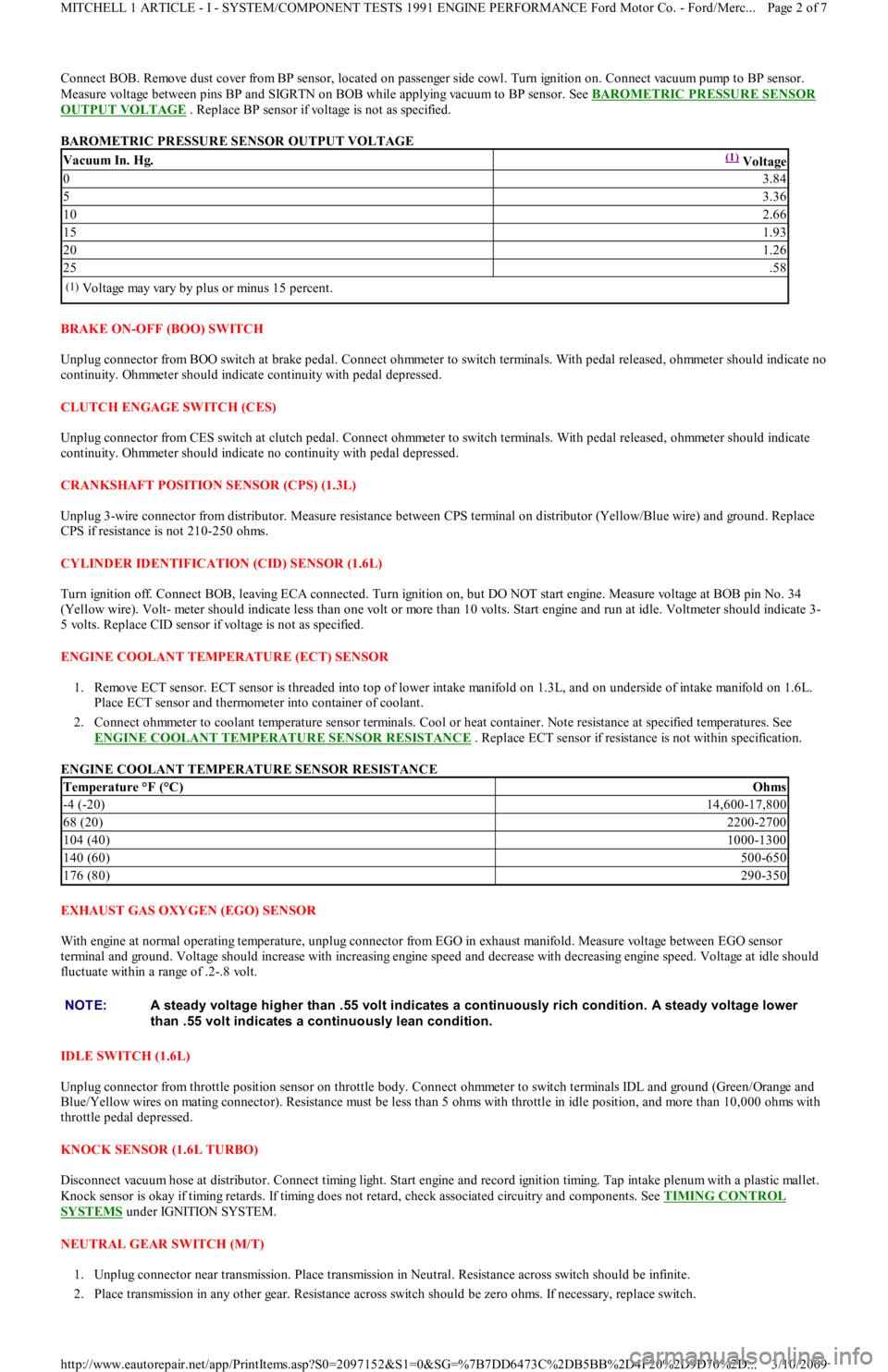
Connect BOB. Remove dust cover from BP sensor, located on passenger side cowl. Turn ignition on. Connect vacuum pump to BP sensor.
Measure voltage between pins BP and SIGRTN on BOB while applying vacuum to BP sensor. See BAROMETRIC PRESSURE SENSOR
OUTPUT VOLTAGE . Replace BP sensor if voltage is not as specified.
BAROMETRIC PRESSURE SENSOR OUTPUT VOLTAGE
BRAKE ON-OFF (BOO) SWITCH
Unplug connector from BOO switch at brake pedal. Connect ohmmeter to switch terminals. With pedal released, ohmmeter should indicate no
continuity. Ohmmeter should indicate continuity with pedal depressed.
CLUTCH ENGAGE SWITCH (CES)
Unplug connector from CES switch at clutch pedal. Connect ohmmeter to switch terminals. With pedal released, ohmmeter should indicate
continuity. Ohmmeter should indicate no continuity with pedal depressed.
CRANKSHAFT POSITION SENSOR (CPS) (1.3L)
Unplug 3-wire connector from distributor. Measure resistance between CPS terminal on distributor (Yellow/Blue wire) and ground. Replace
CPS if resistance is not 210-250 ohms.
CYLINDER IDENTIFICATION (CID) SENSOR (1.6L)
Turn ignition off. Connect BOB, leaving ECA connected. Turn ignition on, but DO NOT start engine. Measure voltage at BOB pin No. 34
(Yellow wire). Volt- meter should indicate less than one volt or more than 10 volts. Start engine and run at idle. Voltmeter should indicate 3-
5 volts. Replace CID sensor if voltage is not as specified.
ENGINE COOLANT TEMPERATURE (ECT) SENSOR
1. Remove ECT sensor. ECT sensor is threaded into top of lower intake manifold on 1.3L, and on underside of intake manifold on 1.6L.
Place ECT sensor and thermometer into container of coolant.
2. Connect ohmmeter to coolant temperature sensor terminals. Cool or heat container. Note resistance at specified temperatures. See
ENGINE COOLANT TEMPERATURE SENSOR RESISTANCE
. Replace ECT sensor if resistance is not within specification.
ENGINE COOLANT TEMPERATURE SENSOR RESISTANCE
EXHAUST GAS OXYGEN (EGO) SENSOR
With engine at normal operating temperature, unplug connector from EGO in exhaust manifold. Measure voltage between EGO sensor
terminal and ground. Voltage should increase with increasing engine speed and decrease with decreasing engine speed. Voltage at idle should
fluctuate within a range of .2-.8 volt.
IDLE SW ITCH (1.6L)
Unplug connector from throttle position sensor on throttle body. Connect ohmmeter to switch terminals IDL and ground (Green/Orange and
Blue/Yellow wires on mating connector). Resistance must be less than 5 ohms with throttle in idle position, and more than 10,000 ohms with
throttle pedal depressed.
KNOCK SENSOR (1.6L TURBO)
Disconnect vacuum hose at distributor. Connect timing light. Start engine and record ignition timing. Tap intake plenum with a plastic mallet.
Knock sensor is okay if timing retards. If timing does not retard, check associated circuitry and components. See TIMING CONTROL
SYSTEMS under IGNITION SYSTEM.
NEUTRAL GEAR SWITCH (M/T)
1. Unplug connector near transmission. Place transmission in Neutral. Resistance across switch should be infinite.
2. Place transmission in any other gear. Resistance across switch should be zero ohms. If necessary, replace switch.
Vacuum In. Hg.(1) Voltage
03.84
53.36
102.66
151.93
201.26
25.58
(1)Voltage may vary by plus or minus 15 percent.
Temperature °F (°C)Ohms
-4 (-20)14,600-17,800
68 (20)2200-2700
104 (40)1000-1300
140 (60)500-650
176 (80)290-350
NOTE:A steady voltage higher than .55 volt indicates a continuously rich condition. A steady voltage lower
than .55 volt indicates a continuously lean condition.
Page 2 of 7 MITCHELL 1 ARTICLE - I - SYSTEM/COMPONENT TESTS 1991 ENGINE PERFORMANCE Ford Motor Co. - Ford/Merc
...
3/10/2009 http://www.eautorepair.net/app/PrintItems.asp?S0=2097152&S1=0&SG=%7B7DD6473C%2DB5BB%2D4F20%2D9D70%2D
...
Page 164 of 454
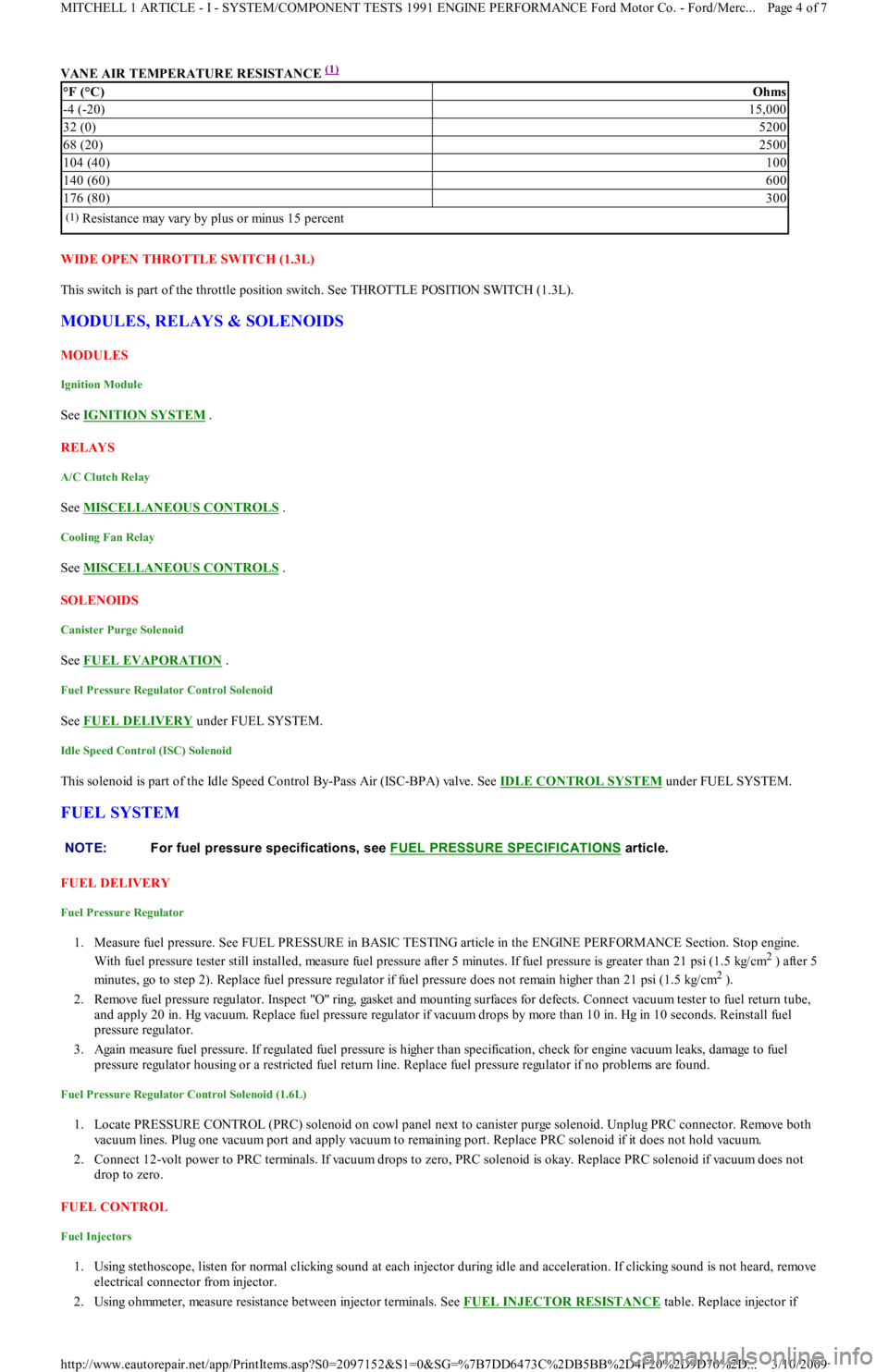
VANE AIR TEMPERATURE RESISTANCE (1)
WIDE OPEN THROTTLE SWITCH (1.3L)
This switch is part of the throttle position switch. See THROTTLE POSITION SWITCH (1.3L).
MODULES, RELAYS & SOLENOIDS
MODULES
Ignition Module
See IGNITION SYSTEM .
RELAYS
A/C Clutch Relay
See MISCELLANEOUS CONTROLS .
Cooling Fan Relay
See MISCELLANEOUS CONTROLS .
SOLENOIDS
Canister Purge Solenoid
See FUEL EVAPORATION .
Fuel Pressure Regulator Control Solenoid
See FUEL DELIVERY under FUEL SYSTEM.
Idle Speed Control (ISC) Solenoid
This solenoid is part of the Idle Speed Control By-Pass Air (ISC-BPA) valve. See IDLE CONTROL SYSTEM under FUEL SYSTEM.
FUEL SYSTEM
FUEL DELIVERY
Fuel Pressure Regulator
1. Measure fuel pressure. See FUEL PRESSURE in BASIC TESTING article in the ENGINE PERFORMANCE Section. Stop engine.
With fuel pressure tester still installed, measure fuel pressure after 5 minutes. If fuel pressure is greater than 21 psi (1.5 kg/cm
2 ) after 5
minutes, go to step 2). Replace fuel pressure regulator if fuel pressure does not remain higher than 21 psi (1.5 kg/cm
2 ).
2. Remove fuel pressure regulator. Inspect "O" ring, gasket and mounting surfaces for defects. Connect vacuum tester to fuel return tube,
and apply 20 in. Hg vacuum. Replace fuel pressure regulator if vacuum drops by more than 10 in. Hg in 10 seconds. Reinstall fuel
pressure regulator.
3. Again measure fuel pressure. If regulated fuel pressure is higher than specification, check for engine vacuum leaks, damage to fuel
pressure regulator housing or a restricted fuel return line. Replace fuel pressure regulator if no problems are found.
Fuel Pressure Regulator Control Solenoid (1.6L)
1. Locate PRESSURE CONTROL (PRC) solenoid on cowl panel next to canister purge solenoid. Unplug PRC connector. Remove both
vacuum lines. Plug one vacuum port and apply vacuum to remaining port. Replace PRC solenoid if it does not hold vacuum.
2. Connect 12-volt power to PRC terminals. If vacuum drops to zero, PRC solenoid is okay. Replace PRC solenoid if vacuum does not
drop to zero.
FUEL CONTROL
Fuel Injectors
1. Using stethoscope, listen for normal clicking sound at each injector during idle and acceleration. If clicking sound is not heard, remove
electrical connector from injector.
2. Using ohmmeter, measure resistance between injector terminals. See FUEL INJECTOR RESISTANCE
table. Replace injector if
°F (°C)Ohms
-4 (-20)15,000
32 (0)5200
68 (20)2500
104 (40)100
140 (60)600
176 (80)300
(1)Resistance may vary by plus or minus 15 percent
NOTE:For fuel pressure specifications, see FUEL PRESSURE SPECIFICAT IONS
article.
Page 4 of 7 MITCHELL 1 ARTICLE - I - SYSTEM/COMPONENT TESTS 1991 ENGINE PERFORMANCE Ford Motor Co. - Ford/Merc
...
3/10/2009 http://www.eautorepair.net/app/PrintItems.asp?S0=2097152&S1=0&SG=%7B7DD6473C%2DB5BB%2D4F20%2D9D70%2D
...
Page 166 of 454
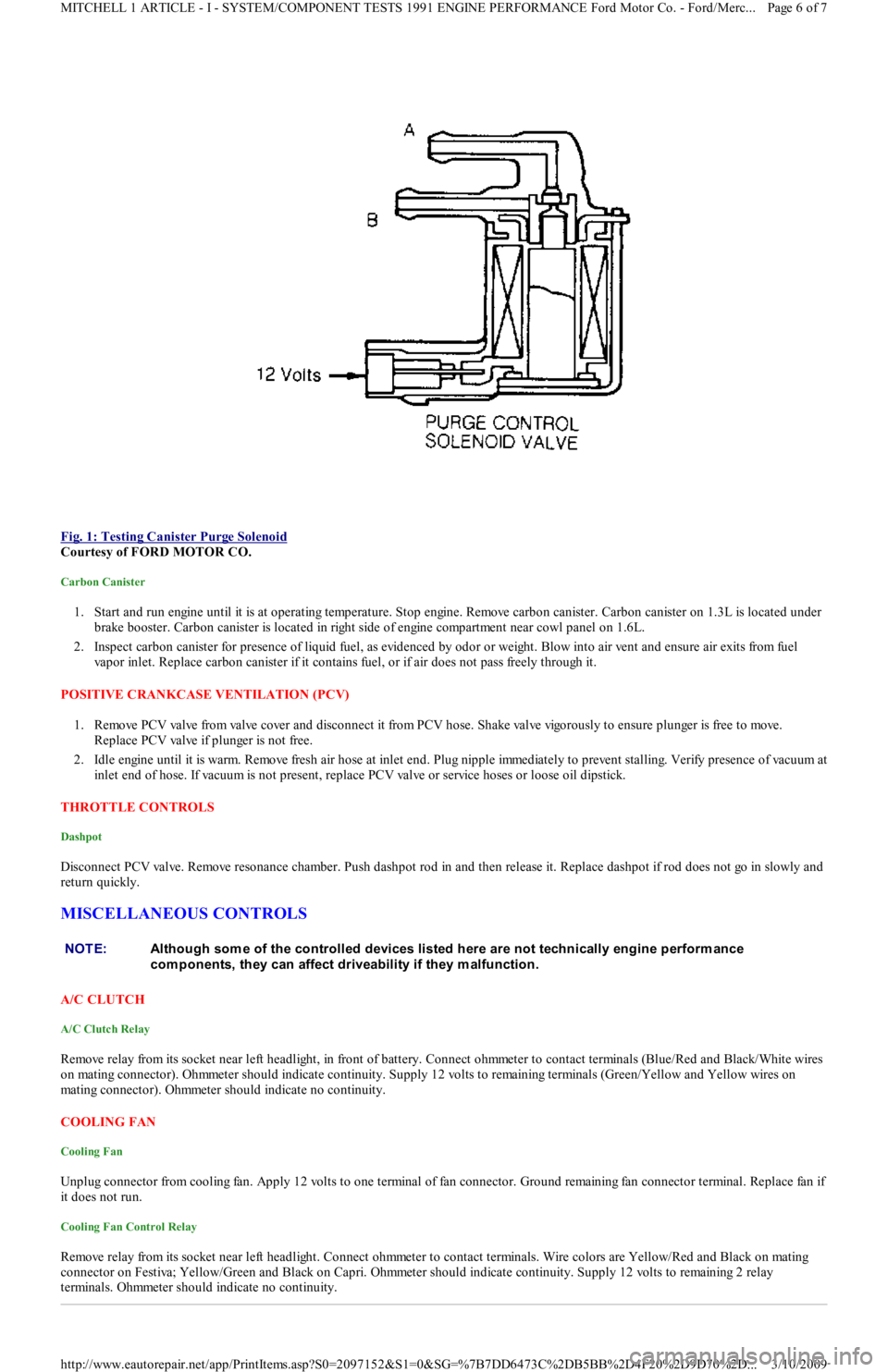
Fig. 1: Testing Canister Purge Solenoid
Courtesy of FORD MOTOR CO.
Carbon Canister
1. Start and run engine until it is at operating temperature. Stop engine. Remove carbon canister. Carbon canister on 1.3L is located under
brake booster. Carbon canister is located in right side of engine compartment near cowl panel on 1.6L.
2. Inspect carbon canister for presence of liquid fuel, as evidenced by odor or weight. Blow into air vent and ensure air exits fro m fu el
vapor inlet. Replace carbon canister if it contains fuel, or if air does not pass freely through it.
POSITIVE CRANKCASE VENTILATION (PCV)
1. Remove PCV valve from valve cover and disconnect it from PCV h o se . S h a ke va l ve vigo r o u sl y t o e n su r e p l u n ge r is fr e e t o mo ve .
Replace PCV valve if plunger is not free.
2. Idle engine until it is warm. Remove fresh air hose at inlet end. Plug nipple immediately to prevent stalling. Verify presence of vacuum at
inlet end of hose. If vacuum is not present, replace PCV valve or service hoses or loose oil dipstick.
THROTTLE CONTROLS
Dashpot
Disconnect PCV valve. Remove resonance chamber. Push dashpot rod in and then release it. Replace dashpot if rod does not go in slowly and
return quickly.
MISCELLANEOUS CONTROLS
A/C CLUTCH
A/C Clutch Relay
Remove relay from its socket near left headlight, in front of battery. Connect ohmmeter to contact terminals (Blue/Red and Black/White wires
on mating connector). Ohmmeter should indicate continuity. Supply 12 volts to remaining terminals (Green/Yellow and Yellow wires on
mating connector). Ohmmeter should indicate no continuity.
COOLING FAN
Cooling Fan
Unplug connector from cooling fan. Apply 12 volts to one terminal of fan connector. Ground remaining fan connector terminal. Replace fan if
it does not run.
Cooling Fan Control Relay
Remove relay from its socket near left headlight. Connect ohmmeter to contact terminals. Wire colors are Yellow/Red and Black on mating
connector on Festiva; Yellow/Green and Black on Capri. Ohmmeter should indicate continuity. Supply 12 volts to remaining 2 relay
terminals. Ohmmeter should indicate no continuity.
NOTE:Although som e of the controlled devices listed here are not technically engine perform ance
com ponents, they can affect driveability if they m alfunction.
Page 6 of 7 MITCHELL 1 ARTICLE - I - SYSTEM/COMPONENT TESTS 1991 ENGINE PERFORMANCE Ford Motor Co. - Ford/Merc
...
3/10/2009 http://www.eautorepair.net/app/PrintItems.asp?S0=2097152&S1=0&SG=%7B7DD6473C%2DB5BB%2D4F20%2D9D70%2D
...
Page 171 of 454
CLEARING CODES
Clearing Codes Procedure
Disconnect negative battery cable. Press brake pedal for 5-10 seconds. Turn off VOM or Super Star II tester. Reconnect battery.
ECA LOCATION
ECA is located on center console behind kick panel on Capri, and under instrument panel on driver side of Festiva.
QUICK TESTS
KEY ON, ENGINE OFF (KOEO) SELF-TEST
KOEO
1. This is a test of electronic engine control system, conducted with power (voltage) applied and engine not running. Activate self-test, and
record all codes displayed.
2. Erase codes, and repeat self-test. Diagnose only codes occurring during repeat self-test. See TROUBLE CODE DEFINITION
table. If
no codes are present, proceed to KEY ON, ENGINE RUNNING (KOER) SELF
-TEST .
KEY ON, ENGINE RUNNING (KOER) SELF-TEST
KOER
1. Deactivate self-test. Start and run engine at 2000 RPM for 2 minutes to warm up EGO sensor. Turn off engine and wait 10 seconds.
2. Restart engine, and activate self-test. Record all service codes displayed. See TROUBLE CODE DEFINITION
table. If no codes are
present, proceed to SWITCH MONITOR TEST
.
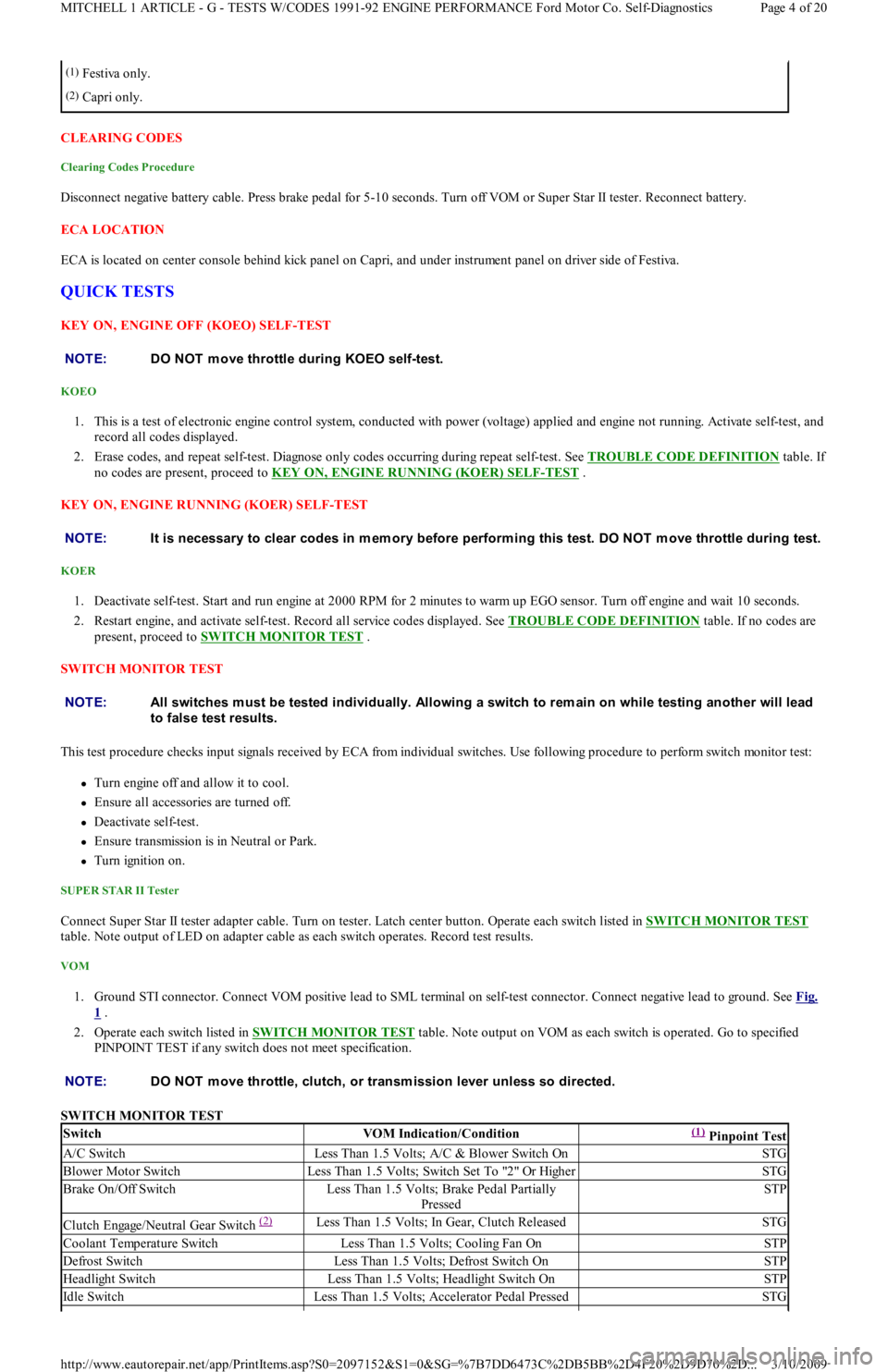
SWITCH MONITOR TEST
This test procedure checks input signals received by ECA from individual switches. Use following procedure to perform switch monitor test:
Turn engine off and allow it to cool.
Ensure all accessories are turned off.
Deactivate self-test.
Ensure transmission is in Neutral or Park.
Turn ignition on.
SUPER STAR II Tester
Connect Super Star II tester adapter cable. Turn on tester. Latch center button. Operate each switch listed in SWITCH MONITOR TEST
table. Note output of LED on adapter cable as each switch operates. Record test results.
VOM
1. Ground STI connector. Connect VOM positive lead to SML terminal on self-test connector. Connect negative lead to ground. See Fig.
1 .
2. Operate each switch listed in SWITCH MONITOR TEST
table. Note output on VOM as each switch is operated. Go to specified
PINPOINT TEST if any switch does not meet specification.
SWITCH MONITOR TEST
(1)Festiva only.
(2)Capri only.
NOTE:DO NOT m ove throttle during KOEO self-test.
NOTE:It is necessary to clear codes in m em ory before perform ing this test. DO NOT m ove throttle during test.
NOTE:All switches m ust be tested individually. Allowing a switch to rem ain on while testing another will lead
to false test results.
NOTE:DO NOT m ove throttle, clutch, or transm ission lever unless so directed.
SwitchVOM Indication/Condition(1) Pinpoint Test
A/C SwitchLess Than 1.5 Volts; A/C & Blower Switch OnSTG
Blower Motor SwitchLess Than 1.5 Volts; Switch Set To "2" Or HigherSTG
Brake On/Off SwitchLess Than 1.5 Volts; Brake Pedal Partially
PressedSTP
Clutch Engage/Neutral Gear Switch (2) Less Than 1.5 Volts; In Gear, Clutch ReleasedSTG
Coolant Temperature SwitchLess Than 1.5 Volts; Cooling Fan OnSTP
Defrost SwitchLess Than 1.5 Volts; Defrost Switch OnSTP
Headlight SwitchLess Than 1.5 Volts; Headlight Switch OnSTP
Id l e Swit chLess Than 1.5 Volts; Accelerator Pedal PressedSTG
Page 4 of 20 MITCHELL 1 ARTICLE - G - TESTS W/CODES 1991-92 ENGINE PERFORMANCE Ford Motor Co. Self-Diagnostics
3/10/2009 http://www.eautorepair.net/app/PrintItems.asp?S0=2097152&S1=0&SG=%7B7DD6473C%2DB5BB%2D4F20%2D9D70%2D
...
Page 189 of 454
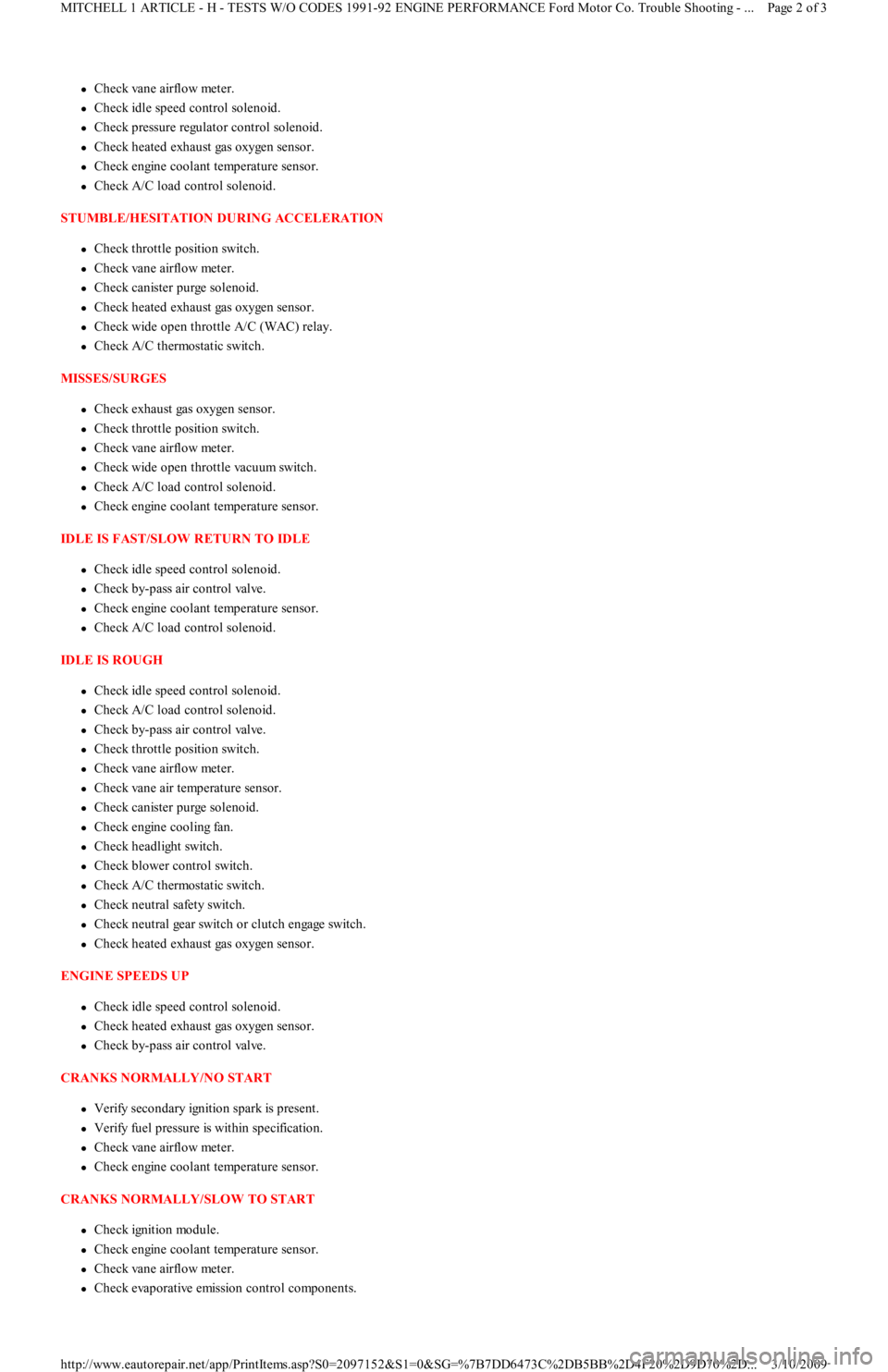
Check vane airflow meter.
Check idle speed control solenoid.
Check pressure regulator control solenoid.
Check heated exhaust gas oxygen sensor.
Check engine coolant temperature sensor.
Check A/C load control solenoid.
STUMBLE/HESITATION DURING ACCELERATION
Check throttle position switch.
Check vane airflow meter.
Check canister purge solenoid.
Check heated exhaust gas oxygen sensor.
Check wide open throttle A/C (WAC) relay.
Check A/C thermostatic switch.
MISSES/SURGES
Check exhaust gas oxygen sensor.
Check throttle position switch.
Check vane airflow meter.
Check wide open throttle vacuum switch.
Check A/C load control solenoid.
Check engine coolant temperature sensor.
IDLE IS FAST/SLOW RETURN TO IDLE
Check idle speed control solenoid.
Check by-pass air control valve.
Check engine coolant temperature sensor.
Check A/C load control solenoid.
IDLE IS ROUGH
Check idle speed control solenoid.
Check A/C load control solenoid.
Check by-pass air control valve.
Check throttle position switch.
Check vane airflow meter.
Check vane air temperature sensor.
Check canister purge solenoid.
Check engine cooling fan.
Check headlight switch.
Check blower control switch.
Check A/C thermostatic switch.
Check neutral safety switch.
Check neutral gear switch or clutch engage switch.
Check heated exhaust gas oxygen sensor.
ENGINE SPEEDS UP
Check idle speed control solenoid.
Check heated exhaust gas oxygen sensor.
Check by-pass air control valve.
CRANKS NORMALLY/NO START
Verify secondary ignition spark is present.
Verify fuel pressure is within specification.
Check vane airflow meter.
Check engine coolant temperature sensor.
CRANKS NORMALLY/SLOW TO START
Check ignition module.
Check engine coolant temperature sensor.
Check vane airflow meter.
Check evaporative emission control components.
Page 2 of 3 MITCHELL 1 ARTICLE - H - TESTS W/O CODES 1991-92 ENGINE PERFORMANCE Ford Motor Co. Trouble Shooting -
...
3/10/2009 http://www.eautorepair.net/app/PrintItems.asp?S0=2097152&S1=0&SG=%7B7DD6473C%2DB5BB%2D4F20%2D9D70%2D
...
Page 192 of 454
CLUTCH ENGAGE SWITCH (CES)
This switch is located on the manual transaxle and informs the ECA of transmission operating conditions. The ECA uses this data fo r id l e
speed control and canister purge valve operation.
CRANKSHAFT POSITION SENSOR (CPS) (FESTIVA)
This sensor is located in the distributor and sends engine RPM and crankshaft position data to the ECA. The ECA uses this data in calculating
fuel metering, ignition timing, idle speed control and canister purge valve operation.
CYLINDER IDENTIFICATION SENSOR (CID) (CAPRI)
This sensor is located in the distributor and provides crankshaft position data to the ECA. The ECA uses this data in calculating fuel metering
and ignition timing.
ELECTRICAL LOAD SWITCHES
Blower control, cooling fan, rear window defroster, air conditioning and headlight switches all send signals to the ECA. The ECA uses these
signals for idle speed control.
ENGINE COOLANT TEMPERATURE (ECT) SENSOR
This sensor is located in the intake manifold and sends coolant temperature data to the ECA. The ECA uses this data in calculating fuel
metering, idle speed control and canister purge valve operation.
EXHAUST GAS OXYGEN (EGO) SENSOR
This sensor is located in the exhaust manifold and senses oxygen concentration in the exhaust gas. The ECA uses this data in calculating fuel
metering, idle speed control and canister purge valve operation.
NEUTRAL SAFETY SWITCH (A/T)
This switch is located on the automatic transaxle and sends a signal to the ECA whenever the transaxle is in Neutral or Park ranges. The ECA
uses this signal in calculating fuel metering, idle speed control and canister purge valve operation.
POWER STEERING PRESSURE SWITCH (PSPS)
This switch is located on the power steering pump and sends data about power steering operation to the ECA. The ECA uses this data for idle
speed control.
THROTTLE POSITION SENSOR (TP)
This device is located on the throttle body and contains 2 switches. The Wide Open Throttle (WOT) Switch sends a signal to the ECA when
throttle valve opening is more than 70 degrees. The ECA uses this signal in calculating fuel metering.
The Idle Switch (IDL) sends a signal to the ECA when throttle valve opening is less than 1.5 degrees. The ECA uses this signal for idle speed
control and canister purge valve operation.
VANE AIRFLOW (VAF) METER
This sensor is located in the air cleaner housing and sends intake airflow data to the ECA. The ECA uses this data in calculating fuel metering.
VANE AIR TEMPERATURE (VAT) SENSOR
This sensor is located inside the vane airflow sensor and senses intake air temperature. The ECA uses this data in calculating fu el met erin g,
idle speed control and canister purge valve operation.
CEC OUTPUT SIGNALS
CANISTER PURGE (CANP) SOLENOID
See EMISSION SYSTEMS.
CHECK ENGINE LIGHT
See SELF-DIAGNOSTIC SYSTEM.
FUEL INJECTORS
See FUEL CONTROL.
IDLE SPEED CONTROL BY-PASS AIR (ISC-BPA) VALVE
See IDLE SPEED. NOTE:Vehicles are equipped with different com binations of com puter-controlled com ponents. Not all
com ponents listed below are used on every vehicle. For theory and operation of each output
com ponent, refer to indicated system .
Page 2 of 6 MITCHELL 1 ARTICLE - E - THEORY/OPERATION 1991 ENGINE PERFORMANCE Ford/Mercury Theory & Operation
3/10/2009 http://www.eautorepair.net/app/PrintItems.asp?S0=2097152&S1=0&SG=%7B7DD6473C%2DB5BB%2D4F20%2D9D70%2D
...
Page 201 of 454
Barometric and Manifold Absolute Pressure Sensor
BOO
Brake On-Off Switch
B/P
Backpressure
BPS
Barometric Pressure Sensor
BPT
Backpressure Transducer
BTDC
Before Top Dead Center
BTU
British Thermal Unit
BVSV
Bimetallic Vacuum Switching Valve
"C"
° C
Celsius (Degrees)
Calif.
California
CANP
Canister Purge
CARB
California Air Resources Board
CAT
Catalytic Converter
CB
Circuit Breaker
CBD
Closed Bowl Distributor
cc
cubic centimeter
CCC
Computer Command Control
CCD
Computer Controlled Dwell
CCOT
Cycling Clutch Orifice Tube
CCW
Counterclockwise
Page 3 of 15 MITCHELL 1 ARTICLE - GENERAL INFORMATION Commonly Used Abbreviations
3/10/2009 http://www.eautorepair.net/app/PrintItems.asp?S0=2097152&S1=0&SG=%7B9B990D68%2D660A%2D45E9%2D8F46%2DE
...