engine coolant FORD FESTIVA 1991 User Guide
[x] Cancel search | Manufacturer: FORD, Model Year: 1991, Model line: FESTIVA, Model: FORD FESTIVA 1991Pages: 454, PDF Size: 9.53 MB
Page 105 of 454
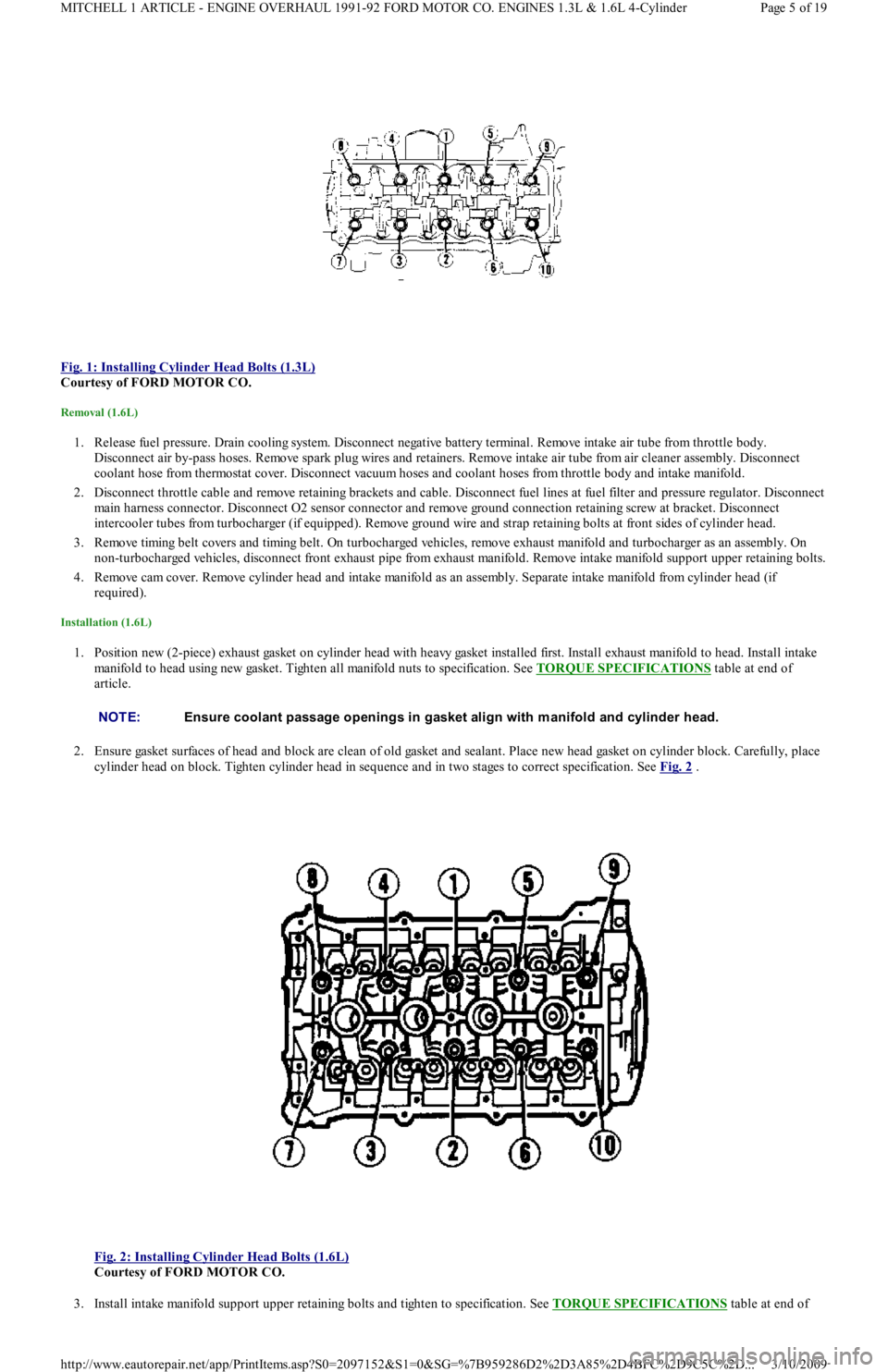
Fig. 1: Installing Cylinder Head Bolts (1.3L)
Courtesy of FORD MOTOR CO.
Removal (1.6L)
1. Release fuel pressure. Drain cooling system. Disconnect negative battery terminal. Remove intake air tube from throttle body.
Disconnect air by-pass hoses. Remove spark plug wires and retainers. Remove intake air tube from air cleaner assembly. Disconnect
coolant hose from thermostat cover. Disconnect vacuum hoses and coolant hoses from throttle body and intake manifold.
2. Disconnect throttle cable and remove retaining brackets and cable. Disconnect fuel lines at fuel filter and pressure regulator. Disconnect
main harness connector. Disconnect O2 sensor connector and remove ground connection retaining screw at bracket. Disconnect
intercooler tubes from turbocharger (if equipped). Remove ground wire and strap retaining bolts at front sides of cylinder head.
3. Remove timing belt covers and timing belt. On turbocharged vehicles, remove exhaust manifold and turbocharger as an assembly. On
non-turbocharged vehicles, disconnect front exhaust pipe from exhaust manifold. Remove intake manifold support upper retaining bolts.
4. Remove cam cover. Remove cylinder head and intake manifold as an assembly. Separate intake manifold from cylinder head (if
required).
Installation (1.6L)
1. Position new (2-piece) exhaust gasket on cylinder head with heavy gasket installed first. Install exhaust manifold to head. Install intake
manifold to head using new gasket. Tighten all manifold nuts to specification. See TORQUE SPECIFICATIONS
table at end of
article.
2. Ensure gasket surfaces of head and block are clean of old gasket and sealant. Place new head gasket on cylinder block. Carefully, place
cylinder head on block. Tighten cylinder head in sequence and in two stages to correct specification. See Fig. 2
.
Fig. 2: Installing Cylinder Head Bolts (1.6L)
Courtesy of FORD MOTOR CO.
3. Install intake manifold support upper retaining bolts and tighten to specification. See TORQUE SPECIFICATIONS
table at end of
NOTE:Ensure coolant passage openings in gasket align with m anifold and cylinder head.
Page 5 of 19 MITCHELL 1 ARTICLE - ENGINE OVERHAUL 1991-92 FORD MOTOR CO. ENGINES 1.3L & 1.6L 4-Cylinder
3/10/2009 http://www.eautorepair.net/app/PrintItems.asp?S0=2097152&S1=0&SG=%7B959286D2%2D3A85%2D4BFC%2D9C5C%2D
...
Page 106 of 454
article. Install timing belt and covers. Install cam cover. On non-turbo engines, connect front exhaust pipe to exhaust manifold. Tighten
nuts to specification.
4. On turbocharged engines, install exhaust manifold and turbocharger assembly. Install ground wire and strap to cylinder head with
retaining bolts. Connect intercooler tubes (if equipped). Connect O2 sensor connector, and install ground wires to bracket on cylinder
head with retaining screw. Connect main engine harness connector. Connect fuel lines to fuel filter and pressure regulator. Install
throttle cable and retaining brackets.
5. Install coolant hoses and vacuum lines to intake manifold and throttle body. Install coolant hose to thermostat cover. Install intake air
tube to air cleaner. Install spark plug wires and retainers. Install intake air tube to throttle body, and connect by-pass hoses. Fill cooling
system. Connect negative battery terminal. Start engine, check for leaks and system operation.
TIMING BELT COVER
Removal & Installation (1.3L)
Remove accessory belts. Remove water pump pulley. Remove crankshaft damper. Remove bolts retaining upper and lower cover halves to
engine front. Remove both covers. To install, reverse removal procedure.
Removal & Installation (1.6L)
Raise vehicle on hoist. Remove RF tire and wheel assembly. Remove RF splash guard. Lower vehicle. Remove spark plugs and set camsh aft
timing to TDC No. 1 cylinder. Remove oil dipstick. Remove water pump pulley. Remove crankshaft pulley, damper and baffle plate. Remove
upper timing belt cover. Remove center and lower timing belt covers. To install, reverse removal procedure.
TIMING BELT
Removal (1.3L)
Remove accessory belts, water pump pulley, crankshaft damper and upper and lower timing belt covers. Mark timing belt direction of rotation
for installation reference. Remove timing belt tensioner pulley bolt. Remove tensioner pulley, spring and spring cover. Remove timing belt.
Installation (1.3L)
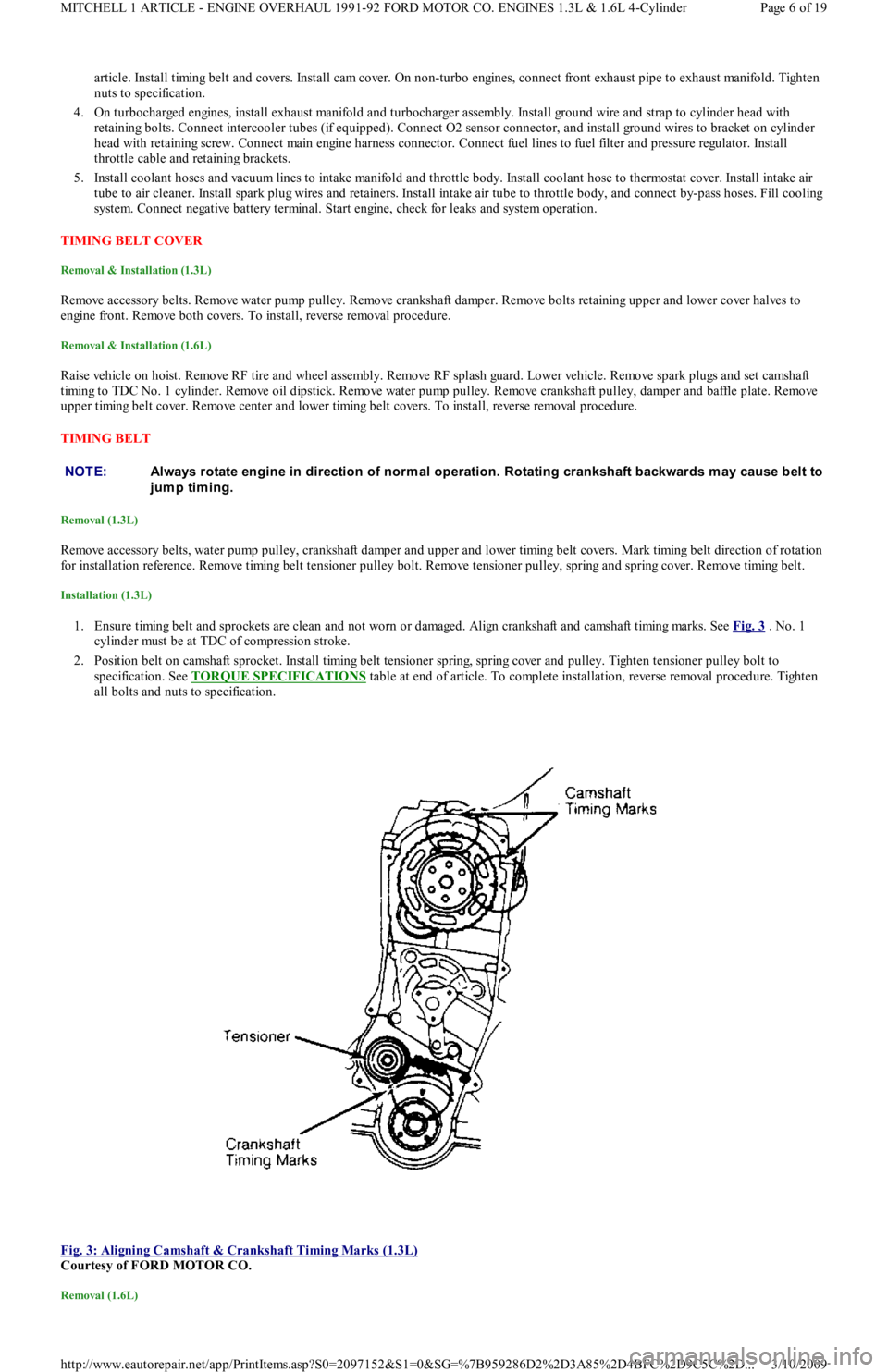
1. Ensure timing belt and sprockets are clean and not worn or damaged. Align crankshaft and camshaft timing marks. See Fig. 3 . No. 1
cylinder must be at TDC of compression stroke.
2. Position belt on camshaft sprocket. Install timing belt tensioner spring, spring cover and pulley. Tighten tensioner pulley bolt to
specification. See TORQUE SPECIFICATIONS
table at end of article. To complete installation, reverse removal procedure. Tighten
all bolts and nuts to specification.
Fig. 3: Aligning Camshaft & Crankshaft Timing Marks (1.3L)
Courtesy of FORD MOTOR CO.
Removal (1.6L)
NOTE:Always rotate engine in direction of norm al operation. Rotating crankshaft backwards m ay cause belt to
jump timing.
Page 6 of 19 MITCHELL 1 ARTICLE - ENGINE OVERHAUL 1991-92 FORD MOTOR CO. ENGINES 1.3L & 1.6L 4-Cylinder
3/10/2009 http://www.eautorepair.net/app/PrintItems.asp?S0=2097152&S1=0&SG=%7B959286D2%2D3A85%2D4BFC%2D9C5C%2D
...
Page 148 of 454
Removal
Drain radiator and remove negative battery cable. Disconnect throttle cable. Remove air duct from throttle body. Disconnect throttle position
sensor/switch connector. Mark all coolant and vacuum hoses for reassembly reference and remove from throttle body. See Fig. 4
. Remove
intake plenum bolts and remove intake plenum and gasket.
Installation
To install, reverse removal procedure. Use NEW intake plenum-to-intake manifold gasket. Tighten bolts to specification, see TORQUE
SPECIFICATIONS at end of article.
OXYGEN (O2) SENSOR
Removal & Installation
Disconnect negative battery cable. Disconnect wire harness connector, and remove oxygen sensor. If exhaust sensor is difficult to remove, use
rust penetrant to avoid possible damage to exhaust threads. If new sensor is not pre-coated with anti-seize, apply anti-seize compound to
sensor threads. DO NOT remove anti-seize from sensor. To install, tighten sensor and attach wire harness connector.
THROTTLE BODY
Removal & Installation
Drain radiator and remove negative battery cable. Remove resonance chamber. Disconnect throttle cable. Remove air duct. Mark all coolant
and vacuum hoses for reassembly reference and remove from throttle body. Disconnect throttle position sensor/switch connector. Remove
throttle body nuts and bolts. Remove throttle body and gasket. To install, reverse removal procedure using NEW throttle body-to-intake
plenum gasket.
THROTTLE POSITION SENSOR/SWITCH
Removal & Installation
Disconnect negative battery cable. Disconnect throttle position sensor/switch connector. Remove attaching bolts. Remove sensor/switch from
throttle body. To install, reverse removal procedure.
TURBOCHARGER
Removal
1. Drain radiator and remove negative battery cable. Remove throttle body air intake tube. Disconnect intercooler hose from turbocharger
assembly. Disconnect O2 sensor. Remove lower heat shield retaining bolts and lower heat shield from turbocharger. Remove upper heat
shield retaining bolts and upper heat shield from exhaust manifold.
2. Slide O2 sensor wire and guide through upper heat shield. Remove side heat shield retaining bolts from turbocharger, and remove sid e
heat shield. Remove power steering belt. Remove power steering pump through bolt and adjuster nuts and bolts. Disconnect lower
radiator hose from water pump.
3. Pull pump from bracket, and position pump to access mounting bracket retaining nut and bolts. Remove mounting bracket-to-engine nut
and bolts and remove bracket. Remove air cleaner duct retaining screws. Loosen clamp at turbocharger and move duct tube out of way.
Disconnect coolant supply hose at turbocharger.
4. Remove bolt and sealing washers attaching oil supply line at engine block. Raise vehicle on hoist. Remove nuts and washers from
exhaust pipe flange. Remove bolts attaching exhaust hanger to engine block. Slide rubber exhaust hangers from catalytic converter. Pull
exhaust pipe downward and to left side of vehicle. Disconnect oil return hose from turbocharger. Disconnect coolant return hose fro m
turbocharger.
5. Remove turbocharger support bracket retaining bolts. Remove coolant by-pass tube outlet-to-water pump bolts. Lower vehicle. Loosen
retaining clamp bolt on coolant by-pass tube at rear of cylinder head. Remove 11 retaining nuts from exhaust manifold. Position coolant
by-pass tube out of way after pulling bracket from exhaust stud.
6. Remove exhaust manifold by pulling off studs and moving assembly towards right side of engine compartment, clearing cooling fan.
With assembly removed from vehicle, remove turbocharger-to-exhaust manifold nuts. Separate assembly and discard gasket.
Installation
1. Install NEW gasket on exhaust manifold and install turbocharger onto studs. Install turbocharger-to-exhaust manifold nuts. Remo ve o il
supply line from turbocharger. Install NEW exhaust gasket on cylinder head. Install turbocharger and exhaust manifold assembly onto
studs. Install coolant by-pass tube bracket onto exhaust stud. Install 11 retaining nuts onto exhaust manifold.
2. Securely tighten heater tube clamp bolt. Raise vehicle. Install coolant by-pass tube outlet-to-water pump bolts. Install turbocharger
support bracket retaining bolts. Connect coolant return hose to turbocharger. Connect oil return hose to turbocharger. Install exhaust
pipe onto turbocharger, and hand tighten nuts and washers. Install bolts attaching exhaust hanger to engine block.
3. Slide rubber exhaust hangers onto catalytic converter. Tighten exhaust pipe nuts and washers. Lower vehicle. Install bolt and sealing
washers attaching oil supply line at engine block. Install oil supply line onto turbocharger. To complete installation, reverse removal
procedure. Tighten bolts and nuts to specification, see TORQUE SPECIFICATIONS
at end of article. NOTE:T o prevent dust and dirt from entering intake m anifold ports, cover ports with clean cloth after
rem oving intake plenum .
WARNING:DO NOT rem ove oxygen sensor when engine is hot.
NOTE:Clean throttle body exterior before rem oval.
CAUT ION: Before installing turbocharger, put .8 oz. (25 m l) engine oil into turbocharger oil inlet.
Page 4 of 5 MITCHELL 1 ARTICLE - N - REMOVE/INSTALL/OVERHAUL 1991 ENGINE PERFORMANCE Ford/Mercury Removal, O
...
3/10/2009 http://www.eautorepair.net/app/PrintItems.asp?S0=2097152&S1=0&SG=%7B959286D2%2D3A85%2D4BFC%2D9C5C%2D
...
Page 149 of 454
VANE AIRFLOW (VAF) METER
Removal
1. Disconnect negative battery cable. On Capri, disconnect primary and secondary wires from coil. On Festiva, disconnect VAF wire
harness connector. Remove air duct.
2. On Capri, remove retaining bolt and ground wire from air cleaner cover. Remove air cleaner cover bolts and air cleaner cover. From
inside of air cleaner cover, remove VAF meter retaining nuts. On Festiva, remove attaching bolt and 4 nuts. Remove vane airflow met er.
Installation
To install, reverse removal procedure. Position new gasket over VAF mounting studs. Tighten bolts and nuts to specification, see TORQUE
SPECIFICATIONS at end of article.
TORQUE SPECIFICATIONS
TORQUE SPECIFICATIONS NOTE:For all on-vehicle adjustm ents not covered in this article, see ADJUST MENT S article in the ENGINE
PERFORMANCE Section.
ApplicationFt. Lbs. (N.m)
Coolant By-Pass Tube Outlet-To-Water Pump Bolts14-19 (19-26)
Distributor Mounting Bolts14-19 (19-26)
Exhaust Manifold Retaining Nuts29-42 (39-57)
Exhaust Pipe Nuts18-25 (24-34)
Fuel Line-To-Fuel Filter Bolt18-25 (24-34)
Fuel Pressure Regulator Nut(1)
Fuel Rail Retaining Bolt14-19 (19-26)
Heat Shield Bolts14-19 (19-26)
Intake Plenum Bolts/Nuts11-16 (15-22)
Oil Supply Line-To-Turbocharger Bolt12-17 (16-23)
Oxygen Sensor(1)
Power Steering Pump Bracket-To-Engine Bolts/Nut35-48 (47-65)
Throttle Body Bolt/Nuts12-17 (16-23)
Turbocharger Support Bracket Bolts32-45 (43-61)
Turbocharger-To-Exhaust Manifold Nuts20-25 (27-34)
INCH Lbs. (N.m)
Barometric Pressure (BP) Sensor Nut54-84 (6-9)
MAP Sensor Nuts54-84 (6-9)
Oil Supply Line-To-Engine Block Bolt104-156 (12-18)
Vane Airflow Meter Nuts110-152 (12-18)
(1)Information not available from manufacturer.
Copyr ight 2009 Mitchell Repair Information Company, LLC. All Rights Reserved.
Article GUID: A00022705
Page 5 of 5 MITCHELL 1 ARTICLE - N - REMOVE/INSTALL/OVERHAUL 1991 ENGINE PERFORMANCE Ford/Mercury Removal, O
...
3/10/2009 http://www.eautorepair.net/app/PrintItems.asp?S0=2097152&S1=0&SG=%7B959286D2%2D3A85%2D4BFC%2D9C5C%2D
...
Page 150 of 454
Back To Article
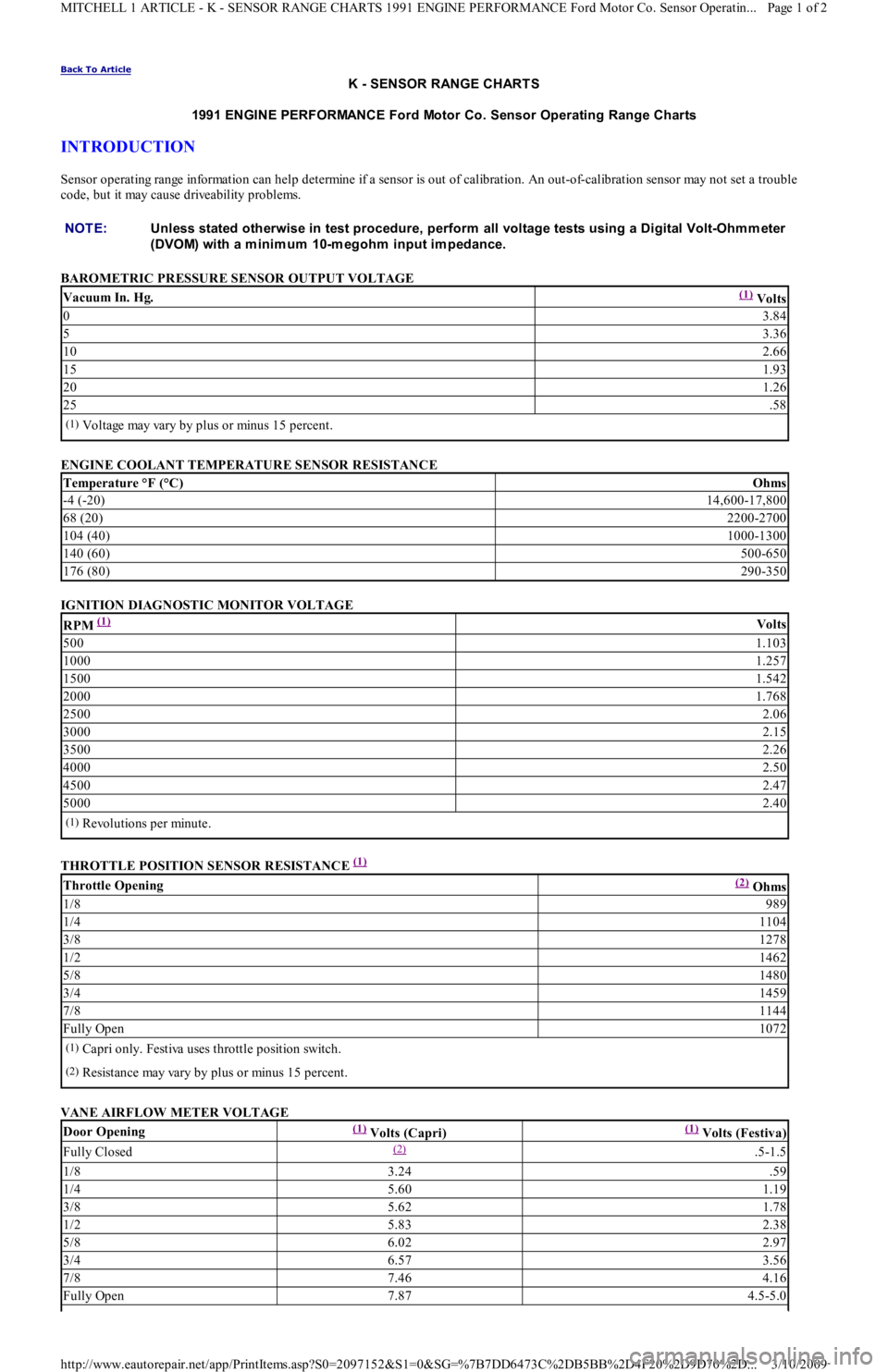
K - SENSOR RANGE CHART S
1991 ENGINE PERFORMANCE Ford Motor Co. Sensor Operating Range Charts
INTRODUCTION
Sensor operating range information can help determine if a sensor is out of calibration. An out-of-calibration sensor may not set a trouble
code, but it may cause driveability problems.
BAROMETRIC PRESSURE SENSOR OUTPUT VOLTAGE
ENGINE COOLANT TEMPERATURE SENSOR RESISTANCE
IGNITION DIAGNOSTIC MONITOR VOLTAGE
THROTTLE POSITION SENSOR RESISTANCE
(1)
VANE AIRFLOW METER VOLTAGE NOTE:Unless stated otherwise in test procedure, perform all voltage tests using a Digital Volt-Ohm m eter
(DVOM) with a m inim um 10-m egohm input im pedance.
Vacuum In. Hg.(1) Volts
03.84
53.36
102.66
151.93
201.26
25.58
(1)Voltage may vary by plus or minus 15 percent.
Temperature °F (°C)Ohms
-4 (-20)14,600-17,800
68 (20)2200-2700
104 (40)1000-1300
140 (60)500-650
176 (80)290-350
RPM (1) Volts
5001.103
10001.257
15001.542
20001.768
25002.06
30002.15
35002.26
40002.50
45002.47
50002.40
(1)Revolutions per minute.
Throttle Opening(2) Ohms
1/8989
1/41104
3/81278
1/21462
5/81480
3/41459
7/81144
Fully Open1072
(1)Capri only. Festiva uses throttle position switch.
(2)Resistance may vary by plus or minus 15 percent.
Door Opening(1) Volts (Capri)(1) Volts (Festiva)
Fully Closed(2) .5-1.5
1/83.24.59
1/45.601.19
3/85.621.78
1/25.832.38
5/86.022.97
3/46.573.56
7/87.464.16
Fully Open7.874.5-5.0
Page 1 of 2 MITCHELL 1 ARTICLE - K - SENSOR RANGE CHARTS 1991 ENGINE PERFORMANCE Ford Motor Co. Sensor Operatin
...
3/10/2009 http://www.eautorepair.net/app/PrintItems.asp?S0=2097152&S1=0&SG=%7B7DD6473C%2DB5BB%2D4F20%2D9D70%2D
...
Page 153 of 454
Back To Article
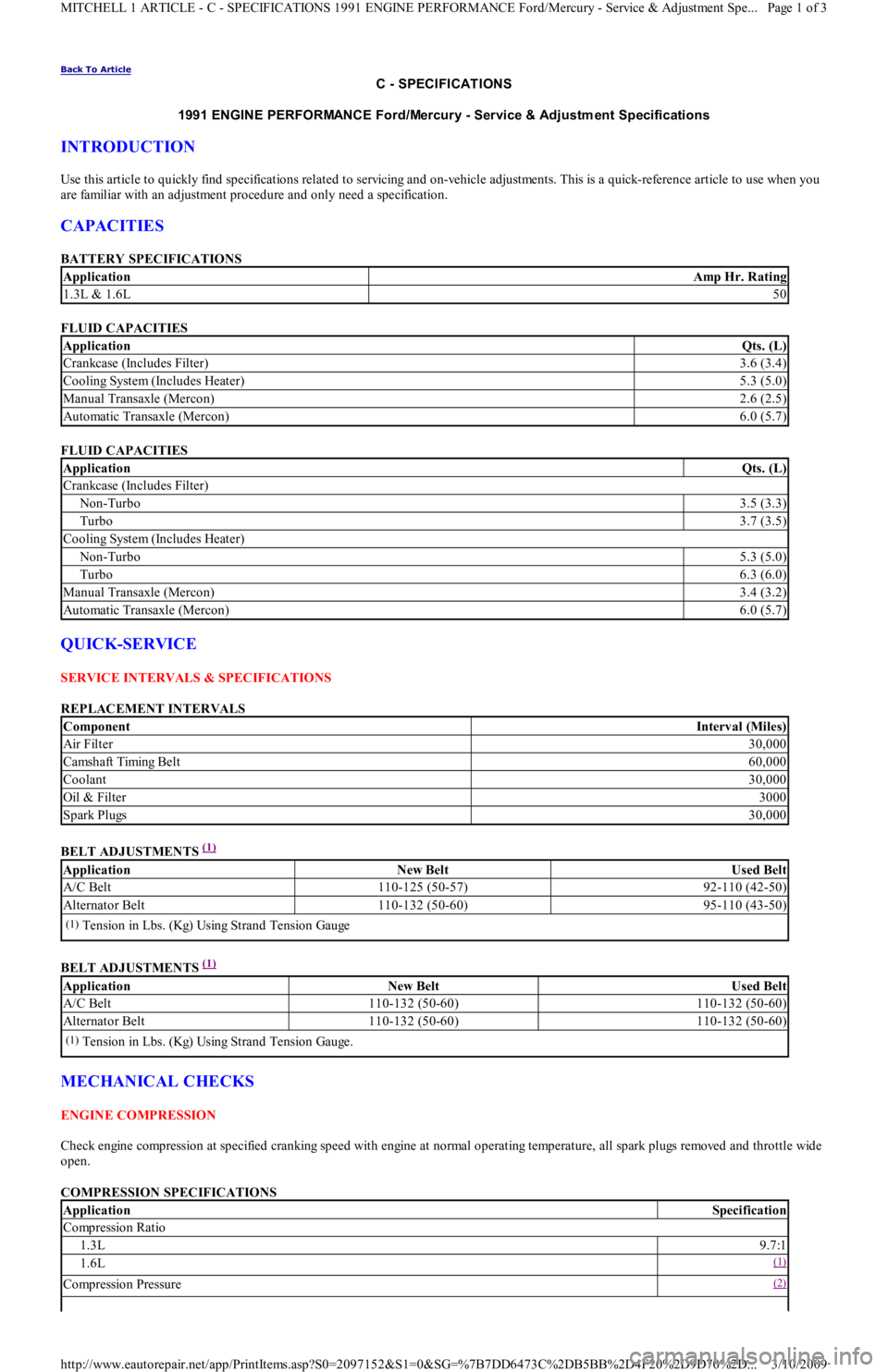
C - SPECIFICATIONS
1991 ENGINE PERFORMANCE Ford/Mercury - Service & Adjustm ent Specifications
INTRODUCTION
Use this article to quickly find specifications related to servicing and on-vehicle adjustments. This is a quick-reference article to use when you
are familiar with an adjustment procedure and only need a specification.
CAPACITIES
BATTERY SPECIFICATIONS
FLUID CAPACITIES
FLUID CAPACITIES
QUICK-SERVICE
SERVICE INTERVALS & SPECIFICATIONS
REPLACEMENT INTERVALS
BELT ADJUSTMENTS
(1)
BELT ADJUSTMENTS
(1)
MECHANICAL CHECKS
ENGINE COMPRESSION
Check engine compression at specified cranking speed with engine at normal operating temperature, all spark plugs removed and throttle wide
open.
COMPRESSION SPECIFICATIONS
ApplicationAmp Hr. Rating
1.3L & 1.6L50
ApplicationQts. (L)
Crankcase (Includes Filter)3.6 (3.4)
Cooling System (Includes Heater)5.3 (5.0)
Manual Transaxle (Mercon)2.6 (2.5)
Automatic Transaxle (Mercon)6.0 (5.7)
ApplicationQts. (L)
Crankcase (Includes Filter)
Non-Turbo3.5 (3.3)
Turbo3.7 (3.5)
Cooling System (Includes Heater)
Non-Turbo5.3 (5.0)
Turbo6.3 (6.0)
Manual Transaxle (Mercon)3.4 (3.2)
Automatic Transaxle (Mercon)6.0 (5.7)
ComponentInterval (Miles)
Air Filter30,000
Camsh aft Timin g Bel t60,000
Coolant30,000
Oil & Filter3000
Spark Plugs30,000
ApplicationNew BeltUsed Belt
A/C Belt110-125 (50-57)92-110 (42-50)
Alternator Belt110-132 (50-60)95-110 (43-50)
(1)Tension in Lbs. (Kg) Using Strand Tension Gauge
ApplicationNew BeltUsed Belt
A/C Belt110-132 (50-60)110-132 (50-60)
Alternator Belt110-132 (50-60)110-132 (50-60)
(1)Tension in Lbs. (Kg) Using Strand Tension Gauge.
ApplicationSpecification
Compression Ratio
1.3L9.7:1
1.6L(1)
Compression Pressure(2)
Page 1 of 3 MITCHELL 1 ARTICLE - C - SPECIFICATIONS 1991 ENGINE PERFORMANCE Ford/Mercury - Service & Adjustment Spe
...
3/10/2009 http://www.eautorepair.net/app/PrintItems.asp?S0=2097152&S1=0&SG=%7B7DD6473C%2DB5BB%2D4F20%2D9D70%2D
...
Page 162 of 454
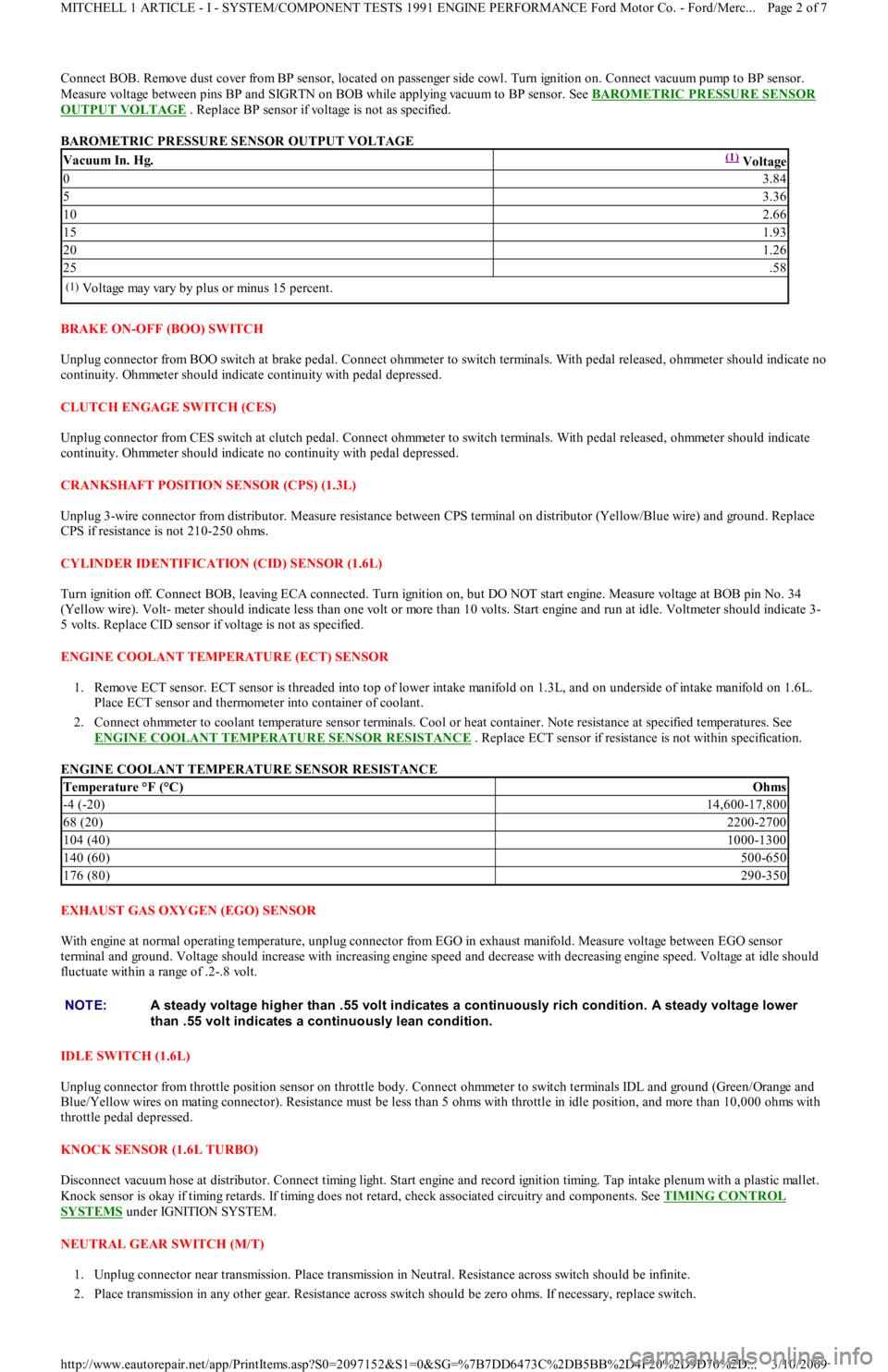
Connect BOB. Remove dust cover from BP sensor, located on passenger side cowl. Turn ignition on. Connect vacuum pump to BP sensor.
Measure voltage between pins BP and SIGRTN on BOB while applying vacuum to BP sensor. See BAROMETRIC PRESSURE SENSOR
OUTPUT VOLTAGE . Replace BP sensor if voltage is not as specified.
BAROMETRIC PRESSURE SENSOR OUTPUT VOLTAGE
BRAKE ON-OFF (BOO) SWITCH
Unplug connector from BOO switch at brake pedal. Connect ohmmeter to switch terminals. With pedal released, ohmmeter should indicate no
continuity. Ohmmeter should indicate continuity with pedal depressed.
CLUTCH ENGAGE SWITCH (CES)
Unplug connector from CES switch at clutch pedal. Connect ohmmeter to switch terminals. With pedal released, ohmmeter should indicate
continuity. Ohmmeter should indicate no continuity with pedal depressed.
CRANKSHAFT POSITION SENSOR (CPS) (1.3L)
Unplug 3-wire connector from distributor. Measure resistance between CPS terminal on distributor (Yellow/Blue wire) and ground. Replace
CPS if resistance is not 210-250 ohms.
CYLINDER IDENTIFICATION (CID) SENSOR (1.6L)
Turn ignition off. Connect BOB, leaving ECA connected. Turn ignition on, but DO NOT start engine. Measure voltage at BOB pin No. 34
(Yellow wire). Volt- meter should indicate less than one volt or more than 10 volts. Start engine and run at idle. Voltmeter should indicate 3-
5 volts. Replace CID sensor if voltage is not as specified.
ENGINE COOLANT TEMPERATURE (ECT) SENSOR
1. Remove ECT sensor. ECT sensor is threaded into top of lower intake manifold on 1.3L, and on underside of intake manifold on 1.6L.
Place ECT sensor and thermometer into container of coolant.
2. Connect ohmmeter to coolant temperature sensor terminals. Cool or heat container. Note resistance at specified temperatures. See
ENGINE COOLANT TEMPERATURE SENSOR RESISTANCE
. Replace ECT sensor if resistance is not within specification.
ENGINE COOLANT TEMPERATURE SENSOR RESISTANCE
EXHAUST GAS OXYGEN (EGO) SENSOR
With engine at normal operating temperature, unplug connector from EGO in exhaust manifold. Measure voltage between EGO sensor
terminal and ground. Voltage should increase with increasing engine speed and decrease with decreasing engine speed. Voltage at idle should
fluctuate within a range of .2-.8 volt.
IDLE SW ITCH (1.6L)
Unplug connector from throttle position sensor on throttle body. Connect ohmmeter to switch terminals IDL and ground (Green/Orange and
Blue/Yellow wires on mating connector). Resistance must be less than 5 ohms with throttle in idle position, and more than 10,000 ohms with
throttle pedal depressed.
KNOCK SENSOR (1.6L TURBO)
Disconnect vacuum hose at distributor. Connect timing light. Start engine and record ignition timing. Tap intake plenum with a plastic mallet.
Knock sensor is okay if timing retards. If timing does not retard, check associated circuitry and components. See TIMING CONTROL
SYSTEMS under IGNITION SYSTEM.
NEUTRAL GEAR SWITCH (M/T)
1. Unplug connector near transmission. Place transmission in Neutral. Resistance across switch should be infinite.
2. Place transmission in any other gear. Resistance across switch should be zero ohms. If necessary, replace switch.
Vacuum In. Hg.(1) Voltage
03.84
53.36
102.66
151.93
201.26
25.58
(1)Voltage may vary by plus or minus 15 percent.
Temperature °F (°C)Ohms
-4 (-20)14,600-17,800
68 (20)2200-2700
104 (40)1000-1300
140 (60)500-650
176 (80)290-350
NOTE:A steady voltage higher than .55 volt indicates a continuously rich condition. A steady voltage lower
than .55 volt indicates a continuously lean condition.
Page 2 of 7 MITCHELL 1 ARTICLE - I - SYSTEM/COMPONENT TESTS 1991 ENGINE PERFORMANCE Ford Motor Co. - Ford/Merc
...
3/10/2009 http://www.eautorepair.net/app/PrintItems.asp?S0=2097152&S1=0&SG=%7B7DD6473C%2DB5BB%2D4F20%2D9D70%2D
...
Page 165 of 454
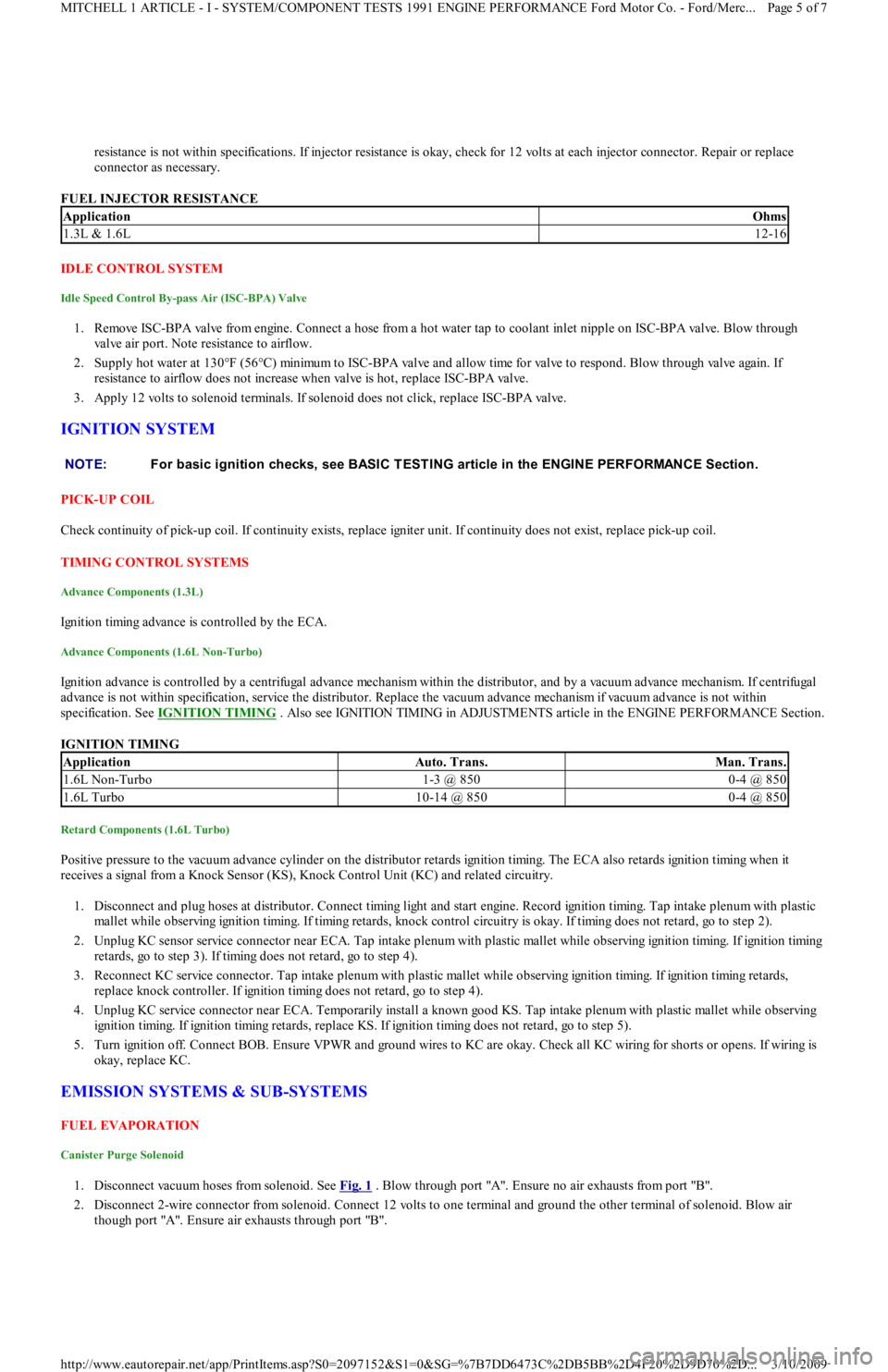
resistance is not within specifications. If injector resistance is okay, check for 12 volts at each injector connector. Repair or replace
connector as necessary.
FUEL INJECTOR RESISTANCE
IDLE CONTROL SYSTEM
Idle Speed Control By-pass Air (ISC-BPA) Valve
1. Remove ISC-BPA valve from engine. Connect a hose from a hot water tap to coolant inlet nipple on ISC-BPA valve. Blow through
valve air port. Note resistance to airflow.
2. Supply hot water at 130°F (56°C) minimum to ISC-BPA valve and allow time for valve to respond. Blow through valve again. If
resistance to airflow does not increase when valve is hot, replace ISC-BPA valve.
3. Apply 12 volts to solenoid terminals. If solenoid does not click, replace ISC-BPA valve.
IGNITION SYSTEM
PICK-UP COIL
Check continuity of pick-up coil. If continuity exists, replace igniter unit. If continuity does not exist, replace pick-up coil.
TIMING CONTROL SYSTEMS
Advance Components (1.3L)
Ignition timing advance is controlled by the ECA.
Advance Components (1.6L Non-Turbo)
Ignition advance is controlled by a centrifugal advance mechanism within the distributor, and by a vacuum advance mechanism. If centrifugal
advance is not within specification, service the distributor. Replace the vacuum advance mechanism if vacuum advance is not within
specification. See IGNITION TIMING
. Also see IGNITION TIMING in ADJUSTMENTS article in the ENGINE PERFORMANCE Section.
IGNITION TIMING
Retard Components (1.6L Turbo)
Positive pressure to the vacuum advance cylinder on the distributor retards ignition timing. The ECA also retards ignition timing when it
receives a signal from a Knock Sensor (KS), Knock Control Unit (KC) and related circuitry.
1. Disconnect and plug hoses at distributor. Connect timing light and start engine. Record ignition timing. Tap intake plenum with plastic
mallet while observing ignition timing. If timing retards, knock control circuitry is okay. If timing does not retard, go to step 2).
2. Unplug KC sensor service connector near ECA. Tap intake plenum with plastic mallet while observing ignition timing. If ignition timing
retards, go to step 3). If timing does not retard, go to step 4).
3. Reconnect KC service connector. Tap intake plenum with plastic mallet while observing ignition timing. If ignition timing retards,
replace knock controller. If ignition timing does not retard, go to step 4).
4. Unplug KC service connector near ECA. Temporarily install a known good KS. Tap intake plenum with plastic mallet while observing
ignition timing. If ignition timing retards, replace KS. If ignition timing does not retard, go to step 5).
5. Turn ignition off. Connect BOB. Ensure VPWR and ground wires to KC are okay. Check all KC wiring for shorts or opens. If wiring is
okay, replace KC.
EMISSION SYSTEMS & SUB-SYSTEMS
FUEL EVAPORATION
Canister Purge Solenoid
1. Disconnect vacuum hoses from solenoid. See Fig. 1 . Blow through port "A". Ensure no air exhausts from port "B".
2. Disconnect 2-wire connector from solenoid. Connect 12 volts to one terminal and ground the other terminal of solenoid. Blow air
though port "A". Ensure air exhausts through port "B".
ApplicationOhms
1.3L & 1.6L12-16
NOTE:For basic ignition checks, see BASIC T EST ING article in the ENGINE PERFORMANCE Section.
ApplicationAuto. Trans.Man. Trans.
1.6L Non-Turbo1-3 @ 8500-4 @ 850
1.6L Turbo10-14 @ 8500-4 @ 850
Page 5 of 7 MITCHELL 1 ARTICLE - I - SYSTEM/COMPONENT TESTS 1991 ENGINE PERFORMANCE Ford Motor Co. - Ford/Merc
...
3/10/2009 http://www.eautorepair.net/app/PrintItems.asp?S0=2097152&S1=0&SG=%7B7DD6473C%2DB5BB%2D4F20%2D9D70%2D
...
Page 168 of 454
Back To Article
G - T EST S W/CODES
1991-92 ENGINE PERFORMANCE Ford Motor Co. Self-Diagnostics
INTRODUCTION
If no faults were found while performing BASIC TESTING , proceed with self-diagnostics. If no fault codes or only pass codes are present
after entering self-diagnostics, proceed to TESTS W/O CODES article in the ENGINE PERFORMANCE Section for diagnosis by symptom
(i.e., ROUGH IDLE, NO START, etc.).
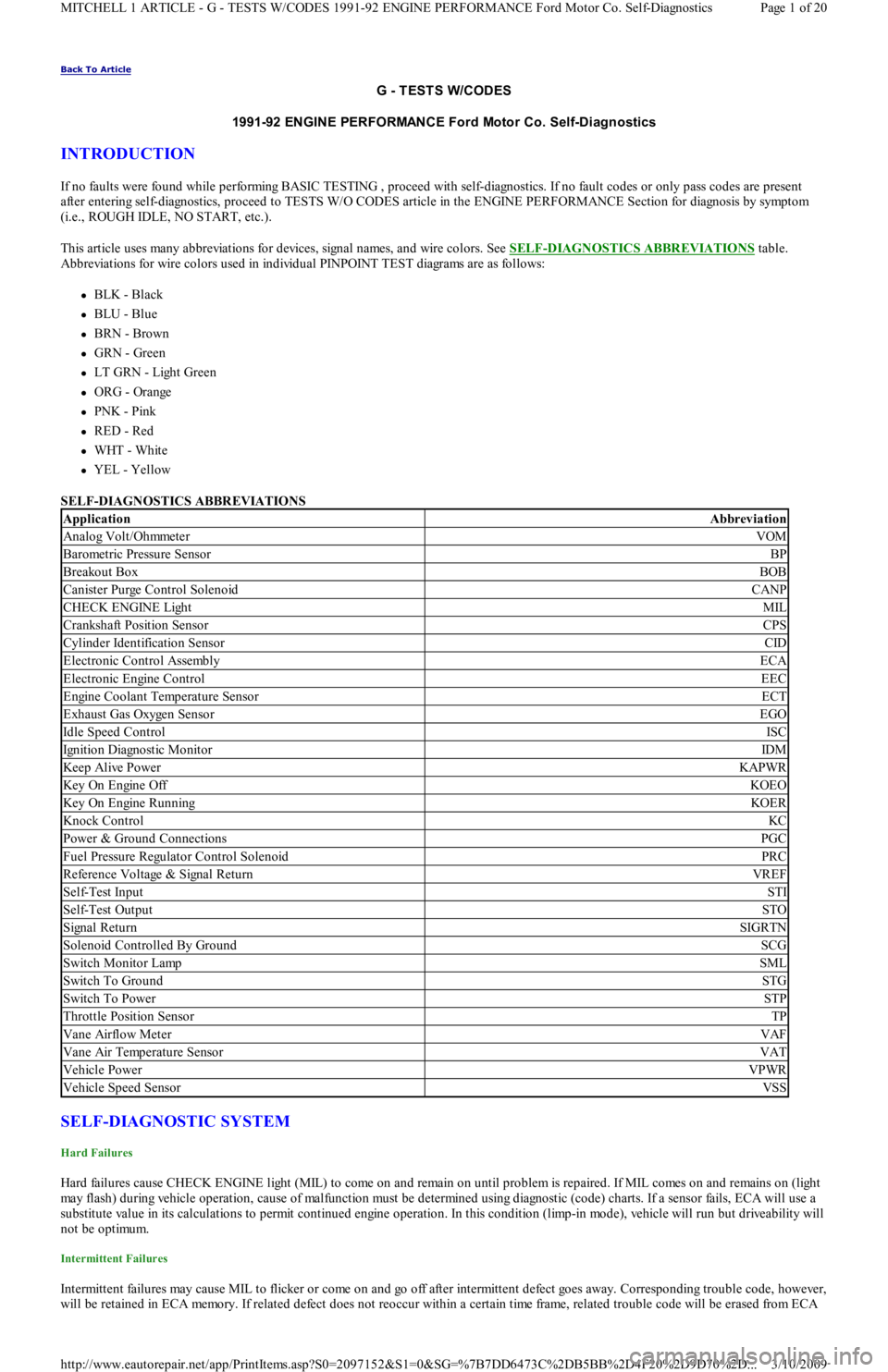
This article uses many abbreviations for devices, signal names, and wire colors. See SELF
-DIAGNOSTICS ABBREVIATIONS table.
Abbreviations for wire colors used in individual PINPOINT TEST diagrams are as follows:
BLK - Black
BLU - Blue
BRN - Brown
GRN - Green
LT GRN - Light Green
ORG - Orange
PNK - Pink
RED - Red
WHT - White
YEL - Yellow
SELF-DIAGNOSTICS ABBREVIATIONS
SELF-DIAGNOSTIC SYSTEM
Hard Failures
Hard failures cause CHECK ENGINE light (MIL) to come on and remain on until problem is repaired. If MIL comes on and remains on (light
may flash) during vehicle operation, cause of malfunction must be determined using diagnostic (code) charts. If a sensor fails, ECA will use a
substitute value in its calculations to permit continued engine operation. In this condition (limp-in mode), vehicle will run but driveability will
not be optimum.
Intermittent Failures
Intermittent failures may cause MIL to flicker or come on and go off after intermittent defect goes away. Corresponding trouble code, however,
will be retained in ECA memory. If related defect does not reoccur within a certain time frame, related trouble code will be erased from ECA
ApplicationAbbreviation
Analog Volt/OhmmeterVOM
Barometric Pressure SensorBP
Breakout BoxBOB
Canister Purge Control SolenoidCANP
CHECK ENGINE LightMIL
Crankshaft Position SensorCPS
Cylinder Identification SensorCID
Electronic Control AssemblyECA
Electronic Engine ControlEEC
Engine Coolant Temperature SensorECT
Exhaust Gas Oxygen SensorEGO
Idle Speed ControlISC
Ignition Diagnostic MonitorIDM
Keep Alive PowerKAPWR
Key On Engine OffKOEO
Key On Engine RunningKOER
Knock ControlKC
Power & Ground ConnectionsPGC
Fuel Pressure Regulator Control SolenoidPRC
Reference Voltage & Signal ReturnVREF
Self-Test InputSTI
Self-Test OutputSTO
Signal ReturnSIGRTN
Solenoid Controlled By GroundSCG
Switch Monitor LampSML
Switch To GroundSTG
Switch To PowerSTP
Throttle Position SensorTP
Vane Airflow MeterVAF
Vane Air Temperature SensorVAT
Vehicle PowerVPWR
Vehicle Speed SensorVSS
Page 1 of 20 MITCHELL 1 ARTICLE - G - TESTS W/CODES 1991-92 ENGINE PERFORMANCE Ford Motor Co. Self-Diagnostics
3/10/2009 http://www.eautorepair.net/app/PrintItems.asp?S0=2097152&S1=0&SG=%7B7DD6473C%2DB5BB%2D4F20%2D9D70%2D
...
Page 169 of 454
memory. Intermittent failures may be caused by a sensor, connector, or wiring. See INTERMITTENTS in TESTS W/O CODES article in the
ENGINE PERFORMANCE Section.
VISUAL CHECK & VEHICLE PREPARATION
Before connecting any equipment to diagnose EEC system, perform following preparatory procedures:
Verify condition of air cleaner and air ducts.
Check all vacuum hoses for leaks, restrictions, or improper routing.
Check EEC system wiring harness electrical connections for corrosion, bent or broken pins, loose wires or terminals, or improper
routing.
Check ECA, sensors, and actuators for physical damage.
Check engine oil and coolant level.
Perform all necessary safety precautions to prevent personal injury or vehicle damage.
Set parking brake. Place shift lever in Park for automatic transmissions, or Neutral for manual transmissions. DO NOT move shift lever
during test unless specifically directed.
Turn off all lights and accessories. Ensure vehicle doors are closed when measuring voltage or resistance.
Start engine. Run at idle until upper radiator hose is hot and pressurized and engine is off fast idle. Check for leaks around exhaust
manifold, exhaust gas oxygen sensor, and vacuum hose connections.
Turn ignition off. Service items as required. Go to EQUIPMENT HOOK-UP .
EQUIPMENT HOOK-UP
VOM
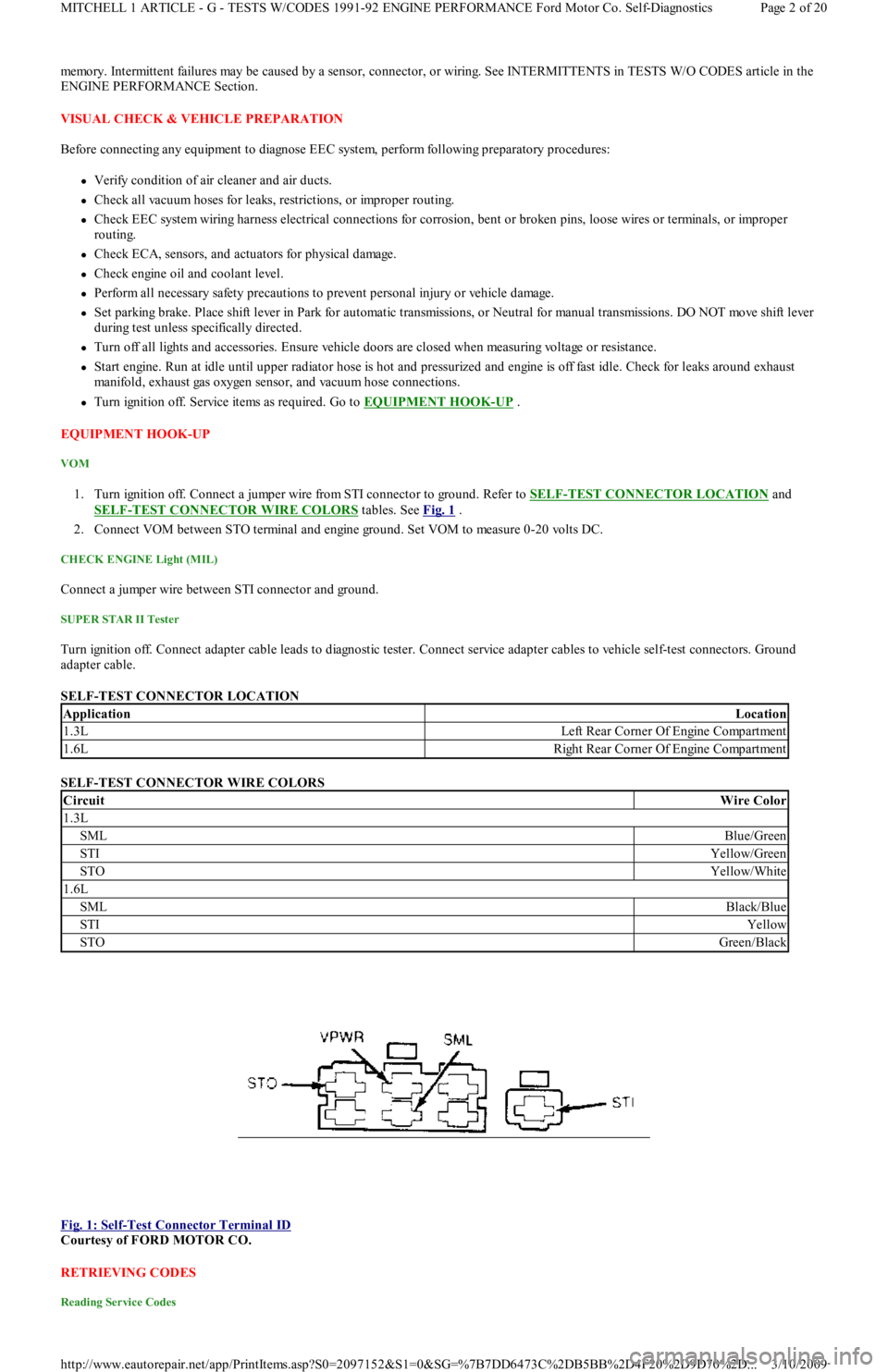
1. Turn ignition off. Connect a jumper wire from STI connector to ground. Refer to SELF-TEST CONNECTOR LOCATION and
SELF
-TEST CONNECTOR WIRE COLORS tables. See Fig. 1 .
2. Connect VOM between STO terminal and engine ground. Set VOM to measure 0-20 volts DC.
CHECK ENGINE Light (MIL)
Connect a jumper wire between STI connector and ground.
SUPER STAR II Tester
Turn ignition off. Connect adapter cable leads to diagnostic tester. Connect service adapter cables to vehicle self-test connectors. Ground
adapter cable.
SELF-TEST CONNECTOR LOCATION
SELF-TEST CONNECTOR WIRE COLORS
Fig. 1: Self
-Test Connector Terminal ID
Courtesy of FORD MOTOR CO.
RETRIEVING CODES
Reading Service Codes
ApplicationLocation
1.3LLeft Rear Corner Of Engine Compartment
1.6LRight Rear Corner Of Engine Compartment
CircuitWire Color
1.3L
SMLBlue/Green
STIYellow/Green
STOYellow/White
1.6L
SMLBlack/Blue
STIYellow
STOGreen/Black
Page 2 of 20 MITCHELL 1 ARTICLE - G - TESTS W/CODES 1991-92 ENGINE PERFORMANCE Ford Motor Co. Self-Diagnostics
3/10/2009 http://www.eautorepair.net/app/PrintItems.asp?S0=2097152&S1=0&SG=%7B7DD6473C%2DB5BB%2D4F20%2D9D70%2D
...