service FORD FESTIVA 1991 Owner's Manual
[x] Cancel search | Manufacturer: FORD, Model Year: 1991, Model line: FESTIVA, Model: FORD FESTIVA 1991Pages: 454, PDF Size: 9.53 MB
Page 172 of 454
WIGGLE TEST
Checking Circuitry
1. Visually inspect suspected sensor, switch, or solenoid. Enter WIGGLE TEST if using Super Star II tester. If using VOM, connect it to
STO terminal on self-test connector, and ground STI self-test connector terminal. Lightly tap sensor, switch, or solenoid.
2. Push and pull on suspected sensor, switch, or solenoid connector, but DO NOT unplug it. Test and wiggle harness vigorously, working
in small sections, from suspected device toward dash panel, and from dash panel to ECA.
3. If VOM or Super Star II tester does not display a positive indication of an intermittent defect, carefully disconnect suspected device.
Remove terminals from connector.
4. Inspect terminals at both ends for corrosion, bad crimps, or improperly seated terminals. Reconnect after inspection. Unplug harness
fro m E CA.
5. Inspect ECA and harness connector terminals for corrosion, bad crimps, or improperly seated terminals. If VOM does not indicate any
intermittent defect, reconnect wiring and erase codes.
PINPOINT TESTS
HOW TO USE PINPOINT TESTS
1. DO NOT perform any PINPOINT TEST unless directed by a QUICK TESTS procedure. Ensure all non-EEC related defects are
corrected. Follow each test step in order until defect is found. DO NOT replace any part unless so directed. When more than one service
code exists, start with first code displayed.
2. PINPOINT TESTS require ensuring electrical circuits are okay before replacing sensors or any other components. Always test circuits
for continuity between sensor and ECA. Test all circuits for shorts to power, opens, or shorts to ground. VREF and VPWR circuits
should be tested with KOEO or as specified in PINPOINT TESTS.
3. DO NOT measure voltage or resistance at ECA, or connect any test light unless specified in testing procedure. DO NOT pierce wiring.
Isolate both ends of a circuit and turn key off whenever checking for shorts or continuity, unless otherwise specified.
4. Disconnect solenoids and switches before checking circuit continuity or energizing solenoids.
5. An open is defined as any resistance greater than 10,000 ohms, unless otherwise specified.
6. To help diagnose circuits to ECA, turn ignition off and disconnect ECA harness. Connect BOB between ECA and ECA harness to
perform circuit and pinpoint tests.
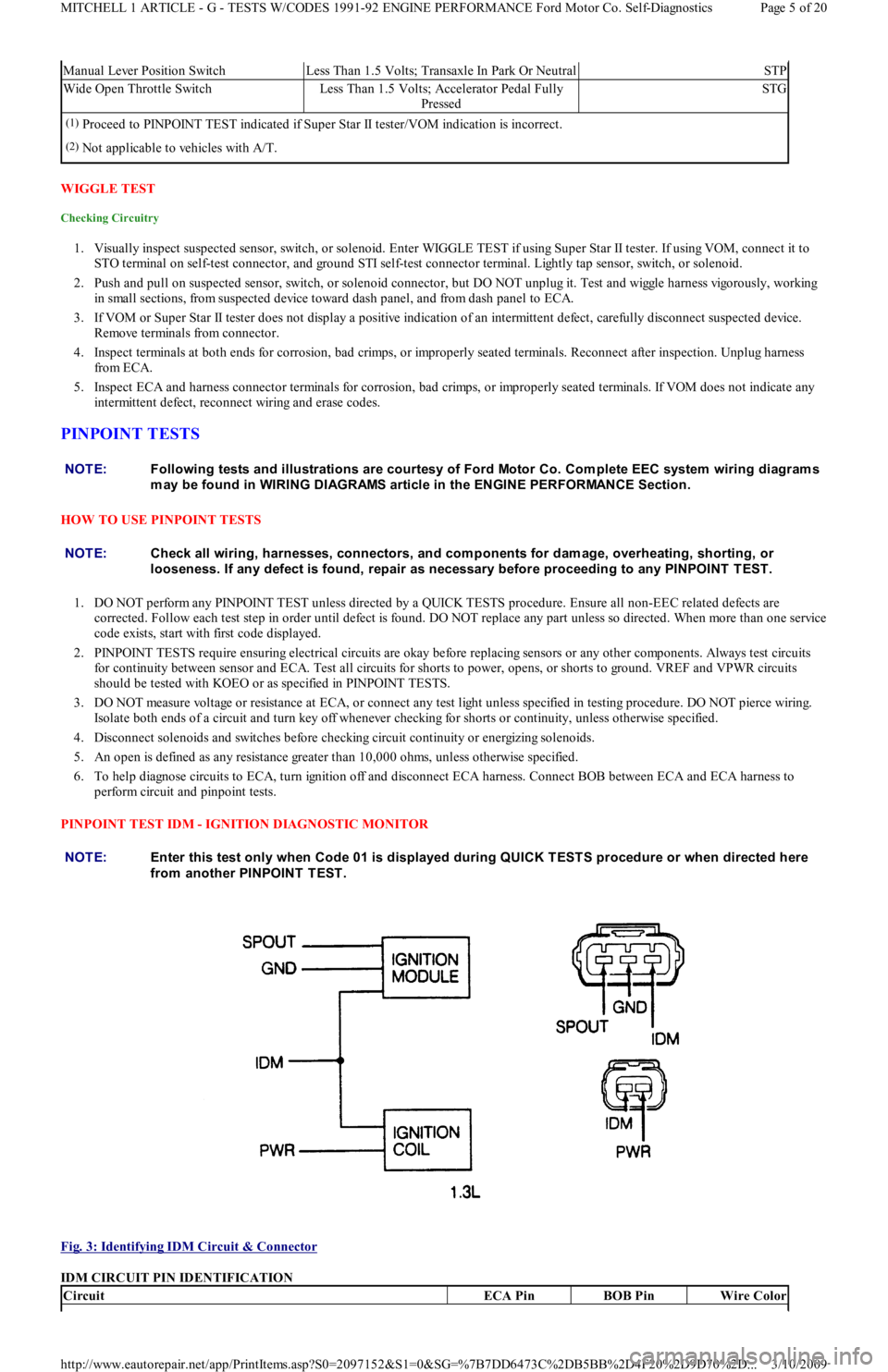
PINPOINT TEST IDM - IGNITION DIAGNOSTIC MONITOR
Fig. 3: Identifying IDM Circuit & Connector
IDM CIRCUIT PIN IDENTIFICATION
Manual Lever Position SwitchLess Than 1.5 Volts; Transaxle In Park Or NeutralSTP
Wide Open Throttle SwitchLess Than 1.5 Volts; Accelerator Pedal Fully
PressedSTG
(1)Proceed to PINPOINT TEST indicated if Super Star II tester/VOM indication is incorrect.
(2)Not applicable to vehicles with A/T.
NOTE:Following tests and illustrations are courtesy of Ford Motor Co. Com plete EEC system wiring diagram s
m ay be found in WIRING DIAGRAMS article in the ENGINE PERFORMANCE Section.
NOTE:Check all wiring, harnesses, connectors, and com ponents for dam age, overheating, shorting, or
looseness. If any defect is found, repair as necessary before proceeding to any PINPOINT T EST .
NOTE:Enter this test only when Code 01 is displayed during QUICK T EST S procedure or when directed here
from another PINPOINT TEST.
CircuitECA PinBOB PinWire Color
Page 5 of 20 MITCHELL 1 ARTICLE - G - TESTS W/CODES 1991-92 ENGINE PERFORMANCE Ford Motor Co. Self-Diagnostics
3/10/2009 http://www.eautorepair.net/app/PrintItems.asp?S0=2097152&S1=0&SG=%7B7DD6473C%2DB5BB%2D4F20%2D9D70%2D
...
Page 175 of 454
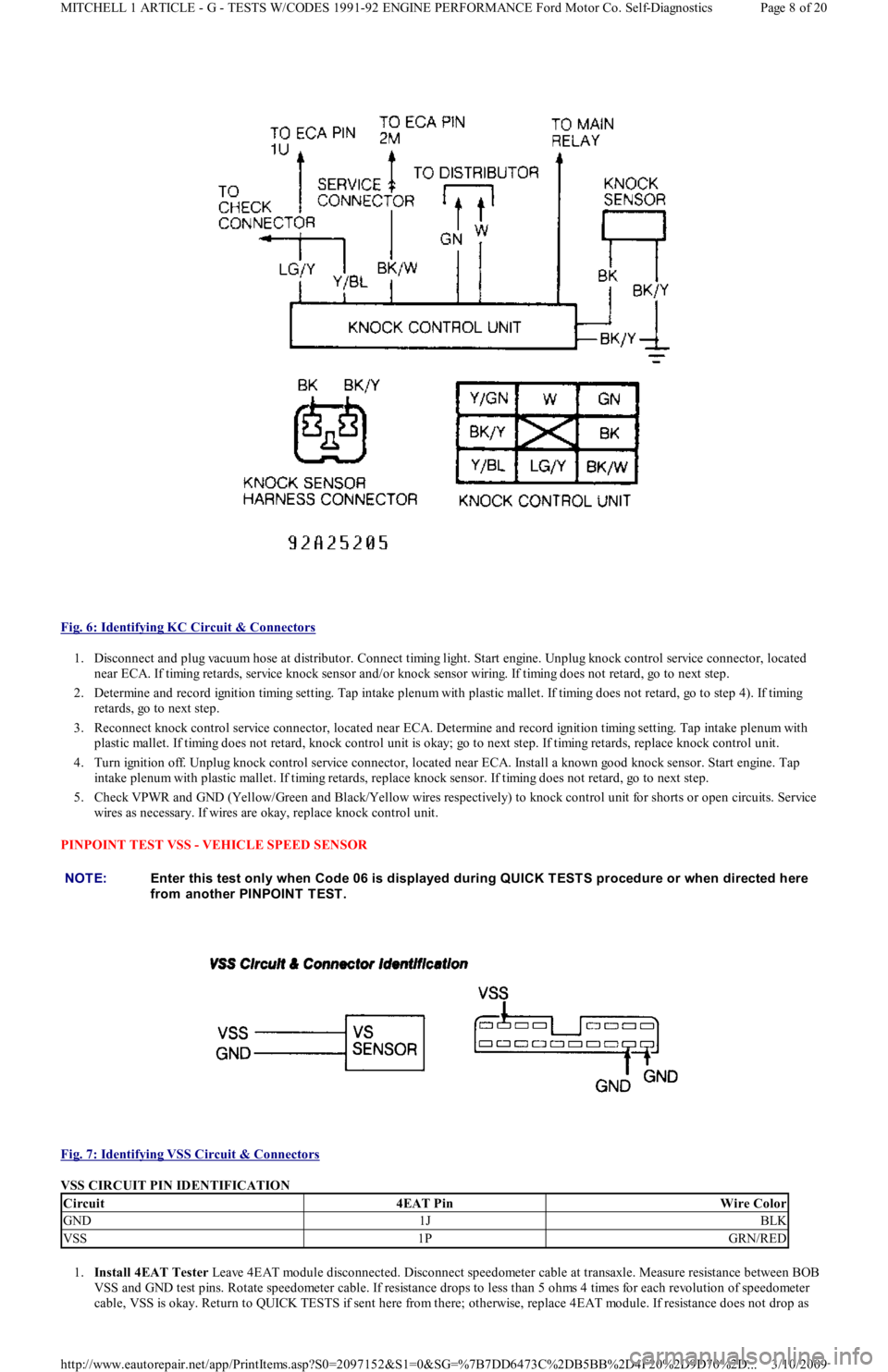
Fig. 6: Identifying KC Circuit & Connectors
1. Disconnect and plug vacuum hose at distributor. Connect timing light. Start engine. Unplug knock control service connector, located
near ECA. If timing retards, service knock sensor and/or knock sensor wiring. If timing does not retard, go to next step.
2. Determine and record ignition timing setting. Tap intake plenum with plastic mallet. If timing does not retard, go to step 4). If t imin g
retards, go to next step.
3. Reconnect knock control service connector, located near ECA. Determine and record ignition timing setting. Tap intake plenum with
plastic mallet. If timing does not retard, knock control unit is okay; go to next step. If timing retards, replace knock control unit.
4. Turn ignition off. Unplug knock control service connector, located near ECA. Install a known good knock sensor. Start engine. Tap
intake plenum with plastic mallet. If timing retards, replace knock sensor. If timing does not retard, go to next step.
5. Check VPWR and GND (Yellow/Green and Black/Yellow wires respectively) to knock control unit for shorts or open circuits. Service
wires as necessary. If wires are okay, replace knock control unit.
PINPOINT TEST VSS - VEHICLE SPEED SENSOR
Fig. 7: Identifying VSS Circuit & Connectors
VSS CIRCUIT PIN IDENTIFICATION
1.Install 4EAT Tester Leave 4EAT module disconnected. Disconnect speedometer cable at transaxle. Measure resistance between BOB
VSS and GND test pins. Rotate speedometer cable. If resistance drops to less than 5 ohms 4 times for each revolution of speedometer
cable, VSS is okay. Return to QUICK TESTS if sent here from there; otherwise, replace 4EAT module. If resistance does not drop as
NOTE:Enter this test only when Code 06 is displayed during QUICK T EST S procedure or when directed here
from another PINPOINT TEST.
Circuit4EAT PinWire Color
GND1JBLK
VSS1PGRN/RED
Page 8 of 20 MITCHELL 1 ARTICLE - G - TESTS W/CODES 1991-92 ENGINE PERFORMANCE Ford Motor Co. Self-Diagnostics
3/10/2009 http://www.eautorepair.net/app/PrintItems.asp?S0=2097152&S1=0&SG=%7B7DD6473C%2DB5BB%2D4F20%2D9D70%2D
...
Page 180 of 454
connector to corresponding terminals on TP sensor connector. Turn ignition on. Measure voltage between TP and SIGRTN terminals on
TP sensor while opening throttle. Compare voltage to specification in TP SENSOR OUTPUT VOLTAGE
table. If voltage is within
specification, repair TP wire to ECA. Go to next step if voltage is not within specification.
3. Turn ignition off. Unplug TP harness connector. Turn ignition on. Measure voltage between VREF and SIGRTN wires on TP harness
connect-or. If voltage is 4-5 volts, replace TP sensor. If voltage is not 4.5-5.5 volts, go to next step.
4. Measure voltage between VREF wire on TP harness connector and ground. If voltage is 4-5 volts, adjust or replace throttle position
sensor. If voltage is not 4-5 volts, go to PINPOINT TEST VREF
.
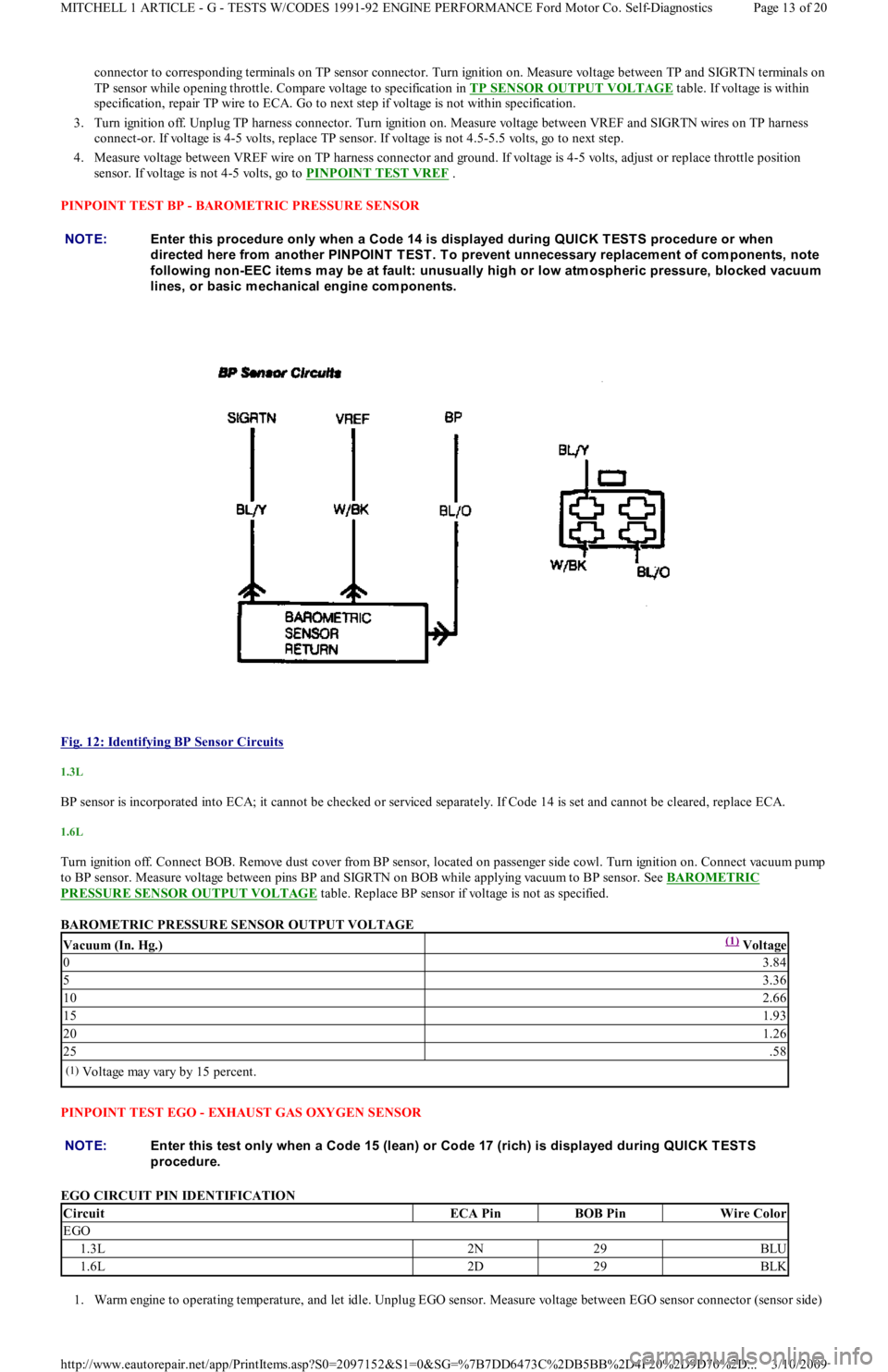
PINPOINT TEST BP - BAROMETRIC PRESSURE SENSOR
Fig. 12: Identifying BP Sensor Circuits
1.3L
BP sensor is incorporated into ECA; it cannot be checked or serviced separately. If Code 14 is set and cannot be cleared, replace ECA.
1.6L
Turn ignition off. Connect BOB. Remove dust cover from BP sensor, located on passenger side cowl. Turn ignition on. Connect vacuum pump
to BP sensor. Measure voltage between pins BP and SIGRTN on BOB while applying vacuum to BP sensor. See BAROMETRIC
PRESSURE SENSOR OUTPUT VOLTAGE table. Replace BP sensor if voltage is not as specified.
BAROMETRIC PRESSURE SENSOR OUTPUT VOLTAGE
PINPOINT TEST EGO - EXHAUST GAS OXYGEN SENSOR
EGO CIRCUIT PIN IDENTIFICATION
1. Warm engine to operating temperature, and let idle. Unplug EGO sensor. Measure voltage between EGO sensor connector (sensor side) NOTE:Enter this procedure only when a Code 14 is displayed during QUICK T EST S procedure or when
directed here from another PINPOINT T EST . T o prevent unnecessary replacem ent of com ponents, note
following non-EEC item s m ay be at fault: unusually high or low atm ospheric pressure, blocked vacuum
lines, or basic m echanical engine com ponents.
Vacuum (In. Hg.)(1) Voltage
03.84
53.36
102.66
151.93
201.26
25.58
(1)Voltage may vary by 15 percent.
NOTE:Enter this test only when a Code 15 (lean) or Code 17 (rich) is displayed during QUICK TESTS
procedure.
CircuitECA PinBOB PinWire Color
EGO
1.3L2N29BLU
1.6L2D29BLK
Page 13 of 20 MITCHELL 1 ARTICLE - G - TESTS W/CODES 1991-92 ENGINE PERFORMANCE Ford Motor Co. Self-Diagnostics
3/10/2009 http://www.eautorepair.net/app/PrintItems.asp?S0=2097152&S1=0&SG=%7B7DD6473C%2DB5BB%2D4F20%2D9D70%2D
...
Page 181 of 454
and ground. With engine at idle, voltage should fluctuate between 0.2-0.8 volt.
2. Increase and decrease engine speed while reading voltmeter. When engine speed is decreasing, voltage should decrease. When engin e
speed is increasing, voltage should increase. If voltage is within specification, go to next step. If voltage is not within specification,
replace EGO sensor.
3. With ignition off, install BOB. Leave ECA disconnected. Unplug EGO sensor connector. Measure continuity between EGO test pin and
EGO sensor connector wire. If continuity exists, EGO circuit is okay; return to QUICK TESTS if sent here from there. If not sent here
from QUICK TESTS, replace ECA. If voltage is not as specified, repair VMREF wire to VAF. If continuity does not exist, service EGO
sensor wire to ECA.
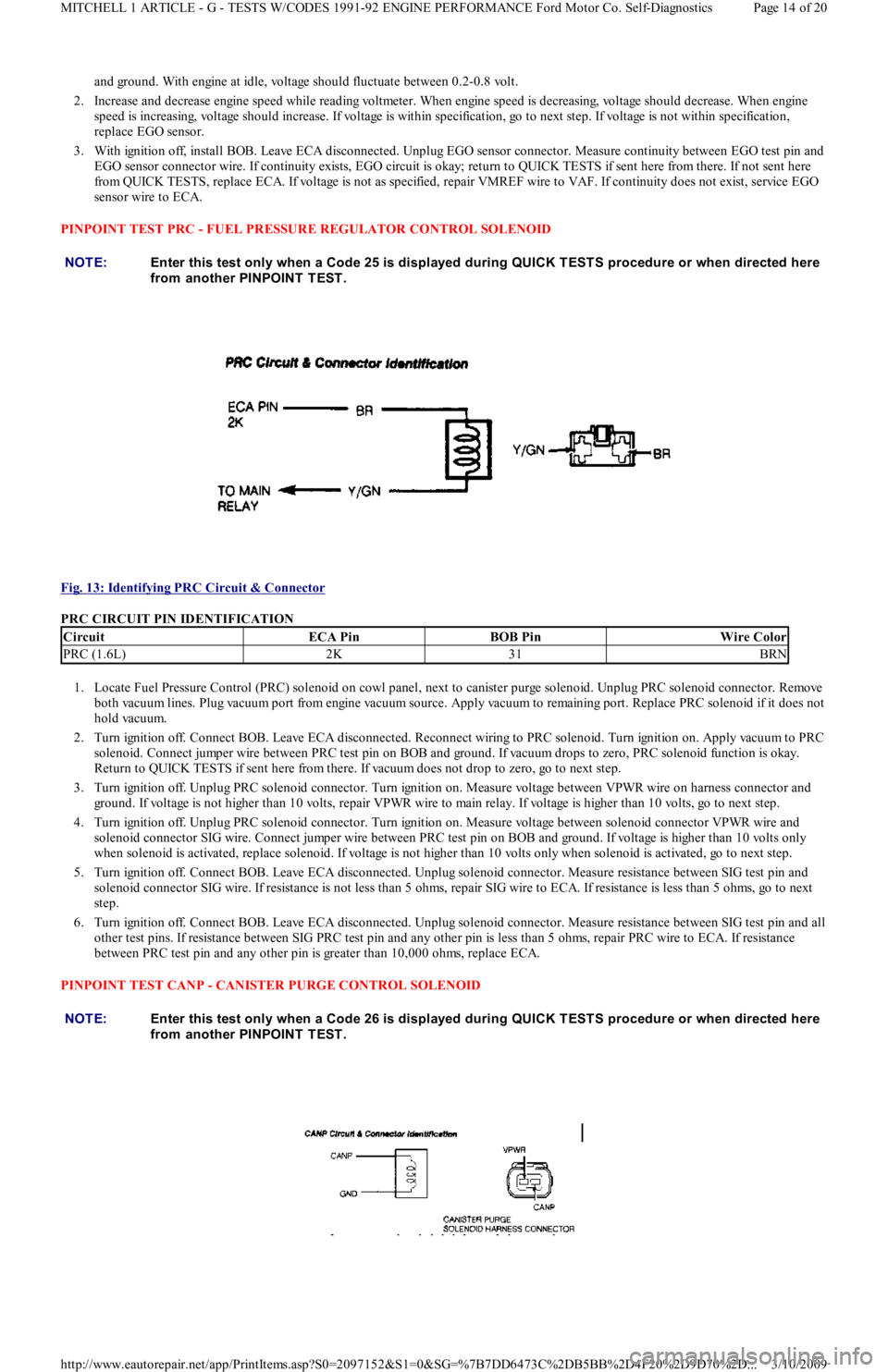
PINPOINT TEST PRC - FUEL PRESSURE REGULATOR CONTROL SOLENOID
Fig. 13: Identifying PRC Circuit & Connector
PRC CIRCUIT PIN IDENTIFICATION
1. Locate Fuel Pressure Control (PRC) solenoid on cowl panel, next to canister purge solenoid. Unplug PRC solenoid connector. Remo ve
both vacuum lines. Plug vacuum port from engine vacuum source. Apply vacuum to remaining port. Replace PRC solenoid if it does not
hold vacuum.
2. Turn ignition off. Connect BOB. Leave ECA disconnected. Reconnect wiring to PRC solenoid. Turn ignition on. Apply vacuum to PRC
solenoid. Connect jumper wire between PRC test pin on BOB and ground. If vacuum drops to zero, PRC solenoid function is okay.
Return to QUICK TESTS if sent here from there. If vacuum does not drop to zero, go to next step.
3. Turn ignition off. Unplug PRC solenoid connector. Turn ignition on. Measure voltage between VPWR wire on harness connector and
gr o u n d . If vo l t a ge is n o t h igh e r t h a n 1 0 vo l t s, r e p a ir VP WR wir e t o ma in r e l a y. If vo l t a ge is h igh e r t h a n 1 0 vo l t s, go t o n e xt step.
4. Turn ignition off. Unplug PRC solenoid connector. Turn ignition on. Measure voltage between solenoid connector VPWR wire and
solenoid connector SIG wire. Connect jumper wire between PRC test pin on BOB and ground. If voltage is higher than 10 volts only
when solenoid is activated, replace solenoid. If voltage is not higher than 10 volts only when solenoid is activated, go to next step.
5. Turn ignition off. Connect BOB. Leave ECA disconnected. Unplug solenoid connector. Measure resistance between SIG test pin and
solenoid connector SIG wire. If resistance is not less than 5 ohms, repair SIG wire to ECA. If resistance is less than 5 ohms, go t o n e xt
step.
6. Turn ignition off. Connect BOB. Leave ECA disconnected. Unplug solenoid connector. Measure resistance between SIG test pin and all
other test pins. If resistance between SIG PRC test pin and any other pin is less than 5 ohms, repair PRC wire to ECA. If resistance
between PRC test pin and any other pin is greater than 10,000 ohms, replace ECA.
PINPOINT TEST CANP - CANISTER PURGE CONTROL SOLENOID
NOTE:Enter this test only when a Code 25 is displayed during QUICK T EST S procedure or when directed here
from another PINPOINT TEST.
CircuitECA PinBOB PinWire Color
PRC (1.6L)2K31BRN
NOTE:Enter this test only when a Code 26 is displayed during QUICK T EST S procedure or when directed here
from another PINPOINT TEST.
Page 14 of 20 MITCHELL 1 ARTICLE - G - TESTS W/CODES 1991-92 ENGINE PERFORMANCE Ford Motor Co. Self-Diagnostics
3/10/2009 http://www.eautorepair.net/app/PrintItems.asp?S0=2097152&S1=0&SG=%7B7DD6473C%2DB5BB%2D4F20%2D9D70%2D
...
Page 191 of 454
Back To Article
E - T HEORY/OPERAT ION
1991 ENGINE PERFORMANCE Ford/Mercury T heory & Operation
INTRODUCTION
This article covers basic description and operation of engine performance-related systems and components. Read this article before attempting
to diagnose systems with which you are not completely familiar.
COMPUTERIZED ENGINE CONTROLS
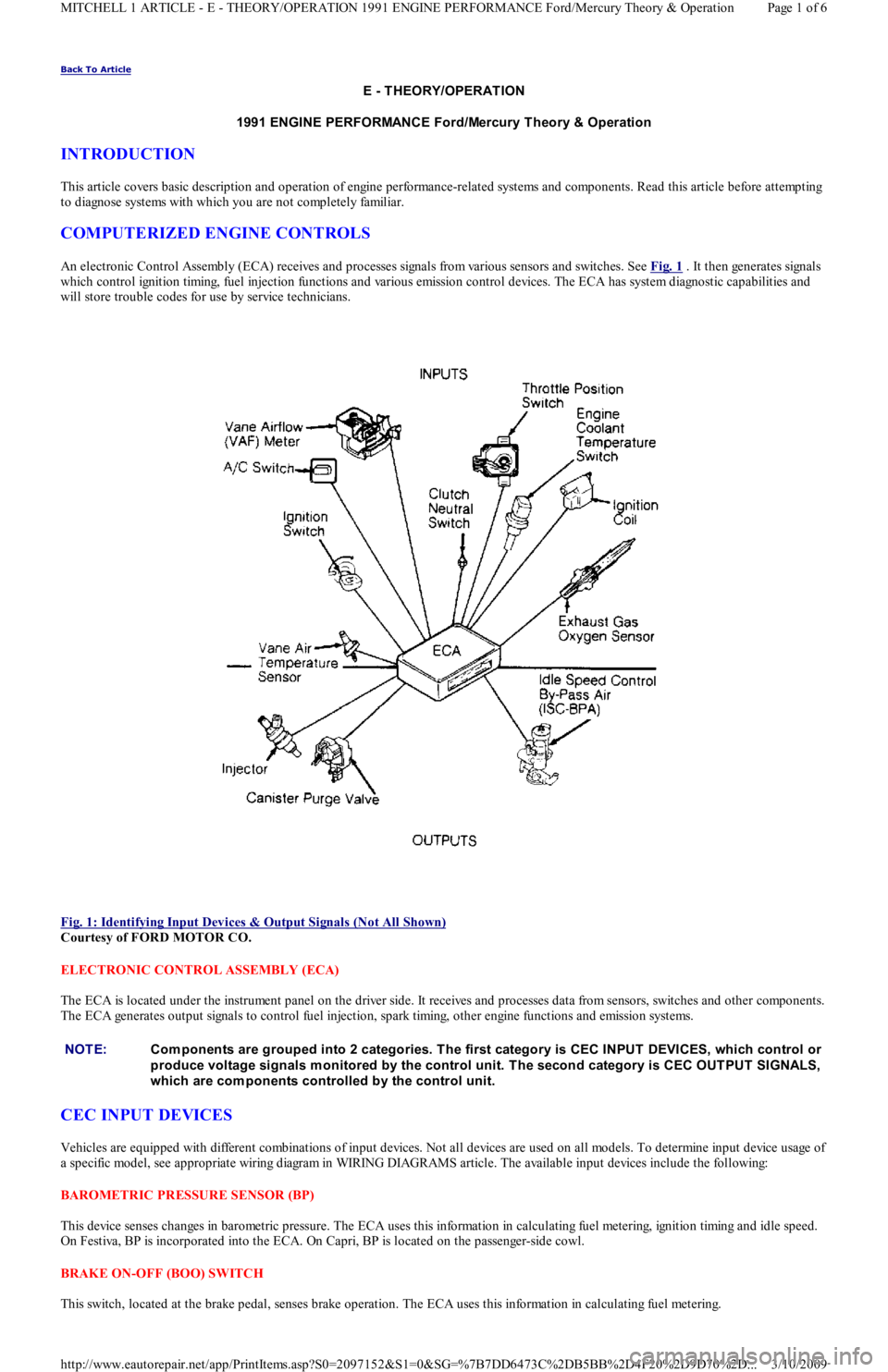
An electronic Control Assembly (ECA) receives and processes signals from various sensors and switches. See Fig. 1 . It then generates signals
which control ignition timing, fuel injection functions and various emission control devices. The ECA has system diagnostic capabilities and
will store trouble codes for use by service technicians.
Fig. 1: Identifying Input Devices & Output Signals (Not All Shown)
Courtesy of FORD MOTOR CO.
ELECTRONIC CONTROL ASSEMBLY (ECA)
The ECA is located under the instrument panel on the driver side. It receives and processes data from sensors, switches and other components.
The ECA generates output signals to control fuel injection, spark timing, other engine functions and emission systems.
CEC INPUT DEVICES
Vehicles are equipped with different combinations of input devices. Not all devices are used on all models. To determine input device usage of
a specific model, see appropriate wiring diagram in WIRING DIAGRAMS article. The available input devices include the following:
BAROMETRIC PRESSURE SENSOR (BP)
This device senses changes in barometric pressure. The ECA uses this information in calculating fuel metering, ignition timing and idle speed.
On Festiva, BP is incorporated into the ECA. On Capri, BP is located on the passenger-side cowl.
BRAKE ON-OFF (BOO) SWITCH
This switch, located at the brake pedal, senses brake operation. The ECA uses this information in calculating fuel metering.
NOTE:Com ponents are grouped into 2 categories. T he first category is CEC INPUT DEVICES, which control or
produce voltage signals m onitored by the control unit. T he second category is CEC OUT PUT SIGNALS,
which are com ponents controlled by the control unit.
Page 1 of 6 MITCHELL 1 ARTICLE - E - THEORY/OPERATION 1991 ENGINE PERFORMANCE Ford/Mercury Theory & Operation
3/10/2009 http://www.eautorepair.net/app/PrintItems.asp?S0=2097152&S1=0&SG=%7B7DD6473C%2DB5BB%2D4F20%2D9D70%2D
...
Page 211 of 454
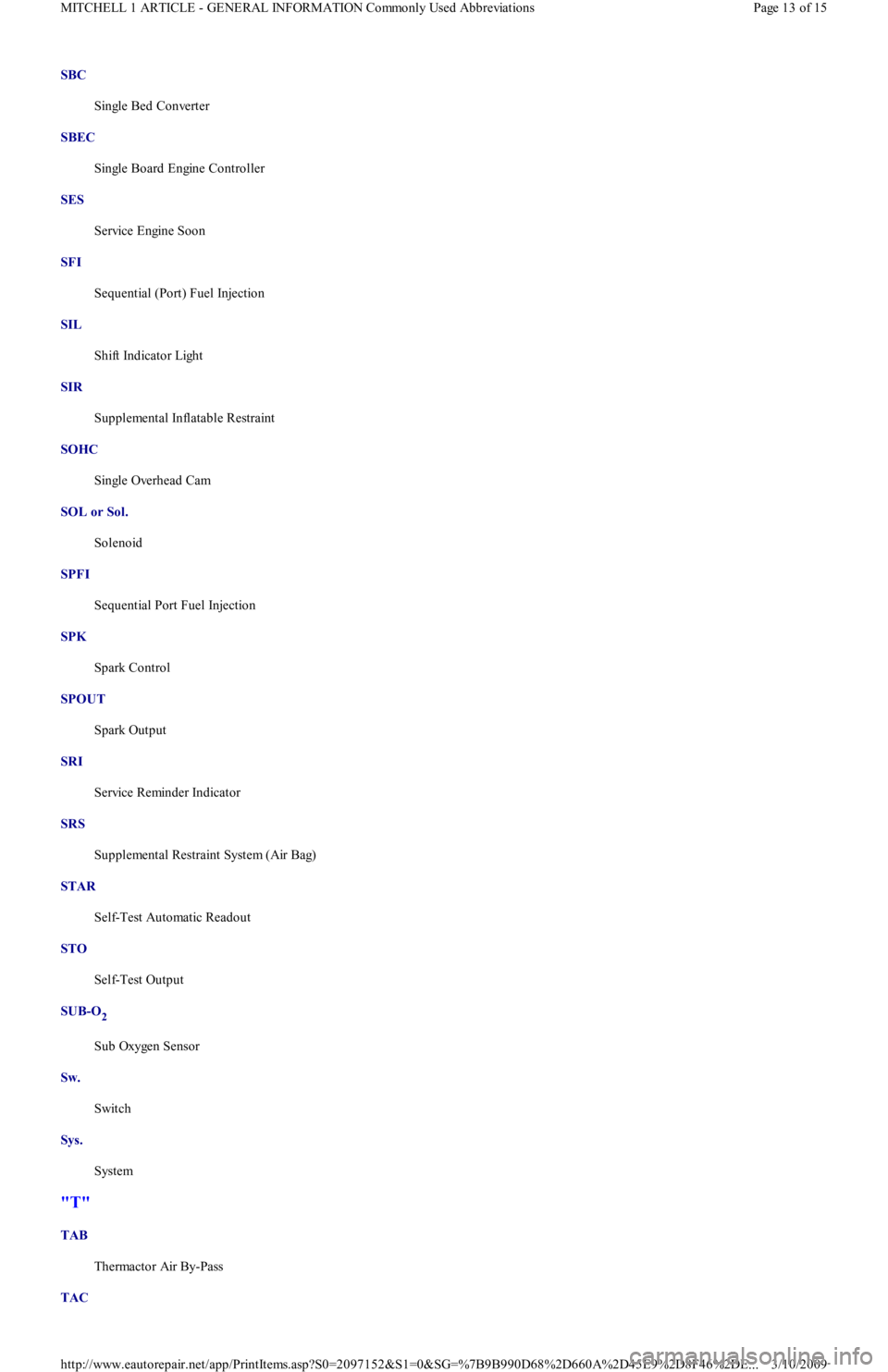
SBC
Single Bed Converter
SBEC
Single Board Engine Controller
SES
Service Engine Soon
SFI
Sequential (Port) Fuel Injection
SIL
Shift Indicator Light
SIR
Supplemental Inflatable Restraint
SOHC
Single Overhead Cam
SOL or Sol.
Solenoid
SPFI
Sequential Port Fuel Injection
SPK
Spark Control
SPOUT
Spark Output
SRI
Service Reminder Indicator
SRS
Supplemental Restraint System (Air Bag)
STAR
Self-Test Automatic Readout
STO
Self-Test Output
SUB-O
2
Sub Oxygen Sensor
Sw.
Switch
Sys.
System
"T"
TAB
Thermactor Air By-Pass
TAC
Page 13 of 15 MITCHELL 1 ARTICLE - GENERAL INFORMATION Commonly Used Abbreviations
3/10/2009 http://www.eautorepair.net/app/PrintItems.asp?S0=2097152&S1=0&SG=%7B9B990D68%2D660A%2D45E9%2D8F46%2DE
...
Page 243 of 454
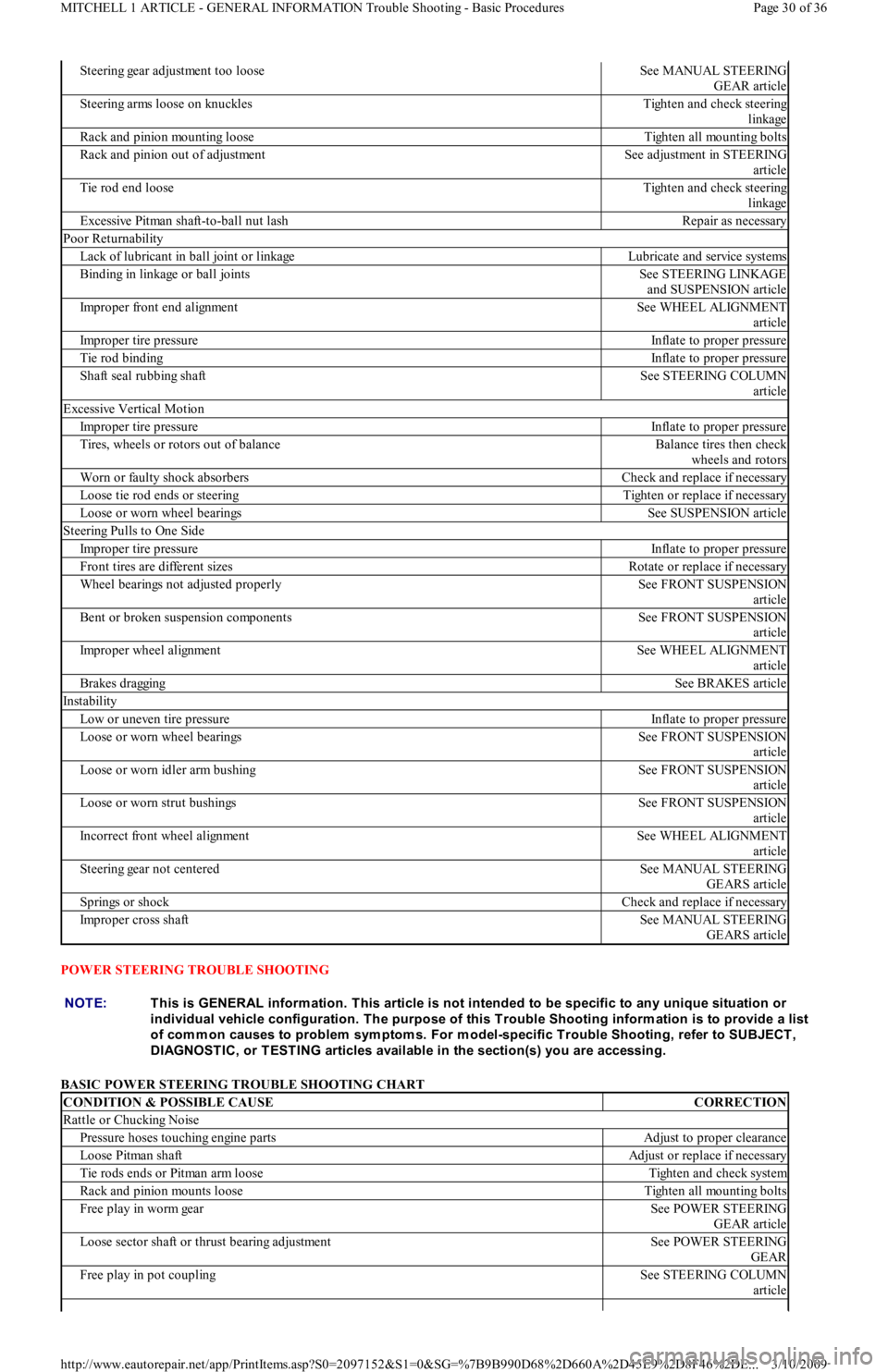
POWER STEERING TROUBLE SHOOTING
BASIC POWER STEERING TROUBLE SHOOTING CHART
Steering gear adjustment too looseSee MANUAL STEERING
GEAR article
Steering arms loose on knucklesTighten and check steering
linkage
Rack and pinion mounting looseTighten all mounting bolts
Rack and pinion out of adjustmentSee adjustment in STEERING
article
Tie rod end looseTighten and check steering
linkage
Excessive Pitman shaft-to-ball nut lashRepair as necessary
Poor Returnability
Lack of lubricant in ball joint or linkageLubricate and service systems
Binding in linkage or ball jointsSee STEERING LINKAGE
and SUSPENSION article
Improper front end alignmentSee WHEEL ALIGNMENT
article
Improper tire pressureInflate to proper pressure
Tie rod bindingInflate to proper pressure
Shaft seal rubbing shaftSee STEERING COLUMN
article
Excessive Vertical Motion
Improper tire pressureInflate to proper pressure
Tires, wheels or rotors out of balanceBalance tires then check
wheels and rotors
Worn or faulty shock absorbersCheck and replace if necessary
Loose tie rod ends or steeringTighten or replace if necessary
Loose or worn wheel bearingsSee SUSPENSION article
Steering Pulls to One Side
Improper tire pressureInflate to proper pressure
Front tires are different sizesRotate or replace if necessary
Wheel bearings not adjusted properlySee FRONT SUSPENSION
article
Bent or broken suspension componentsSee FRONT SUSPENSION
article
Improper wheel alignmentSee WHEEL ALIGNMENT
article
Brakes draggingSee BRAKES article
Instability
Low or uneven tire pressureInflate to proper pressure
Loose or worn wheel bearingsSee FRONT SUSPENSION
article
Loose or worn idler arm bushingSee FRONT SUSPENSION
article
Loose or worn strut bushingsSee FRONT SUSPENSION
article
Incorrect front wheel alignmentSee WHEEL ALIGNMENT
article
Steering gear not centeredSee MANUAL STEERING
GEARS article
Springs or shockCheck and replace if necessary
Improper cross shaftSee MANUAL STEERING
GEARS article
NOTE:This is GENERAL inform ation. This article is not intended to be specific to any unique situation or
individual vehicle configuration. T he purpose of this T rouble Shooting inform ation is to provide a list
of com m on causes to problem sym ptom s. For m odel-specific T rouble Shooting, refer to SUBJECT ,
DIAGNOST IC, or T EST ING articles available in the section(s) you are accessing.
CONDITION & POSSIBLE CAUSECORRECTION
Rattle or Chucking Noise
Pressure hoses touching engine partsAdjust to proper clearance
Loose Pitman shaftAdjust or replace if necessary
Tie rods ends or Pitman arm looseTighten and check system
Rack and pinion mounts looseTighten all mounting bolts
Free play in worm gearSee POWER STEERING
GEAR article
Loose sector shaft or thrust bearing adjustmentSee POWER STEERING
GEAR
Free play in pot couplingSee STEERING COLUMN
article
Page 30 of 36 MITCHELL 1 ARTICLE - GENERAL INFORMATION Trouble Shooting - Basic Procedures
3/10/2009 http://www.eautorepair.net/app/PrintItems.asp?S0=2097152&S1=0&SG=%7B9B990D68%2D660A%2D45E9%2D8F46%2DE
...
Page 245 of 454
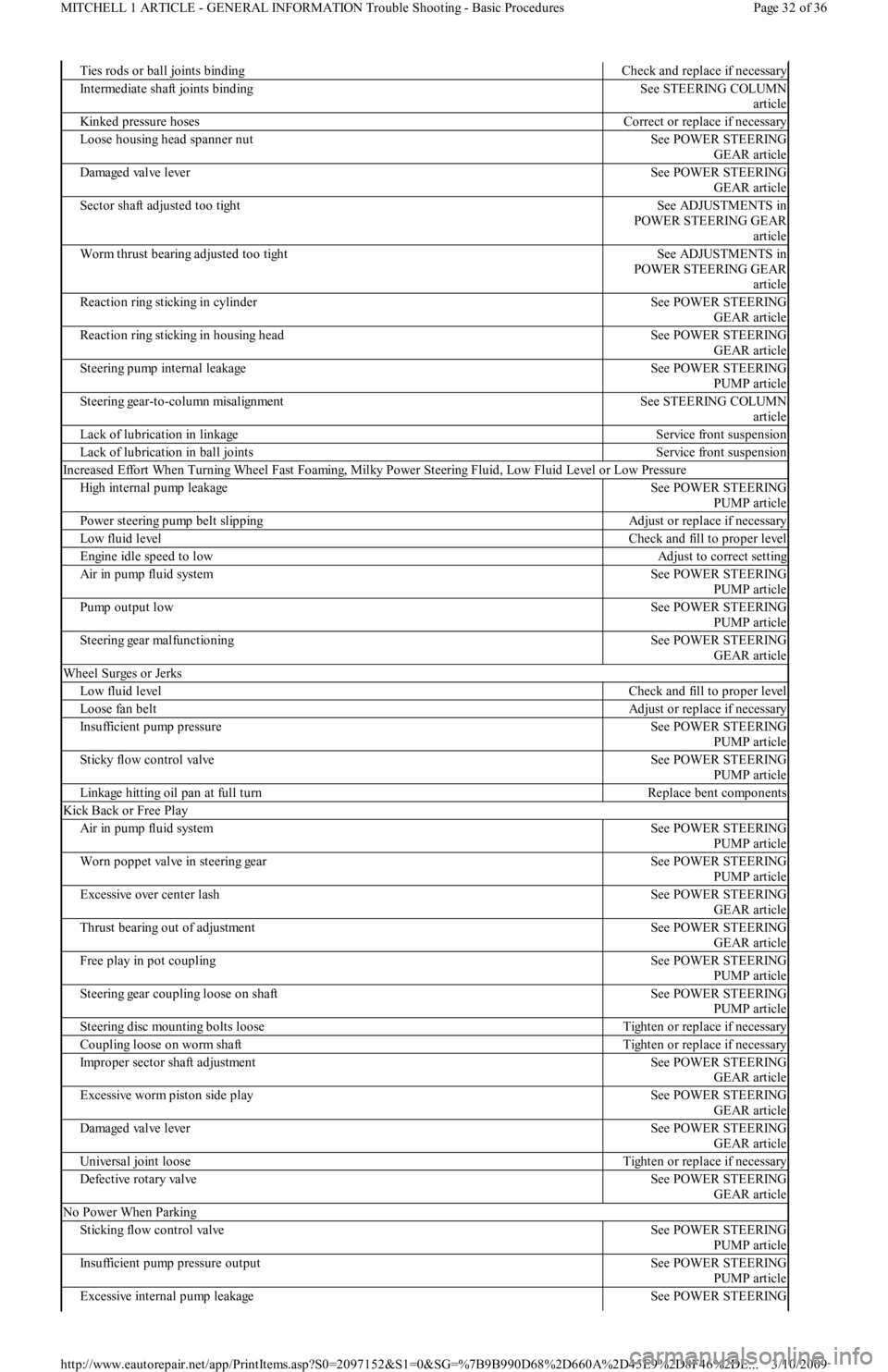
Ties rods or ball joints bindingCheck and replace if necessary
Intermediate shaft joints bindingSee STEERING COLUMN
article
Kinked pressure hosesCorrect or replace if necessary
Loose housing head spanner nutSee POWER STEERING
GEAR article
Damaged valve leverSee POWER STEERING
GEAR article
Sector shaft adjusted too tightSee ADJUSTMENTS in
POWER STEERING GEAR
article
Worm thrust bearing adjusted too tightSee ADJUSTMENTS in
POWER STEERING GEAR
article
Reaction ring sticking in cylinderSee POWER STEERING
GEAR article
Reaction ring sticking in housing headSee POWER STEERING
GEAR article
Steering pump internal leakageSee POWER STEERING
PUMP article
Steering gear-to-column misalignmentSee STEERING COLUMN
article
Lack of lubrication in linkageService front suspension
Lack of lubrication in ball jointsService front suspension
Increased Effort When Turning Wheel Fast Foaming, Milky Power Steering Fluid, Low Fluid Level or Low Pressure
High internal pump leakageSee POWER STEERING
PUMP article
Power steering pump belt slippingAdjust or replace if necessary
Low fluid levelCheck and fill to proper level
Engine idle speed to lowAdjust to correct setting
Air in pump fluid systemSee POWER STEERING
PUMP article
Pump output lowSee POWER STEERING
PUMP article
Steering gear malfunctioningSee POWER STEERING
GEAR article
Wheel Surges or Jerks
Low fluid levelCheck and fill to proper level
Loose fan beltAdjust or replace if necessary
Insufficient pump pressureSee POWER STEERING
PUMP article
Sticky flow control valveSee POWER STEERING
PUMP article
Linkage hitting oil pan at full turnReplace bent components
Kick Back or Free Play
Air in pump fluid systemSee POWER STEERING
PUMP article
Worn poppet valve in steering gearSee POWER STEERING
PUMP article
Excessive over center lashSee POWER STEERING
GEAR article
Thrust bearing out of adjustmentSee POWER STEERING
GEAR article
Free play in pot couplingSee POWER STEERING
PUMP article
Steering gear coupling loose on shaftSee POWER STEERING
PUMP article
Steering disc mounting bolts looseTighten or replace if necessary
Coupling loose on worm shaftTighten or replace if necessary
Improper sector shaft adjustmentSee POWER STEERING
GEAR article
Excessive worm piston side playSee POWER STEERING
GEAR article
Damaged valve leverSee POWER STEERING
GEAR article
Universal joint looseTighten or replace if necessary
Defective rotary valveSee POWER STEERING
GEAR article
No Power When Parking
Sticking flow control valveSee POWER STEERING
PUMP article
Insufficient pump pressure outputSee POWER STEERING
PUMP article
Excessive internal pump leakageSee POWER STEERING
Page 32 of 36 MITCHELL 1 ARTICLE - GENERAL INFORMATION Trouble Shooting - Basic Procedures
3/10/2009 http://www.eautorepair.net/app/PrintItems.asp?S0=2097152&S1=0&SG=%7B9B990D68%2D660A%2D45E9%2D8F46%2DE
...
Page 252 of 454
Back To Article
GENERAL INFORMATION
Com puter Relearn Procedures
COMPUTER RELEARN PROCEDURES
Vehicles equipped with engine or transmission computers may require a relearn procedure after vehicle battery is disconnected. Many vehicle
computers memorize and store vehicle operation patterns for optimum driveability and performance. When vehicle battery is disconnected,
this memory is lost. The computer will use default data until new data from each key start is stored. As computer memorizes vehicle operation
for each new key start, driveability is restored. Vehicle computers may memorize vehicles operation patterns for 40 of more key starts.
Customers often complain of driveability problems during relearn stage because vehicle acts differently then before being serviced. Depending
on type and make of vehicle and how it is equipped, the following complaints (driveability problems) may exist:
Harsh Or Poor Shift Quality
Rough Or Unstable Idle
Hesitation Or Stumble
Rich Or Lean Running
Poor Fuel Mileage
These symptoms and complaints should disappear after a number of drive cycles have been memorized. To reduce the possibility of
complaints, after any service which requires battery power to be disconnected, vehicle should be road tested.
GENERIC COMPUTER RELEARN PROCEDURES
Some manufacturers identify a specific relearn procedure which will help establish suitable driveability during relearn stage. These procedures
are especially important if vehicle is equipped with and electronically controlled automatic transmission or transaxle. Always complete
procedure before returning vehicle to customer. The following general procedures are to be used if driveability problems are encountered after
power loss or battery has been disconnected. These procedures may provide an aid in eliminating these problems.
Automatic Transmission
Set parking brake, start engine in "P" or "N" position. Warm-up vehicle to normal operating temperature or until cooling fan cycles.
Allow vehicle to idle for one minute in "N" position. Select "D" and allow engine to idle for one minute.
Accelerate at normal throttle position (20-50%) until vehicle shifts into top gear.
Cruise at light to medium throttle.
Decelerate to a stop, allowing vehicle to downshift, and use brakes normally.
Process may be repeated as necessary.
Manual Transmission
Place transmission in Neutral position.
Ensure emergency brake has been set and all accessories are turned off.
Start engine and bring to normal operating temperature.
Allow vehicle to idle in Neutral for one minute.
Initial relearn is complete, and process will be completed during normal driving.
Copyr ight 2009 Mitchell Repair Information Company, LLC. All Rights Reserved.
Article GUID: A00012612
Page 1 of 1 MITCHELL 1 ARTICLE - GENERAL INFORMATION Computer Relearn Procedures
3/10/2009 http://www.eautorepair.net/app/PrintItems.asp?S0=2097152&S1=0&SG=%7B9B990D68%2D660A%2D45E9%2D8F46%2DE
...
Page 261 of 454
Back To Article
EMISSION CONT ROL VISUAL INSPECT ION PROCEDURES
1983-93 GENERAL INFORMAT ION Em ission Control Visual Inspection Procedures
EMISSION CONTROL LABELS
This article is provided for general information only. Not all information applies to all makes and models. For more complete information, see
appropriate article(s) in the ENGINE PERFORMANCE Section.
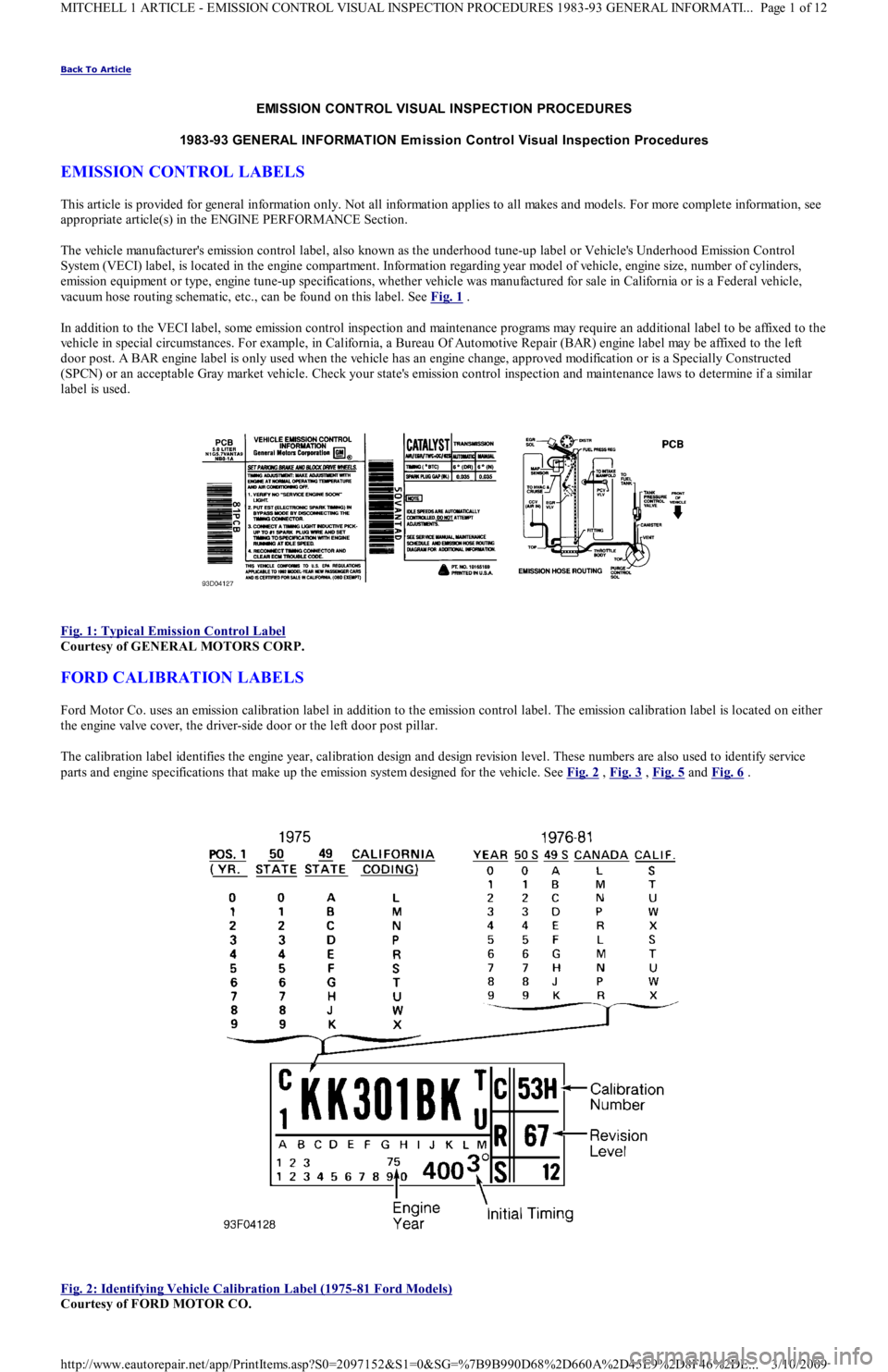
The vehicle manufacturer's emission control label, also known as the underhood tune-up label or Vehicle's Underhood Emission Control
System (VECI) label, is located in the engine compartment. Information regarding year model of vehicle, engine size, number of cylinders,
emission equipment or type, engine tune-up specifications, whether vehicle was manufactured for sale in California or is a Federal vehicle,
vacuum hose routing schematic, etc., can be found on this label. See Fig. 1
.
In addition to the VECI label, some emission control inspection and maintenance programs may require an additional label to be affixed to the
vehicle in special circumstances. For example, in California, a Bureau Of Automotive Repair (BAR) engine label may be affixed to the left
door post. A BAR engine label is only used when the vehicle has an engine change, approved modification or is a Specially Constructed
(SPCN) or an acceptable Gray market vehicle. Check your state's emission control inspection and maintenance laws to determine if a simil ar
label is used.
Fig. 1: Typical Emission Control Label
Courtesy of GENERAL MOTORS CORP.
FORD CALIBRATION LABELS
Ford Motor Co. uses an emission calibration label in addition to the emission control label. The emission calibration label is located on either
the engine valve cover, the driver-side door or the left door post pillar.
The calibration label identifies the engine year, calibration design and design revision level. These numbers are also used to identify service
parts and engine specifications that make up the emission system designed for the vehicle. See Fig. 2 , Fig. 3 , Fig. 5 and Fig. 6 .
Fig. 2: Identifying Vehicle Calibration Label (1975
-81 Ford Models)
Courtesy of FORD MOTOR CO.
Page 1 of 12 MITCHELL 1 ARTICLE - EMISSION CONTROL VISUAL INSPECTION PROCEDURES 1983-93 GENERAL INFORMATI
...
3/10/2009 http://www.eautorepair.net/app/PrintItems.asp?S0=2097152&S1=0&SG=%7B9B990D68%2D660A%2D45E9%2D8F46%2DE
...