coolant FORD FESTIVA 1991 Owner's Guide
[x] Cancel search | Manufacturer: FORD, Model Year: 1991, Model line: FESTIVA, Model: FORD FESTIVA 1991Pages: 454, PDF Size: 9.53 MB
Page 222 of 454
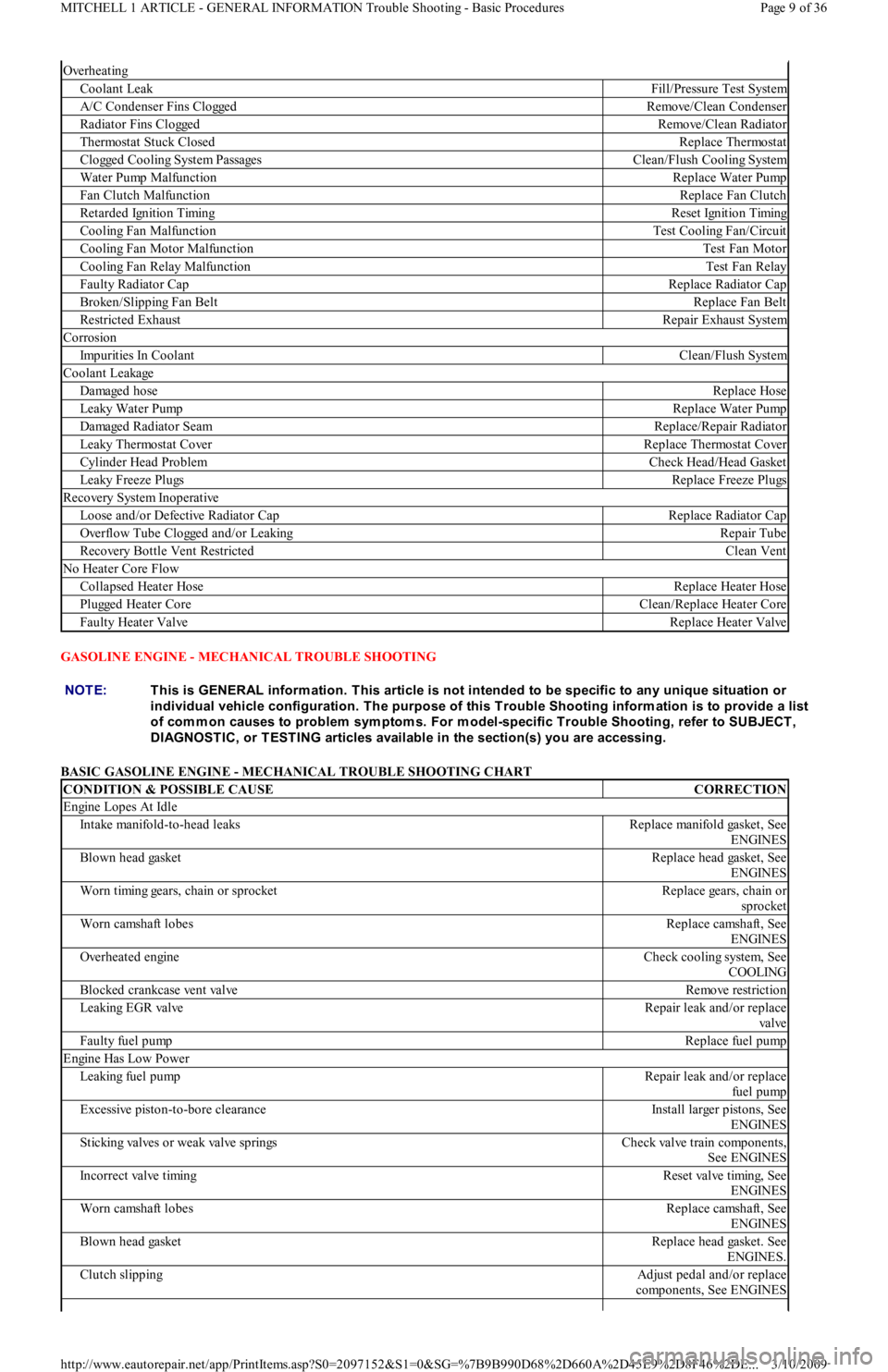
GASOLINE ENGINE - MECHANICAL TROUBLE SHOOTING
BASIC GASOLINE ENGINE - MECHANICAL TROUBLE SHOOTING CHART
Overheating
Coolant LeakFill/Pressure Test System
A/C Condenser Fins CloggedRemove/Clean Condenser
Radiator Fins CloggedRemove/Clean Radiator
Thermostat Stuck ClosedReplace Thermostat
C l o gge d C o o l in g S yst e m P a ssa ge sClean/Flush Cooling System
Water Pump MalfunctionReplace Water Pump
Fan Clutch MalfunctionReplace Fan Clutch
Retarded Ignition TimingReset Ignition Timing
Cooling Fan MalfunctionTest Cooling Fan/Circuit
Cooling Fan Motor MalfunctionTest Fan Motor
Cooling Fan Relay MalfunctionTest Fan Relay
Faulty Radiator CapReplace Radiator Cap
Broken/Slipping Fan BeltReplace Fan Belt
Restricted ExhaustRepair Exhaust System
Corrosion
Impurities In CoolantClean/Flush System
Coolant Leakage
Damaged hoseReplace Hose
Leaky Water PumpReplace Water Pump
Damaged Radiator SeamReplace/Repair Radiator
Leaky Thermostat CoverReplace Thermostat Cover
Cylinder Head ProblemCheck Head/Head Gasket
Leaky Freeze PlugsReplace Freeze Plugs
Recovery System Inoperative
Loose and/or Defective Radiator CapReplace Radiator Cap
Overflow Tube Clogged and/or LeakingRepair Tube
Recovery Bottle Vent RestrictedClean Vent
No Heater Core Flow
Collapsed Heater HoseReplace Heater Hose
Pl u gge d He a t e r C o r eClean/Replace Heater Core
Faulty Heater ValveReplace Heater Valve
NOTE:This is GENERAL inform ation. This article is not intended to be specific to any unique situation or
individual vehicle configuration. T he purpose of this T rouble Shooting inform ation is to provide a list
of com m on causes to problem sym ptom s. For m odel-specific T rouble Shooting, refer to SUBJECT ,
DIAGNOST IC, or T EST ING articles available in the section(s) you are accessing.
CONDITION & POSSIBLE CAUSECORRECTION
Engine Lopes At Idle
In t ake man ifo l d -t o -h ead l eaksReplace manifold gasket, See
ENGINES
Blown head gasketReplace head gasket, See
ENGINES
Worn timing gears, chain or sprocketReplace gears, chain or
sprocket
Worn camshaft lobesReplace camshaft, See
ENGINES
Overheated engineCheck cooling system, See
COOLING
Blocked crankcase vent valveRemove restriction
Le a kin g E GR va l veRepair leak and/or replace
va l ve
Faulty fuel pumpReplace fuel pump
Engine Has Low Power
Leaking fuel pumpRepair leak and/or replace
fu el p u mp
Excessive piston-to-bore clearanceInstall larger pistons, See
ENGINES
Sticking valves or weak valve springsCheck valve train components,
See ENGINES
Incorrect valve timingReset valve timing, See
ENGINES
Worn camshaft lobesReplace camshaft, See
ENGINES
Blown head gasketReplace head gasket. See
ENGINES.
Clutch slippingAdjust pedal and/or replace
components, See ENGINES
Page 9 of 36 MITCHELL 1 ARTICLE - GENERAL INFORMATION Trouble Shooting - Basic Procedures
3/10/2009 http://www.eautorepair.net/app/PrintItems.asp?S0=2097152&S1=0&SG=%7B9B990D68%2D660A%2D45E9%2D8F46%2DE
...
Page 230 of 454
IGNITION SYSTEM TROUBLE SHOOTING
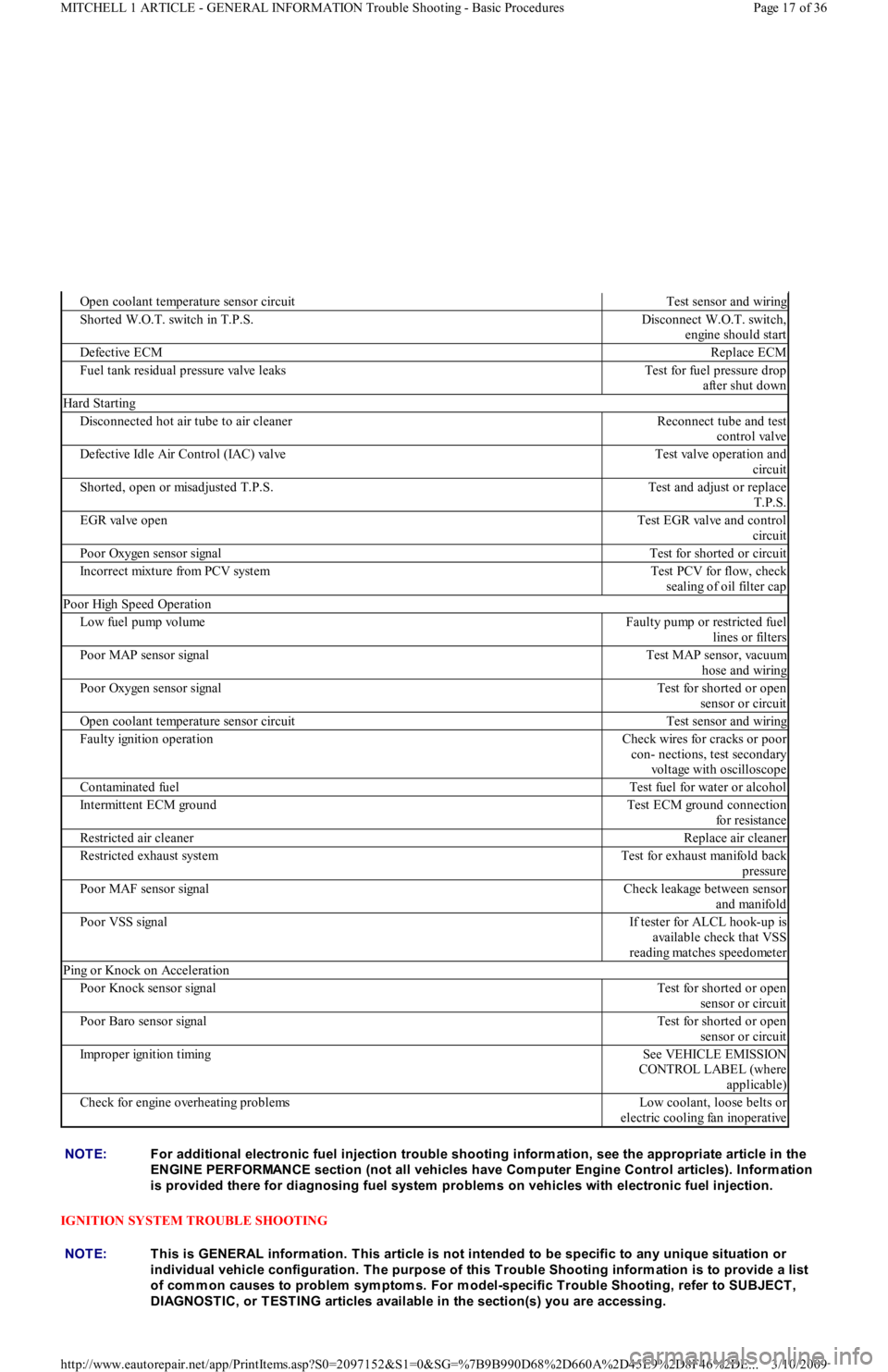
Open coolant temperature sensor circuitTest sensor and wiring
Shorted W.O.T. switch in T.P.S.Disconnect W.O.T. switch,
engine should start
Defective ECMReplace ECM
Fuel tank residual pressure valve leaksTest for fuel pressure drop
after shut down
Hard Starting
Disconnected hot air tube to air cleanerReconnect tube and test
control valve
Defective Idle Air Control (IAC) valveTest valve operation and
circuit
Shorted, open or misadjusted T.P.S.Test and adjust or replace
T.P.S.
EGR valve openTest EGR valve and control
circuit
Poor Oxygen sensor signalTest for shorted or circuit
Incorrect mixture from PCV systemTest PCV for flow, check
sealing of oil filter cap
Poor High Speed Operation
Low fuel pump volumeFaulty pump or restricted fuel
lines or filters
Poor MAP sensor signalTest MAP sensor, vacuum
hose and wiring
Poor Oxygen sensor signalTest for shorted or open
sensor or circuit
Open coolant temperature sensor circuitTest sensor and wiring
Faulty ignition operationCheck wires for cracks or poor
con- nections, test secondary
voltage with oscilloscope
Contaminated fuelTest fuel for water or alcohol
Intermittent ECM groundTest ECM ground connection
for resistance
Restricted air cleanerReplace air cleaner
Restricted exhaust systemTest for exhaust manifold back
pressure
Poor MAF sensor signalCheck leakage between sensor
and manifold
Poor VSS signalIf tester for ALCL hook-up is
available check that VSS
reading matches speedometer
Ping or Knock on Acceleration
Poor Knock sensor signalTest for shorted or open
sensor or circuit
Poor Baro sensor signalTest for shorted or open
sensor or circuit
Improper ignition timingSee VEHICLE EMISSION
CONTROL LABEL (where
applicable)
Check for engine overheating problemsLow coolant, loose belts or
electric cooling fan inoperative
NOTE:For additional electronic fuel injection trouble shooting inform ation, see the appropriate article in the
ENGINE PERFORMANCE section (not all vehicles have Com puter Engine Control articles). Inform ation
is provided there for diagnosing fuel system problem s on vehicles with electronic fuel injection.
NOTE:This is GENERAL inform ation. This article is not intended to be specific to any unique situation or
individual vehicle configuration. T he purpose of this T rouble Shooting inform ation is to provide a list
of com m on causes to problem sym ptom s. For m odel-specific T rouble Shooting, refer to SUBJECT ,
DIAGNOST IC, or T EST ING articles available in the section(s) you are accessing.
Page 17 of 36 MITCHELL 1 ARTICLE - GENERAL INFORMATION Trouble Shooting - Basic Procedures
3/10/2009 http://www.eautorepair.net/app/PrintItems.asp?S0=2097152&S1=0&SG=%7B9B990D68%2D660A%2D45E9%2D8F46%2DE
...
Page 251 of 454
FUEL INJECTION TROUBLE SHOOTING
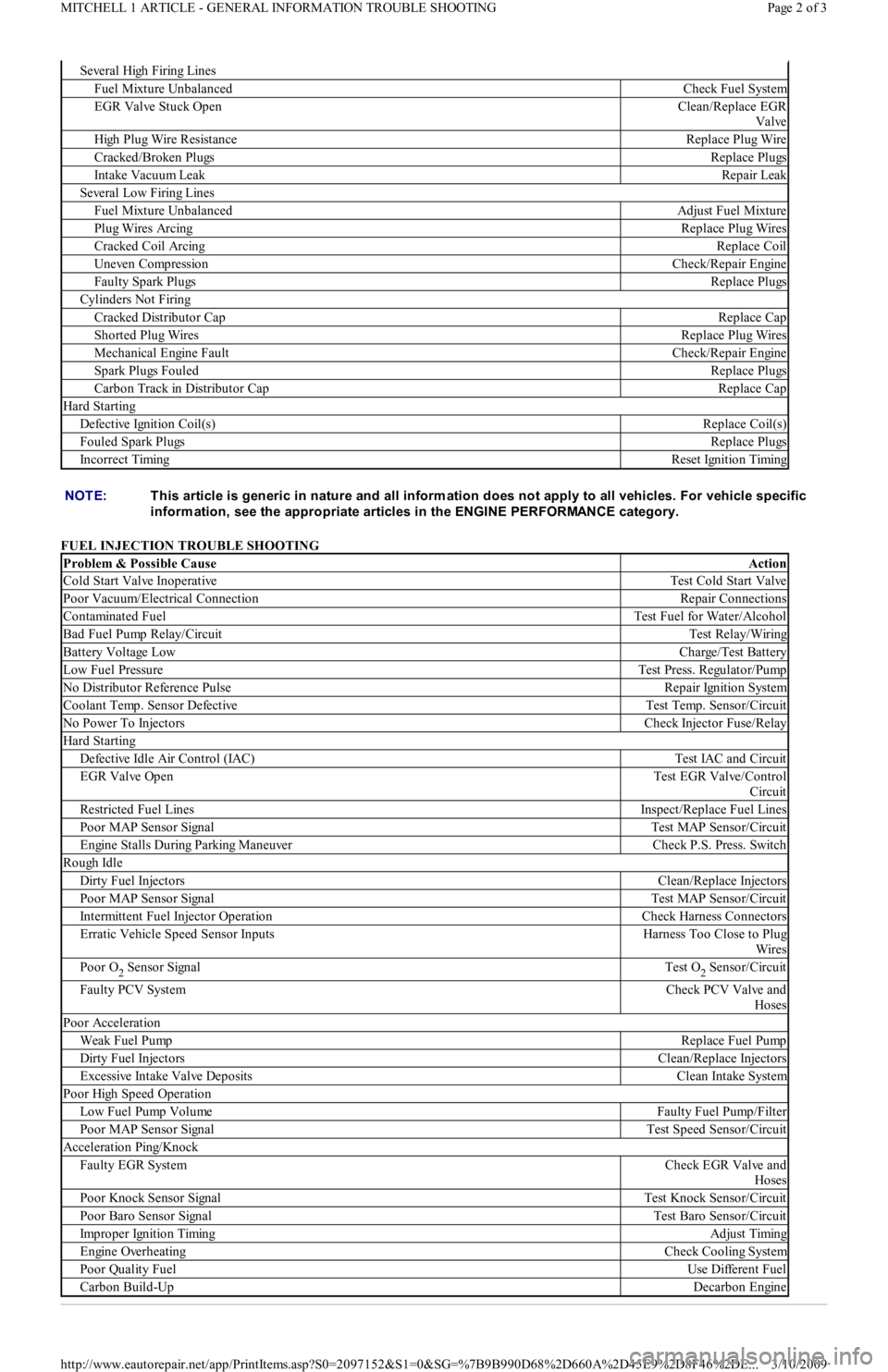
Se ve r a l High F ir in g Lin e s
Fuel Mixture UnbalancedCheck Fuel System
EGR Valve Stuck OpenClean/Replace EGR
Valve
High Plug Wire ResistanceReplace Plug Wire
Cracked/Broken PlugsReplace Plugs
Intake Vacuum LeakRepair Leak
Several Low Firing Lines
Fuel Mixture UnbalancedAdjust Fuel Mixture
Plug Wires ArcingReplace Plug Wires
Cracked Coil ArcingReplace Coil
Uneven CompressionCheck/Repair Engine
Faulty Spark PlugsReplace Plugs
Cylinders Not Firing
Cracked Distributor CapReplace Cap
Shorted Plug WiresReplace Plug Wires
Mechanical Engine FaultCheck/Repair Engine
Spark Plugs FouledReplace Plugs
Carbon Track in Distributor CapReplace Cap
Hard Starting
Defective Ignition Coil(s)Replace Coil(s)
Fouled Spark PlugsReplace Plugs
Incorrect TimingReset Ignition Timing
NOTE:T his article is generic in nature and all inform ation does not apply to all vehicles. For vehicle specific
inform ation, see the appropriate articles in the ENGINE PERFORMANCE category.
Problem & Possible CauseAction
Cold Start Valve InoperativeTest Cold Start Valve
Poor Vacuum/Electrical ConnectionRepair Connections
Contaminated FuelTest Fuel for Water/Alcohol
Bad Fuel Pump Relay/CircuitTest Relay/Wiring
Battery Voltage LowCharge/Test Battery
Low Fuel PressureTest Press. Regulator/Pump
No Distributor Reference PulseRepair Ignition System
Coolant Temp. Sensor DefectiveTest Temp. Sensor/Circuit
No Power To InjectorsCheck Injector Fuse/Relay
Hard Starting
Defective Idle Air Control (IAC)Test IAC and Circuit
EGR Valve OpenTest EGR Valve/Control
Circuit
Restricted Fuel LinesInspect/Replace Fuel Lines
Poor MAP Sensor SignalTest MAP Sensor/Circuit
Engine Stalls During Parking ManeuverCheck P.S. Press. Switch
Rough Idle
Dirty Fuel InjectorsClean/Replace Injectors
Poor MAP Sensor SignalTest MAP Sensor/Circuit
Intermittent Fuel Injector OperationCheck Harness Connectors
Erratic Vehicle Speed Sensor InputsHarness Too Close to Plug
Wires
Poor O2 Sensor SignalTest O2 Sensor/Circuit
Faulty PCV SystemCheck PCV Valve and
Hoses
Poor Acceleration
Weak Fuel PumpReplace Fuel Pump
Dirty Fuel InjectorsClean/Replace Injectors
Excessive Intake Valve DepositsClean Intake System
Poor High Speed Operation
Low Fuel Pump VolumeFaulty Fuel Pump/Filter
Poor MAP Sensor SignalTest Speed Sensor/Circuit
Acceleration Ping/Knock
Faulty EGR SystemCheck EGR Valve and
Hoses
Poor Knock Sensor SignalTest Knock Sensor/Circuit
Poor Baro Sensor SignalTest Baro Sensor/Circuit
Improper Ignition TimingAdjust Timing
Engine OverheatingCheck Cooling System
Poor Quality FuelUse Different Fuel
Carbon Build-UpDecarbon Engine
Page 2 of 3 MITCHELL 1 ARTICLE - GENERAL INFORMATION TROUBLE SHOOTING
3/10/2009 http://www.eautorepair.net/app/PrintItems.asp?S0=2097152&S1=0&SG=%7B9B990D68%2D660A%2D45E9%2D8F46%2DE
...
Page 268 of 454

Fig. 14: Typical Negative Backpressure EGR Valve
Courtesy of GENERAL MOTORS CORP.
Digital EGR Valve
The digital EGR valve operates independently of engine manifold vacuum. This valve controls EGR flow through 3 orifices. These 3 orifices
are opened and closed by electric solenoids. The solenoids are, in turn, controlled by the Electronic Control Module (ECM). When a
solenoid is energized, the armature with attached shaft and swivel pintle is lifted, opening the orifice. See Fig. 15
.
The ECM uses inputs from the Coolant Temperature Sensor (CTS), Throttle Position Sensor (TPS) and Mass Airflow (MAF) sensors to
control the EGR orifices to make 7 different combinations for precise EGR flow control. At idle, the EGR valve allows a very small amount of
exhaust gas to enter the intake manifold. This EGR valve normally operates above idle speed during warm engine operation.
Verify EGR valve is present and not modified or purposely damaged. Ensure thermal vacuum switches, pressure transducers, speed switches,
etc., (if applicable) are not by-passed or modified. Ensure vacuum hose(s) to EGR valve is not plugged. Ensure electrical connector to EGR
valve is not disconnected.
Page 8 of 12 MITCHELL 1 ARTICLE - EMISSION CONTROL VISUAL INSPECTION PROCEDURES 1983-93 GENERAL INFORMATI
...
3/10/2009 http://www.eautorepair.net/app/PrintItems.asp?S0=2097152&S1=0&SG=%7B9B990D68%2D660A%2D45E9%2D8F46%2DE
...
Page 345 of 454
Back To Article
HEAT ER SYST EM
1990-92 HEAT ER SYST EMS Ford Motor Co.
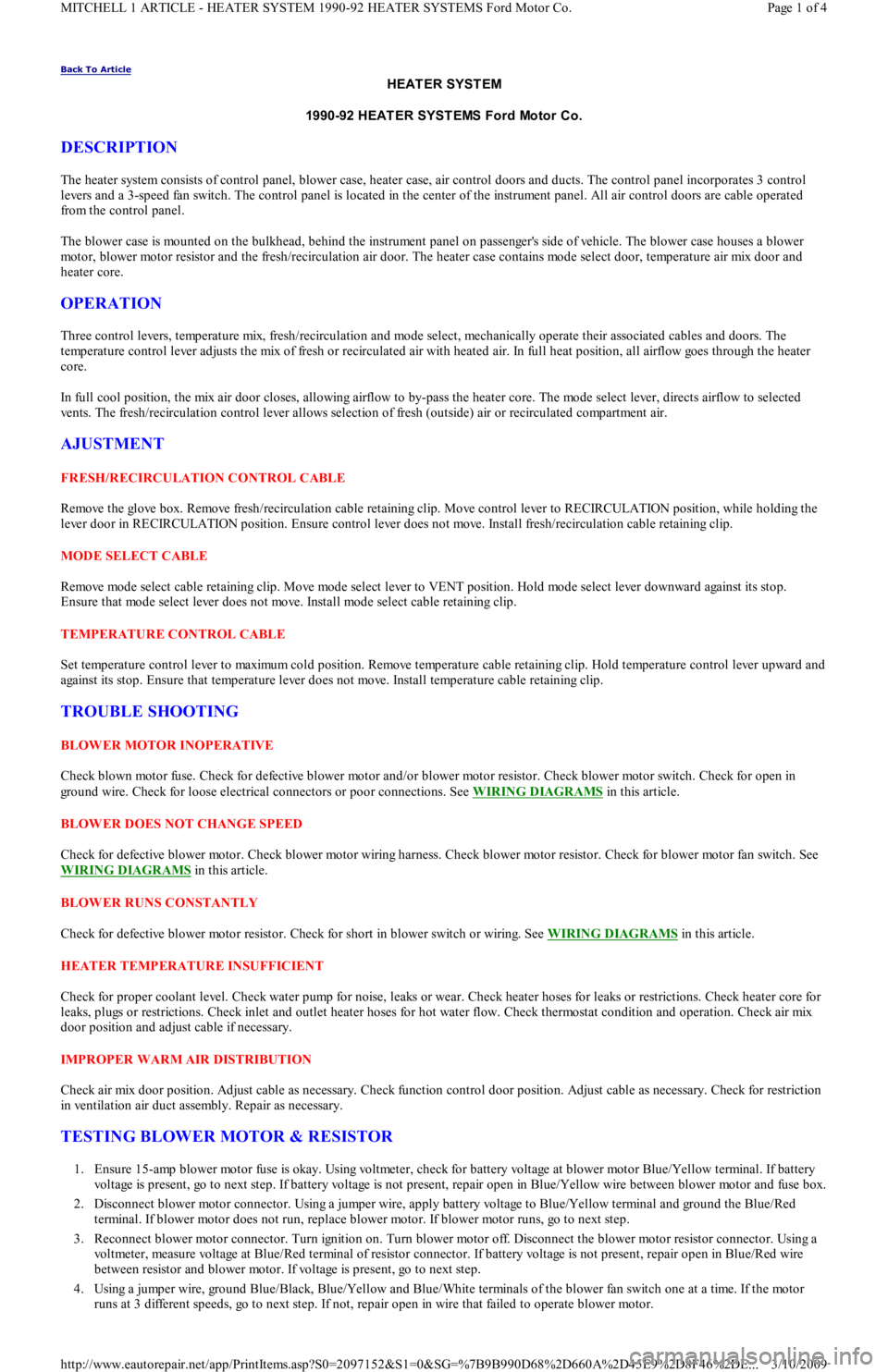
DESCRIPTION
The heater system consists of control panel, blower case, heater case, air control doors and ducts. The control panel incorporates 3 control
levers and a 3-speed fan switch. The control panel is located in the center of the instrument panel. All air control doors are cable operated
from the control panel.
The blower case is mounted on the bulkhead, behind the instrument panel on passenger's side of vehicle. The blower case houses a blower
motor, blower motor resistor and the fresh/recirculation air door. The heater case contains mode select door, temperature air mix door and
heater core.
OPERATION
Three control levers, temperature mix, fresh/recirculation and mode select, mechanically operate their associated cables and doors. The
temperature control lever adjusts the mix of fresh or recirculated air with heated air. In full heat position, all airflow goes through the heater
core.
In full cool position, the mix air door closes, allowing airflow to by-pass the heater core. The mode select lever, directs airflow to selected
vents. The fresh/recirculation control lever allows selection of fresh (outside) air or recirculated compartment air.
AJUSTMENT
FRESH/RECIRCULATION CONTROL CABLE
Remove the glove box. Remove fresh/recirculation cable retaining clip. Move control lever to RECIRCULATION position, while holding the
lever door in RECIRCULATION position. Ensure control lever does not move. Install fresh/recirculation cable retaining clip.
MODE SELECT CABLE
Remove mode select cable retaining clip. Move mode select lever to VENT position. Hold mode select lever downward against its stop.
Ensure that mode select lever does not move. Install mode select cable retaining clip.
TEMPERATURE CONTROL CABLE
Set temperature control lever to maximum cold position. Remove temperature cable retaining clip. Hold temperature control lever upward and
against its stop. Ensure that temperature lever does not move. Install temperature cable retaining clip.
TROUBLE SHOOTING
BLOWER MOTOR INOPERATIVE
Check blown motor fuse. Check for defective blower motor and/or blower motor resistor. Check blower motor switch. Check for open in
ground wire. Check for loose electrical connectors or poor connections. See WIRING DIAGRAMS
in this article.
BLOWER DOES NOT CHANGE SPEED
Check for defective blower motor. Check blower motor wiring harness. Check blower motor resistor. Check for blower motor fan switch. See
WIRING DIAGRAMS
in this article.
BLOWER RUNS CONSTANTLY
Check for defective blower motor resistor. Check for short in blower switch or wiring. See WIRING DIAGRAMS
in this article.
HEATER TEMPERATURE INSUFFICIENT
Check for proper coolant level. Check water pump for noise, leaks or wear. Check heater hoses for leaks or restrictions. Check heater core for
leaks, plugs or restrictions. Check inlet and outlet heater hoses for hot water flow. Check thermostat condition and operation. Check air mix
door position and adjust cable if necessary.
IMPROPER WARM AIR DISTRIBUTION
Check air mix door position. Adjust cable as necessary. Check function control door position. Adjust cable as necessary. Check for restriction
in ventilation air duct assembly. Repair as necessary.
TESTING BLOWER MOTOR & RESISTOR
1. Ensure 15-amp blower motor fuse is okay. Using voltmeter, check for battery voltage at blower motor Blue/Yellow terminal. If battery
voltage is present, go to next step. If battery voltage is not present, repair open in Blue/Yellow wire between blower motor and fuse box.
2. Disconnect blower motor connector. Using a jumper wire, apply battery voltage to Blue/Yellow terminal and ground the Blue/Red
terminal. If blower motor does not run, replace blower motor. If blower motor runs, go to next step.
3. Reconnect blower motor connector. Turn ignition on. Turn blower motor off. Disconnect the blower motor resistor connector. Using a
voltmeter, measure voltage at Blue/Red terminal of resistor connector. If battery voltage is not present, repair open in Blue/Red wire
between resistor and blower motor. If voltage is present, go to next step.
4. Using a jumper wire, ground Blue/Black, Blue/Yellow and Blue/White terminals of the blower fan switch one at a time. If the motor
runs at 3 different speeds, go to next step. If not, repair open in wire that failed to operate blower motor.
Page 1 of 4 MITCHELL 1 ARTICLE - HEATER SYSTEM 1990-92 HEATER SYSTEMS Ford Motor Co.
3/10/2009 http://www.eautorepair.net/app/PrintItems.asp?S0=2097152&S1=0&SG=%7B9B990D68%2D660A%2D45E9%2D8F46%2DE
...
Page 349 of 454
Back To Article
1991 AIR CONDIT IONING & HEAT
MANUAL A/C
A/C SYSTEM SPECIFICATIONS
SPECIFICATIONS
DESCRIPTION
This A/C-heater system is fully integrated to provide cooling, heating and ventilation with either fresh or recirculated air. A/C system is
expansion valve type. Interior air temperature is controlled by cycling the compressor on and off at different rates. A/C compressor is protected
by a low pressure switch, which stops compressor operation when refrigerant pressure is too low. Compressor operation is cut when throttle is
wide open to improve driveability.
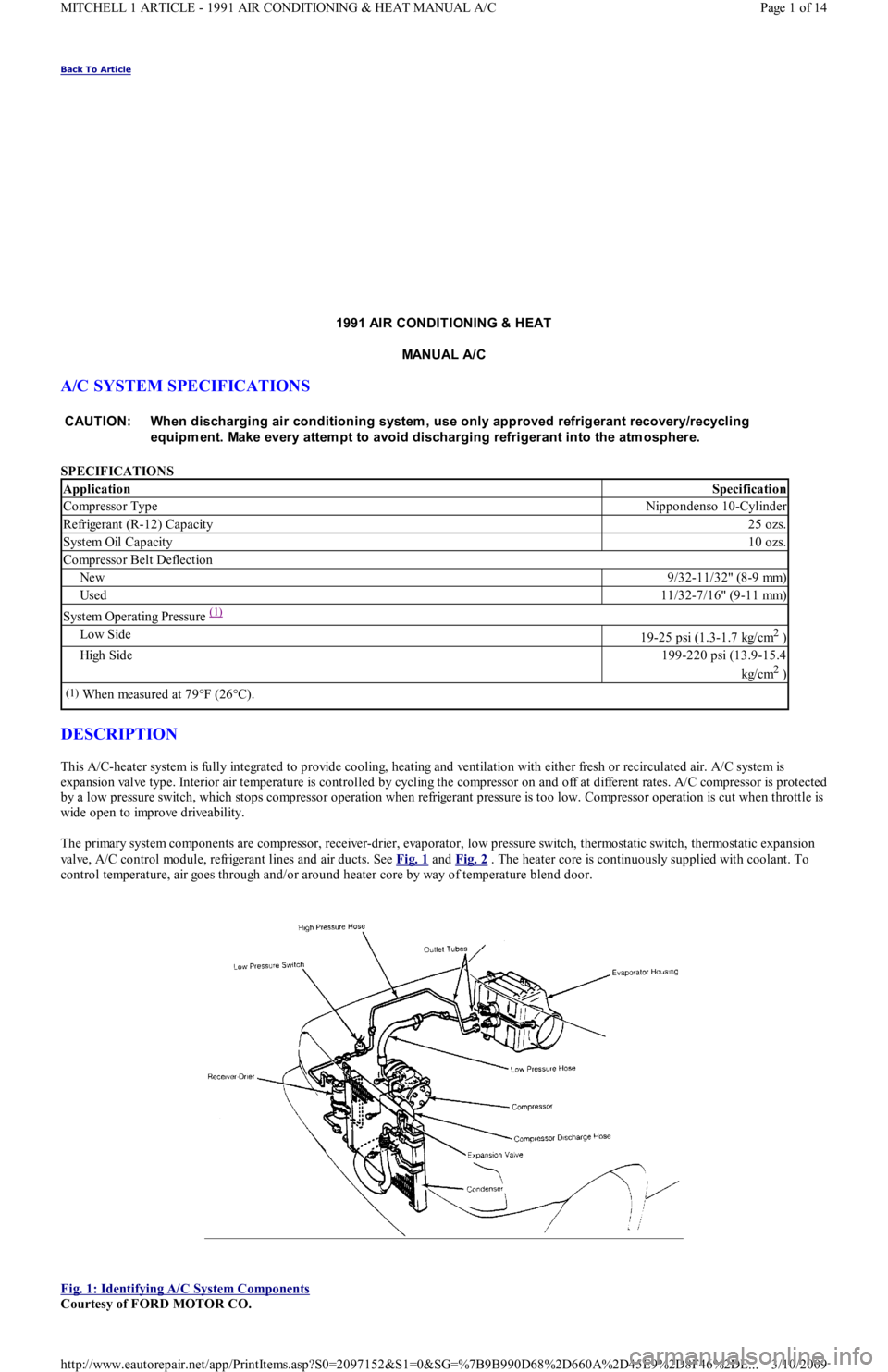
The primary system components are compressor, receiver-drier, evaporator, low pressure switch, thermostatic switch, thermostatic expansion
valve, A/C control module, refrigerant lines and air ducts. See Fig. 1
and Fig. 2 . The heater core is continuously supplied with coolant. To
control temperature, air goes through and/or around heater core by way of temperature blend door.
Fig. 1: Identifying A/C System Components
Courtesy of FORD MOTOR CO. CAUT ION: When discharging air conditioning system , use only approved refrigerant recovery/recycling
equipm ent. Make every attem pt to avoid discharging refrigerant into the atm osphere.
ApplicationSpecification
Compressor TypeNippondenso 10-Cylinder
Refrigerant (R-12) Capacity25 ozs.
System Oil Capacity10 ozs.
Compressor Belt Deflection
New9/32-11/32" (8-9 mm)
Used11/32-7/16" (9-11 mm)
System Operating Pressure (1)
Low Side19-25 psi (1.3-1.7 kg/cm2 )
High Side199-220 psi (13.9-15.4
kg/cm
2 )
(1)When measured at 79°F (26°C).
Page 1 of 14 MITCHELL 1 ARTICLE - 1991 AIR CONDITIONING & HEAT MANUAL A/C
3/10/2009 http://www.eautorepair.net/app/PrintItems.asp?S0=2097152&S1=0&SG=%7B9B990D68%2D660A%2D45E9%2D8F46%2DE
...
Page 366 of 454
Driven More Than 10 Miles Daily
No Operating Conditions From Severe Service Schedule
CAMSHAFT TIMING BELT
The condition of camshaft drive belts should always be checked on vehicles which have more than 50,000 miles. Although some
manufacturers do not recommend belt replacement at a specified mileage, others require it at 60,000-100,000 miles. A camshaft drive belt
failure may cause extensive damage to internal engine components on most engines, although some designs do not allow piston-to-va l ve
contact. These designs are often called "Free Wheeling".
Many manufacturers changed their maintenance and warranty schedules in the mid-1980's to reflect timing belt inspection and/or replacement
at 50,000-60,000 miles. Most service interval schedules in this manual reflect these changes.
Belts or components should be inspected and replaced if any of the following conditions exist:
Cracks Or Tears In Belt Surface
Missing, Damaged, Cracked Or Rounded Teeth
Oil Contamination
Damaged Or Faulty Tensioners
Incorrect Tension Adjustment
Replace camshaft timing belt every 60,000 miles.
COOLING SYSTEM
Replace engine coolant every 36 months or 30,000 miles. Check condition of hoses and clamps every 12 months or 15,000 miles, whichever
comes first. Replace hoses and clamps if necessary.
SERVICE POINT LOCATIONS
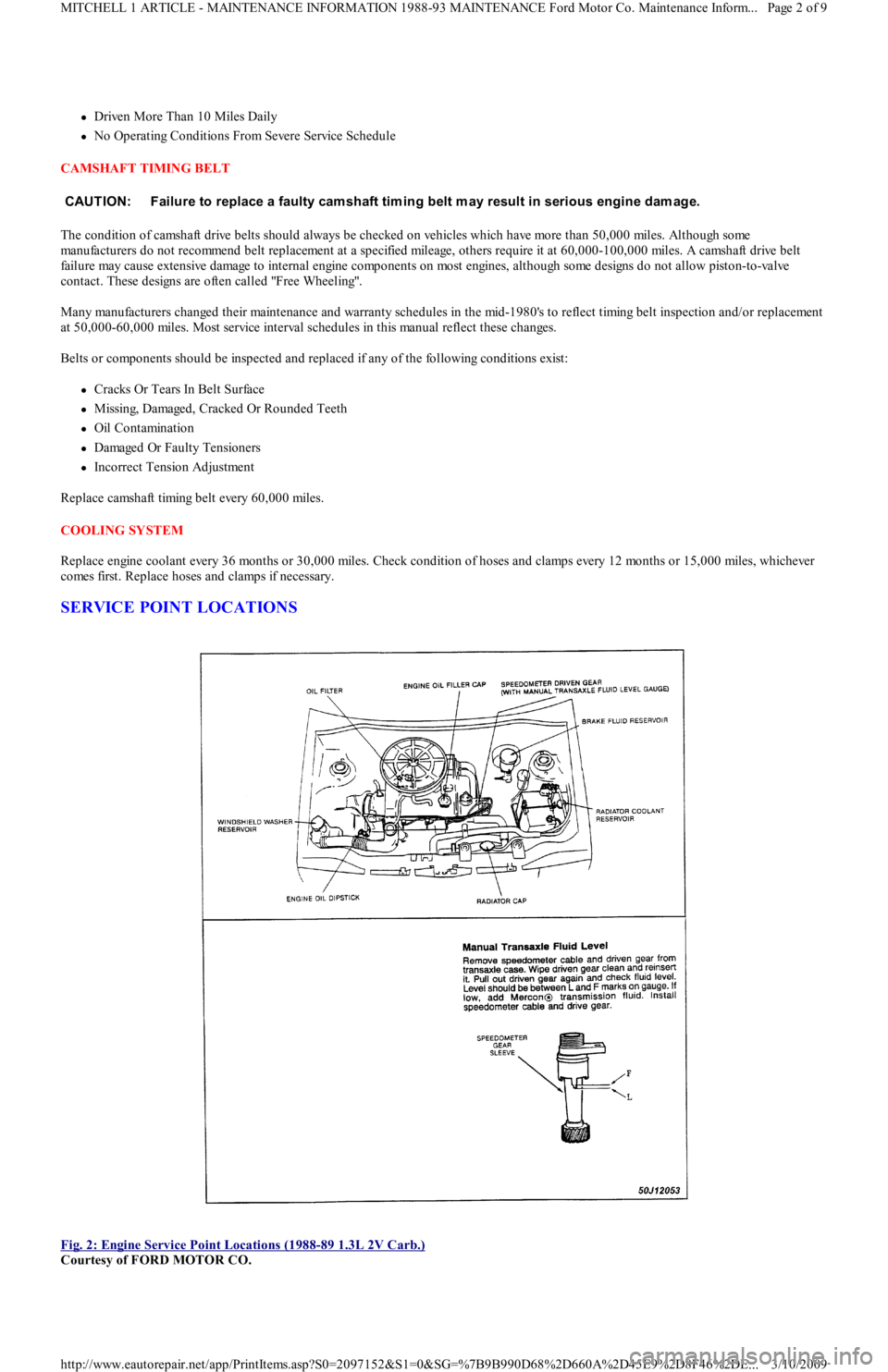
Fig. 2: Engine Service Point Locations (1988
-89 1.3L 2V Carb.)
Courtesy of FORD MOTOR CO. CAUT ION: Failure to replace a faulty cam shaft tim ing belt m ay result in serious engine dam age.
Page 2 of 9 MITCHELL 1 ARTICLE - MAINTENANCE INFORMATION 1988-93 MAINTENANCE Ford Motor Co. Maintenance Inform...
3/10/2009 http://www.eautorepair.net/app/PrintItems.asp?S0=2097152&S1=0&SG=%7B9B990D68%2D660A%2D45E9%2D8F46%2DE
...
Page 370 of 454
BRAKE PAD WEAR INDICATOR
CATALYTIC CONVERTER
COOLANT (PROPYLENE-GLYCOL FORMULATIONS)
ELECTROSTATIC DISCHARGE SENSITIVE (ESD) PARTS
ENGINE OIL
FUEL PUMP SHUTOFF SWITCH
This switch stops flow of fuel to engine after a collision. The impact does not have to be great for switch to be triggered. Switch must be reset
after collision. Switch is located under left rear speaker in luggage compartment. Press button to reset switch.
FUEL SYSTEM SERVICE
HALOGEN BULBS
PASSIVE RESTRAINTS
RADIATOR CAP
RADIATOR FAN
WARRANTY INFORMATION
BASIC NEW CAR LIMITED WARRANTY
All parts of the vehicle, except tires, are covered against defects in factory-supplied materials and workmanship for 12 months or 12,000 miles, CAUT ION: Indicator will cause a squealing or scraping noise, warning that brake pads need replacem ent.
CAUT ION: Continued operation of vehicle with a severe m alfunction could cause converter to overheat, resulting
in possible dam age to converter and vehicle.
CAUT ION: T o avoid possible dam age to vehicle use only ethylene-glycol based coolants with a m ixture ratio from
44-68% anti-freeze. DO NOT use 100% anti-freeze as it will cause the form ation of cooling system
deposits. T his results in coolant tem peratures of over 300° F (149°C) which can m elt plastics. 100% anti-
freeze has a freeze point of only -8° F (-22°C).
CAUT ION: Propylene-Glycol Mixtures has a sm aller tem perature range than Ethylene-Glycol. T he tem perature
range (freeze-boil) of a 50/50 Anti-Freeze/Water Mix is as follows: Propylene-Glycol -26° F (-32°C) - 257° F
(125°C) Ethylene-Glycol -35° F (-37°C) - 263° F (128°C)
CAUT ION: Propylene-Glycol/Ethylene-Glycol Mixtures can cause the destabilization of various corrosion inhibitors.
Also Propylene-Glycol/Ethylene-Glycol has a different specific gravity than Ethylene-Glycol coolant,
which will result in inaccurate freeze point calculations.
WARNING:Many solid state electrical com ponents can be dam aged by static electricity (ESD). Som e will display a
warning label, but m any will not. Discharge personal static electricity by touching a m etal ground point
on the vehicle prior to servicing any ESD sensitive com ponent.
CAUT ION: Never use non-detergent or straight m ineral oil.
WARNING:Relieve fuel system pressure prior to servicing any fuel system com ponent (fuel injection m odels).
WARNING:Halogen bulbs contain pressurized gas which m ay explode if overheated. DO NOT touch glass portion
of bulb with bare hands. Eye protection should be worn when handling or working around halogen
bulbs.
CAUT ION: Before operating vehicle, securely fasten passive shoulder restraints to the em ergency release buckles.
T he buckle fits in only one way. Ensure to position it properly.
CAUT ION: Always disconnect the fan m otor when working near the radiator fan. T he fan is tem perature controlled
and could start at any tim e even when the ignition key is in the OFF position. DO NOT loosen or rem ove
radiator cap when cooling system is hot.
WARNING:Keep hands away from radiator fan. Fan is controlled by a therm ostatic switch which m ay com e on or
run for up to 15 m inutes even after engine is turned off.
CAUT ION: Due to the different warranties offered in various regions and the variety of after-m arket extended
warranties available, please refer to the warranty package that cam e with the vehicle to verify all
warranty options.
Page 6 of 9 MITCHELL 1 ARTICLE - MAINTENANCE INFORMATION 1988-93 MAINTENANCE Ford Motor Co. Maintenance Inform...
3/10/2009 http://www.eautorepair.net/app/PrintItems.asp?S0=2097152&S1=0&SG=%7B9B990D68%2D660A%2D45E9%2D8F46%2DE
...
Page 374 of 454
Back To Article
SERVICE INDICATOR & WARNING LIGHTS
1988-92 MAINT ENANCE Ford Motor Co. Service Indicator & Warning Lights
SERVICE INDICATOR & WARNING LIGHTS
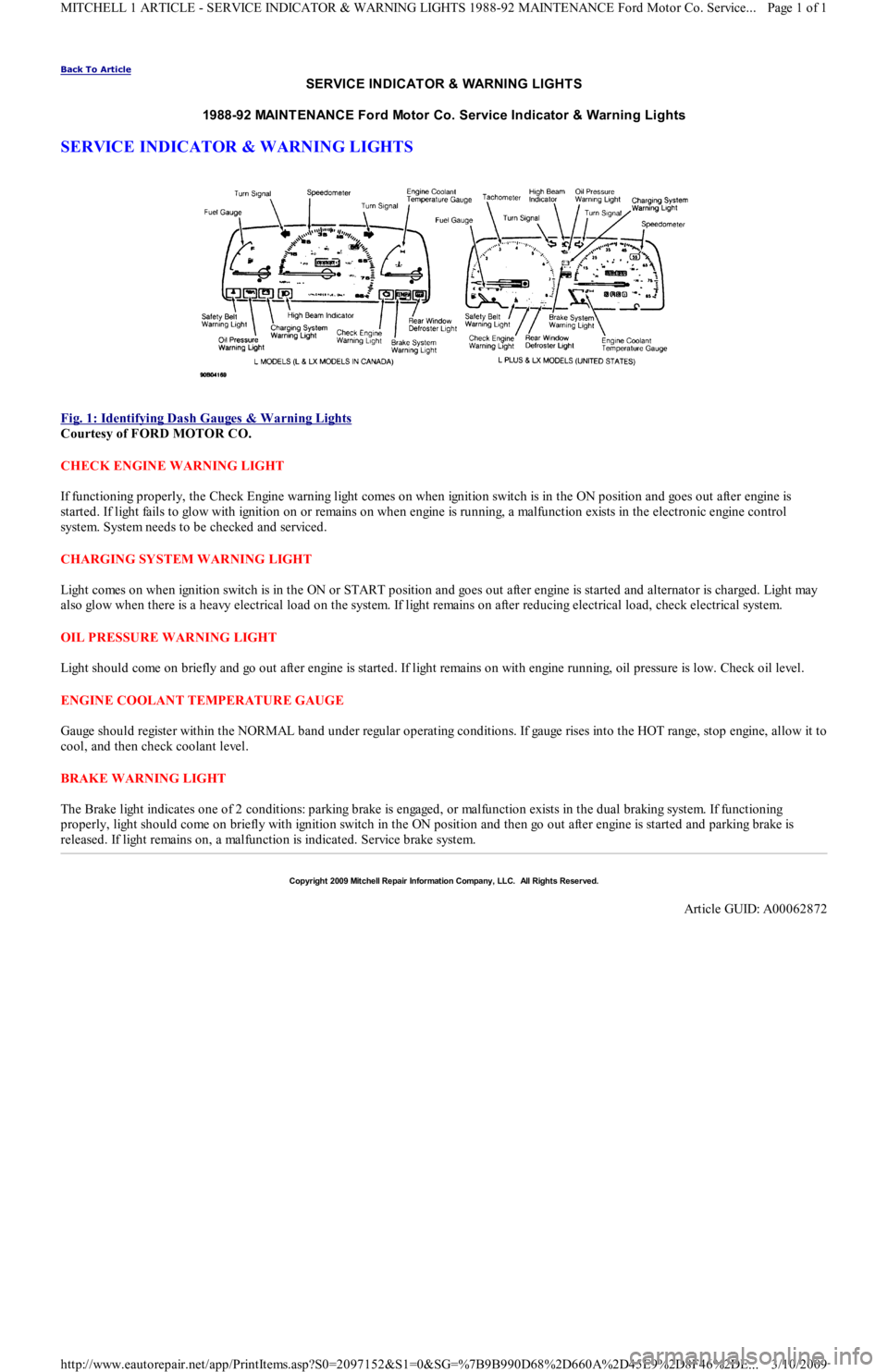
Fig. 1: Identifying Dash Gauges & W arning Lights
Courtesy of FORD MOTOR CO.
CHECK ENGINE WARNING LIGHT
If functioning properly, the Check Engine warning light comes on when ignition switch is in the ON position and goes out after engine is
started. If light fails to glow with ignition on or remains on when engine is running, a malfunction exists in the electronic engine control
system. System needs to be checked and serviced.
CHARGING SYSTEM WARNING LIGHT
Light comes on when ignition switch is in the ON or START position and goes out after engine is started and alternator is charged. Light may
also glow when there is a heavy electrical load on the system. If light remains on after reducing electrical load, check electrical system.
OIL PRESSURE WARNING LIGHT
Light should come on briefly and go out after engine is started. If light remains on with engine running, oil pressure is low. Check oil level.
ENGINE COOLANT TEMPERATURE GAUGE
Gauge should register within the NORMAL band under regular operating conditions. If gauge rises into the HOT range, stop engine, allow it to
cool, and then check coolant level.
BRAKE WARNING LIGHT
The Brake light indicates one of 2 conditions: parking brake is engaged, or malfunction exists in the dual braking system. If functioning
properly, light should come on briefly with ignition switch in the ON position and then go out after engine is started and parking brake is
released. If light remains on, a malfunction is indicated. Service brake system.
Copyr ight 2009 Mitchell Repair Information Company, LLC. All Rights Reserved.
Article GUID: A00062872
Page 1 of 1 MITCHELL 1 ARTICLE - SERVICE INDICATOR & WARNING LIGHTS 1988-92 MAINTENANCE Ford Motor Co. Service
...
3/10/2009 http://www.eautorepair.net/app/PrintItems.asp?S0=2097152&S1=0&SG=%7B9B990D68%2D660A%2D45E9%2D8F46%2DE
...