diagram FORD FESTIVA 1991 Owner's Guide
[x] Cancel search | Manufacturer: FORD, Model Year: 1991, Model line: FESTIVA, Model: FORD FESTIVA 1991Pages: 454, PDF Size: 9.53 MB
Page 214 of 454
Back To Article
GENERAL INFORMATION
T rouble Shooting - Basic Procedures
* PLEASE READ THIS FIRST *
ACCESSORIES & ELECTRICAL
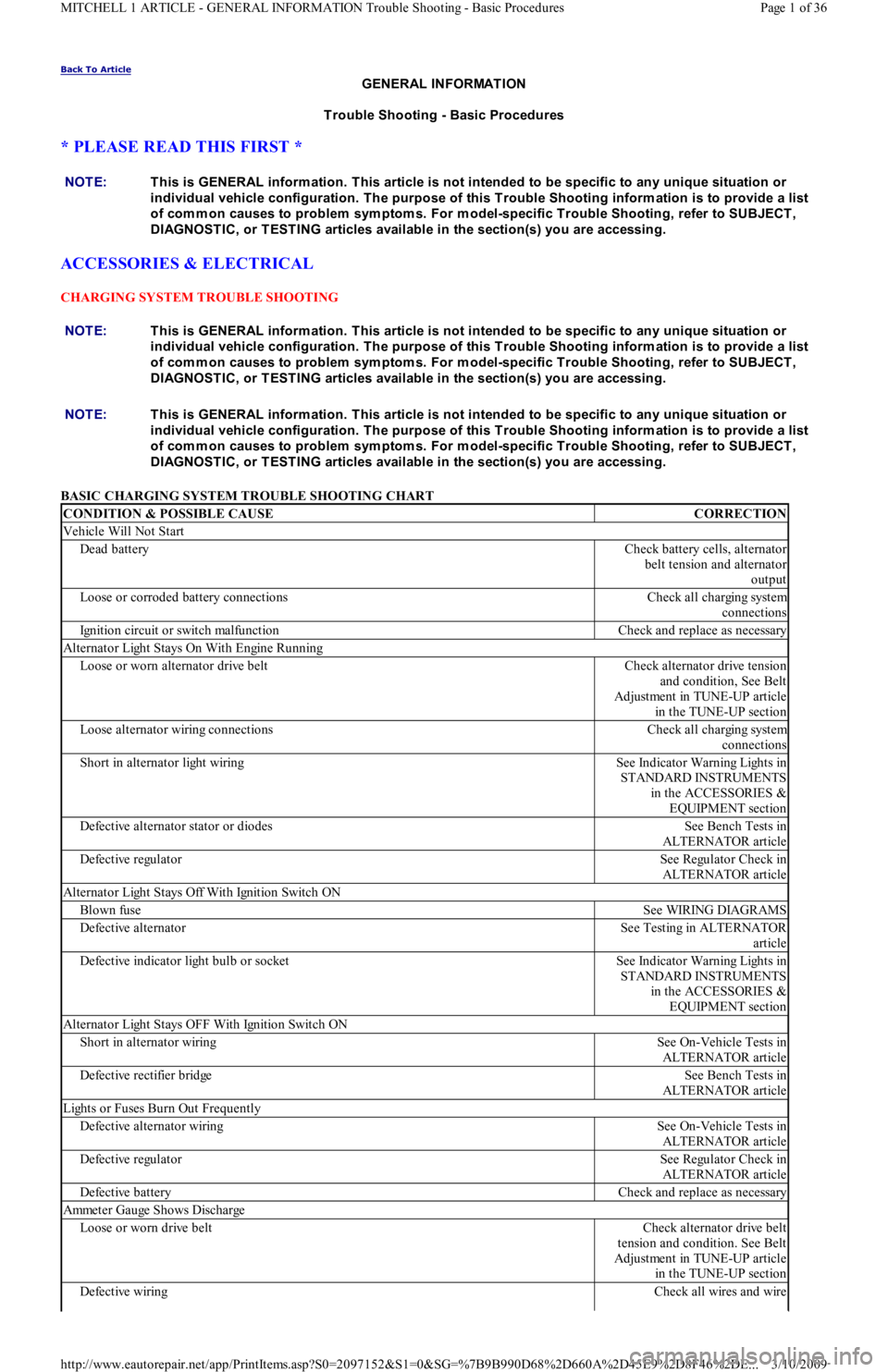
CHARGING SYSTEM TROUBLE SHOOTING
BASIC CHARGING SYSTEM TROUBLE SHOOTING CHART NOTE:This is GENERAL inform ation. This article is not intended to be specific to any unique situation or
individual vehicle configuration. T he purpose of this T rouble Shooting inform ation is to provide a list
of com m on causes to problem sym ptom s. For m odel-specific T rouble Shooting, refer to SUBJECT ,
DIAGNOST IC, or T EST ING articles available in the section(s) you are accessing.
NOTE:This is GENERAL inform ation. This article is not intended to be specific to any unique situation or
individual vehicle configuration. T he purpose of this T rouble Shooting inform ation is to provide a list
of com m on causes to problem sym ptom s. For m odel-specific T rouble Shooting, refer to SUBJECT ,
DIAGNOST IC, or T EST ING articles available in the section(s) you are accessing.
NOTE:This is GENERAL inform ation. This article is not intended to be specific to any unique situation or
individual vehicle configuration. T he purpose of this T rouble Shooting inform ation is to provide a list
of com m on causes to problem sym ptom s. For m odel-specific T rouble Shooting, refer to SUBJECT ,
DIAGNOST IC, or T EST ING articles available in the section(s) you are accessing.
CONDITION & POSSIBLE CAUSECORRECTION
Vehicle Will Not Start
Dead batteryCheck battery cells, alternator
belt tension and alternator
output
Loose or corroded battery connectionsCheck all charging system
connections
Ignition circuit or switch malfunctionCheck and replace as necessary
Alternator Light Stays On With Engine Running
Loose or worn alternator drive beltCheck alternator drive tension
and condition, See Belt
Adjustment in TUNE-UP article
in the TUNE-UP section
Loose alternator wiring connectionsCheck all charging system
connections
Short in alternator light wiringSee Indicator Warning Lights in
STANDARD INSTRUMENTS
in the ACCESSORIES &
EQUIPMENT section
Defective alternator stator or diodesSee Bench Tests in
ALTERNATOR article
Defective regulatorSee Regulator Check in
ALTERNATOR article
Alternator Light Stays Off With Ignition Switch ON
Blown fuseSee WIRING DIAGRAMS
Defective alternatorSee Testing in ALTERNATOR
article
Defective indicator light bulb or socketSee Indicator Warning Lights in
STANDARD INSTRUMENTS
in the ACCESSORIES &
EQUIPMENT section
Alternator Light Stays OFF With Ignition Switch ON
Short in alternator wiringSee On-Vehicle Tests in
ALTERNATOR article
Defective rectifier bridgeSee Bench Tests in
ALTERNATOR article
Lights or Fuses Burn Out Frequently
Defective alternator wiringSee On-Vehicle Tests in
ALTERNATOR article
Defective regulatorSee Regulator Check in
ALTERNATOR article
Defective batteryCheck and replace as necessary
Ammeter Gauge Shows Discharge
Loose or worn drive beltCheck alternator drive belt
tension and condition. See Belt
Adjustment in TUNE-UP article
in the TUNE-UP section
Defective wiringCheck all wires and wire
Page 1 of 36 MITCHELL 1 ARTICLE - GENERAL INFORMATION Trouble Shooting - Basic Procedures
3/10/2009 http://www.eautorepair.net/app/PrintItems.asp?S0=2097152&S1=0&SG=%7B9B990D68%2D660A%2D45E9%2D8F46%2DE
...
Page 275 of 454
Back To Article
GENERAL INFORMATION
How To Use The Engine Perform ance Section - 1989 & Newer Models
* PLEASE READ THIS FIRST *
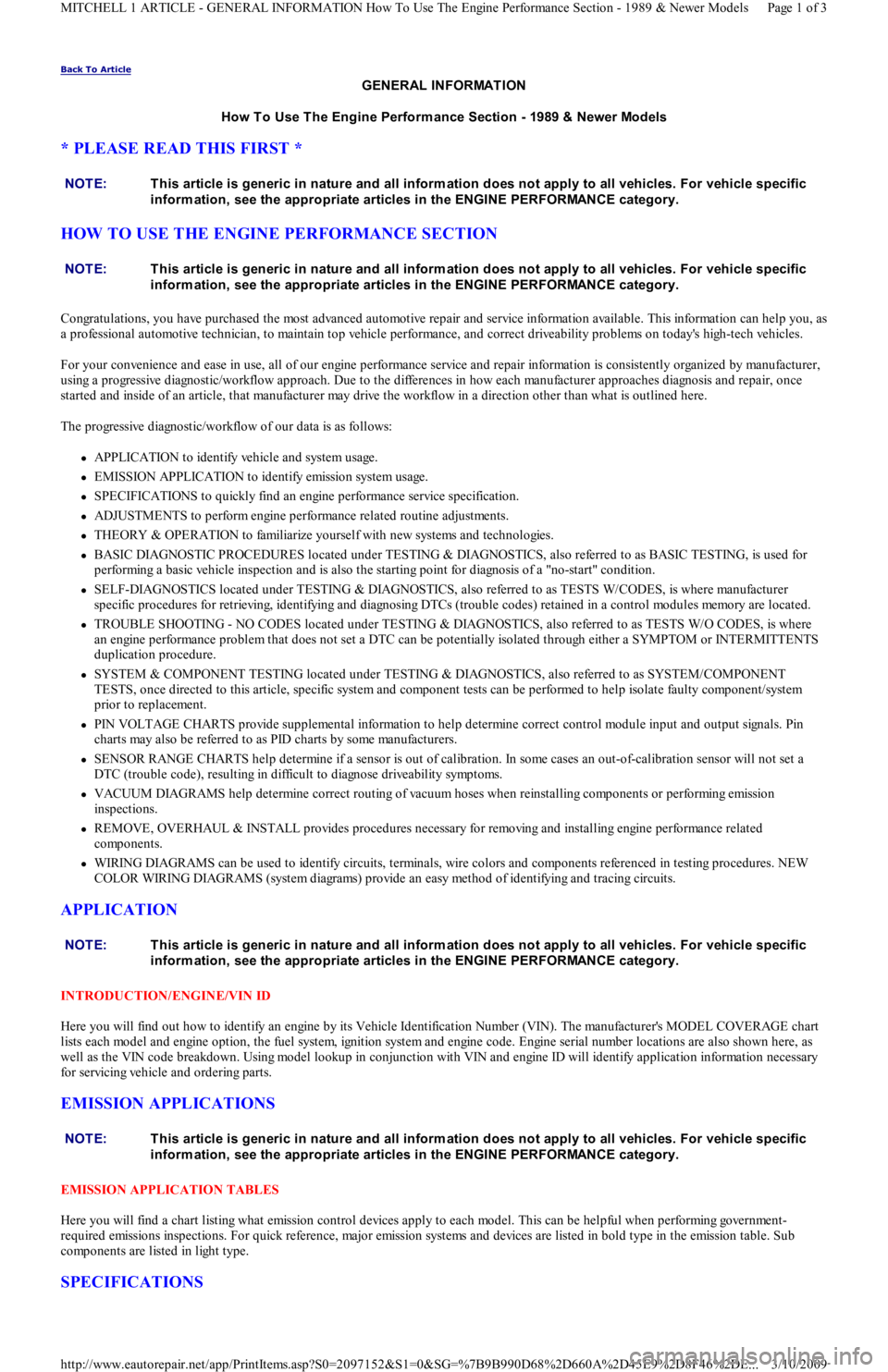
HOW TO USE THE ENGINE PERFORMANCE SECTION
Congratulations, you have purchased the most advanced automotive repair and service information available. This information can help you, as
a professional automotive technician, to maintain top vehicle performance, and correct driveability problems on today's high-tech vehicles.
For your convenience and ease in use, all of our engine performance service and repair information is consistently organized by manufacturer,
using a progressive diagnostic/workflow approach. Due to the differences in how each manufacturer approaches diagnosis and repair, once
started and inside of an article, that manufacturer may drive the workflow in a direction other than what is outlined here.
The progressive diagnostic/workflow of our data is as follows:
APPLICATION to identify vehicle and system usage.
EMISSION APPLICATION to identify emission system usage.
SPECIFICATIONS to quickly find an engine performance service specification.
ADJUSTMENTS to perform engine performance related routine adjustments.
THEORY & OPERATION to familiarize yourself with new systems and technologies.
BASIC DIAGNOSTIC PROCEDURES located under TESTING & DIAGNOSTICS, also referred to as BASIC TESTING, is used for
performing a basic vehicle inspection and is also the starting point for diagnosis of a "no-start" condition.
SELF-DIAGNOSTICS located under TESTING & DIAGNOSTICS, also referred to as TESTS W/CODES, is where manufacturer
specific procedures for retrieving, identifying and diagnosing DTCs (trouble codes) retained in a control modules memory are located.
TROUBLE SHOOTING - NO CODES located under TESTING & DIAGNOSTICS, also referred to as TESTS W/O CODES, is where
an engine performance problem that does not set a DTC can be potentially isolated through either a SYMPTOM or INTERMITTENTS
duplication procedure.
SYSTEM & COMPONENT TESTING located under TESTING & DIAGNOSTICS, also referred to as SYSTEM/COMPONENT
TESTS, once directed to this article, specific system and component tests can be performed to help isolate faulty component/system
prior to replacement.
PIN VOLTAGE CHARTS provide supplemental information to help determine correct control module input and output signals. Pin
charts may also be referred to as PID charts by some manufacturers.
SENSOR RANGE CHARTS help determine if a sensor is out of calibration. In some cases an out-of-calibration sensor will not set a
DTC (trouble code), resulting in difficult to diagnose driveability symptoms.
VACUUM DIAGRAMS help determine correct routing of vacuum hoses when reinstalling components or performing emission
inspections.
REMOVE, OVERHAUL & INSTALL provides procedures necessary for removing and installing engine performance related
components.
WIRING DIAGRAMS can be used to identify circuits, terminals, wire colors and components referenced in testing procedures. NEW
COLOR WIRING DIAGRAMS (system diagrams) provide an easy method of identifying and tracing circuits.
APPLICATION
INTRODUCTION/ENGINE/VIN ID
Here you will find out how to identify an engine by its Vehicle Identification Number (VIN). The manufacturer's MODEL COVERAGE chart
lists each model and engine option, the fuel system, ignition system and engine code. Engine serial number locations are also shown here, as
well as the VIN code breakdown. Using model lookup in conjunction with VIN and engine ID will identify application information necessary
for servicing vehicle and ordering parts.
EMISSION APPLICATIONS
EMISSION APPLICATION TABLES
Here you will find a chart listing what emission control devices apply to each model. This can be helpful when performing government-
required emissions inspections. For quick reference, major emission systems and devices are listed in bold type in the emission table. Sub
components are listed in light type.
SPECIFICATIONS
NOTE:T his article is generic in nature and all inform ation does not apply to all vehicles. For vehicle specific
inform ation, see the appropriate articles in the ENGINE PERFORMANCE category.
NOTE:T his article is generic in nature and all inform ation does not apply to all vehicles. For vehicle specific
inform ation, see the appropriate articles in the ENGINE PERFORMANCE category.
NOTE:T his article is generic in nature and all inform ation does not apply to all vehicles. For vehicle specific
inform ation, see the appropriate articles in the ENGINE PERFORMANCE category.
NOTE:T his article is generic in nature and all inform ation does not apply to all vehicles. For vehicle specific
inform ation, see the appropriate articles in the ENGINE PERFORMANCE category.
Page 1 of 3 MITCHELL 1 ARTICLE - GENERAL INFORMATION How To Use The Engine Performance Section - 1989 & Newer Models
3/10/2009 http://www.eautorepair.net/app/PrintItems.asp?S0=2097152&S1=0&SG=%7B9B990D68%2D660A%2D45E9%2D8F46%2DE
...
Page 276 of 454
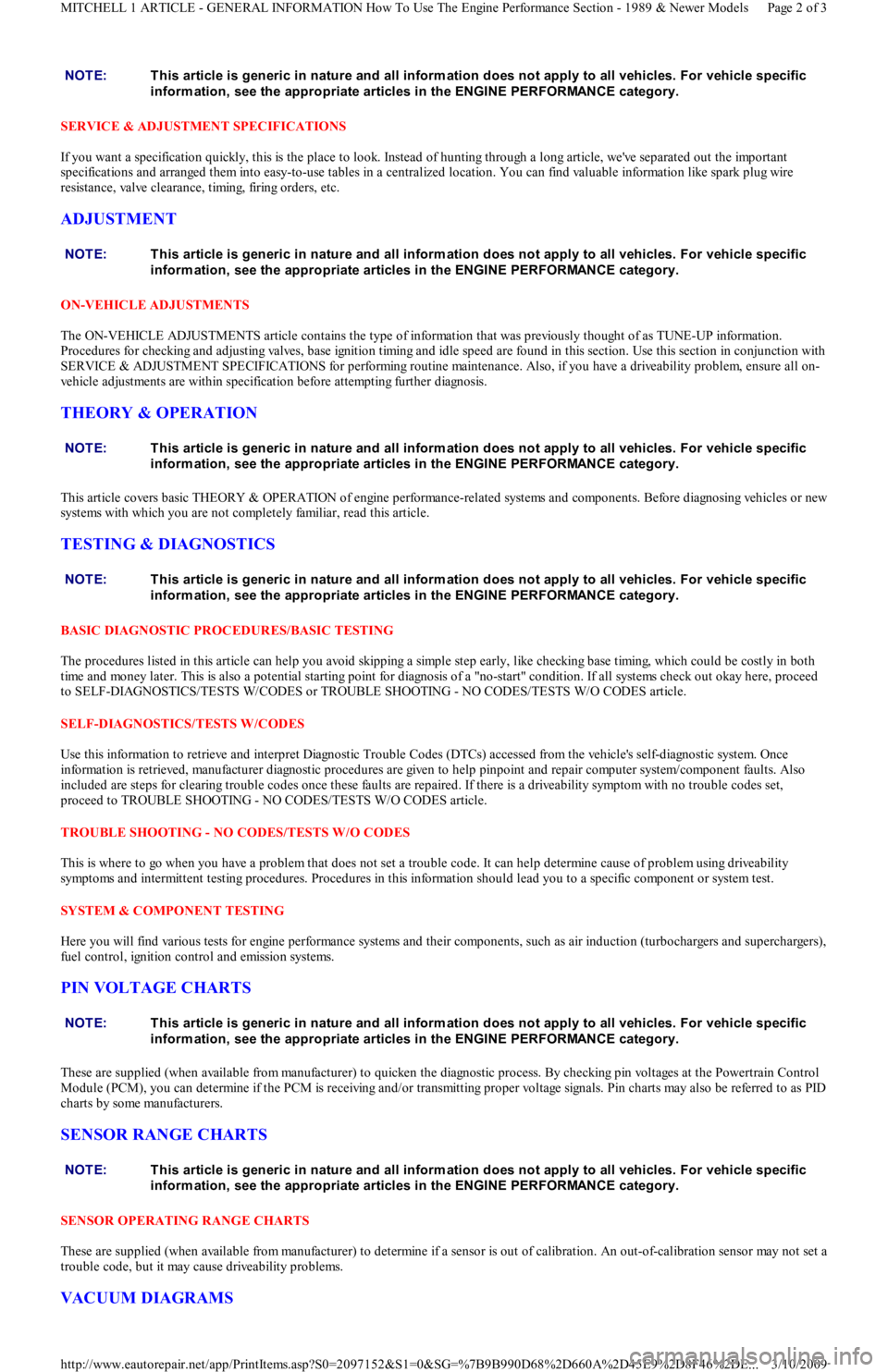
SERVICE & ADJUSTMENT SPECIFICATIONS
If you want a specification quickly, this is the place to look. Instead of hunting through a long article, we've separated out the important
specifications and arranged them into easy-to-use tables in a centralized location. You can find valuable information like spark plug wire
resistance, valve clearance, timing, firing orders, etc.
ADJUSTMENT
ON-VEHICLE ADJUSTMENTS
The ON-VEHICLE ADJUSTMENTS article contains the type of information that was previously thought of as TUNE-UP information.
Procedures for checking and adjusting valves, base ignition timing and idle speed are found in this section. Use this section in conjunction with
SERVICE & ADJUSTMENT SPECIFICATIONS for performing routine maintenance. Also, if you have a driveability problem, ensure all on-
vehicle adjustments are within specification before attempting further diagnosis.
THEORY & OPERATION
This article covers basic THEORY & OPERATION of engine performance-related systems and components. Before diagnosing vehicles or new
systems with which you are not completely familiar, read this article.
TESTING & DIAGNOSTICS
BASIC DIAGNOSTIC PROCEDURES/BASIC TESTING
The procedures listed in this article can help you avoid skipping a simple step early, like checking base timing, which could be costly in both
time and money later. This is also a potential starting point for diagnosis of a "no-start" condition. If all systems check out okay here, proceed
to SELF-DIAGNOSTICS/TESTS W/CODES or TROUBLE SHOOTING - NO CODES/TESTS W/O CODES article.
SELF-DIAGNOSTICS/TESTS W/CODES
Use this information to retrieve and interpret Diagnostic Trouble Codes (DTCs) accessed from the vehicle's self-diagnostic system. Once
information is retrieved, manufacturer diagnostic procedures are given to help pinpoint and repair computer system/component faults. Also
included are steps for clearing trouble codes once these faults are repaired. If there is a driveability symptom with no trouble codes set,
proceed to TROUBLE SHOOTING - NO CODES/TESTS W/O CODES article.
TROUBLE SHOOTING - NO CODES/TESTS W/O CODES
This is where to go when you have a problem that does not set a trouble code. It can help determine cause of problem using driveability
symptoms and intermittent testing procedures. Procedures in this information should lead you to a specific component or system test.
SYSTEM & COMPONENT TESTING
Here you will find various tests for engine performance systems and their components, such as air induction (turbochargers and superchargers),
fuel control, ignition control and emission systems.
PIN VOLTAGE CHARTS
These are supplied (when available from manufacturer) to quicken the diagnostic process. By checking pin voltages at the Powertrain Control
Module (PCM), you can determine if the PCM is receiving and/or transmitting proper voltage signals. Pin charts may also be referred to as PID
charts by some manufacturers.
SENSOR RANGE CHARTS
SENSOR OPERATING RANGE CHARTS
These are supplied (when available from manufacturer) to determine if a sensor is out of calibration. An out-of-calibration sensor may not set a
trouble code, but it may cause driveability problems.
VACUUM DIAGRAMS
NOTE:T his article is generic in nature and all inform ation does not apply to all vehicles. For vehicle specific
inform ation, see the appropriate articles in the ENGINE PERFORMANCE category.
NOTE:T his article is generic in nature and all inform ation does not apply to all vehicles. For vehicle specific
inform ation, see the appropriate articles in the ENGINE PERFORMANCE category.
NOTE:T his article is generic in nature and all inform ation does not apply to all vehicles. For vehicle specific
inform ation, see the appropriate articles in the ENGINE PERFORMANCE category.
NOTE:T his article is generic in nature and all inform ation does not apply to all vehicles. For vehicle specific
inform ation, see the appropriate articles in the ENGINE PERFORMANCE category.
NOTE:T his article is generic in nature and all inform ation does not apply to all vehicles. For vehicle specific
inform ation, see the appropriate articles in the ENGINE PERFORMANCE category.
NOTE:T his article is generic in nature and all inform ation does not apply to all vehicles. For vehicle specific
inform ation, see the appropriate articles in the ENGINE PERFORMANCE category.
Page 2 of 3 MITCHELL 1 ARTICLE - GENERAL INFORMATION How To Use The Engine Performance Section - 1989 & Newer Models
3/10/2009 http://www.eautorepair.net/app/PrintItems.asp?S0=2097152&S1=0&SG=%7B9B990D68%2D660A%2D45E9%2D8F46%2DE
...
Page 277 of 454
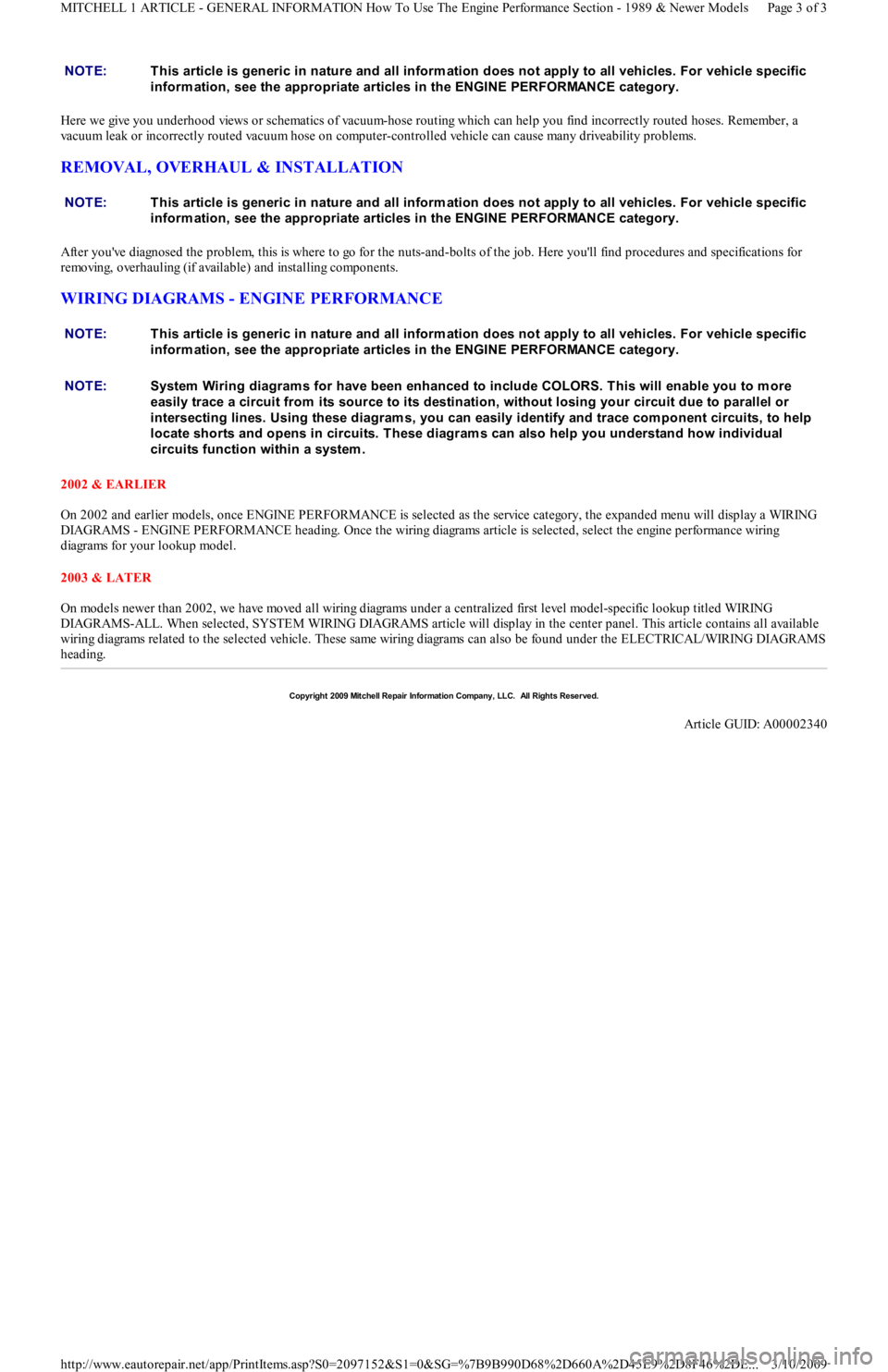
Here we give you underhood views or schematics of vacuum-hose routing which can help you find incorrectly routed hoses. Remember, a
vacuum leak or incorrectly routed vacuum hose on computer-controlled vehicle can cause many driveability problems.
REMOVAL, OVERHAUL & INSTALLATION
After you've diagnosed the problem, this is where to go for the nuts-and-bolts of the job. Here you'll find procedures and specifications for
removing, overhauling (if available) and installing components.
WIRING DIAGRAMS - ENGINE PERFORMANCE
2002 & EARLIER
On 2002 and earlier models, once ENGINE PERFORMANCE is selected as the service category, the expanded menu will display a WIRING
DIAGRAMS - ENGINE PERFORMANCE heading. Once the wiring diagrams article is selected, select the engine performance wiring
diagrams for your lookup model.
2003 & LATER
On models newer than 2002, we have moved all wiring diagrams under a centralized first level model-specific lookup titled WIRING
DIAGRAMS-ALL. When selected, SYSTEM WIRING DIAGRAMS article will display in the center panel. This article contains all available
wiring diagrams related to the selected vehicle. These same wiring diagrams can also be found under the ELECTRICAL/WIRING DIAGRAMS
heading. NOTE:T his article is generic in nature and all inform ation does not apply to all vehicles. For vehicle specific
inform ation, see the appropriate articles in the ENGINE PERFORMANCE category.
NOTE:T his article is generic in nature and all inform ation does not apply to all vehicles. For vehicle specific
inform ation, see the appropriate articles in the ENGINE PERFORMANCE category.
NOTE:T his article is generic in nature and all inform ation does not apply to all vehicles. For vehicle specific
inform ation, see the appropriate articles in the ENGINE PERFORMANCE category.
NOTE:System Wiring diagram s for have been enhanced to include COLORS. T his will enable you to m ore
easily trace a circuit from its source to its destination, without losing your circuit due to parallel or
intersecting lines. Using these diagram s, you can easily identify and trace com ponent circuits, to help
locate shorts and opens in circuits. T hese diagram s can also help you understand how individual
circuits function within a system .
Copyr ight 2009 Mitchell Repair Information Company, LLC. All Rights Reserved.
Article GUID: A00002340
Page 3 of 3 MITCHELL 1 ARTICLE - GENERAL INFORMATION How To Use The Engine Performance Section - 1989 & Newer Models
3/10/2009 http://www.eautorepair.net/app/PrintItems.asp?S0=2097152&S1=0&SG=%7B9B990D68%2D660A%2D45E9%2D8F46%2DE
...
Page 345 of 454
Back To Article
HEAT ER SYST EM
1990-92 HEAT ER SYST EMS Ford Motor Co.
DESCRIPTION
The heater system consists of control panel, blower case, heater case, air control doors and ducts. The control panel incorporates 3 control
levers and a 3-speed fan switch. The control panel is located in the center of the instrument panel. All air control doors are cable operated
from the control panel.
The blower case is mounted on the bulkhead, behind the instrument panel on passenger's side of vehicle. The blower case houses a blower
motor, blower motor resistor and the fresh/recirculation air door. The heater case contains mode select door, temperature air mix door and
heater core.
OPERATION
Three control levers, temperature mix, fresh/recirculation and mode select, mechanically operate their associated cables and doors. The
temperature control lever adjusts the mix of fresh or recirculated air with heated air. In full heat position, all airflow goes through the heater
core.
In full cool position, the mix air door closes, allowing airflow to by-pass the heater core. The mode select lever, directs airflow to selected
vents. The fresh/recirculation control lever allows selection of fresh (outside) air or recirculated compartment air.
AJUSTMENT
FRESH/RECIRCULATION CONTROL CABLE
Remove the glove box. Remove fresh/recirculation cable retaining clip. Move control lever to RECIRCULATION position, while holding the
lever door in RECIRCULATION position. Ensure control lever does not move. Install fresh/recirculation cable retaining clip.
MODE SELECT CABLE
Remove mode select cable retaining clip. Move mode select lever to VENT position. Hold mode select lever downward against its stop.
Ensure that mode select lever does not move. Install mode select cable retaining clip.
TEMPERATURE CONTROL CABLE
Set temperature control lever to maximum cold position. Remove temperature cable retaining clip. Hold temperature control lever upward and
against its stop. Ensure that temperature lever does not move. Install temperature cable retaining clip.
TROUBLE SHOOTING
BLOWER MOTOR INOPERATIVE
Check blown motor fuse. Check for defective blower motor and/or blower motor resistor. Check blower motor switch. Check for open in
ground wire. Check for loose electrical connectors or poor connections. See WIRING DIAGRAMS
in this article.
BLOWER DOES NOT CHANGE SPEED
Check for defective blower motor. Check blower motor wiring harness. Check blower motor resistor. Check for blower motor fan switch. See
WIRING DIAGRAMS
in this article.
BLOWER RUNS CONSTANTLY
Check for defective blower motor resistor. Check for short in blower switch or wiring. See WIRING DIAGRAMS
in this article.
HEATER TEMPERATURE INSUFFICIENT
Check for proper coolant level. Check water pump for noise, leaks or wear. Check heater hoses for leaks or restrictions. Check heater core for
leaks, plugs or restrictions. Check inlet and outlet heater hoses for hot water flow. Check thermostat condition and operation. Check air mix
door position and adjust cable if necessary.
IMPROPER WARM AIR DISTRIBUTION
Check air mix door position. Adjust cable as necessary. Check function control door position. Adjust cable as necessary. Check for restriction
in ventilation air duct assembly. Repair as necessary.
TESTING BLOWER MOTOR & RESISTOR
1. Ensure 15-amp blower motor fuse is okay. Using voltmeter, check for battery voltage at blower motor Blue/Yellow terminal. If battery
voltage is present, go to next step. If battery voltage is not present, repair open in Blue/Yellow wire between blower motor and fuse box.
2. Disconnect blower motor connector. Using a jumper wire, apply battery voltage to Blue/Yellow terminal and ground the Blue/Red
terminal. If blower motor does not run, replace blower motor. If blower motor runs, go to next step.
3. Reconnect blower motor connector. Turn ignition on. Turn blower motor off. Disconnect the blower motor resistor connector. Using a
voltmeter, measure voltage at Blue/Red terminal of resistor connector. If battery voltage is not present, repair open in Blue/Red wire
between resistor and blower motor. If voltage is present, go to next step.
4. Using a jumper wire, ground Blue/Black, Blue/Yellow and Blue/White terminals of the blower fan switch one at a time. If the motor
runs at 3 different speeds, go to next step. If not, repair open in wire that failed to operate blower motor.
Page 1 of 4 MITCHELL 1 ARTICLE - HEATER SYSTEM 1990-92 HEATER SYSTEMS Ford Motor Co.
3/10/2009 http://www.eautorepair.net/app/PrintItems.asp?S0=2097152&S1=0&SG=%7B9B990D68%2D660A%2D45E9%2D8F46%2DE
...
Page 347 of 454
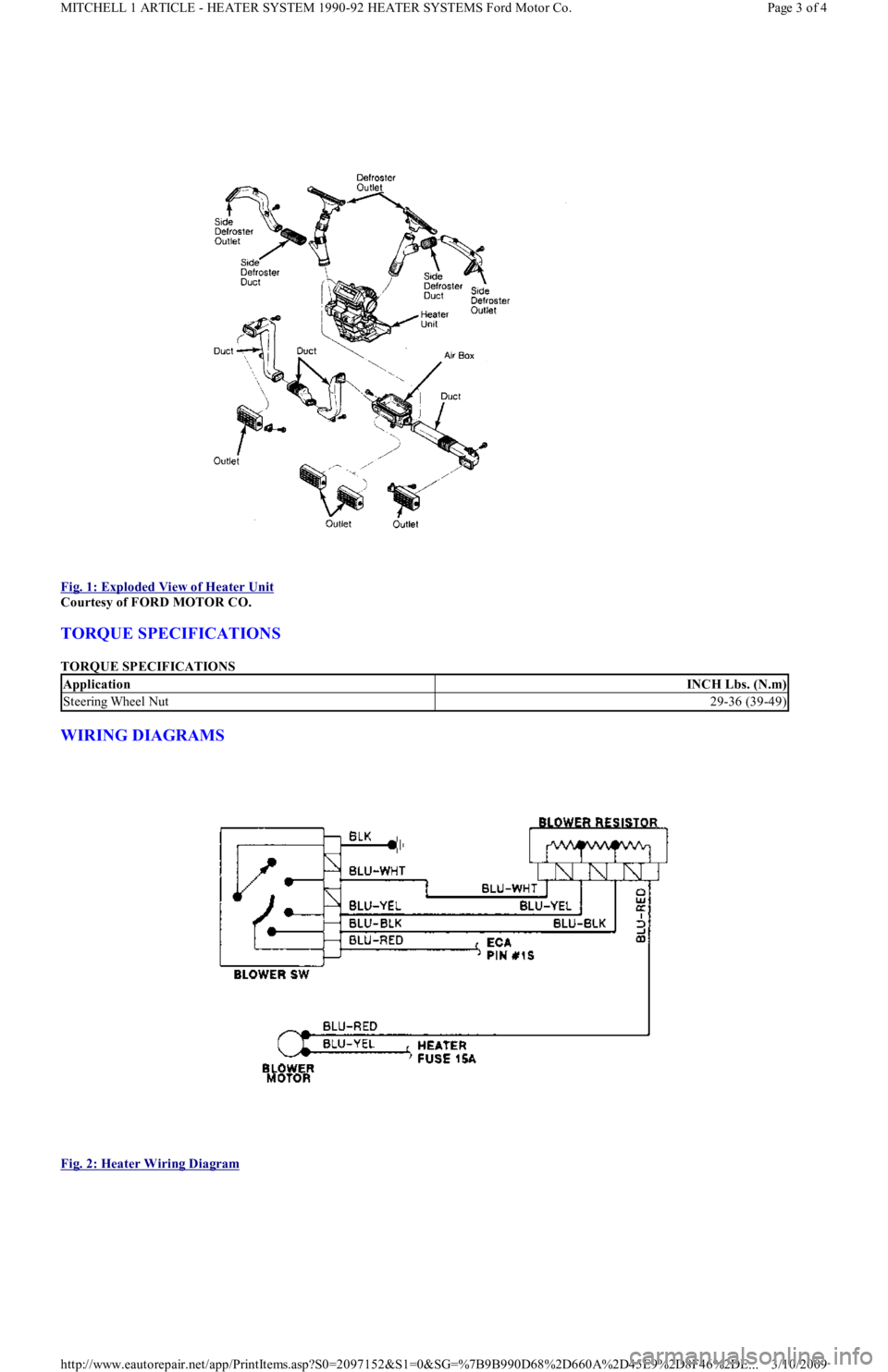
Fig. 1: Exploded View of Heater Unit
Courtesy of FORD MOTOR CO.
TORQUE SPECIFICATIONS
TORQUE SPECIFICATIONS
WIRING DIAGRAMS
Fig. 2: Heater Wiring Diagram
ApplicationINCH Lbs. (N.m)
Steering Wheel Nut29-36 (39-49)
Page 3 of 4 MITCHELL 1 ARTICLE - HEATER SYSTEM 1990-92 HEATER SYSTEMS Ford Motor Co.
3/10/2009 http://www.eautorepair.net/app/PrintItems.asp?S0=2097152&S1=0&SG=%7B9B990D68%2D660A%2D45E9%2D8F46%2DE
...
Page 348 of 454
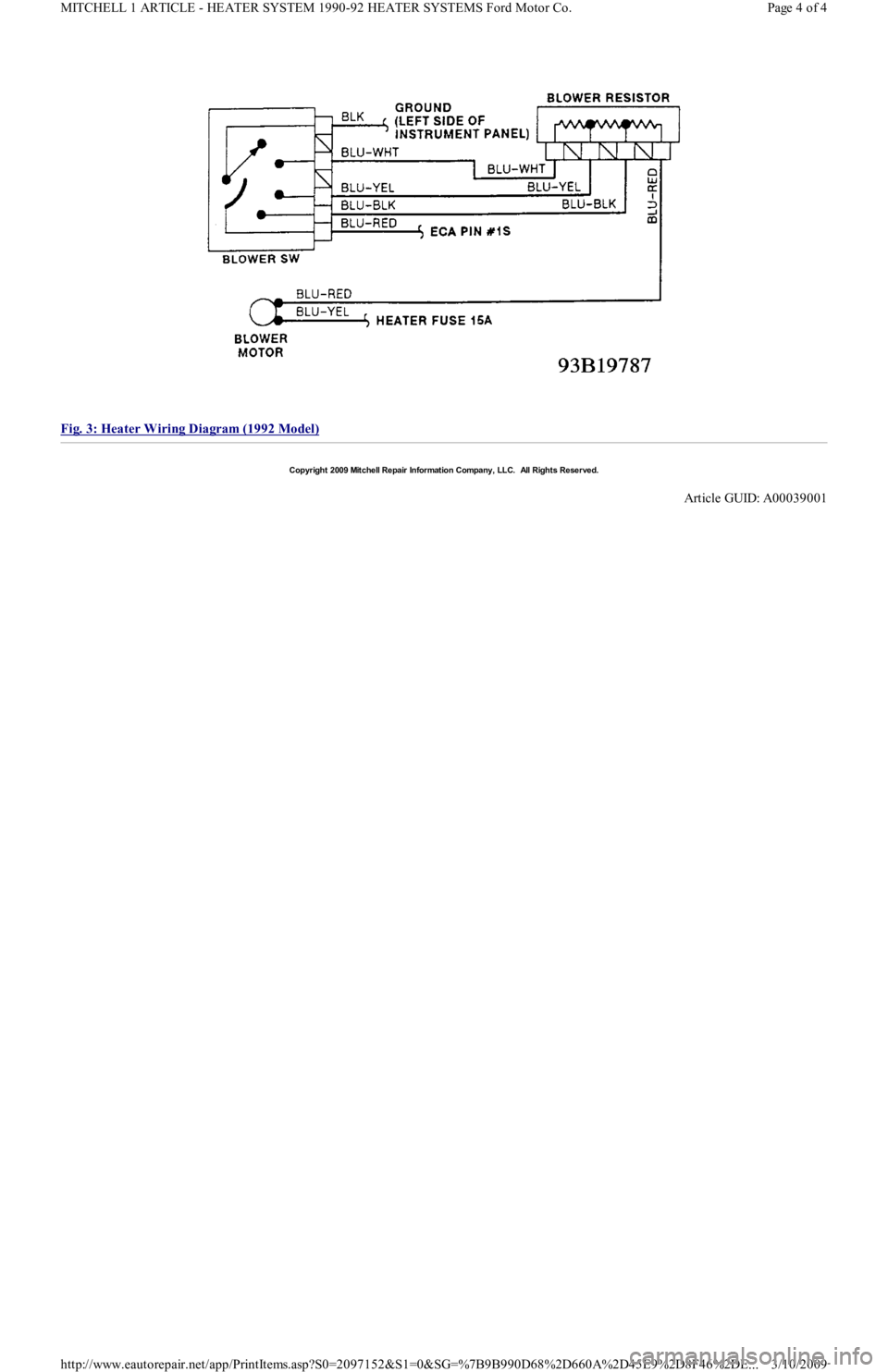
Fig. 3: Heater Wiring Diagram (1992 Model)
Copyr ight 2009 Mitchell Repair Information Company, LLC. All Rights Reserved.
Article GUID: A00039001
Page 4 of 4 MITCHELL 1 ARTICLE - HEATER SYSTEM 1990-92 HEATER SYSTEMS Ford Motor Co.
3/10/2009 http://www.eautorepair.net/app/PrintItems.asp?S0=2097152&S1=0&SG=%7B9B990D68%2D660A%2D45E9%2D8F46%2DE
...
Page 362 of 454
4. Remove radio and A/C-heater control assembly. See A/C-HEATER CONTROL ASSEMBLY under REMOVAL &
INSTALLATION. Disconnect cigarette lighter connector. Remove snap-in trim inserts concealing instrument panel attaching bolts.
Remove 7 instrument panel attaching bolts.
5. Remove 2 lower instrument panel-to-body bracket stud nuts. Disconnect remaining electrical connectors from instrument panel.
Remove instrument panel. To install, reverse removal procedures.
WIRING DIAGRAM
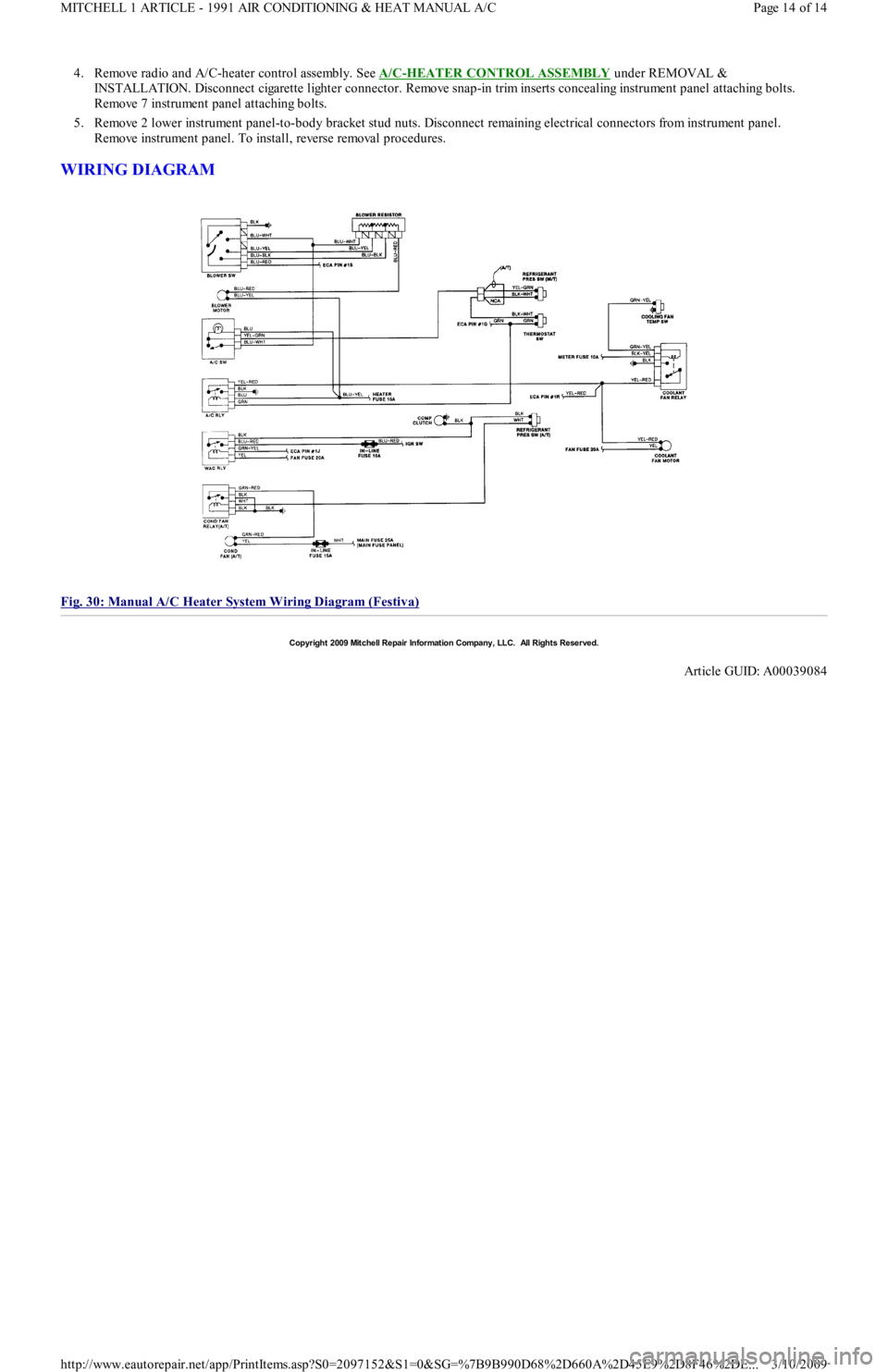
Fig. 30: Manual A/C Heater System Wiring Diagram (Festiva)
Copyr ight 2009 Mitchell Repair Information Company, LLC. All Rights Reserved.
Article GUID: A00039084
Page 14 of 14 MITCHELL 1 ARTICLE - 1991 AIR CONDITIONING & HEAT MANUAL A/C
3/10/2009 http://www.eautorepair.net/app/PrintItems.asp?S0=2097152&S1=0&SG=%7B9B990D68%2D660A%2D45E9%2D8F46%2DE
...
Page 445 of 454
Back To Article
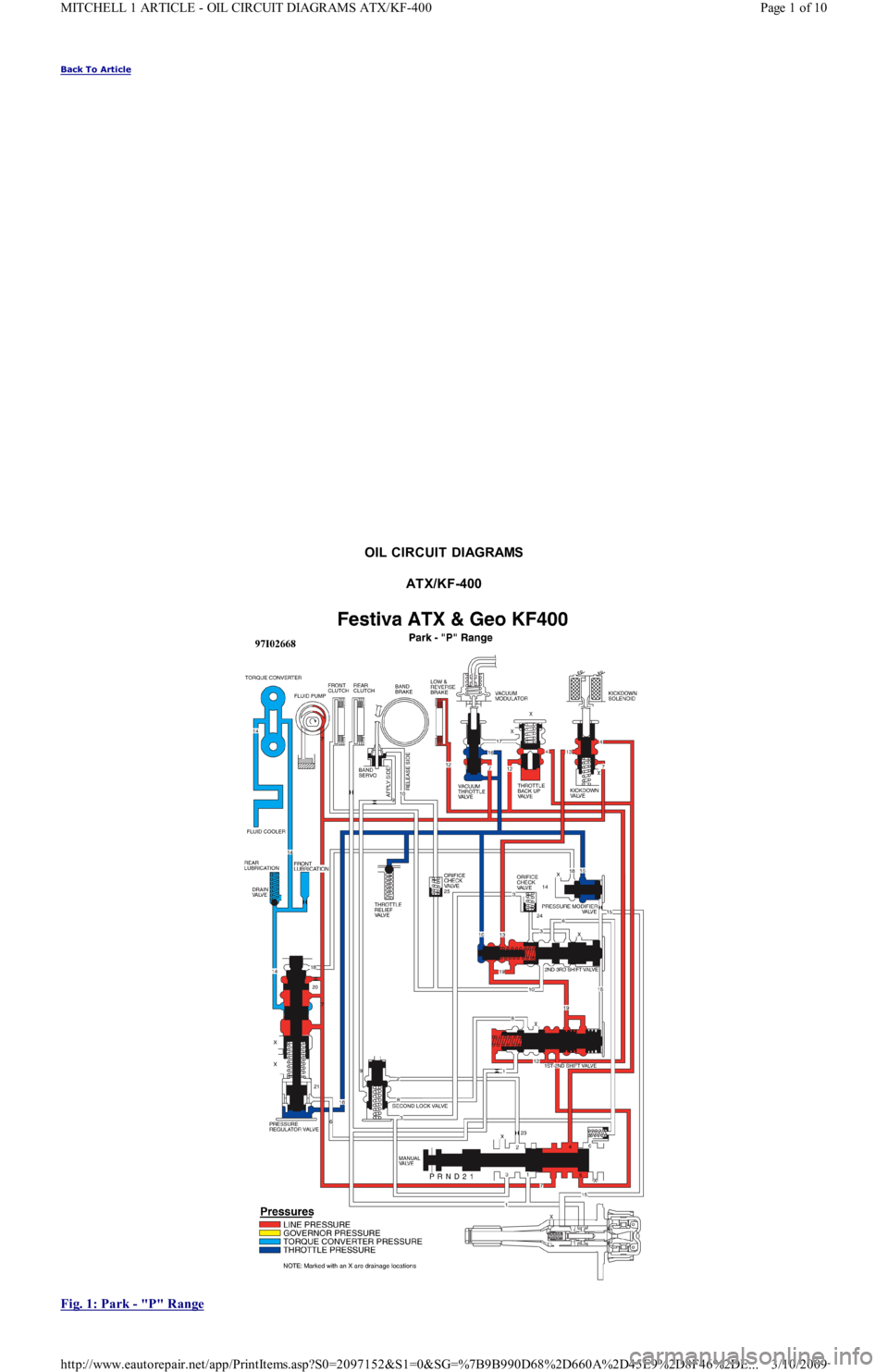
OIL CIRCUIT DIAGRAMS
AT X/KF-400
Fig. 1: Park
- "P" Range
Page 1 of 10 MITCHELL 1 ARTICLE - OIL CIRCUIT DIAGRAMS ATX/KF-400
3/10/2009 http://www.eautorepair.net/app/PrintItems.asp?S0=2097152&S1=0&SG=%7B9B990D68%2D660A%2D45E9%2D8F46%2DE
...
Page 446 of 454
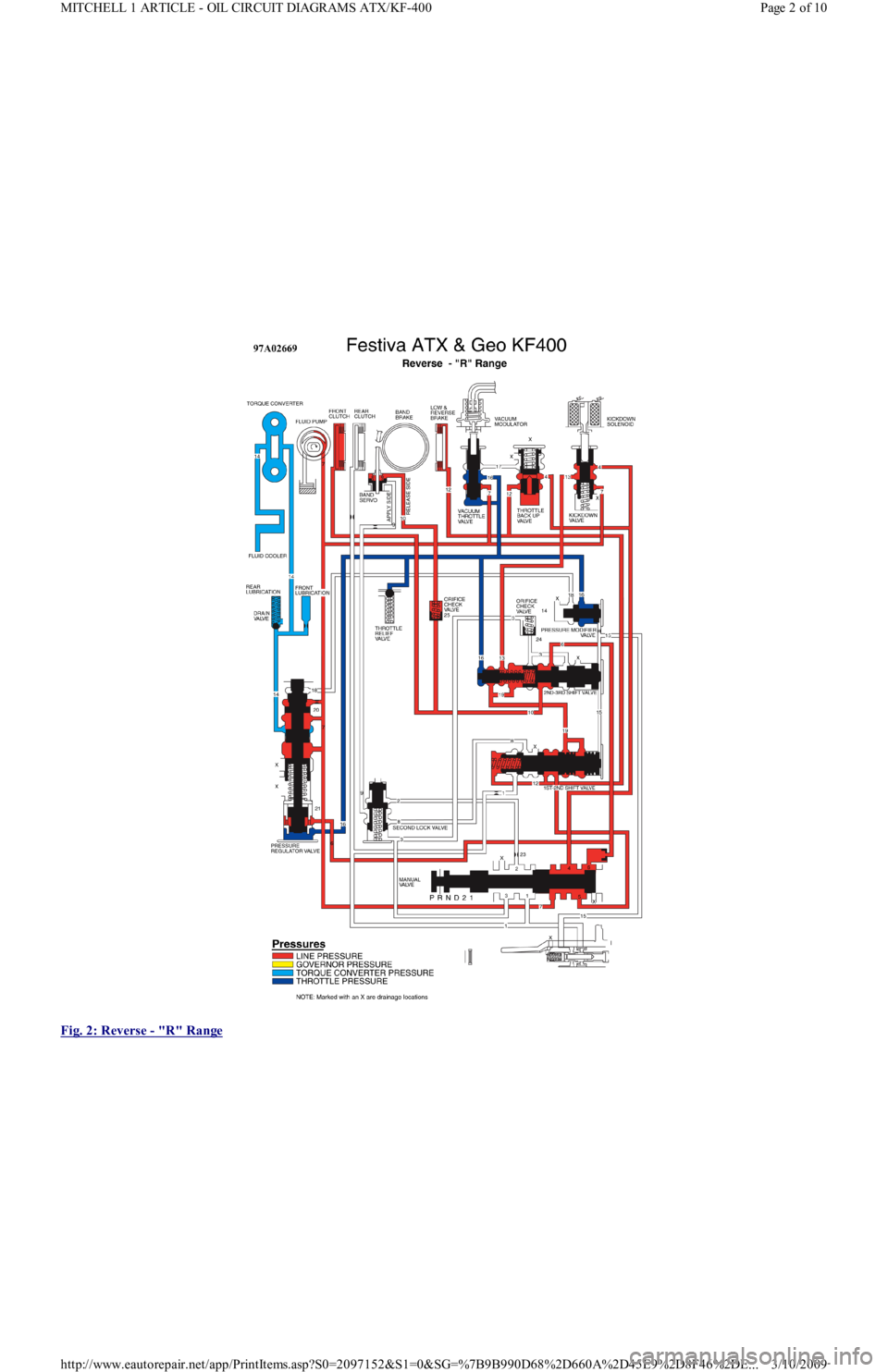
Fig. 2: Reverse
- "R" Range
Page 2 of 10 MITCHELL 1 ARTICLE - OIL CIRCUIT DIAGRAMS ATX/KF-400
3/10/2009 http://www.eautorepair.net/app/PrintItems.asp?S0=2097152&S1=0&SG=%7B9B990D68%2D660A%2D45E9%2D8F46%2DE
...