clutch FORD FESTIVA 1991 Manual PDF
[x] Cancel search | Manufacturer: FORD, Model Year: 1991, Model line: FESTIVA, Model: FORD FESTIVA 1991Pages: 454, PDF Size: 9.53 MB
Page 416 of 454
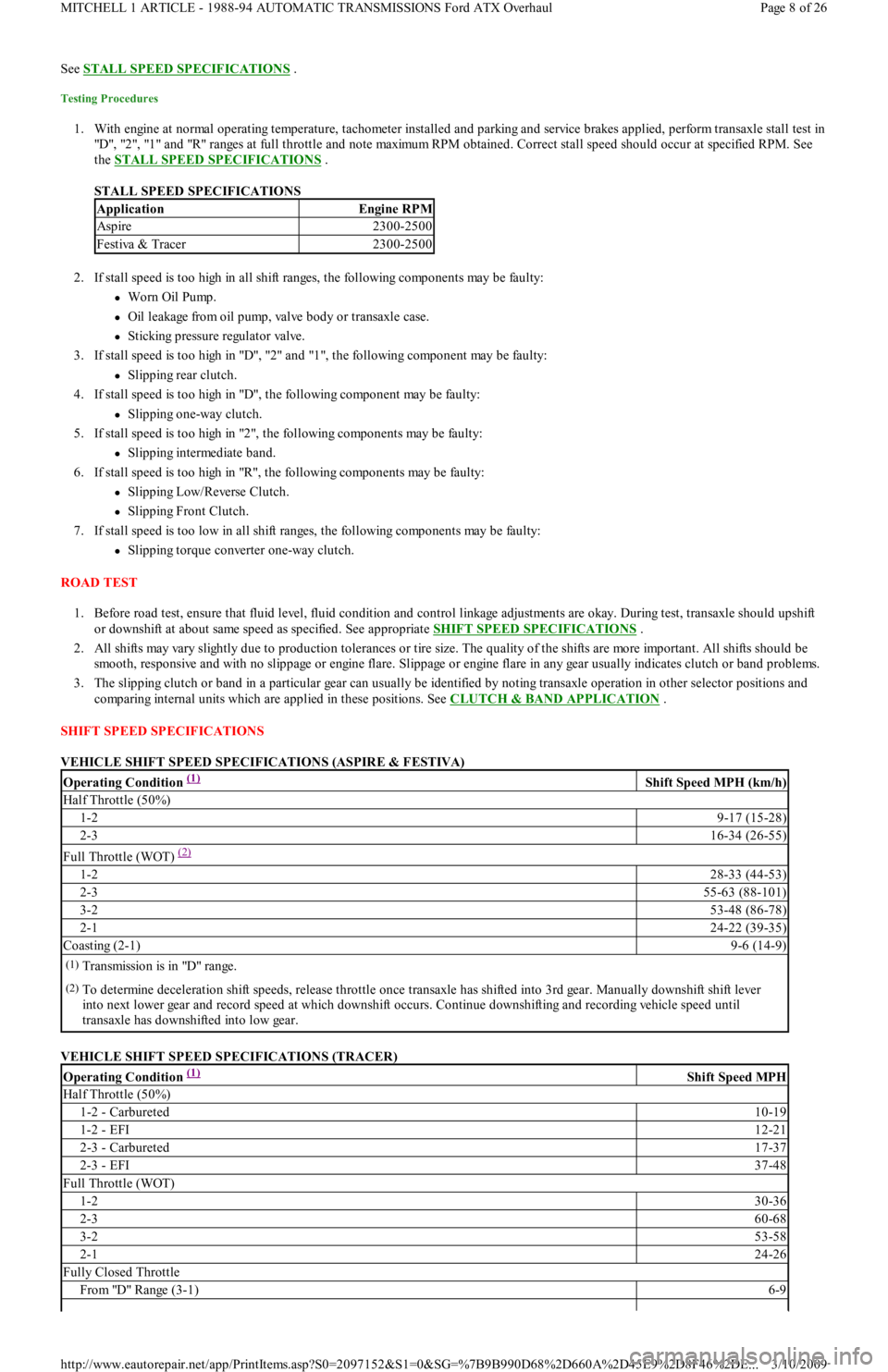
See STALL SPEED SPECIFICATIONS .
Testing Procedures
1. With engine at normal operating temperature, tachometer installed and parking and service brakes applied, perform transaxle stall test in
"D", "2", "1" and "R" ranges at full throttle and note maximum RPM obtained. Correct stall speed should occur at specified RPM. See
the STALL SPEED SPECIFICATIONS
.
STALL SPEED SPECIFICATIONS
2. If stall speed is too high in all shift ranges, the following components may be faulty:
Worn Oil Pump.
Oil leakage from oil pump, valve body or transaxle case.
Sticking pressure regulator valve.
3. If stall speed is too high in "D", "2" and "1", the following component may be faulty:
Slipping rear clutch.
4. If stall speed is too high in "D", the following component may be faulty:
Slipping one-way clutch.
5. If stall speed is too high in "2", the following components may be faulty:
Slipping intermediate band.
6. If stall speed is too high in "R", the following components may be faulty:
Slipping Low/Reverse Clutch.
Slipping Front Clutch.
7. If stall speed is too low in all shift ranges, the following components may be faulty:
Slipping torque converter one-way clutch.
ROAD TEST
1. Before road test, ensure that fluid level, fluid condition and control linkage adjustments are okay. During test, transaxle should upshift
or downshift at about same speed as specified. See appropriate SHIFT SPEED SPECIFICATIONS
.
2. All shifts may vary slightly due to production tolerances or tire size. The quality of the shifts are more important. All shifts should be
smooth, responsive and with no slippage or engine flare. Slippage or engine flare in any gear usually indicates clutch or band problems.
3. The slipping clutch or band in a particular gear can usually be identified by noting transaxle operation in other selector positions and
comparing internal units which are applied in these positions. See CLUTCH & BAND APPLICATION
.
SHIFT SPEED SPECIFICATIONS
VEHICLE SHIFT SPEED SPECIFICATIONS (ASPIRE & FESTIVA)
VEHICLE SHIFT SPEED SPECIFICATIONS (TRACER)
ApplicationEngine RPM
Aspire2300-2500
Festiva & Tracer2300-2500
Operating Condition (1) Shift Speed MPH (km/h)
Half Throttle (50%)
1-29-17 (15-28)
2-316-34 (26-55)
Full Throttle (WOT) (2)
1-228-33 (44-53)
2-355-63 (88-101)
3-253-48 (86-78)
2-124-22 (39-35)
Coasting (2-1)9-6 (14-9)
(1)Transmission is in "D" range.
(2)To determine deceleration shift speeds, release throttle once transaxle has shifted into 3rd gear. Manually downshift shift lever
into next lower gear and record speed at which downshift occurs. Continue downshifting and recording vehicle speed until
transaxle has downshifted into low gear.
Operating Condition (1) Shift Speed MPH
Half Throttle (50%)
1-2 - Carbureted10-19
1-2 - EFI12-21
2-3 - Carbureted17-37
2-3 - EFI37-48
Full Throttle (WOT)
1-230-36
2-360-68
3-253-58
2-124-26
Fully Closed Throttle
Fro m "D" Ran ge (3 -1 )6-9
Page 8 of 26 MITCHELL 1 ARTICLE - 1988-94 AUTOMATIC TRANSMISSIONS Ford ATX Overhaul
3/10/2009 http://www.eautorepair.net/app/PrintItems.asp?S0=2097152&S1=0&SG=%7B9B990D68%2D660A%2D45E9%2D8F46%2DE
...
Page 417 of 454
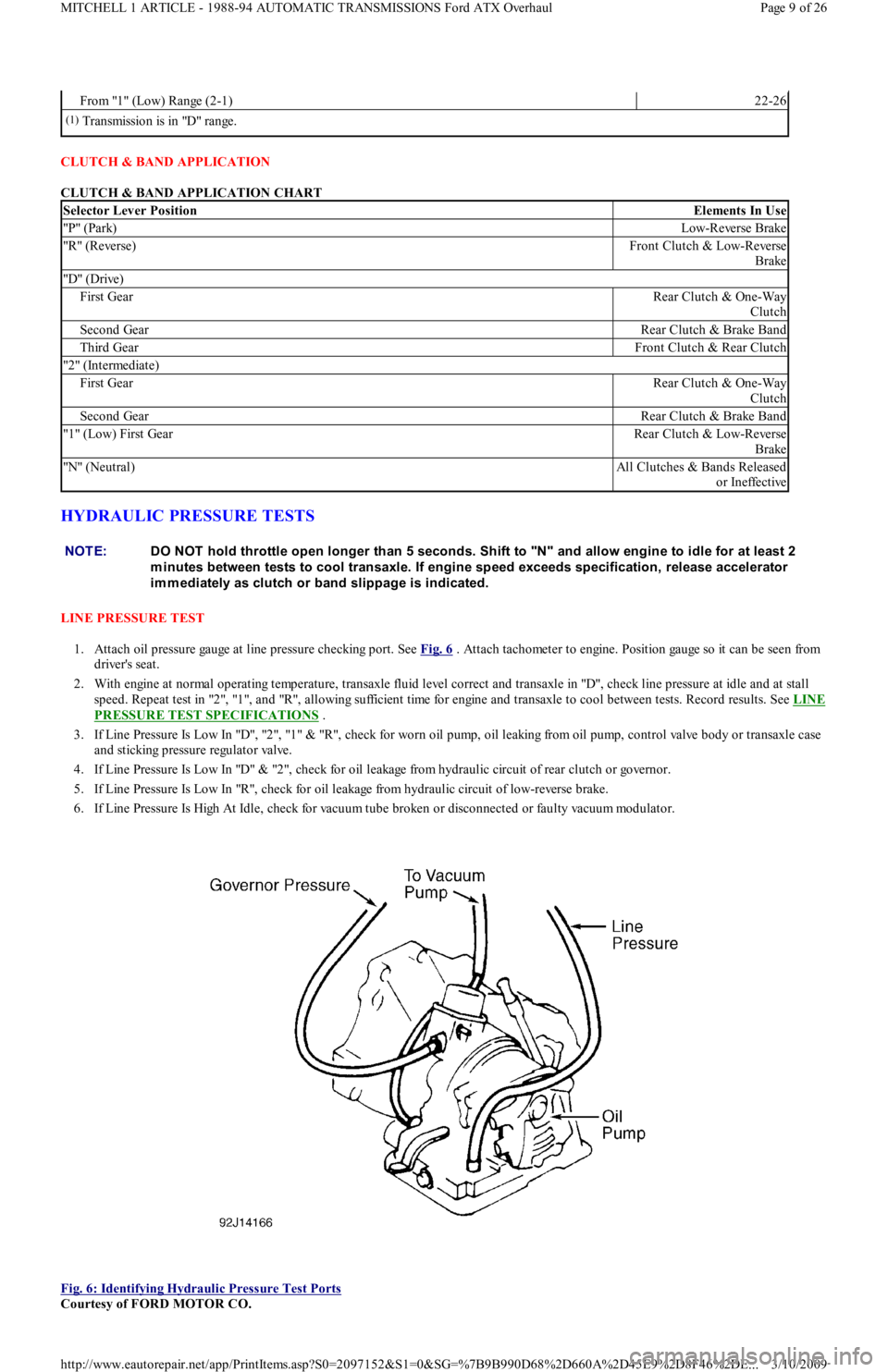
CLUTCH & BAND APPLICATION
CLUTCH & BAND APPLICATION CHART
HYDRAULIC PRESSURE TESTS
LINE PRESSURE TEST
1. Attach oil pressure gauge at line pressure checking port. See Fig. 6
. Attach tachometer to engine. Position gauge so it can be seen from
driver's seat.
2. With engine at normal operating temperature, transaxle fluid level correct and transaxle in "D", check line pressure at idle and at stall
sp eed . Rep eat t est in "2 ", "1 ", an d "R", al l o win g su fficien t t ime for engine and transaxle to cool between tests. Record results. See LINE
PRESSURE TEST SPECIFICATIONS .
3 . If Lin e Pressu re Is Lo w In "D", "2 ", "1 " & "R", ch eck fo r worn oil pump, oil leaking from oil pump, control valve body or transaxle case
and sticking pressure regulator valve.
4. If Line Pressure Is Low In "D" & "2", check for oil leakage from hydraulic circuit of rear clutch or governor.
5. If Line Pressure Is Low In "R", check for oil leakage from hydraulic circuit of low-reverse brake.
6. If Line Pressure Is High At Idle, check for vacuum tube broken or disconnected or faulty vacuum modulator.
Fig. 6: Identifying Hydraulic Pressure Test Ports
Courtesy of FORD MOTOR CO.
From "1" (Low) Range (2-1)22-26
(1)Transmission is in "D" range.
Selector Lever PositionElements In Use
"P" (Park)Low-Reverse Brake
"R" (Reverse)Front Clutch & Low-Reverse
Brake
"D" (Drive)
First GearRear Clutch & One-Way
Clutch
Second GearRear Clutch & Brake Band
Third GearFront Clutch & Rear Clutch
"2" (Intermediate)
First GearRear Clutch & One-Way
Clutch
Second GearRear Clutch & Brake Band
"1" (Low) First GearRear Clutch & Low-Reverse
Brake
"N" (Neutral)All Clutches & Bands Released
o r In effect ive
NOTE:DO NOT hold throttle open longer than 5 seconds. Shift to "N" and allow engine to idle for at least 2
m inutes between tests to cool transaxle. If engine speed exceeds specification, release accelerator
im m ediately as clutch or band slippage is indicated.
Page 9 of 26 MITCHELL 1 ARTICLE - 1988-94 AUTOMATIC TRANSMISSIONS Ford ATX Overhaul
3/10/2009 http://www.eautorepair.net/app/PrintItems.asp?S0=2097152&S1=0&SG=%7B9B990D68%2D660A%2D45E9%2D8F46%2DE
...
Page 418 of 454
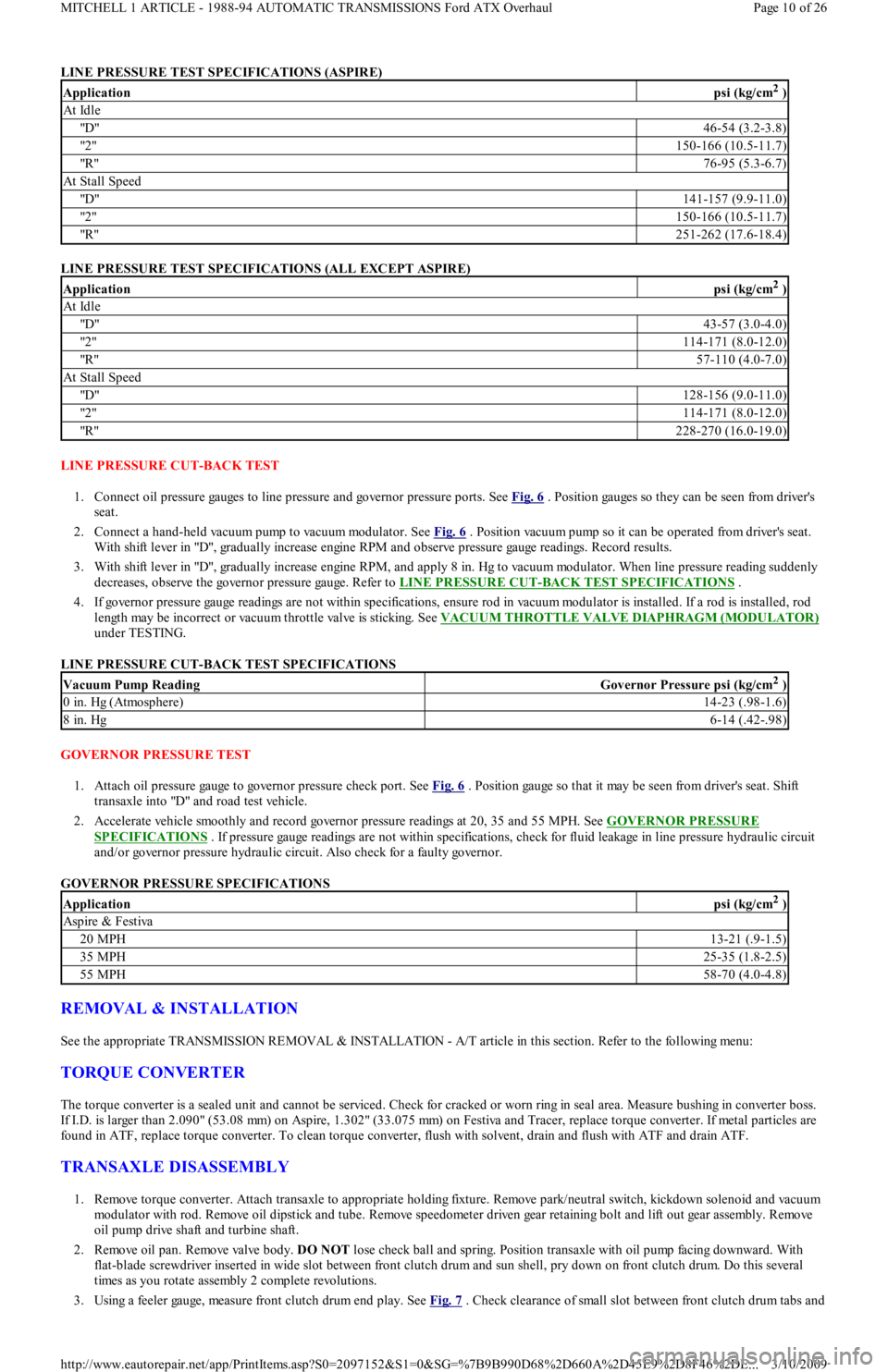
LINE PRESSURE TEST SPECIFICATIONS (ASPIRE)
LINE PRESSURE TEST SPECIFICATIONS (ALL EXCEPT ASPIRE)
LINE PRESSURE CUT-BACK TEST
1. Connect oil pressure gauges to line pressure and governor pressure ports. See Fig. 6
. Position gauges so they can be seen from driver's
seat.
2. Connect a hand-held vacuum pump to vacuum modulator. See Fig. 6
. Position vacuum pump so it can be operated from driver's seat.
With shift lever in "D", gradually increase engine RPM and observe pressure gauge readings. Record results.
3. With shift lever in "D", gradually increase engine RPM, and apply 8 in. Hg to vacuum modulator. When line pressure reading suddenly
decreases, observe the governor pressure gauge. Refer to LINE PRESSURE CUT
-BACK TEST SPECIFICATIONS .
4. If governor pressure gauge readings are not within specifications, ensure rod in vacuum modulator is installed. If a rod is installed, rod
length may be incorrect or vacuum throttle valve is sticking. See VACUUM THROTTLE VALVE DIAPHRAGM (MODULATOR)
under TESTING.
LINE PRESSURE CUT-BACK TEST SPECIFICATIONS
GOVERNOR PRESSURE TEST
1. Attach oil pressure gauge to governor pressure check port. See Fig. 6
. Position gauge so that it may be seen from driver's seat. Shift
transaxle into "D" and road test vehicle.
2. Accelerate vehicle smoothly and record governor pressure readings at 20, 35 and 55 MPH. See GOVERNOR PRESSURE
SPECIFICATIONS . If pressure gauge readings are not within specifications, check for fluid leakage in line pressure hydraulic circuit
and/or governor pressure hydraulic circuit. Also check for a faulty governor.
GOVERNOR PRESSURE SPECIFICATIONS
REMOVAL & INSTALLATION
See the appropriate TRANSMISSION REMOVAL & INSTALLATION - A/T article in this section. Refer to the following menu:
TORQUE CONVERTER
The torque converter is a sealed unit and cannot be serviced. Check for cracked or worn ring in seal area. Measure bushing in converter boss.
If I.D. is larger than 2.090" (53.08 mm) on Aspire, 1.302" (33.075 mm) on Festiva and Tracer, replace torque converter. If metal particles are
found in ATF, replace torque converter. To clean torque converter, flush with solvent, drain and flush with ATF and drain ATF.
TRANSAXLE DISASSEMBLY
1. Remove torque converter. Attach transaxle to appropriate holding fixture. Remove park/neutral switch, kickdown solenoid and vacuum
modulator with rod. Remove oil dipstick and tube. Remove speedometer driven gear retaining bolt and lift out gear assembly. Remove
oil pump drive shaft and turbine shaft.
2. Remove oil pan. Remove valve body. DO NOT lose check ball and spring. Position transaxle with oil pump facing downward. With
flat-blade screwdriver inserted in wide slot between front clutch drum and sun shell, pry down on front clutch drum. Do this seve r a l
times as you rotate assembly 2 complete revolutions.
3. Using a feeler gauge, measure front clutch drum end play. See Fig. 7
. Check clearance of small slot between front clutch drum tabs and
Applicationpsi (kg/cm2 )
At Idle
"D"46-54 (3.2-3.8)
"2 "150-166 (10.5-11.7)
"R"76-95 (5.3-6.7)
At Stall Speed
"D"141-157 (9.9-11.0)
"2 "150-166 (10.5-11.7)
"R"251-262 (17.6-18.4)
Applicationpsi (kg/cm2 )
At Idle
"D"43-57 (3.0-4.0)
"2 "114-171 (8.0-12.0)
"R"57-110 (4.0-7.0)
At Stall Speed
"D"128-156 (9.0-11.0)
"2 "114-171 (8.0-12.0)
"R"228-270 (16.0-19.0)
Vacuum Pump ReadingGovernor Pressure psi (kg/cm2 )
0 in. Hg (Atmosphere)14-23 (.98-1.6)
8 in. Hg6-14 (.42-.98)
Applicationpsi (kg/cm2 )
Aspire & Festiva
20 MPH13-21 (.9-1.5)
35 MPH25-35 (1.8-2.5)
55 MPH58-70 (4.0-4.8)
Page 10 of 26 MITCHELL 1 ARTICLE - 1988-94 AUTOMATIC TRANSMISSIONS Ford ATX Overhaul
3/10/2009 http://www.eautorepair.net/app/PrintItems.asp?S0=2097152&S1=0&SG=%7B9B990D68%2D660A%2D45E9%2D8F46%2DE
...
Page 419 of 454
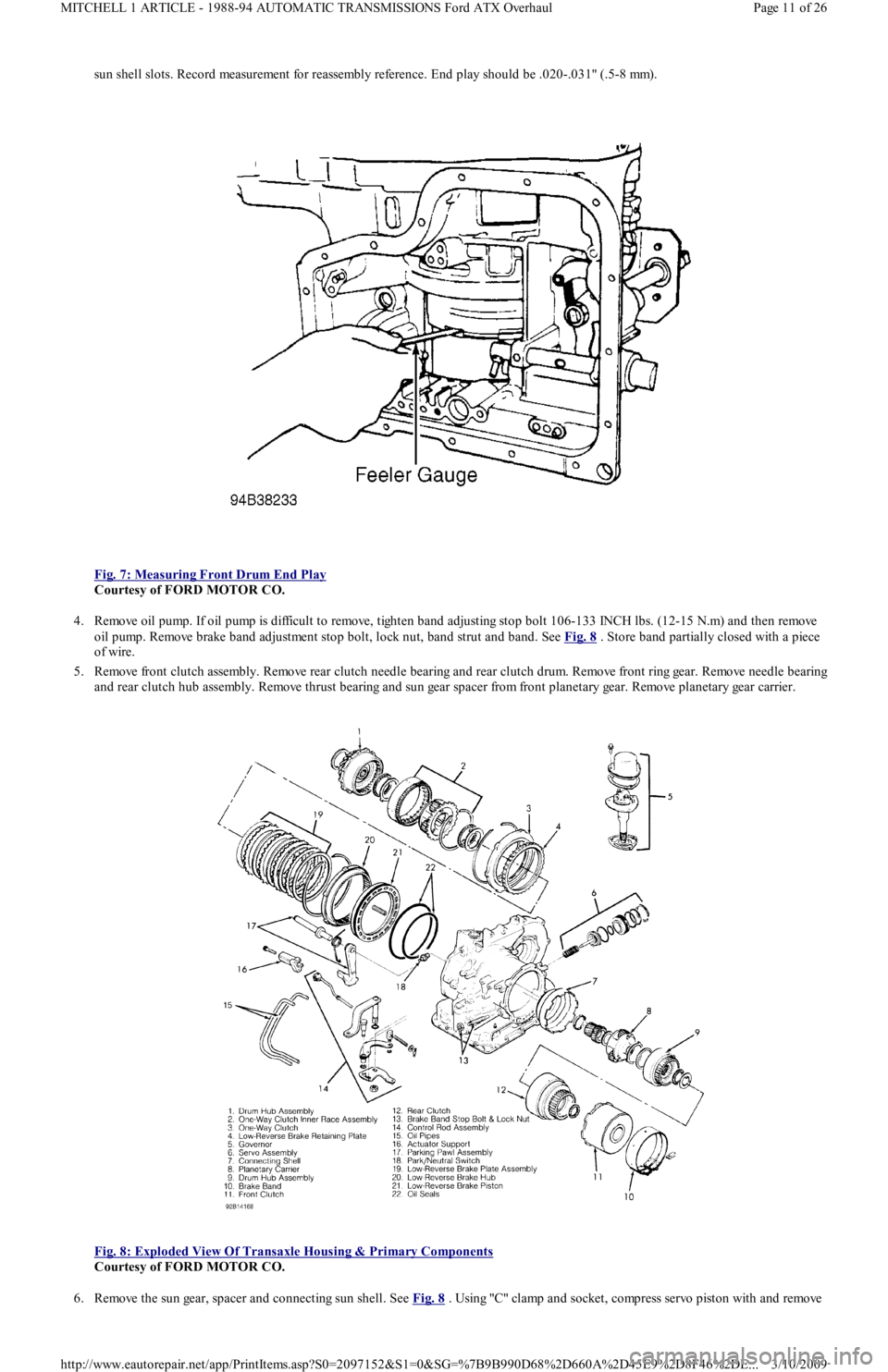
sun shell slots. Record measurement for reassembly reference. End play should be .020-.031" (.5-8 mm).
Fig. 7: Measuring Front Drum End Play
Courtesy of FORD MOTOR CO.
4. Remove oil pump. If oil pump is difficult to remove, tighten band adjusting stop bolt 106-133 INCH lbs. (12-15 N.m) and then remove
oil pump. Remove brake band adjustment stop bolt, lock nut, band strut and band. See Fig. 8
. Store band partially closed with a piece
of wire.
5. Remove front clutch assembly. Remove rear clutch needle bearing and rear clutch drum. Remove front ring gear. Remove needle bearing
and rear clutch hub assembly. Remove thrust bearing and sun gear spacer from front planetary gear. Remove planetary gear carrier.
Fig. 8: Exploded View Of Transaxle Housing & Primary Components
Courtesy of FORD MOTOR CO.
6. Remove the sun gear, spacer and connecting sun shell. See Fig. 8
. Using "C" clamp and socket, compress servo piston with and remove
Page 11 of 26 MITCHELL 1 ARTICLE - 1988-94 AUTOMATIC TRANSMISSIONS Ford ATX Overhaul
3/10/2009 http://www.eautorepair.net/app/PrintItems.asp?S0=2097152&S1=0&SG=%7B9B990D68%2D660A%2D45E9%2D8F46%2DE
...
Page 420 of 454
snap ring. Release the "C" clamp and remove the servo piston. See Fig. 2 . R e mo ve go ve r n o r c o ve r a n d p u l l go ve r n o r fr o m t r a n sa xl e
case. Remove transaxle case-to-torque converter housing bolts. Separate case halves.
7. Remove differential assembly. Remove oil pipes and parking pawl assembly. Remove drum hub assembly. Remove one-way clutch inner
race assembly. See Fig. 8
. Remove rear planetary carrier with needle bearing and thrust washer. Before disassembling one-way clutch,
measure and record clearance between one-way clutch and low-reverse brake retaining plate. Clearance should .032-.041" (.8-1.05
mm).
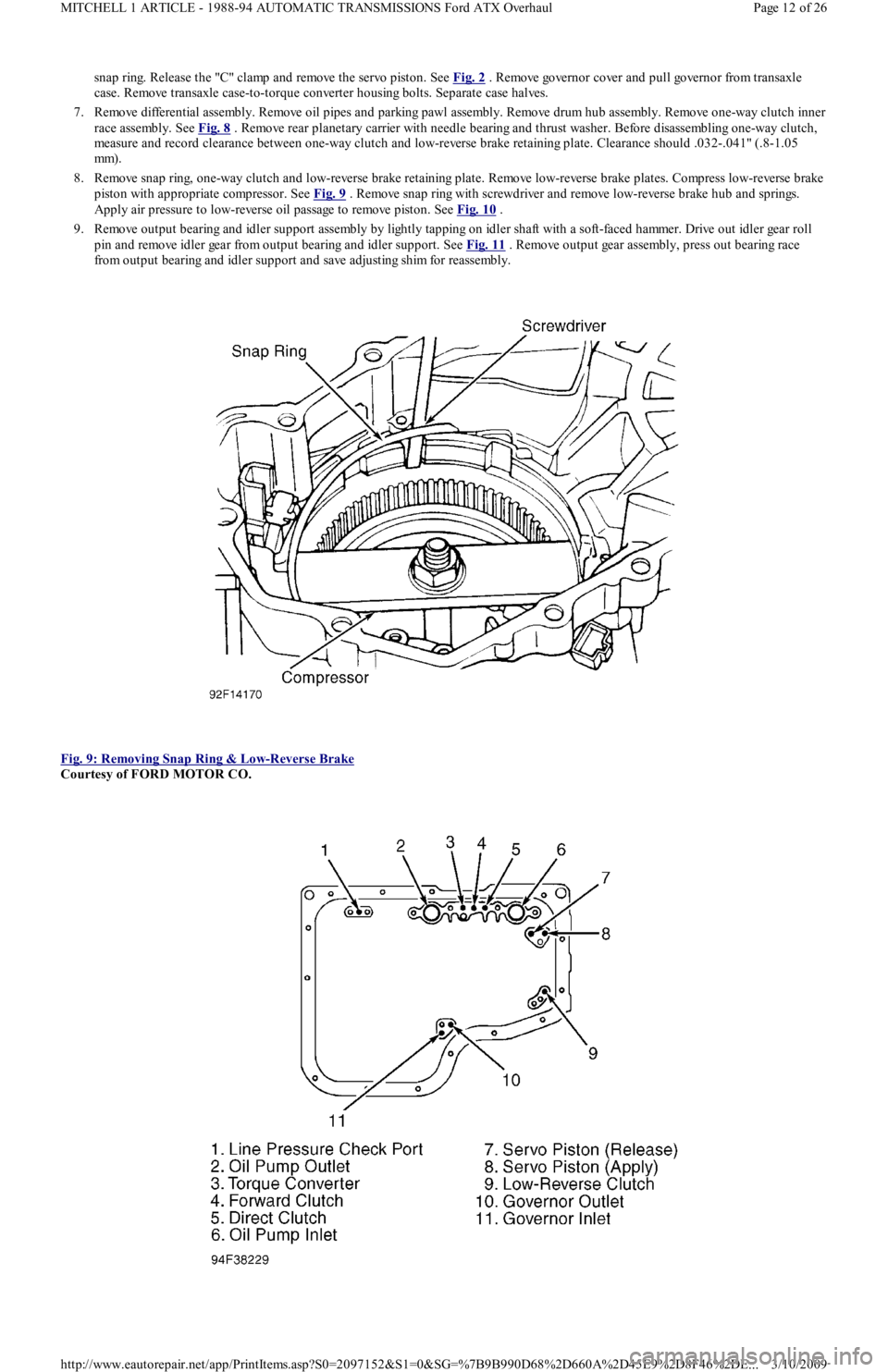
8. Remove snap ring, one-way clutch and low-reverse brake retaining plate. Remove low-reverse brake plates. Compress low-reverse brake
piston with appropriate compressor. See Fig. 9
. Remove snap ring with screwdriver and remove low-reverse brake hub and springs.
Apply air pressure to low-reverse oil passage to remove piston. See Fig. 10
.
9. Remove output bearing and idler support assembly by lightly tapping on idler shaft with a soft-faced hammer. Drive out idler gear roll
pin and remove idler gear from output bearing and idler support. See Fig. 11
. Remove output gear assembly, press out bearing race
from output bearing and idler support and save adjusting shim for reassembly.
Fig. 9: Removing Snap Ring & Low
-Reverse Brake
Courtesy of FORD MOTOR CO.
Page 12 of 26 MITCHELL 1 ARTICLE - 1988-94 AUTOMATIC TRANSMISSIONS Ford ATX Overhaul
3/10/2009 http://www.eautorepair.net/app/PrintItems.asp?S0=2097152&S1=0&SG=%7B9B990D68%2D660A%2D45E9%2D8F46%2DE
...
Page 423 of 454
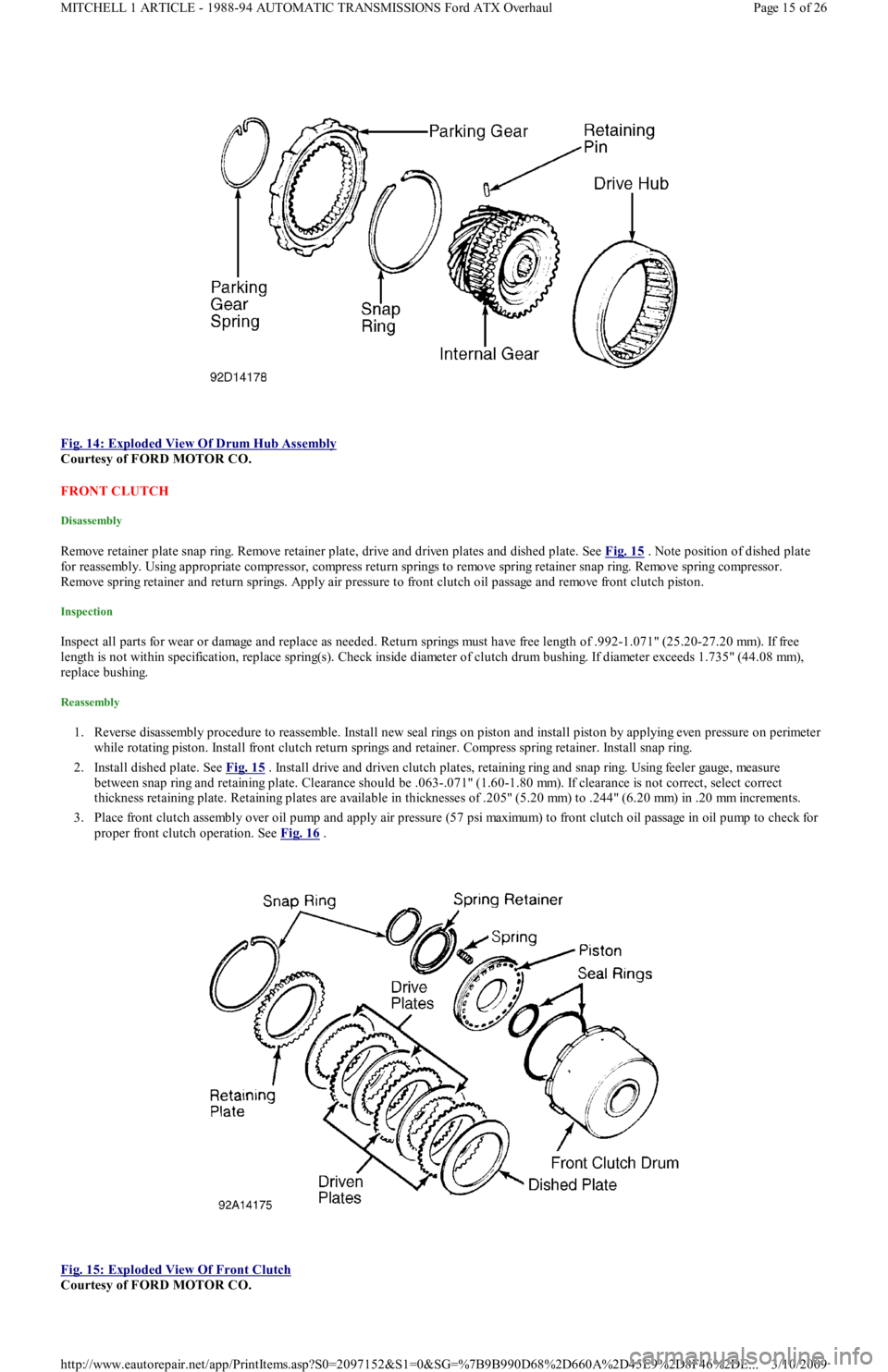
Fig. 14: Exploded View Of Drum Hub Assembly
Courtesy of FORD MOTOR CO.
FRONT CLUTCH
Disassembly
Remove retainer plate snap ring. Remove retainer plate, drive and driven plates and dished plate. See Fig. 15 . Note position of dished plate
for reassembly. Using appropriate compressor, compress return springs to remove spring retainer snap ring. Remove spring compressor.
Remove spring retainer and return springs. Apply air pressure to front clutch oil passage and remove front clutch piston.
Inspection
Inspect all parts for wear or damage and replace as needed. Return springs must have free length of .992-1.071" (25.20-27.20 mm). If free
length is not within specification, replace spring(s). Check inside diameter of clutch drum bushing. If diameter exceeds 1.735" (44.08 mm),
replace bushing.
Reassembly
1. Reverse disassembly procedure to reassemble. Install new seal rings on piston and install piston by applying even pressure on perimeter
while rotating piston. Install front clutch return springs and retainer. Compress spring retainer. Install snap ring.
2. Install dished plate. See Fig. 15
. Install drive and driven clutch plates, retaining ring and snap ring. Using feeler gauge, measure
between snap ring and retaining plate. Clearance should be .063-.071" (1.60-1.80 mm). If clearance is not correct, select correct
thickness retaining plate. Retaining plates are available in thicknesses of .205" (5.20 mm) to .244" (6.20 mm) in .20 mm increments.
3. Place front clutch assembly over oil pump and apply air pressure (57 psi maximum) to front clutch oil passage in oil pump to check for
proper front clutch operation. See Fig. 16
.
Fig. 15: Exploded View Of Front Clutch
Courtesy of FORD MOTOR CO.
Page 15 of 26 MITCHELL 1 ARTICLE - 1988-94 AUTOMATIC TRANSMISSIONS Ford ATX Overhaul
3/10/2009 http://www.eautorepair.net/app/PrintItems.asp?S0=2097152&S1=0&SG=%7B9B990D68%2D660A%2D45E9%2D8F46%2DE
...
Page 426 of 454
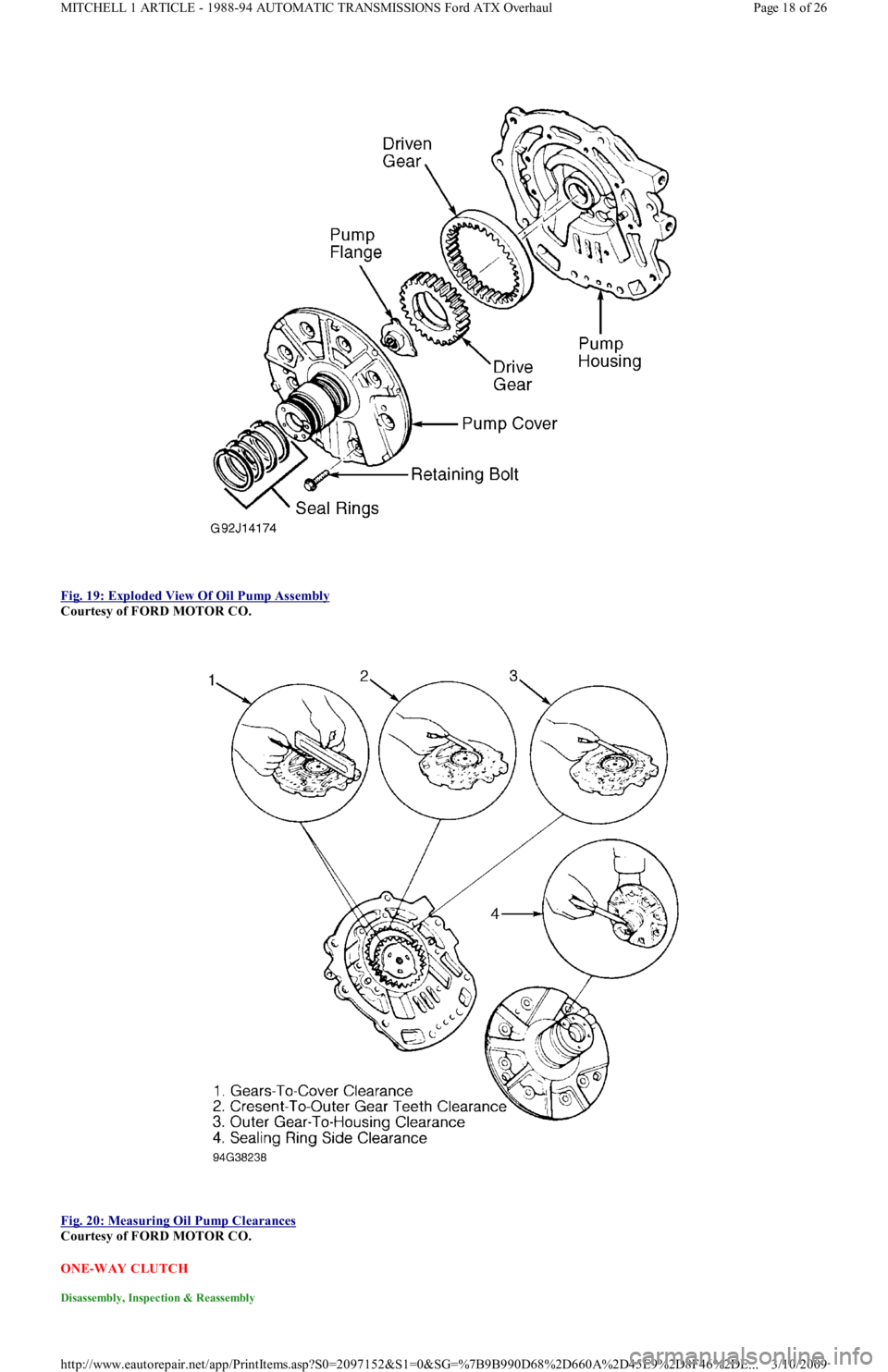
Fig. 19: Exploded View Of Oil Pump Assembly
Courtesy of FORD MOTOR CO.
Fig. 20: Measuring Oil Pump Clearances
Courtesy of FORD MOTOR CO.
ONE-WAY CLUTCH
Disassembly, Inspection & Reassembly
Page 18 of 26 MITCHELL 1 ARTICLE - 1988-94 AUTOMATIC TRANSMISSIONS Ford ATX Overhaul
3/10/2009 http://www.eautorepair.net/app/PrintItems.asp?S0=2097152&S1=0&SG=%7B9B990D68%2D660A%2D45E9%2D8F46%2DE
...
Page 427 of 454
1. Record direction of rotation one-way clutch locks and turns. Remove snap ring and pull out planetary carrier from one-way clutch inner
race. See Fig. 8
. Check for worn or damaged parts. Bushing wear on one-way clutch must not exceed 5.120" (130.06 mm).
2. Check clearance between pinion gears and washers in planetary carrier. If clearance exceeds .031" (.80 mm), replace planetary carrier.
Reverse disassembly procedure to reassemble. Install one-way clutch in inner race and ensure that it will turn in one direction
(clockwise) only.
REAR CLUTCH
Disassembly
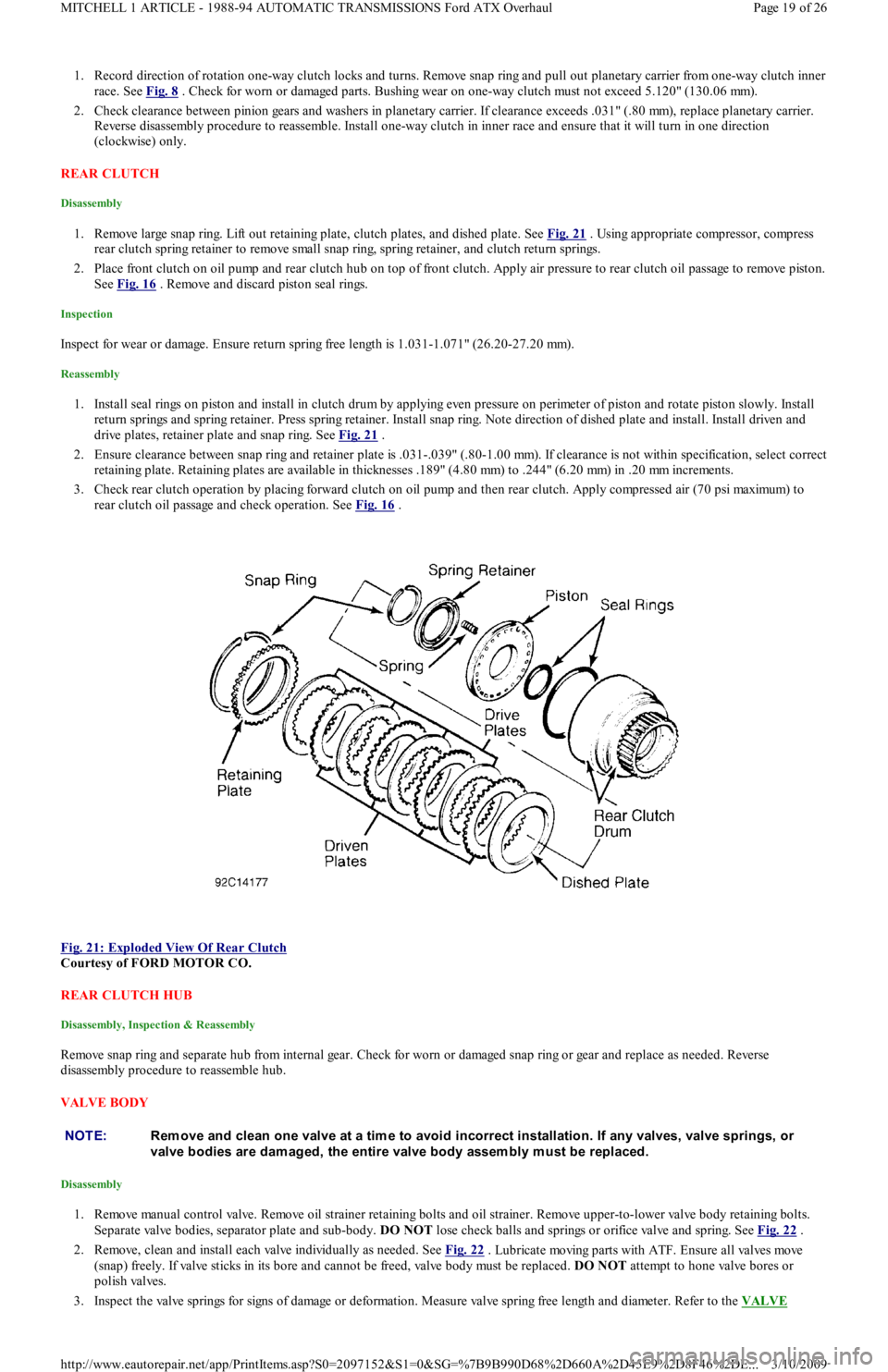
1. Remove large snap ring. Lift out retaining plate, clutch plates, and dished plate. See Fig. 21 . Using appropriate compressor, compress
rear clutch spring retainer to remove small snap ring, spring retainer, and clutch return springs.
2. Place front clutch on oil pump and rear clutch hub on top of front clutch. Apply air pressure to rear clutch oil passage to remove piston.
See Fig. 16
. Remove and discard piston seal rings.
Inspection
Inspect for wear or damage. Ensure return spring free length is 1.031-1.071" (26.20-27.20 mm).
Reassembly
1. Install seal rings on piston and install in clutch drum by applying even pressure on perimeter of piston and rotate piston slowly. Install
return springs and spring retainer. Press spring retainer. Install snap ring. Note direction of dished plate and install. Install driven and
drive plates, retainer plate and snap ring. See Fig. 21
.
2. Ensure clearance between snap ring and retainer plate is .031-.039" (.80-1.00 mm). If clearance is not within specification, select correct
retaining plate. Retaining plates are available in thicknesses .189" (4.80 mm) to .244" (6.20 mm) in .20 mm increments.
3. Check rear clutch operation by placing forward clutch on oil pump and then rear clutch. Apply compressed air (70 psi maximum) to
rear clutch oil passage and check operation. See Fig. 16
.
Fig. 21: Exploded View Of Rear Clutch
Courtesy of FORD MOTOR CO.
REAR CLUTCH HUB
Disassembly, Inspection & Reassembly
Remove snap ring and separate hub from internal gear. Check for worn or damaged snap ring or gear and replace as needed. Reverse
disassembly procedure to reassemble hub.
VALVE BODY
Disassembly
1. Remove manual control valve. Remove oil strainer retaining bolts and oil strainer. Remove upper-to-lower valve body retaining bolts.
Separate valve bodies, separator plate and sub-body. DO NOT lose check balls and springs or orifice valve and spring. See Fig. 22
.
2. Remove, clean and install each valve individually as needed. See Fig. 22
. Lubricate moving parts with ATF. Ensure all valves move
(snap) freely. If valve sticks in its bore and cannot be freed, valve body must be replaced. DO NOT attempt to hone valve bores or
polish valves.
3. Inspect the valve springs for signs of damage or deformation. Measure valve spring free length and diameter. Refer to the VALVE
NOTE:Rem ove and clean one valve at a tim e to avoid incorrect installation. If any valves, valve springs, or
valve bodies are dam aged, the entire valve body assem bly m ust be replaced.
Page 19 of 26 MITCHELL 1 ARTICLE - 1988-94 AUTOMATIC TRANSMISSIONS Ford ATX Overhaul
3/10/2009 http://www.eautorepair.net/app/PrintItems.asp?S0=2097152&S1=0&SG=%7B9B990D68%2D660A%2D45E9%2D8F46%2DE
...
Page 431 of 454
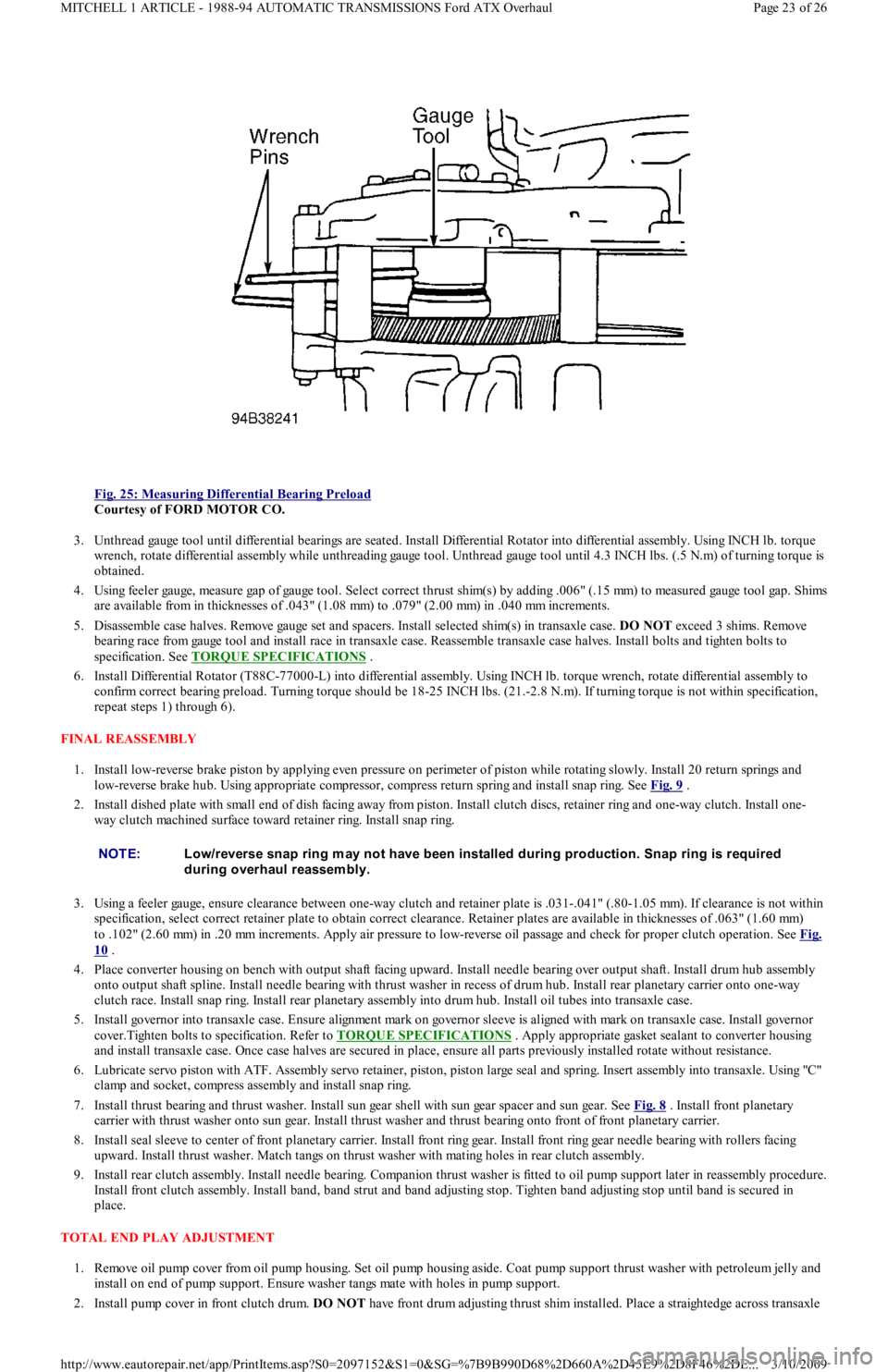
Fig. 25: Measuring Differential Bearing Preload
Courtesy of FORD MOTOR CO.
3. Unthread gauge tool until differential bearings are seated. Install Differential Rotator into differential assembly. Using INCH lb. torque
wrench, rotate differential assembly while unthreading gauge tool. Unthread gauge tool until 4.3 INCH lbs. (.5 N.m) of turning torque is
obtained.
4. Using feeler gauge, measure gap of gauge tool. Select correct thrust shim(s) by adding .006" (.15 mm) to measured gauge tool ga p . S h ims
are available from in thicknesses of .043" (1.08 mm) to .079" (2.00 mm) in .040 mm increments.
5. Disassemble case halves. Remove gauge set and spacers. Install selected shim(s) in transaxle case. DO NOT exceed 3 shims. Remove
bearing race from gauge tool and install race in transaxle case. Reassemble transaxle case halves. Install bolts and tighten bolts to
specification. See TORQUE SPECIFICATIONS
.
6. Install Differential Rotator (T88C-77000-L) into differential assembly. Using INCH lb. torque wrench, rotate differential assembly to
confirm correct bearing preload. Turning torque should be 18-25 INCH lbs. (21.-2.8 N.m). If turning torque is not within specification,
repeat steps 1) through 6).
FINAL REASSEMBLY
1. Install low-reverse brake piston by applying even pressure on perimeter of piston while rotating slowly. Install 20 return springs and
low-reverse brake hub. Using appropriate compressor, compress return spring and install snap ring. See Fig. 9
.
2. Install dished plate with small end of dish facing away from piston. Install clutch discs, retainer ring and one-way clutch. Install one-
way clutch machined surface toward retainer ring. Install snap ring.
3. Using a feeler gauge, ensure clearance between one-way clutch and retainer plate is .031-.041" (.80-1.05 mm). If clearance is not within
specification, select correct retainer plate to obtain correct clearance. Retainer plates are available in thicknesses of .063" (1.60 mm)
to .102" (2.60 mm) in .20 mm increments. Apply air pressure to low-reverse oil passage and check for proper clutch operation. See Fig.
10 .
4. Place converter housing on bench with output shaft facing upward. Install needle bearing over output shaft. Install drum hub assembly
onto output shaft spline. Install needle bearing with thrust washer in recess of drum hub. Install rear planetary carrier onto one-way
clutch race. Install snap ring. Install rear planetary assembly into drum hub. Install oil tubes into transaxle case.
5. Install governor into transaxle case. Ensure alignment mark on governor sleeve is aligned with mark on transaxle case. Install go ve r n o r
cover.Tighten bolts to specification. Refer to TORQUE SPECIFICATIONS
. Apply appropriate gasket sealant to converter housing
and install transaxle case. Once case halves are secured in place, ensure all parts previously installed rotate without resistance.
6. Lubricate servo piston with ATF. Assembly servo retainer, piston, piston large seal and spring. Insert assembly into transaxle. Usin g "C"
clamp and socket, compress assembly and install snap ring.
7. Install thrust bearing and thrust washer. Install sun gear shell with sun gear spacer and sun gear. See Fig. 8
. Install front planetary
carrier with thrust washer onto sun gear. Install thrust washer and thrust bearing onto front of front planetary carrier.
8. Install seal sleeve to center of front planetary carrier. Install front ring gear. Install front ring gear needle bearing with rollers facing
upward. Install thrust washer. Match tangs on thrust washer with mating holes in rear clutch assembly.
9. Install rear clutch assembly. Install needle bearing. Companion thrust washer is fitted to oil pump support later in reassembly procedure.
Install front clutch assembly. Install band, band strut and band adjusting stop. Tighten band adjusting stop until band is secured in
place.
TOTAL END PLAY ADJUSTMENT
1. Remove oil pump cover from oil pump housing. Set oil pump housing aside. Coat pump support thrust washer with petroleum jelly and
install on end of pump support. Ensure washer tangs mate with holes in pump support.
2. Install pump cover in front clutch drum. DO NOT have front drum adjusting thrust shim installed. Place a straightedge across transaxle
NOTE:Low/reverse snap ring m ay not have been installed during production. Snap ring is required
during overhaul reassem bly.
Page 23 of 26 MITCHELL 1 ARTICLE - 1988-94 AUTOMATIC TRANSMISSIONS Ford ATX Overhaul
3/10/2009 http://www.eautorepair.net/app/PrintItems.asp?S0=2097152&S1=0&SG=%7B9B990D68%2D660A%2D45E9%2D8F46%2DE
...
Page 432 of 454
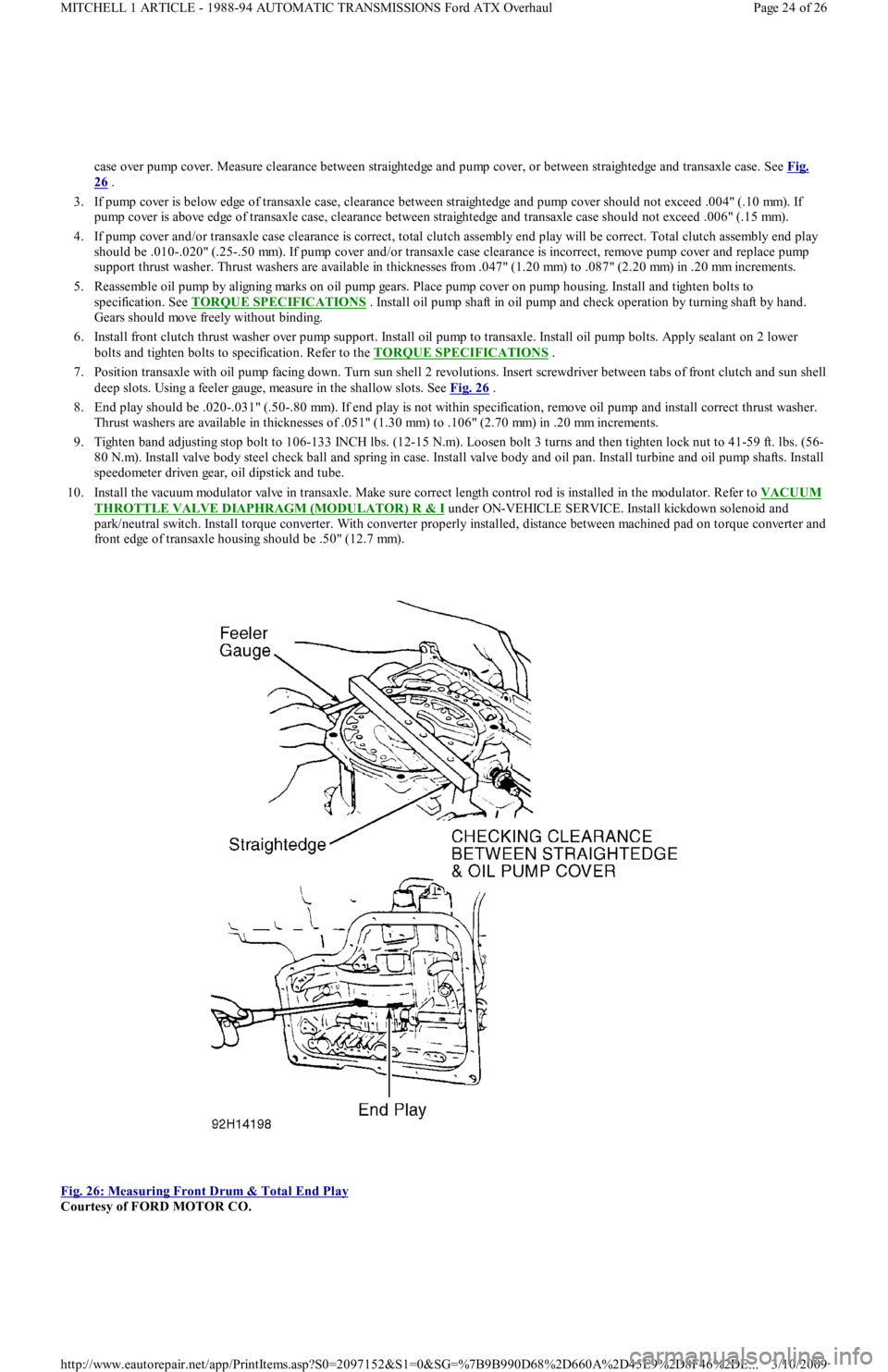
case over pump cover. Measure clearance between straightedge and pump cover, or between straightedge and transaxle case. See Fig.
26 .
3. If pump cover is below edge of transaxle case, clearance between straightedge and pump cover should not exceed .004" (.10 mm). If
pump cover is above edge of transaxle case, clearance between straightedge and transaxle case should not exceed .006" (.15 mm).
4. If pump cover and/or transaxle case clearance is correct, total clutch assembly end play will be correct. Total clutch assembly end play
should be .010-.020" (.25-.50 mm). If pump cover and/or transaxle case clearance is incorrect, remove pump cover and replace pump
support thrust washer. Thrust washers are available in thicknesses from .047" (1.20 mm) to .087" (2.20 mm) in .20 mm increments.
5. Reassemble oil pump by aligning marks on oil pump gears. Place pump cover on pump housing. Install and tighten bolts to
specification. See TORQUE SPECIFICATIONS
. Install oil pump shaft in oil pump and check operation by turning shaft by hand.
Gears should move freely without binding.
6. Install front clutch thrust washer over pump support. Install oil pump to transaxle. Install oil pump bolts. Apply sealant on 2 lower
bolts and tighten bolts to specification. Refer to the TORQUE SPECIFICATIONS
.
7. Position transaxle with oil pump facing down. Turn sun shell 2 revolutions. Insert screwdriver between tabs of front clutch and sun shell
deep slots. Using a feeler gauge, measure in the shallow slots. See Fig. 26
.
8. End play should be .020-.031" (.50-.80 mm). If end play is not within specification, remove oil pump and install correct thrust washer.
Thrust washers are available in thicknesses of .051" (1.30 mm) to .106" (2.70 mm) in .20 mm increments.
9. Tighten band adjusting stop bolt to 106-133 INCH lbs. (12-15 N.m). Loosen bolt 3 turns and then tighten lock nut to 41-59 ft. lbs. (56-
80 N.m). Install valve body steel check ball and spring in case. Install valve body and oil pan. Install turbine and oil pump sh aft s. In st al l
speedometer driven gear, oil dipstick and tube.
10. Install the vacuum modulator valve in transaxle. Make sure correct length control rod is installed in the modulator. Refer to VACUUM
THROTTLE VALVE DIAPHRAGM (MODULATOR) R & I under ON-VEHICLE SERVICE. Install kickdown solenoid and
park/neutral switch. Install torque converter. With converter properly installed, distance between machined pad on torque converter and
front edge of transaxle housing should be .50" (12.7 mm).
Fig. 26: Measuring Front Drum & Total End Play
Courtesy of FORD MOTOR CO.
Page 24 of 26 MITCHELL 1 ARTICLE - 1988-94 AUTOMATIC TRANSMISSIONS Ford ATX Overhaul
3/10/2009 http://www.eautorepair.net/app/PrintItems.asp?S0=2097152&S1=0&SG=%7B9B990D68%2D660A%2D45E9%2D8F46%2DE
...