clock FORD FIESTA 1989 Service Owner's Guide
[x] Cancel search | Manufacturer: FORD, Model Year: 1989, Model line: FIESTA, Model: FORD FIESTA 1989Pages: 296, PDF Size: 10.65 MB
Page 241 of 296
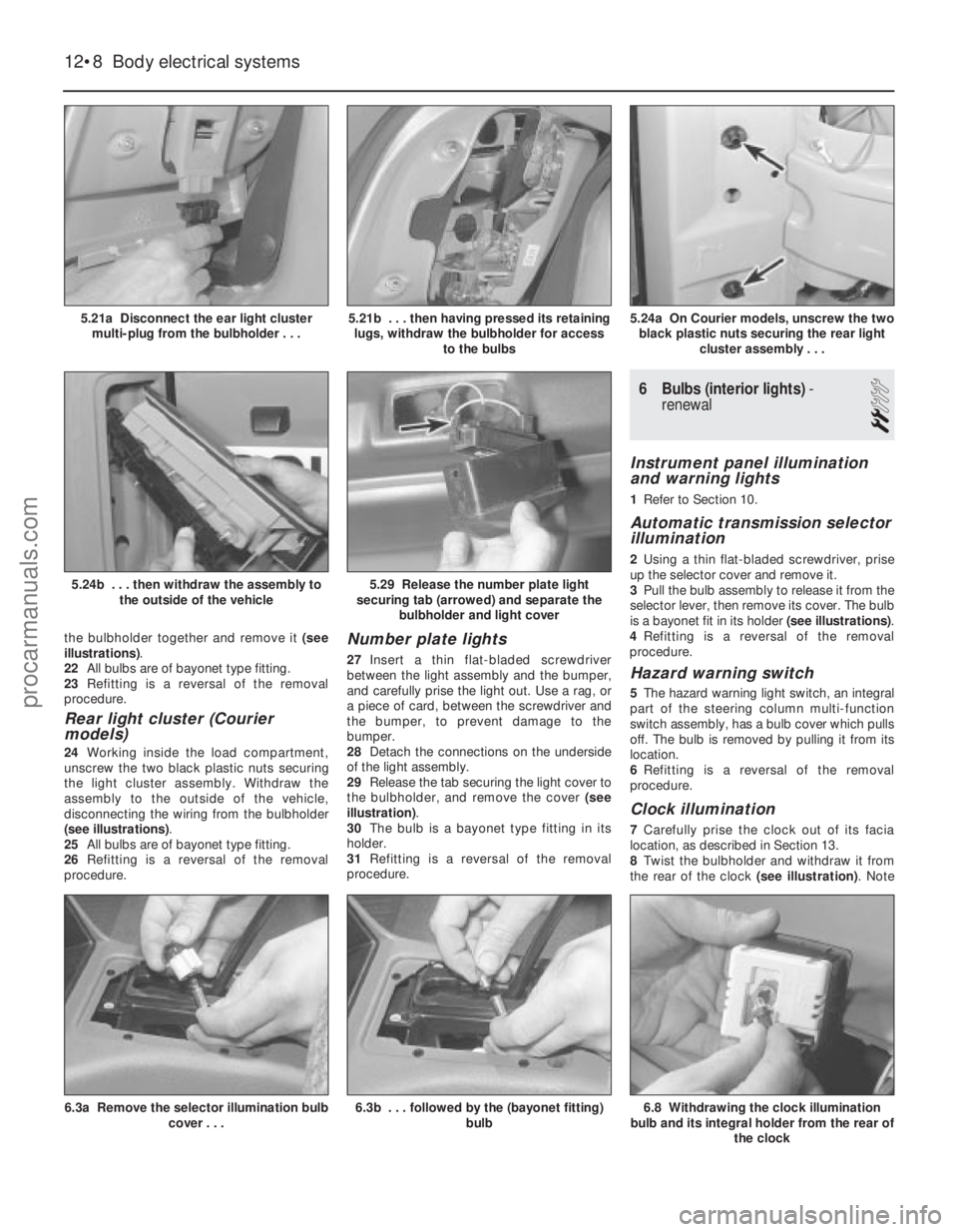
the bulbholder together and remove it (see
illustrations) .
22 All bulbs are of bayonet type fitting.
23 Refitting is a reversal of the removal
procedure.
Rear light cluster (Courier
models)
24 Working inside the load compartment,
unscrew the two black plastic nuts securing
the light cluster assembly. Withdraw the
assembly to the outside of the vehicle,
disconnecting the wiring from the bulbholder
(see illustrations) .
25 All bulbs are of bayonet type fitting.
26 Refitting is a reversal of the removal
procedure.
Number plate lights
27 Insert a thin flat-bladed screwdriver
between the light assembly and the bumper,
and carefully prise the light out. Use a rag, or
a piece of card, between the screwdriver and
the bumper, to prevent damage to the
bumper.
28 Detach the connections on the underside
of the light assembly.
29 Release the tab securing the light cover to
the bulbholder, and remove the cover (see
illustration) .
30 The bulb is a bayonet type fitting in its
holder.
31 Refitting is a reversal of the removal
procedure.
6 Bulbs (interior lights) -
renewal
2
Instrument panel illumination
and warning lights
1 Refer to Section 10.
Automatic transmission selector
illumination
2Using a thin flat-bladed screwdriver, prise
up the selector cover and remove it.
3 Pull the bulb assembly to release it from the
selector lever, then remove its cover. The bulb
is a bayonet fit in its holder (see illustrations).
4 Refitting is a reversal of the removal
procedure.
Hazard warning switch
5 The hazard warning light switch, an integral
part of the steering column multi-function
switch assembly, has a bulb cover which pulls
off. The bulb is removed by pulling it from its
location.
6 Refitting is a reversal of the removal
procedure.
Clock illumination
7 Carefully prise the clock out of its facia
location, as described in Section 13.
8 Twist the bulbholder and withdraw it from
the rear of the clock (see illustration). Note
12•8Body electrical systems
6.8 Withdrawing the clock illumination
bulb and its integral holder from the rear of
the clock6.3b . . . followed by the (bayonet fitting) bulb6.3a Remove the selector illumination bulbcover . . .
5.29 Release the number plate light
securing tab (arrowed) and separate the bulbholder and light cover5.24b . . . then withdraw the assembly to
the outside of the vehicle
5.24a On Courier models, unscrew the twoblack plastic nuts securing the rear light cluster assembly . . .5.21b . . . then having pressed its retaininglugs, withdraw the bulbholder for access to the bulbs5.21a Disconnect the ear light clustermulti-plug from the bulbholder . . .
1595Ford Fiesta Remakeprocarmanuals.com
http://vnx.su
Page 242 of 296
that the bulb and bulbholder cannot be
separated - they are replaced as an assembly.
9Refitting is a reversal of the removal
procedure.
Cigarette lighter illumination
10 Remove the cigarette lighter, as described
in Section 12.
11 Pull the bulbholder from its location in the
illuminated surround, then pull the bulb out of
the bulbholder.
12 Refitting is a reversal of the removal
procedure.
Heater facia illumination
13 Pull the heater fan motor control knob off,
then move the air distribution and
temperature controls fully to the right. Unclip
and remove the heater slide facia towards the
left-hand side of the vehicle, removing the
slide control knobs only as necessary, and
disconnecting its bulbholder (bayonet type) as
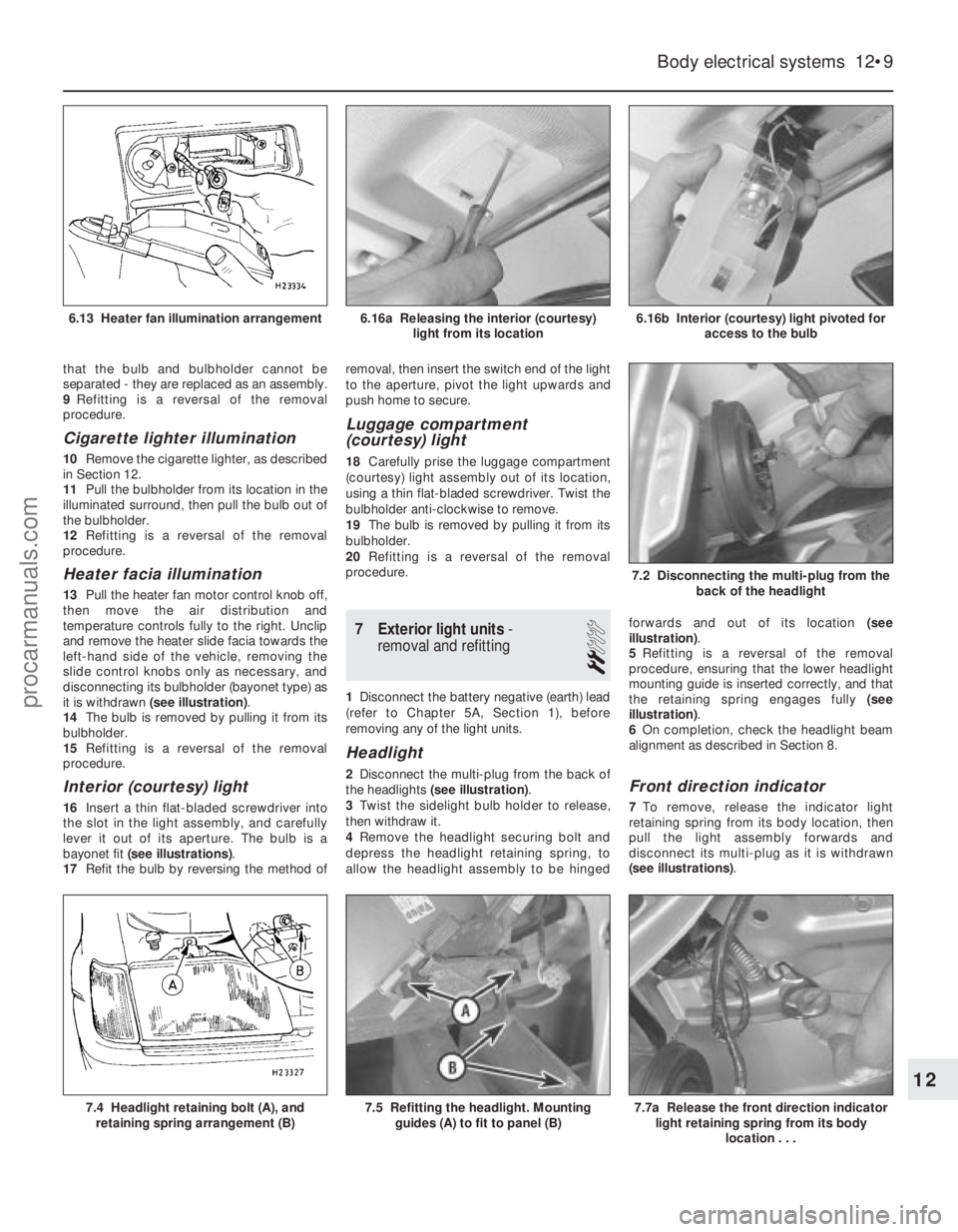
it is withdrawn (see illustration) .
14 The bulb is removed by pulling it from its
bulbholder.
15 Refitting is a reversal of the removal
procedure.
Interior (courtesy) light
16 Insert a thin flat-bladed screwdriver into
the slot in the light assembly, and carefully
lever it out of its aperture. The bulb is a
bayonet fit (see illustrations) .
17 Refit the bulb by reversing the method of removal, then insert the switch end of the light
to the aperture, pivot the light upwards and
push home to secure.
Luggage compartment
(courtesy) light
18
Carefully prise the luggage compartment
(courtesy) light assembly out of its location,
using a thin flat-bladed screwdriver. Twist the
bulbholder anti-clockwise to remove.
19 The bulb is removed by pulling it from its
bulbholder.
20 Refitting is a reversal of the removal
procedure.
7 Exterior light units -
removal and refitting
2
1 Disconnect the battery negative (earth) lead
(refer to Chapter 5A, Section 1), before
removing any of the light units.
Headlight
2 Disconnect the multi-plug from the back of
the headlights (see illustration) .
3 Twist the sidelight bulb holder to release,
then withdraw it.
4 Remove the headlight securing bolt and
depress the headlight retaining spring, to
allow the headlight assembly to be hinged forwards and out of its location
(see
illustration) .
5 Refitting is a reversal of the removal
procedure, ensuring that the lower headlight
mounting guide is inserted correctly, and that
the retaining spring engages fully (see
illustration) .
6 On completion, check the headlight beam
alignment as described in Section 8.Front direction indicator
7 To remove, release the indicator light
retaining spring from its body location, then
pull the light assembly forwards and
disconnect its multi-plug as it is withdrawn
(see illustrations) .
Body electrical systems 12•9
6.16b Interior (courtesy) light pivoted for
access to the bulb
7.2 Disconnecting the multi-plug from the
back of the headlight
6.16a Releasing the interior (courtesy)light from its location6.13 Heater fan illumination arrangement
7.7a Release the front direction indicatorlight retaining spring from its body
location . . .7.5 Refitting the headlight. Mountingguides (A) to fit to panel (B)7.4 Headlight retaining bolt (A), andretaining spring arrangement (B)
12
1595Ford Fiesta Remakeprocarmanuals.com
http://vnx.su
Page 245 of 296
retaining tags, taking care to avoid damaging
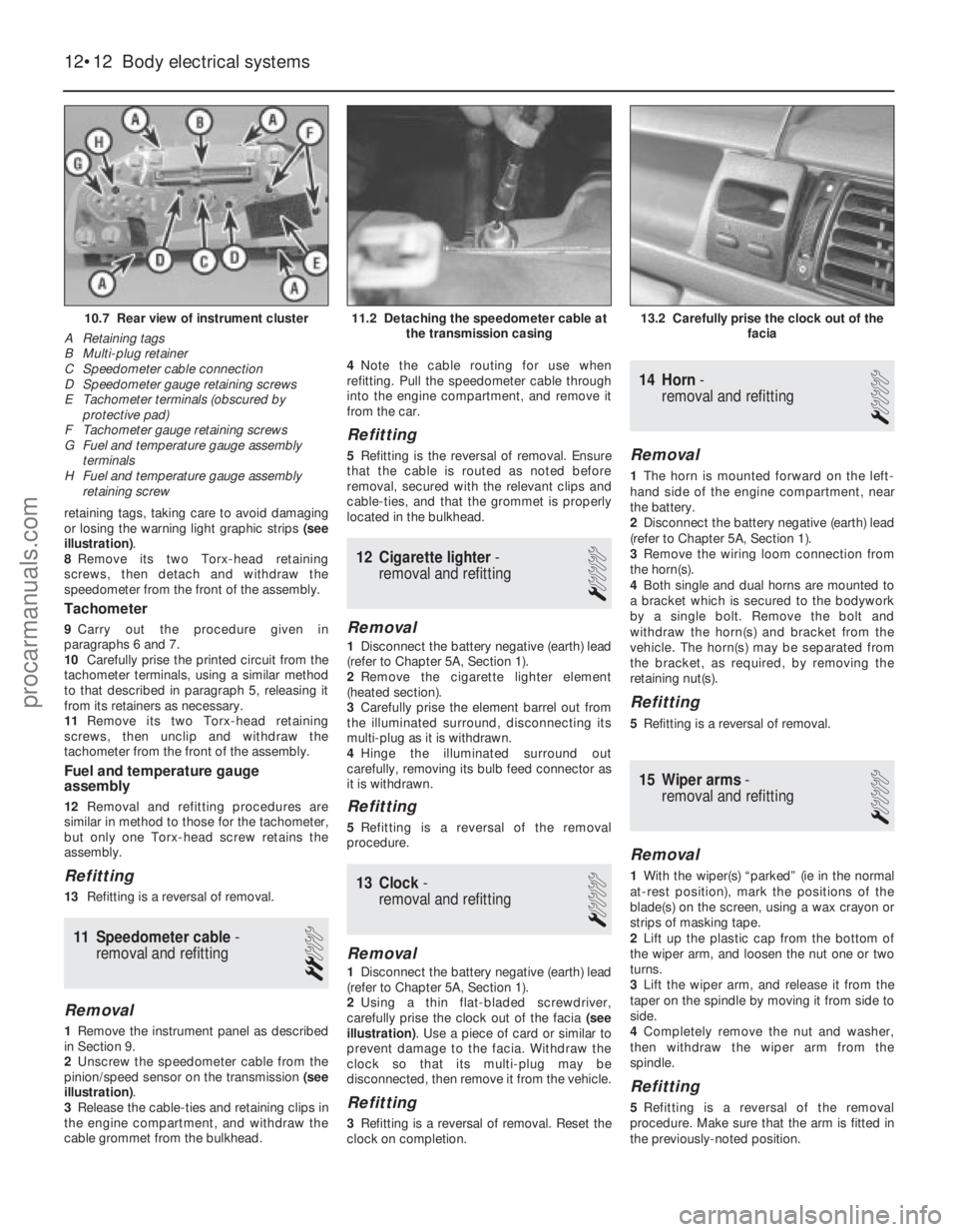
or losing the warning light graphic strips (see
illustration) .
8 Remove its two Torx-head retaining
screws, then detach and withdraw the
speedometer from the front of the assembly.
Tachometer
9 Carry out the procedure given in
paragraphs 6 and 7.
10 Carefully prise the printed circuit from the
tachometer terminals, using a similar method
to that described in paragraph 5, releasing it
from its retainers as necessary.
11 Remove its two Torx-head retaining
screws, then unclip and withdraw the
tachometer from the front of the assembly.
Fuel and temperature gauge
assembly
12 Removal and refitting procedures are
similar in method to those for the tachometer,
but only one Torx-head screw retains the
assembly.
Refitting
13 Refitting is a reversal of removal.
11 Speedometer cable -
removal and refitting
2
Removal
1 Remove the instrument panel as described
in Section 9.
2 Unscrew the speedometer cable from the
pinion/speed sensor on the transmission (see
illustration) .
3 Release the cable-ties and retaining clips in
the engine compartment, and withdraw the
cable grommet from the bulkhead. 4
Note the cable routing for use when
refitting. Pull the speedometer cable through
into the engine compartment, and remove it
from the car.
Refitting
5 Refitting is the reversal of removal. Ensure
that the cable is routed as noted before
removal, secured with the relevant clips and
cable-ties, and that the grommet is properly
located in the bulkhead.
12 Cigarette lighter -
removal and refitting
1
Removal
1 Disconnect the battery negative (earth) lead
(refer to Chapter 5A, Section 1).
2 Remove the cigarette lighter element
(heated section).
3 Carefully prise the element barrel out from
the illuminated surround, disconnecting its
multi-plug as it is withdrawn.
4 Hinge the illuminated surround out
carefully, removing its bulb feed connector as
it is withdrawn.
Refitting
5 Refitting is a reversal of the removal
procedure.
13 Clock -
removal and refitting
1
Removal
1 Disconnect the battery negative (earth) lead
(refer to Chapter 5A, Section 1).
2 Using a thin flat-bladed screwdriver,
carefully prise the clock out of the facia (see
illustration) . Use a piece of card or similar to
prevent damage to the facia. Withdraw the
clock so that its multi-plug may be
disconnected, then remove it from the vehicle.
Refitting
3 Refitting is a reversal of removal. Reset the
clock on completion.
14 Horn -
removal and refitting
1
Removal
1 The horn is mounted forward on the left-
hand side of the engine compartment, near
the battery.
2 Disconnect the battery negative (earth) lead
(refer to Chapter 5A, Section 1).
3 Remove the wiring loom connection from
the horn(s).
4 Both single and dual horns are mounted to
a bracket which is secured to the bodywork
by a single bolt. Remove the bolt and
withdraw the horn(s) and bracket from the
vehicle. The horn(s) may be separated from
the bracket, as required, by removing the
retaining nut(s).
Refitting
5 Refitting is a reversal of removal.
15 Wiper arms -
removal and refitting
1
Removal
1 With the wiper(s) “parked” (ie in the normal
at-rest position), mark the positions of the
blade(s) on the screen, using a wax crayon or
strips of masking tape.
2 Lift up the plastic cap from the bottom of
the wiper arm, and loosen the nut one or two
turns.
3 Lift the wiper arm, and release it from the
taper on the spindle by moving it from side to
side.
4 Completely remove the nut and washer,
then withdraw the wiper arm from the
spindle.
Refitting
5 Refitting is a reversal of the removal
procedure. Make sure that the arm is fitted in
the previously-noted position.
12•12 Body electrical systems
13.2 Carefully prise the clock out of the facia11.2 Detaching the speedometer cable atthe transmission casing10.7 Rear view of instrument cluster
A Retaining tags
B Multi-plug retainer
C Speedometer cable connection
D Speedometer gauge retaining screws
E Tachometer terminals (obscured by protective pad)
F Tachometer gauge retaining screws
G Fuel and temperature gauge assembly
terminals
H Fuel and temperature gauge assembly retaining screw
1595Ford Fiesta Remakeprocarmanuals.com
http://vnx.su
Page 250 of 296
27 Anti-theft systems-
general information
Anti-theft alarm system
1 This system provides an added form of
vehicle security. When the system is
activated, the alarm will sound if the vehicle is
broken into through any one of the doors, the
bonnet, or tailgate. The alarm will also be
triggered if the ignition system is turned on or
the radio/cassette disconnected whilst the
system is activated.
2 This system is activated/de-activated
whenever one of the front doors is
locked/unlocked by the key. The system
operates on all doors, the bonnet and tailgate
whenever each door is individually locked (or,
in the case of central locking, when the central
locking is engaged). In addition, the
ignition/starting system is also immobilised
when the system is activated.
3 A further security feature included is that
even though the battery may be disconnected
whilst the system is activated, the alarm
activation continues as soon as the battery is
reconnected. Because of this feature, it is
important to ensure that the system is de-
activated before disconnecting the battery at
any time, such as when working on the
vehicle.
4 The system incorporates a diagnostic mode
to enable Ford technicians to quickly identify
any faults in the system. In the event of a
system malfunction, any testing or
component removal and refitting should be
entrusted to a Ford dealer.
Passive Anti-Theft System
(PATS)
5 From 1994 model year onwards, a Passive
Anti-Theft System (PATS) is fitted. This
system, (which works independently of the
standard alarm system) is a vehicle
immobiliser which prevents the engine from
being started unless a specific code,
programmed into the ignition key, is
recognised by the PATS transceiver.
6 The PATS transceiver, fitted around the
ignition switch, decodes a signal from the
ignition key as the key is turned from position
“O” to position “II”. If the coded signal
matches that stored in the memory of the
PATS module, the engine will start. If the
signal is not recognised, the engine will crank
on the starter but will not fire.
28 Air bag (driver’s side) -
removal and refitting
4
Warning: Handle the air bag
with extreme care as a
precaution against personal
injury, and always hold it with the cover facing away from your body. If in
doubt concerning any proposed work
involving the air bag or its control circuitry,
consult a Ford dealer or other qualified
specialist.
Removal
1
Disconnect the battery negative (earth) lead
(refer to Chapter 5A, Section 1). Warning: Before proceeding,
wait a minimum of 15 minutes,
as a precaution against
accidental firing of the air bag.
This period ensures that any stored energy
in the back-up capacitor is dissipated.
2 Undo the screws, and remove the steering
column lower shroud.
3 Undo the two external screws and the two
internal screws and remove the steering
column upper shroud.
4 Turn the steering wheel as necessary so
that one of the air bag module retaining bolts
becomes accessible from the rear of the
steering wheel. Undo the bolt, then turn the
steering wheel again until the second bolt is
accessible. Undo this bolt also.
5 Withdraw the air bag module from the
steering wheel far enough to access the
wiring multi-plug. Some force may be needed
to free the module from the additional steering
wheel spoke retainers.
6 Disconnect the multi-plug from the rear of
the module, and remove the module from the
vehicle. Warning: Position the air bag
module in a safe place, with the
mechanism facing downwards
as a precaution against
accidental operation.
Warning: Do not attempt to
open or repair the air bag unit,
or apply any electrical current to
it. Do not use any air bag which
is visibly damaged or which has been
tampered with.
Refitting
7 Refitting is a reversal of the removal
procedure.
29 Air bag (passenger’s side) -
removal and refitting
4
Warning: Handle the air bag
with extreme care as a
precaution against personal
injury, and always hold it with
the cover facing away from your body. If in
doubt concerning any proposed work
involving the air bag or its control circuitry,
consult a Ford dealer or other qualified
specialist.
Removal
1 Disconnect the battery negative (earth) lead
(refer to Chapter 5A, Section 1). Warning: Before proceeding,
wait a minimum of 15 minutes,
as a precaution against
accidental firing of the air bag.
This period ensures that any stored energy
in the back-up capacitor is dissipated.
2 Remove the facia as described in Chap-
ter 11.
3 Undo the air bag module retaining nuts and
remove the unit from the facia. Warning: Position the air bag
module in a safe place, with the
mechanism facing downwards
as a precaution against
accidental operation.
Warning: Do not attempt to
open or repair the air bag unit,
or apply any electrical current to
it. Do not use any air bag which
is visibly damaged or which has been
tampered with.
Refitting
4 Refitting is a reversal of the removal
procedure.
30 Air bag control module -
removal and refitting
4
Removal
1 Disconnect the battery negative (earth) lead
(refer to Chapter 5A, Section 1). Warning: Before proceeding,
wait a minimum of 15 minutes,
as a precaution against
accidental firing of the air bag
unit. This period ensures that any stored
energy in the back-up capacitor is
dissipated.
2 Remove the module access cover from the
rear of the glovebox.
3 Press the module wiring multi-plug locking
tag upwards then pivot the retaining strap
over and disconnect the multi-plug.
4 Remove the facia as described in Chap-
ter 11.
5 Undo the three retaining bolts and remove
the module from its location.
Refitting
6 Refitting is a reversal of the removal
procedure.
31 Air bag clock spring -
removal and refitting
4
Removal
1 Remove the steering wheel as described in
Chapter 10.
2 Undo the three retaining screws, and
remove the clock spring from the steering
wheel. As the unit is withdrawn, note which
aperture in the steering wheel the air bag
Body electrical systems 12•17
12
1595Ford Fiesta Remakeprocarmanuals.com
http://vnx.su
Page 251 of 296
wiring passes through, as an aid to
reassembly.
Refitting
3Position the clock spring on the steering
wheel, routing the wiring as noted on removal,
and secure with the retaining screws.
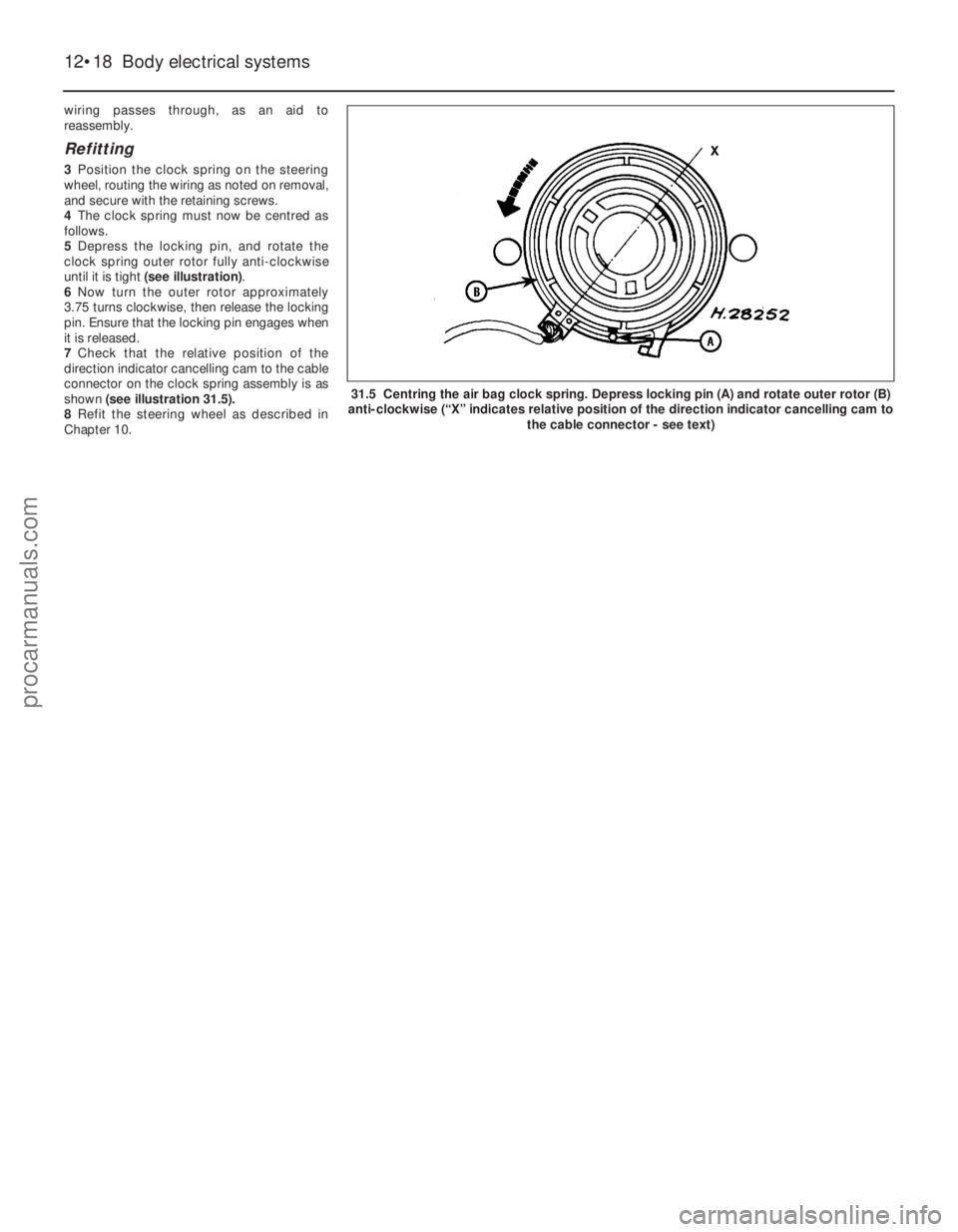
4 The clock spring must now be centred as
follows.
5 Depress the locking pin, and rotate the
clock spring outer rotor fully anti-clockwise
until it is tight (see illustration) .
6 Now turn the outer rotor approximately
3.75 turns clockwise, then release the locking
pin. Ensure that the locking pin engages when
it is released.
7 Check that the relative position of the
direction indicator cancelling cam to the cable
connector on the clock spring assembly is as
shown (see illustration 31.5).
8 Refit the steering wheel as described in
Chapter 10.
12•18 Body electrical systems
31.5 Centring the air bag clock spring. Depress locking pin (A) and r\
otate outer rotor (B)
anti-clockwise (“X” indicates relative position of the direction \
indicator cancelling cam to the cable connector - see text)
1595Ford Fiesta Remakeprocarmanuals.com
http://vnx.su
Page 261 of 296

12•28 Wiring diagrams
Diagram 2b: Interior lighting, lights-on warning buzzer, clock and cigar\
lighter
1595Ford Fiesta Remakeprocarmanuals.com
http://vnx.su
Page 278 of 296
1595 Ford Fiesta Remake
REF•12MOT test checks
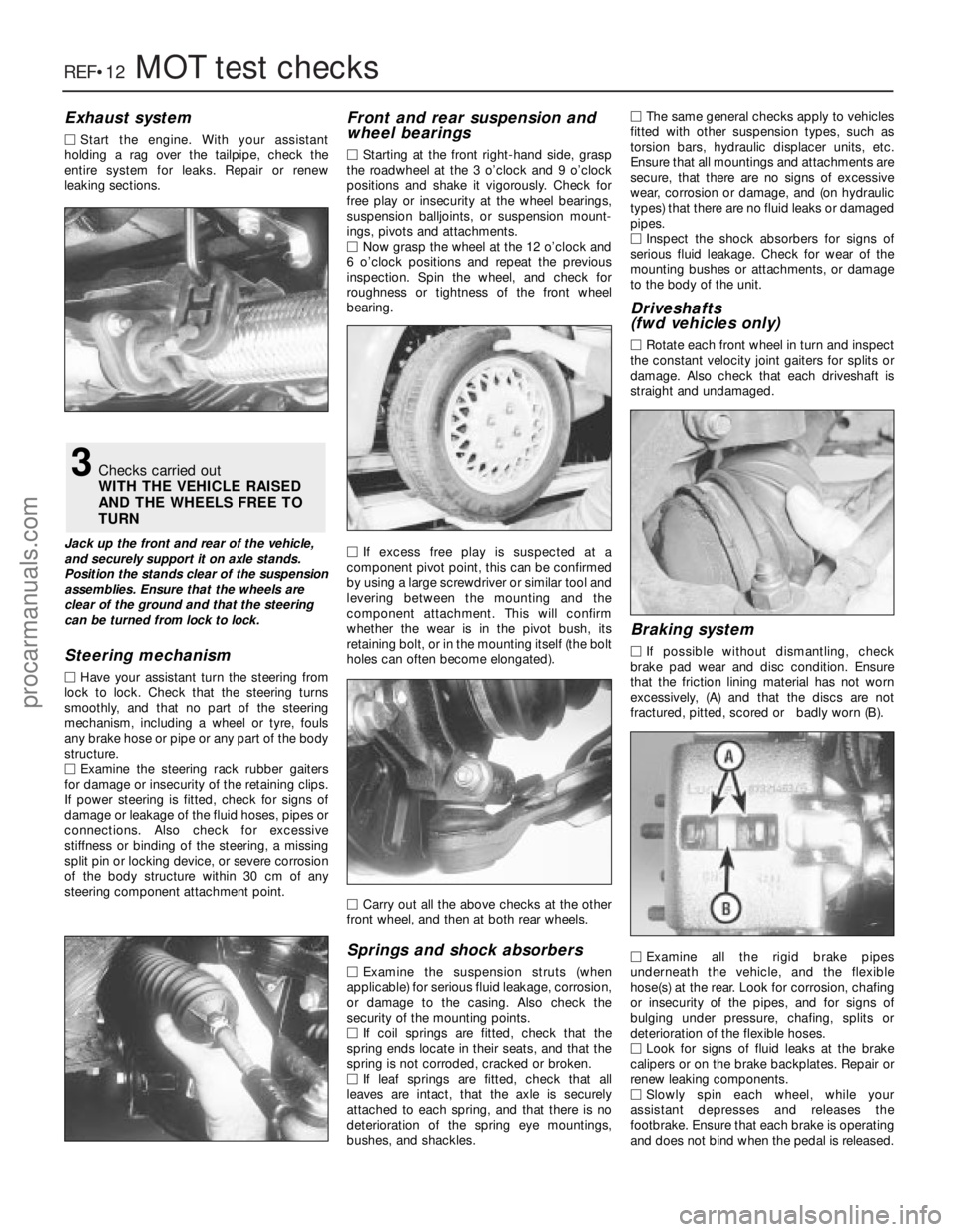
Exhaust system
MStart the engine. With your assistant
holding a rag over the tailpipe, check the
entir e system for leaks. Repair or renew
leaking sections.
Jack up the front and rear of the vehicle,
and securely support it on axle stands.
Position the stands clear of the suspension
assemblies. Ensure that the wheels are
clear of the ground and that the steering
can be turned from lock to lock.
Steering mechanism
M Have your assistant turn the steering fr om
lock to lock. Check that the steering turns
smoothly , and that no part of the steering
mechanism, including a wheel or tyre, fouls
any brake hose or pipe or any part of the body
structure.
M Examine the steering rack rubber gaiters
for damage or insecurity of the retaining clips.
If power steering is fitted, check for signs of
damage or leakage of the fluid hoses, pipes or
connections. Also check for excessive
stif fness or binding of the steering, a missing
split pin or locking device, or severe corrosion
of the body structure within 30 cm of any
steering component attachment point.
Front and rear suspension and
wheel bearings
M Starting at the front right-hand side, grasp
the roadwheel at the 3 o’clock and 9 o’clock
positions and shake it vigorously. Check for
fr ee play or insecurity at the wheel bearings,
suspension balljoints, or suspension mount-
ings, pivots and attachments.
M Now grasp the wheel at the 12 o’clock and
6 o’clock positions and repeat the previous
inspection. Spin the wheel, and check for
r oughness or tightness of the front wheel
bearing.
M If excess free play is suspected at a
component pivot point, this can be confirmed
by using a large screwdriver or similar tool and
levering between the mounting and the
component attachment. This will confirm
whether the wear is in the pivot bush, its
r etaining bolt, or in the mounting itself (the bolt
holes can often become elongated).
M Carry out all the above checks at the other
fr ont wheel, and then at both rear wheels.
Springs and shock absorbers
M Examine the suspension struts (when
applicable) for serious fluid leakage, corrosion,
or damage to the casing. Also check the
security of the mounting points.
M If coil springs are fitted, check that the
spring ends locate in their seats, and that the
spring is not corroded, cracked or broken.
M If leaf springs are fitted, check that all
leaves are intact, that the axle is securely
attached to each spring, and that there is no
deterioration of the spring eye mountings,
bushes, and shackles. M
The same general checks apply to vehicles
fitted with other suspension types, such as
torsion bars, hydraulic displacer units, etc.
Ensur e that all mountings and attachments are
secur e, that there are no signs of excessive
wear , corrosion or damage, and (on hydraulic
types) that ther e are no fluid leaks or damaged
pipes.
M Inspect the shock absorbers for signs of
serious fluid leakage. Check for wear of the
mounting bushes or attachments, or damage
to the body of the unit.
Driveshafts
(fwd vehicles only)
M Rotate each front wheel in turn and inspect
the constant velocity joint gaiters for splits or
damage. Also check that each driveshaft is
straight and undamaged.
Braking system
M If possible without dismantling, check
brake pad wear and disc condition. Ensure
that the friction lining material has not worn
excessively , (A) and that the discs are not
fractur ed, pitted, scored or badly worn (B).
M Examine all the rigid brake pipes
under neath the vehicle, and the flexible
hose(s) at the rear. Look for corrosion, chafing
or insecurity of the pipes, and for signs of
bulging under pressure, chafing, splits or
deterioration of the flexible hoses.
M Look for signs of fluid leaks at the brake
calipers or on the brake backplates. Repair or
r enew leaking components.
M Slowly spin each wheel, while your
assistant depresses and releases the
footbrake. Ensure that each brake is operating
and does not bind when the pedal is released.
3Checks carried out
WITH THE VEHICLE RAISED
AND THE WHEELS FREE TO
TURN
procarmanuals.com
http://vnx.su
Page 293 of 296
1595 Ford Fiesta Remake
IndexREF•27
REF
Note: References throughout this index relate to Chapter•page number
A
Accelerator cable -4A•4, 4B•4, 4C•4, 4D•3
Accelerator pedal - 4A•4, 4B•4, 4C•4, 4D•3
Accelerator pump - 4A•8
Acknowledgements - 0•4
Aerial - 12•16
Air bags - 0•5, 12•17
Air cleaner - 1•22, 1•23, 4A•3, 4B•4, 4C•3,
4D•3, 4E•5
Air temperature control system - 1•23,
4B•8, 4C•7, 4D•6
Alarm system - 12•17, REF• 5
Alternator - 5A•4
Anti-lock braking system (ABS) - 9•11,
9•14, 9•16
Anti-roll bar - 10•7, 10•11
Anti-theft alarm system - 12•17, REF•5
Antifreeze - 0•12, 0•17, 1•21, 1•22, 3•2
Asbestos - 0•5
ATF - 0•17, 1•18, 1•24
Automatic choke - 4A•16, 4A•17
Automatic transmission -2A•10, 2B•13,
2C•15, 2D•6, 2D•8, 2D•10, 7B•1 et seq,
12 •6, 12 •8
Automatic transmission fault finding - REF• 18
Automatic transmission fluid - 0•17, 1•18,
1•24
Auxiliary lights - 12•7, 12•10
Axle - 10•10
B
Backfire - REF•16
Backrest - 11•17
Ballast resistor - 4B•9
Balljoint - 10•17
Battery - 0•5, 0•14, 5A•2, 5A•3
Battery fault - REF•20
Big-end bearings - 2D•21, 2D•24
Bleeding braking system - 9•10, 9•11
Bleeding power steering - 10•17
Body electrical systems -1•18, 12 •1et seq,
REF• 11
Body electrical system fault finding - 5A•2,
12 •3, REF •20
Bodywork and fittings -1•18, 11 •1et seq,
REF• 13
Bonnet - 1•18, 11•4,11•5
Boot - 1•16
Boots - 8•3, 8•4, 10 •15
Brake fluid - 0•13, 0•17, 1•26, 12 •6
Braking system -1•17, 9•1 et seq, 12•6,
REF• 10, REF•11, REF• 12
Braking system fault finding - REF•18 Bulbs -
0•16, 12 •7,12•8
Bumpers - 11•7, 11•8
Burning - 0•5
Buying spare parts - REF•5
C
Cables -4A•4, 4B•4, 4C•4, 4D•3, 6•1, 7B•2,
9•12, 9•13, 12 •12
Calipers - 9•3
Camshaft - 2B•6, 2B•7, 2C•7, 2C•8, 2D•16
Camshaft position sensor - 4D•6
Carburettor - 4A•7, 4A•8, 4A•9, 4A•11,
4A•13, 4A•14, 4A•15, 4A•17, 4A•18
Carpets - 11•2
Cassette player - 12•15, REF •5
Catalytic converter - 4E•2, 4E•5
Centre console - 11•20, 12 •5
Charcoal canister - 4E•6
Charging system - 5A•3
Choke - 4A•4, 4A•16, 4A•17
Cigarette lighter - 12•9, 12 •12
Clock - 12•8, 12•12
Clutch -1•18, 6•1 et seq
Clutch fault finding - REF•17
Coil - 5B•4
Compression test - 2A•3, 2B•3, 2C•3
Connecting rods - 2D•17, 2D•24, 2D•25
Console - 11•20, 12•5
Contents - 0•2
Conversion factors - REF•6
Coolant - 0•12, 0•17, 1•21, 1•22, 3•2
Coolant pump - 3•7
Coolant temperature sensor - 4B•8, 4C•7,
4D•6
Cooling ,heating and ventilation systems -
3•1 et seq
Cooling system fault finding - REF•16
Courtesy light - 12•6, 12•9
Crankcase - 2D•19
Crankcase ventilation system - 1•24
Crankshaft - 2A•6, 2A•9, 2B•4, 2B•6,
2B•12, 2C•4, 2C•7, 2C•14, 2D•18,
2D•22, 2D•24
Crankshaft position sensor - 4B•8, 4C•7,
4D•6, 5B•5
Crossmember - 10•7
Crushing - 0•5
Cushion - 11•17
CV joint - 1•16, 8•3, 8•4
CVH and PTE engine in-car repair
procedures -2B•1 et seq
Cylinder block - 2D•19
Cylinder head - 2A•4, 2A•5, 2B•4, 2B•9,
2C•3, 2C•10, 2D•12, 2D•14, 2D•15
D
Dents in bodywork - 11•2
Depressurising fuel system - 4B•3, 4C•3,
4D•2
Differential - 7A•3, 7B•3
Dimensions - REF•1
Direction indicators - 12•7, 12•9, 12•10
Discs - 9•4
Distributor - 1•20, 5B•5, 5B•6, 5B•7
Doors - 1•18, 11• 6,11•9, 11 •10,,11 •11,
11 •13, 11•14, 11•15, REF •11
Drip rail moulding - 11•5
Drivebelt - 1•11
Driveplate - 2B•14, 2C•16
Driveshafts -1•16, 8•1 et seq,REF•12
Driveshafts fault finding - REF•19
Drivetrain - 1•18
Drums - 9•4
E
Earth fault - 12•4
EEC IV engine management module - 4C•6
Electric shock - 0•5
Electric windows - 11•14, 12 •7, 12•15,
REF•20
Emblems - 11•5
Emission control system - 1•24, 4E•1
Engine fault finding - REF•15, REF•16,
REF •18
Engine oil - 0•12, 0•17, 1•9
Engine removal and overhaul procedures -
2D•1 et seq
Environmental considerations - REF•4
Evaporative emission control systems - 1•24, 4E•2, 4E•5
Exhaust and emission control systems -
4E•1 et seq
Exhaust emission checks - REF•13
Exhaust manifold - 4E•3
Exhaust system - 1•16, 4E•1, 4E•2, REF •5,
REF •12
Exhaust system fault - REF•17
Expansion tank - 3•6
F
Facia - 11•20, 12 •5
Fan - 3•4
Fast-idle speed adjustment - 4A•13, 4A•15,
4A•9, 4A•7
Fault finding - REF•14et seq
Fault finding - automatic transmission -
REF •18
Fault finding - braking system - REF•18
procarmanuals.com
http://vnx.su