Electrical FORD FIESTA 2007 Workshop Manual
[x] Cancel search | Manufacturer: FORD, Model Year: 2007, Model line: FIESTA, Model: FORD FIESTA 2007Pages: 1226, PDF Size: 61.26 MB
Page 881 of 1226
303-07A-3 Engine Ignition 303-07A-3
DIAGNOSIS AND TESTING
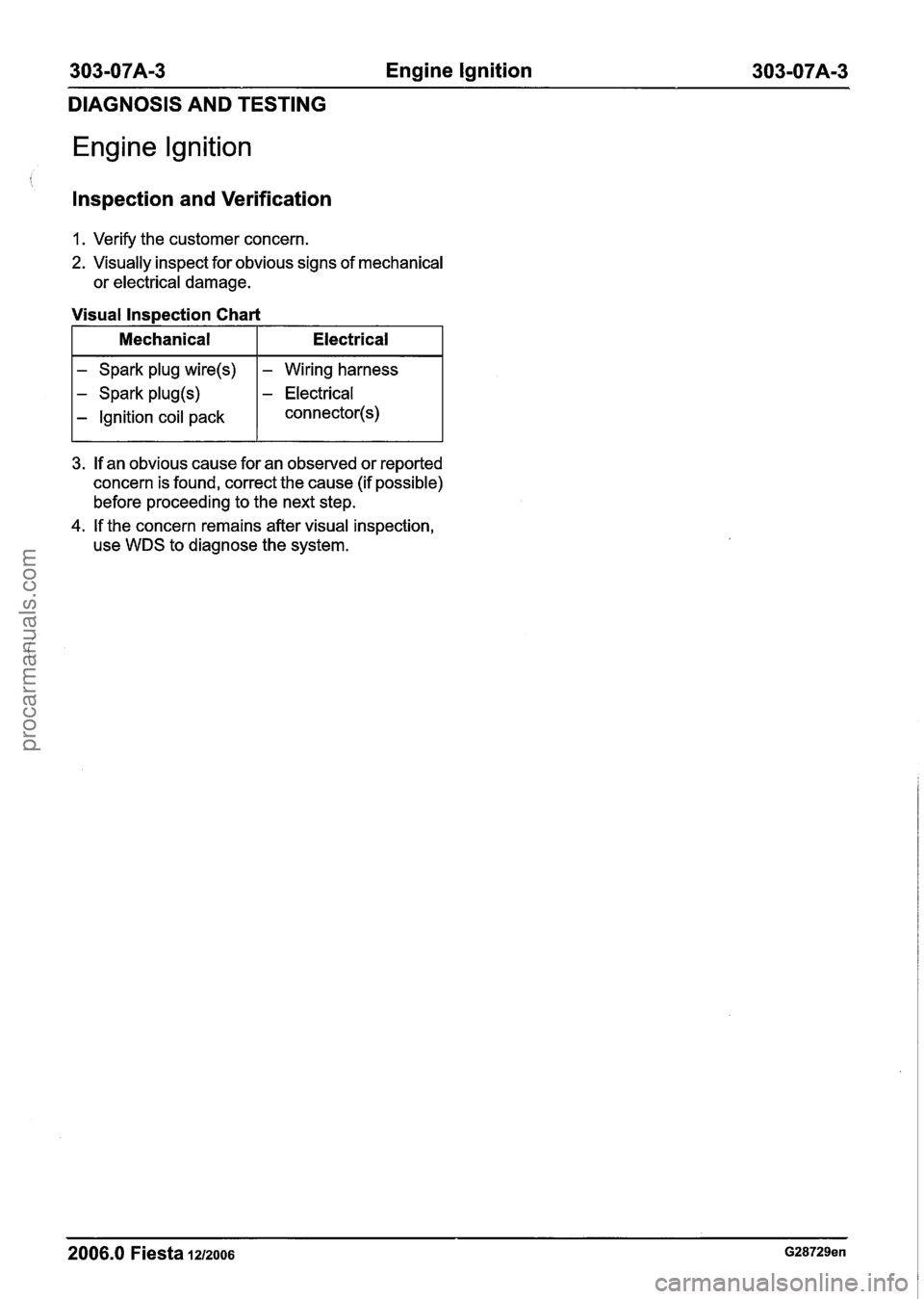
Engine lgnition
lnspection and Verification
1. Verify the customer concern.
2. Visually inspect for obvious signs of mechanical
or electrical damage.
Visual Inspection Chart
I Mechanical I Electrical I
3. If an obvious cause for an observed or reported
concern is found, correct the cause (if possible)
before proceeding to the next step.
- Spark plug wire(s)
- Spark plug(s)
- Ignition coil pack
4. If the concern remains after visual inspection,
use WDS to diagnose the system.
- Wiring harness
- Electrical
connector(s)
2006.0 Fiesta 1212006 G28729en
procarmanuals.com
Page 885 of 1226
Engine lgnition - 2.OL Duratec-HE (M14)
DIAGNOSIS AND TESTING
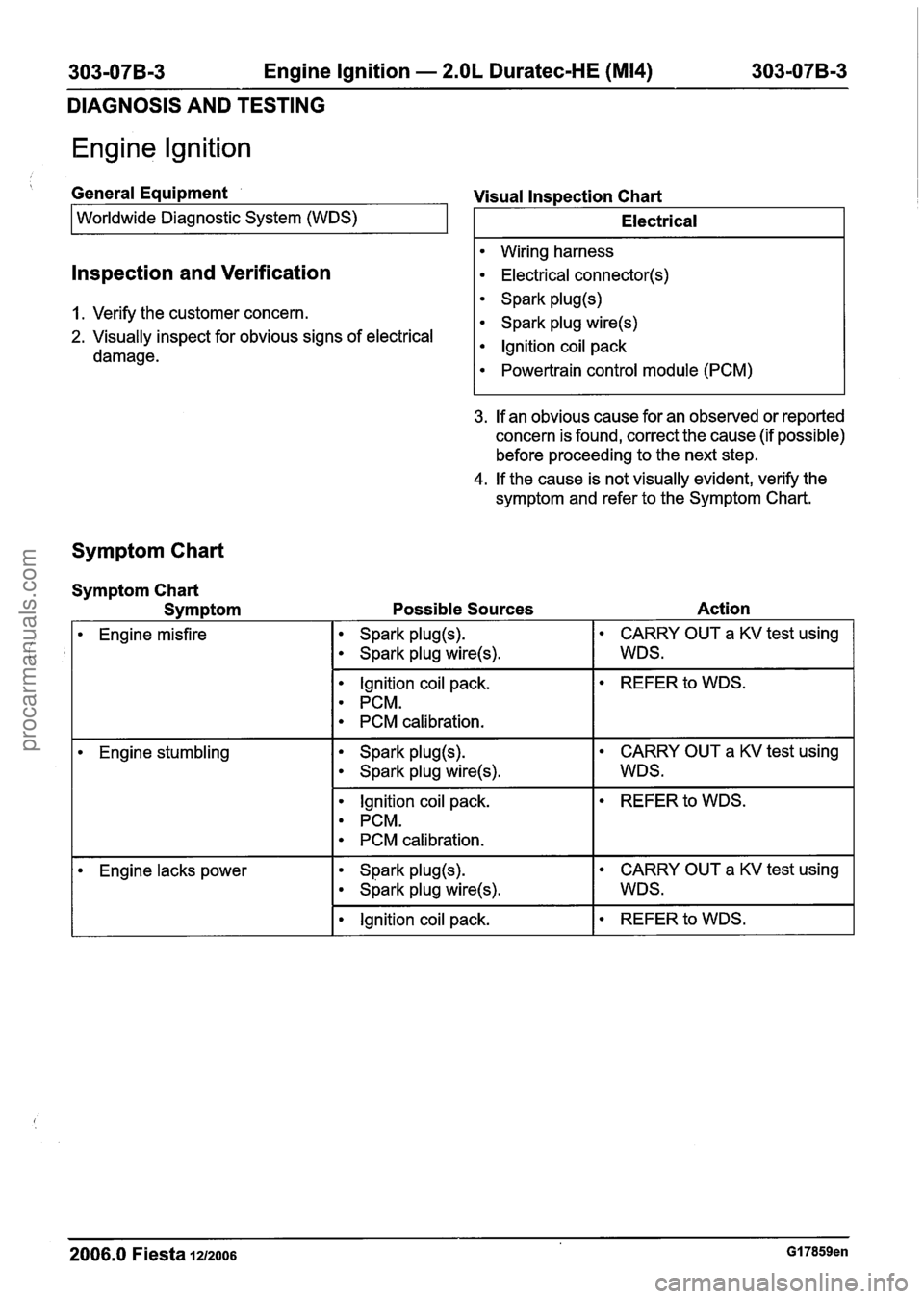
Engine lgnition
General Equipment
I Worldwide Diagnostic System (WDS) I
lnspection and Verification
I. Verify the customer concern.
2. Visually inspect for obvious signs of electrical
damage.
Symptom Chart
Visual lnspection Chart
Symptom Chart Symptom
I Electrical I
( I
Wiring harness
Electrical
connector(s)
Spark plug(s)
Spark plug wire(s)
lgnition coil pack
Powertrain control module (PCM)
Engine misfire
3. If an obvious cause for an observed or reported
concern is found, correct the cause (if possible)
before proceeding to the next step.
4. If the cause is not visually evident, verify the
symptom and refer to the Symptom Chart.
Possible Sources Action
Spark plug(s).
Spark plug wire(s).
CARRY OUT a KV test using
I WDS.
lgnition coil pack.
PCM.
PCM calibration.
REFER to WDS.
Engine stumbling Spark plug(s).
Spark plug wire(s).
CARRY
OUT a KV test using
I WDS.
lgnition coil pack.
PCM.
PCM calibration.
REFER to WDS.
Engine lacks power Spark
plug(s).
spark plug wire(s).
CARRY
OUT a KV test using
I WDS.
nlgniibn coil pack. I REFER to WDS. I
2006.0 Fiesta IZIZOO~ GI 7859en
procarmanuals.com
Page 900 of 1226
Engine Emission Control - 2.OL Duratec-HE
303-08B-6
(MI41 303-08B-6
DIAGNOSIS AND TESTING
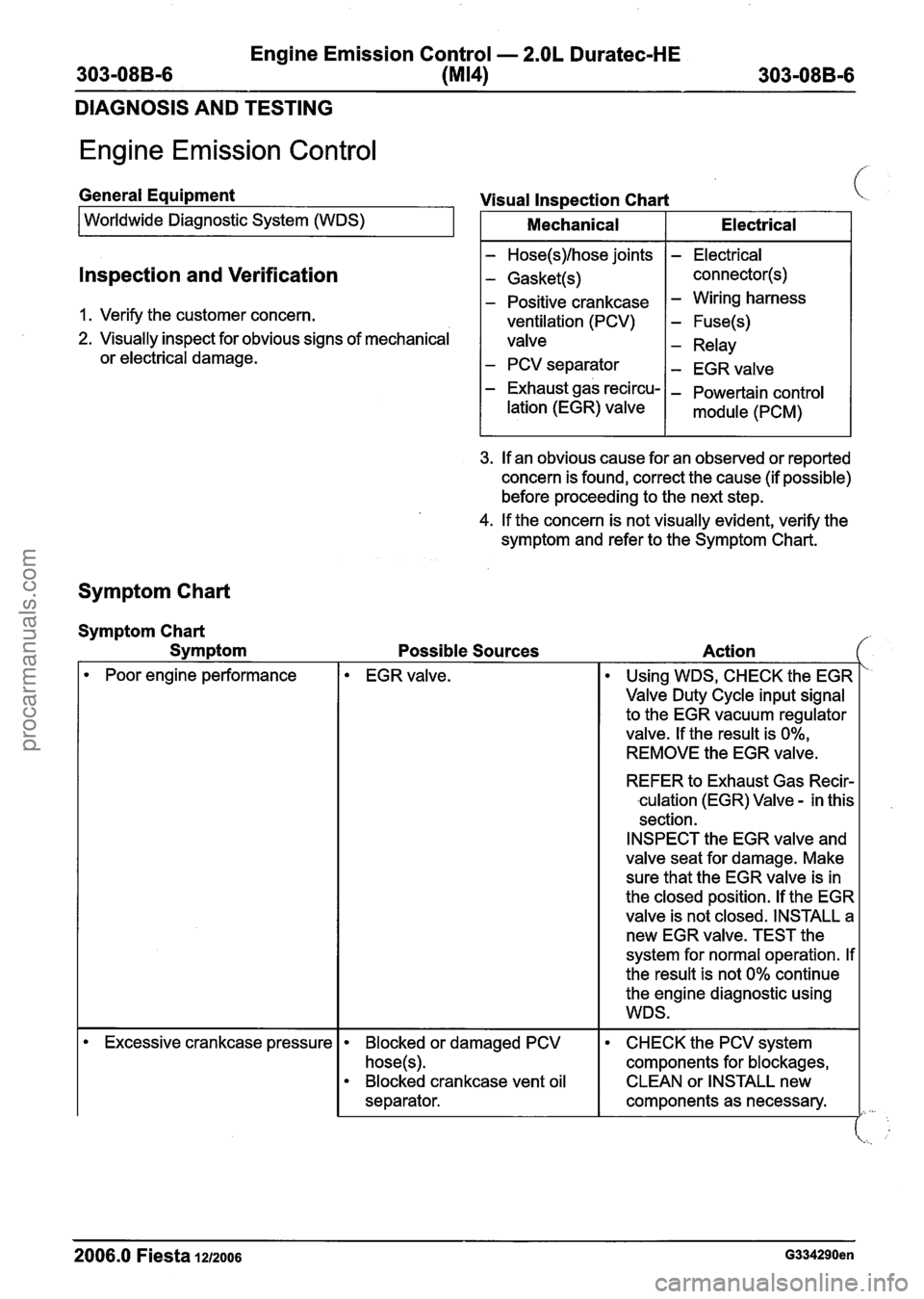
Engine Emission Control
lnspection and Verification
General Equipment Visual Inspection Chart L..
I. Verify the customer concern.
2. Visually inspect for obvious signs of mechanical
or electrical damage.
Worldwide Diagnostic System
(WDS)
- Hose(s)/hose joints
- Gasket(s)
- Positive crankcase
ventilation (PCV)
valve
- PCV separator
Mechanical
- Exhaust gas recircu-
lation (EGR) valve
Electrical
- Electrical
con
nector(s)
- Wiring harness
- Fuse(s)
- Relay
- EGRvalve
- Powertain control
module (PCM)
3. If an obvious cause for an observed or reported
concern is found, correct the cause (if possible)
before proceeding to the next step.
4. If the concern is not visually evident, verify the
symptom and refer to the Symptom Chart.
Symptom Chart
Symptom Chart
Symptom Possible Sources Action
I
Poor engine performance EGR valve.
Using WDS, CHECK the EGR
Valve Duty Cycle input signal
I to the EGR vacuum regulator
valve. If the result is 0%,
REMOVE the EGR valve.
REFER to Exhaust Gas Recir-
culation (EGR) Valve
- in this
section.
INSPECT the EGR valve and
valve seat for damage. Make
sure that the EGR valve is in
the closed position. If the EGR
valve is not closed. INSTALL
a
new EGR valve. TEST the
system for normal operation. If
the result is not 0% continue
the engine diagnostic using
WDS.
2006.0 Fiesta 1212006 G334290en
Excessive crankcase pressure Blocked or damaged PCV
hose(s).
Blocked crankcase vent oil
separator. CHECK
the PCV system
components for blockages, CLEAN or INSTALL new
components as necessary.
procarmanuals.com
Page 903 of 1226
Engine Emission Control - 2.OL Duratec-HE
(MI41
REMOVAL AND INSTALLATION
I
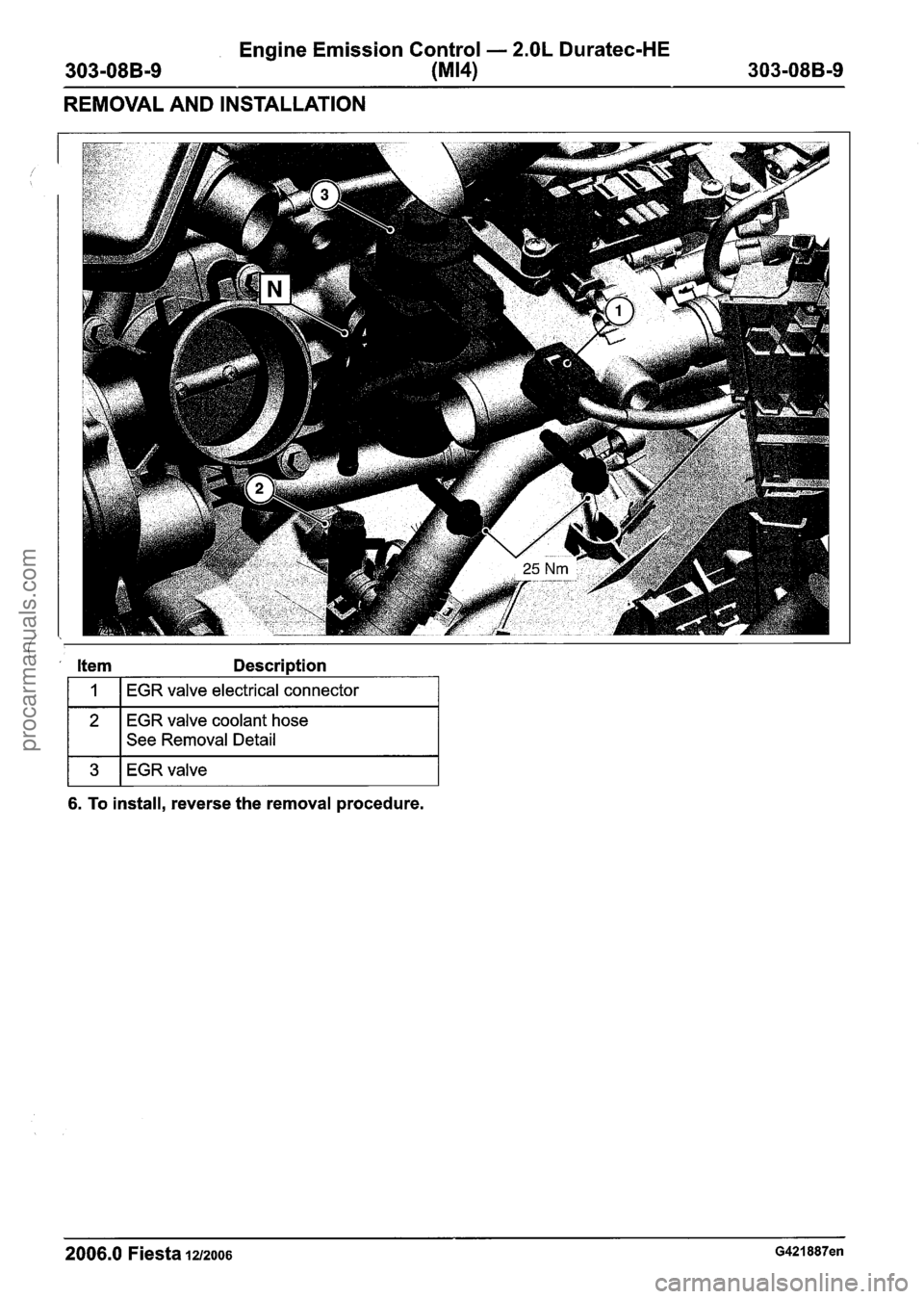
' Item Description
I 1 I EGR valve electrical connector I
I * 1
EGR valve coolant hose
See Removal Detail
6. To install, reverse the removal procedure.
2006.0 Fiesta 1212006 G421887en
procarmanuals.com
Page 911 of 1226
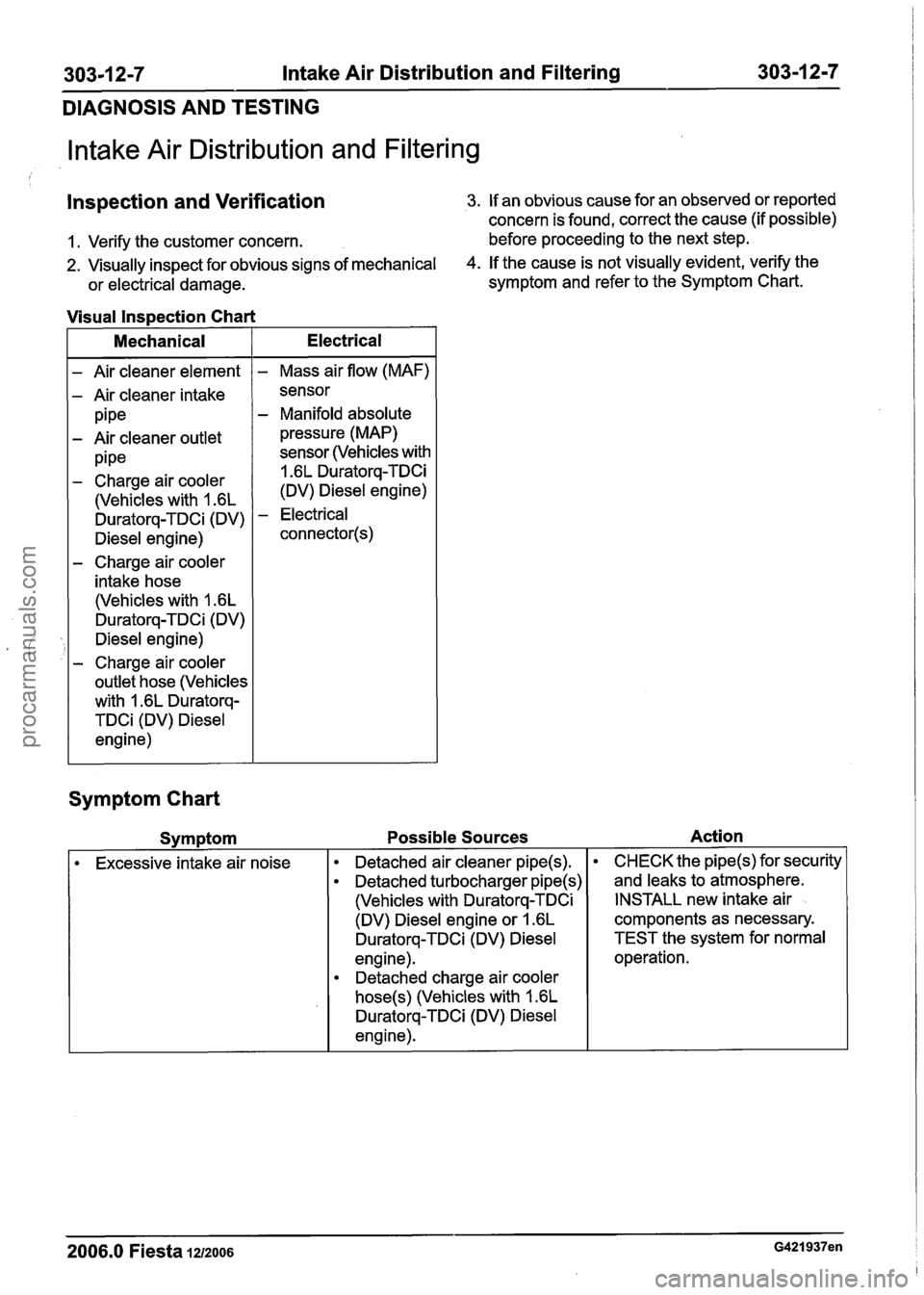
303-1 2-7 Intake Air Distribution and Filtering 303-1 2-7
DIAGNOSIS AND TESTING
Intake Air Distribution and Filtering
Inspection and Verification 3. If an obvious cause for an observed or reported
concern is found, correct the cause (if possible)
1. Verify the customer concern. before proceeding
to the next step.
2. Visually inspect for obvious signs of mechanical 4. If the cause is not visually evident, verify the
or electrical damage. symptom and
refer to the Symptom Chart.
Visual
Ins~ection Chart
I Mechanical I Electrical I
- Air cleaner element
- Air cleaner intake
pipe
- Air cleaner outlet
pipe
- Charge air cooler
(Vehicles with
1.6L
Duratorq-TDCi (DV)
Diesel engine)
- Charge air cooler
intake hose
(Vehicles with
1.6L
Duratorq-TDCi (DV)
Diesel engine)
- Charge air cooler
outlet hose (Vehicles
with
I .6L Duratorq-
TDCi (DV) Diesel
engine)
- Mass air flow (MAF)
sensor
- Manifold absolute
pressure (MAP)
sensor (Vehicles with
1.6L Duratorq-TDCi
(DV) Diesel engine)
- Electrical
connector(s)
Symptom Chart
Symptom
Excessive intake air noise Possible Sources
Detached air cleaner
pipe(s).
Detached turbocharger pipe(s)
(Vehicles with Duratorq-TDCi
(DV) Diesel engine or
1.6L
Duratorq-TDCi (DV) Diesel
engine). Detached charge air cooler
hose(s) (Vehicles with 1.6L
Duratorq-TDCi (DV) Diesel
engine). Action
CHECK the
pipe(s) for security
and leaks to atmosphere.
INSTALL new intake air
components as necessary.
TEST the system for normal
operation.
2006.0 Fiesta 1212006 G421937en
procarmanuals.com
Page 921 of 1226
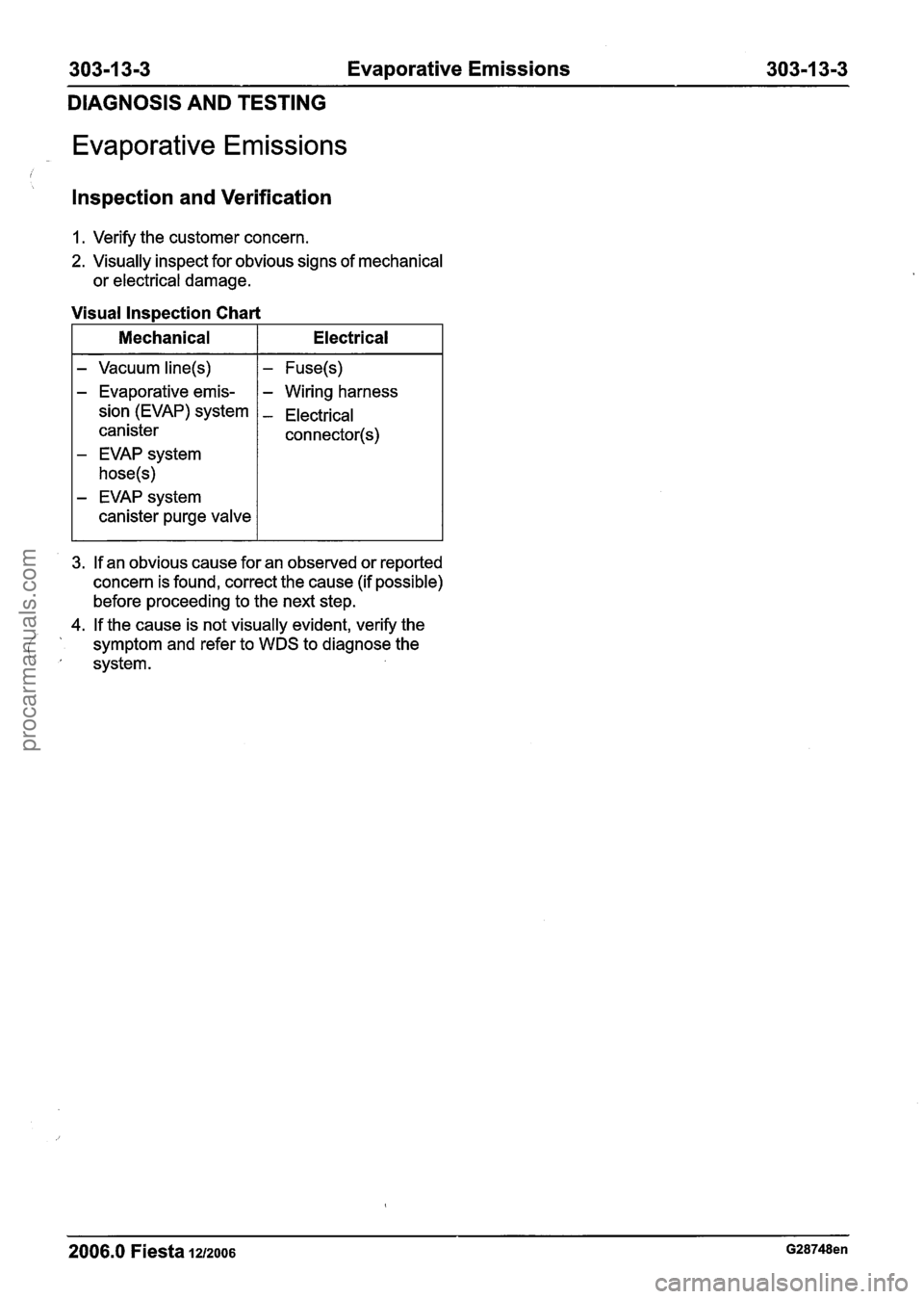
303-1 3-3 Evaporative Emissions 303-1 3-3
DIAGNOSIS AND TESTING
Evaporative Emissions
i
Inspection and Verification
1. Verify the customer concern.
2. Visually inspect for obvious signs of mechanical
or electrical damage.
Visual Inspection Chart
I Mechanical I Electrical I
- Vacuum line(s)
- Evaporative emis-
sion (EVAP) system
canister
- EVAP system
hose(s)
- EVAP system
canister purge valve
I - Fuse(s) I I - Wiring harness
- Electrical
connector(s)
3. If an obvious cause for an observed or reported
concern is found, correct the cause (if possible)
before proceeding to the next step.
4. If the cause is not visually evident, verify the
i
' symptom and refer to WDS to diagnose the
' system.
2006.0 Fiesta 12/2006 G28748en
procarmanuals.com
Page 923 of 1226
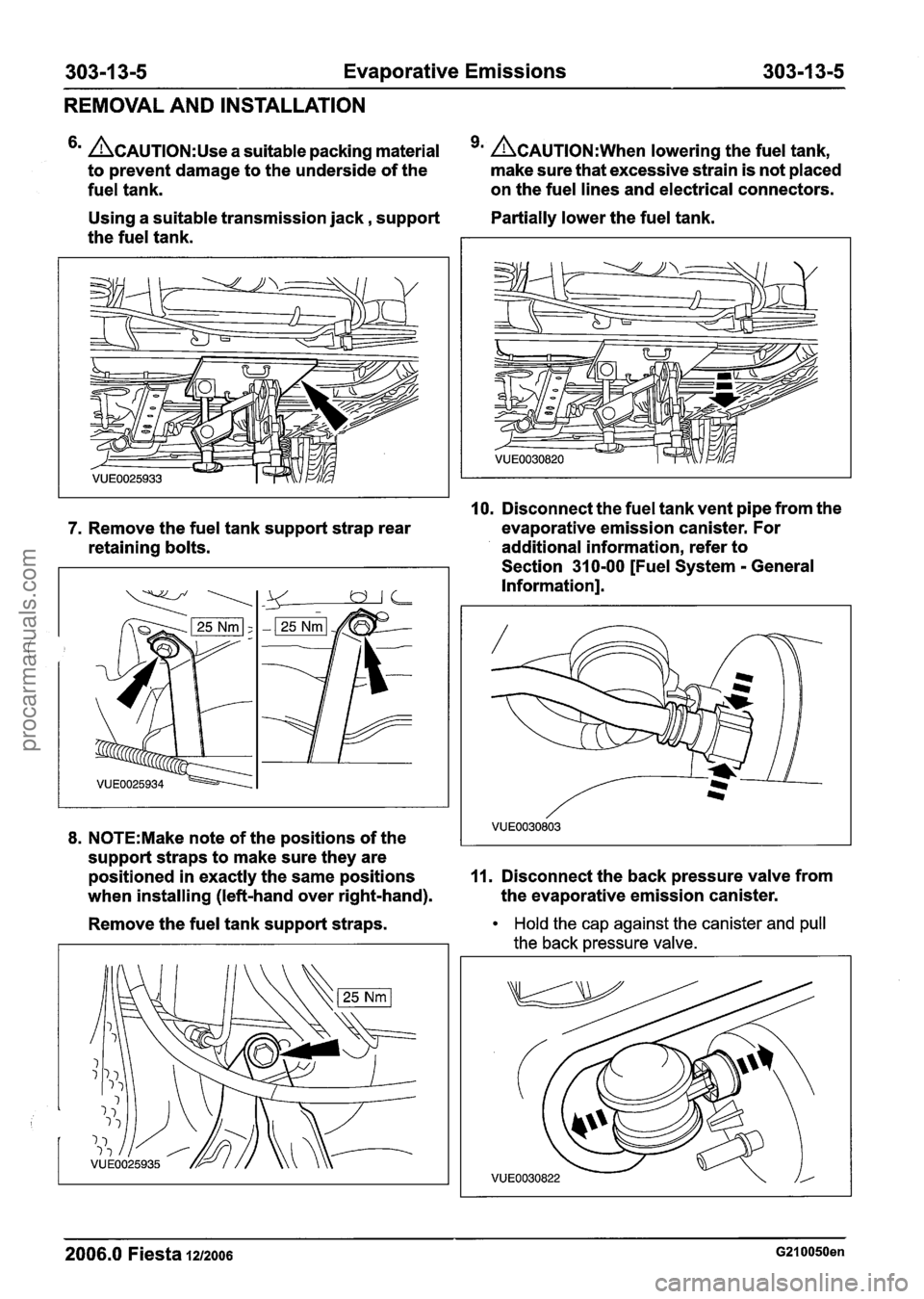
303-1 3-5 Evaporative Emissions 303-1 3-5
REMOVAL
AND INSTALLATION
ACAUTION:U~~ a suitable packing material 9m ACAUTION:W~~~ lowering the fuel tank,
to prevent damage to the underside of the make
sure that excessive strain is not placed
fuel tank. on
the fuel lines and electrical connectors.
Using a suitable transmission jack, support Partially lower
the fuel tank.
the fuel tank.
10. Disconnect the fuel tank vent pipe from the
7. Remove the fuel tank support strap rear evaporative
emission canister. For
retaining bolts. additional information,
refer to
Section 31 0-00 [Fuel System
- General
Information].
8. N0TE:Make note of the positions of the
support straps to make sure they are
positioned in exactly the same positions
11. Disconnect the back pressure valve from
when installing (left-hand over right-hand). the
evaporative emission canister.
Remove the fuel tank support straps.
Hold the cap against the canister and pull
the back pressure valve.
2006.0 Fiesta 1212006 G210050en
procarmanuals.com
Page 936 of 1226
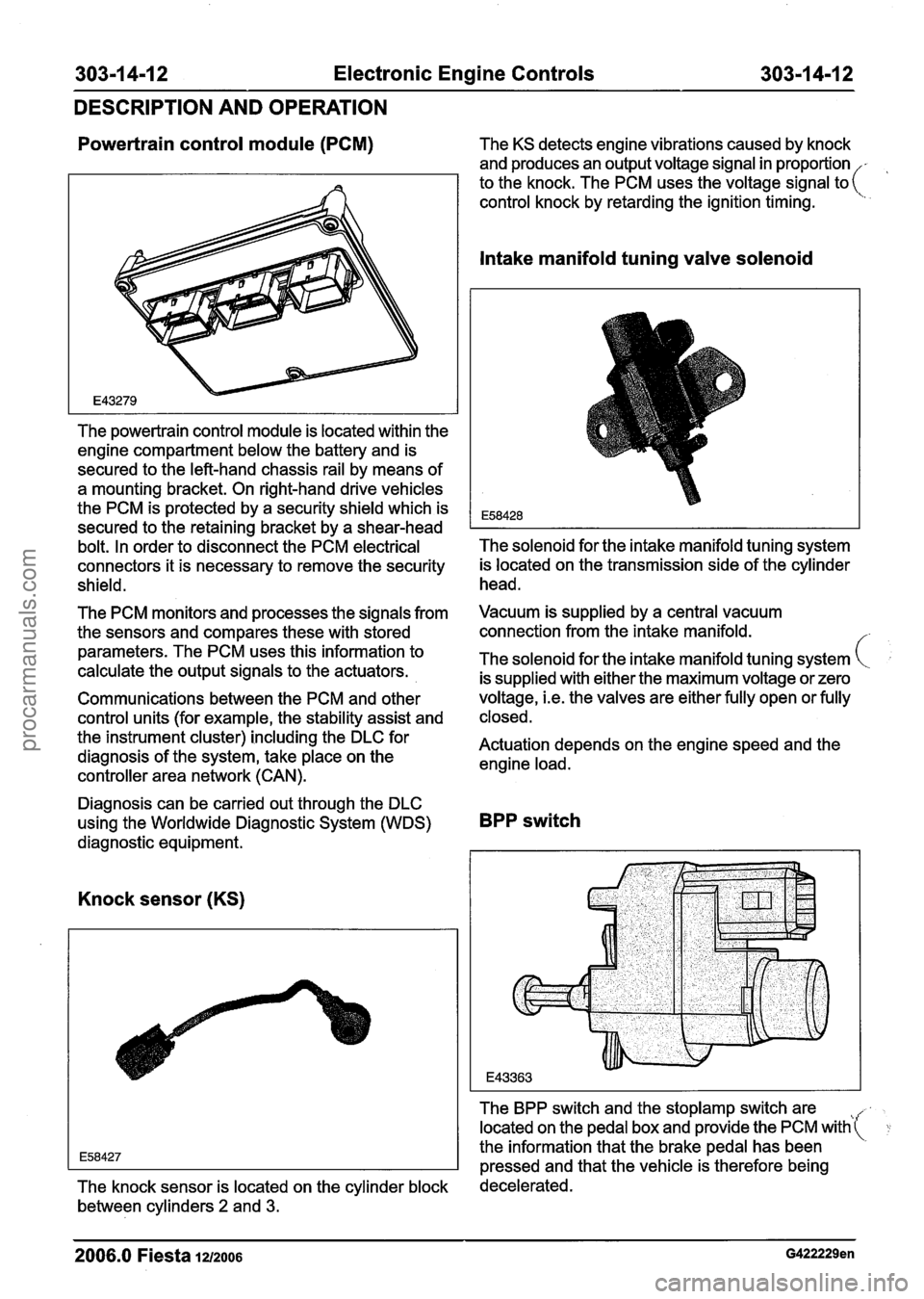
303-1 4-1 2 Electronic Engine Controls 303-1 4-1 2
DESCRIPTION AND OPERATION
Powertrain control module (PCM) The KS detects engine vibrations caused by knock
and produces an output voltage signal in proportion
, to the knock. The PCM uses the voltage signal to(
control knock by retarding the ignition timing.
The powertrain control module is located within the
engine compartment below the battery and is
secured to the left-hand chassis rail by means of
a mounting bracket. On right-hand drive vehicles
the PCM is protected by a security shield which is
secured to the retaining bracket by a shear-head
bolt. In order to disconnect the PCM electrical
connectors it is necessary to remove the security
shield.
The PCM monitors and processes the signals from
the sensors and compares these with stored
parameters. The PCM uses this information to
calculate the output signals to the actuators.
Communications between the PCM and other
control units (for example, the stability assist and
the instrument cluster) including the DLC for
diagnosis of the system, take place on the
controller area network (CAN).
Intake manifold tuning valve solenoid
The solenoid for the intake manifold tuning system
is located on the transmission side of the cylinder
head.
Vacuum is supplied by a central vacuum
connection from the intake manifold.
The solenoid for the intake manifold tuning system
is supplied with either the maximum voltage or zero
voltage,
i.e. the valves are either fully open or fully
closed.
Actuation depends on the engine speed and the
engine load.
Diagnosis can be carried out through the DLC
using the Worldwide Diagnostic System (WDS)
BPP switch
diagnostic equipment.
Knock sensor (KS)
The BPP switch and the stoplamp switch are tt(r located on the pedal box and provide the PCM with
the information that the brake pedal has been
pressed and that the vehicle is therefore being
The knock sensor is located on the cylinder block decelerated.
between cylinders
2 and 3.
2006.0 Fiesta 1212006 G422229en
procarmanuals.com
Page 945 of 1226
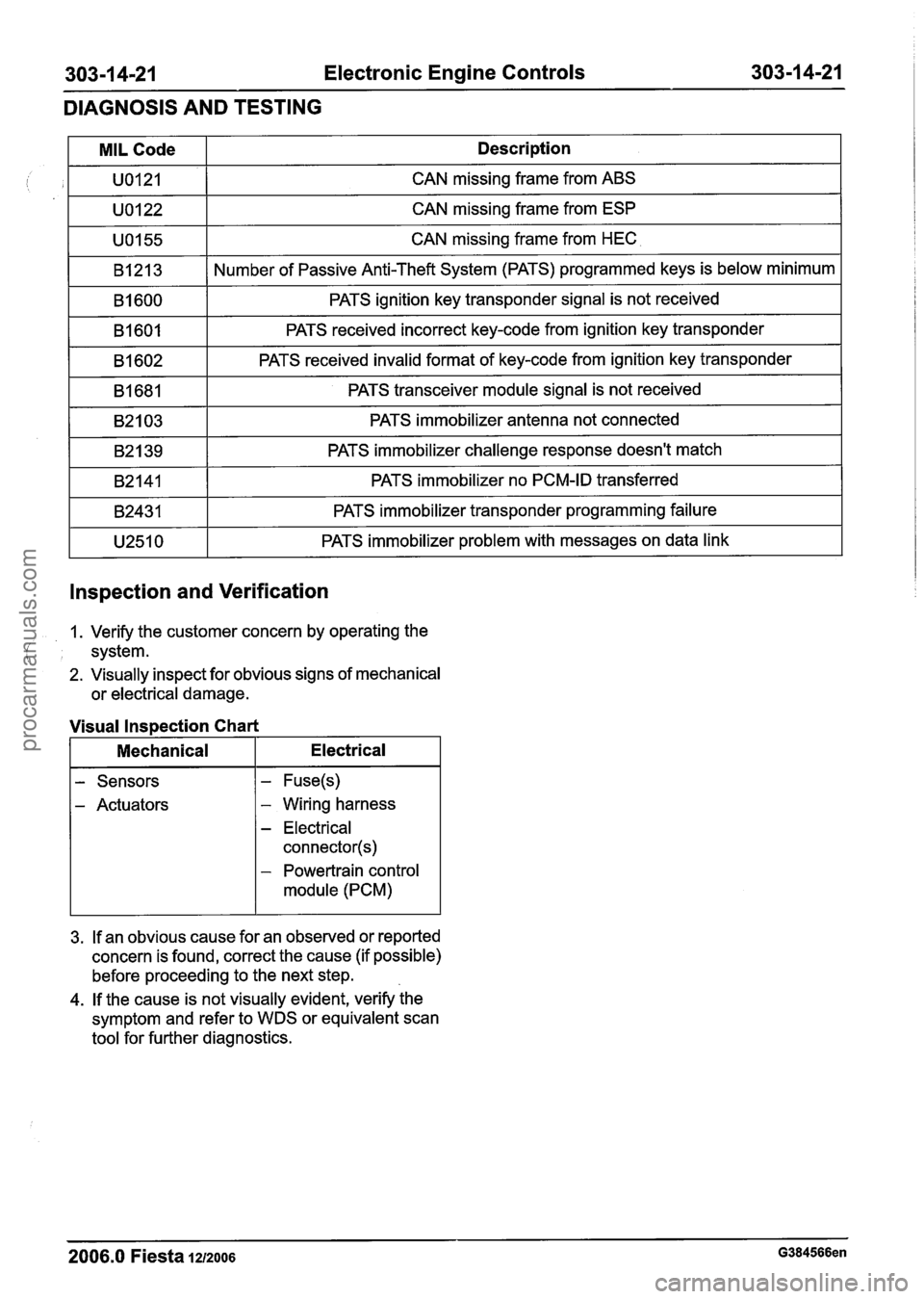
303-1 4-21 Electronic Engine Controls 303-1 4-21
DIAGNOSIS AND TESTING
lnspection and Verification
MIL Code
U0121
U0122
U0155
B1213
B1600
B1601
B1602
B1681
B2103
B2139
B2141
B2431
U2510
1. Verify the customer concern by operating the
( I system.
2. Visually inspect for obvious signs of mechanical
or electrical damage. Description
CAN missing frame from ABS
CAN missing frame from ESP
CAN missing frame from HEC
Number of Passive Anti-Theft System (PATS) programmed keys is below minimum
PATS ignition key transponder signal is not received
PATS received incorrect key-code from ignition key transponder
PATS received invalid format of key-code from ignition key transponder
PATS transceiver module signal is not received
PATS immobilizer antenna not connected
PATS immobilizer challenge response doesn't match
PATS immobilizer no PCM-ID transferred
PATS immobilizer transponder programming failure
PATS immobilizer problem with messages on data link
Visual Inspection Chart
Mechanical
I Electrical
- Sensors
- Actuators - Wiring harness
- Electrical
connector(s)
- Powertrain control
module (PCM)
3. If an obvious cause for an observed or reported
concern is found, correct the cause (if possible)
before proceeding to the next step.
4. If the cause is not visually evident, verify the
symptom and refer to WDS or equivalent scan
tool for further diagnostics.
- -
2006.0 Fiesta 1212006 G384566en
procarmanuals.com
Page 946 of 1226
303-1 4-22 Electronic Engine Controls
REMOVAL AND INSTALLATION
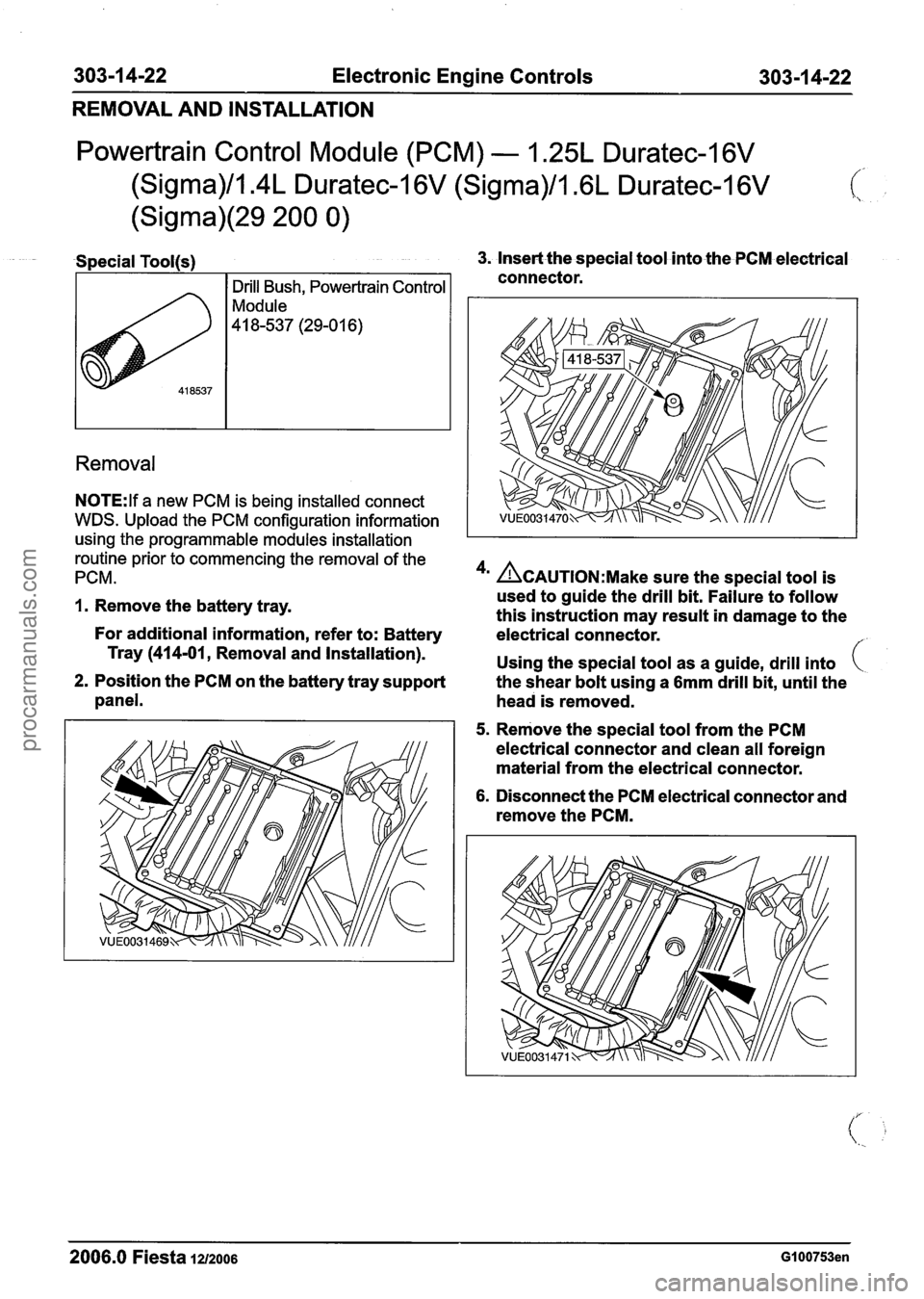
Powertrain Control Module (PCM) - I .25L Duratec-1 6V
(Sigma)/l.4L Duratec-1 6V (Sigma)/l .6L Duratec-1 6V
(Sigma)(29 200 0)
c
Removal
Special Tool(s) 3. Insert the special tool into the PCM electrical
N0TE:lf a new PCM is being installed connect
WDS. Upload the PCM configuration information
using the programmable modules installation
routine prior to commencing the removal of the
PCM. Drill
Bush, Powertrain Control
Module
4 1 8-537 (29-0 1 6)
1. Remove the battery tray. connector.
For additional information, refer to: Battery
Tray (414-01, Removal and Installation).
2. Position the PCM on the battery tray support
panel.
4m ACAUTION:M~~~ sure the special tool is
used to guide the drill bit. Failure to follow
this instruction may result in damage to the
electrical connector.
f
Using the special tool as a guide, drill into (
the shear bolt using a 6mm drill bit, until the
head is removed.
5. Remove the special tool from the PCM
electrical connector and clean all foreign
material from the electrical connector.
6. Disconnect the PCM electrical connector and
remove the PCM.
2006.0 Fiesta 1212006 GI 00753en
procarmanuals.com