brake light FORD FIESTA 2007 User Guide
[x] Cancel search | Manufacturer: FORD, Model Year: 2007, Model line: FIESTA, Model: FORD FIESTA 2007Pages: 1226, PDF Size: 61.26 MB
Page 192 of 1226
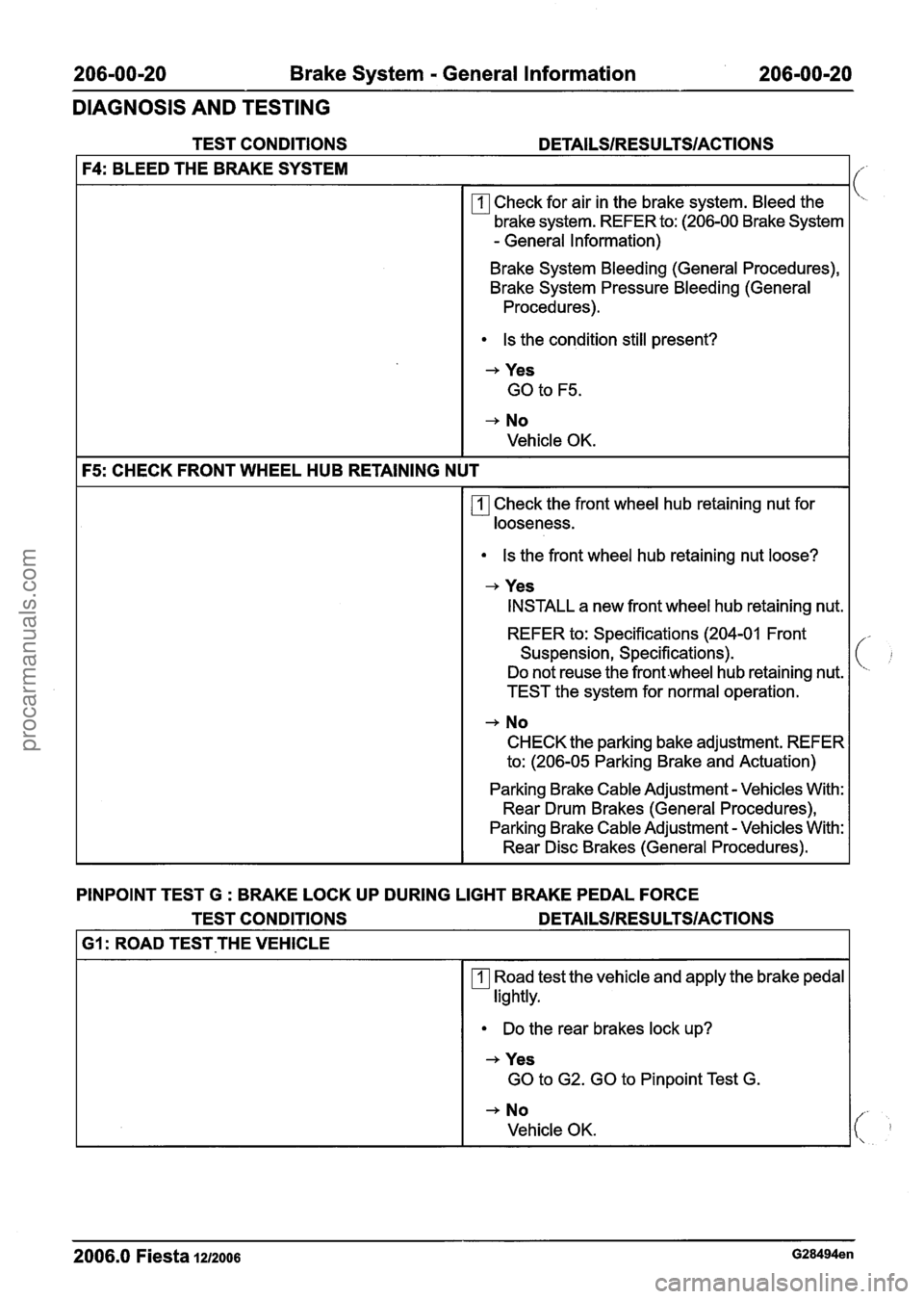
206-00-20 Brake System - General Information 206=00-20
DIAGNOSIS AND TESTING
TEST CONDITIONS
DETAILSIRESULTSIACTIONS
F4: BLEED THE BRAKE SYSTEM
rn Check for air in the brake system. Bleed the
brake system. REFER to: (206-00 Brake System
- General lnformation)
Brake System Bleeding (General Procedures),
Brake System Pressure Bleeding (General Procedures)
.
Is the condition still present?
+ Yes
GO to F5.
+ No
Vehicle OK.
F5: CHECK FRONT WHEEL HUB RETAINING NUT
Check the front wheel hub retaining nut for
looseness.
Is the front wheel hub retaining nut loose?
+ Yes
INSTALL a new front wheel hub retaining nut.
REFER to: Specifications (204-01 Front
Suspension, Specifications).
Do not reuse the
frontwheel hub retaining nut.
TEST the system for normal operation.
+ No
CHECK the parking bake adjustment. REFER
to: (206-05 Parking Brake and Actuation)
Parking Brake Cable Adjustment
- Vehicles With:
Rear Drum Brakes (General Procedures),
Parking Brake Cable Adjustment
- Vehicles With:
Rear Disc Brakes (General Procedures).
PINPOINT TEST G
: BRAKE LOCK UP DURING LIGHT BRAKE PEDAL FORCE
TEST CONDITIONS
DETAILSIRESULTSIACTIONS
I GI : ROAD TEST-THE VEHICLE I
Road test the vehicle and apply the brake pedal
lightly.
Do the rear brakes lock up?
+ Yes
GO to G2. GO to Pinpoint Test G.
+ No
Vehicle OK.
2006.0 Fiesta 12/2006 G28494en
procarmanuals.com
Page 196 of 1226
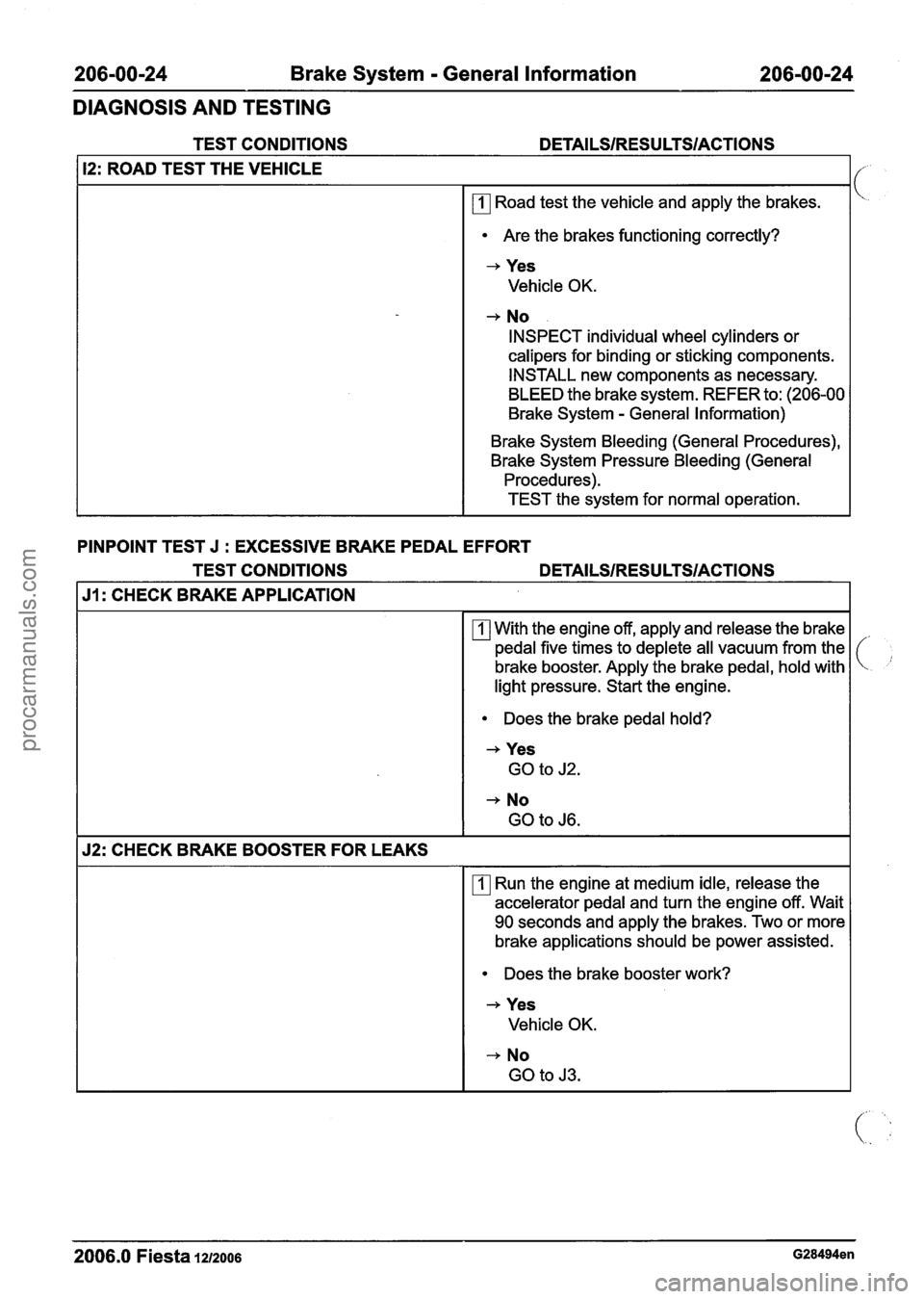
206-00-24 Brake System - General Information 206-00-24
DIAGNOSIS AND TESTING
TEST CONDITIONS DETAILSIRESU LTSIACTIONS
12: ROAD TEST THE VEHICLE
rn Road test the vehicle and apply the brakes.
Are the brakes functioning correctly?
-+ Yes
Vehicle OK.
+ No
INSPECT individual wheel cylinders or
calipers for binding or sticking components.
INSTALL new components as necessary.
BLEED the brake system. REFER to: (206-00
Brake System
- General Information)
Brake System Bleeding (General Procedures),
Brake System Pressure Bleeding (General Procedures).
TEST the system for normal operation.
PINPOINT TEST J
: EXCESSIVE BRAKE PEDAL EFFORT
TEST CONDITIONS
DETAILSIRESULTSIACTIONS
J1: CHECK BRAKE APPLICATION
With the engine off, apply and release the brake
pedal five times to deplete all vacuum from the
brake booster. Apply the brake pedal, hold with
light pressure. Start the engine.
Does the brake pedal hold?
+ Yes
GO to J2.
+ No
GO to J6.
52: CHECK BRAKE BOOSTER FOR LEAKS
rn Run the engine at medium idle, release the
accelerator pedal and turn the engine off. Wait
90 seconds and apply the brakes. Two or more
brake applications should be power assisted.
Does the brake booster work?
+ Yes
Vehicle OK.
-+ No
GO to
J3.
2006.0 Fiesta 1212006 G28494en
procarmanuals.com
Page 201 of 1226
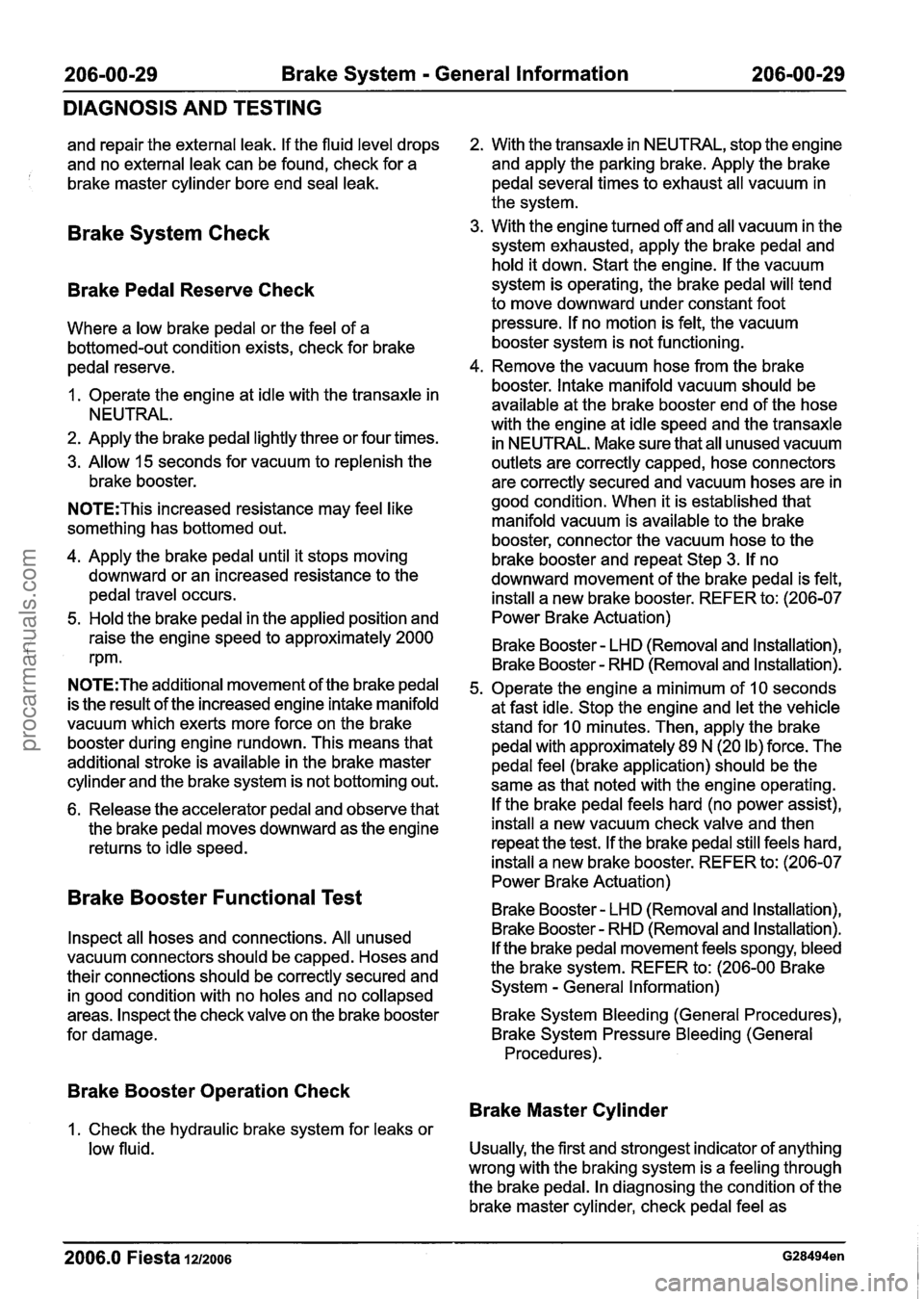
206-00-29 Brake System - General Information 206-00-29
DIAGNOSIS AND TESTING
and repair the external leak. If the fluid level drops
and no external leak can be found, check for a
brake master cylinder bore end seal leak.
Brake System Check
Brake Pedal Reserve Check
Where a low brake pedal or the feel of a
bottomed-out condition exists, check for brake
pedal reserve.
1. Operate the engine at idle with the transaxle in
NEUTRAL.
2. Apply the brake pedal lightly three or four times.
3. Allow 15 seconds for vacuum to replenish the
brake booster.
N0TE:This increased resistance may feel like
something has bottomed out.
4. Apply the brake pedal until it stops moving
downward or an increased resistance to the
pedal travel occurs.
5. Hold the brake pedal in the applied position and
raise the engine speed to approximately 2000
rpm.
N0TE:The additional movement of the brake pedal
is the result of the increased engine intake manifold
vacuum which exerts more force on the brake
booster during engine rundown. This means that
additional stroke is available in the brake master
cylinder and the brake system is not bottoming out.
6. Release the accelerator pedal and observe that
the brake pedal moves downward as the engine
returns to idle speed.
Brake Booster Functional Test
lnspect all hoses and connections. All unused
vacuum connectors should be capped. Hoses and
their connections should be correctly secured and
in good condition with no holes and no collapsed 2.
With the transaxle in NEUTRAL, stop the engine
and apply the parking brake. Apply the brake
pedal several times to exhaust all vacuum in
the system.
3. With the engine turned off and all vacuum in the
system exhausted, apply the brake pedal and hold it down. Start the engine. If the vacuum
system is operating, the brake pedal will tend
to move downward under constant foot
pressure. If no motion is felt, the vacuum
booster system is not functioning.
4. Remove the vacuum hose from the brake
booster.
Intake manifold vacuum should be
available at the brake booster end of the hose
with the engine at idle speed and the transaxle
in NEUTRAL. Make sure that all unused vacuum
outlets are correctly capped, hose connectors
are correctly secured and vacuum hoses are in
good condition. When it is established that
manifold vacuum is available to the brake
booster, connector the vacuum hose to the
brake booster and repeat Step
3. If no
downward movement of the brake pedal is felt,
install a new brake booster. REFER to: (206-07
Power Brake Actuation)
Brake Booster
- LHD (Removal and lnstallation),
Brake Booster
- RHD (Removal and lnstallation).
5. Operate the engine a minimum of 10 seconds
at fast idle. Stop the engine and let the vehicle
stand for
10 minutes. Then, apply the brake
pedal with approximately 89
N (20 lb) force. The
pedal feel (brake application) should be the
same as that noted with the engine operating.
If the brake pedal feels hard (no power assist),
install a new vacuum check valve and then
repeat the test. If the brake pedal still feels hard,
install a new brake booster. REFER to: (206-07
Power Brake Actuation)
Brake Booster
- LHD (Removal and Installation),
Brake Booster
- RHD e em oval and installation).
If the brake pedal movement feels spongy, bleed
the brake system. REFER to: (206-00 Brake
System
- General Information)
areas. Inspect the check valve on the brake booster Brake System Bleeding (General Procedures),
for damage. Brake
System Pressure Bleeding (General
Procedures).
Brake Booster Operation Check
Brake Master Cylinder
1. Check the hydraulic brake system for leaks or
low fluid. Usually,
the first and strongest indicator of anything
wrong with the braking system is a feeling through
the brake pedal. In diagnosing the condition of the
brake master cylinder, check pedal feel as
2006.0 Fiesta 1212006 G28494en I
i
procarmanuals.com
Page 202 of 1226
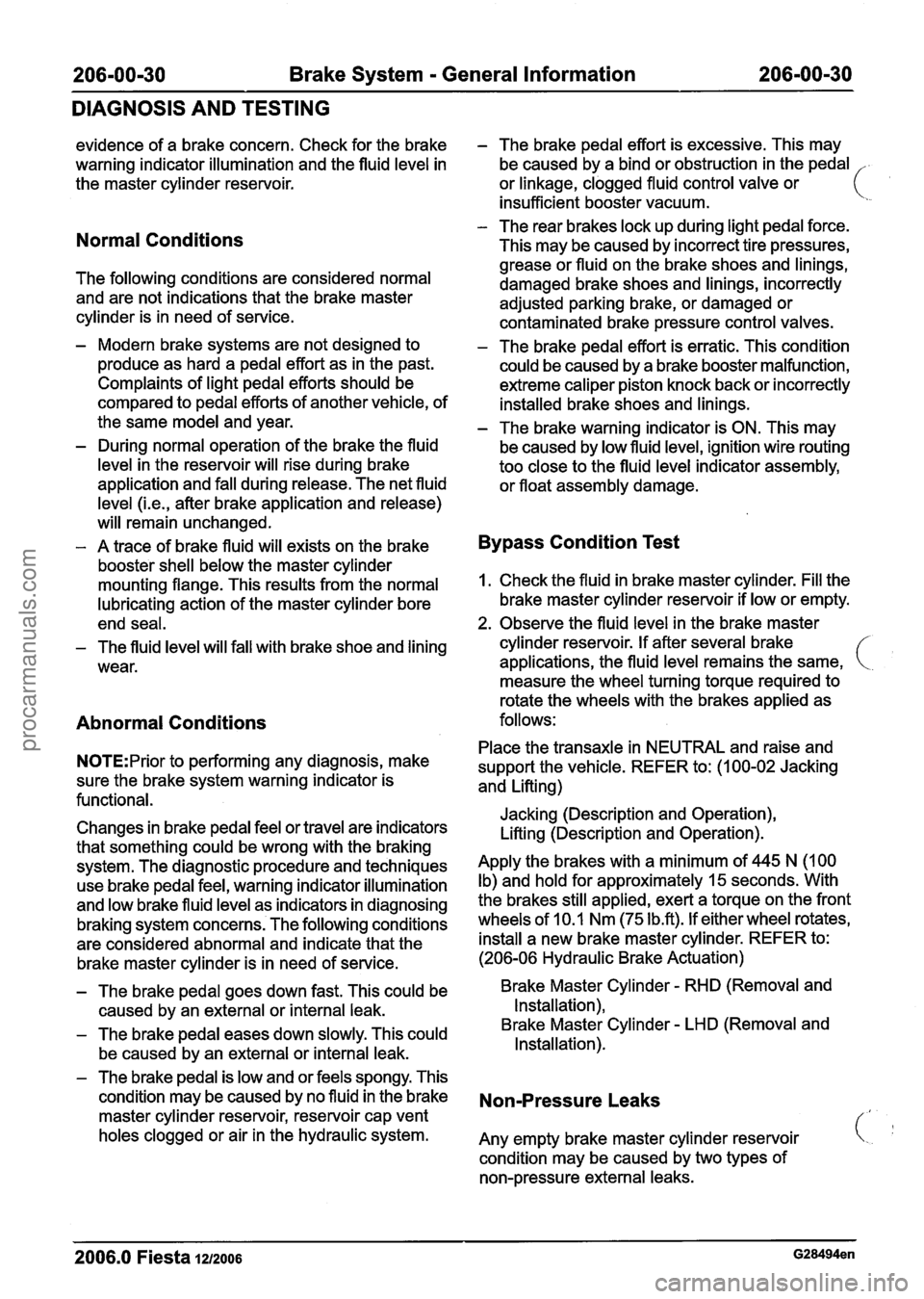
Brake System - General Information
DIAGNOSIS AND TESTING
evidence of a brake concern. Check for the brake
warning indicator illumination and the fluid level in
the master cylinder reservoir.
Normal Conditions
The following conditions are considered normal
and are not indications that the brake master
cylinder is in need of service.
- Modern brake systems are not designed to
produce as hard a pedal effort as in the past.
Complaints of light pedal efforts should be
compared to pedal efforts of another vehicle, of
the same model and year.
- During normal operation of the brake the fluid
level in the reservoir will rise during brake
application and fall during release. The net fluid
level
(i.e., after brake application and release)
will remain unchanged.
- A trace of brake fluid will exists on the brake
booster shell below the master cylinder
mounting flange. This results from the normal
lubricating action of the master cylinder bore
end seal.
- The fluid level will fall with brake shoe and lining
wear.
Abnormal Conditions
N0TE:Prior to performing any diagnosis, make
sure the brake system warning indicator is
functional.
Changes in brake pedal feel or travel are indicators
that something could be wrong with the braking system. The diagnostic procedure and techniques
use brake pedal feel, warning indicator illumination
and low brake fluid level as indicators in diagnosing
braking system concerns. The following conditions
are considered abnormal and indicate that the
brake master cylinder is in need of service.
- The brake pedal effort is excessive. This may
be caused by a bind or obstruction in the pedal
.
or linkage, clogged fluid control valve or ( ' insufficient booster vacuum.
- The rear brakes lock up during light pedal force.
This may be caused by incorrect tire pressures,
grease or fluid on the brake shoes and linings,
damaged brake shoes and linings, incorrectly
adjusted parking brake, or damaged or
contaminated brake pressure control valves.
- The brake pedal effort is erratic. This condition
could be caused by a brake booster malfunction,
extreme caliper piston knock back or incorrectly
installed brake shoes and linings.
- The brake warning indicator is ON. This may
be caused by low fluid level, ignition wire routing
too close to the fluid level indicator assembly,
or float assembly damage.
Bypass Condition Test
1. Check the fluid in brake master cylinder. Fill the
brake master cylinder reservoir if low or empty.
2. Observe the fluid level in the brake master
cylinder reservoir. If after several brake
applications, the fluid level remains the same,
measure the wheel turning torque required to
rotate the wheels with the brakes applied as
follows:
Place the transaxle in NEUTRAL and raise and
support the vehicle. REFER to: (1 00-02 Jacking
and Lifting)
Jacking (Description and Operation),
Lifting (Description and Operation).
Apply the brakes with a minimum of 445 N (100
Ib) and hold for approximately 15 seconds. With
the brakes still applied, exert a torque on the front
wheels of 10.1 Nm (75
1b.R). If either wheel rotates,
install a new brake master cylinder. REFER to:
(206-06 Hydraulic Brake Actuation)
- The brake pedal goes down fast. This could be Brake Master Cylinder - RHD (Removal and
caused by an external or internal leak. Installation),
- The brake
pedal eases down slowly. This could Brake Master Cylinder - LHD
(Removal and
be caused by an external or internal leak. Installation).
- The
brake pedal is low and or feels spongy. This
condition may be caused by no fluid in the brake
Non-Pressure Leaks master cylinder reservoir, reservoir cap vent
holes clogged or air in the hydraulic system.
Any empty brake master cylinder reservoir
condition may be caused by two types of
non-pressure external leaks.
2006.0 Fiesta 1212006
procarmanuals.com
Page 549 of 1226
Engine - 1.25L Duratec-1 6V (Sigma)lIl4L
Duratec-1 6V (Sigma)ll .6L Duratec-1 6V (Sigma)
REMOVAL
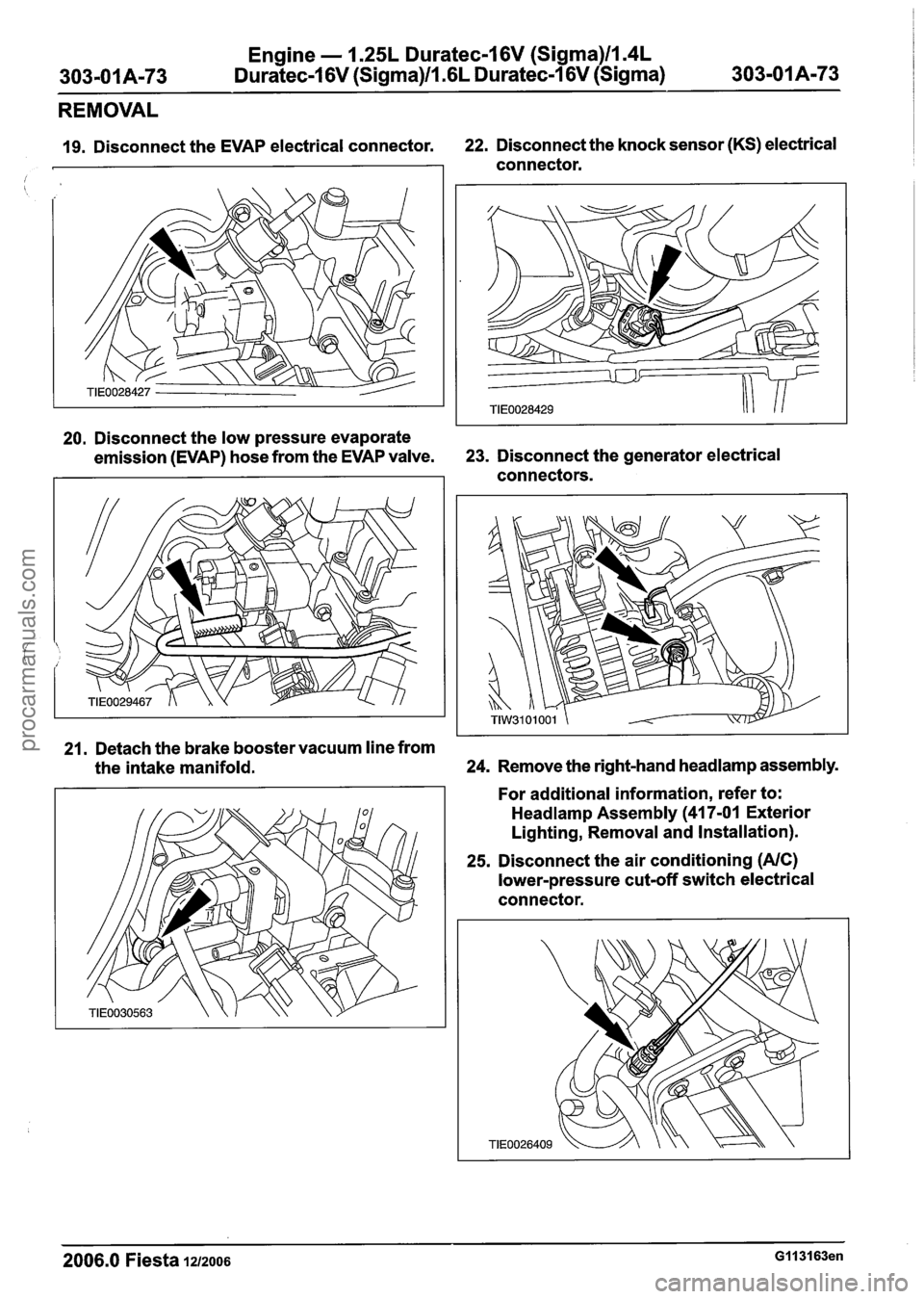
19. Disconnect the EVAP electrical connector. 22.
Disconnect the knock sensor (KS) electrical
connector.
20. Disconnect the low pressure evaporate
emission (EVAP) hose from the EVAP valve. 23.
Disconnect the generator electrical
connectors.
21. Detach the brake booster vacuum line from
the intake manifold. 24.
Remove the right-hand
headlamp assembly.
For additional information, refer to:
Headlamp Assembly (41 7-01 Exterior
Lighting, Removal and Installation).
25. Disconnect the air conditioning
(AIC)
lower-pressure cut-off switch electrical
connector.
2006.0 Fiesta 1212006 GI 131 63en
procarmanuals.com
Page 741 of 1226
303-01 B-1/19 Engine - 2.OL Duratec-HE (M14) 303-01 B-119
INSTALLATION
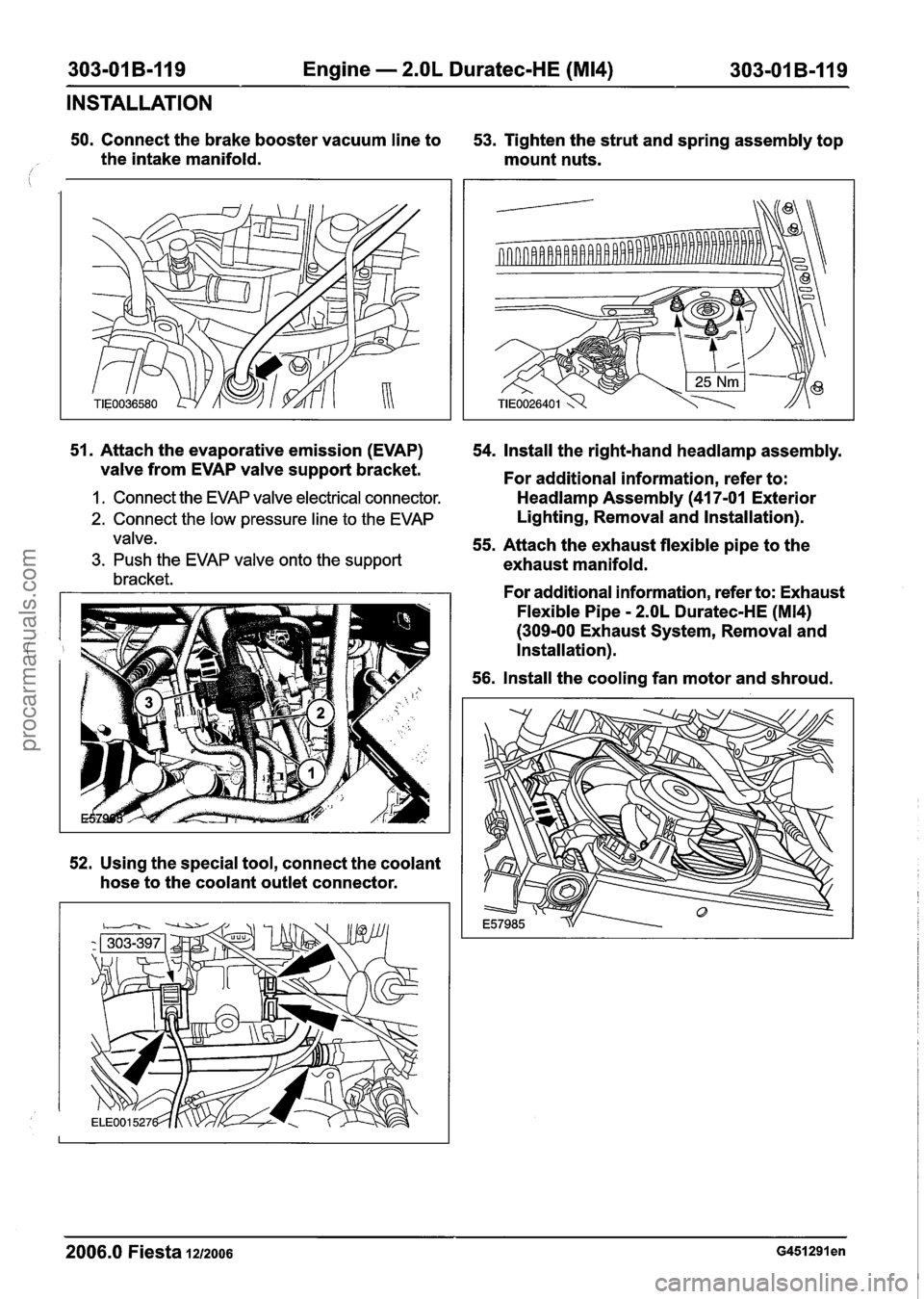
50. Connect the brake booster vacuum line to
53. Tighten the strut and spring assembly top
the intake manifold. mount nuts.
/
51. Attach the evaporative emission (EVAP)
valve from EVAP valve support bracket.
I. Connect the EVAP valve electrical connector.
2. Connect the low pressure line to the EVAP
valve.
3. Push the EVAP valve onto the support
bracket.
52. Using the special tool, connect the coolant
hose to the coolant outlet connector. 54.
Install the right-hand
headlamp assembly.
For additional information, refer to:
Headlamp Assembly (41 7-01 Exterior
Lighting, Removal and Installation).
55. Attach the exhaust flexible pipe to the
exhaust manifold.
For additional information, refer to: Exhaust
Flexible Pipe
- 2.OL Duratec-HE (M14)
(309-00 Exhaust System, Removal and
Installation).
56. Install the cooling fan motor and shroud.
2006.0 Fiesta 1212006 ~451291 en
procarmanuals.com
Page 990 of 1226
Automatic Transmission/Transaxle -
Vehicles With: 4-Speed Automatic
307-01 -30 Transmission (AW81-40) 307-01 -30
DESCRIPTION AND OPERATION
The transmission control unit can be diagnosed
with WDS via the DLC.
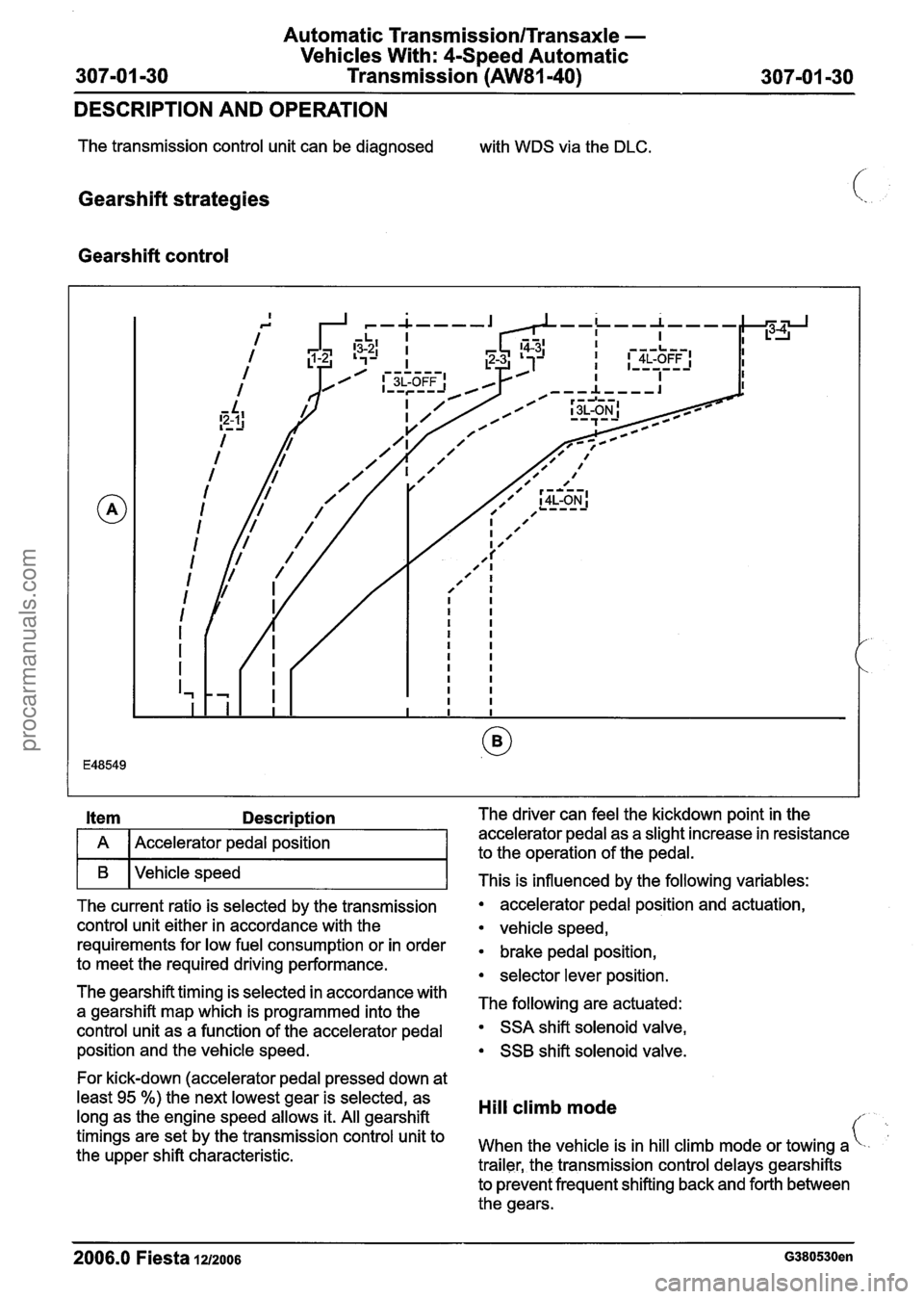
Gearshift strategies
Gearshift control
I A I Accelerator pedal position I
I B I vehicle speed 1
The current ratio is selected by the transmission
control unit either in accordance with the
requirements for low fuel consumption or in order
to meet the required driving performance.
The gearshift timing is selected in accordance with
a gearshift map which is programmed into the
control unit as a function of the accelerator pedal
position and the vehicle speed.
For kick-down (accelerator pedal pressed down at
least
95 %) the next lowest gear is selected, as
long as the engine speed allows it. All gearshift
timings are set by the transmission control unit to
the upper shift characteristic. The driver can feel the
kickdown point
in the
accelerator pedal as a slight increase in resistance
to the operation of the pedal.
This is influenced by the following variables:
accelerator pedal position and actuation,
vehicle speed,
brake pedal position,
selector lever position.
The following are actuated:
SSA shift solenoid valve,
SSB shift solenoid valve.
Hill climb mode
When the vehicle is in hill climb mode or towing a
trailer, the transmission control delays gearshifts
to prevent frequent shifting back and forth between
the gears.
2006.0 Fiesta 1u2oos
procarmanuals.com
Page 1219 of 1226
Acceleration Control - 1.3L Duratec-8V
(Rocam)ll.25L Duratec-1 6V (Sigma)ll.4L
31 0-02A-5 Duratec-1 6V (Sigma)/l .6L Duratec-1 6V (Sigma)
31 0-02A-5
DIAGNOSIS AND TESTING
PCM to the electronic throttle body including
the electrical connectors in area "B" (see
system overview).
- There is an obstruction inside the throttle
body bore. Remove the air cleaner outlet pipe
and check for obstructions.
- There is an obstruction inside the electronic
throttle body. Remove the air cleaner outlet
pipe and check that the plate moves freely
against the springs and returns to a slightly
open position. If it does not, install a new
electronic throttle body.
P2176 - Throttle plate adaptation error
- When the ignition is turned off, the throttle
body carries out an adaptation cycle and
spring check. This can be audible after a
short delay (up to 30 seconds) following the ignition key being turned to position
0 and
can be visually observed with the air cleaner
outlet pipe removed. The throttle plate is
moved through a series of positions to check
the TP sensor value and relearn the
electronic throttle body characteristics. If a
concern is detected during this test,
P2176
DTC will be set. If there are already any of
I the other DTCs, the adaptation test could
potentially fail. Therefore the other DTCs
should be resolved first
(e.g. low battery
voltage) and a retest can be carried out by
clearing the DTCs and keying on and off
again. Check the whole area "B" (see system
overview) for any concerns and if no concern
is found, install a new electronic throttle body.
P2100 - H bridge error
- A fault has been detected on the circuit
connecting the electronic throttle body motor
and the PCM. Check for any other
non-electronic accelerator control related
DTCs and rectify them first. Check area "B"
(see system overview) and if no failure is
found, install a new PCM.
PCM Related Codes
The PCM continuously monitors all the sensors. It
also checks that the monitor is functioning as
expected. If there is a fault with the monitor, the
following DTCs will be set.
P2107 - Processor monitoring on the main
controller fault.
P2108 -Analogue to digital converter
- Inferred intake mass air flow lower than
expected
- Engine speed monitor ratio error
- Pedal ratio monitor error
- TP sensor ratio monitor error
- Fault in torque generation
- Fault present in engine speed limitation
Multiple sensor faults can make the PCM assume
that there is a monitor fault. If other DTCs exist,
rectify these first. These DTCs indicate a failure in
area
"A or "B" and they are also related to the
manifold absolute pressure and temperature
(MAPT) sensor and the crankshaft position (CKP)
sensor. If no other failures are found, install a new
PCM.
Indirect Codes
There are two brake pedal switches located under
the brake pedal. Check that both of these are
connected and functioning correctly. A brake pedal
switch concern will only cause the "EAC FAIL"
message to be displayed, it will not lead to a limited
performance mode. Follow WDS instructions.
PO571 - Brake switch error
If the voltage to the accelerator pedal and the
electronic throttle body cannot be regulated
correctly, the components may not operate as
expected. Therefore it is important to detect if there
is a concern in the supply voltage
PO641 - Sensor voltage supply circuit I noisy
signal
PO642 - Sensor voltage supply circuit 1 short
to ground or open circuit
PO643 - Sensor voltage supply circuit 1 short
to battery
PO651 - Sensor voltage supply circuit 2 noisy
signal
PO652 - Sensor voltage supply circuit 2 short
to ground or open circuit
2006.0 Fiesta 1212006 G356253en
procarmanuals.com