tire pressure FORD FIESTA 2007 User Guide
[x] Cancel search | Manufacturer: FORD, Model Year: 2007, Model line: FIESTA, Model: FORD FIESTA 2007Pages: 1226, PDF Size: 61.26 MB
Page 179 of 1226
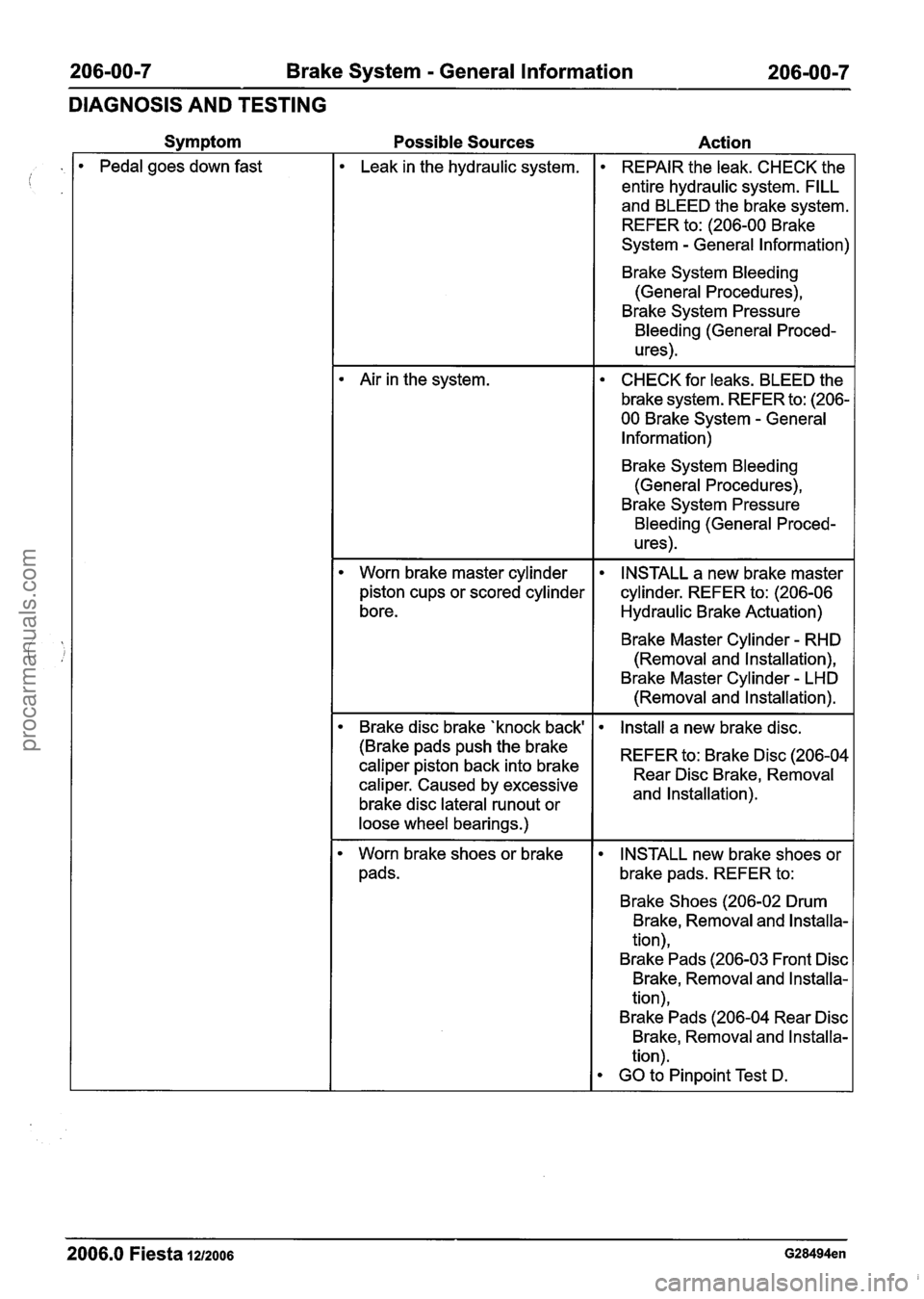
206-00-7 Brake System - General Information 206-00-7
DIAGNOSIS AND TESTING
1 Pedal goes down fast
Possible Sources Action
Leak in the hydraulic system. REPAIR the leak. CHECK the
entire hydraulic system. FILL
and BLEED the brake system.
REFER to: (206-00 Brake
System
- General Information)
Brake System Bleeding
(General Procedures),
Brake System Pressure
Bleeding (General Proced-
ures).
Air in the system.
CHECK for leaks. BLEED the
brake system. REFER to: (206-
00 Brake System
- General
Information)
Brake System Bleeding
(General Procedures),
Brake System Pressure
Bleeding (General Proced-
u res).
Worn brake master cylinder piston cups or scored cylinder
bore. INSTALL
a new brake master
cylinder. REFER to: (206-06
Hydraulic Brake Actuation)
Brake Master Cylinder
- RHD
(Removal and lnstallation),
Brake Master Cylinder
- LHD
(Removal and lnstallation).
I Brake disc brake 'knock back' I Install a new brake disc. I
I loose wheel bearings.) I I
(Brake pads push the brake
caliper piston back into brake
caliper. Caused by excessive
brake disc lateral
runout or
Worn brake shoes or brake
pads. REFER to:
Brake Disc (206-04
Rear Disc Brake, Removal
and Installation). INSTALL new brake shoes or
brake pads. REFER to:
Brake Shoes (206-02 Drum
Brake, Removal and Installa-
tion),
Brake Pads (206-03 Front Disc
Brake, Removal and Installa-
tion),
Brake Pads (206-04 Rear Disc Brake, Removal and Installa-
tion).
GO to Pinpoint Test D.
2006.0 Fiesta 1212006 G28494en
procarmanuals.com
Page 180 of 1226
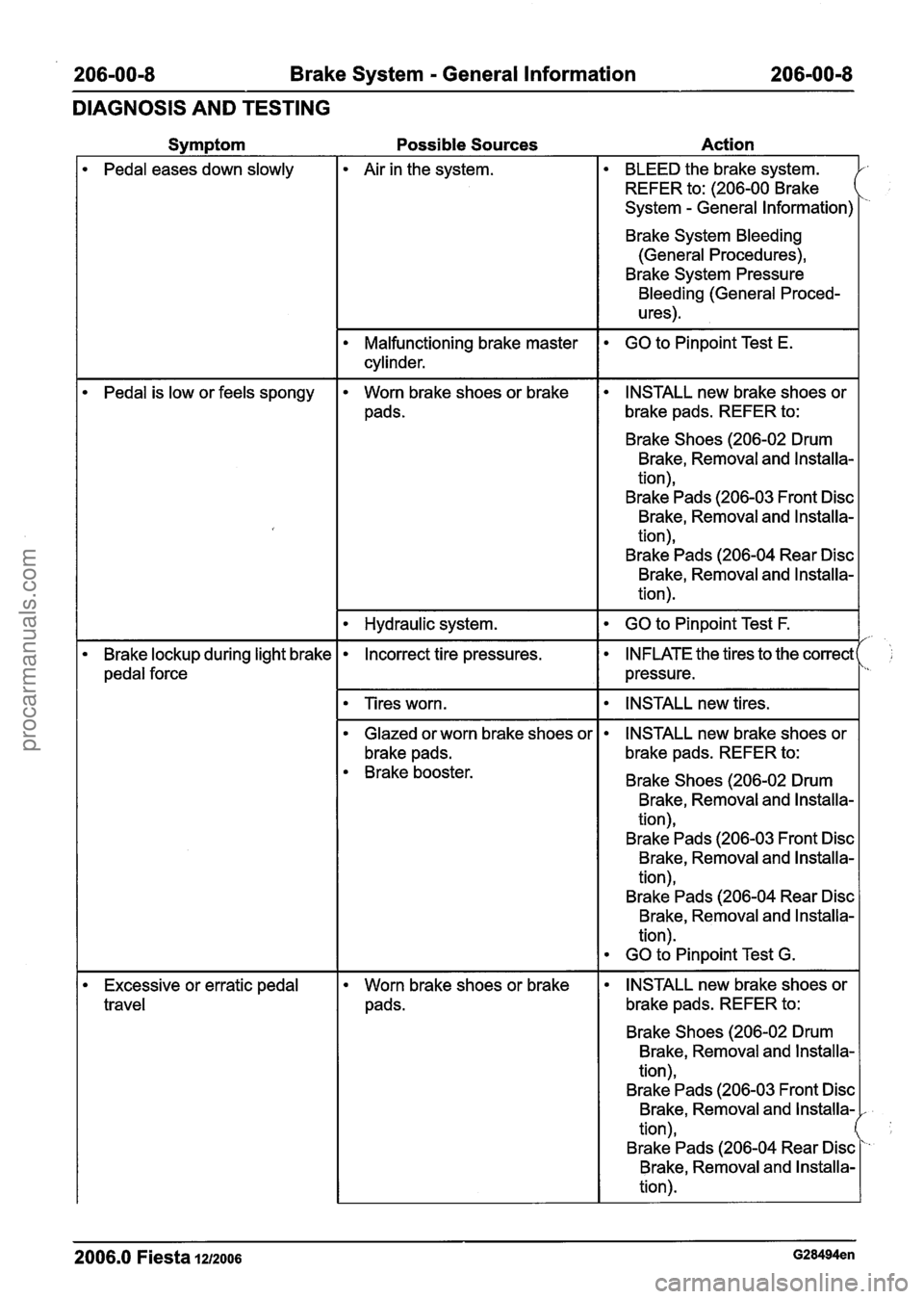
206-00-8 Brake System - General Information 206-00-8
DIAGNOSIS AND TESTING
Svm~tom Possible Sources Action
Pedal eases down slowly Air in the system.
Malfunctioning brake master
cylinder.
BLEED the brake system.
REFER to: (206-00 Brake
System
- General Information)
Brake System Bleeding (General Procedures),
Brake System Pressure Bleeding (General Proced-
ures).
GO to Pinpoint Test E.
Brake, Removal and Installa-
tion),
Brake Pads (206-03 Front Disc
Brake, Removal and Installa-
tion),
Brake Pads (206-04 Rear Disc
Brake, Removal and Installa-
Pedal is low or feels spongy
I tion). I
Brake lockup during light brake I
Worn brake shoes or brake
pads.
pedal force INSTALL new brake shoes or
brake pads. REFER to:
Hydraulic system.
Incorrect tire pressures.
Tires worn.
Glazed or worn brake shoes or
brake pads.
Brake booster.
GO to Pinpoint Test F. I
INFLATE the tires to the correct
pressure.
INSTALL new tires. I
brake pads. REFER to:
Brake Shoes (206-02 Drum
Brake, Removal and Installa-
tion),
Brake Pads (206-03 Front Disc Brake, Removal and Installa-
tion),
Brake Pads (206-04 Rear Disc
Brake, Removal and Installa-
tion).
GO to Pinpoint Test G.
Excessive or erratic pedal
travel Worn brake shoes or brake
pads. INSTALL new brake shoes or
brake pads. REFER to:
Brake Shoes (206-02 Drum Brake, Removal and Installa-
tion),
Brake Pads (206-03 Front Disc Brake, Removal and Installa-
tion),
I
Brake Pads (206-04 Rear Disc
Brake, Removal and Installa-
tion).
2006.0 Fiesta 1212006 G28494en
procarmanuals.com
Page 182 of 1226
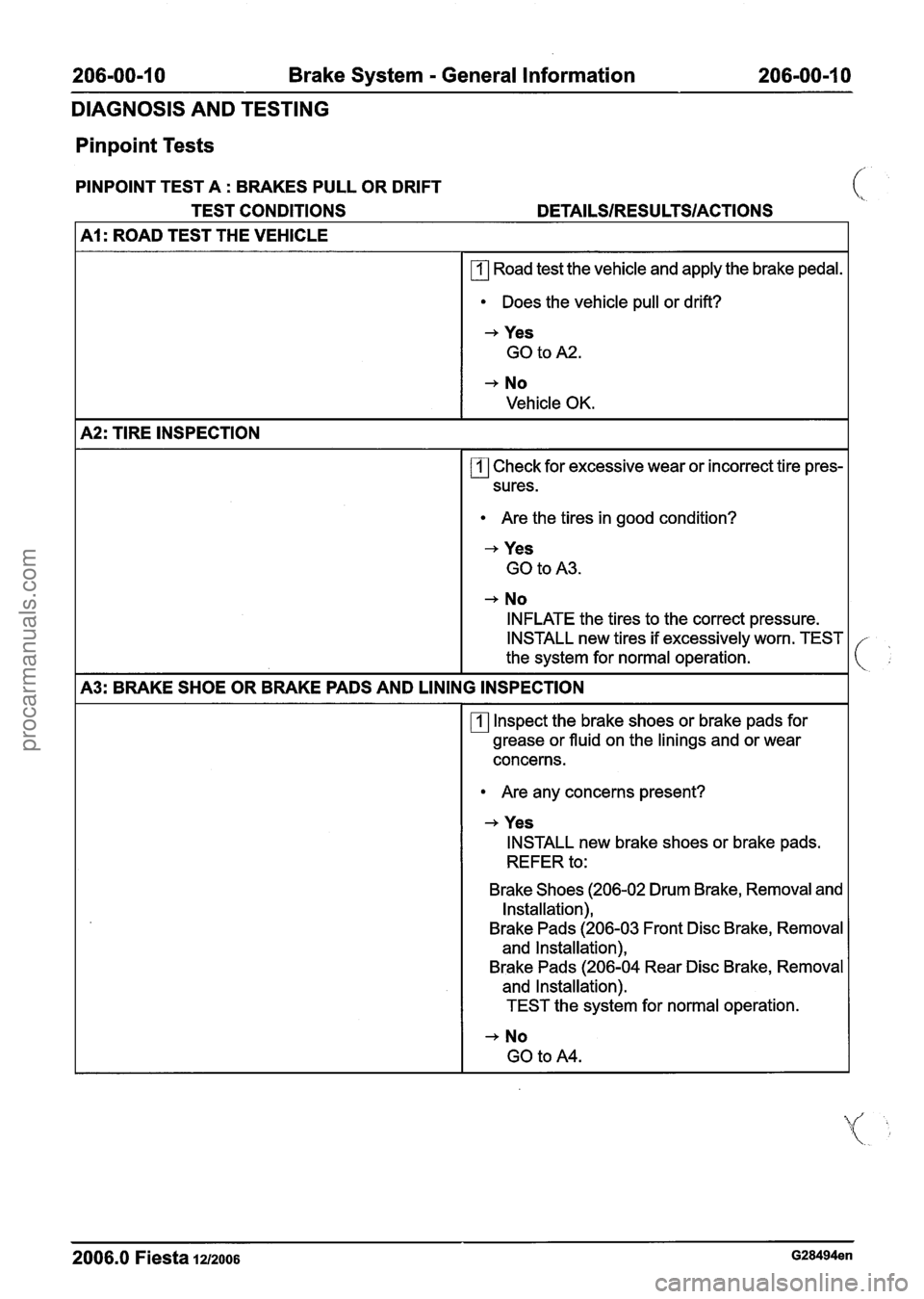
206-00-1 0 Brake System - General Information 206-00-1 0
DIAGNOSIS AND TESTING
Pinpoint Tests
PINPOINT TEST A : BRAKES PULL OR DRIFT
TEST CONDITIONS
DETAILSIRESU LTSIACTIONS
A1 : ROAD TEST THE VEHICLE
Road test the vehicle and apply the brake pedal.
Does the vehicle pull or drift?
+ Yes
GO to A2.
+ No
Vehicle OK.
A2: TIRE INSPECTION
Check for excessive wear or incorrect tire pres-
sures.
Are the tires in good condition?
-, Yes
GO to A3.
+ No
INFLATE the tires to the correct pressure.
INSTALL new tires if excessively worn. TEST
the system for normal operation.
A3: BRAKE SHOE OR BRAKE PADS AND LINING INSPECTION
Inspect the brake shoes or brake pads for
grease or fluid on the linings and or wear
concerns.
Are any concerns present?
+ Yes
INSTALL new brake shoes or brake pads.
REFER to:
Brake Shoes (206-02 Drum Brake, Removal and
Installation),
Brake Pads (206-03 Front Disc Brake, Removal
and Installation),
Brake Pads (206-04 Rear Disc Brake, Removal
and Installation).
TEST the system for normal operation.
+ No
GO to A4.
2006.0 Fiesta 1212006 G28494en
procarmanuals.com
Page 193 of 1226
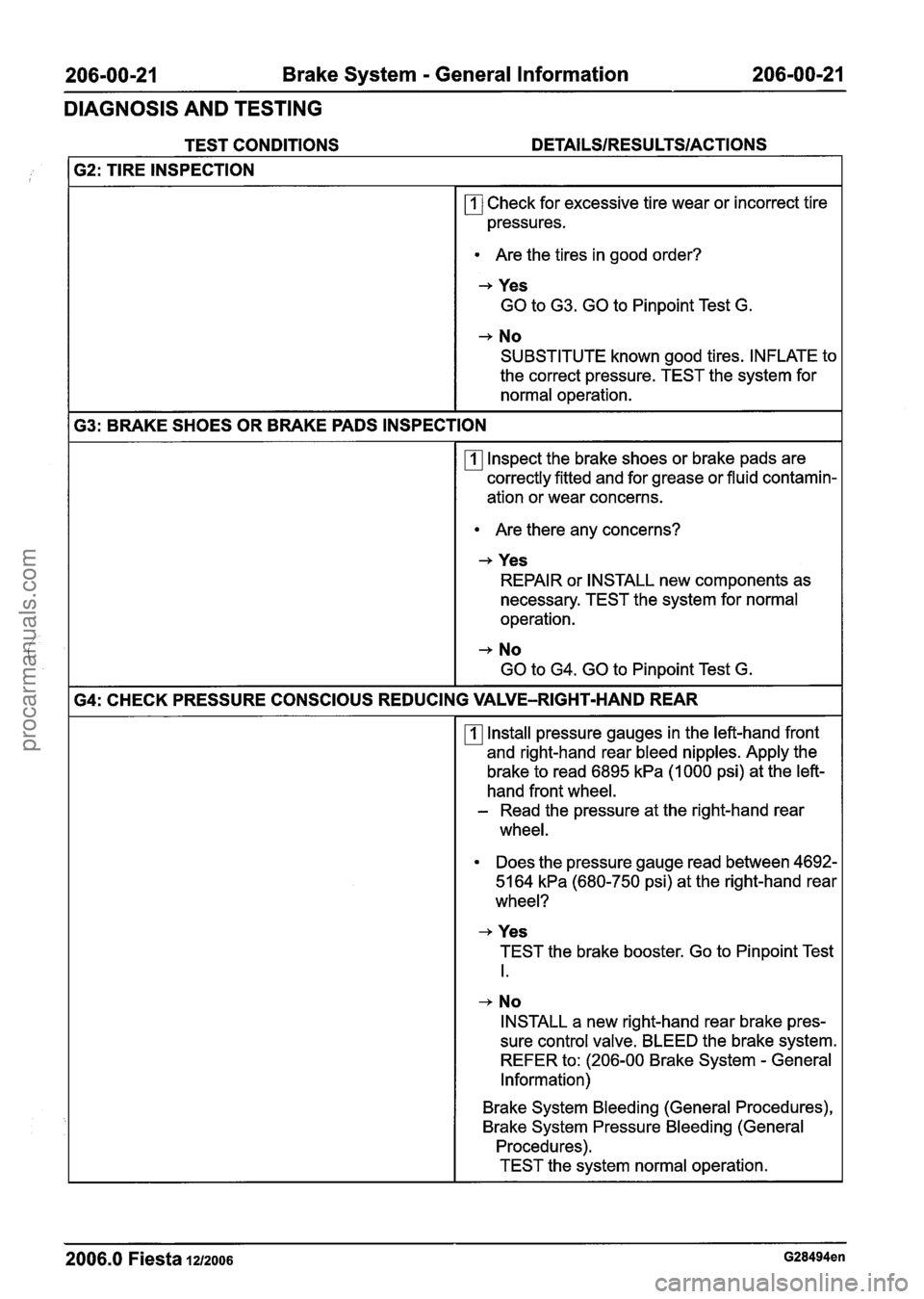
206-00-21 Brake System - General Information 206-00-21
DIAGNOSIS AND TESTING
TEST CONDITIONS DETAILSIRESU LTSIACTIONS
162: TIRE INSPECTION
rn Check for excessive tire wear or incorrect tire
pressures.
Are the tires in good order?
-+ Yes
GO to G3. GO to Pinpoint Test G.
-+ No
SUBSTITUTE known good tires. INFLATE to
the correct pressure. TEST the system for
normal operation.
163: BRAKE SHOES OR BRAKE PADS INSPECTION I
rn Inspect the brake shoes or brake pads are
correctly fitted and for grease or fluid contamin-
ation or wear concerns.
Are there any concerns?
-+ Yes
REPAIR or INSTALL new components as
necessary. TEST the system for normal
operation.
-+ No
GO to G4. GO to Pinpoint Test G.
1 64: CHECK PRESSURE CONSCIOUS REDUCING VALVE-RIGHT-HAND REAR I
rn Install pressure gauges in the left-hand front
and right-hand rear bleed nipples. Apply the brake to read 6895
kPa (1 000 psi) at the left-
hand front wheel.
- Read the pressure at the right-hand rear
wheel.
Does the pressure gauge read between 4692-
5164
kPa (680-750 psi) at the right-hand rear
wheel?
-+ Yes
TEST the brake booster. Go to Pinpoint Test
I.
-+ No
INSTALL a new right-hand rear brake pres-
sure control valve. BLEED the brake system.
REFER to: (206-00 Brake System
- General
Information)
Brake System Bleeding (General Procedures),
Brake System Pressure Bleeding (General
Procedures). TEST the system normal operation.
2006.0 Fiesta 12/2006 G28494en
procarmanuals.com
Page 202 of 1226
Brake System - General Information
DIAGNOSIS AND TESTING
evidence of a brake concern. Check for the brake
warning indicator illumination and the fluid level in
the master cylinder reservoir.
Normal Conditions
The following conditions are considered normal
and are not indications that the brake master
cylinder is in need of service.
- Modern brake systems are not designed to
produce as hard a pedal effort as in the past.
Complaints of light pedal efforts should be
compared to pedal efforts of another vehicle, of
the same model and year.
- During normal operation of the brake the fluid
level in the reservoir will rise during brake
application and fall during release. The net fluid
level
(i.e., after brake application and release)
will remain unchanged.
- A trace of brake fluid will exists on the brake
booster shell below the master cylinder
mounting flange. This results from the normal
lubricating action of the master cylinder bore
end seal.
- The fluid level will fall with brake shoe and lining
wear.
Abnormal Conditions
N0TE:Prior to performing any diagnosis, make
sure the brake system warning indicator is
functional.
Changes in brake pedal feel or travel are indicators
that something could be wrong with the braking system. The diagnostic procedure and techniques
use brake pedal feel, warning indicator illumination
and low brake fluid level as indicators in diagnosing
braking system concerns. The following conditions
are considered abnormal and indicate that the
brake master cylinder is in need of service.
- The brake pedal effort is excessive. This may
be caused by a bind or obstruction in the pedal
.
or linkage, clogged fluid control valve or ( ' insufficient booster vacuum.
- The rear brakes lock up during light pedal force.
This may be caused by incorrect tire pressures,
grease or fluid on the brake shoes and linings,
damaged brake shoes and linings, incorrectly
adjusted parking brake, or damaged or
contaminated brake pressure control valves.
- The brake pedal effort is erratic. This condition
could be caused by a brake booster malfunction,
extreme caliper piston knock back or incorrectly
installed brake shoes and linings.
- The brake warning indicator is ON. This may
be caused by low fluid level, ignition wire routing
too close to the fluid level indicator assembly,
or float assembly damage.
Bypass Condition Test
1. Check the fluid in brake master cylinder. Fill the
brake master cylinder reservoir if low or empty.
2. Observe the fluid level in the brake master
cylinder reservoir. If after several brake
applications, the fluid level remains the same,
measure the wheel turning torque required to
rotate the wheels with the brakes applied as
follows:
Place the transaxle in NEUTRAL and raise and
support the vehicle. REFER to: (1 00-02 Jacking
and Lifting)
Jacking (Description and Operation),
Lifting (Description and Operation).
Apply the brakes with a minimum of 445 N (100
Ib) and hold for approximately 15 seconds. With
the brakes still applied, exert a torque on the front
wheels of 10.1 Nm (75
1b.R). If either wheel rotates,
install a new brake master cylinder. REFER to:
(206-06 Hydraulic Brake Actuation)
- The brake pedal goes down fast. This could be Brake Master Cylinder - RHD (Removal and
caused by an external or internal leak. Installation),
- The brake
pedal eases down slowly. This could Brake Master Cylinder - LHD
(Removal and
be caused by an external or internal leak. Installation).
- The
brake pedal is low and or feels spongy. This
condition may be caused by no fluid in the brake
Non-Pressure Leaks master cylinder reservoir, reservoir cap vent
holes clogged or air in the hydraulic system.
Any empty brake master cylinder reservoir
condition may be caused by two types of
non-pressure external leaks.
2006.0 Fiesta 1212006
procarmanuals.com
Page 325 of 1226
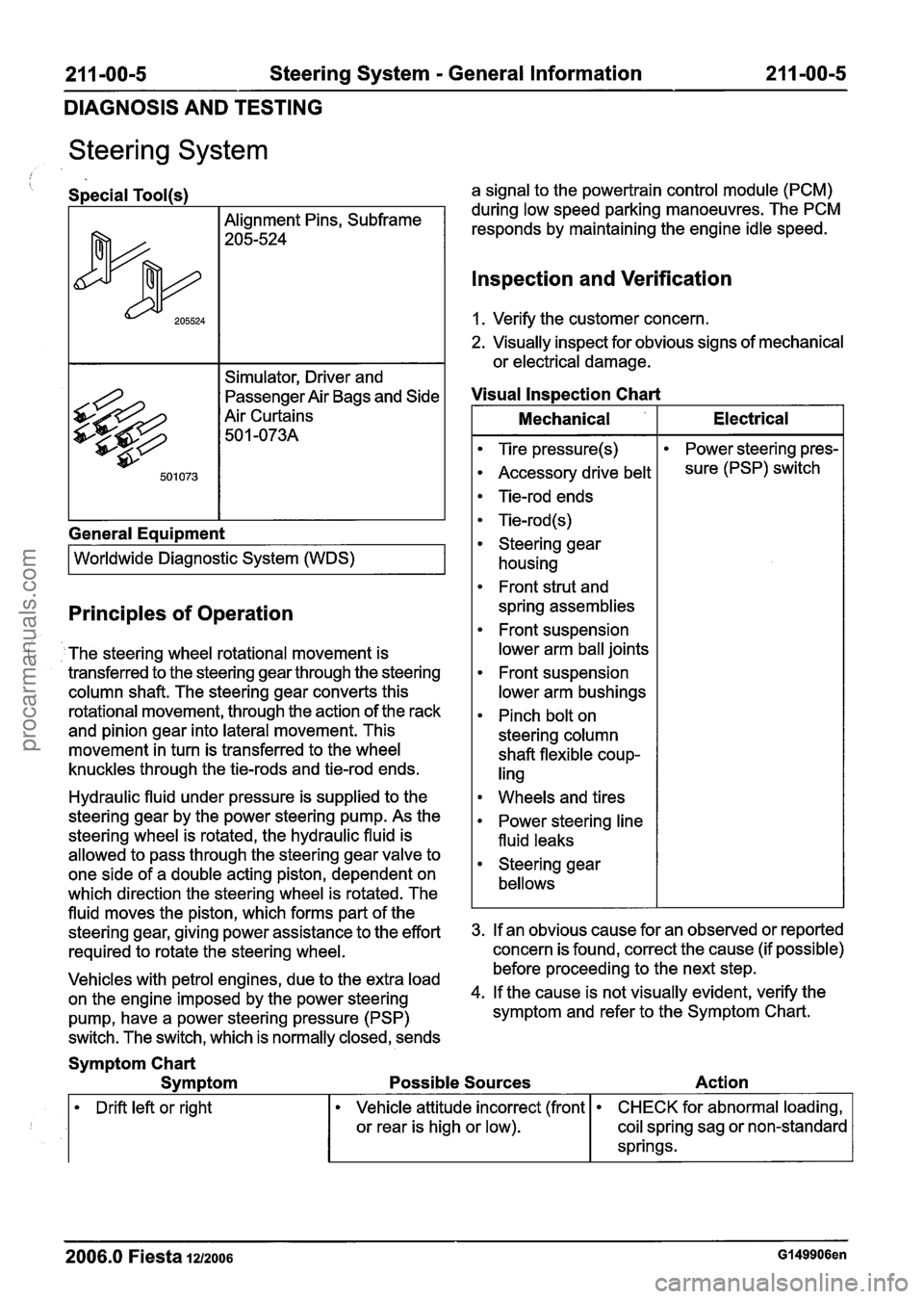
211 -00-5 Steering System - General Information 211 -00-5
DIAGNOSIS AND TESTING
Steering System
/ Special Tool(s)
Alignment Pins, Subframe
205-524
Simulator, Driver and
passenger ~ir Bags and Side
Air Curtains 50
1 -073A
General Eaui~ment
I Worldwide Diagnostic System (WDS) I
Principles of Operation
The steering wheel rotational movement is
transferred to the steering gear through the steering
column shaft. The steering gear converts this
rotational movement, through the action of the rack
and pinion gear into lateral movement. This
movement in turn is transferred to the wheel
knuckles through the tie-rods and tie-rod ends.
Hydraulic fluid under pressure is supplied to the
steering gear by the power steering pump. As the
steering wheel is rotated, the hydraulic fluid is
allowed to pass through the steering gear valve to
one side of a double acting piston, dependent on
which direction the steering wheel is rotated. The
fluid moves the piston, which forms part of the
steering gear, giving power assistance to the effort
required to rotate the steering wheel.
Vehicles with petrol engines, due to the extra load
on the engine imposed by the power steering
pump, have a power steering pressure (PSP)
switch. The switch, which is normally closed, sends a signal
to the powertrain control module (PCM)
during low speed parking manoeuvres. The PCM
responds by maintaining the engine idle speed.
lnspection and Verification
1. Verify the customer concern.
2. Visually inspect for obvious signs of mechanical
or electrical damage.
Visual lnspection Chart
I Mechanical I Electrical I
Tire pressure(s)
Accessory drive belt
Tie-rod ends
Tie-rod (s)
Steering gear housing
Front strut and
spring assemblies
Front suspension
lower arm ball joints
Front suspension
lower arm bushings
Pinch bolt on
steering column
shaft flexible coup-
ling Power
steering pres-
sure (PSP) switch
Wheels and tires
Power steering line
fluid leaks
Steering gear
bellows
3. If an obvious cause for an observed or reported
concern is found, correct the cause (if possible)
before proceeding to the next step.
4. If the cause is not visually evident, verify the
symptom and refer to the Symptom Chart.
Symptom Chart
Symptom Possible Sources Action
Drift left or right
2006.0 Fiesta 1212006 Gl49906en
Vehicle attitude incorrect (front
or rear is high or low). CHECK for abnormal loading,
coil spring sag or non-standard
springs.
procarmanuals.com
Page 336 of 1226
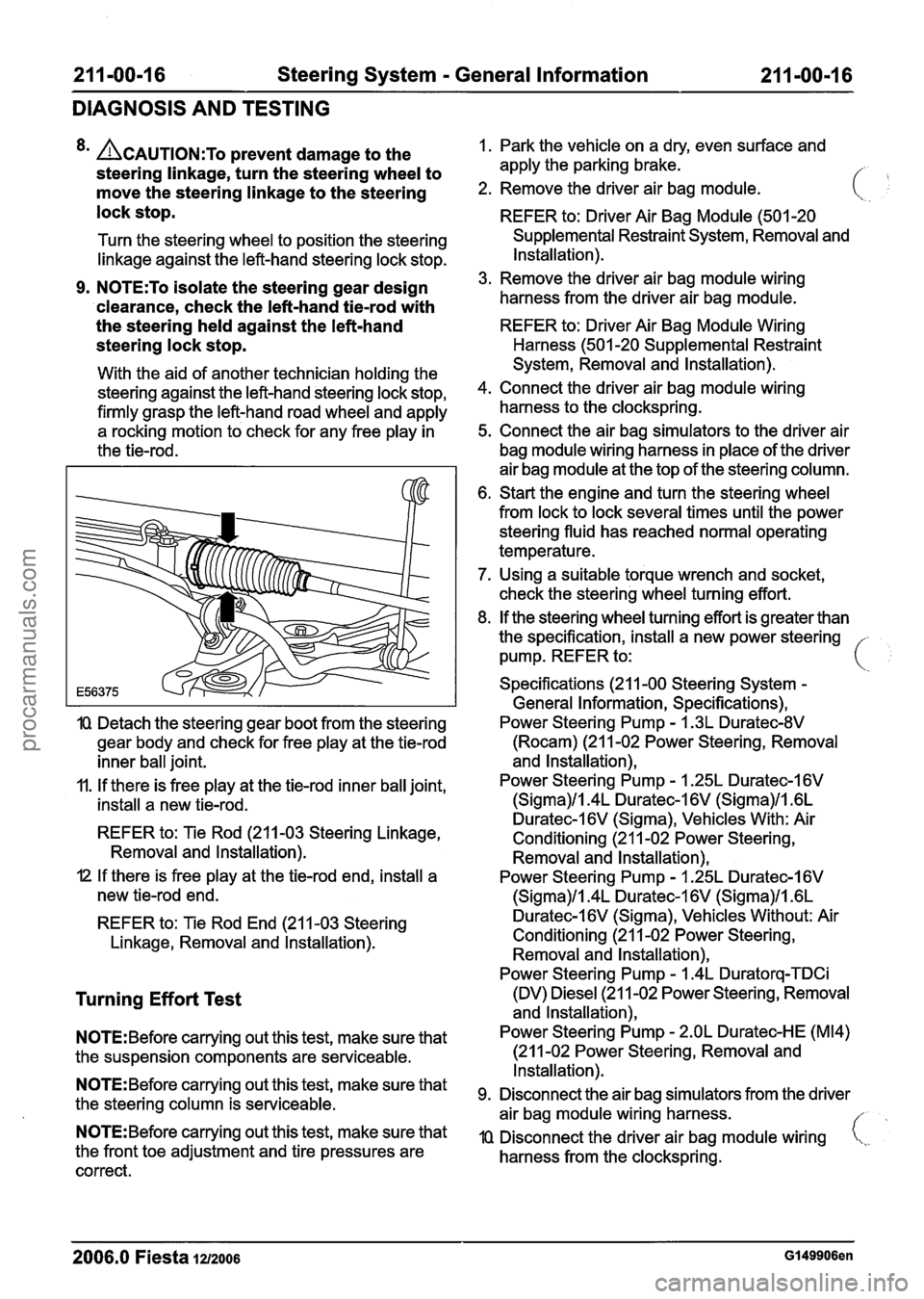
21 1-00-1 6 Steering System - General Information 21 I -00-1 6
DIAGNOSIS AND TESTING
8m ACAUTION:T~ prevent damage to the
steering linkage, turn the steering wheel to
move the steering linkage to the steering
lock stop.
Turn the steering wheel to position the steering
linkage against the left-hand steering lock stop.
9. N0TE:To isolate the steering gear design
'clearance, check the left-hand
tiemrod with
the steering held against the left-hand
steering lock stop.
With the aid of another technician holding the
steering against the left-hand steering lock stop,
firmly grasp the left-hand road wheel and apply
a rocking motion to check for any free play in
the tie-rod.
IQ Detach the steering gear boot from the steering
gear body and check for free play at the tie-rod
inner ball joint.
11. If there is free play at the tie-rod inner ball joint,
install a new tie-rod.
REFER to: Tie Rod (211-03 Steering Linkage,
Removal and lnstallation).
I2 If there is free play at the tie-rod end, install a
new tie-rod end.
REFER to: Tie Rod End (21 1-03 Steering
Linkage, Removal and lnstallation).
Turning Effort Test
N0TE:Before carrying out this test, make sure that
the suspension components are serviceable.
N0TE:Before carrying out this test, make sure that
the steering column is serviceable.
N0TE:Before carrying out this test, make sure that
the front toe adjustment and tire pressures are
correct. 1.
Park the vehicle on a dry, even surface and
apply the parking brake.
/- ,
2. Remove the driver air bag module.
REFER to: Driver Air Bag Module (501 -20
Supplemental Restraint System, Removal and
Installation).
3. Remove the driver air bag module wiring
harness from the driver air bag module.
REFER to: Driver Air Bag Module Wiring
Harness (501 -20 Supplemental Restraint
System, Removal and Installation).
4. Connect the driver air bag module wiring
harness to the clockspring.
5. Connect the air bag simulators to the driver air
bag module wiring harness in place of the driver
air bag module at the top of the steering column.
6. Start the engine and turn the steering wheel
from lock to lock several times until the power
steering fluid has reached normal operating
temperature.
7. Using a suitable torque wrench and socket,
check the steering wheel turning effort.
8. If the steering wheel turning effort is greater than
the specification, install a new power steering -
pump. REFER to: i
Specifications (21 1-00 Steering System -
General Information, Specifications),
Power Steering Pump
- I .3L Duratec-8V
(Rocam) (21 1-02 Power Steering, Removal
and lnstallation),
Power Steering Pump
- 1.25L Duratec-1 6V
(Sigma)/l.4L Duratec-1 6V (Sigma)/l .6L
Duratec-l6V (Sigma), Vehicles With: Air
Conditioning (21 1-02 Power Steering,
Removal and lnstallation),
Power Steering Pump
- I .25L Duratec-I 6V
(Sigma)/l.4L Duratec-1 6V (Sigma)/l .6L
Duratec-I 6V (Sigma), Vehicles Without: Air
Conditioning (21 1-02 Power Steering, Removal and lnstallation),
Power Steering Pump
- 1.4L Duratorq-TDCi
(DV) Diesel (21 1-02 Power Steering, Removal
and lnstallation),
Power Steering Pump
- 2.OL Duratec-HE (M14)
(21 1-02 Power Steering, Removal and
Installation).
Disconnect the air bag simulators from the driver
air bag module wiring harness.
//
IQ Disconnect the driver air bag module wiring i,,.
harness from the clockspring.
2006.0 Fiesta 1212006 GI 49906en
procarmanuals.com
Page 371 of 1226
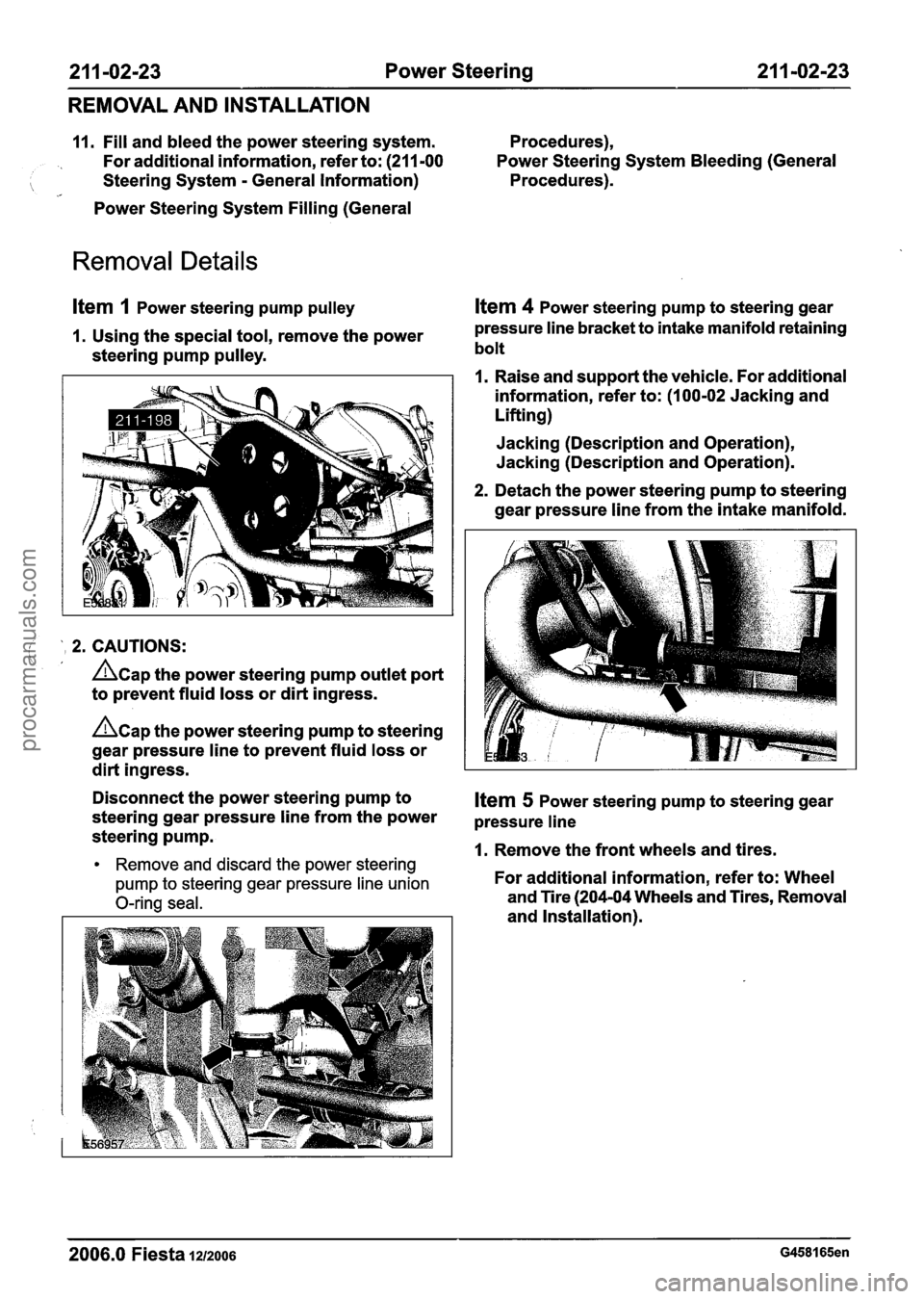
21 1 -02123 Power Steering 21 I -02-23
REMOVAL AND INSTALLATION
11. Fill and bleed the power steering system. Procedures),
For additional information, refer to: (211 -00 Power Steering System
Bleeding (General
Steering System - General Information) Procedures).
Power Steering System Filling (General
Removal Details
ltem 1 Power steering pump pulley
1. Using the special tool, remove the power
steering pump pulley.
I ' 2. CAUTIONS: /,
Acap the power steering pump outlet port
to prevent fluid loss or dirt ingress.
hap the power steering pump to steering
gear pressure line to prevent fluid loss or
dirt ingress.
Item 4 Power steering pump to steering gear
pressure line bracket to intake manifold retaining
bolt
1. Raise and support the vehicle. For additional
information, refer to: (1 00-02 Jacking and
Lifting)
Jacking (Description and Operation),
Jacking (Description and Operation).
2. Detach the power steering pump to steering
gear pressure line from the intake manifold.
Disconnect the power steering pump to
Item 5 Power steering pump to steering gear
steering gear pressure line from the power
pressure line steering pump. 1. Remove the front wheels and tires. Remove and discard the power steering
pump to steering gear pressure line union
For additional information, refer to: Wheel
O-ring seal. and Tire (204-04 Wheels and Tires, Removal
and Installation).
2006.0 Fiesta 1212006 G458165en
procarmanuals.com
Page 377 of 1226
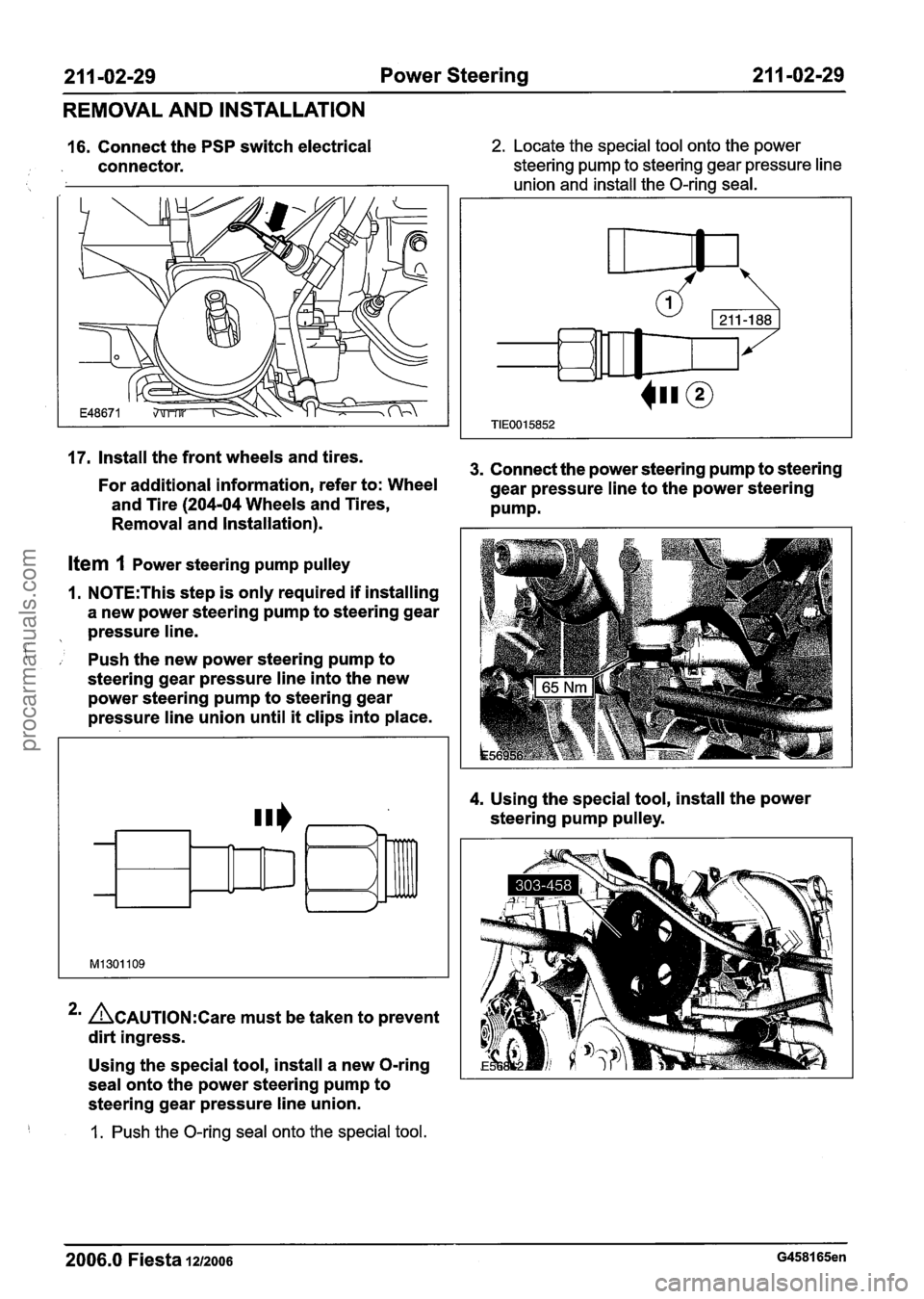
21 I -02-29 Power Steering 21 1 -02-29
REMOVAL AND INSTALLATION
16. Connect the PSP switch electrical
connector. 2. Locate the special tool onto the power
steering pump to steering gear pressure line
union and install the O-ring seal.
17. Install the front wheels and tires. 3. Connect the power steering pump to steering
For additional information, refer to: Wheel
gear pressure line to the power steering
and Tire
(204-04 Wheels and Tires,
Removal and Installation). Pump.
Item 1 Power steering pump pulley
1. N0TE:This step is only required if installing
a new power steering pump to steering gear
, pressure line.
, Push the new power steering pump to
steering gear pressure line into the new
power steering pump to steering gear
pressure line union until
it clips into place.
2m ACAUTION:~~~~ must be taken to prevent
dirt ingress.
Using the special tool, install a new O-ring
seal onto the power steering pump to
steering gear pressure line union.
1. Push the O-ring seal onto the special tool. 4.
Using
the special tool, install the power
steering pump pulley.
2006.0 Fiesta 1212006 G458165en
procarmanuals.com
Page 546 of 1226
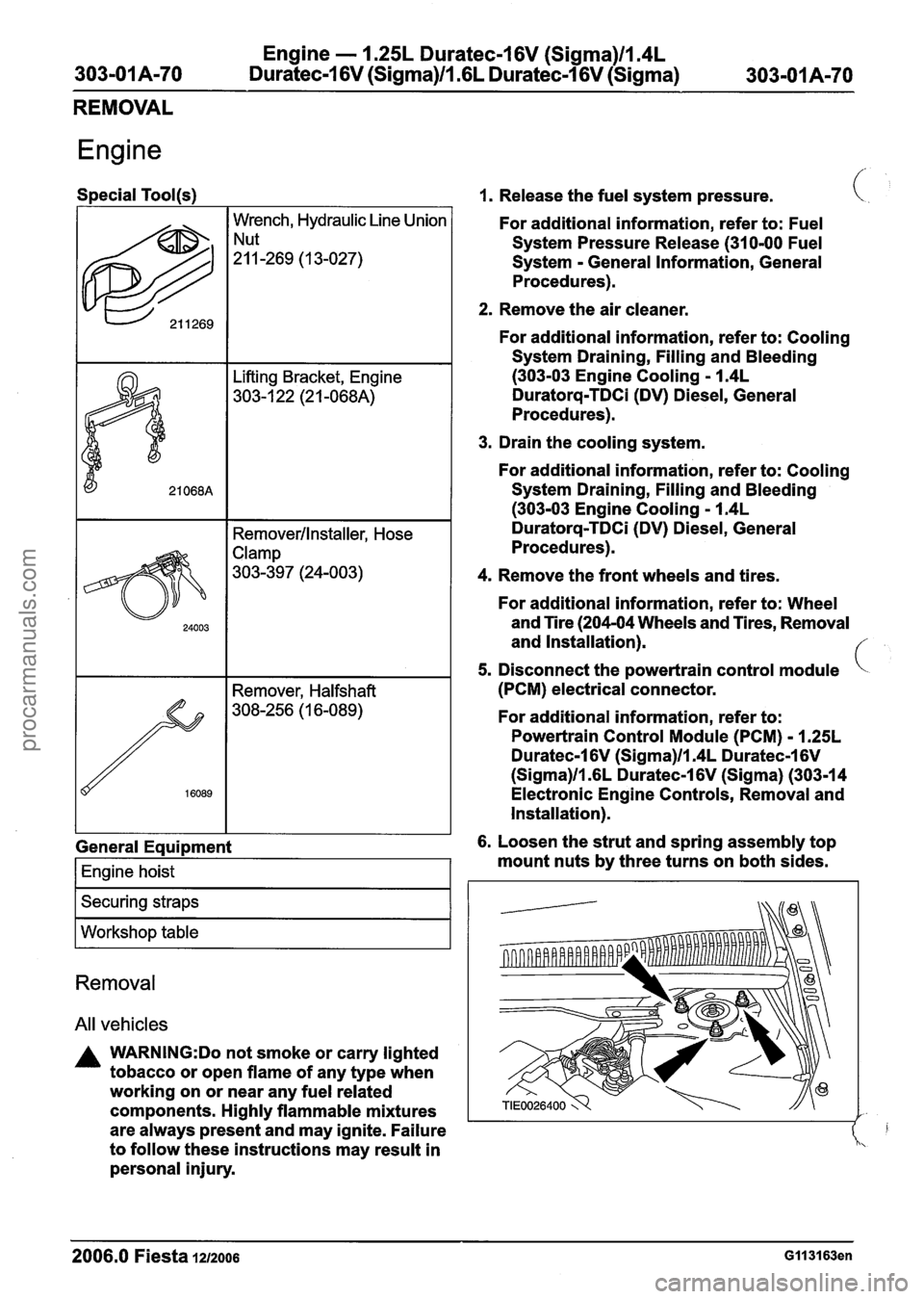
Engine - 1.25L Duratec-1 6V (Sigma)ll.4L
303-01 A-70 Duratec-I 6V (Sigma)lll6L Duratec-1 6V (Sigma) 303-01 A-70
REMOVAL
Engine
Special Tool(s)
I I Removerllnstaller, Hose
622
General Eaui~ment
Wrench, Hydraulic Line Union
!:!-269 ( 1 3-027)
I Engine hoist I
I Securing straps I
I Workshop table I
Removal
All vehicles
A WARNING:Do not smoke or carry lighted
tobacco or open flame of any type when
working on or near any fuel related
components. Highly flammable mixtures
are always present and may ignite. Failure
to follow these instructions may result in
personal injury.
1. Release the fuel system pressure.
For additional information, refer to: Fuel
System Pressure Release (31 0-00 Fuel
System
- General Information, General
Procedures).
2. Remove the air cleaner.
For additional information, refer to: Cooling
System Draining, Filling and Bleeding
(303-03 Engine Cooling - 1.4L
Duratorq-TDCi (DV) Diesel, General
Procedures).
3. Drain the cooling system.
For additional information, refer to: Cooling
System Draining, Filling and Bleeding
(303-03 Engine Cooling - 1.4L
Duratorq-TDCi (DV) Diesel, General
Procedures).
4. Remove the front wheels and tires.
For additional information, refer to: Wheel
and Tire (204-04 Wheels and Tires, Removal
and Installation).
5. Disconnect the powertrain control module
(PCM) electrical connector.
For additional information, refer to:
Powertrain Control Module (PCM)
- 1.25L
Duratec-1 6V (Sigma)ll.4L Duratec-1 6V
(Sigma)ll .6L Duratec-1 6V (Sigma) (303-1 4
Electronic Engine Controls, Removal and
Installation).
6. Loosen the strut and spring assembly top
mount nuts by three turns on both sides.
2006.0 Fiesta 1212006 GII 31 63en
procarmanuals.com