ECO mode FORD FIESTA 2011 Owner's Manual
[x] Cancel search | Manufacturer: FORD, Model Year: 2011, Model line: FIESTA, Model: FORD FIESTA 2011Pages: 356, PDF Size: 3.12 MB
Page 271 of 356
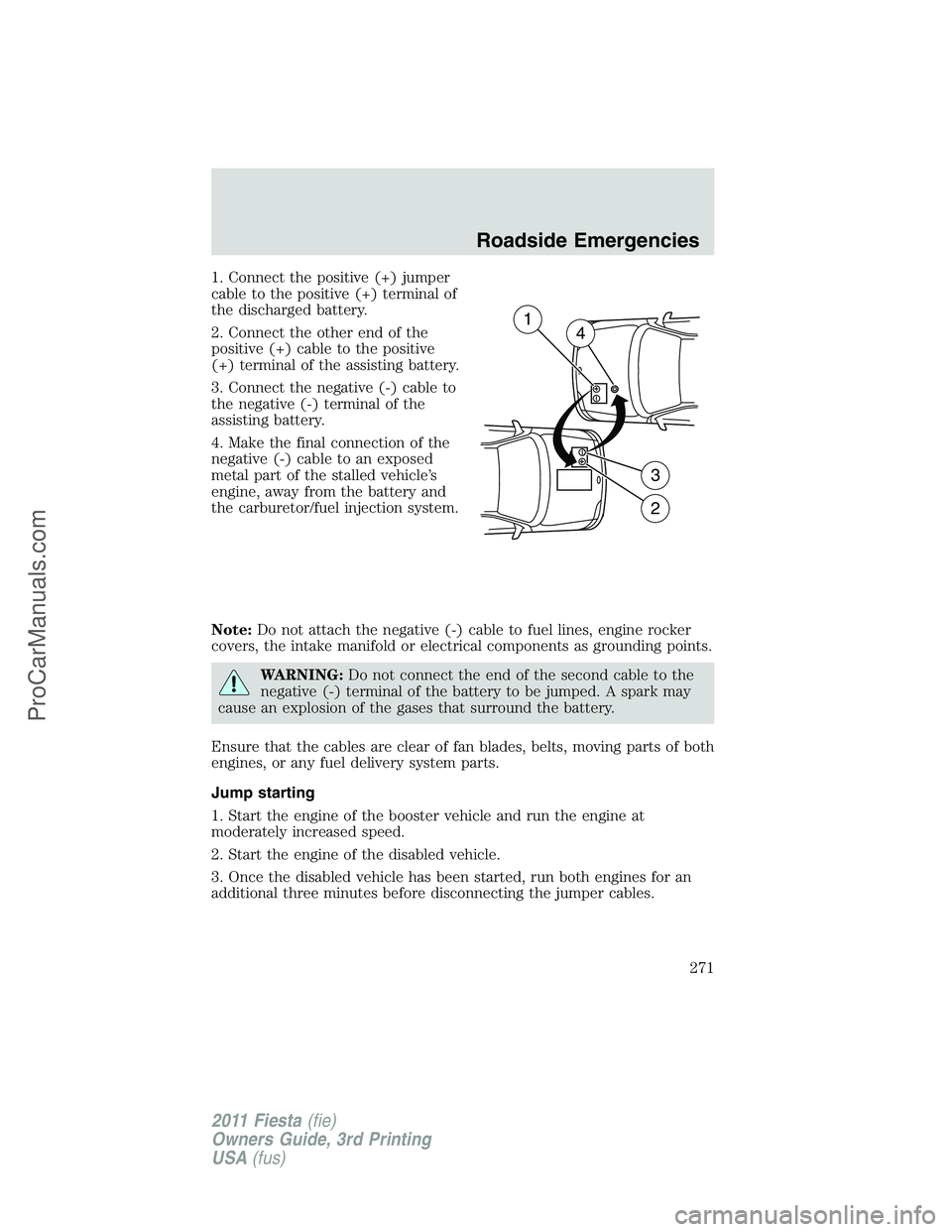
1. Connect the positive (+) jumper
cable to the positive (+) terminal of
the discharged battery.
2. Connect the other end of the
positive (+) cable to the positive
(+) terminal of the assisting battery.
3. Connect the negative (-) cable to
the negative (-) terminal of the
assisting battery.
4. Make the final connection of the
negative (-) cable to an exposed
metal part of the stalled vehicle’s
engine, away from the battery and
the carburetor/fuel injection system.
Note:Do not attach the negative (-) cable to fuel lines, engine rocker
covers, the intake manifold or electrical components as grounding points.
WARNING:Do not connect the end of the second cable to the
negative (-) terminal of the battery to be jumped. A spark may
cause an explosion of the gases that surround the battery.
Ensure that the cables are clear of fan blades, belts, moving parts of both
engines, or any fuel delivery system parts.
Jump starting
1. Start the engine of the booster vehicle and run the engine at
moderately increased speed.
2. Start the engine of the disabled vehicle.
3. Once the disabled vehicle has been started, run both engines for an
additional three minutes before disconnecting the jumper cables.
+–
+–
2
3
14
Roadside Emergencies
271
2011 Fiesta(fie)
Owners Guide, 3rd Printing
USA(fus)
ProCarManuals.com
Page 311 of 356
•Have the vehicle loading and distribution the same every time.
Your results will be most accurate if your filling method is consistent.
Calculating fuel economy
1. Fill the fuel tank completely and record the initial odometer reading
(in miles or kilometers).
2. Each time you fill the tank, record the amount of fuel added (in
gallons or liters).
3. After at least three to five tank fill-ups, fill the fuel tank and record
the current odometer reading.
4. Subtract your initial odometer reading from the current odometer
reading.
5. Follow one of the simple calculations in order to determine fuel
economy:
Calculation 1:Divide total miles traveled by total gallons used.
Calculation 2:Multiply liters used by 100, then divide by total
kilometers traveled.
Keep a record for at least one month and record the type of driving (city
or highway). This will provide an accurate estimate of the vehicle’s fuel
economy under current driving conditions. Additionally, keeping records
during summer and winter will show how temperature impacts fuel
economy. In general, lower temperatures give lower fuel economy.
Driving style — good driving and fuel economy habits
Give consideration to the lists that follow and you may be able to change
a number of variables and improve your fuel economy.
Habits
•Smooth, moderate operation can yield up to 10% savings in fuel.
•Steady speeds without stopping will usually give the best fuel
economy.
•Idling for long periods of time (greater than one minute) may waste
fuel.
•Anticipate stopping; slowing down may eliminate the need to stop.
•Sudden or hard accelerations may reduce fuel economy.
•Slow down gradually.
•Driving at reasonable speeds (traveling at 55 mph [88 km/h] uses 15%
less fuel than traveling at 65 mph [105 km/h]).
Maintenance and Specifications
311
2011 Fiesta(fie)
Owners Guide, 3rd Printing
USA(fus)
ProCarManuals.com
Page 352 of 356
Doors
central unlocking ....................134
Downloading unread text
messages ......................................58
Driving under special
conditions ..................................249
through water .........................253
E
Electronic message center .........18
Emergencies, roadside
jump-starting ..........................270
running out of fuel .........269, 308
Emission control system ..........313
Ending a call ...............................51
End user license agreement ......96
Engine ................................323–324
cleaning ...................................284
coolant .....................................299
idle speed control ...................297
lubrication specifications .......321
refill capacities ........................321
service points ..................293–294
Engine block heater .................236
Engine fan .................................293
Engine oil ..................................295
checking and adding ..............295
dipstick ....................................295
filter, specifications ........296, 320
recommendations ...................296
refill capacities ........................321
specifications ..........................321
Event data recording ....................6
Exhaust fumes ..........................235
Exiting phone mode ...................51
Exploring the USB device ..........93F
Fan, Engine Cooling .........291, 293
Floor mats .........................131–132
Fluid capacities .........................321
Fuel ............................................304
calculating fuel economy .......310
cap ...........................................306
capacity ...................................321
choosing the right fuel ...........307
detergent in fuel .....................308
filler funnel .............................308
filling your vehicle with
fuel ...........................304, 306, 310
filter, specifications ........304, 320
fuel pump shut-off ..................255
improving fuel economy ........310
octane rating ...........308, 323–324
quality ......................................308
running out of fuel .........269, 308
safety information relating to
automotive fuels .....................304
Fuses ..................................256–257
G
Gas cap (see Fuel cap) ............306
Gas mileage
(see Fuel economy) .................310
Gauges .........................................17
H
Hazard flashers .........................255
Headlamps .................................106
aiming ......................................107
bulb specifications ..................111
daytime running lights ...........107
high beam ...............................106
replacing bulbs .......................112
Index
352
2011 Fiesta(fie)
Owners Guide, 3rd Printing
USA(fus)
ProCarManuals.com