transmission FORD FIESTA 2012 User Guide
[x] Cancel search | Manufacturer: FORD, Model Year: 2012, Model line: FIESTA, Model: FORD FIESTA 2012Pages: 360, PDF Size: 3.39 MB
Page 230 of 360
•A final example for your vehicle with 1400 lb. (635 kg) of cargo and
luggage capacity. You and one of your friends decide to pick up
cement from the local home improvement store to finish that patio
you have been planning for the past 2 years. Measuring the inside of
the vehicle with the rear seat folded down, you have room for
12-100 lb. (45 kg) bags of cement. Do you have enough load capacity
to transport the cement to your home? If you and your friend each
weigh 220 lb. (99 kg), the calculation would be: 1400 - (2 x 220) - (12
x 100) = 1400 - 440 - 1200 = - 240 lb. No, you do not have enough
cargo capacity to carry that much weight. In metric units, the
calculation would be: 635 kg - (2 x 99 kg) - (12 x 45 kg) = 635 - 198 -
540 = -103 kg. You will need to reduce the load weight by at least
240 lb. (104 kg). If you remove 3-100 lb. (45 kg) cement bags, then
the load calculation would be:
1400 - (2 x 220) - (9 x 100) = 1400 - 440 - 900 = 60 lb. Now you have
the load capacity to transport the cement and your friend home. In
metric units, the calculation would be: 635 kg - (2 x 99 kg) - (9 x
45 kg) = 635 - 198 - 405 = 32 kg.
The above calculations also assume that the loads are positioned in your
vehicle in a manner that does not overload the Front or the Rear Gross
Axle Weight Rating specified for your vehicle on the Safety Compliance
Certification Label. The label shall be affixed to either the door hinge
pillar, door-latch post, or the door edge that meets the door-latch post,
next to the driver’s seating position.
TRAILER TOWING
WARNING:Never tow a trailer with this vehicle. Your vehicle is
not equipped to tow. No towing packages are available through
an authorized dealer.
RECREATIONAL TOWING
Note:Put your climate control system in recirculated air mode to
prevent exhaust fumes from entering the vehicle. Refer to theClimate
Controlschapter for more information.
Note:The vehicle must be towed in the forward position to ensure no
damage is done to the internal transmission components. In addition, it is
recommended that you follow the instructions provided by the
aftermarket manufacturer of the towing equipment, if provided.
Tires, Wheels and Loading
230
2012 Fiesta(fie)
Owners Guide, 3rd Printing
USA(fus)
ProCarManuals.com
Page 231 of 360
Follow these guidelines if you have a need for recreational (RV) towing.
An example of recreational towing would be towing your vehicle behind
a motor home. These guidelines are designed to ensure that your
transmission is not damaged.
Before you tow your vehicle, follow these directions for your specific
vehicle configurationafterit is hooked-up to the RV or tow dolly:
Vehicles with a Manual Transmission
1. Release the parking brake.
2. Move the gearshift to the neutral position.
•The maximum towing speed is 70 mph (113 km/h).
•There is no limitation on towing distance.
Vehicles with an Automatic Transmission but No Push Button Start
System
Note:Theremustbe battery power to properly move the transmission’s
internal components to N (Neutral) in Step 3. Also, moving the gearshift
to the N (Neutral) position without first turning the ignition to the on
(II) position limits the towing capability to 35 mph (56 km/h) and
50 miles (80 km).
1. Release the parking brake.
2. Turn the ignition to the on (II) position.
3. Press the brake pedal, then move the gearshift to the N (Neutral)
position.
4. Wait for TRANSMISSION READY to appear in the multi-function
display, then turn the ignition to the off (0) position and release the
brake pedal.
5. Disconnect the negative (black) cable from the battery. (The
anti-theft system is disabled until the battery cable is reconnected.)
Refer toBatteryin theMaintenance and Specificationschapter
when disconnecting and reconnecting the battery cable.
•The maximum towing speed is 70 mph (113 km/h).
•There is no limitation on towing distance.
When done towing, start the engine within 15 minutes of reconnecting
the battery cable. When reconnecting that cable, tighten it until it’s snug
against the terminal; be careful not to overtighten.
Tires, Wheels and Loading
231
2012 Fiesta(fie)
Owners Guide, 3rd Printing
USA(fus)
ProCarManuals.com
Page 232 of 360
Vehicles with an Automatic Transmission and Push Button Start
System
Note:Theremustbe battery power to properly move the transmission’s
internal components to N (Neutral) in Step 3. Also, moving the gearshift
to the N (Neutral) position without first turning the ignition to the on
(II) position limits the towing capability to 35 mph (56 km/h) and
50 miles (80 km).
1. Release the parking brake.
2. Activate the ignition by pressing the START/STOP button, butnot
applying the brake pedal.
3. Press the brake pedal, then move the gearshift to the N (Neutral)
position. Release the brake pedal.
4. Wait for TRANSMISSION READY to appear in the multi-function
display, then deactivate the ignition by pressing the START/STOP
button.
5. Disconnect the negative (black) cable from the battery. (The door
key [inside the Intelligent Access Key] is needed to lock/unlock doors
when the battery cable is disconnected. Also, the anti-theft system is
disabled until the battery cable is reconnected.) Refer toBatteryin
theMaintenance and Specificationschapter when disconnecting
and reconnecting the battery cable.
•The maximum towing speed is 70 mph (113 km/h).
•There is no limitation on towing distance.
When done towing, start the engine within 15 minutes of reconnecting
the battery cable. When reconnecting that cable, tighten it until it’s snug
against the terminal; be careful not to overtighten.
Tires, Wheels and Loading
232
2012 Fiesta(fie)
Owners Guide, 3rd Printing
USA(fus)
ProCarManuals.com
Page 233 of 360
STARTING
Positions of the ignition
If your vehicle is equipped with a push button start system, refer to
Push button start systemin this section for ignition modes.
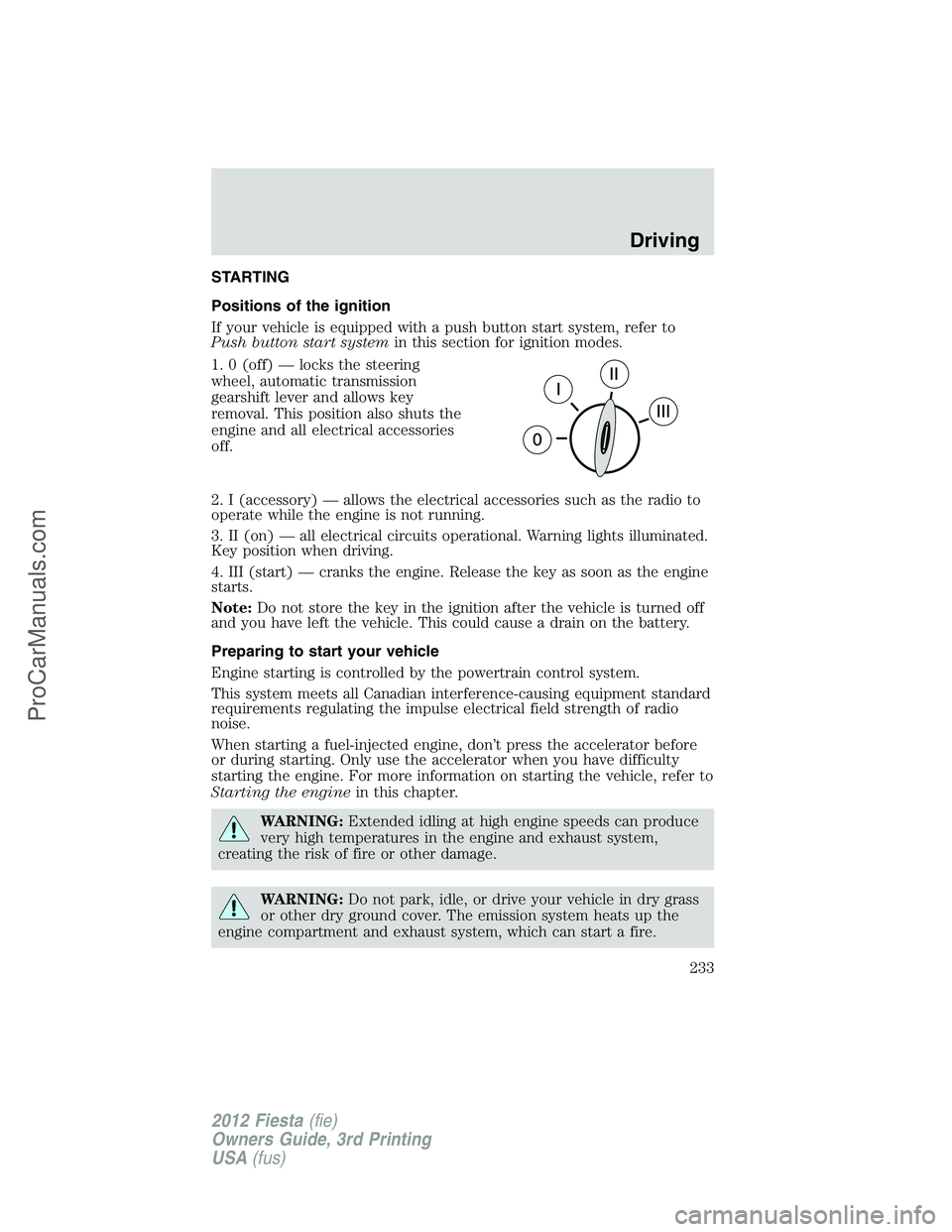
1. 0 (off) — locks the steering
wheel, automatic transmission
gearshift lever and allows key
removal. This position also shuts the
engine and all electrical accessories
off.
2. I (accessory) — allows the electrical accessories such as the radio to
operate while the engine is not running.
3. II (on) — all electrical circuits operational. Warning lights illuminated.
Key position when driving.
4. III (start) — cranks the engine. Release the key as soon as the engine
starts.
Note:Do not store the key in the ignition after the vehicle is turned off
and you have left the vehicle. This could cause a drain on the battery.
Preparing to start your vehicle
Engine starting is controlled by the powertrain control system.
This system meets all Canadian interference-causing equipment standard
requirements regulating the impulse electrical field strength of radio
noise.
When starting a fuel-injected engine, don’t press the accelerator before
or during starting. Only use the accelerator when you have difficulty
starting the engine. For more information on starting the vehicle, refer to
Starting the enginein this chapter.
WARNING:Extended idling at high engine speeds can produce
very high temperatures in the engine and exhaust system,
creating the risk of fire or other damage.
WARNING:Do not park, idle, or drive your vehicle in dry grass
or other dry ground cover. The emission system heats up the
engine compartment and exhaust system, which can start a fire.
Driving
233
2012 Fiesta(fie)
Owners Guide, 3rd Printing
USA(fus)
ProCarManuals.com
Page 234 of 360
WARNING:Do not start your vehicle in a closed garage or in
other enclosed areas. Exhaust fumes can be toxic. Always open
the garage door before you start the engine. SeeGuarding against
exhaust fumesin this chapter for more instructions.
WARNING:If you smell exhaust fumes inside your vehicle, have
your dealer inspect your vehicle immediately. Do not drive if you
smell exhaust fumes.
Important safety precautions
When the engine starts, the idle RPM runs faster to warm the engine. If
the engine idle speed does not slow down automatically, have the vehicle
checked.
Before starting the vehicle:
1. Make sure all occupants buckle their safety belts. For more
information on safety belts and their proper usage, refer to theSeating
and Safety Restraintschapter.
2. Make sure the headlamps and electrical accessories are off.
If starting a vehicle with an automatic transmission:
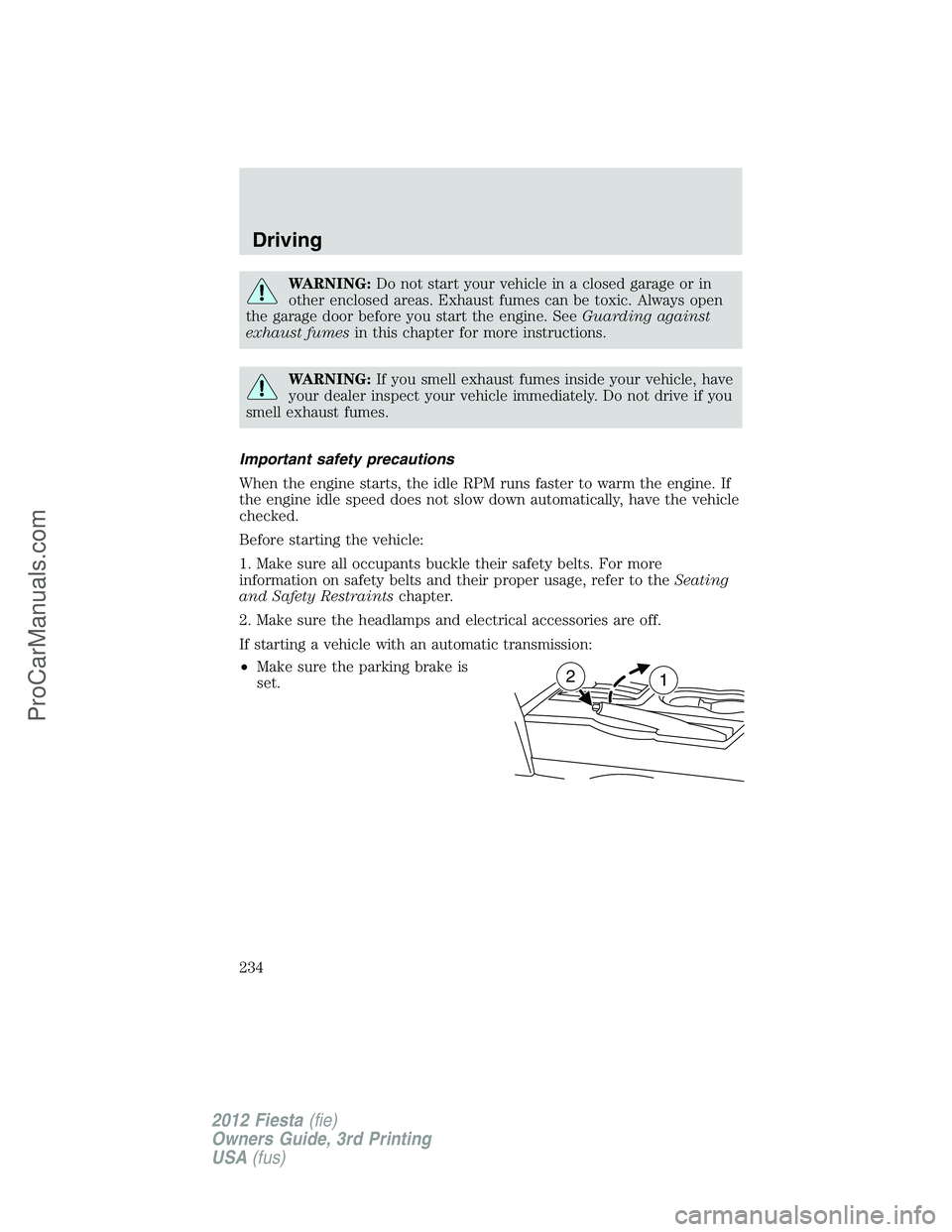
•Make sure the parking brake is
set.
12
Driving
234
2012 Fiesta(fie)
Owners Guide, 3rd Printing
USA(fus)
ProCarManuals.com
Page 235 of 360
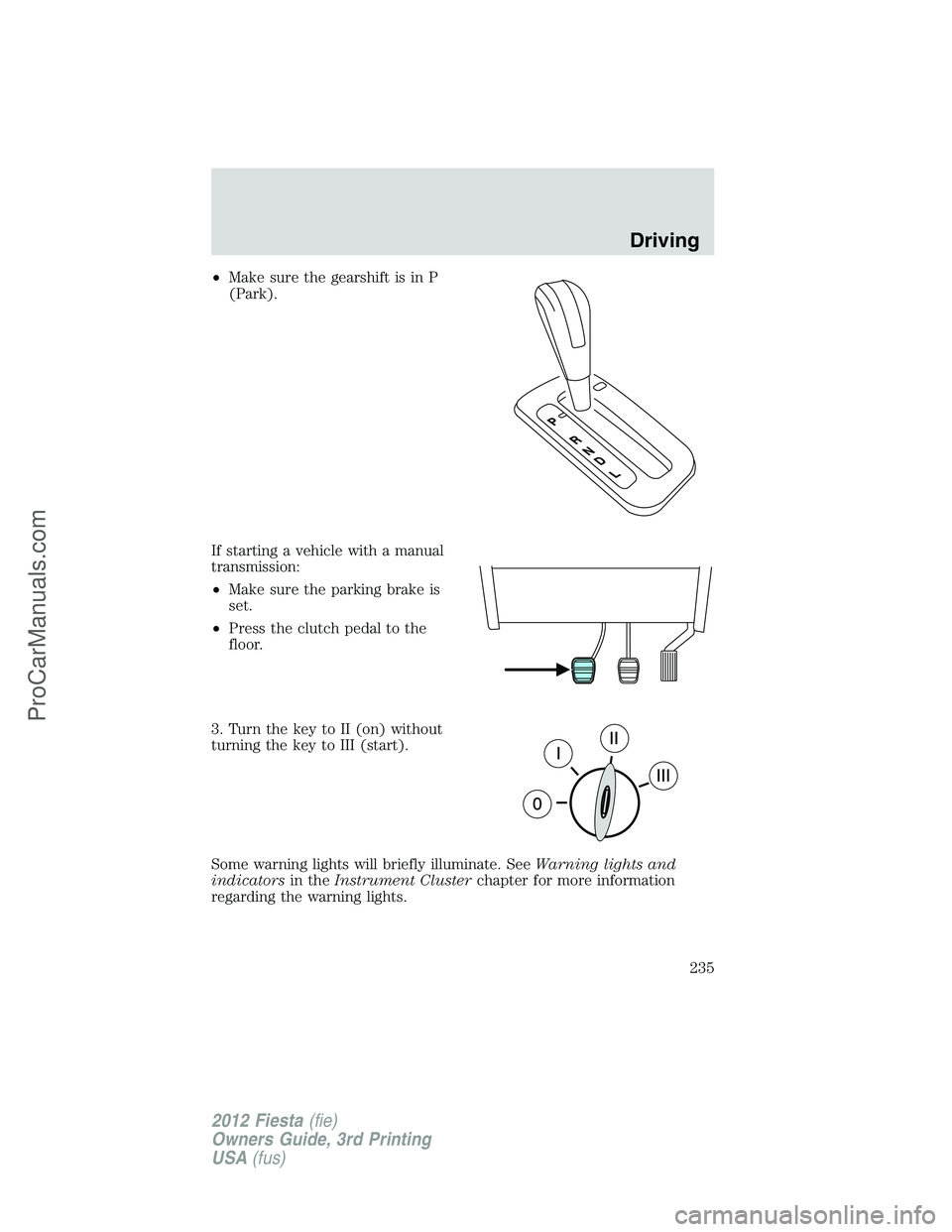
•Make sure the gearshift is in P
(Park).
If starting a vehicle with a manual
transmission:
•Make sure the parking brake is
set.
•Press the clutch pedal to the
floor.
3. Turn the key to II (on) without
turning the key to III (start).
Some warning lights will briefly illuminate. SeeWarning lights and
indicatorsin theInstrument Clusterchapter for more information
regarding the warning lights.
Driving
235
2012 Fiesta(fie)
Owners Guide, 3rd Printing
USA(fus)
ProCarManuals.com
Page 236 of 360
Starting the engine
Note:If your vehicle is equipped with a push button start system, refer
toPush button start systemin this section for starting.
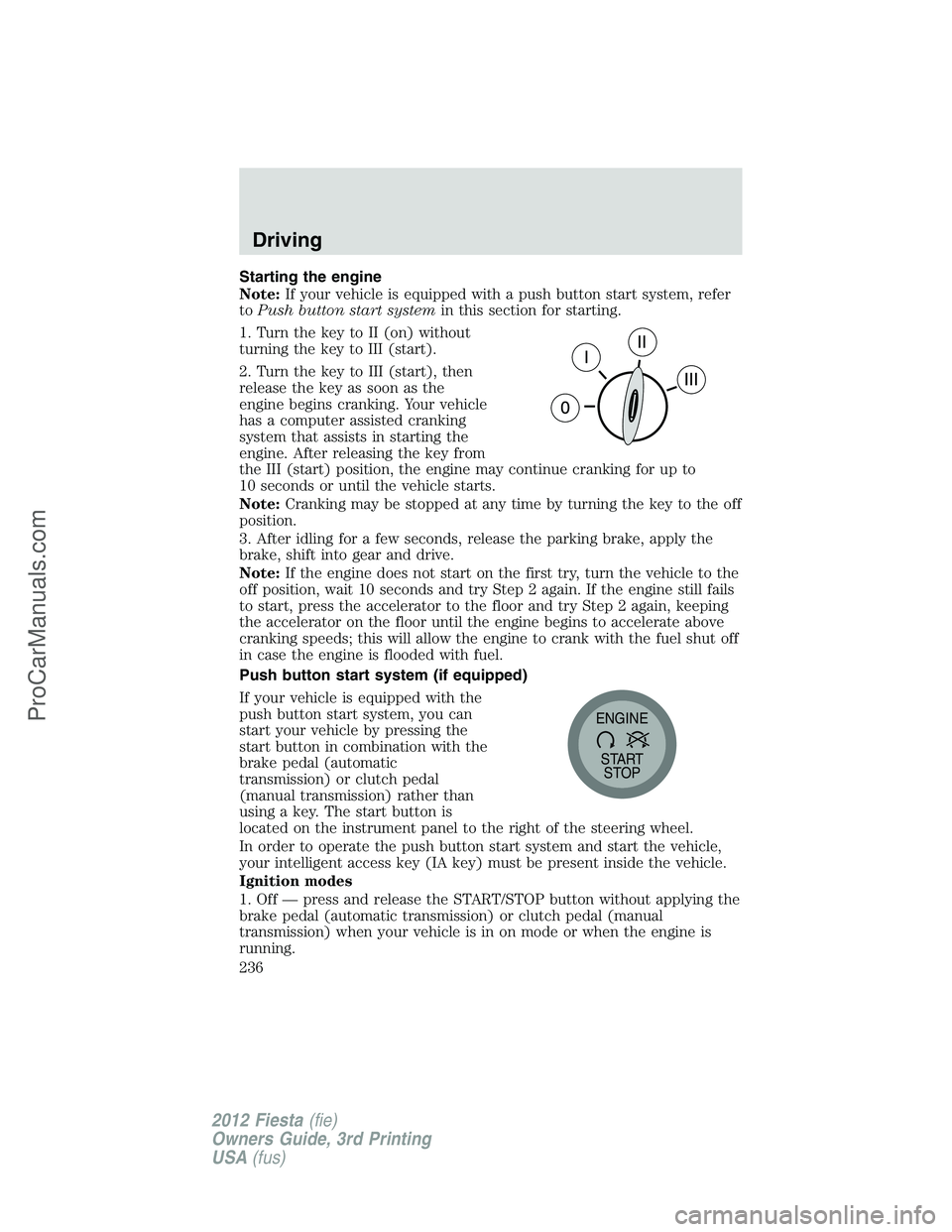
1. Turn the key to II (on) without
turning the key to III (start).
2. Turn the key to III (start), then
release the key as soon as the
engine begins cranking. Your vehicle
has a computer assisted cranking
system that assists in starting the
engine. After releasing the key from
the III (start) position, the engine may continue cranking for up to
10 seconds or until the vehicle starts.
Note:Cranking may be stopped at any time by turning the key to the off
position.
3. After idling for a few seconds, release the parking brake, apply the
brake, shift into gear and drive.
Note:If the engine does not start on the first try, turn the vehicle to the
off position, wait 10 seconds and try Step 2 again. If the engine still fails
to start, press the accelerator to the floor and try Step 2 again, keeping
the accelerator on the floor until the engine begins to accelerate above
cranking speeds; this will allow the engine to crank with the fuel shut off
in case the engine is flooded with fuel.
Push button start system (if equipped)
If your vehicle is equipped with the
push button start system, you can
start your vehicle by pressing the
start button in combination with the
brake pedal (automatic
transmission) or clutch pedal
(manual transmission) rather than
using a key. The start button is
located on the instrument panel to the right of the steering wheel.
In order to operate the push button start system and start the vehicle,
your intelligent access key (IA key) must be present inside the vehicle.
Ignition modes
1. Off — press and release the START/STOP button without applying the
brake pedal (automatic transmission) or clutch pedal (manual
transmission) when your vehicle is in on mode or when the engine is
running.
START
STOP ENGINE
Driving
236
2012 Fiesta(fie)
Owners Guide, 3rd Printing
USA(fus)
ProCarManuals.com
Page 237 of 360
2. On — press the START/STOP button without applying the brake pedal
(automatic transmission) or clutch pedal (manual transmission). This will
power your vehicle’s electrical system and the warning lights in the
instrument cluster will illuminate, but the engine will remain off.
3. Start — press the START/STOP button (for any length of time) while
applying the brake pedal (automatic transmission) or clutch pedal
(manual transmission).Note:The indicator light on the start button will
illuminate when the vehicle is in on mode and when the engine is
started.
There may be areas inside your vehicle where the IA key is not detected.
If the message KEY NOT DETECTED appears on your multifunction
display when you press the START/STOP button, it may be necessary to
move your IA key to another area within the vehicle. The IA key may not
be detected near the roof (between the driver or passenger sunvisor and
the roof, or in the overhead console area) or in the extreme corners of
the rear package tray, near your audio speakers. It is not recommended
that you stow the IA key in these locations. If you move the IA key to a
location where it has been detected before and you still see the KEY
NOT DETECTED message, your IA key’s battery may be low or you may
be in an area with excessive radio frequency interference. If this occurs,
you can use the backup method to start your vehicle (see below).
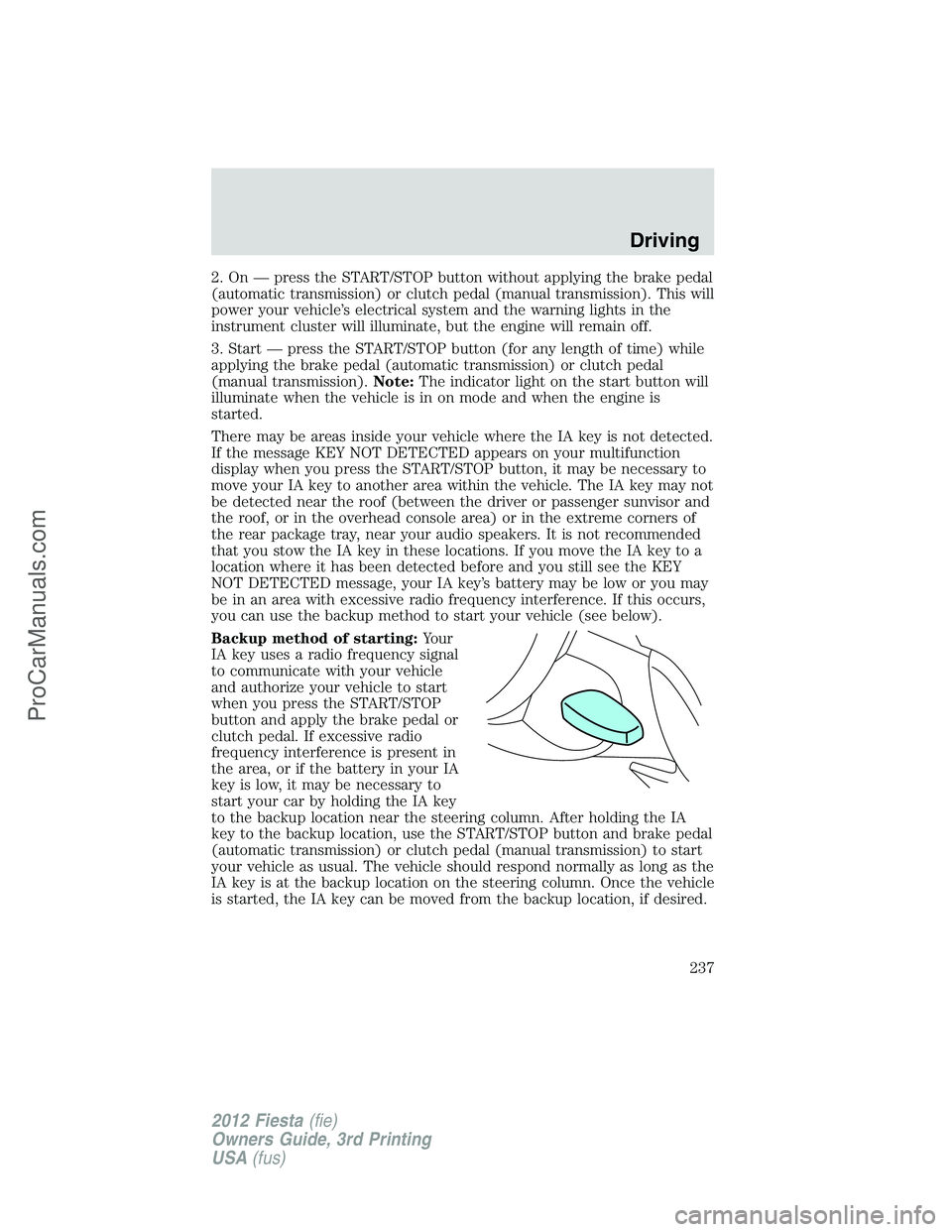
Backup method of starting:Your
IA key uses a radio frequency signal
to communicate with your vehicle
and authorize your vehicle to start
when you press the START/STOP
button and apply the brake pedal or
clutch pedal. If excessive radio
frequency interference is present in
the area, or if the battery in your IA
key is low, it may be necessary to
start your car by holding the IA key
to the backup location near the steering column. After holding the IA
key to the backup location, use the START/STOP button and brake pedal
(automatic transmission) or clutch pedal (manual transmission) to start
your vehicle as usual. The vehicle should respond normally as long as the
IA key is at the backup location on the steering column. Once the vehicle
is started, the IA key can be moved from the backup location, if desired.
Driving
237
2012 Fiesta(fie)
Owners Guide, 3rd Printing
USA(fus)
ProCarManuals.com
Page 242 of 360
Brake over accelerator
This vehicle is equipped with a brake over accelerator feature. In the
event the accelerator pedal becomes stuck or entrapped, applying steady
and firm pressure to the brake pedal will both slow the vehicle and
reduce engine power. If you experience this condition, apply the brakes
and bring your vehicle to a safe stop. Turn the engine off, shift to P
(Park) and apply the parking brake, and then inspect the accelerator
pedal for any interferences. If none are found and the condition persists,
have your vehicle towed to the nearest authorized dealer.
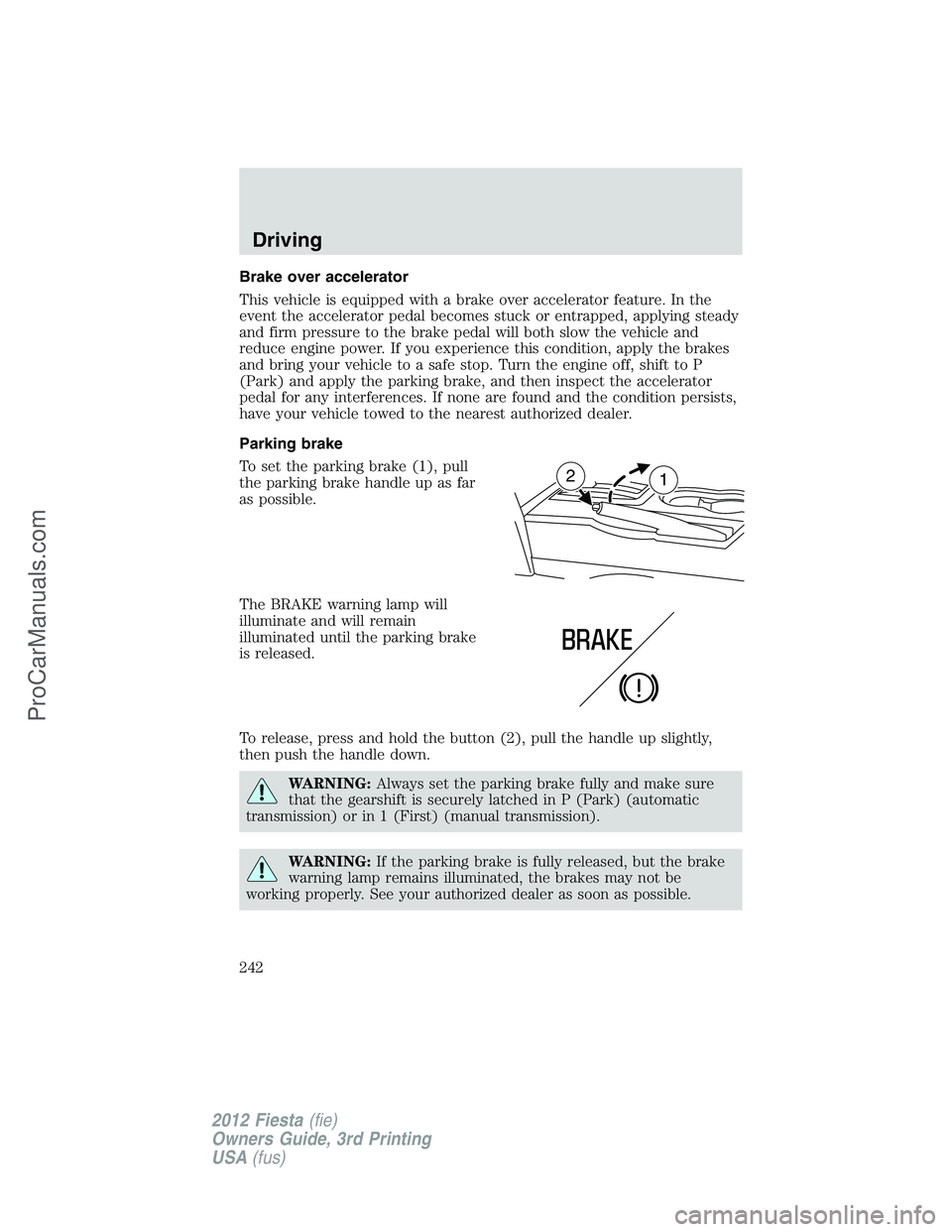
Parking brake
To set the parking brake (1), pull
the parking brake handle up as far
as possible.
The BRAKE warning lamp will
illuminate and will remain
illuminated until the parking brake
is released.
To release, press and hold the button (2), pull the handle up slightly,
then push the handle down.
WARNING:Always set the parking brake fully and make sure
that the gearshift is securely latched in P (Park) (automatic
transmission) or in 1 (First) (manual transmission).
WARNING:If the parking brake is fully released, but the brake
warning lamp remains illuminated, the brakes may not be
working properly. See your authorized dealer as soon as possible.
12
Driving
242
2012 Fiesta(fie)
Owners Guide, 3rd Printing
USA(fus)
ProCarManuals.com
Page 249 of 360
WARNING:If the parking brake is fully released, but the brake
warning lamp remains illuminated, the brakes may not be
working properly. See your authorized dealer.
AUTOMATIC TRANSMISSION (IF EQUIPPED)
Understanding the gearshift positions of the 6–speed automatic
transmission (if equipped)
WARNING:Do not apply the brake pedal and accelerator pedal
simultaneously. Applying both pedals simultaneously for more
than three seconds will limit engine rpm, which may result in difficulty
maintaining speed in traffic and could lead to serious injury.
WARNING:Always set the parking brake fully and make sure
the gearshift is latched in P (Park). Turn the ignition to the off
position and remove the key whenever you leave your vehicle.
Note:The automatic transmission performs a series of automated checks
when the ignition is turned to the off position. A slight clicking sound
may be heard and is considered a normal part of operation.
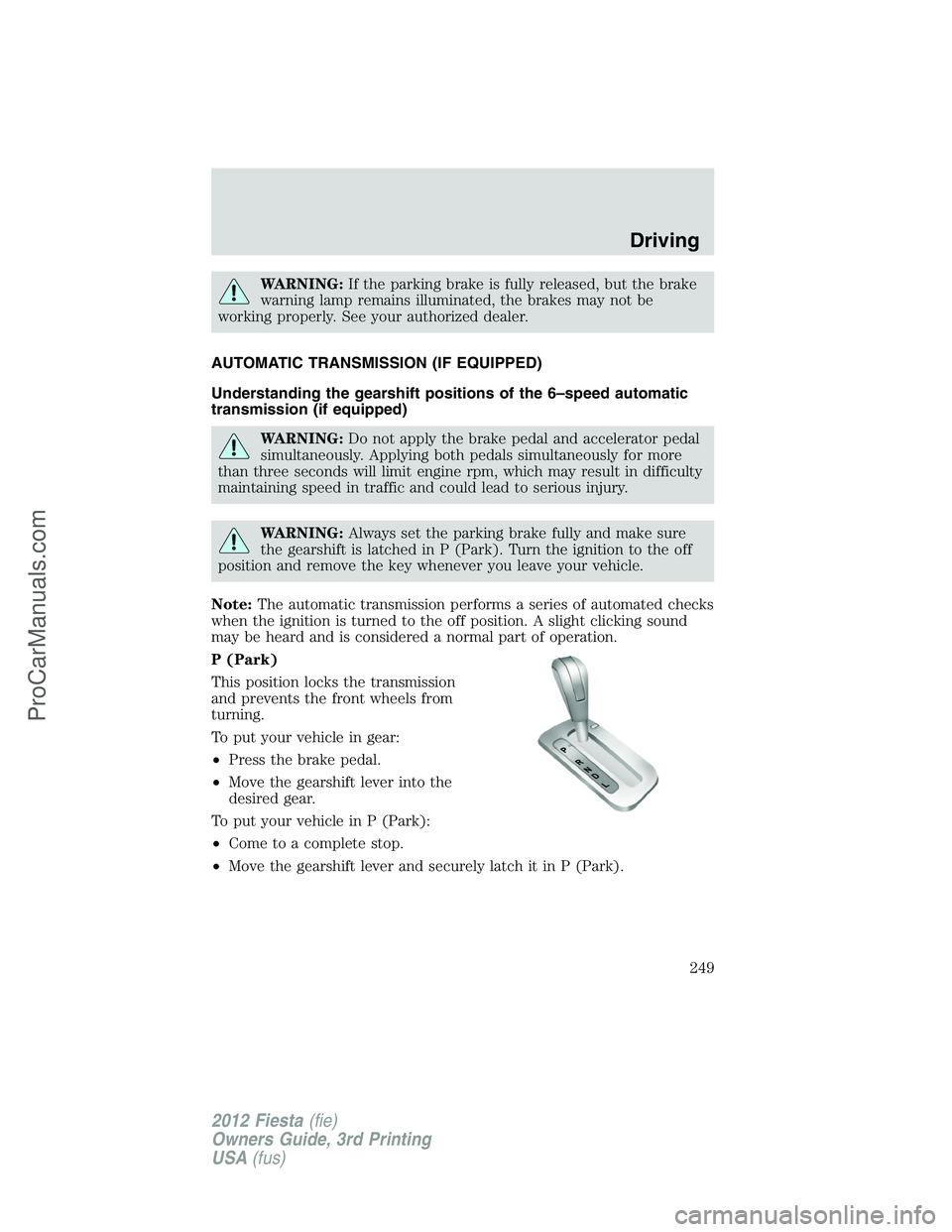
P (Park)
This position locks the transmission
and prevents the front wheels from
turning.
To put your vehicle in gear:
•Press the brake pedal.
•Move the gearshift lever into the
desired gear.
To put your vehicle in P (Park):
•Come to a complete stop.
•Move the gearshift lever and securely latch it in P (Park).
Driving
249
2012 Fiesta(fie)
Owners Guide, 3rd Printing
USA(fus)
ProCarManuals.com