battery FORD FIESTA 2013 6.G User Guide
[x] Cancel search | Manufacturer: FORD, Model Year: 2013, Model line: FIESTA, Model: FORD FIESTA 2013 6.GPages: 341, PDF Size: 4.13 MB
Page 96 of 341
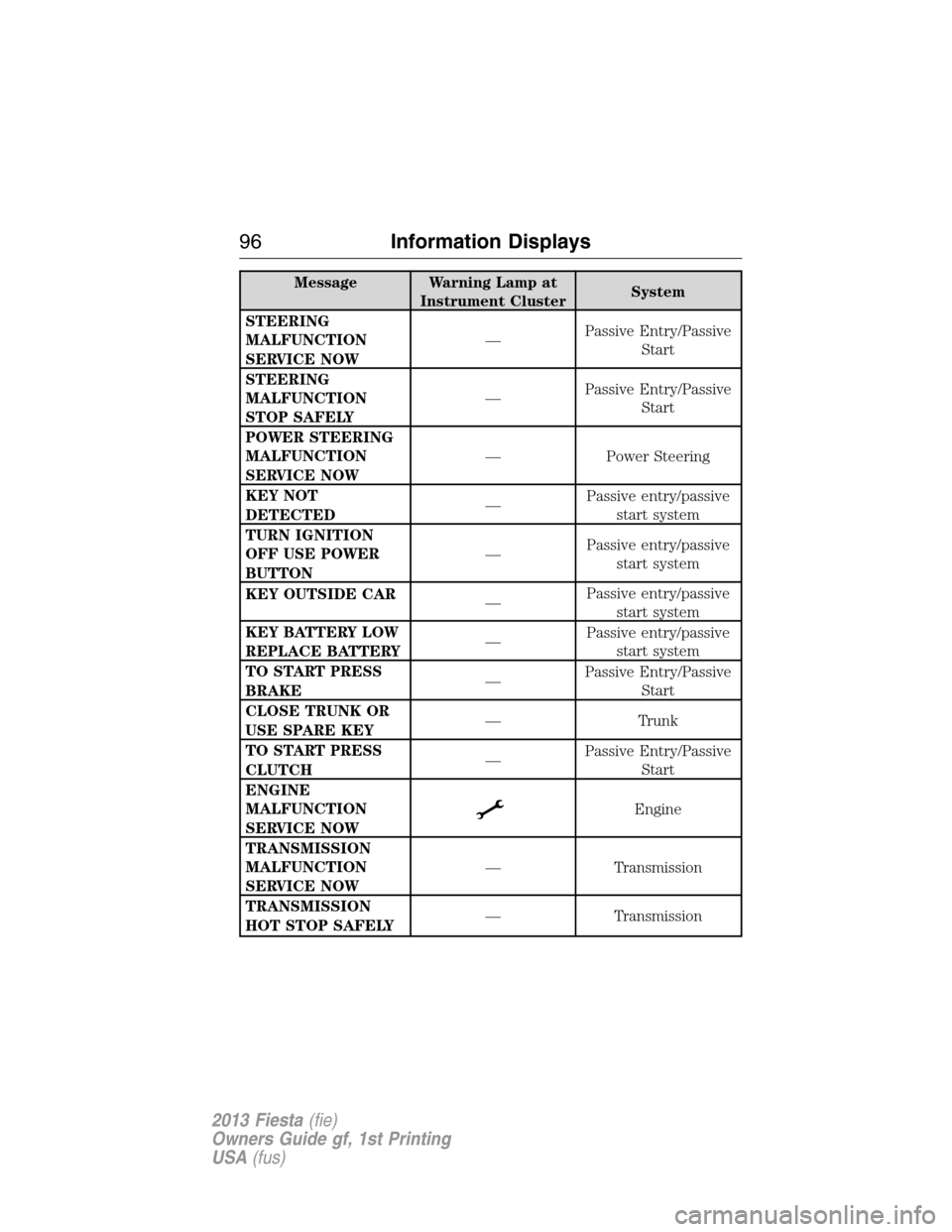
Message Warning Lamp at
Instrument ClusterSystem
STEERING
MALFUNCTION
SERVICE NOW—Passive Entry/Passive
Start
STEERING
MALFUNCTION
STOP SAFELY—Passive Entry/Passive
Start
POWER STEERING
MALFUNCTION
SERVICE NOW— Power Steering
KEY NOT
DETECTED—Passive entry/passive
start system
TURN IGNITION
OFF USE POWER
BUTTON—Passive entry/passive
start system
KEY OUTSIDE CAR
—Passive entry/passive
start system
KEY BATTERY LOW
REPLACE BATTERY—Passive entry/passive
start system
TO START PRESS
BRAKE—Passive Entry/Passive
Start
CLOSE TRUNK OR
USE SPARE KEY— Trunk
TO START PRESS
CLUTCH—Passive Entry/Passive
Start
ENGINE
MALFUNCTION
SERVICE NOW
Engine
TRANSMISSION
MALFUNCTION
SERVICE NOW— Transmission
TRANSMISSION
HOT STOP SAFELY— Transmission
96Information Displays
2013 Fiesta(fie)
Owners Guide gf, 1st Printing
USA(fus)
Page 126 of 341
AUXILIARY POWER POINTS
WARNING:Do not plug optional electrical accessories into the
cigarette lighter socket (if equipped). Improper use of the lighter
can cause damage not covered by your warranty, and can result in fire
or serious injury.
Note:Do not insert objects other than an accessory plug into the power
point. This will damage the outlet and blow the fuse.
Note:Do not hang any type of accessory or accessory bracket from the
plug.
Note:Do not use the power point over the vehicle capacity of 12 volts
DC 180 watts or a fuse may blow.
Note:Do not use the power point for operating a cigarette lighter
element.
Note:Improper use of the power point can cause damage not covered
by your warranty.
Note:Always keep the power point caps closed when not in use.
Run the engine for full capacity use of the power point. To prevent the
battery from being discharged:
•Do not use the power point longer than necessary when the engine is
not running.
•Do not leave devices plugged in overnight or when the vehicle is
parked for extended periods.
Locations
Power points may be found:
•on the instrument panel
•on the rear of the center console
•inside the center console storage bin.
126Auxiliary Power Points
2013 Fiesta(fie)
Owners Guide gf, 1st Printing
USA(fus)
Page 128 of 341
GENERAL INFORMATION
WARNING:Extended idling at high engine speeds can produce
very high temperatures in the engine and exhaust system,
creating the risk of fire or other damage.
WARNING:Do not park, idle, or drive your vehicle on dry grass
or other dry ground cover. The emission system heats up the
engine compartment and exhaust system, which can start a fire.
WARNING:Do not start your vehicle in a closed garage or in
other enclosed areas. Exhaust fumes can be toxic. Always open
the garage door before you start the engine.
WARNING:If you smell exhaust fumes inside your vehicle, have
your vehicle checked by an authorized dealer immediately. Do
not drive if you smell exhaust fumes.
If you disconnect the battery, your vehicle may exhibit some unusual
driving characteristics for approximately 5 miles (8 kilometers) after you
connect it. This is because the engine management system must realign
itself with the engine. You may disregard any unusual driving
characteristics during this period.
This system meets all Canadian interference-causing equipment standard
requirements regulating the impulse electrical field strength of radio
noise.
When starting your vehicle, avoid pressing the accelerator pedal before
and during operation. Only use the accelerator pedal when you have
difficulty starting the engine.
128Starting and Stopping the Engine
2013 Fiesta(fie)
Owners Guide gf, 1st Printing
USA(fus)
Page 129 of 341
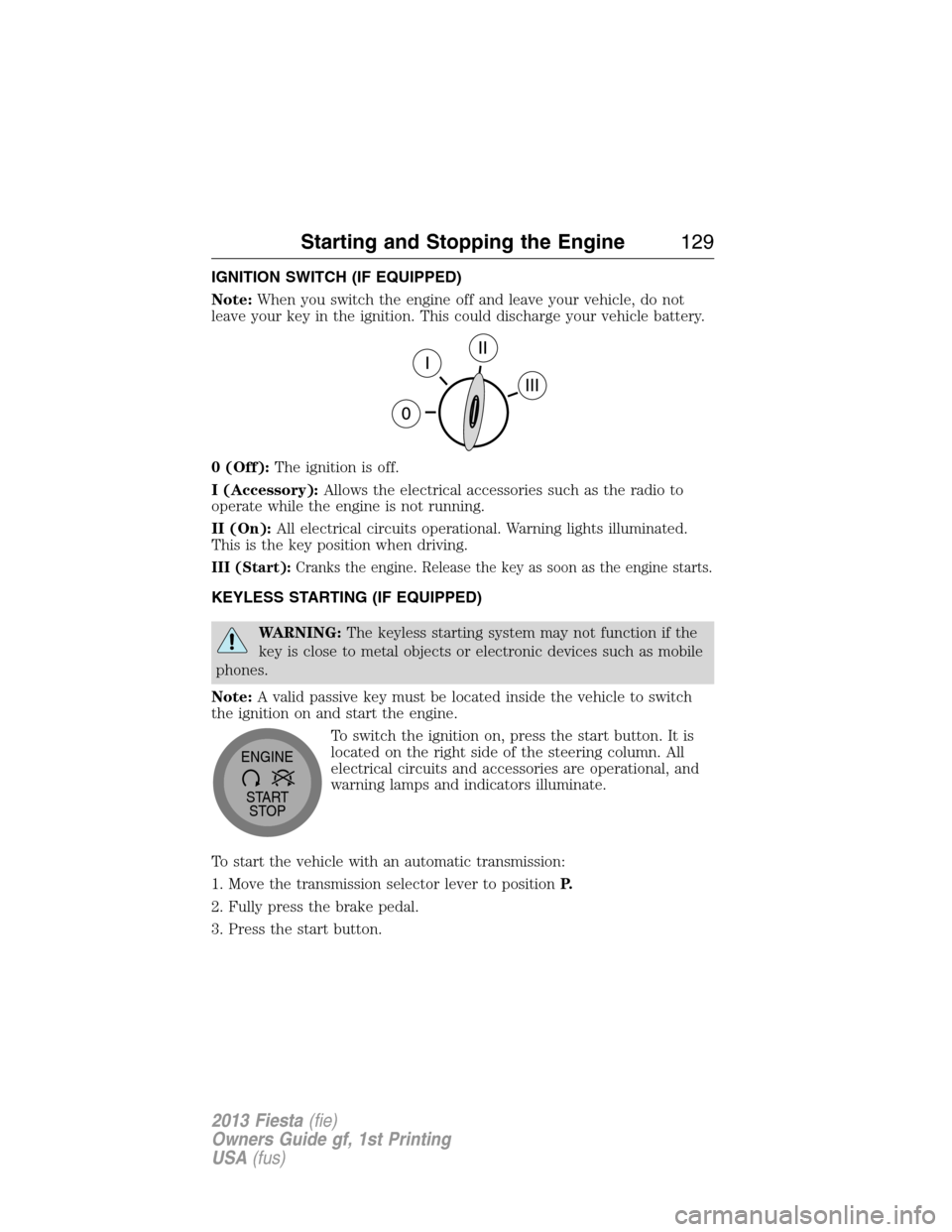
IGNITION SWITCH (IF EQUIPPED)
Note:When you switch the engine off and leave your vehicle, do not
leave your key in the ignition. This could discharge your vehicle battery.
0 (Off):The ignition is off.
I (Accessory):Allows the electrical accessories such as the radio to
operate while the engine is not running.
II (On):All electrical circuits operational. Warning lights illuminated.
This is the key position when driving.
III (Start):Cranks the engine. Release the key as soon as the engine starts.
KEYLESS STARTING (IF EQUIPPED)
WARNING:The keyless starting system may not function if the
key is close to metal objects or electronic devices such as mobile
phones.
Note:A valid passive key must be located inside the vehicle to switch
the ignition on and start the engine.
To switch the ignition on, press the start button. It is
located on the right side of the steering column. All
electrical circuits and accessories are operational, and
warning lamps and indicators illuminate.
To start the vehicle with an automatic transmission:
1. Move the transmission selector lever to positionP.
2. Fully press the brake pedal.
3. Press the start button.
START
STOP ENGINE
Starting and Stopping the Engine129
2013 Fiesta(fie)
Owners Guide gf, 1st Printing
USA(fus)
Page 130 of 341
To start the vehicle with a manual transmission:
1. Move the transmission selector lever to the neutral position.
2. Fully press the clutch pedal.
3. Press the start button.
The system does not function if:
•the key frequencies are jammed.
•the key battery has no charge.
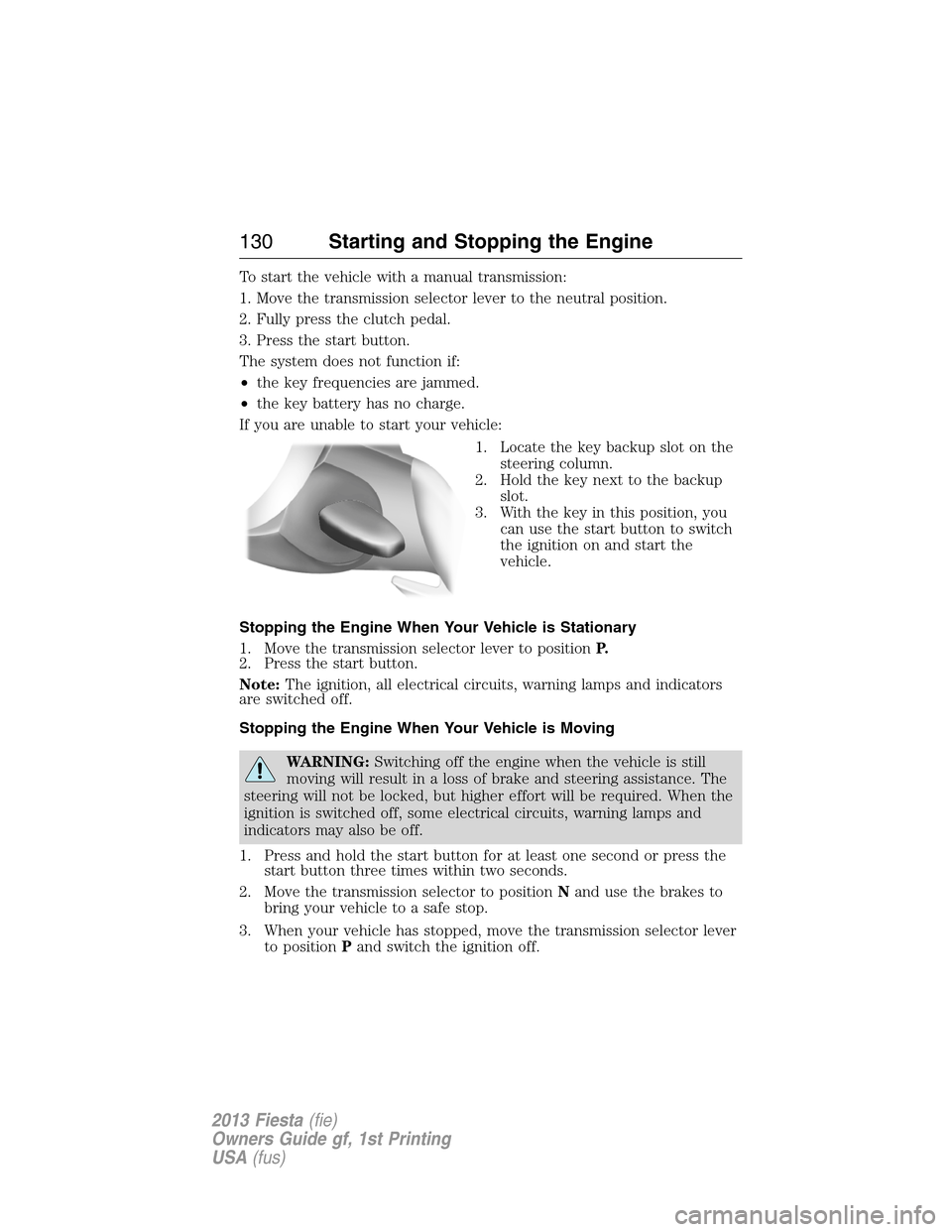
If you are unable to start your vehicle:
1. Locate the key backup slot on the
steering column.
2. Hold the key next to the backup
slot.
3. With the key in this position, you
can use the start button to switch
the ignition on and start the
vehicle.
Stopping the Engine When Your Vehicle is Stationary
1. Move the transmission selector lever to positionP.
2. Press the start button.
Note:The ignition, all electrical circuits, warning lamps and indicators
are switched off.
Stopping the Engine When Your Vehicle is Moving
WARNING:Switching off the engine when the vehicle is still
moving will result in a loss of brake and steering assistance. The
steering will not be locked, but higher effort will be required. When the
ignition is switched off, some electrical circuits, warning lamps and
indicators may also be off.
1. Press and hold the start button for at least one second or press the
start button three times within two seconds.
2. Move the transmission selector to positionNand use the brakes to
bring your vehicle to a safe stop.
3. When your vehicle has stopped, move the transmission selector lever
to positionPand switch the ignition off.
130Starting and Stopping the Engine
2013 Fiesta(fie)
Owners Guide gf, 1st Printing
USA(fus)
Page 142 of 341
Readiness for Inspection/Maintenance (I/M) Testing
Some state/provincial and local governments may have
Inspection/Maintenance (I/M) programs to inspect the emission control
equipment on your vehicle. Failure to pass this inspection could prevent
you from getting a vehicle registration.
If the service engine soon indicator is on or the bulb does not
work, the vehicle may need to be serviced. Refer toOn-board
diagnostics (OBD-II)in this chapter.
Your vehicle may not pass the I/M test if the service engine soon
indicator is on or not working properly (bulb is burned out), or if the
OBD-II system has determined that some of the emission control systems
have not been properly checked. In this case, the vehicle is considered
not ready for I/M testing.
If the vehicle’s engine or transmission has just been serviced, or the
battery has recently run down or been replaced, the OBD-II system may
indicate that the vehicle is not ready for I/M testing. To determine if the
vehicle is ready for I/M testing, turn the ignition key to the on position
for 15 seconds without cranking the engine. If the service engine soon
indicator blinks eight times, it means that the vehicle is not ready for I/M
testing; if the service engine soon indicator stays on solid, it means that
the vehicle is ready for I/M testing.
The OBD-II system is designed to check the emission control system
during normal driving. A complete check may take several days. If the
vehicle is not ready for I/M testing, the following driving cycle consisting
of mixed city and highway driving may be performed:
15 minutes of steady driving on an expressway/highway followed by
20 minutes of stop-and-go driving with at least four 30-second idle
periods.
Allow the vehicle to sit for at least eight hours without starting the
engine. Then, start the engine and complete the above driving cycle. The
engine must warm up to its normal operating temperature. Once started,
do not turn off the engine until the above driving cycle is complete. If
the vehicle is still not ready for I/M testing, the above driving cycle will
have to be repeated.
142Fuel and Refueling
2013 Fiesta(fie)
Owners Guide gf, 1st Printing
USA(fus)
Page 169 of 341
Vehicles with an Automatic Transmission but No Push Button Start
System
Note:Theremustbe battery power to properly move the transmission’s
internal components to N (Neutral) in Step 3. Also, moving the gearshift
to the N (Neutral) position without first turning the ignition to the on
(II) position limits the towing capability to 35 mph (56 km/h) and
50 miles (80 kilometers).
1. Release the parking brake.
2. Turn the ignition to the on (II) position.
3. Press the brake pedal, then move the gearshift to the N (Neutral)
position.
4. Wait for TRANSMISSION READY to appear in the multi-function
display, then turn the ignition to the off (0) position and release the
brake pedal.
5. Disconnect the negative (black) cable from the battery. (The
anti-theft system is disabled until the battery cable is reconnected.)
Refer toBatteryin theMaintenancechapter when disconnecting
and reconnecting the battery cable.
•The maximum towing speed is 70 mph (113 km/h).
•There is no limitation on towing distance.
When done towing, start the engine within 15 minutes of reconnecting
the battery cable. When reconnecting that cable, tighten it until it’s snug
against the terminal; be careful not to overtighten.
Vehicles with an Automatic Transmission and Push Button Start
System
Note:Theremustbe battery power to properly move the transmission’s
internal components to N (Neutral) in Step 3. Also, moving the gearshift
to the N (Neutral) position without first turning the ignition to the on
(II) position limits the towing capability to 35 mph (56 km/h) and
50 miles (80 kilometers).
1. Release the parking brake.
2. Activate the ignition by pressing the START/STOP button, butnot
applying the brake pedal.
3. Press the brake pedal, then move the gearshift to the N (Neutral)
position. Release the brake pedal.
4. Wait for TRANSMISSION READY to appear in the multi-function
display, then deactivate the ignition by pressing the START/STOP
button.
Towing169
2013 Fiesta(fie)
Owners Guide gf, 1st Printing
USA(fus)
Page 170 of 341
![FORD FIESTA 2013 6.G User Guide 5. Disconnect the negative (black) cable from the battery. (The door
key [inside the Intelligent Access Key] is needed to lock/unlock doors
when the battery cable is disconnected. Also, the anti-theft](/img/11/5087/w960_5087-169.png "FORD FIESTA 2013 6.G User Guide 5. Disconnect the negative (black) cable from the battery. (The door
key [inside the Intelligent Access Key] is needed to lock/unlock doors
when the battery cable is disconnected. Also, the anti-theft")
5. Disconnect the negative (black) cable from the battery. (The door
key [inside the Intelligent Access Key] is needed to lock/unlock doors
when the battery cable is disconnected. Also, the anti-theft system is
disabled until the battery cable is reconnected.) Refer toBatteryin
theMaintenance and Specificationschapter when disconnecting
and reconnecting the battery cable.
•The maximum towing speed is 70 mph (113 km/h).
•There is no limitation on towing distance.
When done towing, start the engine within 15 minutes of reconnecting
the battery cable. When reconnecting that cable, tighten it until it’s snug
against the terminal; be careful not to overtighten.
170Towing
2013 Fiesta(fie)
Owners Guide gf, 1st Printing
USA(fus)
Page 175 of 341
ROADSIDE ASSISTANCE
Vehicles sold in the U.S. : Getting roadside assistance
To fully assist you should you have a vehicle concern, Ford Motor Company
offers a complimentary roadside assistance program. This program is
separate from the New Vehicle Limited Warranty. The service is available:
•24-hours, seven days a week
•for the coverage period listed on the Roadside Assistance Card
included in your Owner manual portfolio.
Roadside assistance will cover:
•a flat tire change with a good spare (except vehicles that have been
supplied with a tire inflation kit).
•battery jump start.
•lock-out assistance (key replacement cost is the customer’s
responsibility).
•fuel delivery – Independent Service Contractors, if not prohibited by
state, local or municipal law shall deliver up to 2.0 gallons (7.5L) of
gasoline or 5.0 gallons (18.9L) of diesel fuel to a disabled vehicle. Fuel
delivery service is limited to two no-charge occurrences within a
12-month period.
•winch out – available within 100 feet (30.5 meters) of a paved or
county maintained road, no recoveries.
•towing – Ford and Lincoln eligible vehicles towed to an authorized
dealer within 35 miles (56 km) of the disablement location or to the
nearest authorized dealer. If a member requests to be towed to an
authorized dealer more than 35 miles (56 km) from the disablement
location, the member shall be responsible for any mileage costs in
excess of 35 miles (56 km).
Trailers shall be covered up to $200 if the disabled eligible vehicle
requires service at the nearest authorized dealer. If the trailer is disabled,
but the towing vehicle is operational, the trailer does not qualify for any
roadside services.
Vehicles sold in the U.S. : Using roadside assistance
Complete the roadside assistance identification card and place it in your
wallet for quick reference. This card is found in the owner’s information
portfolio in the glove compartment.
U.S. Ford vehicle customers who require Roadside Assistance, call
1-800-241-3673.
Roadside Emergencies175
2013 Fiesta(fie)
Owners Guide gf, 1st Printing
USA(fus)
Page 176 of 341
If you need to arrange roadside assistance for yourself, Ford Motor
Company will reimburse a reasonable amount for towing to the nearest
dealership within 35 miles (56 km). To obtain reimbursement
information, U.S. Ford vehicle customers call 1-800-241-3673. Customers
will be asked to submit their original receipts.
Vehicles sold in Canada : Getting roadside assistance
Canadian customers who require roadside assistance, call 1–800–665–2006.
Vehicles sold in Canada : Using roadside assistance
Complete the roadside assistance identification card and place it in your
wallet for quick reference. In Canada, the card is found in the Warranty
Guide in the glove box.
Canadian Roadside coverage and benefits may differ from the U.S.
coverage. Please refer to your Warranty Guide or visit our website at
www.ford.ca for information on Canadian services and benefits.
Canadian customers who need to obtain roadside information, call
1-800-665-2006 or visit our website at www.ford.ca.
HAZARD WARNING FLASHERS
The hazard flasher control is located on the instrument panel
by the radio. Use it when your vehicle is disabled and is
creating a safety hazard for other motorists.
•Press the flasher control and all front and rear direction signals will
flash.
•Press the flasher control again to turn them off.
Note:With extended use, the flashers may run down your 12 volt battery.
FUEL CUT-OFF SWITCH
WARNING:Failure to inspect and if necessary repair fuel leaks
after a collision may increase the risk of fire and serious injury.
Ford Motor Company recommends that the fuel system be inspected by
an authorized dealer after any collision.
In the event of a moderate to severe collision, this vehicle is equipped
with a fuel pump shut-off feature that stops the flow of fuel to the
engine. Not every impact will cause a shut-off.
176Roadside Emergencies
2013 Fiesta(fie)
Owners Guide gf, 1st Printing
USA(fus)