engine FORD FIESTA 2013 Repair Manual
[x] Cancel search | Manufacturer: FORD, Model Year: 2013, Model line: FIESTA, Model: FORD FIESTA 2013Pages: 346, PDF Size: 5.27 MB
Page 193 of 346
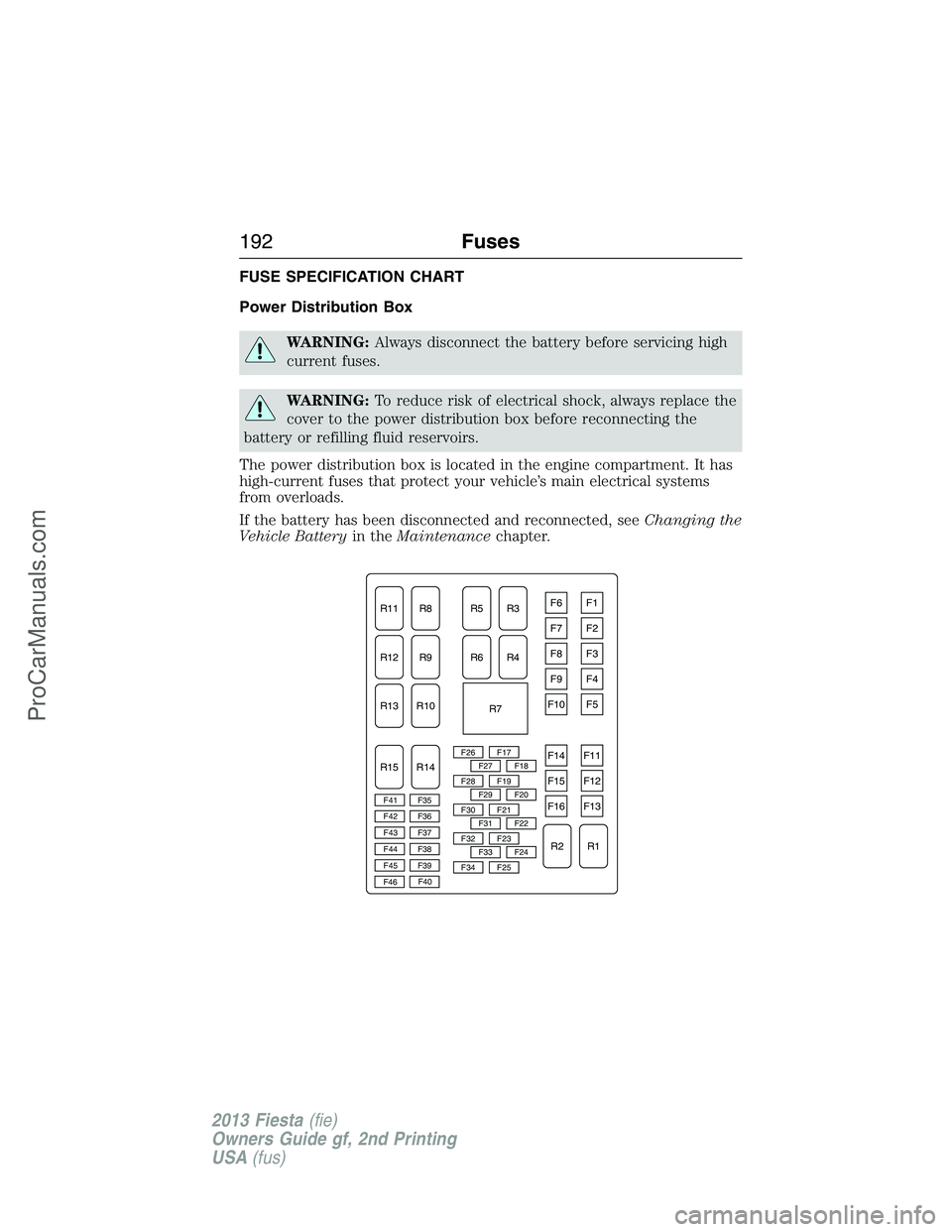
FUSE SPECIFICATION CHART
Power Distribution Box
WARNING:Always disconnect the battery before servicing high
current fuses.
WARNING:To reduce risk of electrical shock, always replace the
cover to the power distribution box before reconnecting the
battery or refilling fluid reservoirs.
The power distribution box is located in the engine compartment. It has
high-current fuses that protect your vehicle’s main electrical systems
from overloads.
If the battery has been disconnected and reconnected, seeChanging the
Vehicle Batteryin theMaintenancechapter.
R11R8
R12R9
R5R3
R6R4
R13R10
R2R1
R15R14
R7
F41F35
F26F17F27F18F28F19F29F20F30F21F31F22F32F23F33F24F34F25
F42F36
F43F37
F44F38
F45F39
F40
F6F1
F7F2
F8F3
F9F4
F10F5
F14F11
F15F12
F16F13
F46
192Fuses
2013 Fiesta(fie)
Owners Guide gf, 2nd Printing
USA(fus)
ProCarManuals.com
Page 194 of 346
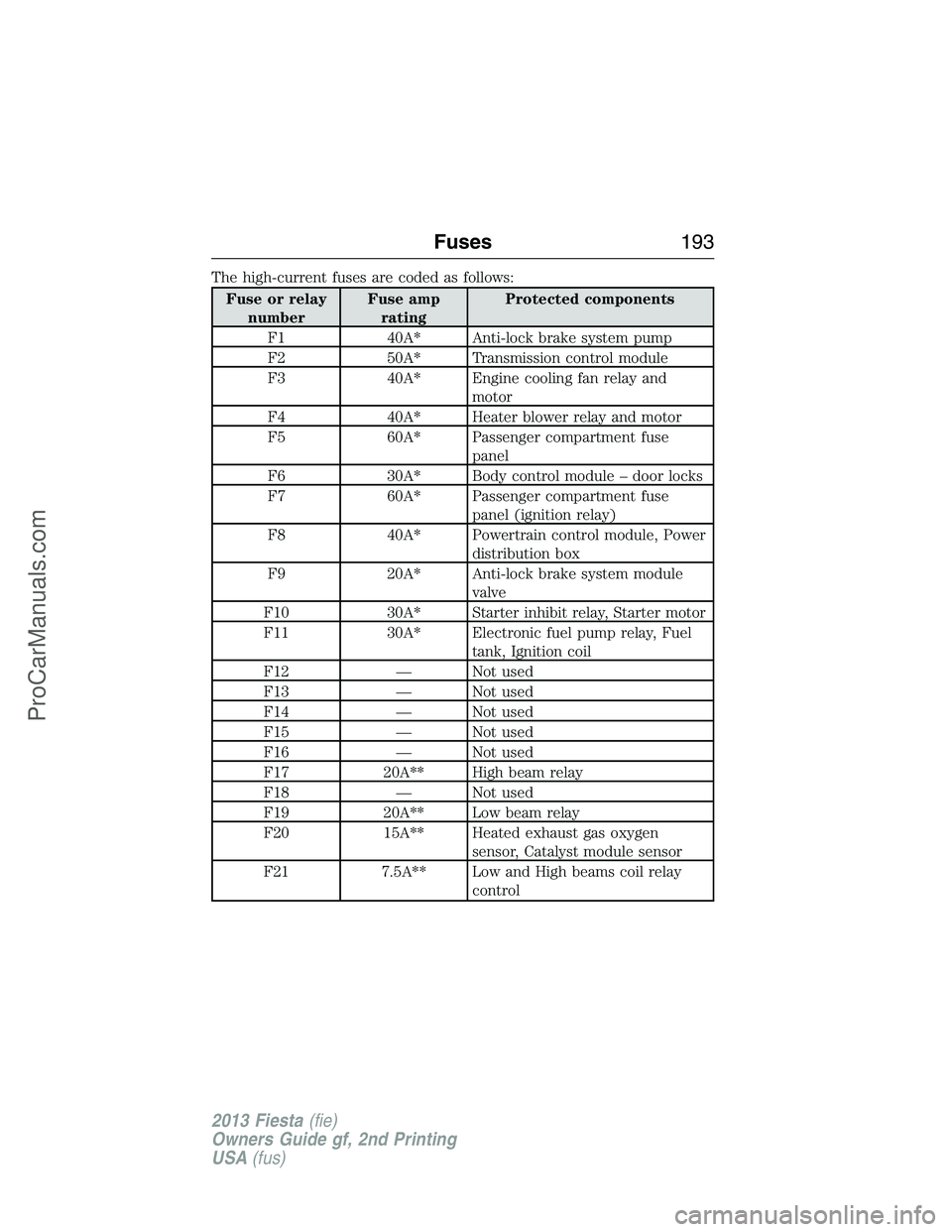
The high-current fuses are coded as follows:
Fuse or relay
numberFuse amp
ratingProtected components
F1 40A* Anti-lock brake system pump
F2 50A* Transmission control module
F3 40A* Engine cooling fan relay and
motor
F4 40A* Heater blower relay and motor
F5 60A* Passenger compartment fuse
panel
F6 30A* Body control module – door locks
F7 60A* Passenger compartment fuse
panel (ignition relay)
F8 40A* Powertrain control module, Power
distribution box
F9 20A* Anti-lock brake system module
valve
F10 30A* Starter inhibit relay, Starter motor
F11 30A* Electronic fuel pump relay, Fuel
tank, Ignition coil
F12 — Not used
F13 — Not used
F14 — Not used
F15 — Not used
F16 — Not used
F17 20A** High beam relay
F18 — Not used
F19 20A** Low beam relay
F20 15A** Heated exhaust gas oxygen
sensor, Catalyst module sensor
F21 7.5A** Low and High beams coil relay
control
Fuses193
2013 Fiesta(fie)
Owners Guide gf, 2nd Printing
USA(fus)
ProCarManuals.com
Page 196 of 346
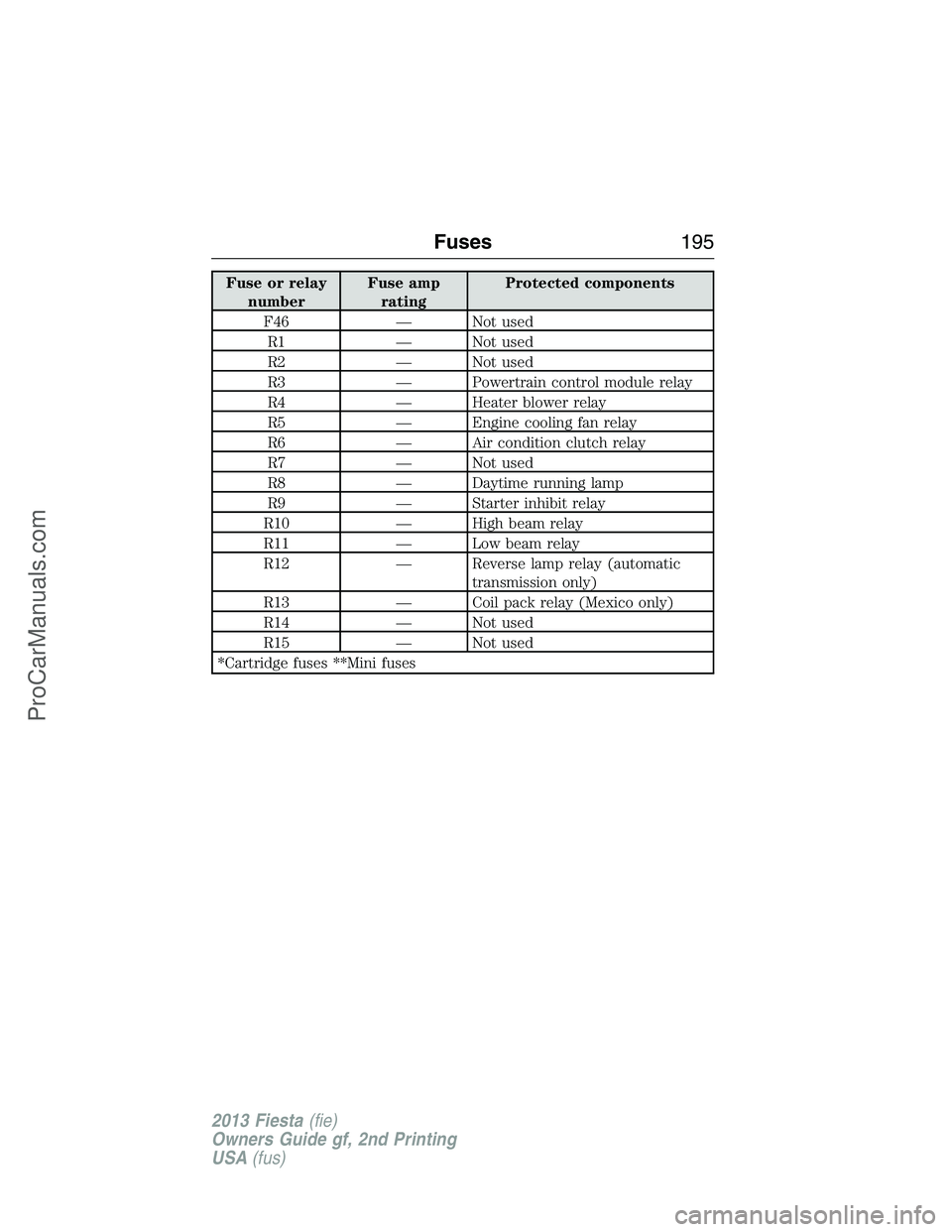
Fuse or relay
numberFuse amp
ratingProtected components
F46 — Not used
R1 — Not used
R2 — Not used
R3 — Powertrain control module relay
R4 — Heater blower relay
R5 — Engine cooling fan relay
R6 — Air condition clutch relay
R7 — Not used
R8 — Daytime running lamp
R9 — Starter inhibit relay
R10 — High beam relay
R11 — Low beam relay
R12 — Reverse lamp relay (automatic
transmission only)
R13 — Coil pack relay (Mexico only)
R14 — Not used
R15 — Not used
*Cartridge fuses **Mini fuses
Fuses195
2013 Fiesta(fie)
Owners Guide gf, 2nd Printing
USA(fus)
ProCarManuals.com
Page 197 of 346
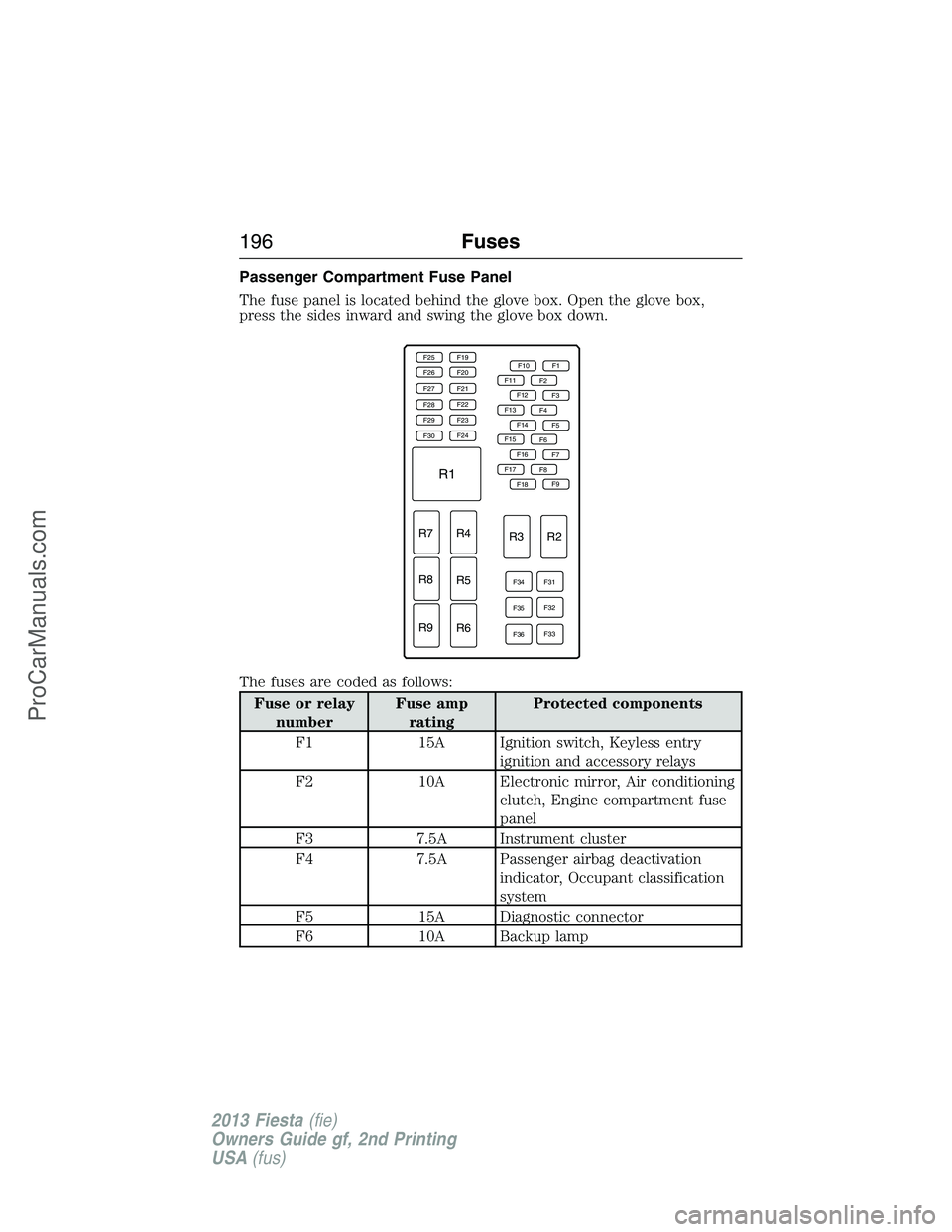
Passenger Compartment Fuse Panel
The fuse panel is located behind the glove box. Open the glove box,
press the sides inward and swing the glove box down.
The fuses are coded as follows:
Fuse or relay
numberFuse amp
ratingProtected components
F1 15A Ignition switch, Keyless entry
ignition and accessory relays
F2 10A Electronic mirror, Air conditioning
clutch, Engine compartment fuse
panel
F3 7.5A Instrument cluster
F4 7.5A Passenger airbag deactivation
indicator, Occupant classification
system
F5 15A Diagnostic connector
F6 10A Backup lamp
F25 F19
F10 F1
F11
F13
F15
F17F2
F4
F6
F8 F12
F14
F16
F18
F34
F35
F36F31
F32
F33F3
F5
F7
F9 F20
F21
F22
F23
F24 F26
F27
F28
F29
F30
R1
R7 R4
R3 R2
R5
R6 R8
R9
196Fuses
2013 Fiesta(fie)
Owners Guide gf, 2nd Printing
USA(fus)
ProCarManuals.com
Page 198 of 346
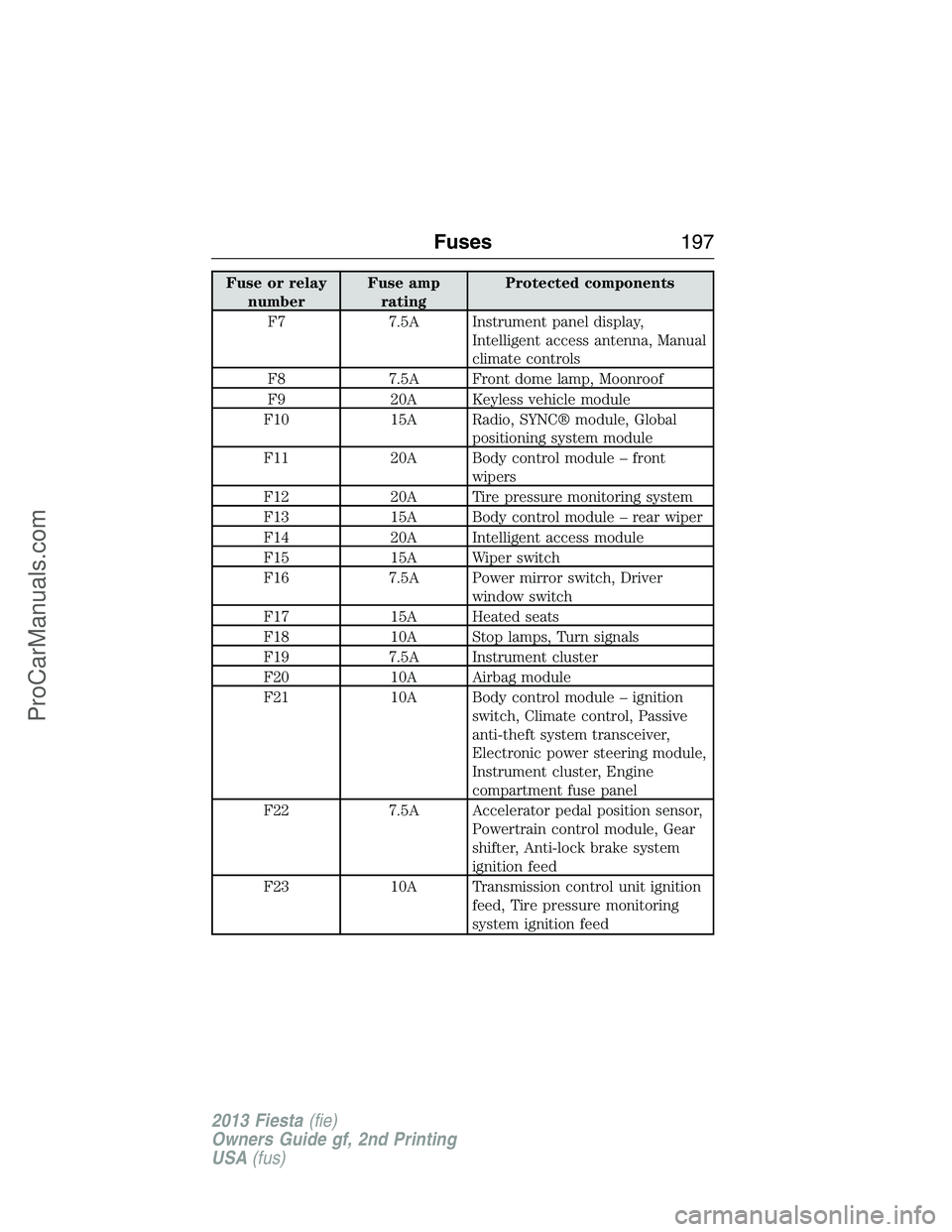
Fuse or relay
numberFuse amp
ratingProtected components
F7 7.5A Instrument panel display,
Intelligent access antenna, Manual
climate controls
F8 7.5A Front dome lamp, Moonroof
F9 20A Keyless vehicle module
F10 15A Radio, SYNC® module, Global
positioning system module
F11 20A Body control module – front
wipers
F12 20A Tire pressure monitoring system
F13 15A Body control module – rear wiper
F14 20A Intelligent access module
F15 15A Wiper switch
F16 7.5A Power mirror switch, Driver
window switch
F17 15A Heated seats
F18 10A Stop lamps, Turn signals
F19 7.5A Instrument cluster
F20 10A Airbag module
F21 10A Body control module – ignition
switch, Climate control, Passive
anti-theft system transceiver,
Electronic power steering module,
Instrument cluster, Engine
compartment fuse panel
F22 7.5A Accelerator pedal position sensor,
Powertrain control module, Gear
shifter, Anti-lock brake system
ignition feed
F23 10A Transmission control unit ignition
feed, Tire pressure monitoring
system ignition feed
Fuses197
2013 Fiesta(fie)
Owners Guide gf, 2nd Printing
USA(fus)
ProCarManuals.com
Page 200 of 346
GENERAL INFORMATION
Have your vehicle serviced regularly to help maintain its roadworthiness
and resale value. There is a large network of Ford authorized dealers
that are there to help you with their professional servicing expertise. We
believe that their specially trained technicians are best qualified to
service your vehicle properly and expertly. They are supported by a wide
range of highly specialized tools developed specifically for servicing your
vehicle.
To help you service your vehicle, we provideScheduled Maintenance
Informationwhich makes tracking routine service easy.
If your vehicle requires professional service, your authorized dealer can
provide the necessary parts and service. Check your warranty
information to find out which parts and services are covered.
Use only recommended fuels, lubricants, fluids and service parts
conforming to specifications. Motorcraft® parts are designed and built to
provide the best performance in your vehicle.
Precautions
•Do not work on a hot engine.
•Make sure that nothing gets caught in moving parts.
•Do not work on a vehicle with the engine running in an enclosed
space, unless you are sure you have enough ventilation.
•Keep all open flames and other burning material (such as cigarettes)
away from the battery and all fuel related parts.
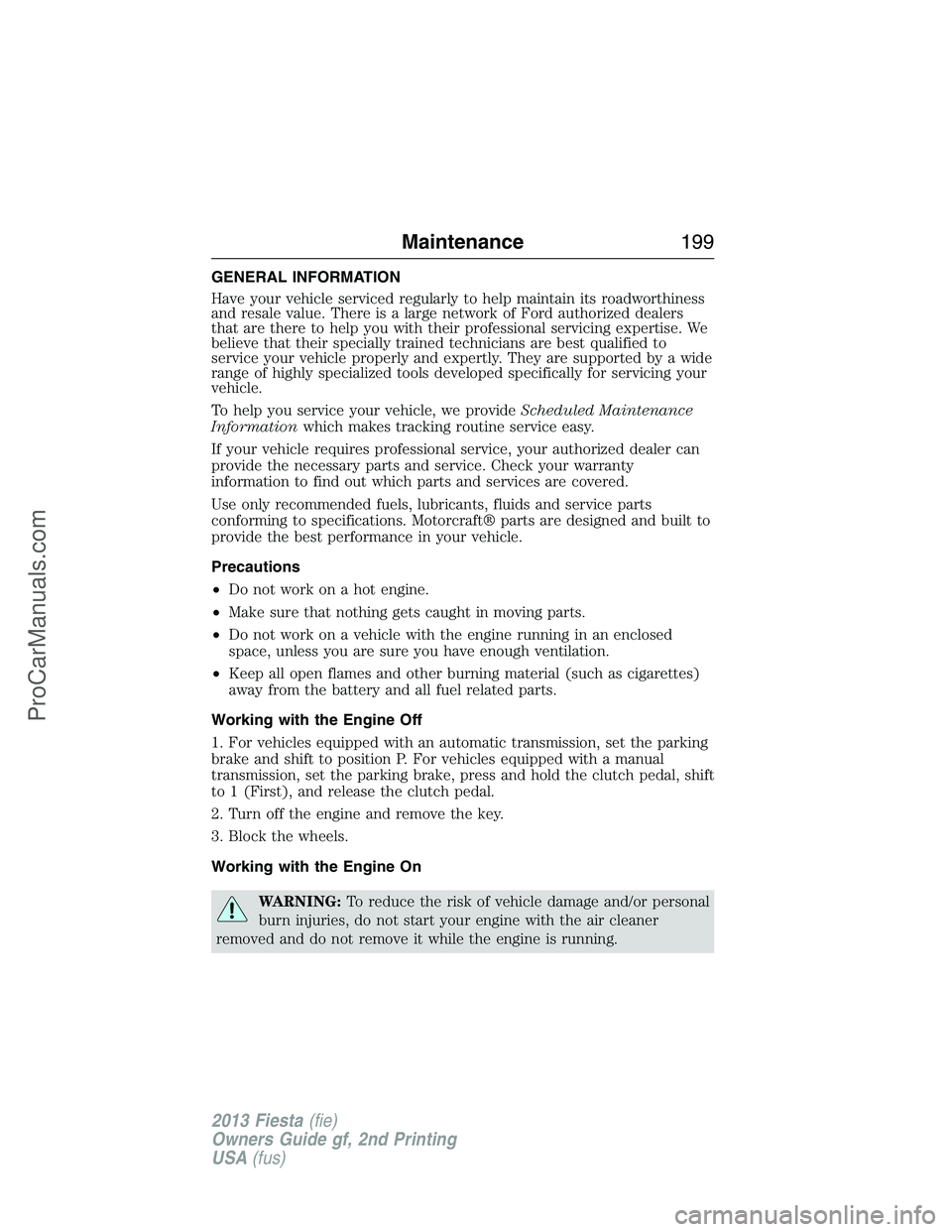
Working with the Engine Off
1. For vehicles equipped with an automatic transmission, set the parking
brake and shift to position P. For vehicles equipped with a manual
transmission, set the parking brake, press and hold the clutch pedal, shift
to 1 (First), and release the clutch pedal.
2. Turn off the engine and remove the key.
3. Block the wheels.
Working with the Engine On
WARNING:To reduce the risk of vehicle damage and/or personal
burn injuries, do not start your engine with the air cleaner
removed and do not remove it while the engine is running.
Maintenance199
2013 Fiesta(fie)
Owners Guide gf, 2nd Printing
USA(fus)
ProCarManuals.com
Page 202 of 346
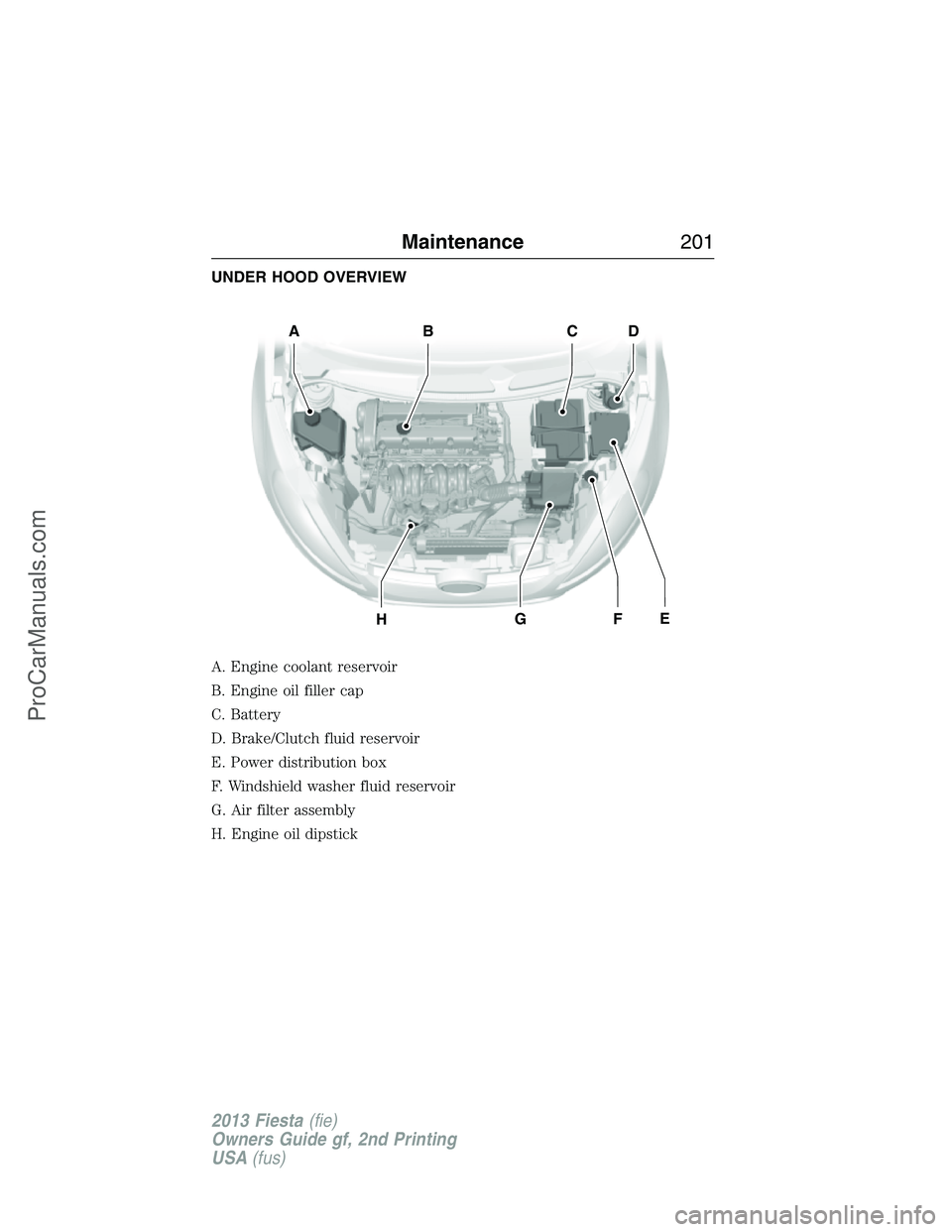
UNDER HOOD OVERVIEW
A. Engine coolant reservoir
B. Engine oil filler cap
C. Battery
D. Brake/Clutch fluid reservoir
E. Power distribution box
F. Windshield washer fluid reservoir
G. Air filter assembly
H. Engine oil dipstick
ABCD
HGFE
Maintenance201
2013 Fiesta(fie)
Owners Guide gf, 2nd Printing
USA(fus)
ProCarManuals.com
Page 203 of 346
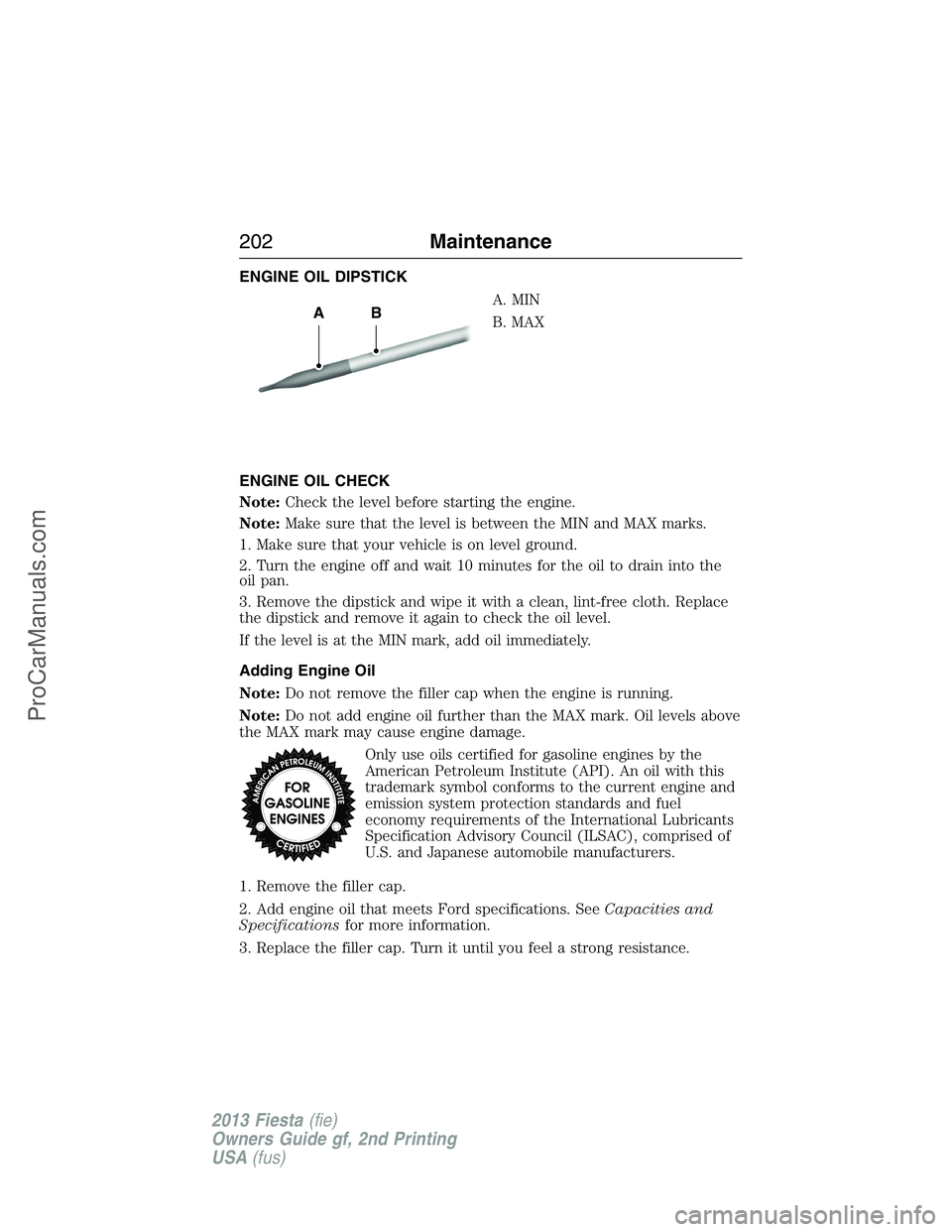
ENGINE OIL DIPSTICK
A. MIN
B. MAX
ENGINE OIL CHECK
Note:Check the level before starting the engine.
Note:Make sure that the level is between the MIN and MAX marks.
1. Make sure that your vehicle is on level ground.
2. Turn the engine off and wait 10 minutes for the oil to drain into the
oil pan.
3. Remove the dipstick and wipe it with a clean, lint-free cloth. Replace
the dipstick and remove it again to check the oil level.
If the level is at the MIN mark, add oil immediately.
Adding Engine Oil
Note:Do not remove the filler cap when the engine is running.
Note:Do not add engine oil further than the MAX mark. Oil levels above
the MAX mark may cause engine damage.
Only use oils certified for gasoline engines by the
American Petroleum Institute (API). An oil with this
trademark symbol conforms to the current engine and
emission system protection standards and fuel
economy requirements of the International Lubricants
Specification Advisory Council (ILSAC), comprised of
U.S. and Japanese automobile manufacturers.
1. Remove the filler cap.
2. Add engine oil that meets Ford specifications. SeeCapacities and
Specificationsfor more information.
3. Replace the filler cap. Turn it until you feel a strong resistance.
AB
202Maintenance
2013 Fiesta(fie)
Owners Guide gf, 2nd Printing
USA(fus)
ProCarManuals.com
Page 204 of 346
ENGINE COOLANT CHECK
Checking the Engine Coolant
Note:If your vehicle is equipped with a diesel engine, refer to
Maintenance and Specificationssection of yourDiesel Supplement
The concentration and level of engine coolant should be checked at the
intervals listed inscheduled maintenance information.
Note:Make sure that the level is between the MIN and MAX marks on
the coolant reservoir.
The coolant concentration should be maintained within 48% to 50%,
which equates to a freeze point between -30°F (-34°C) and -34°F
(-37°C).
Note:For best results, coolant concentration should be tested with a
refractometer such as Rotunda tool 300-ROB75240 available from your
dealer. Ford does not recommend the use of hydrometers or coolant test
strips for measuring coolant concentrations.
Note:Coolant expands when it is hot. The level may extend beyond the
MAX mark.
If the level is at the MIN mark, add coolant immediately.
Note:Automotive fluids are not interchangeable; do not use engine
coolant/antifreeze or windshield washer fluid outside of its specified
function and vehicle location.
Adding Engine Coolant
WARNING:Do not add engine coolant when the engine is hot.
Steam and scalding liquids released from a hot cooling system
can burn you badly. Also, you can be burned if you spill coolant on hot
engine parts.
WARNING:Do not put engine coolant in the windshield washer
fluid container. If sprayed on the windshield, engine coolant
could make it difficult to see through the windshield.
Maintenance203
2013 Fiesta(fie)
Owners Guide gf, 2nd Printing
USA(fus)
ProCarManuals.com
Page 205 of 346
WARNING:To reduce the risk of personal injury, make sure the
engine is cool before unscrewing the coolant pressure relief cap.
The cooling system is under pressure; steam and hot liquid can come
out forcefully when the cap is loosened slightly.
WARNING:Do not add coolant further than the MAX mark.
Note:Do not use stop leak pellets or cooling system sealants/additives
as they can cause damage to the engine cooling and/or heating systems.
This damage would not be covered under your vehicle’s warranty.
Note:During normal vehicle operation, the engine coolant may change
color from orange to pink or light red. As long as the engine coolant is
clear and uncontaminated, this color change does not indicate the engine
coolant has degraded nor does it require the engine coolant to be
drained, the system to be flushed, or the engine coolant to be replaced.
•DO NOT MIX different colors or types of coolant in your vehicle. Make
sure the correct coolant is used. Mixing of engine coolants may harm
your engine’s cooling system. The use of an improper coolant may
harm engine and cooling system components and may void the
warranty.
•In case of emergency, a large amount of water without engine coolant
may be added in order to reach a vehicle service location. In this
instance, the cooling system must be drained, chemically cleaned with
Motorcraft® Premium Cooling System Flush, and refilled with
prediluted engine coolant as soon as possible. Water alone (without
engine coolant) can cause engine damage from corrosion, overheating
or freezing.
•Do not use alcohol, methanol, brine or any engine coolants mixed with
alcohol or methanol antifreeze (coolant). Alcohol and other liquids can
cause engine damage from overheating or freezing.
•Do not add extra inhibitors or additives to the coolant. These can be
harmful and compromise the corrosion protection of the engine
coolant.
Unscrew the cap slowly. Any pressure will escape as you unscrew the
cap.
Add prediluted engine coolant meeting the Ford specification. See
Capacities and Specificationsfor more information.
204Maintenance
2013 Fiesta(fie)
Owners Guide gf, 2nd Printing
USA(fus)
ProCarManuals.com