engine oil FORD FIESTA 2014 User Guide
[x] Cancel search | Manufacturer: FORD, Model Year: 2014, Model line: FIESTA, Model: FORD FIESTA 2014Pages: 398, PDF Size: 6.09 MB
Page 184 of 398
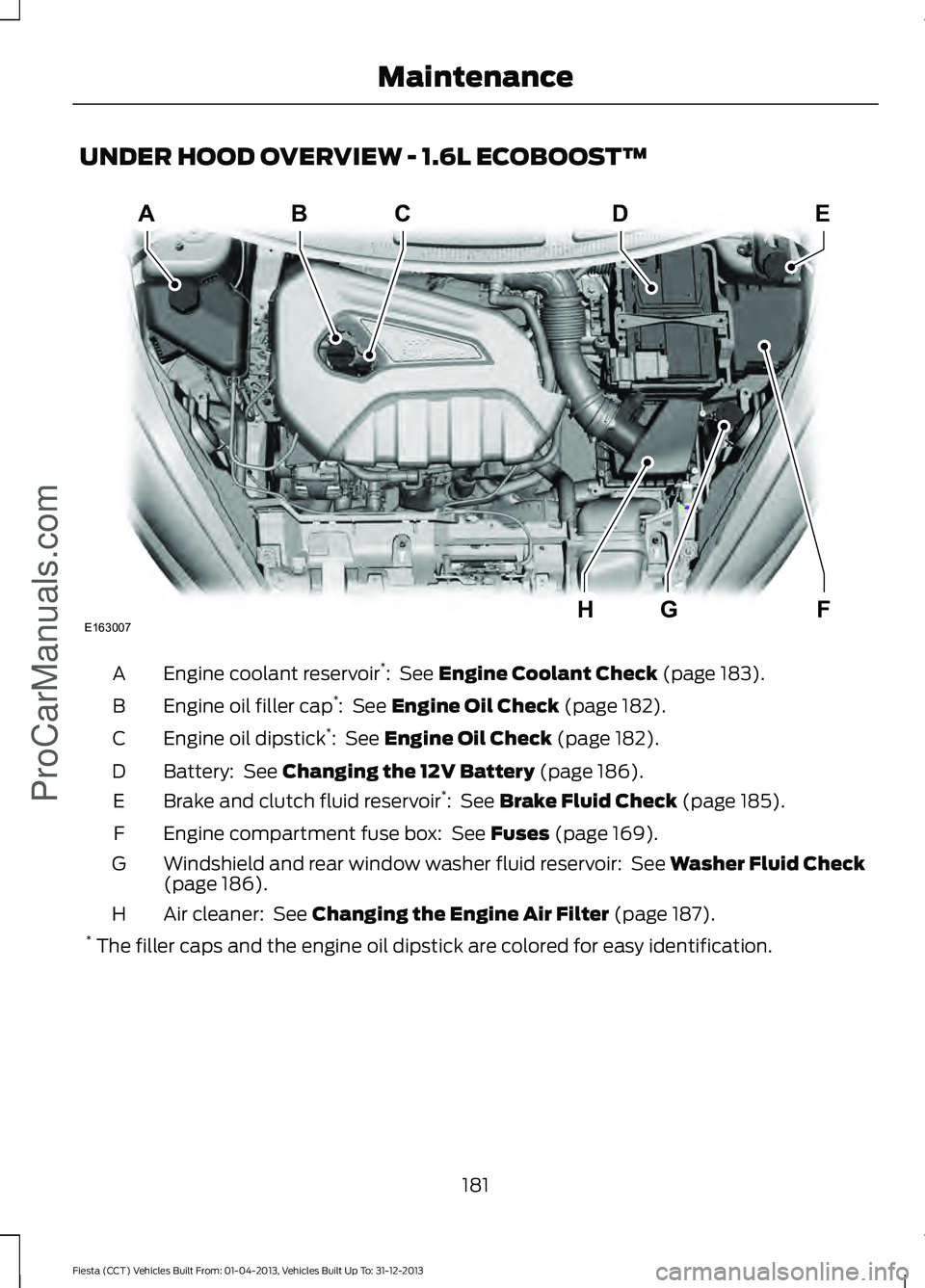
UNDER HOOD OVERVIEW - 1.6L ECOBOOST™
Engine coolant reservoir
*
: See Engine Coolant Check (page 183).
A
Engine oil filler cap *
:
See Engine Oil Check (page 182).
B
Engine oil dipstick *
:
See Engine Oil Check (page 182).
C
Battery:
See Changing the 12V Battery (page 186).
D
Brake and clutch fluid reservoir *
:
See Brake Fluid Check (page 185).
E
Engine compartment fuse box:
See Fuses (page 169).
F
Windshield and rear window washer fluid reservoir:
See Washer Fluid Check
(page 186).
G
Air cleaner:
See Changing the Engine Air Filter (page 187).
H
* The filler caps and the engine oil dipstick are colored for easy identification.
181
Fiesta (CCT) Vehicles Built From: 01-04-2013, Vehicles Built Up To: 31-12-2013 Maintenance
ProCarManuals.comABCD
FGH
E
E163007
Page 185 of 398
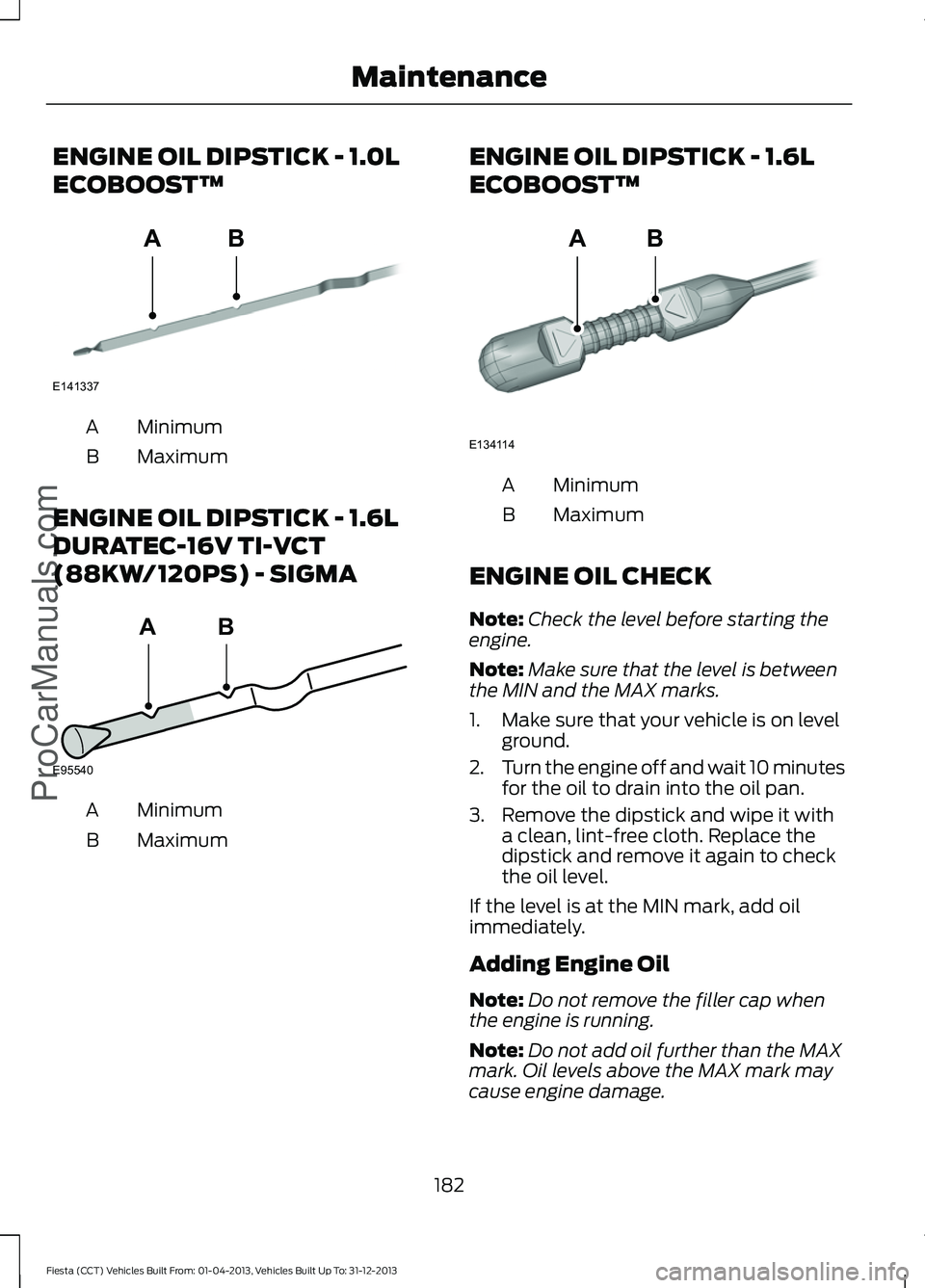
ENGINE OIL DIPSTICK - 1.0L
ECOBOOST™
Minimum
A
Maximum
B
ENGINE OIL DIPSTICK - 1.6L
DURATEC-16V TI-VCT
(88KW/120PS) - SIGMA Minimum
A
Maximum
B ENGINE OIL DIPSTICK - 1.6L
ECOBOOST™ Minimum
A
Maximum
B
ENGINE OIL CHECK
Note: Check the level before starting the
engine.
Note: Make sure that the level is between
the MIN and the MAX marks.
1. Make sure that your vehicle is on level ground.
2. Turn the engine off and wait 10 minutes
for the oil to drain into the oil pan.
3. Remove the dipstick and wipe it with a clean, lint-free cloth. Replace the
dipstick and remove it again to check
the oil level.
If the level is at the MIN mark, add oil
immediately.
Adding Engine Oil
Note: Do not remove the filler cap when
the engine is running.
Note: Do not add oil further than the MAX
mark. Oil levels above the MAX mark may
cause engine damage.
182
Fiesta (CCT) Vehicles Built From: 01-04-2013, Vehicles Built Up To: 31-12-2013 MaintenanceProCarManuals.comE141337
AB E95540
BA AB
E134114
Page 186 of 398
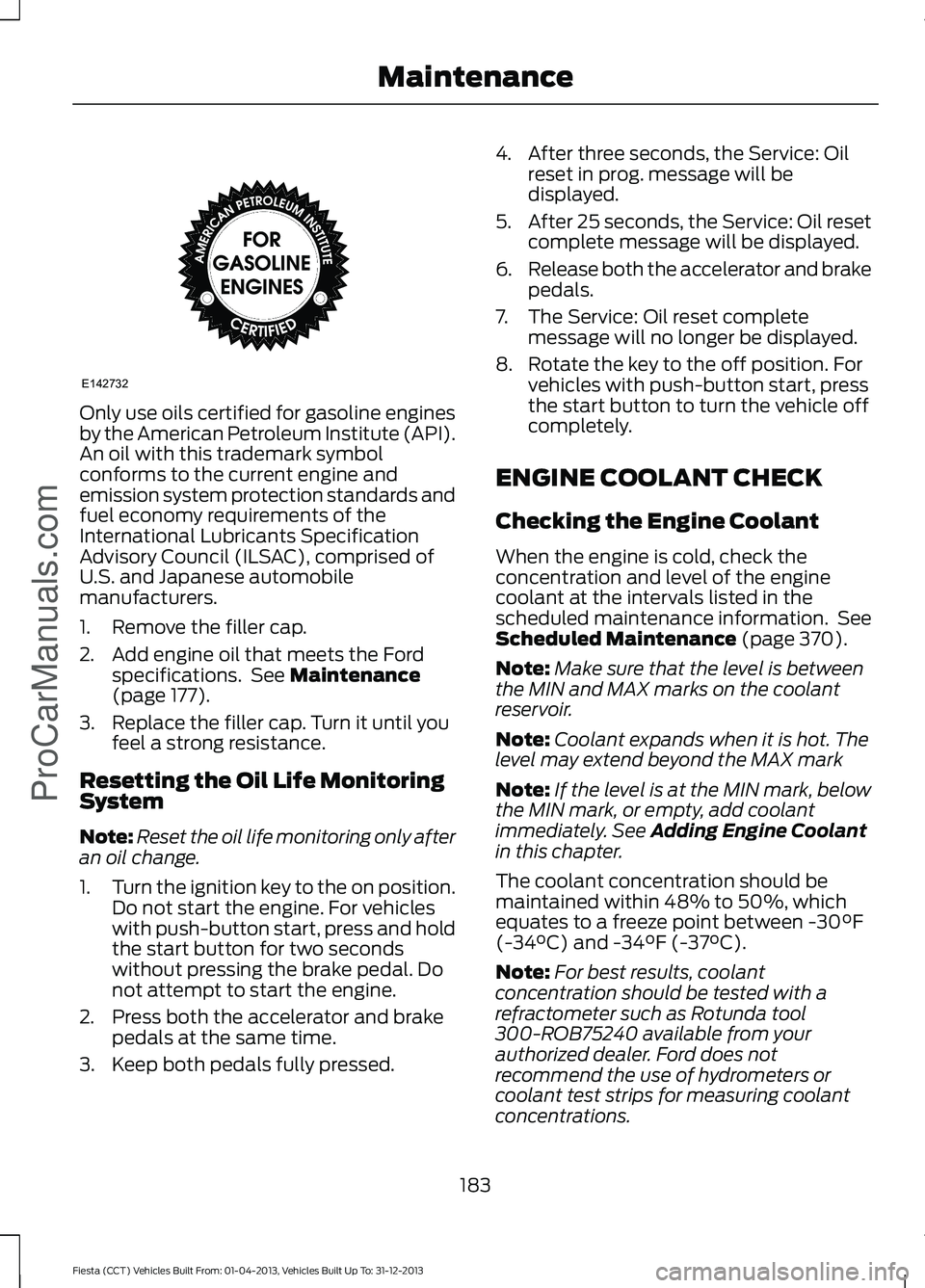
Only use oils certified for gasoline engines
by the American Petroleum Institute (API).
An oil with this trademark symbol
conforms to the current engine and
emission system protection standards and
fuel economy requirements of the
International Lubricants Specification
Advisory Council (ILSAC), comprised of
U.S. and Japanese automobile
manufacturers.
1. Remove the filler cap.
2. Add engine oil that meets the Ford
specifications. See Maintenance
(page 177).
3. Replace the filler cap. Turn it until you feel a strong resistance.
Resetting the Oil Life Monitoring
System
Note: Reset the oil life monitoring only after
an oil change.
1. Turn the ignition key to the on position.
Do not start the engine. For vehicles
with push-button start, press and hold
the start button for two seconds
without pressing the brake pedal. Do
not attempt to start the engine.
2. Press both the accelerator and brake pedals at the same time.
3. Keep both pedals fully pressed. 4. After three seconds, the Service: Oil
reset in prog. message will be
displayed.
5. After 25 seconds, the Service: Oil reset
complete message will be displayed.
6. Release both the accelerator and brake
pedals.
7. The Service: Oil reset complete message will no longer be displayed.
8. Rotate the key to the off position. For vehicles with push-button start, press
the start button to turn the vehicle off
completely.
ENGINE COOLANT CHECK
Checking the Engine Coolant
When the engine is cold, check the
concentration and level of the engine
coolant at the intervals listed in the
scheduled maintenance information. See
Scheduled Maintenance
(page 370).
Note: Make sure that the level is between
the MIN and MAX marks on the coolant
reservoir.
Note: Coolant expands when it is hot. The
level may extend beyond the MAX mark
Note: If the level is at the MIN mark, below
the MIN mark, or empty, add coolant
immediately. See
Adding Engine Coolant
in this chapter.
The coolant concentration should be
maintained within 48% to 50%, which
equates to a freeze point between -30°F
(-34°C) and -34°F (-37°C).
Note: For best results, coolant
concentration should be tested with a
refractometer such as Rotunda tool
300-ROB75240 available from your
authorized dealer. Ford does not
recommend the use of hydrometers or
coolant test strips for measuring coolant
concentrations.
183
Fiesta (CCT) Vehicles Built From: 01-04-2013, Vehicles Built Up To: 31-12-2013 Maintenance
ProCarManuals.comE142732
Page 203 of 398
Note:
On some vehicles the lamps are LED.
These are not serviceable items, have your
vehicle checked by an authorized dealer as
soon as possible.
TECHNICAL SPECIFICATIONS - 1.0L ECOBOOST™
Capacities Capacity
Item
6.1 qt (5.8 L)
Engine cooling system
4.3 qt (4.1 L)
Engine lubrication system - including the oil filter
4.2 qt (4.0 L)
Engine lubrication system - excluding the oil filter
0.8 qt (0.75 L)
Engine oil top-up - raise the level on the dipstick
from minimum to maximum
12.4 gal (47 L)
Fuel tank
1.8 qt (1.7 L)
Automatic transmission
2.6 qt (2.5 L)
Windshield and rear window washer system -
including headlamp washer
Specifications
Materials Specification
Name
WSS-M2C945-A
Motorcraft® SAE 5W-20 Premium Synthetic Blend
Motor Oil
XO-5W20-QSP
WSS-M2C200-D2
Motorcraft® Dual Clutch Transmission Fluid
XT-11-QDC
WSD-M2C200-C
Motorcraft® Full Synthetic Manual Transmission Fluid
XT-M5-QS
WSS-M97B44-D2
Motorcraft® Orange Antifreeze/Coolant Prediluted
VC-3DIL-B
WSS-M6C65-A2
Motorcraft® DOT 4 LV High Performance Motor Vehicle
Brake Fluid ISO 4925 Class 6
PM-20
ESB-M1C93-B
Motorcraft® Multi-Purpose Grease Spray
XL-5
200
Fiesta (CCT) Vehicles Built From: 01-04-2013, Vehicles Built Up To: 31-12-2013 MaintenanceProCarManuals.com
Page 204 of 398
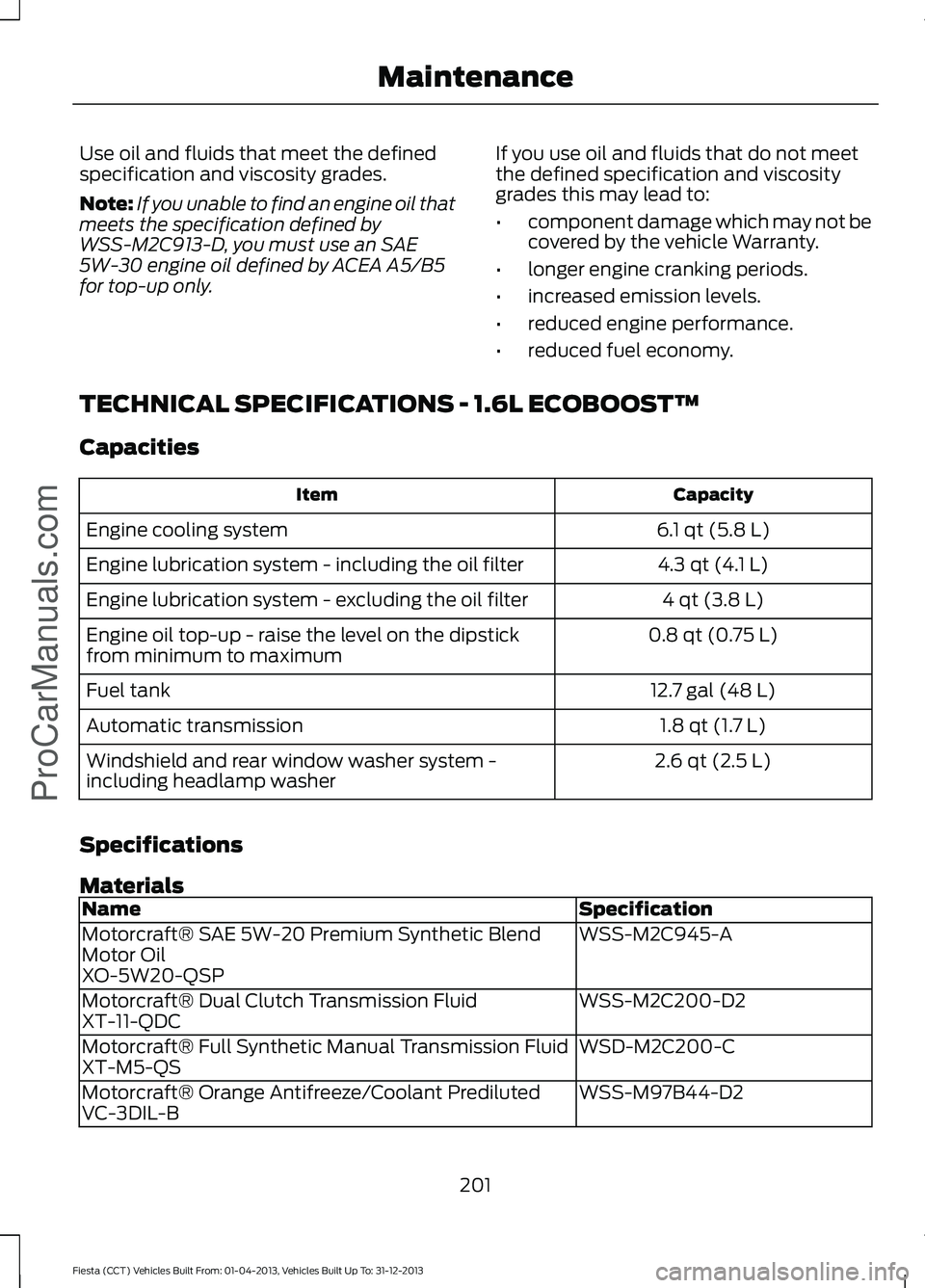
Use oil and fluids that meet the defined
specification and viscosity grades.
Note:
If you unable to find an engine oil that
meets the specification defined by
WSS-M2C913-D, you must use an SAE
5W-30 engine oil defined by ACEA A5/B5
for top-up only. If you use oil and fluids that do not meet
the defined specification and viscosity
grades this may lead to:
•
component damage which may not be
covered by the vehicle Warranty.
• longer engine cranking periods.
• increased emission levels.
• reduced engine performance.
• reduced fuel economy.
TECHNICAL SPECIFICATIONS - 1.6L ECOBOOST™
Capacities Capacity
Item
6.1 qt (5.8 L)
Engine cooling system
4.3 qt (4.1 L)
Engine lubrication system - including the oil filter
4 qt (3.8 L)
Engine lubrication system - excluding the oil filter
0.8 qt (0.75 L)
Engine oil top-up - raise the level on the dipstick
from minimum to maximum
12.7 gal (48 L)
Fuel tank
1.8 qt (1.7 L)
Automatic transmission
2.6 qt (2.5 L)
Windshield and rear window washer system -
including headlamp washer
Specifications
Materials Specification
Name
WSS-M2C945-A
Motorcraft® SAE 5W-20 Premium Synthetic Blend
Motor Oil
XO-5W20-QSP
WSS-M2C200-D2
Motorcraft® Dual Clutch Transmission Fluid
XT-11-QDC
WSD-M2C200-C
Motorcraft® Full Synthetic Manual Transmission Fluid
XT-M5-QS
WSS-M97B44-D2
Motorcraft® Orange Antifreeze/Coolant Prediluted
VC-3DIL-B
201
Fiesta (CCT) Vehicles Built From: 01-04-2013, Vehicles Built Up To: 31-12-2013 MaintenanceProCarManuals.com
Page 205 of 398
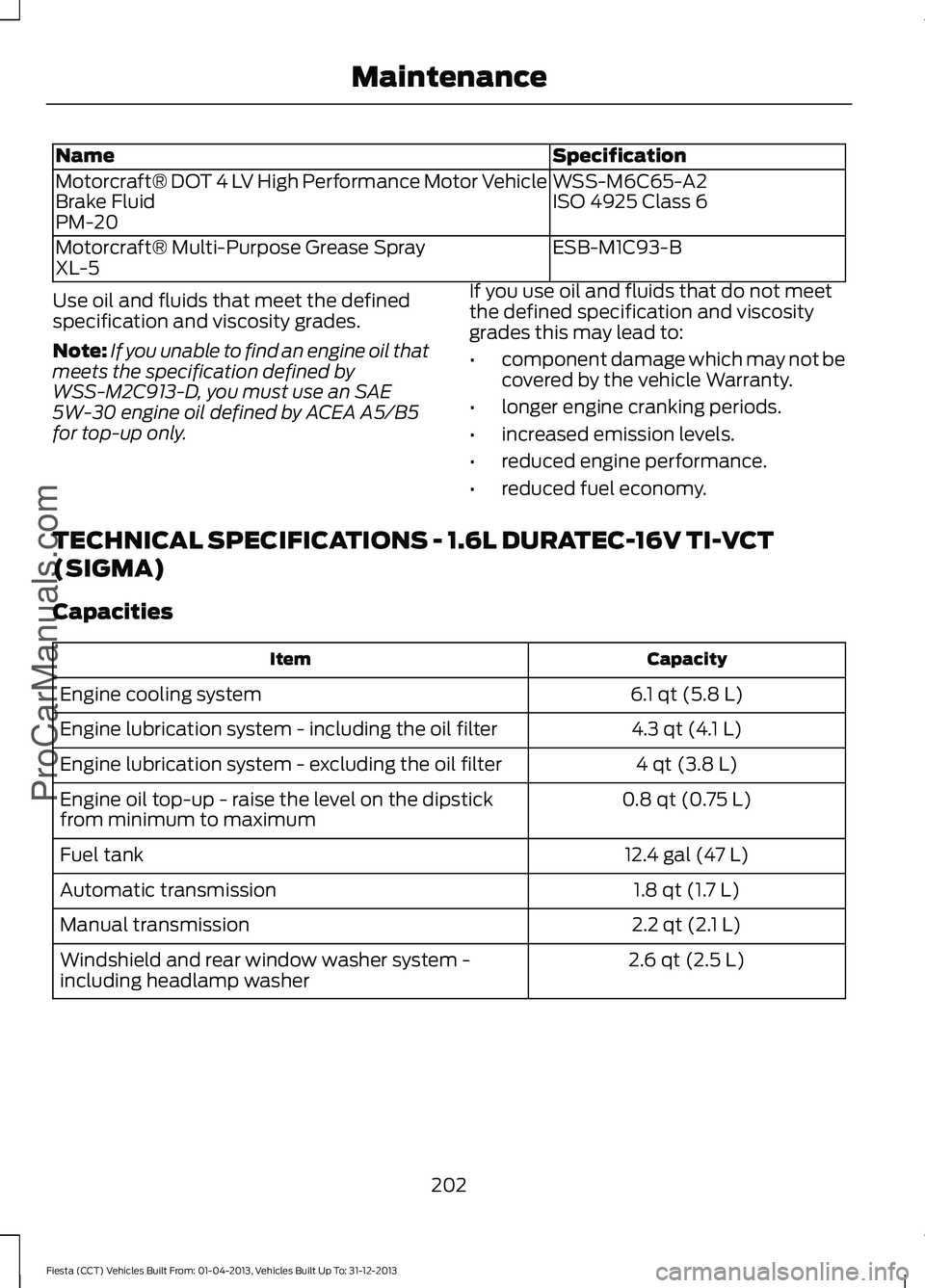
Specification
Name
WSS-M6C65-A2
Motorcraft® DOT 4 LV High Performance Motor Vehicle
Brake Fluid ISO 4925 Class 6
PM-20
ESB-M1C93-B
Motorcraft® Multi-Purpose Grease Spray
XL-5
Use oil and fluids that meet the defined
specification and viscosity grades.
Note: If you unable to find an engine oil that
meets the specification defined by
WSS-M2C913-D, you must use an SAE
5W-30 engine oil defined by ACEA A5/B5
for top-up only. If you use oil and fluids that do not meet
the defined specification and viscosity
grades this may lead to:
•
component damage which may not be
covered by the vehicle Warranty.
• longer engine cranking periods.
• increased emission levels.
• reduced engine performance.
• reduced fuel economy.
TECHNICAL SPECIFICATIONS - 1.6L DURATEC-16V TI-VCT
(SIGMA)
Capacities Capacity
Item
6.1 qt (5.8 L)
Engine cooling system
4.3 qt (4.1 L)
Engine lubrication system - including the oil filter
4 qt (3.8 L)
Engine lubrication system - excluding the oil filter
0.8 qt (0.75 L)
Engine oil top-up - raise the level on the dipstick
from minimum to maximum
12.4 gal (47 L)
Fuel tank
1.8 qt (1.7 L)
Automatic transmission
2.2 qt (2.1 L)
Manual transmission
2.6 qt (2.5 L)
Windshield and rear window washer system -
including headlamp washer
202
Fiesta (CCT) Vehicles Built From: 01-04-2013, Vehicles Built Up To: 31-12-2013 MaintenanceProCarManuals.com
Page 206 of 398
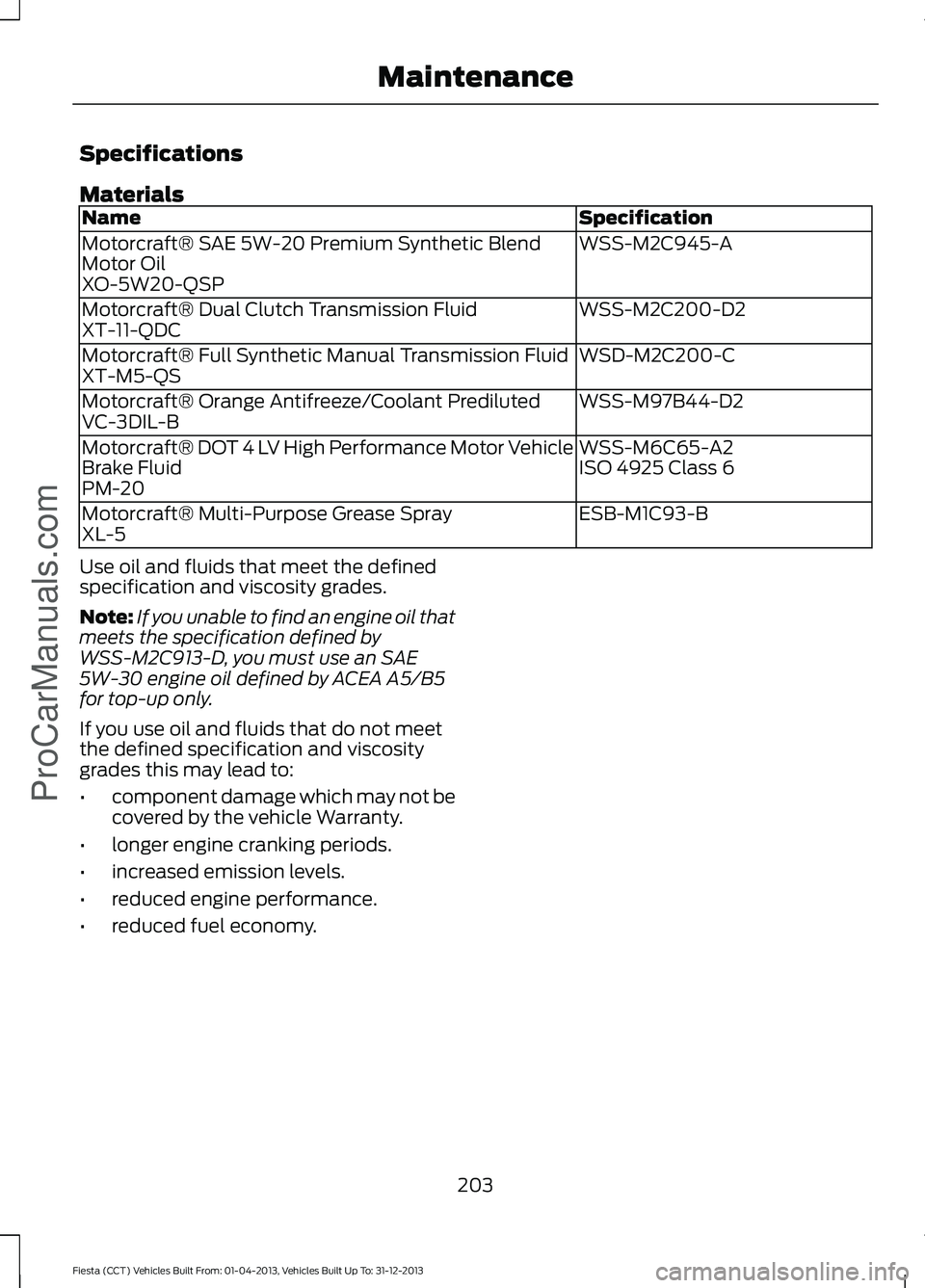
Specifications
Materials
Specification
Name
WSS-M2C945-A
Motorcraft® SAE 5W-20 Premium Synthetic Blend
Motor Oil
XO-5W20-QSP
WSS-M2C200-D2
Motorcraft® Dual Clutch Transmission Fluid
XT-11-QDC
WSD-M2C200-C
Motorcraft® Full Synthetic Manual Transmission Fluid
XT-M5-QS
WSS-M97B44-D2
Motorcraft® Orange Antifreeze/Coolant Prediluted
VC-3DIL-B
WSS-M6C65-A2
Motorcraft® DOT 4 LV High Performance Motor Vehicle
Brake Fluid ISO 4925 Class 6
PM-20
ESB-M1C93-B
Motorcraft® Multi-Purpose Grease Spray
XL-5
Use oil and fluids that meet the defined
specification and viscosity grades.
Note: If you unable to find an engine oil that
meets the specification defined by
WSS-M2C913-D, you must use an SAE
5W-30 engine oil defined by ACEA A5/B5
for top-up only.
If you use oil and fluids that do not meet
the defined specification and viscosity
grades this may lead to:
• component damage which may not be
covered by the vehicle Warranty.
• longer engine cranking periods.
• increased emission levels.
• reduced engine performance.
• reduced fuel economy.
203
Fiesta (CCT) Vehicles Built From: 01-04-2013, Vehicles Built Up To: 31-12-2013 MaintenanceProCarManuals.com
Page 209 of 398
•
Never wash or rinse any ignition coil,
spark plug wire or spark plug well, or
the area in and around these locations.
• Cover the battery, power distribution
box, and air filter assembly to prevent
water damage when cleaning the
engine.
CLEANING THE WINDOWS AND
WIPER BLADES
Clean your windows and wiper blades
regularly. If the wipers do not wipe
properly, substances on the vehicle ’s glass
or the wiper blades may cause squeaking
or chatter noise from the blades, and
streaking and smearing of the windshield.
To clean these items, follow these tips:
• You can clean the windows with a
non-abrasive cleaner such as
Motorcraft Ultra-Clear Spray Glass
Cleaner.
• You can clean the wiper blades with
isopropyl rubbing-alcohol or Motorcraft
Premium Windshield Wash
Concentrate with Bitterant in the U.S.,
or Premium Quality Windshield Washer
Fluid in Canada. Be sure to replace
wiper blades when they appear worn
or do not function properly.
• Do not use abrasives, as they may
cause scratches.
• Do not use fuel, kerosene, or paint
thinner to clean any parts. If you cannot remove those streaks after
cleaning with the glass cleaner or if the
wipers chatter and move in a jerky motion,
clean the outer surface of the windshield
and the wiper blades using a sponge or
soft cloth with a neutral detergent or
mild-abrasive cleaning solution. After
cleaning, rinse the windshield and wiper
blades with clean water. The windshield
is clean if beads do not form when you
rinse the windshield with water.
Note:
Do not use sharp objects, such as a
razorblade, to clean the inside of the rear
window or to remove decals, as this may
cause damage to the rear window
defroster ’s heated grid lines.
CLEANING THE INTERIOR WARNINGS
Do not use cleaning solvents, bleach
or dye on the vehicle
’s safety belts,
as these actions may weaken the
belt webbing. On vehicles equipped with
seat-mounted airbags, do not use
chemical solvents or strong
detergents. Such products could
contaminate the side airbag system and
affect performance of the side airbag in a
collision. For fabric, carpets, cloth seats, safety belts
and seats equipped with side airbags:
•
Remove dust and loose dirt with a
vacuum cleaner.
• Remove light stains and soil with
Motorcraft Professional Strength
Carpet & Upholstery Cleaner.
206
Fiesta (CCT) Vehicles Built From: 01-04-2013, Vehicles Built Up To: 31-12-2013 Vehicle CareProCarManuals.com
Page 212 of 398
VEHICLE STORAGE
If you plan on storing your vehicle for an
extended period of time (30 days or more),
read the following maintenance
recommendations to make sure your
vehicle stays in good operating condition.
All motor vehicles and their components
were engineered and tested for reliable,
regular driving. Long term storage under
various conditions may lead to component
degradation or failure unless specific
precautions are taken to preserve the
components.
General
•
Store all vehicles in a dry, ventilated
place.
• Protect from sunlight, if possible.
• If vehicles are stored outside, they
require regular maintenance to protect
against rust and damage.
Body
• Wash your vehicle thoroughly to
remove dirt, grease, oil, tar or mud from
exterior surfaces, rear-wheel housing
and underside of front fenders.
• Periodically wash your vehicle stored
in exposed locations.
• Touch-up exposed or primed metal to
prevent rust.
• Cover chrome and stainless steel parts
with a thick coat of auto wax to prevent
discoloration. Re-wax as necessary
when your vehicle is washed.
• Lubricate all hood, door and trunk lid
hinges, and latches with a light grade
oil.
• Cover interior trim to prevent fading.
• Keep all rubber parts free from oil and
solvents. Engine
•
The engine oil and filter should be
changed prior to storage, as used
engine oil contain contaminates that
may cause engine damage.
• Start the engine every 15 days. Run at
fast idle until it reaches normal
operating temperature
• With your foot on the brake, shift
through all the gears while the engine
is running.
Fuel system
• Fill the fuel tank with high-quality fuel
until the first automatic shutoff of the
fuel pump nozzle.
Cooling system
• Protect against freezing temperatures.
• When removing your vehicle from
storage, check coolant fluid level.
Confirm there are no cooling system
leaks, and fluid is at the recommended
level.
Battery
• Check and recharge as necessary. Keep
connections clean.
• If storing your vehicle for more than 30
days without recharging the battery, it
may be advisable to disconnect the
battery cables to ensure battery charge
is maintained for quick starting.
Note: If battery cables are disconnected, it
will be necessary to reset memory features.
Brakes
• Make sure brakes and parking brake
are fully released.
Tires
• Maintain recommended air pressure.
209
Fiesta (CCT) Vehicles Built From: 01-04-2013, Vehicles Built Up To: 31-12-2013 Vehicle CareProCarManuals.com
Page 235 of 398
WARNINGS
Do not attempt to change a tire on
the side of the vehicle close to
moving traffic. Pull far enough off the
road to avoid the danger of being hit when
operating the jack or changing the wheel. Always use the jack provided as
original equipment with your vehicle.
If using a jack other than the one
provided as original equipment with your
vehicle, make sure the jack capacity is
adequate for the vehicle weight, including
any vehicle cargo or modifications. Make sure there is no lubrication
(grease or oil) on the threads or the
surface between the wheel lugs and
nuts. This can cause the lug nuts to loosen
while driving. Note:
Passengers should not remain in the
vehicle when the vehicle is being jacked.
1. Park on a level surface, set the parking
brake and activate the hazard flashers.
2. Place the transmission selector lever in position P (automatic transmission)
or position R (manual transmission)
and turn the engine off.
3. Remove the carpeted wheel cover.
4. Remove the spare tire bolt securing the
spare tire by turning it
counterclockwise.
5. Remove the spare tire from the spare tire compartment. 6. Remove the lug wrench and jack from
the foam holder. 7. Block the diagonally opposite wheel.
8. Loosen each wheel lug nut one-half
turn counterclockwise but do not
remove them until the wheel is raised
off the ground.
Note: Jack at the specified locations to
avoid damage to the vehicle.
9. The vehicle jacking points are shown here, and are depicted on the yellow
warning label on the jack. 232
Fiesta (CCT) Vehicles Built From: 01-04-2013, Vehicles Built Up To: 31-12-2013 Wheels and Tires
ProCarManuals.comE142550 E142551 E145908