heating FORD FIESTA 2015 Owners Manual
[x] Cancel search | Manufacturer: FORD, Model Year: 2015, Model line: FIESTA, Model: FORD FIESTA 2015Pages: 423, PDF Size: 5.5 MB
Page 98 of 423
PRINCIPLE OF OPERATION
Outside Air
Keep the air intakes in front of the
windshield free from obstruction (such as
snow or leaves) to allow the climate
control system to function effectively.
Recirculated Air
WARNING
Prolonged use of recirculated air may
cause the windows to mist up. If the
windows mist up, follow the settings
for demisting the windshield. The air currently in the passenger
compartment recirculates. Outside air does
not enter your vehicle.
Heating
Heating performance depends on the
temperature of the engine coolant.
General Information on Controlling
the Interior Climate
Fully close all the windows.
Warming the Interior
Direct the air toward your feet. In cold or
humid weather conditions, direct some of
the air toward the windshield and the door
windows.
Cooling the Interior
Direct the air toward your face. Air Conditioning
The system directs air through the
evaporator for cooling. The evaporator
extracts humidity from the air to help keep
the windows free of mist. The system
directs the resulting condensation to the
outside of your vehicle, which may cause
a small pool to form under your vehicle.
This is normal.
Note:
The air conditioning operates only
when the temperature is above 39°F (4°C).
Note: When you use air conditioning, your
vehicle uses more fuel.
AIR VENTS
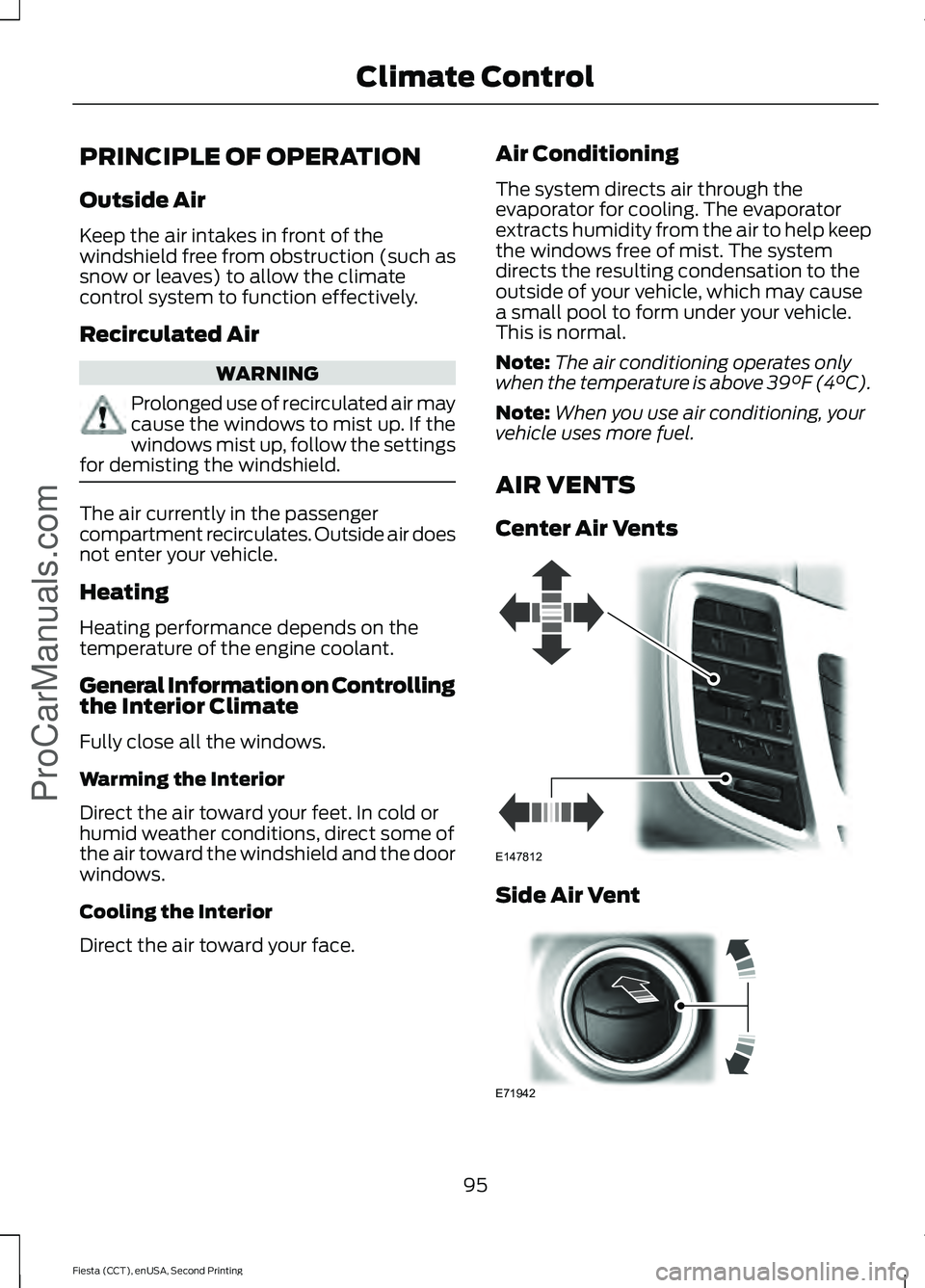
Center Air Vents Side Air Vent
95
Fiesta (CCT), enUSA, Second Printing Climate ControlProCarManuals.comE147812 E71942
Page 101 of 423
Air conditioning: Press the button to switch the air conditioning on or off. Air
conditioning cools your vehicle using outside air. To improve air conditioning
when starting your vehicle, drive with the windows slightly open for two to three
minutes.
G
Recirculated air:
Press the button to switch between outside air and
recirculated air. The air currently in the passenger compartment recirculates.
This can reduce the time needed to cool the interior and reduce unwanted odors
from entering your vehicle.
H
OFF:
Press the button to switch the system off.
I
Heated rear window:
Press the button to defog and clear the rear window of
a thin covering of ice.
J
Footwell:
Press the button to distribute air through the footwell air vents.
K
AUTO:
Press the button to switch the system on and off. The system
automatically controls the temperature, amount and distribution of the airflow
to reach and maintain your previously selected temperature.
L
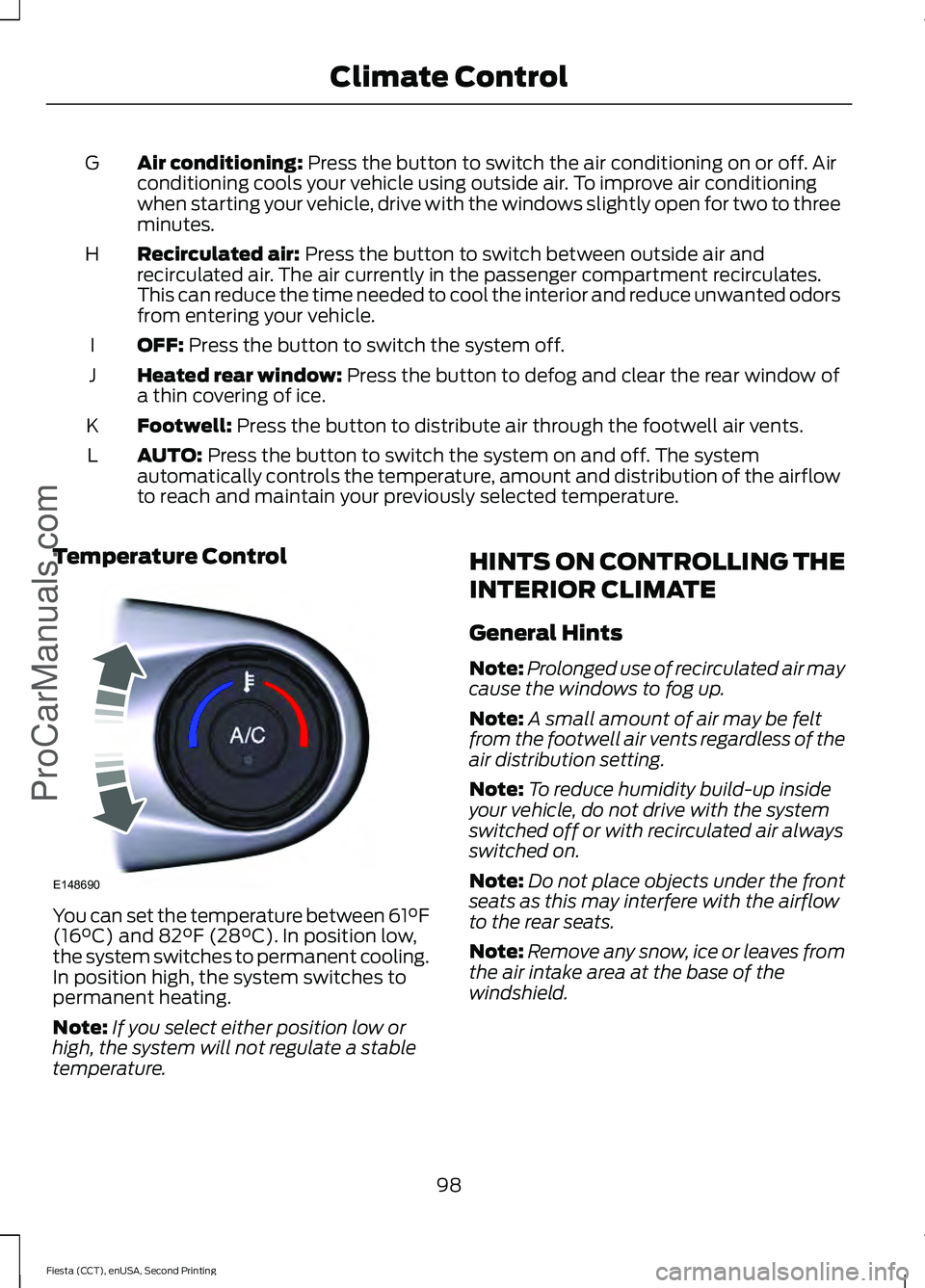
Temperature Control You can set the temperature between 61°F
(16°C)
and 82°F (28°C). In position low,
the system switches to permanent cooling.
In position high, the system switches to
permanent heating.
Note: If you select either position low or
high, the system will not regulate a stable
temperature. HINTS ON CONTROLLING THE
INTERIOR CLIMATE
General Hints
Note:
Prolonged use of recirculated air may
cause the windows to fog up.
Note: A small amount of air may be felt
from the footwell air vents regardless of the
air distribution setting.
Note: To reduce humidity build-up inside
your vehicle, do not drive with the system
switched off or with recirculated air always
switched on.
Note: Do not place objects under the front
seats as this may interfere with the airflow
to the rear seats.
Note: Remove any snow, ice or leaves from
the air intake area at the base of the
windshield.
98
Fiesta (CCT), enUSA, Second Printing Climate Control
ProCarManuals.comE148690
Page 102 of 423
Manual Climate Control
Note:
To reduce fogging of the windshield
during humid weather, adjust the air
distribution control to the windshield air
vents position. Increase the temperature
and fan speed to improve clearing, if
required.
Automatic Climate Control
Note: Do not adjust the settings when your
vehicle interior is extremely hot or cold. The
system automatically adjusts to the
previously stored settings. For the system
to function efficiently, the instrument panel
and side air vents should be fully open.
Note: At low ambient temperatures with
AUTO selected, the air stream is directed
toward the windshield and side windows
for as long as the engine remains cold. Note:
When the system is switched off,
outside air is prevented from entering your
vehicle.
Note: When you select
AUTO mode and
the interior and exterior temperatures are
high, the system automatically selects
recirculated air to maximize cooling of the
interior. When the desired air temperature
is reached, the system automatically selects
outside air.
Note: When you select windshield
defrosting and defogging, the instrument
panel and footwell level functions
automatically switch off and air conditioning
switches on. Outside air flows into your
vehicle.
Heating the Interior Quickly Vehicles With Automatic Climate Control
Vehicles With Manual Climate Control
Press the
AUTO button.
Adjust the fan speed to the highest
setting.
1
Adjust the temperature control to the
desired setting.
Adjust the temperature control to the
highest setting.
2
Adjust the air distribution control to the
footwell air vents position.
3
Recommended Settings for Heating Vehicles With Automatic Climate Control
Vehicles With Manual Climate Control
Press the
AUTO button.
Adjust the fan speed to the second
setting.
1
Adjust the temperature control to the
desired setting.
Adjust the temperature control to the
desired setting.
2
Adjust the air distribution control to the
footwell and windshield air vents posi-
tion.
3
99
Fiesta (CCT), enUSA, Second Printing Climate Control
ProCarManuals.com
Page 104 of 423
Side Window Defogging in Cold Weather
Vehicles With Automatic Climate Control
Vehicles With Manual Climate Control
Press the MAX defrost button.
Adjust the fan speed to the highest
setting.
1
Adjust the temperature control to the
desired setting.
Adjust the temperature control to the
highest setting.
2
Adjust the air distribution control to the
windshield position.
3
Press the A/C button.
4
Maximum Cooling Performance in
Instrument Panel or Instrument
Panel and Footwell Positions
1. Adjust the temperature control to the lowest setting.
2. Press the
A/C and recirculated air
buttons.
3. Adjust the fan speed to the highest setting initially and then adjust it to suit
the desired comfort level.
HEATED WINDOWS AND
MIRRORS
Heated Windows
Use the heated windows to defrost or
demist the rear window.
Note: The heated windows operate only
when the engine is running.
Heated Rear Window Heated Exterior Mirrors
Electric exterior mirrors have a heating
element that will defrost or demist the
mirror glass. They will switch on
automatically when you switch the heated
rear window on.
CABIN AIR FILTER
Your vehicle is equipped with a cabin air
filter. It is located behind the center
console.
The particulate filtration system reduces
the concentration of airborne particles
such as dust, spores and pollen in the air
supplied to the interior of your vehicle.
Note:
Make sure you have a cabin air filter
installed at all times. This prevents foreign
objects from entering the system. Running
the system without a filter in place could
result in degradation or damage to the
system.
101
Fiesta (CCT), enUSA, Second Printing Climate Control
ProCarManuals.comE72507
Page 110 of 423
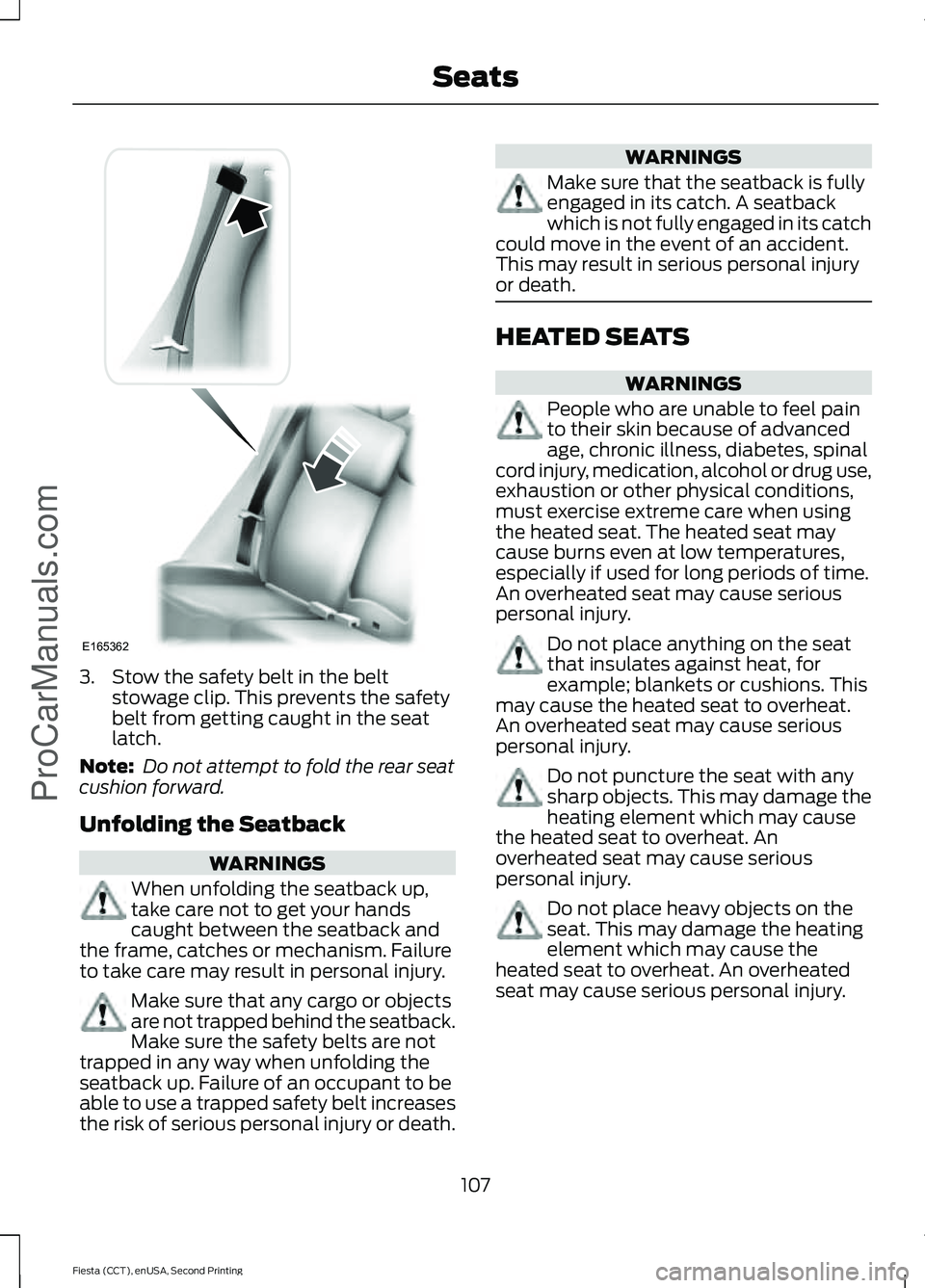
3. Stow the safety belt in the belt
stowage clip. This prevents the safety
belt from getting caught in the seat
latch.
Note: Do not attempt to fold the rear seat
cushion forward.
Unfolding the Seatback WARNINGS
When unfolding the seatback up,
take care not to get your hands
caught between the seatback and
the frame, catches or mechanism. Failure
to take care may result in personal injury. Make sure that any cargo or objects
are not trapped behind the seatback.
Make sure the safety belts are not
trapped in any way when unfolding the
seatback up. Failure of an occupant to be
able to use a trapped safety belt increases
the risk of serious personal injury or death. WARNINGS
Make sure that the seatback is fully
engaged in its catch. A seatback
which is not fully engaged in its catch
could move in the event of an accident.
This may result in serious personal injury
or death. HEATED SEATS
WARNINGS
People who are unable to feel pain
to their skin because of advanced
age, chronic illness, diabetes, spinal
cord injury, medication, alcohol or drug use,
exhaustion or other physical conditions,
must exercise extreme care when using
the heated seat. The heated seat may
cause burns even at low temperatures,
especially if used for long periods of time.
An overheated seat may cause serious
personal injury. Do not place anything on the seat
that insulates against heat, for
example; blankets or cushions. This
may cause the heated seat to overheat.
An overheated seat may cause serious
personal injury. Do not puncture the seat with any
sharp objects. This may damage the
heating element which may cause
the heated seat to overheat. An
overheated seat may cause serious
personal injury. Do not place heavy objects on the
seat. This may damage the heating
element which may cause the
heated seat to overheat. An overheated
seat may cause serious personal injury.
107
Fiesta (CCT), enUSA, Second Printing SeatsProCarManuals.comE165362
Page 111 of 423
WARNINGS
Do not use the seat heater if any
liquid is spilled on the seat. This may
damage the heating element which
may cause the heated seat to overheat.
Allow the seat to dry thoroughly before
reusing the seat heater. An overheated
seat may cause serious personal injury. Note:
The heated seats include both a
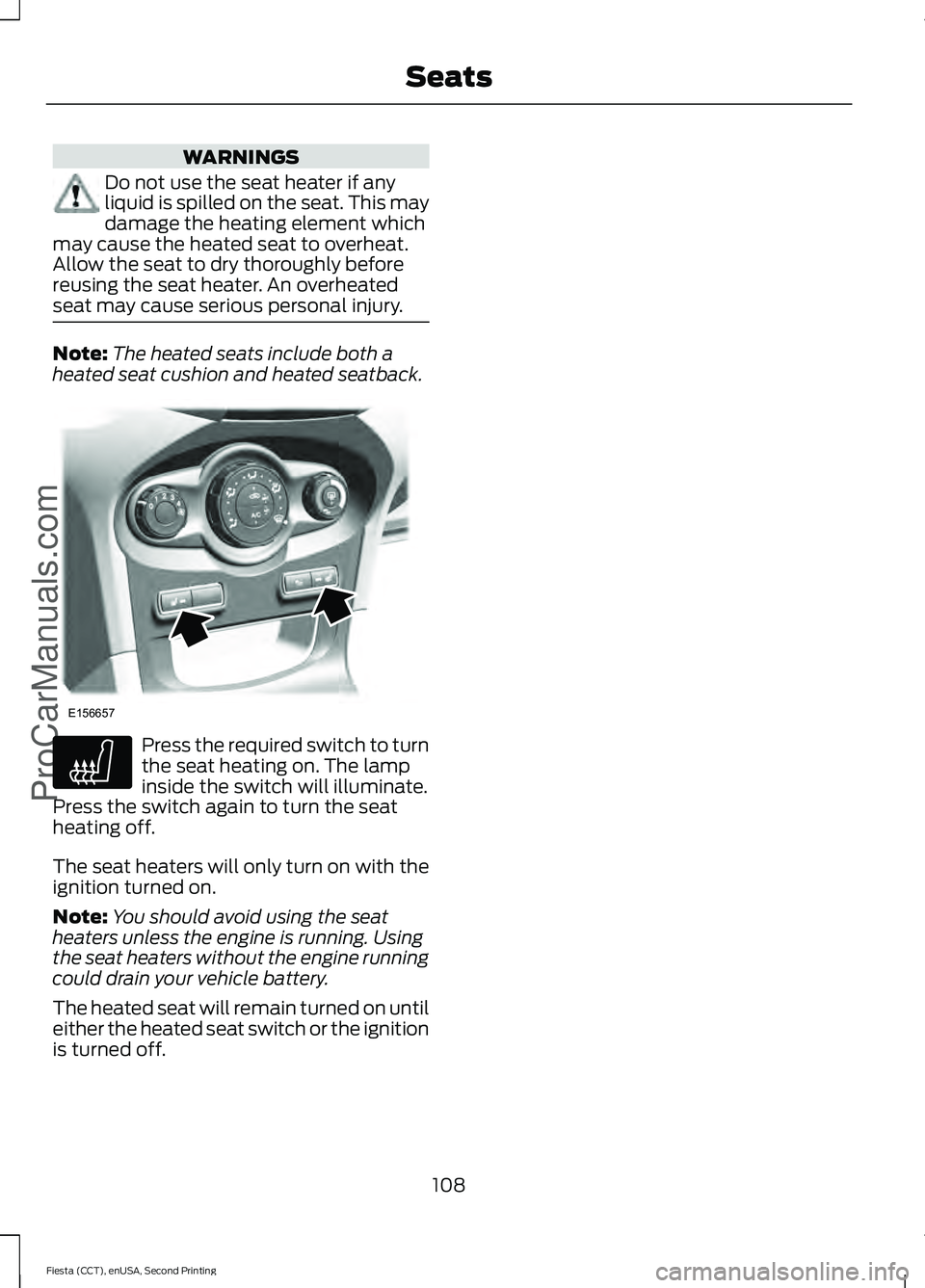
heated seat cushion and heated seatback. Press the required switch to turn
the seat heating on. The lamp
inside the switch will illuminate.
Press the switch again to turn the seat
heating off.
The seat heaters will only turn on with the
ignition turned on.
Note: You should avoid using the seat
heaters unless the engine is running. Using
the seat heaters without the engine running
could drain your vehicle battery.
The heated seat will remain turned on until
either the heated seat switch or the ignition
is turned off.
108
Fiesta (CCT), enUSA, Second Printing SeatsProCarManuals.comE156657
Page 144 of 423
STEERING
Electric Power Steering
WARNING
The electric power steering system
has diagnostic checks that
continuously monitor the system. If
a fault is detected, a message displays in
the information display. Stop your vehicle
as soon as it is safe to do so. Switch the
ignition off. After at least 10 seconds,
switch the ignition on and watch the
information display for a steering system
warning message. If a steering system
warning message returns, have the system
checked by an authorized dealer. Your vehicle has an electric power steering
system. There is no fluid reservoir. No
maintenance is required.
If your vehicle loses electrical power while
you are driving, electric power steering
assistance is lost. The steering system still
operates and you can steer your vehicle
manually. Manually steering your vehicle
requires more effort.
Extreme continuous steering may increase
the effort required for you to steer your
vehicle. This increased effort prevents
overheating and permanent damage to
the steering system. You do not lose the
ability to steer your vehicle manually.
Typical steering and driving maneuvers
allow the system to cool and return to
normal operation.
Steering Tips
If the steering wanders or pulls, check for:
•
Correct tire pressures.
• Uneven tire wear.
• Loose or worn suspension
components. •
Loose or worn steering components.
• Improper vehicle alignment.
Note: A high crown in the road or high
crosswinds may also make the steering
seem to wander or pull.
Adaptive Learning
The electronic power steering system
adaptive learning helps correct road
irregularities and improves overall handling
and steering feel. It communicates with
the brake system to help operate
advanced stability control and accident
avoidance systems. Additionally, whenever
the battery is disconnected or a new
battery installed, you must drive your
vehicle a short distance before the system
relearns the strategy and reactivates all
systems.
141
Fiesta (CCT), enUSA, Second Printing Driving AidsProCarManuals.com
Page 187 of 423
Note:
Coolant expands when it is hot. The
level may extend beyond the MAX mark.
Note: If the level is at the MIN mark, below
the MIN mark, or empty, add coolant
immediately. See Adding Engine Coolant
in this chapter.
Maintain coolant concentration within
48% to 50%, which equates to a freeze
point between -30°F (-34°C) and -34°F
(-37°C).
Note: For best results, coolant
concentration should be tested with a
refractometer, for example Robinair®
coolant and battery refractometer 75240.
We do not recommend the use of
hydrometers or coolant test strips for
measuring coolant concentrations.
Note: Automotive fluids are not
interchangeable. Do not use engine coolant,
antifreeze or windshield washer fluid outside
of its specified function and vehicle location.
Adding Engine Coolant WARNINGS
Do not add engine coolant when the
engine is hot. Steam and scalding
liquids released from a hot cooling
system can burn you badly. Also, spilling
coolant on hot engine parts can burn you. Do not put engine coolant in the
windshield washer fluid reservoir. If
sprayed on the windshield, engine
coolant could make it difficult to see
through the windshield. Do not add coolant further than the
MAX mark.
To reduce the risk of personal injury,
make sure the engine is cool before
unscrewing the coolant pressure
relief cap. The cooling system is under
pressure; steam and hot liquid can come
out forcefully when the cap is loosened
slightly. Note:
Do not use stop leak pellets, cooling
system sealants or additives as they can
cause damage to the engine cooling or
heating systems. The vehicle warranty does
not cover this damage.
Note: During normal vehicle operation, the
engine coolant may change color from
orange to pink or light red. As long as the
engine coolant is clear and uncontaminated,
this color change does not indicate that the
engine coolant has degraded or that you
drain the engine coolant, flush the system
or replace the engine coolant.
• Do not mix different colors or types of
coolant in your vehicle. Make sure the
correct coolant is used. Mixing of
engine coolants may harm the engine ’s
cooling system. The use of incorrect
coolant may harm engine and cooling
system components and may void the
warranty. Use prediluted engine
coolant meeting the Ford specification.
See
Capacities and Specifications
(page 241).
• In case of emergency, you can add a
large amount of water without engine
coolant in order to reach a vehicle
service location. In this instance, you
must have the cooling system drained,
chemically cleaned with Motorcraft
Premium Cooling System Flush, and
refilled with engine coolant as soon as
possible. Water alone (without engine
coolant) can cause engine damage, for
example corrosion, overheating or
freezing.
• Do not use alcohol, methanol, brine or
any engine coolants mixed with alcohol
or methanol antifreeze. Alcohol and
other liquids can cause engine damage,
for example overheating or freezing.
• Do not add extra inhibitors or additives
to the coolant. These can be harmful
and compromise the corrosion
protection of the engine coolant.
184
Fiesta (CCT), enUSA, Second Printing Maintenance
ProCarManuals.com
Page 400 of 423
When ENGINE OIL CHANGE DUE NEXT
SERVICE or OIL CHANGE REQUIRED
appears in the information display, it is
time for an oil change; the oil change must
be done within two weeks or 500 miles
(800 kilometers) of the
ENGINE OIL
CHANGE DUE NEXT SERVICE or OIL
CHANGE REQUIRED message appearing.
The oil minder system must be reset after
each oil change. See
Oil Change
Indicator Reset (page 183).
If your information display resets
prematurely or becomes inoperative, you
should perform the oil change interval at
six months or 5000 miles (8000
kilometers) from your last oil change.
Never exceed one year or 10000 miles
(16000 kilometers) between oil change
intervals.
Your vehicle is very sophisticated and built
with multiple, complex, performance
systems. Every manufacturer develops
these systems using different
specifications and performance features.
That is why it is important to rely upon your
dealership to properly diagnose and repair
your vehicle.
Ford Motor Company has recommended
maintenance intervals for various parts
and component systems based upon
engineering testing. Ford Motor Company
relies upon this testing to determine the
most appropriate mileage for replacement
of oils and fluids to protect your vehicle at
the lowest overall cost to you and
recommends against maintenance
schedules that deviate from the scheduled
maintenance information. We strongly recommend the use of only
genuine Ford, Motorcraft or
Ford-authorized re-manufactured
replacement parts engineered for your
vehicle.
Additives and Chemicals
This owner's manual and the Ford
Workshop Manual list the recommended
additives and chemicals for your vehicle.
We do not recommend using chemicals or
additives not approved by us as part of
your vehicle
’s normal maintenance. Please
consult your warranty information.
Oils, Fluids and Flushing
In many cases, fluid discoloration is a
normal operating characteristic and, by
itself, does not necessarily indicate a
concern or that the fluid needs to be
changed. However, a qualified expert, such
as the factory-trained technicians at your
dealership, should inspect discolored fluids
that also show signs of overheating or
foreign material contamination
immediately.
Make sure to change your vehicle ’s oils and
fluids at the specified intervals or in
conjunction with a repair. Flushing is a
viable way to change fluid for many vehicle
sub-systems during scheduled
maintenance. It is critical that systems are
flushed only with new fluid that is the same
as that required to fill and operate the
system or using a Ford-approved flushing
chemical.
Owner Checks and Services
Make sure you perform the following basic
maintenance checks and inspections every
month or at six-month intervals.
397
Fiesta (CCT), enUSA, Second Printing Scheduled Maintenance
ProCarManuals.com
Page 417 of 423
Fuel Consumption.........................................119
Calculating Fuel Economy............................... 119
Filling the Tank..................................................... 119
Fuel Filter.........................................................186
Fuel Quality - Gasoline.................................117
Choosing the Right Fuel (Flexible Fuel
Vehicles)............................................................. 117
Choosing the Right Fuel (Gasoline Vehicles)............................................................. 117
Octane Recommendations.............................. 117
Fuel Shutoff
....................................................158
Fuses.................................................................168
Fuse Specification Chart
...........................168
Engine Compartment Fuse Box................... 168
Passenger Compartment Fuse Box.............172
G
Gauges................................................................75 Compass (If Equipped)...................................... 75
Engine Coolant Temperature Gauge.............76
Fuel Gauge.............................................................. 76
General Information on Radio Frequencies...................................................42
Intelligent Access................................................. 42
General Maintenance Information.......396 Multi-Point Inspection..................................... 398
Owner Checks and Services.......................... 397
Protecting Your Investment.......................... 396
Why Maintain Your Vehicle?......................... 396
Why Maintain Your Vehicle at Your Dealership?..................................................... 396
Getting Assistance Outside the U.S. and Canada..........................................................165
Getting the Services You Need................162 Away From Home............................................... 162
Global Opening and Closing.......................71 Global Closing........................................................ 72
Global Opening...................................................... 71
H
Handbrake See: Parking Brake............................................... 131
Hazard Warning Flashers..........................158
Headlamp Exit Delay....................................67
Head Restraints............................................103 Adjusting the Head Restraint........................ 104Heated Seats..................................................107
Heated Windows and Mirrors...................101
Heated Exterior Mirrors..................................... 101
Heated Windows................................................. 101
Heating See: Climate Control........................................... 95
Hill Start Assist..............................................128 Switching the System On and Off...............129
Using Hill Start Assist....................................... 128
Hints on Controlling the Interior Climate
...........................................................98
Cooling the Interior Quickly............................ 100
General Hints......................................................... 98
Heating the Interior Quickly............................. 99
Maximum Cooling Performance in Instrument Panel or Instrument Panel
and Footwell Positions................................ 101
Recommended Settings for Cooling .........100
Recommended Settings for Heating...........99
Side Window Defogging in Cold Weather.............................................................. 101
Vehicle Stationary for Extended Periods During Extreme High Ambient
Temperatures................................................. 100
Hints on Driving With Anti-Lock Brakes............................................................130
Hood Lock See: Opening and Closing the Hood............177
I
Ignition Switch
.................................................111
In California (U.S. Only).............................163
Information Displays.....................................83 General Information............................................ 83
Information....................................................352 911 Assist............................................................... 358
Alerts...................................................................... 358
Calendar............................................................... 358
Sirius Travel Link................................................ 356
SYNC Services (If Equipped, United States Only).................................................................. 353
Vehicle Health Report..................................... 360
Information Messages
..................................87
414
Fiesta (CCT), enUSA, Second Printing Index
ProCarManuals.com