airbag FORD FLEX 2009 1.G Owner's Manual
[x] Cancel search | Manufacturer: FORD, Model Year: 2009, Model line: FLEX, Model: FORD FLEX 2009 1.GPages: 374
Page 189 of 374
WARNING:To reduce the risk of possible serious injury:
Do not stow objects in seat back map pocket (if equipped) or
hang objects off seat back if a child is in the front passenger seat.
Do not place objects underneath the front passenger seat or between
the seat and the center console (if equipped).
Check the “passenger airbag off” or “pass airbag off” indicator lamp for
proper airbag Status.
Failure to follow these instructions may interfere with the front
passenger seat sensing system.
In case there is a problem with the
front passenger sensing system, the
airbag readiness lamp in the
instrument cluster will stay lit.
If the airbag readiness lamp is lit, do the following:
The driver and/or adult passengers should check for any objects that
may be lodged underneath the front passenger seat or cargo interfering
with the seat.
If objects are lodged and/or cargo is interfering with the seat; please take
the following steps to remove the obstruction:
•Pull the vehicle over.
•Turn the vehicle off.
•Driver and/or adult passengers should check for any objects lodged
underneath the front passenger seat or cargo interfering with the seat.
•Remove the obstruction(s) (if found).
•Restart the vehicle.
•Wait at least two minutes and verify that the airbag readiness lamp is
no longer illuminated
•If the airbag readiness lamp remains illuminated, this may or may/not
be a problem due to the front passenger sensing system.
DO NOT attempt to repair or service the system; take your vehicle
immediately to an authorized dealer.
If it is necessary to modify an advanced front airbag system to
accommodate a person with disabilities, contact the Ford Customer
Relationship Center at the phone number shown in theCustomer
Assistancechapter of thisOwner’s Guide.
2009 Flex(471)
Owners Guide (post-2002-fmt)
USA(fus)
Seating and Safety Restraints
189
Page 190 of 374
WARNING:Any alteration/modification to the front passenger
seat may affect the performance of the front passenger sensing
system.
Determining if the system is operational
The supplemental restraint system uses a warning indicator light in the
instrument cluster or a back-up tone to indicate the condition of the
system. Refer to theWarning lights and chimessection in the
Instrument Clusterchapter. Routine maintenance of the airbag is not
required.
A difficulty with the system is indicated by one or more of the following:
•The readiness light (same light
for front and side airbag system)
will either flash or stay lit.
•The readiness light will not
illuminate immediately after ignition is turned on.
•A series of five beeps will be heard. The tone pattern will repeat
periodically until the problem and/or light are repaired.
If any of these things happen, even intermittently, have the supplemental
restraint system serviced at an authorized dealer immediately. Unless
serviced, the system may not function properly in the event of a
collision.
Seat-mounted side airbag system
WARNING:Do not place objects or mount equipment on or
near the airbag cover on the side of the seatbacks of the front
seats or in front seat areas that may come into contact with a
deploying airbag. Failure to follow these instructions may increase the
risk of personal injury in the event of a collision.
WARNING:Do not use accessory seat covers. The use of
accessory seat covers may prevent the deployment of the side
airbags and increase the risk of injury in an accident.
WARNING:Do not lean your head on the door. The side airbag
could injure you as it deploys from the side of the seatback.
2009 Flex(471)
Owners Guide (post-2002-fmt)
USA(fus)
Seating and Safety Restraints
190
Page 191 of 374
WARNING:Do not attempt to service, repair, or modify the
airbag SRS, its fuses or the seat cover on a seat containing an
airbag. See your authorized dealer.
WARNING:All occupants of the vehicle should always wear
their safety belts even when an airbag SRS is provided.
How does the side airbag system work?
The design and development of the side airbag system included
recommended testing procedures that were developed by a group of
automotive safety experts known as the Side Airbag Technical Working
Group. These recommended testing procedures help reduce the risk of
injuries related to the deployment of side airbags.
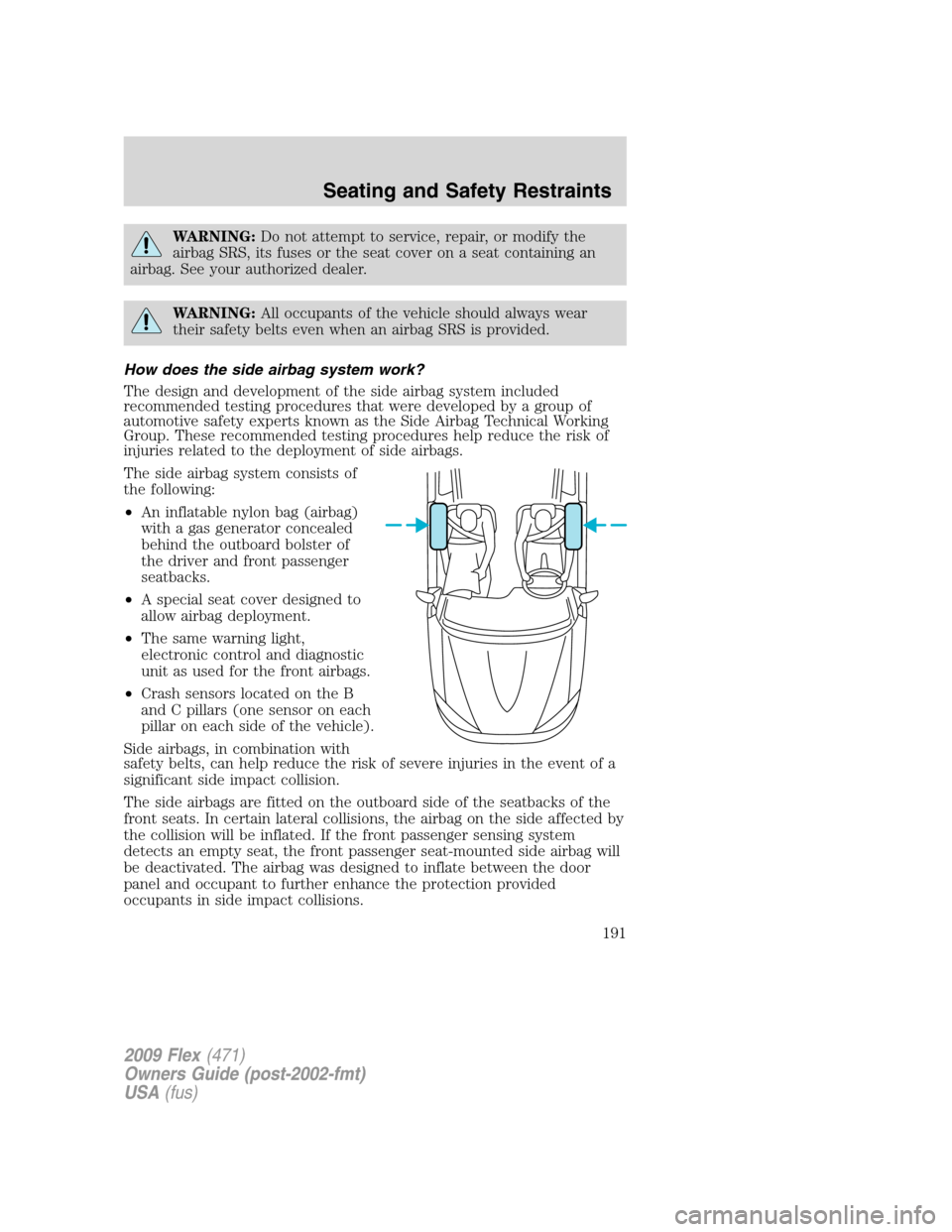
The side airbag system consists of
the following:
•An inflatable nylon bag (airbag)
with a gas generator concealed
behind the outboard bolster of
the driver and front passenger
seatbacks.
•A special seat cover designed to
allow airbag deployment.
•The same warning light,
electronic control and diagnostic
unit as used for the front airbags.
•Crash sensors located on the B
and C pillars (one sensor on each
pillar on each side of the vehicle).
Side airbags, in combination with
safety belts, can help reduce the risk of severe injuries in the event of a
significant side impact collision.
The side airbags are fitted on the outboard side of the seatbacks of the
front seats. In certain lateral collisions, the airbag on the side affected by
the collision will be inflated. If the front passenger sensing system
detects an empty seat, the front passenger seat-mounted side airbag will
be deactivated. The airbag was designed to inflate between the door
panel and occupant to further enhance the protection provided
occupants in side impact collisions.
2009 Flex(471)
Owners Guide (post-2002-fmt)
USA(fus)
Seating and Safety Restraints
191
Page 192 of 374
The airbag SRS is designed to activate when the vehicle sustains lateral
deceleration sufficient to cause the sensors to close an electrical circuit
that initiates airbag inflation.
The fact that the airbags did not inflate in a collision does not mean that
something is wrong with the system. Rather, it means the forces were
not of the type sufficient to cause activation. Side airbags are designed
to inflate in side-impact collisions, not roll-over, rear-impact, frontal or
near-frontal collisions, unless the collision causes sufficient lateral
deceleration.
WARNING:Several air bag system components get hot after
inflation. Do not touch them after inflation.
WARNING:If the side
airbag has deployed,the
airbag will not function again.
The side airbag system
(including the seat) must be
inspected and serviced by an
authorized dealer.If the airbag
is not replaced, the unrepaired
area will increase the risk of injury
in a collision.
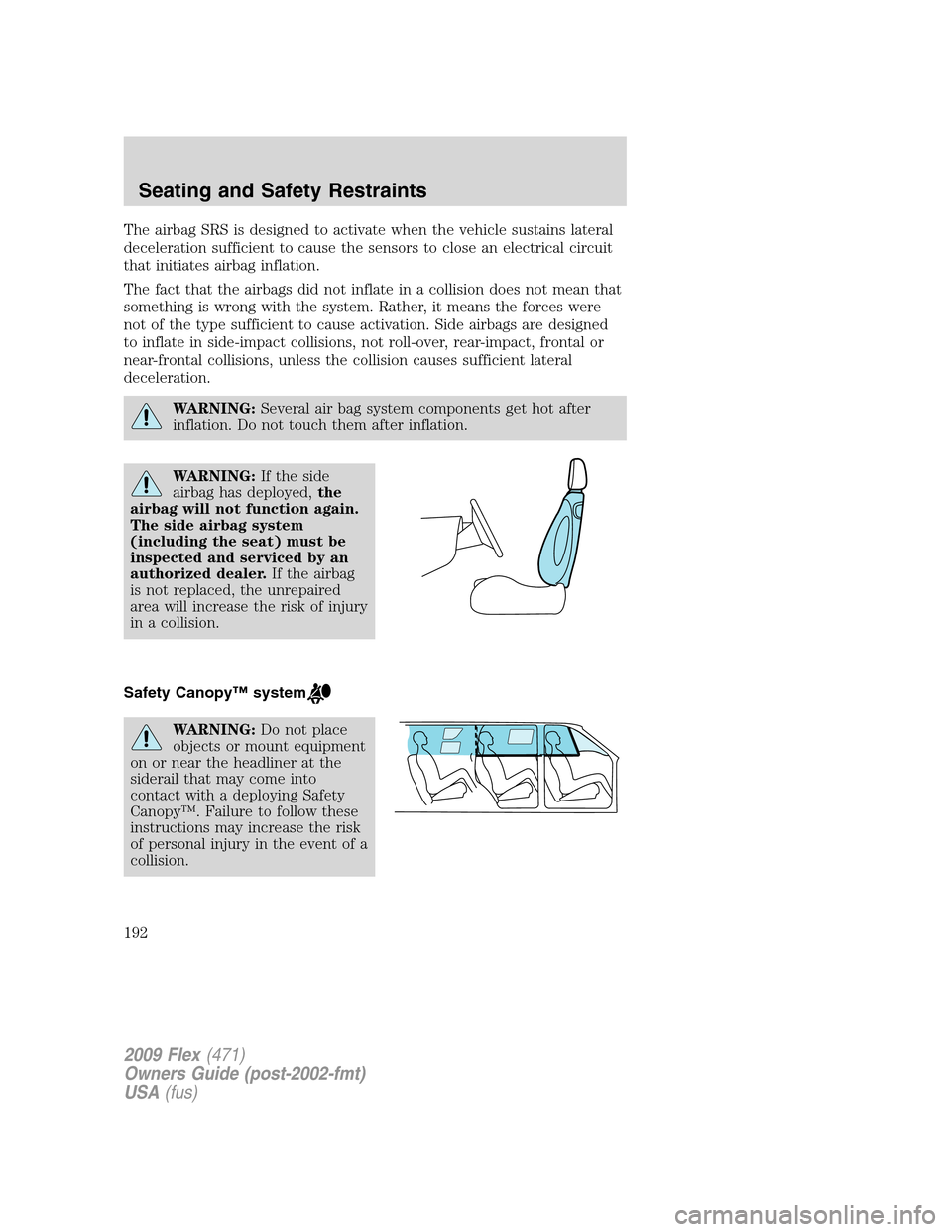
Safety Canopy™ system
WARNING:Do not place
objects or mount equipment
on or near the headliner at the
siderail that may come into
contact with a deploying Safety
Canopy™. Failure to follow these
instructions may increase the risk
of personal injury in the event of a
collision.
2009 Flex(471)
Owners Guide (post-2002-fmt)
USA(fus)
Seating and Safety Restraints
192
Page 193 of 374
WARNING:Do not lean your head on the door. The Safety
Canopy™ could injure you as it deploys from the headliner.
WARNING:Do not attempt to service, repair, or modify the
Safety Canopy™ system, its fuses, the A, B, C or D pillar trim, or
the headliner on a vehicle containing a Safety Canopy™. See your
authorized dealer.
WARNING:All occupants of the vehicle including the driver
should always wear their safety belts even when an airbag SRS
and Safety Canopy™ system is provided.
WARNING:To reduce risk of injury, do not obstruct or place
objects in the deployment path of the inflatable Safety Canopy™.
2009 Flex(471)
Owners Guide (post-2002-fmt)
USA(fus)
Seating and Safety Restraints
193
Page 194 of 374
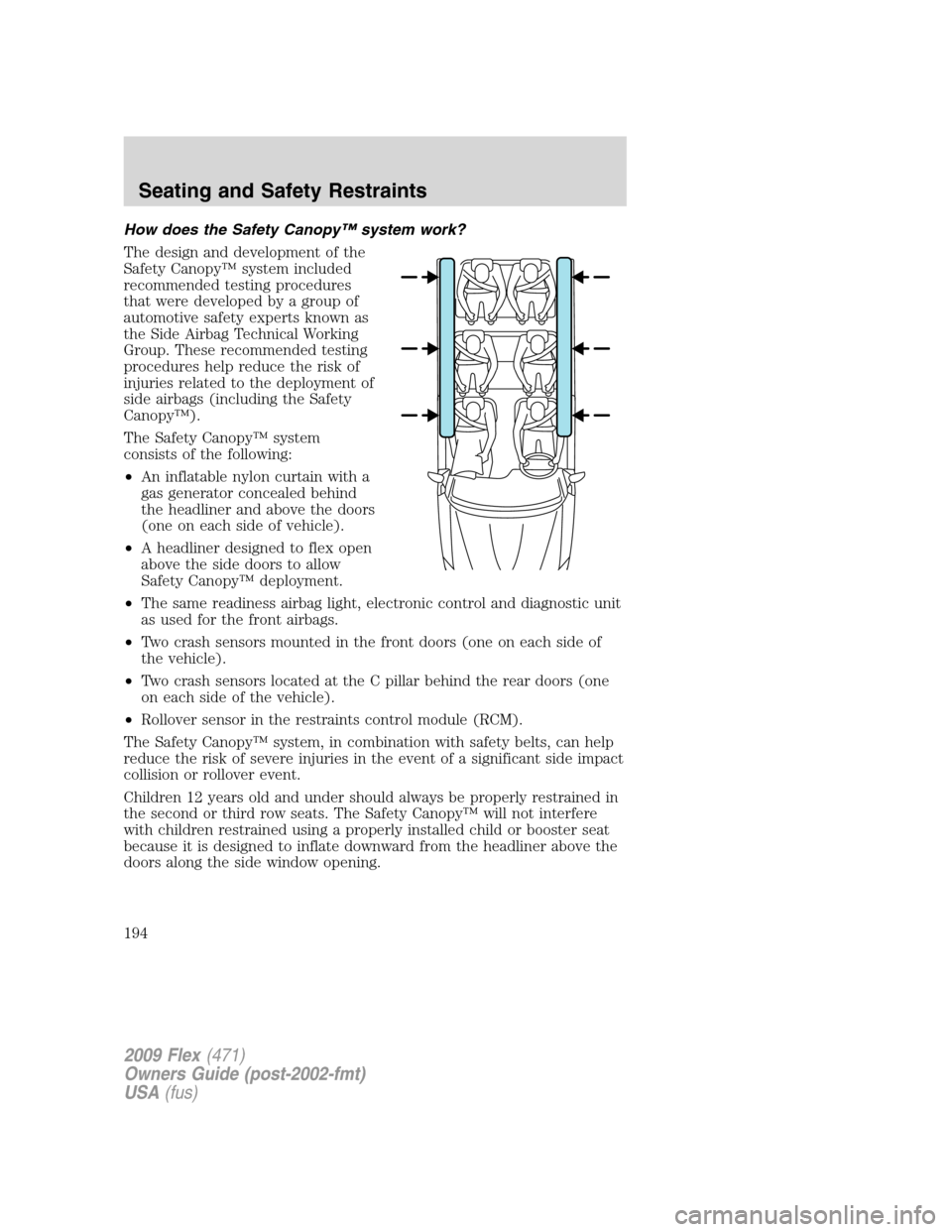
How does the Safety Canopy™ system work?
The design and development of the
Safety Canopy™ system included
recommended testing procedures
that were developed by a group of
automotive safety experts known as
the Side Airbag Technical Working
Group. These recommended testing
procedures help reduce the risk of
injuries related to the deployment of
side airbags (including the Safety
Canopy™).
The Safety Canopy™ system
consists of the following:
•An inflatable nylon curtain with a
gas generator concealed behind
the headliner and above the doors
(one on each side of vehicle).
•A headliner designed to flex open
above the side doors to allow
Safety Canopy™ deployment.
•The same readiness airbag light, electronic control and diagnostic unit
as used for the front airbags.
•Two crash sensors mounted in the front doors (one on each side of
the vehicle).
•Two crash sensors located at the C pillar behind the rear doors (one
on each side of the vehicle).
•Rollover sensor in the restraints control module (RCM).
The Safety Canopy™ system, in combination with safety belts, can help
reduce the risk of severe injuries in the event of a significant side impact
collision or rollover event.
Children 12 years old and under should always be properly restrained in
the second or third row seats. The Safety Canopy™ will not interfere
with children restrained using a properly installed child or booster seat
because it is designed to inflate downward from the headliner above the
doors along the side window opening.
2009 Flex(471)
Owners Guide (post-2002-fmt)
USA(fus)
Seating and Safety Restraints
194
Page 195 of 374
The Safety Canopy™ system is designed to activate when the vehicle
sustains lateral deceleration sufficient to cause the side crash sensor to
close an electrical circuit that initiates Safety Canopy™ inflation or when
a certain likelihood of a rollover event is detected by the rollover sensor.
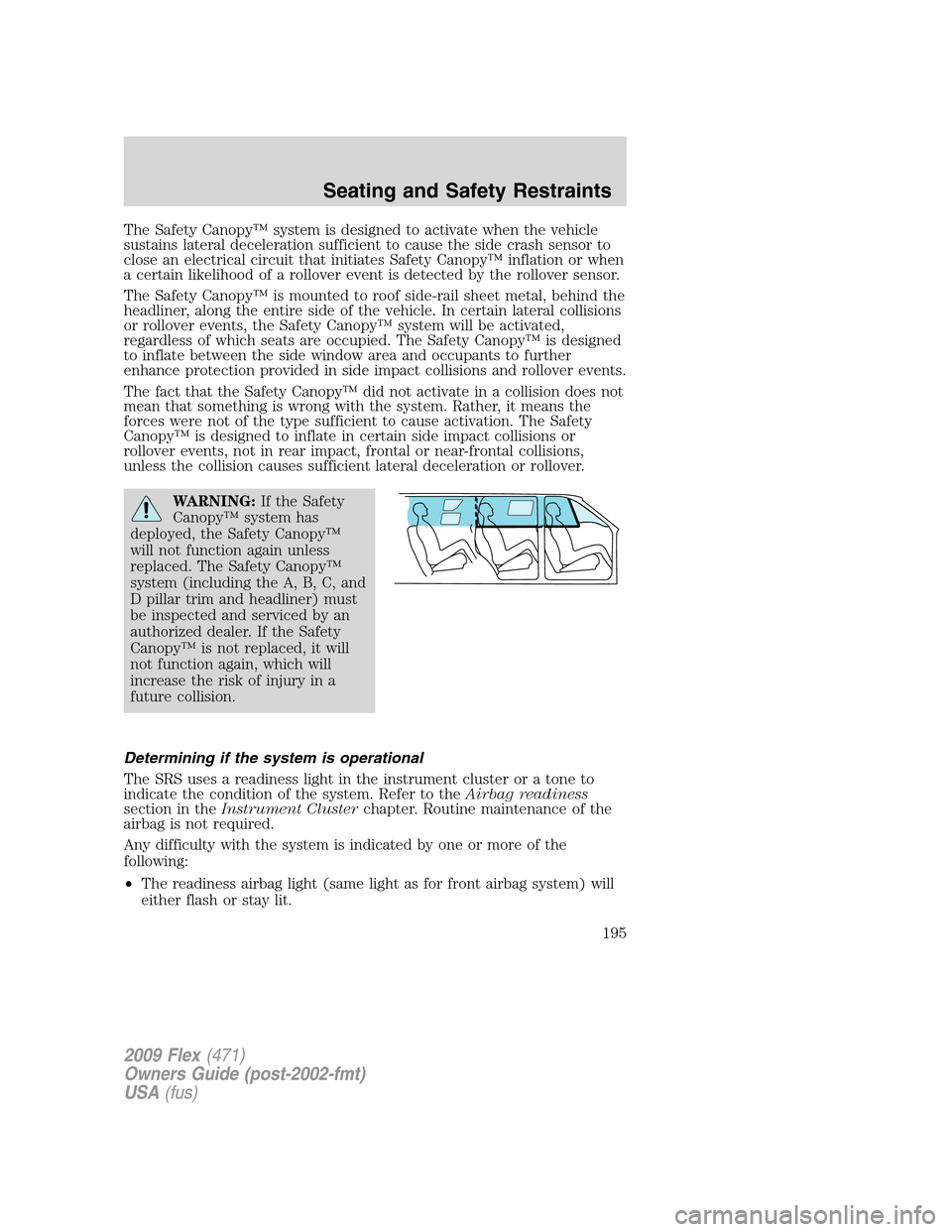
The Safety Canopy™ is mounted to roof side-rail sheet metal, behind the
headliner, along the entire side of the vehicle. In certain lateral collisions
or rollover events, the Safety Canopy™ system will be activated,
regardless of which seats are occupied. The Safety Canopy™ is designed
to inflate between the side window area and occupants to further
enhance protection provided in side impact collisions and rollover events.
The fact that the Safety Canopy™ did not activate in a collision does not
mean that something is wrong with the system. Rather, it means the
forces were not of the type sufficient to cause activation. The Safety
Canopy™ is designed to inflate in certain side impact collisions or
rollover events, not in rear impact, frontal or near-frontal collisions,
unless the collision causes sufficient lateral deceleration or rollover.
WARNING:If the Safety
Canopy™ system has
deployed, the Safety Canopy™
will not function again unless
replaced. The Safety Canopy™
system (including the A, B, C, and
D pillar trim and headliner) must
be inspected and serviced by an
authorized dealer. If the Safety
Canopy™ is not replaced, it will
not function again, which will
increase the risk of injury in a
future collision.
Determining if the system is operational
The SRS uses a readiness light in the instrument cluster or a tone to
indicate the condition of the system. Refer to theAirbag readiness
section in theInstrument Clusterchapter. Routine maintenance of the
airbag is not required.
Any difficulty with the system is indicated by one or more of the
following:
•The readiness airbag light (same light as for front airbag system) will
either flash or stay lit.
2009 Flex(471)
Owners Guide (post-2002-fmt)
USA(fus)
Seating and Safety Restraints
195
Page 196 of 374
•The readiness light will not illuminate immediately after ignition is
turned on.
•A series of five beeps will be heard. The tone pattern will repeat
periodically until the problem and light are repaired.
If any of these things happen, even intermittently, have the SRS serviced
at your an authorized dealer immediately. Unless serviced, the system
may not function properly in the event of a collision or rollover event.
S.O.S. Post Crash Alert
The S.O.S Post Crash Alert automatically flashes the turn signal lamps
and sounds the horn three times at four second intervals in the event of
a serious impact that deploys an airbag (front, side, side curtain or
Safety Canopy™) or the safety belt pretensioners.
The S.O.S. Post Crash Alert can be turned off when any one of the
following actions are taken by the driver or any other person:
•pressing the hazard control button,
•or pressing the panic button on the remote key fob.
The feature will continue to operate until the vehicle runs out of power.
Disposal of airbags and airbag equipped vehicles
(including pretensioners)
See your authorized dealer. Airbags MUST BE disposed of by qualified
personnel.
SAFETY RESTRAINTS FOR CHILDREN
See the following sections for directions on how to properly use safety
restraints for children. Also seeAirbag supplemental restraint system
(SRS)in this chapter for special instructions about using airbags.
Important child restraint precautions
WARNING:Always make sure your child is secured properly in
a device that is appropriate for their height, age and weight.
Child safety restraints must be purchased separately from the vehicle.
Failure to follow these instructions and guidelines may result in an
increased risk of serious injury or death to your child.
2009 Flex(471)
Owners Guide (post-2002-fmt)
USA(fus)
Seating and Safety Restraints
196
Page 201 of 374
training to ensure that all children ages 0 to 16 are properly restrained in
the correct restraint system. Ford recommends checking with a NHTSA
Certified Child Passenger Safety Technician (CPST) and your
pediatrician to make sure your seat is appropriate for your child and
properly installed in the vehicle. To locate a child seat fitting station and
CPST contact the NHTSA toll free at1-888-327-4236or on the internet
at http://www.nhtsa.dot.gov.
Follow all the safety restraint and airbag precautions that apply to adult
passengers in your vehicle.
If the child is the proper height, age, and weight (as specified by your
child safety seat or booster manufacturer), fits the restraint and can be
restrained properly, then restrain the child in the child safety seat or
with the belt-positioning booster. Remember that child seats and
belt-positioning boosters vary and may be designed to fit children of
different heights, ages and weights. Children who are too large for child
safety seats or belt-positioning boosters (as specified by your child safety
seat manufacturer) should always properly wear safety belts.
SAFETY SEATS FOR CHILDREN
Infant and/or toddler seats
Use a safety seat that is recommended for the size and weight of the child.
When installing a child safety seat:
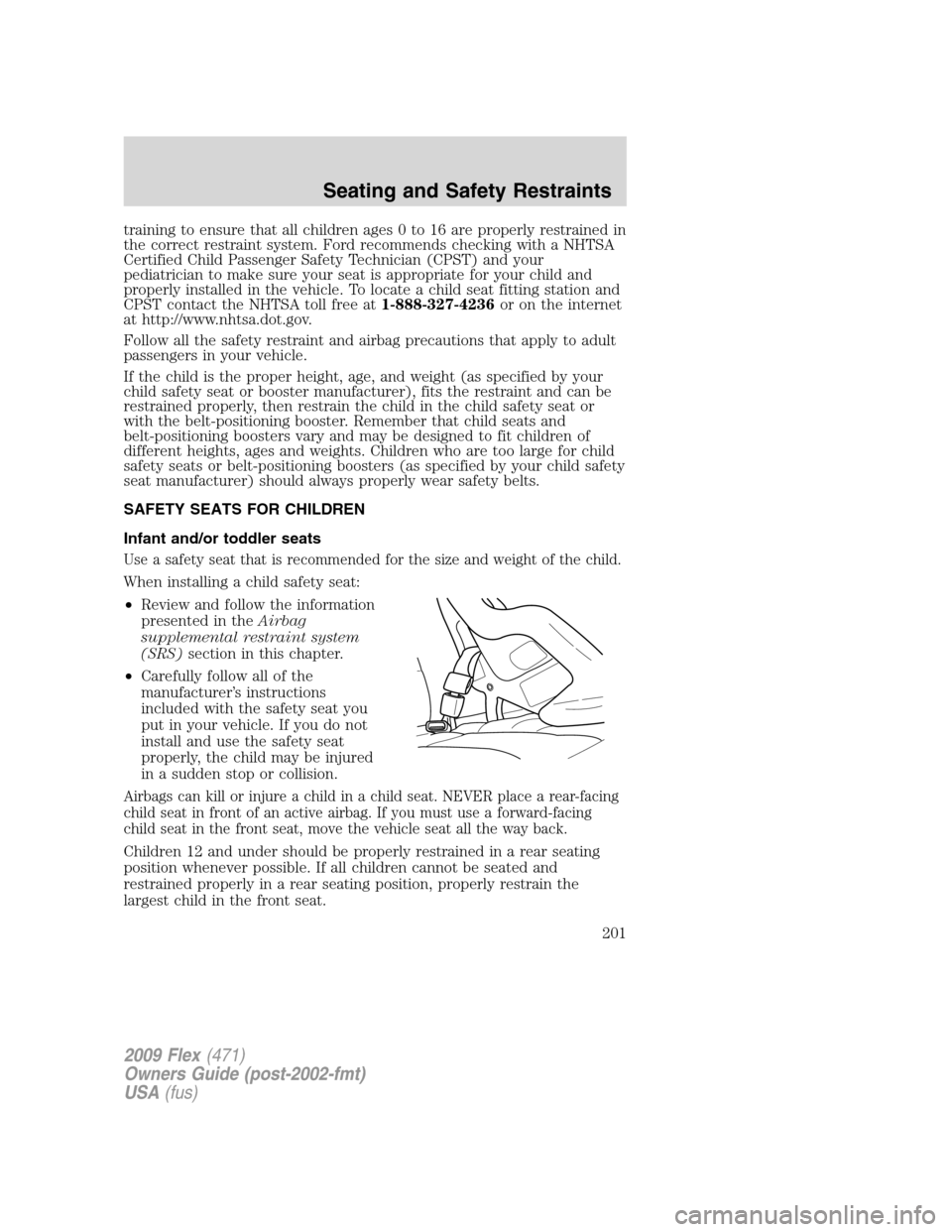
•Review and follow the information
presented in theAirbag
supplemental restraint system
(SRS)section in this chapter.
•Carefully follow all of the
manufacturer’s instructions
included with the safety seat you
put in your vehicle. If you do not
install and use the safety seat
properly, the child may be injured
in a sudden stop or collision.
Airbags can kill or injure a child in a child seat. NEVER place a rear-facing
child seat in front of an active airbag. If you must use a forward-facing
child seat in the front seat, move the vehicle seat all the way back.
Children 12 and under should be properly restrained in a rear seating
position whenever possible. If all children cannot be seated and
restrained properly in a rear seating position, properly restrain the
largest child in the front seat.
2009 Flex(471)
Owners Guide (post-2002-fmt)
USA(fus)
Seating and Safety Restraints
201
Page 284 of 374
Fuse/Relay
LocationFuse Amp
RatingProtected Circuits
34 5A Yaw rate sensor, ABS R/S,
Refrigerator relay coil
35 10A Steering rotation sensor, Rear
park assist, Heated seat modules,
AWD, DC/AC inverter
36 5A PATS module
37 10A Not used (spare)
38 20A Not used (spare)
39 20A Radio
40 20A Second row heated seats
41 15A Switch illumination, EC mirror,
Moon roof, Front lock switches,
Radio
42 10A Not used (spare)
43 10A Aux relay, Heated back light relay,
rear wiper
44 10A Not used (spare)
45 5A Relay coils: PDB, Front and rear
wipers, Front blower motor
46 7.5A Occupant Classification Sensor
(OCS), Passenger Airbag
Deactivation Indicator (PADI)
47 30A Circuit
BreakerPower windows
48 Full ISO relay Delayed accessory relay
Power distribution box
The power distribution box is located in the engine compartment. The
power distribution box contains high-current fuses that protect your
vehicle’s main electrical systems from overloads.
WARNING:Always disconnect the battery before servicing high
current fuses.
2009 Flex(471)
Owners Guide (post-2002-fmt)
USA(fus)
Roadside Emergencies
284