four wheel drive FORD FLEX 2019 User Guide
[x] Cancel search | Manufacturer: FORD, Model Year: 2019, Model line: FLEX, Model: FORD FLEX 2019Pages: 513, PDF Size: 39.3 MB
Page 288 of 513
U.S. DOT Tire Identification
Number
Both United States and Canada
Federal regulations require tire
manufacturers to place
standardized information on the
sidewall of all tires. This
information identifies and
describes the fundamental
characteristics of the tire and also
provides a U.S. DOT Tire
Identification Number for safety
standard certification and in case
of a recall.
This begins with the letters DOT
and indicates that the tire meets
all federal standards. The next
two numbers or letters are the
plant code designating where it
was manufactured, the next two
are the tire size code and the last
four numbers represent the week
and year the tire was built. For
example, the numbers 317 mean
the 31st week of 1997. After 2000,
the numbers go to four digits. For
example, 2501 means the 25th
week of 2001. The numbers in
between are identification codes
used for traceability. This
information is used to contact
customers if a tire defect requires
a recall.
Tire Replacement
Requirements
Your vehicle is equipped with tires
designed to provide a safe ride
and handling capability.
WARNING: Only use
replacement tires and wheels that
are the same size, load index,
speed rating and type (such as
P-metric versus LT-metric or
all-season versus all-terrain) as
those originally provided by Ford.
The recommended tire and wheel
size may be found on either the
Safety Compliance Certification
Label (affixed to either the door
hinge pillar, door-latch post, or the
door edge that meets the
door-latch post, next to the
driver's seating position), or the
Tire Label which is located on the
B-Pillar or edge of the driver's
door. If this information is not
found on these labels, then you
should contact your authorized
dealer as soon as possible. Use of
any tire or wheel not
recommended by Ford can affect
the safety and performance of
your vehicle, which could result in
an increased risk of loss of vehicle
control, vehicle rollover, personal
injury and death. WARNING:
To reduce the
risk of serious injury, when
mounting replacement tires and
wheels, you should not exceed the
maximum pressure indicated on
the sidewall of the tire to set the
beads without additional
precautions listed below. If the
beads do not seat at the
maximum pressure indicated,
re-lubricate and try again.
285
Flex (TP3) , enUSA, Edition date: 201803, Second-Printing Wheels and Tires
Page 290 of 513
*Avoid potholes and objects on
the road
*Do not run over curbs or hit the
tire against a curb when parking
Highway Hazards
No matter how carefully you drive,
there is always the possibility that
you may eventually have a flat tire
on the highway. Drive slowly to the
closest safe area out of traffic.
This may further damage the flat
tire, but your safety is more
important.
If you feel a sudden vibration or
ride disturbance while driving, or
you suspect your tire or vehicle
has been damaged, immediately
reduce your speed. Drive with
caution until you can safely pull
off the road. Stop and inspect the
tires for damage. If a tire is
under-inflated or damaged,
deflate it, remove wheel and
replace it with your spare tire and
wheel. If you cannot detect a
cause, have the vehicle towed to
the nearest repair facility or tire
dealer to have the vehicle
inspected.
Tire and Wheel Alignment
A bad jolt from hitting a curb or
pothole can cause the front end
of your vehicle to become
misaligned or cause damage to
your tires. If your vehicle seems to
pull to one side when you are
driving, the wheels may be out of
alignment. Have an authorized
dealer check the wheel alignment
periodically.
Wheel misalignment in the front
or the rear can cause uneven and
rapid treadwear of your tires and
should be corrected by an
authorized dealer. Front-wheel
drive vehicles and those with an
independent rear suspension (if
equipped) may require alignment
of all four wheels.
The tires should also be balanced
periodically. An unbalanced tire
and wheel assembly may result in
irregular tire wear.
Tire Rotation
Note:
If your tires show uneven
wear, ask an authorized dealer to
check for and correct any wheel
misalignment, tire imbalance or
mechanical problem involved
before tire rotation.
287
Flex (TP3) , enUSA, Edition date: 201803, Second-Printing Wheels and Tires
Page 293 of 513
Please note that the TPMS is not a
substitute for proper tire maintenance, and
it is the driver
’s responsibility to maintain
correct tire pressure, even if under-inflation
has not reached the level to trigger
illumination of the TPMS low tire pressure
telltale.
Your vehicle has also been equipped with
a TPMS malfunction indicator to indicate
when the system is not operating properly.
The TPMS malfunction indicator is
combined with the low tire pressure
telltale. When the system detects a
malfunction, the telltale will flash for
approximately one minute and then remain
continuously illuminated. This sequence
will continue upon subsequent vehicle
start-ups as long as the malfunction exists.
When the malfunction indicator is
illuminated, the system may not be able
to detect or signal low tire pressure as
intended. TPMS malfunctions may occur
for a variety of reasons, including the
installation of replacement or alternate
tires or wheels on the vehicle that prevent
the TPMS from functioning properly.
Always check the TPMS malfunction
telltale after replacing one or more tires or
wheels on your vehicle to ensure that the
replacement or alternate tires and wheels
allow the TPMS to continue to function
properly.
This device complies with Part 15 of the
FCC Rules and with License exempt RSS
Standards of Industry Canada. Operation
is subject to the following two conditions:
1. This device may not cause harmful interference, and
2. This device must accept any interference received, including
interference that may cause undesired
operation. Note:
Changes or modifications not
expressively approved by the party
responsible for compliance could void the
user's authority to operate the equipment.
The term "IC:" before the radio certification
number only signifies that Industry Canada
technical specifications were met.
Changing Tires With a Tire
Pressure Monitoring System Note:
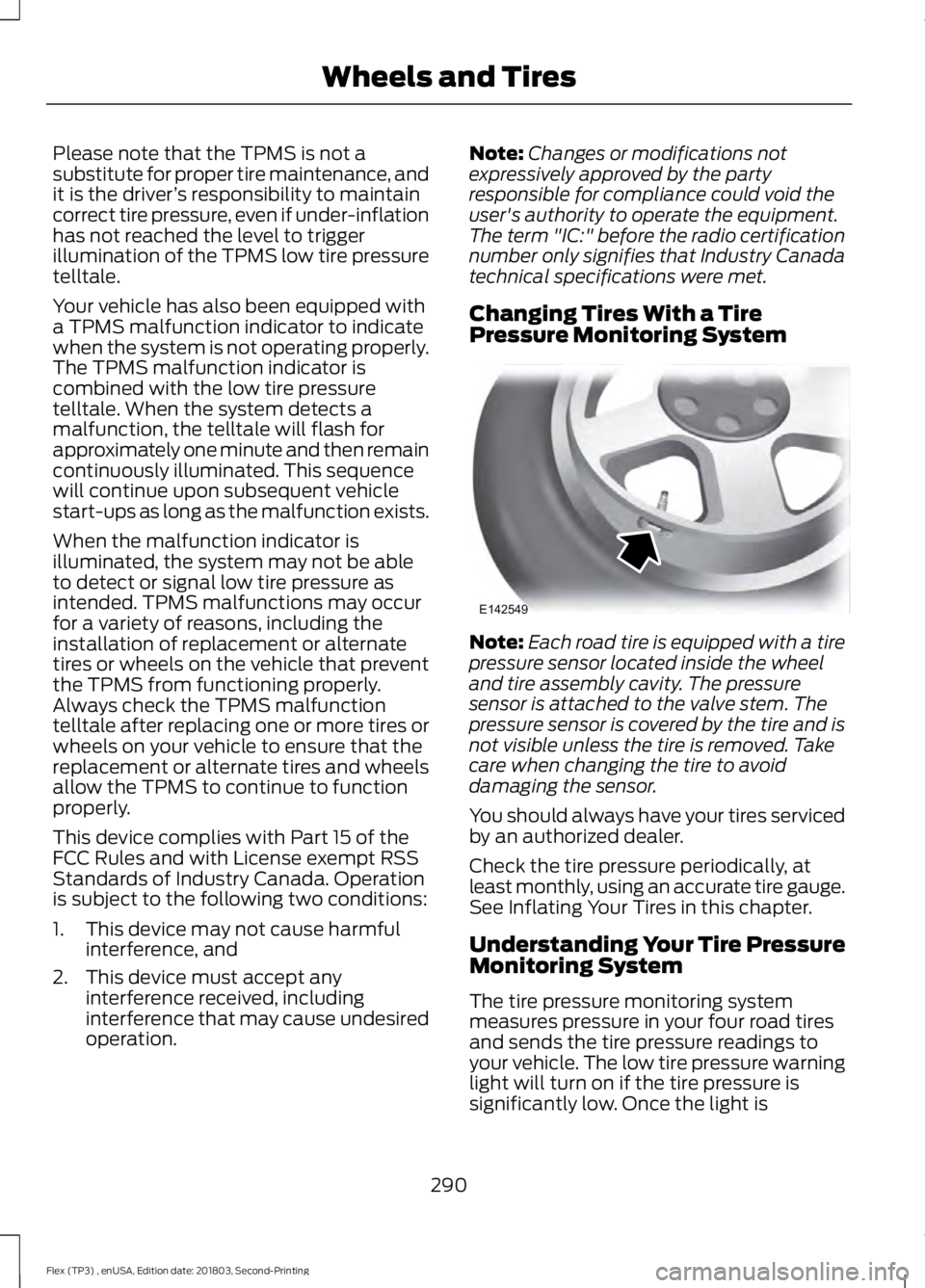
Each road tire is equipped with a tire
pressure sensor located inside the wheel
and tire assembly cavity. The pressure
sensor is attached to the valve stem. The
pressure sensor is covered by the tire and is
not visible unless the tire is removed. Take
care when changing the tire to avoid
damaging the sensor.
You should always have your tires serviced
by an authorized dealer.
Check the tire pressure periodically, at
least monthly, using an accurate tire gauge.
See Inflating Your Tires in this chapter.
Understanding Your Tire Pressure
Monitoring System
The tire pressure monitoring system
measures pressure in your four road tires
and sends the tire pressure readings to
your vehicle. The low tire pressure warning
light will turn on if the tire pressure is
significantly low. Once the light is
290
Flex (TP3) , enUSA, Edition date: 201803, Second-Printing Wheels and TiresE142549
Page 511 of 513
Supplementary Restraints System.........44
Principle of Operation........................................ 44
Symbols Glossary.............................................7
SYNC™ 3........................................................362 General Information......................................... 362
SYNC™ 3 Troubleshooting......................424
SYNC™ Applications and Services........................................................342
911 Assist............................................................... 342
SYNC™............................................................324 General Information......................................... 324
SYNC™ Troubleshooting.........................354
T
Technical Specifications See: Capacities and Specifications............299
The Better Business Bureau (BBB) Auto Line Program (U.S. Only).......................227
Tire Care...........................................................275 Glossary of Tire Terminology.......................... 277
Information About Uniform Tire Quality Grading.............................................................. 275
Information Contained on the Tire Sidewall............................................................ 278
Temperature A B C............................................ 276
Traction AA A B C............................................... 276
Treadwear............................................................. 276
Tire Pressure Monitoring System..........289 Changing Tires With a Tire Pressure
Monitoring System....................................... 290
Understanding Your Tire Pressure Monitoring System ...................................... 290
Tires See: Wheels and Tires...................................... 273
Towing a Trailer............................................208 Load Placement................................................ 208
Towing the Vehicle on Four Wheels...........................................................214
Emergency Towing............................................. 214
Recreational Towing.......................................... 214
Towing.............................................................208
Traction Control.............................................175 Principle of Operation....................................... 175
Trailer Sway Control...................................209
Transmission Code Designation............304
Transmission..................................................162
Transporting the Vehicle
...........................223 Type Approvals
............................................488
Radio Frequency Certification Logos for
Blind Spot Information System..............495
Radio Frequency Certification Logos for Mid Range Radar.................................................. 490
Radio Frequency Certification Logos for Passive Anti-Theft System........................ 491
Radio Frequency Certification Logos for Radio Transceiver Module........................ 494
Radio Frequency Certification Logos for SYNC 3.............................................................. 497
Radio Frequency Certification Logos for Tire Pressure Monitoring Sensor(s)...............488
Radio Frequency Certification Logos for Wireless Charging........................................ 496
U
Under Hood Overview - 3.5L Duratec.........................................................244
Under Hood Overview - 3.5L Ecoboost™.................................................245
Universal Garage Door Opener...............136 HomeLink Wireless Control System............136
USB Port..........................................................323
Using Adaptive Cruise Control................188 Automatic Cancellation.................................... 191
Blocked Sensor.................................................... 192
Canceling the Set Speed.................................. 191
Changing the Set Speed................................... 191
Detection Issues................................................... 191
Following a Vehicle............................................ 189
Hilly Condition Usage......................................... 191
Overriding the Set Speed................................ 190
Resuming the Set Speed.................................. 191
Setting the Adaptive Cruise Speed.............189
Setting the Gap Distance................................ 190
Switching Adaptive Cruise Control Off........................................................................\
191
Switching Adaptive Cruise Control On........................................................................\
189
Switching to Normal Cruise Control............193
System Not Available........................................ 192
Using All-Wheel Drive................................166 Driving In Special Conditions With
All-Wheel Drive (AWD)............................... 168
Operating AWD Vehicles With Mismatched Tires..................................................................... 167
508
Flex (TP3) , enUSA, Edition date: 201803, Second-Printing Index