lights FORD FOCUS 2003 1.G Owner's Manual
[x] Cancel search | Manufacturer: FORD, Model Year: 2003, Model line: FOCUS, Model: FORD FOCUS 2003 1.GPages: 216, PDF Size: 4.15 MB
Page 107 of 216
DrivingSTARTING
Positions of the ignition
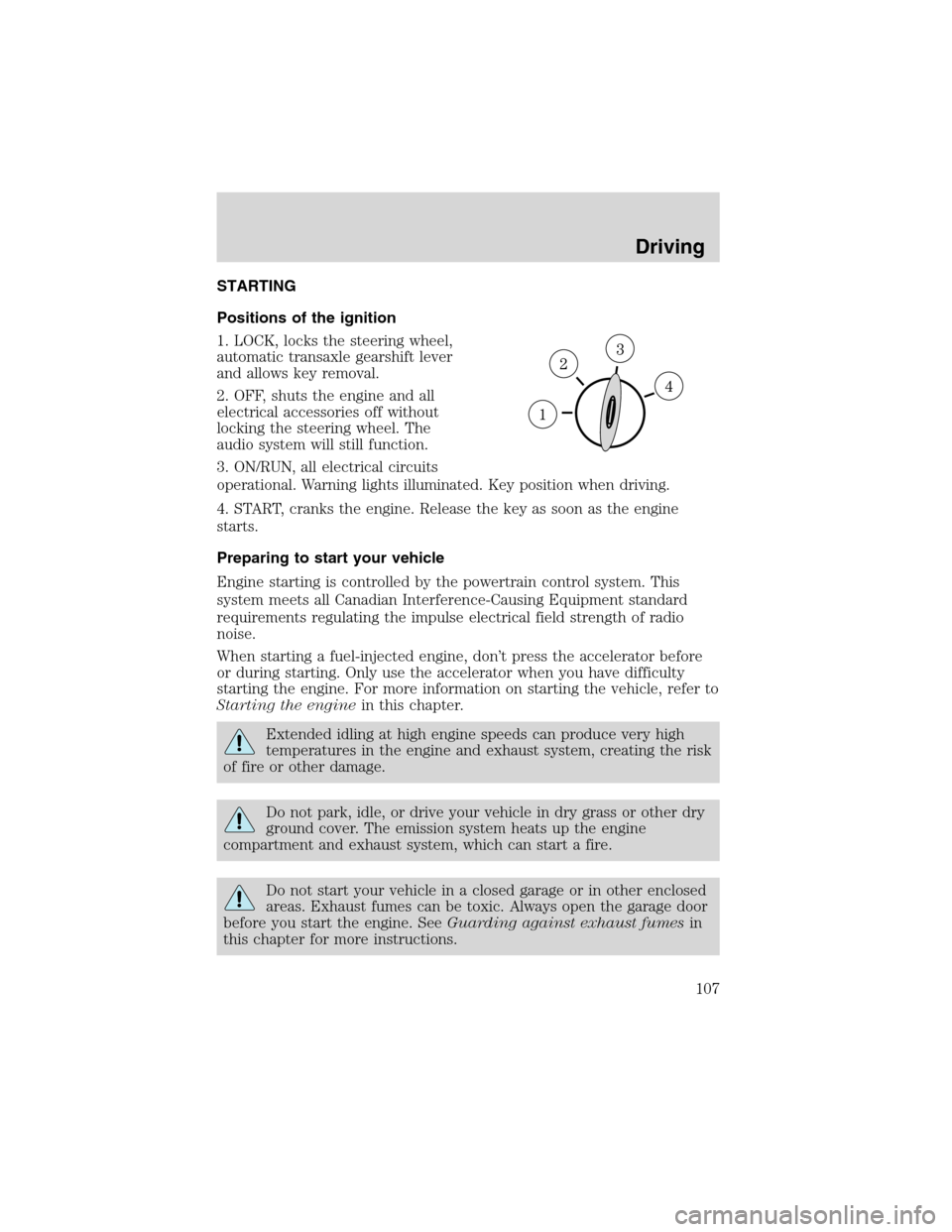
1. LOCK, locks the steering wheel,
automatic transaxle gearshift lever
and allows key removal.
2. OFF, shuts the engine and all
electrical accessories off without
locking the steering wheel. The
audio system will still function.
3. ON/RUN, all electrical circuits
operational. Warning lights illuminated. Key position when driving.
4. START, cranks the engine. Release the key as soon as the engine
starts.
Preparing to start your vehicle
Engine starting is controlled by the powertrain control system. This
system meets all Canadian Interference-Causing Equipment standard
requirements regulating the impulse electrical field strength of radio
noise.
When starting a fuel-injected engine, don’t press the accelerator before
or during starting. Only use the accelerator when you have difficulty
starting the engine. For more information on starting the vehicle, refer to
Starting the enginein this chapter.
Extended idling at high engine speeds can produce very high
temperatures in the engine and exhaust system, creating the risk
of fire or other damage.
Do not park, idle, or drive your vehicle in dry grass or other dry
ground cover. The emission system heats up the engine
compartment and exhaust system, which can start a fire.
Do not start your vehicle in a closed garage or in other enclosed
areas. Exhaust fumes can be toxic. Always open the garage door
before you start the engine. SeeGuarding against exhaust fumesin
this chapter for more instructions.
Driving
107
Page 108 of 216
If you smell exhaust fumes inside your vehicle, have your dealer
inspect your vehicle immediately. Do not drive if you smell
exhaust fumes.
Make sure the corresponding lights illuminate or illuminate briefly. If a
light fails to illuminate, have the vehicle serviced.
•If the driver’s safety belt is fastened, the
light may not illuminate.
Important safety precautions
When the engine starts, the idle RPM runs faster to warm the engine. If
the engine idle speed does not slow down automatically, have the vehicle
checked.
Before starting the vehicle:
1. Make sure all occupants buckle their safety belts. For more
information on safety belts and their proper usage, refer to theSeating
and safety restraintschapter.
2. Make sure the headlamps and electrical accessories are off.
If starting a vehicle with an automatic transaxle:
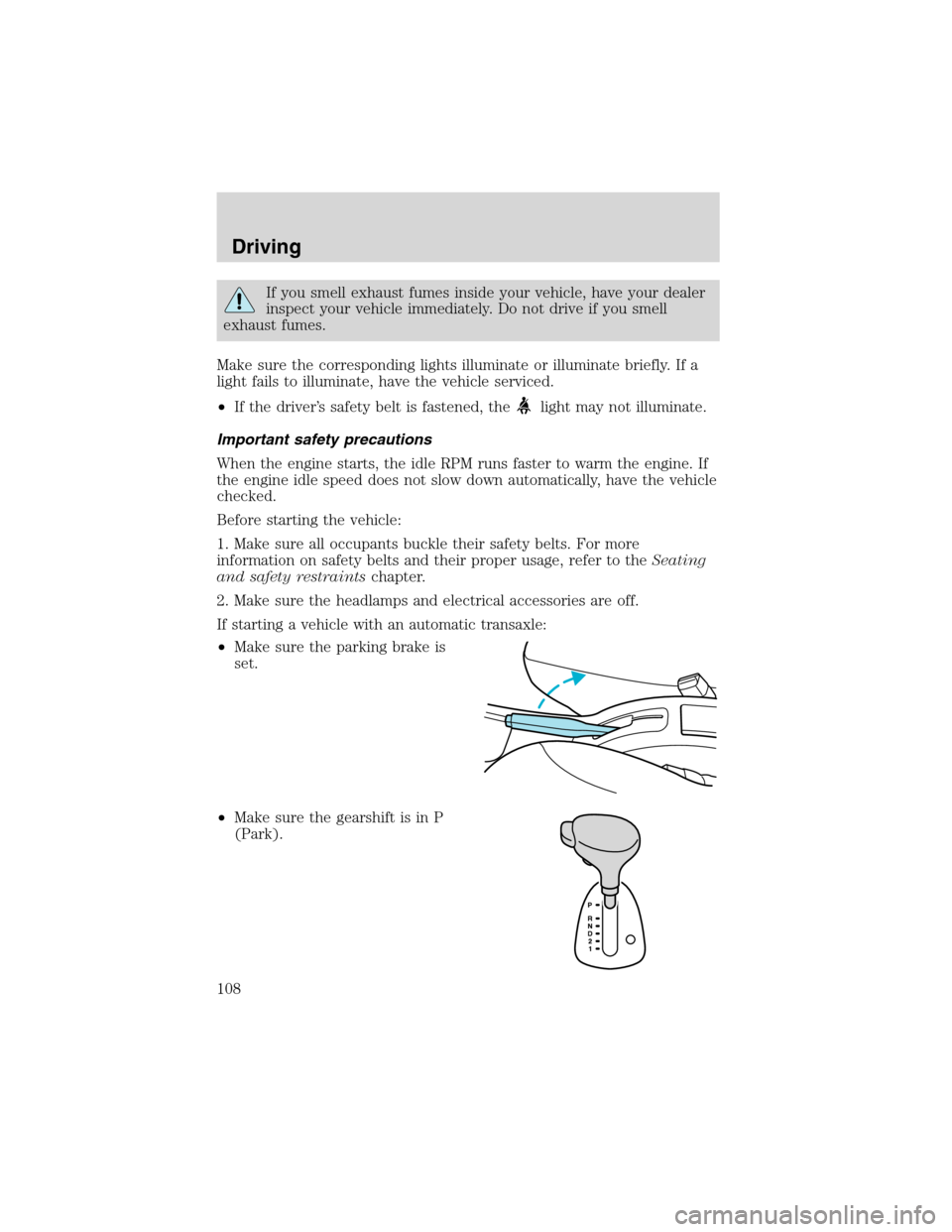
•Make sure the parking brake is
set.
•Make sure the gearshift is in P
(Park).
Driving
108
Page 110 of 216
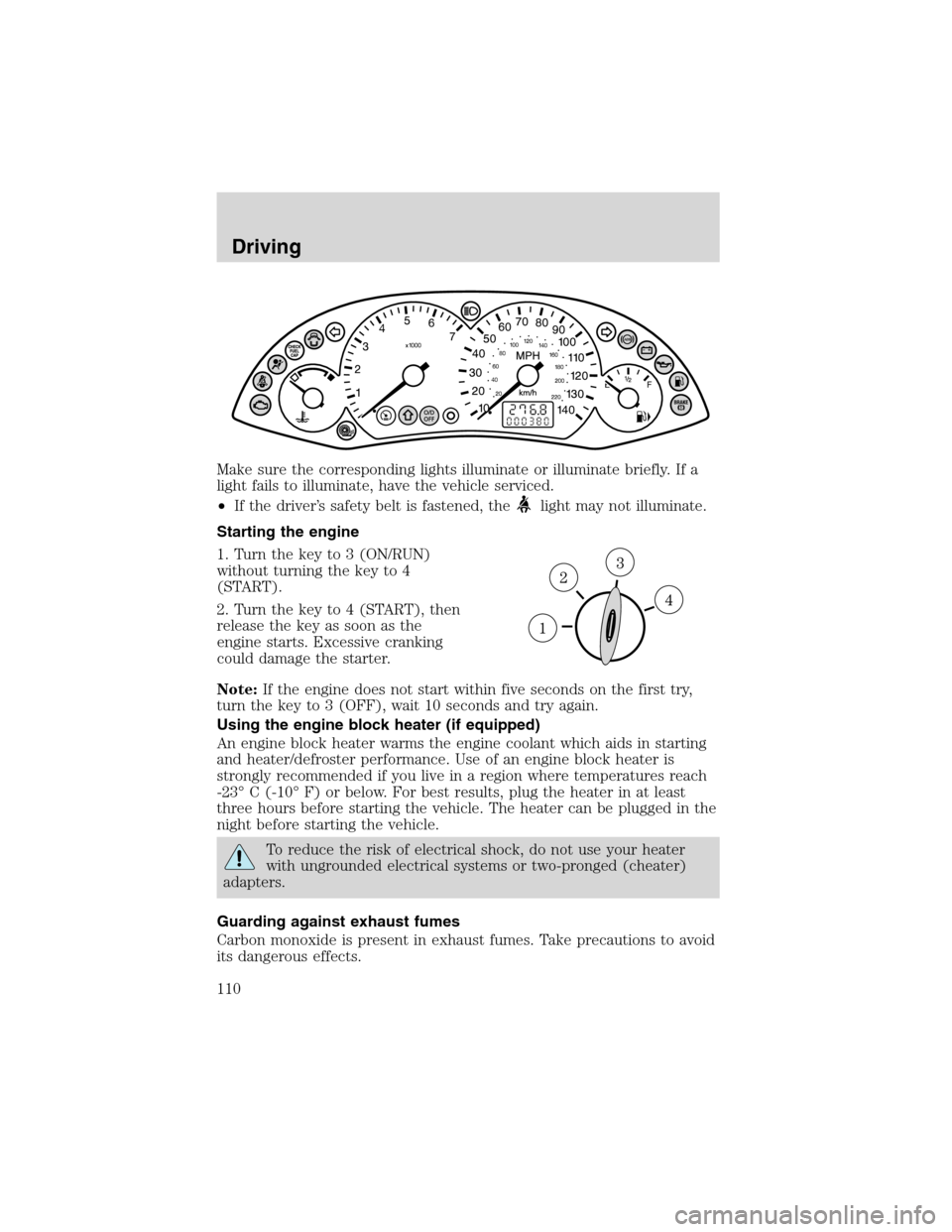
Make sure the corresponding lights illuminate or illuminate briefly. If a
light fails to illuminate, have the vehicle serviced.
•If the driver’s safety belt is fastened, the
light may not illuminate.
Starting the engine
1. Turn the key to 3 (ON/RUN)
without turning the key to 4
(START).
2. Turn the key to 4 (START), then
release the key as soon as the
engine starts. Excessive cranking
could damage the starter.
Note:If the engine does not start within five seconds on the first try,
turn the key to 3 (OFF), wait 10 seconds and try again.
Using the engine block heater (if equipped)
An engine block heater warms the engine coolant which aids in starting
and heater/defroster performance. Use of an engine block heater is
strongly recommended if you live in a region where temperatures reach
-23°C (-10°F) or below. For best results, plug the heater in at least
three hours before starting the vehicle. The heater can be plugged in the
night before starting the vehicle.
To reduce the risk of electrical shock, do not use your heater
with ungrounded electrical systems or two-pronged (cheater)
adapters.
Guarding against exhaust fumes
Carbon monoxide is present in exhaust fumes. Take precautions to avoid
its dangerous effects.
Driving
110
Page 131 of 216
Fuse/Relay
LocationFuse Amp
RatingPassenger Compartment Fuse
Panel Description
48 10A Data link connector
49 25A Rear defroster
50 7.5A Heated mirror, Heated backlite
indicator
51—Not used
52 15A Heated seats
53 10A Backup lamps (manual transaxle)
54 25A Rear power windows
55 25A Front power windows
56 20A Front wipers
57 7.5A Position and side lights (right)
58 7.5A Position and side lights (left)
59 7.5A Light switch (headlamps)
60 7.5A Air bag module
61 7.5A PATS modules, Instrument cluster
62 7.5A License plate lamp
63 20A Power locks (GEM)
Fuse 63 is located on the back of the fuse panel. See your dealer or a
certified technician for service of this fuse.
Power distribution box
The power distribution box is located in the engine compartment. The
power distribution box contains high-current fuses that protect your
vehicle’s main electrical systems from overloads.
Always disconnect the battery before servicing high current
fuses.
Always replace the cover to the power distribution box before
reconnecting the battery or refilling fluid reservoirs
If the battery has been disconnected and reconnected, refer to the
Batterysection of theMaintenance and specificationschapter.
Roadside Emergencies
131
Page 187 of 216
3. The fuel cap may not have been securely tightened.
These temporary malfunctions can be corrected by filling the fuel tank
with good quality fuel and/or properly tightening the fuel cap. After three
driving cycles without these or any other temporary malfunctions
present, theCheck Engine/Service Engine Soonlight should turn off.
(A driving cycle consists of a cold engine startup followed by mixed
city/highway driving.) No additional vehicle service is required.
If theCheck Engine/Service Engine Soonlight remains on, have your
vehicle serviced at the first available opportunity.
Readiness for Inspection/Maintenance (I/M) testing
In some localities, it may be a legal requirement to pass an I/M test of
the on-board diagnostics system. If your
indicator is on, refer to the
description in theWarning lights and chimessection of the
Instrument Clusterchapter. Your vehicle may not pass the I/M test with
the
indicator on.
If the vehicle’s powertrain system or its battery has just been serviced,
the on-board diagnostics system is reset to a“not ready for I/M test”
condition. To ready the on-board diagnostics system for I/M testing, a
minimum of 30 minutes of city and highway driving is necessary as
described below:
•First, at least 10 minutes of driving on an expressway or highway.
•Next, at least 20 minutes driving in stop-and-go, city-type traffic with
at least four idle periods.
Allow the vehicle to sit for at least eight hours without starting the
engine. Then, start the engine and complete the above driving cycle. The
engine must warm up to its normal operating temperature. Once started,
do not turn off the engine until the above driving cycle is complete.
Maintenance and Specifications
187
Page 206 of 216
Travel equipment
Automatic headlamp system
Daytime running lights (DRL)
First aid kit
Fog lights
Highway safety kit
Luggage/cargo basket
Navigation system
Removable luggage rack
Removable luggage rack adapters (bike, ski and snowboard)
Speed control
Protection and appearance equipment
Car cover
Carpet floor mats
Chrome exhaust trim
Door edge guards
Door sill scuff plates
Exterior B-pillar trim
Flat splash guards
Front end covers (full and mini)
Ground effects kit
Hood Deflectors
Leather wrap steering wheel
Molded splash guards
Molded vinyl floor mats
Projector headlamps
Side window deflector
Spoilers
Accessories
206
Page 210 of 216
capacity ...................................196
choosing the right fuel ...........180
comparisons with EPA fuel
economy estimates .................185
detergent in fuel .....................181
filling your vehicle with
fuel ...........................178, 180, 182
filter, specifications ........182, 196
fuel pump shut-off switch .....126
improving fuel economy ........182
octane rating ...................181, 200
quality ......................................181
running out of fuel .................182
safety information relating to
automotive fuels .....................178
Fuel pump shut-off switch .......126
Fuses ..................................127, 129
G
Gas cap (see Fuel cap) ............180
Gas mileage (see Fuel
economy) ...................................182
Gauges .........................................14
GAWR (Gross Axle Weight
Rating) .......................................120
definition .................................120
driving with a heavy load ......120
location ....................................120
GVWR (Gross Vehicle Weight
Rating) .......................................120
calculating ...............................120
definition .................................120
driving with a heavy load ......120
location ....................................120
H
Hazard flashers .........................126
Headlamps ...................................38aiming ........................................39
bulb specifications ....................43
daytime running lights .............38
flash to pass ..............................39
high beam .................................39
turning on and off ....................38
Heating
heater only system ...................35
Hood ..........................................162
I
Ignition ...............................107, 200
Infant seats (see Safety seats) ..99
Inspection/maintenance (I/M)
testing ........................................187
Instrument panel
cleaning ...................................158
cluster ........................................10
lighting up panel and
interior .......................................39
J
Jump-starting your vehicle ......138
K
Keys
positions of the ignition .........107
L
Lamps
bulb replacement
specifications chart ............42–43
cargo lamps ...............................39
daytime running light ...............38
fog lamps ...................................38
headlamps .................................38
headlamps, flash to pass ..........39
Index
210
Page 211 of 216
instrument panel, dimming .....39
interior lamps ...........................42
Lane change indicator
(see Turn signal) ........................41
Liftgate ........................................59
Lights, warning and indicator ....10
anti-lock brakes (ABS) ..........111
Load limits .................................120
GAWR ......................................120
GVWR ......................................120
trailer towing ..........................120
Locks
childproof ..................................63
Lubricant specifications ...198, 200
M
Manual transaxle
lubricant specifications ..........200
Manual transmission .................119
fluid capacities ........................196
reverse .....................................119
Mirrors .........................................53
side view mirrors (power) .......53
Moon roof ....................................56
Motorcraft parts ................182, 196
O
Octane rating ............................181
Oil (see Engine oil) ..................166
P
Parking brake ............................112
Parts (see Motorcraft parts) ....196
Power distribution box
(see Fuses) ...............................131Power steering ..........................115
fluid, checking and adding ....188
fluid, refill capacity ................196
fluid, specifications .........198, 200
Power Windows ...........................52
R
Rear window defroster ...............37
Relays ........................................127
Remote entry system .................65
locking/unlocking doors ...........62
opening the trunk .....................66
Roadside assistance ..................125
S
Safety Belt Maintenance ............88
Safety belts (see Safety
restraints) ........................76, 79–83
Safety defects, reporting ..........153
Safety restraints ..............76, 79–83
belt minder ...............................84
extension assembly ..................88
for adults .............................80–82
for children .........................95–96
safety belt maintenance ...........88
warning light and chime ..........84
Safety seats for children ............99
Seat belts (see Safety
restraints) ....................................76
Seats ............................................72
child safety seats ......................99
Servicing your vehicle ..............161
Spare tire (see Changing the
Tire) ...........................................135
Spark plugs,
specifications .....................196, 200
Index
211
Page 212 of 216
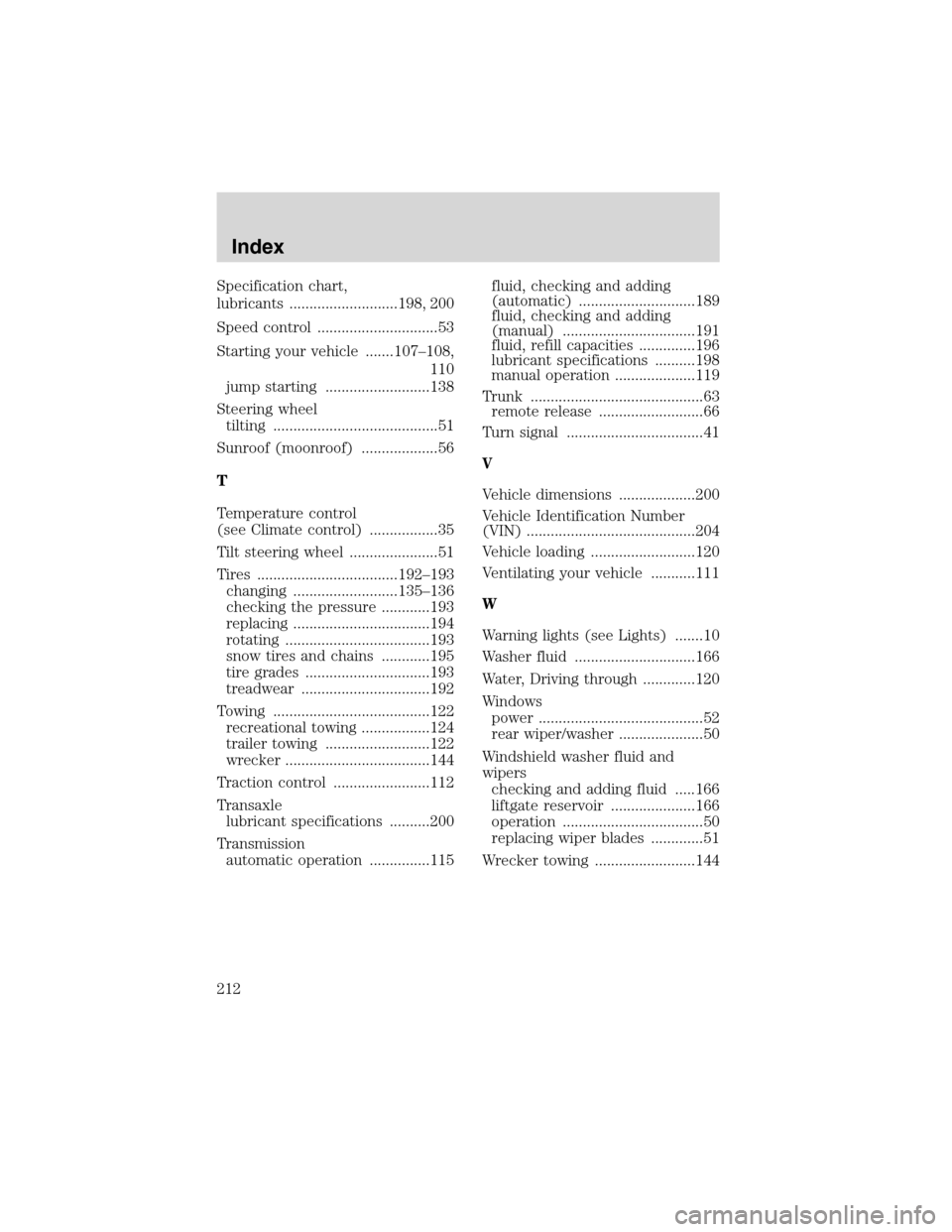
Specification chart,
lubricants ...........................198, 200
Speed control ..............................53
Starting your vehicle .......107–108,
110
jump starting ..........................138
Steering wheel
tilting .........................................51
Sunroof (moonroof) ...................56
T
Temperature control
(see Climate control) .................35
Tilt steering wheel ......................51
Tires ...................................192–193
changing ..........................135–136
checking the pressure ............193
replacing ..................................194
rotating ....................................193
snow tires and chains ............195
tire grades ...............................193
treadwear ................................192
Towing .......................................122
recreational towing .................124
trailer towing ..........................122
wrecker ....................................144
Traction control ........................112
Transaxle
lubricant specifications ..........200
Transmission
automatic operation ...............115fluid, checking and adding
(automatic) .............................189
fluid, checking and adding
(manual) .................................191
fluid, refill capacities ..............196
lubricant specifications ..........198
manual operation ....................119
Trunk ...........................................63
remote release ..........................66
Turn signal ..................................41
V
Vehicle dimensions ...................200
Vehicle Identification Number
(VIN) ..........................................204
Vehicle loading ..........................120
Ventilating your vehicle ...........111
W
Warning lights (see Lights) .......10
Washer fluid ..............................166
Water, Driving through .............120
Windows
power .........................................52
rear wiper/washer .....................50
Windshield washer fluid and
wipers
checking and adding fluid .....166
liftgate reservoir .....................166
operation ...................................50
replacing wiper blades .............51
Wrecker towing .........................144
Index
212