cooling FORD FOCUS 2005 1.G Owners Manual
[x] Cancel search | Manufacturer: FORD, Model Year: 2005, Model line: FOCUS, Model: FORD FOCUS 2005 1.GPages: 224, PDF Size: 3.39 MB
Page 14 of 224
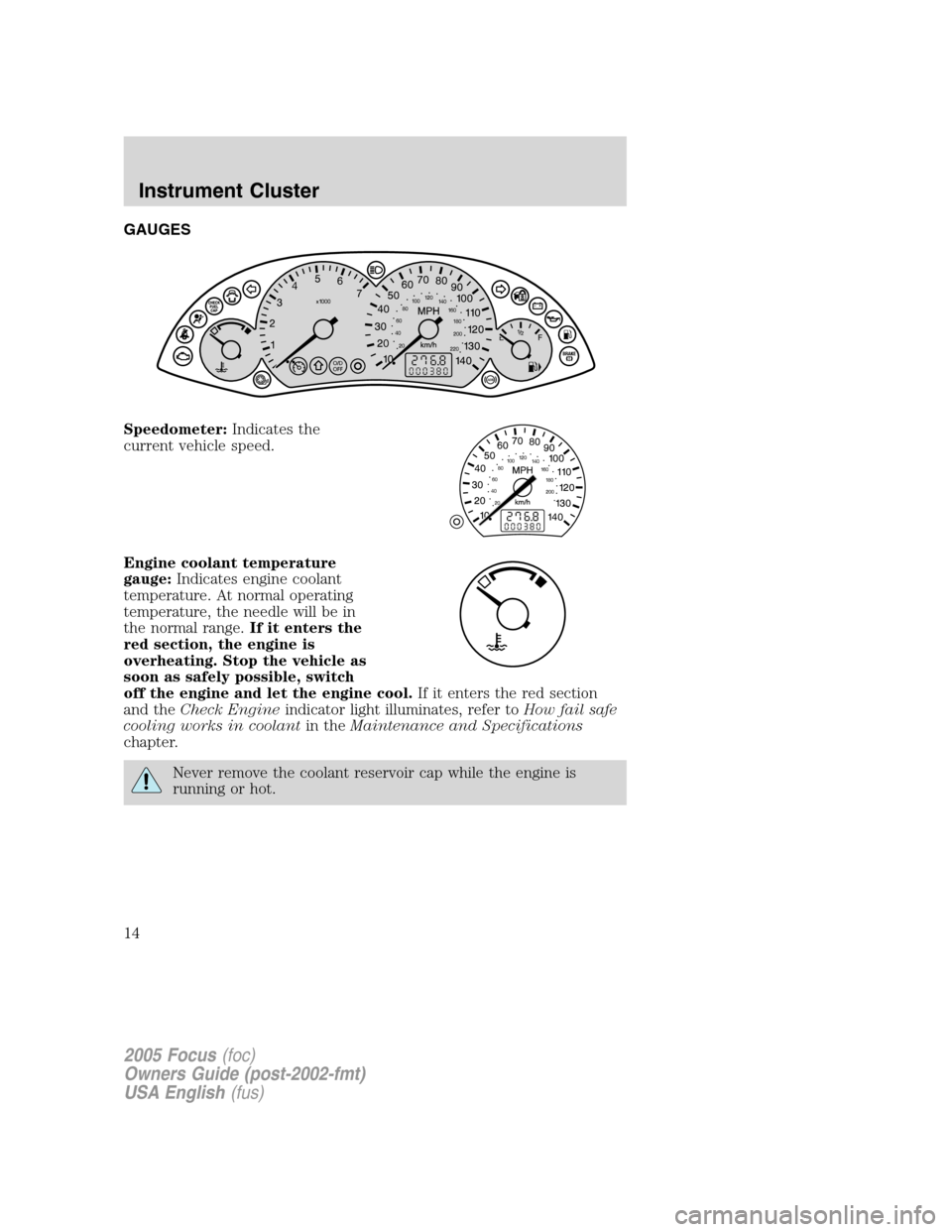
GAUGES
Speedometer:Indicates the
current vehicle speed.
Engine coolant temperature
gauge:Indicates engine coolant
temperature. At normal operating
temperature, the needle will be in
the normal range.If it enters the
red section, the engine is
overheating. Stop the vehicle as
soon as safely possible, switch
off the engine and let the engine cool.If it enters the red section
and theCheck Engineindicator light illuminates, refer toHow fail safe
cooling works in coolantin theMaintenance and Specifications
chapter.
Never remove the coolant reservoir cap while the engine is
running or hot.
2005 Focus(foc)
Owners Guide (post-2002-fmt)
USA English(fus)
Instrument Cluster
14
Page 28 of 224
5.A/C:Provides cabin cooling.
6.Temperature selection:Controls the temperature of the airflow in
the cabin.
Max A/C:For maximum cabin cooling performance, select A/C (5)
and
(4).
Operating tips
•To reduce fog build up on the windshield during humid weather, place
the air flow selector in the
position and turn the fan on.
•To reduce humidity build up inside the vehicle, do not drive with the
fan turned off or with recirculated air engaged.
•Do not put objects under the front seats that will interfere with the
airflow to the back seats.
•Remove any snow, ice or leaves from the air intake area at the base of
the windshield.
•To improve A/C cool down, drive with the windows slightly open for
2–3 minutes after starting the vehicle or until the vehicle has been
“aired out.”
To allow side window defogging and demisting while warming up the
vehicle cabin:
1. Select
.
2. Select A/C.
3. Set the temperature control to maintain comfort.
4. Set the highest fan speed.
5. Direct the outer instrument panel vents towards the side windows.
To increase airflow to the outer instrument panel vents, close the vents
located in the middle of the instrument panel.
Do not place objects on top of the instrument panel as these
objects may become projectiles in a collision or sudden stop.
2005 Focus(foc)
Owners Guide (post-2002-fmt)
USA English(fus)
Climate Controls
28
Page 123 of 224
Driving while you tow
When towing a trailer:
•Turn off the speed control. The speed control may shut off
automatically when you are towing on long, steep grades.
•Consult your local motor vehicle speed regulations for towing a trailer.
•To eliminate excessive shifting, use a lower gear. This will also assist
in transaxle cooling.
•Anticipate stops and brake gradually.
•Do not exceed the GCWR rating or transaxle damage may occur.
Servicing after towing
If you tow a trailer for long distances, your vehicle will require more
frequent service intervals. Refer to yourScheduled Maintenance Guide
for more information.
Trailer towing tips
•Practice turning, stopping and backing up before starting on a trip to
get the feel of the vehicle trailer combination. When turning, make
wider turns so the trailer wheels will clear curbs and other obstacles.
•Allow more distance for stopping with a trailer attached.
•If you are driving down a long or steep hill, shift to a lower gear. Do
not apply the brakes continuously, as they may overheat and become
less effective.
•The trailer tongue weight should be 10–15% of the loaded trailer
weight.
•After you have traveled 50 miles (80 km), thoroughly check your
hitch, electrical connections and trailer wheel lug nuts.
•To aid in engine/transmission cooling and A/C efficiency during hot
weather while stopped in traffic, place the gearshift lever in P (Park).
•Vehicles with trailers should not be parked on a grade. If you must
park on a grade, place wheel chocks under the trailer’s wheels.
2005 Focus(foc)
Owners Guide (post-2002-fmt)
USA English(fus)
Driving
123
Page 132 of 224
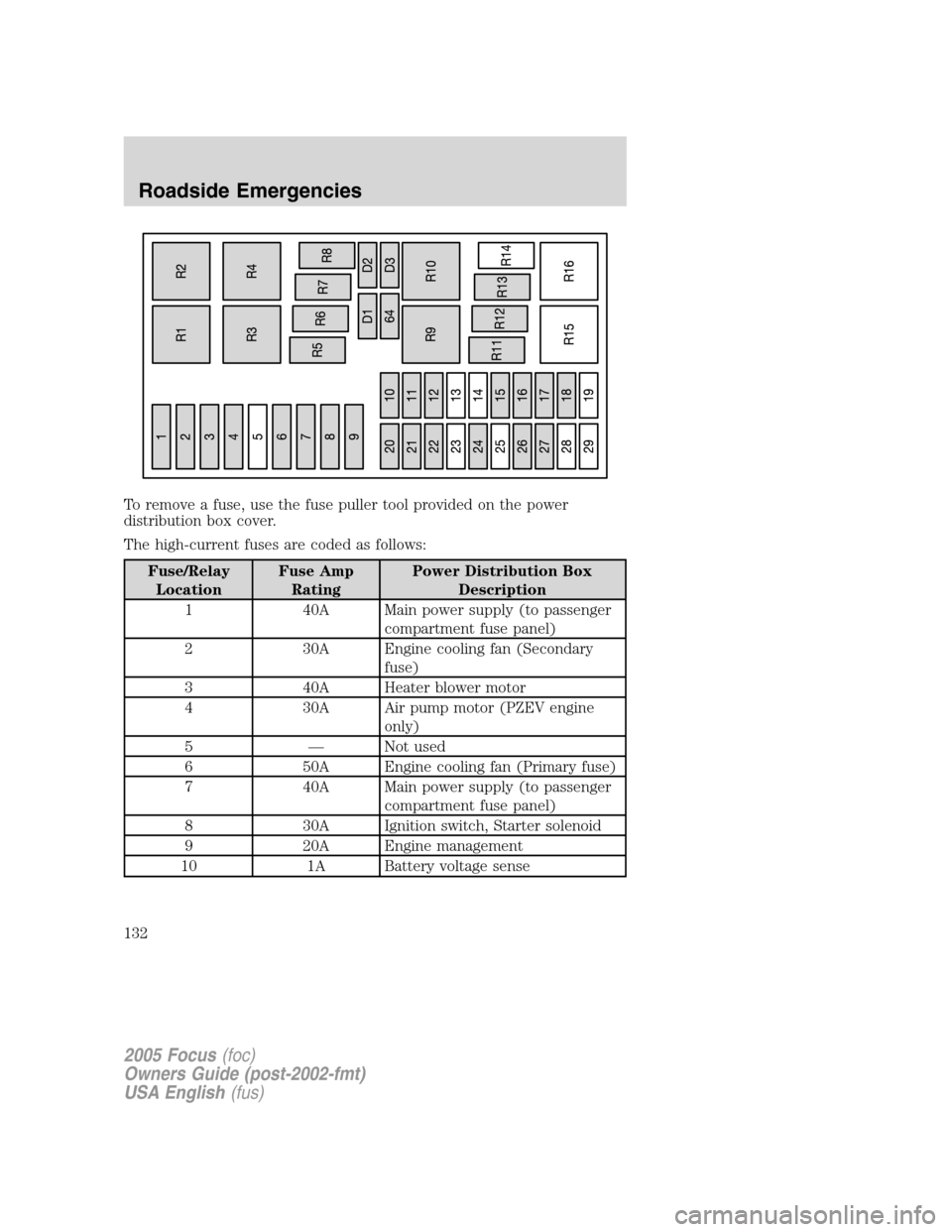
To remove a fuse, use the fuse puller tool provided on the power
distribution box cover.
The high-current fuses are coded as follows:
Fuse/Relay
LocationFuse Amp
RatingPower Distribution Box
Description
1 40A Main power supply (to passenger
compartment fuse panel)
2 30A Engine cooling fan (Secondary
fuse)
3 40A Heater blower motor
4 30A Air pump motor (PZEV engine
only)
5—Not used
6 50A Engine cooling fan (Primary fuse)
7 40A Main power supply (to passenger
compartment fuse panel)
8 30A Ignition switch, Starter solenoid
9 20A Engine management
10 1A Battery voltage sense
2005 Focus(foc)
Owners Guide (post-2002-fmt)
USA English(fus)
Roadside Emergencies
132
Page 133 of 224
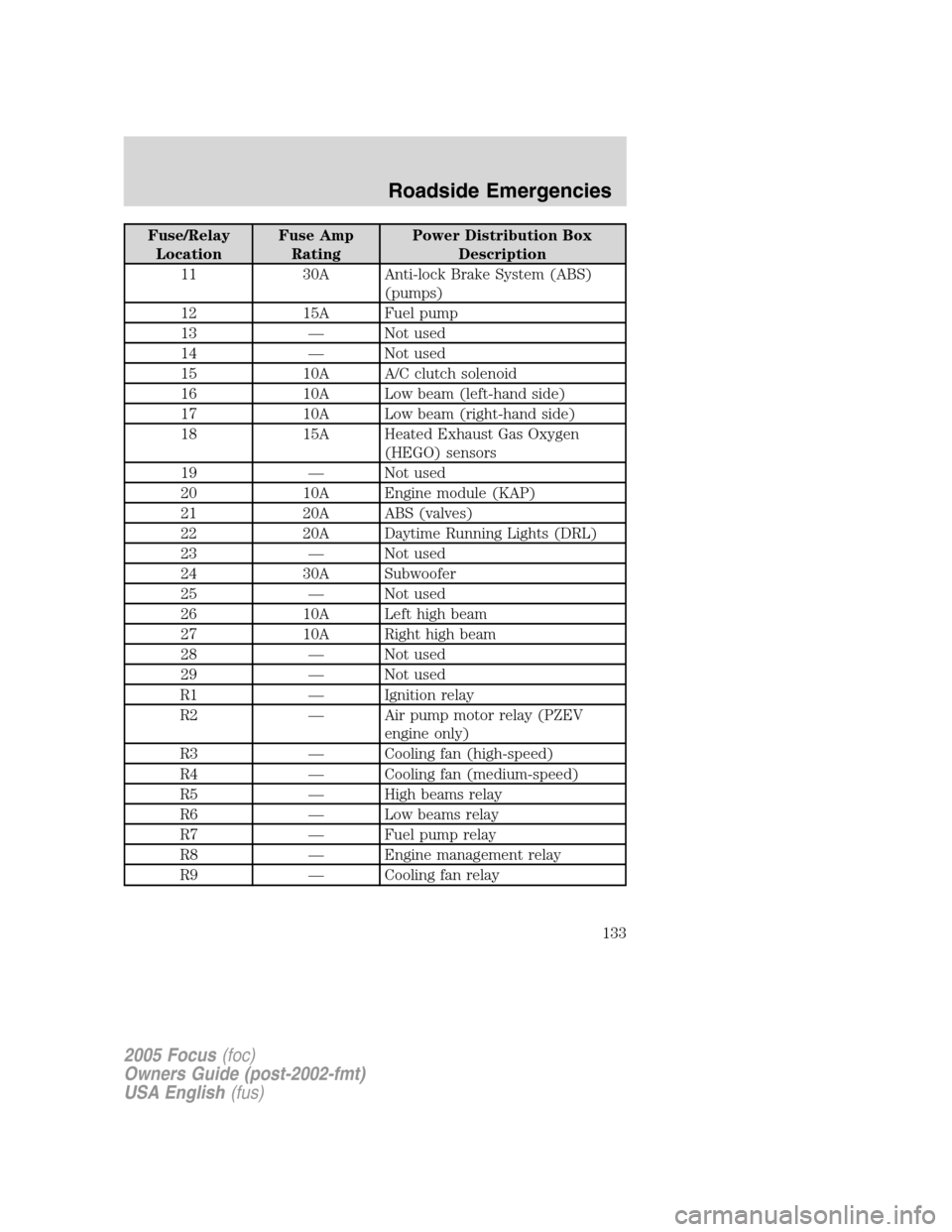
Fuse/Relay
LocationFuse Amp
RatingPower Distribution Box
Description
11 30A Anti-lock Brake System (ABS)
(pumps)
12 15A Fuel pump
13—Not used
14—Not used
15 10A A/C clutch solenoid
16 10A Low beam (left-hand side)
17 10A Low beam (right-hand side)
18 15A Heated Exhaust Gas Oxygen
(HEGO) sensors
19—Not used
20 10A Engine module (KAP)
21 20A ABS (valves)
22 20A Daytime Running Lights (DRL)
23—Not used
24 30A Subwoofer
25—Not used
26 10A Left high beam
27 10A Right high beam
28—Not used
29—Not used
R1—Ignition relay
R2—Air pump motor relay (PZEV
engine only)
R3—Cooling fan (high-speed)
R4—Cooling fan (medium-speed)
R5—High beams relay
R6—Low beams relay
R7—Fuel pump relay
R8—Engine management relay
R9—Cooling fan relay
2005 Focus(foc)
Owners Guide (post-2002-fmt)
USA English(fus)
Roadside Emergencies
133
Page 134 of 224
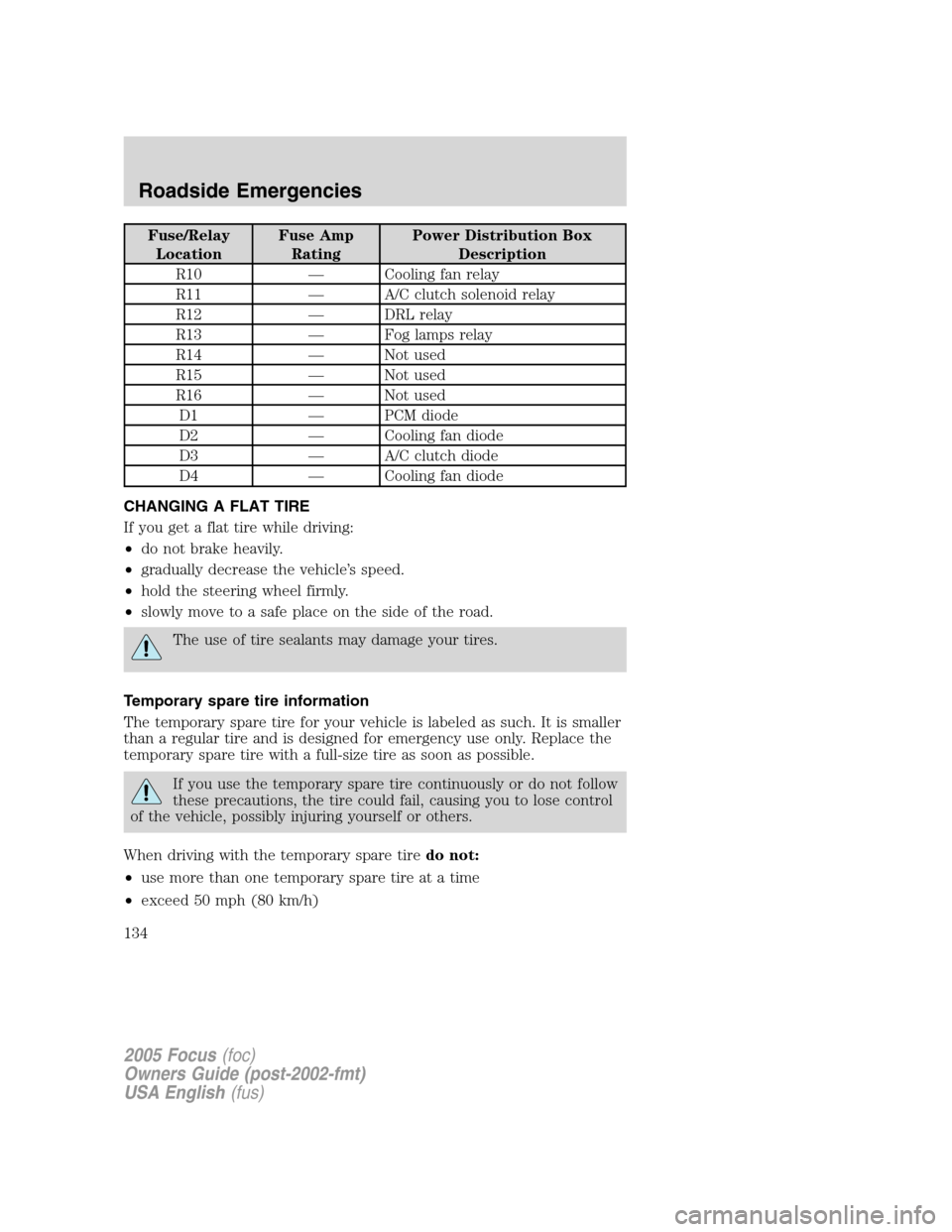
Fuse/Relay
LocationFuse Amp
RatingPower Distribution Box
Description
R10—Cooling fan relay
R11—A/C clutch solenoid relay
R12—DRL relay
R13—Fog lamps relay
R14—Not used
R15—Not used
R16—Not used
D1—PCM diode
D2—Cooling fan diode
D3—A/C clutch diode
D4—Cooling fan diode
CHANGING A FLAT TIRE
If you get a flat tire while driving:
•do not brake heavily.
•gradually decrease the vehicle’s speed.
•hold the steering wheel firmly.
•slowly move to a safe place on the side of the road.
The use of tire sealants may damage your tires.
Temporary spare tire information
The temporary spare tire for your vehicle is labeled as such. It is smaller
than a regular tire and is designed for emergency use only. Replace the
temporary spare tire with a full-size tire as soon as possible.
If you use the temporary spare tire continuously or do not follow
these precautions, the tire could fail, causing you to lose control
of the vehicle, possibly injuring yourself or others.
When driving with the temporary spare tiredo not:
•use more than one temporary spare tire at a time
•exceed 50 mph (80 km/h)
2005 Focus(foc)
Owners Guide (post-2002-fmt)
USA English(fus)
Roadside Emergencies
134
Page 140 of 224
Do not attempt to push-start your vehicle. Automatic
transmissions do not have push-start capability; doing so may
damage the catalytic converter.
Preparing your vehicle
When the battery is disconnected or a new battery is installed, the
transmission must relearn its shift strategy. As a result, the transmission
may have firm and/or soft shifts. This operation is considered normal and
will not affect function or durability of the transmission. Over time, the
adaptive learning process will fully update transmission operation.
1.Use only a 12–volt supply to start your vehicle.
2. Do not disconnect the battery of the disabled vehicle as this could
damage the vehicle’s electrical system.
3. Park the booster vehicle close to the hood of the disabled vehicle
making sure the two vehiclesdo nottouch. Set the parking brake on
both vehicles and stay clear of the engine cooling fan and other moving
parts.
4. Check all battery terminals and remove any excessive corrosion before
you attach the battery cables. Ensure that vent caps are tight and level.
5. Turn the heater fan on in both vehicles to protect any electrical
surges. Turn all other accessories off.
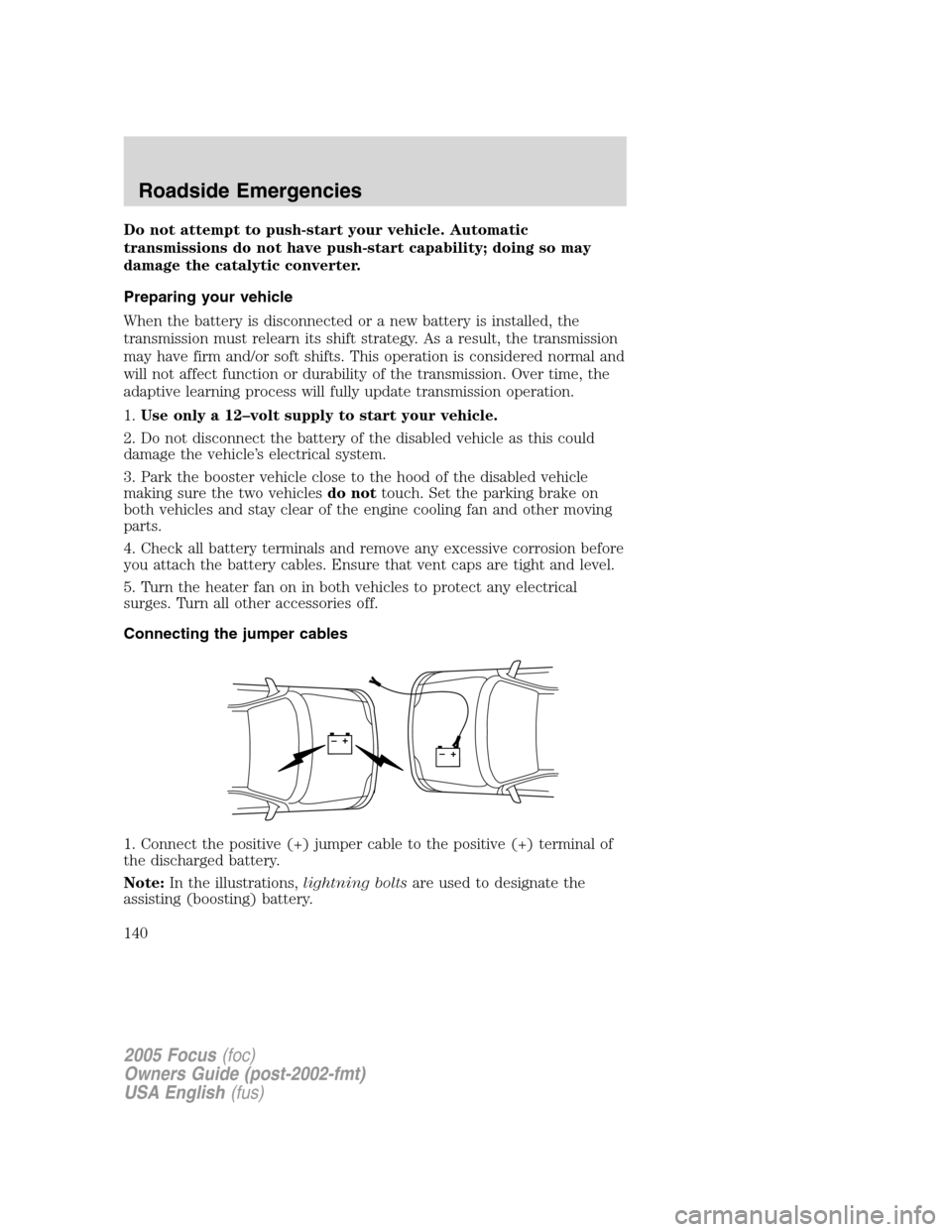
Connecting the jumper cables
1. Connect the positive (+) jumper cable to the positive (+) terminal of
the discharged battery.
Note:In the illustrations,lightning boltsare used to designate the
assisting (boosting) battery.
+–+–
2005 Focus(foc)
Owners Guide (post-2002-fmt)
USA English(fus)
Roadside Emergencies
140
Page 165 of 224
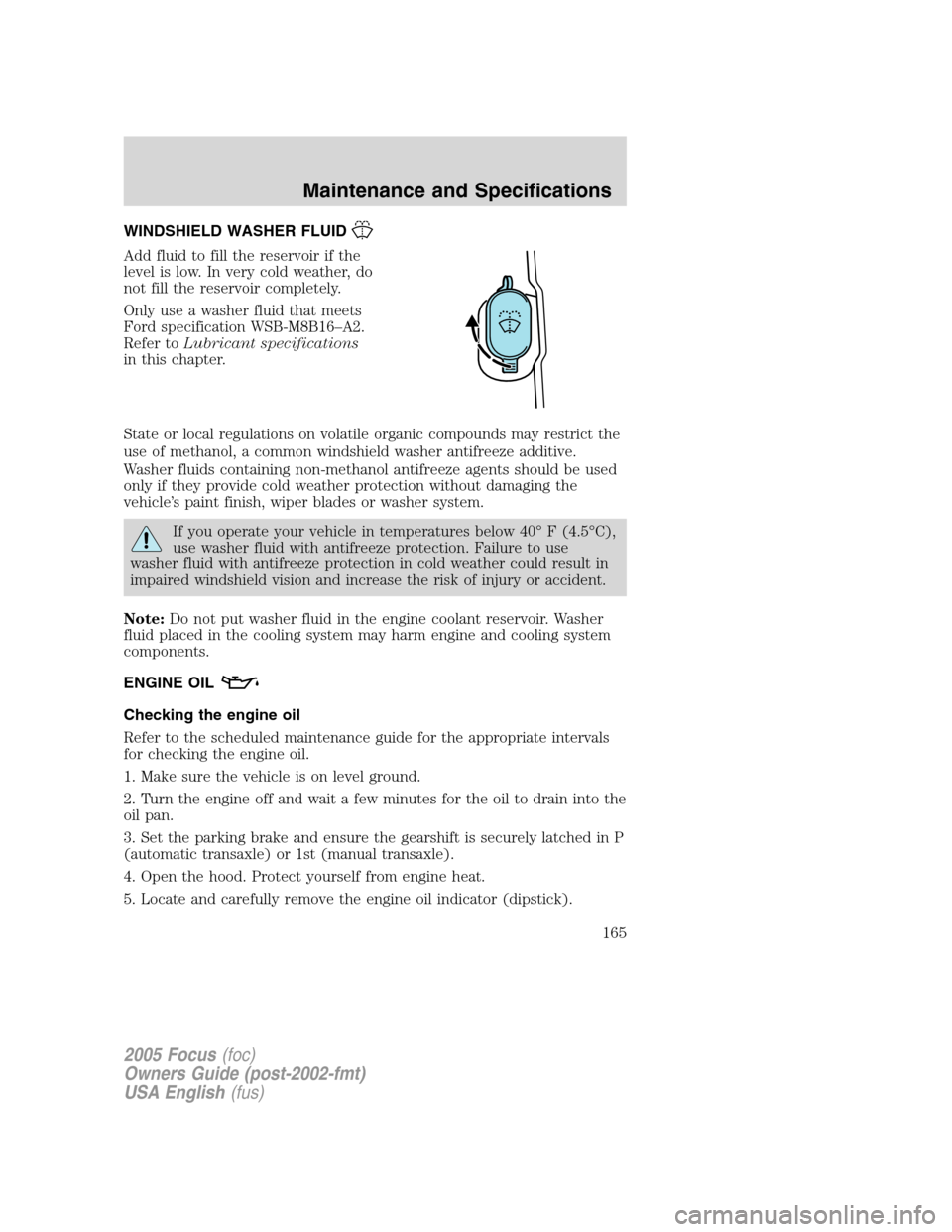
WINDSHIELD WASHER FLUID
Add fluid to fill the reservoir if the
level is low. In very cold weather, do
not fill the reservoir completely.
Only use a washer fluid that meets
Ford specification WSB-M8B16–A2.
Refer toLubricant specifications
in this chapter.
State or local regulations on volatile organic compounds may restrict the
use of methanol, a common windshield washer antifreeze additive.
Washer fluids containing non-methanol antifreeze agents should be used
only if they provide cold weather protection without damaging the
vehicle’s paint finish, wiper blades or washer system.
If you operate your vehicle in temperatures below 40°F (4.5°C),
use washer fluid with antifreeze protection. Failure to use
washer fluid with antifreeze protection in cold weather could result in
impaired windshield vision and increase the risk of injury or accident.
Note:Do not put washer fluid in the engine coolant reservoir. Washer
fluid placed in the cooling system may harm engine and cooling system
components.
ENGINE OIL
Checking the engine oil
Refer to the scheduled maintenance guide for the appropriate intervals
for checking the engine oil.
1. Make sure the vehicle is on level ground.
2. Turn the engine off and wait a few minutes for the oil to drain into the
oil pan.
3. Set the parking brake and ensure the gearshift is securely latched in P
(automatic transaxle) or 1st (manual transaxle).
4. Open the hood. Protect yourself from engine heat.
5. Locate and carefully remove the engine oil indicator (dipstick).
2005 Focus(foc)
Owners Guide (post-2002-fmt)
USA English(fus)
Maintenance and Specifications
165
Page 171 of 224
Note:Automotive fluids are not interchangeable; do not use engine
coolant, antifreeze or windshield washer fluid outside of its specified
function and vehicle location.
Adding engine coolant
When adding coolant, make sure it is a 50/50 mixture of engine coolant
and distilled water. Add the mixture to the coolant reservoir,when the
engine is cool, until the appropriate fill level is obtained.
Do not add engine coolant when the engine is hot. Steam and
scalding liquids released from a hot cooling system can burn you
badly. Also, you can be burned if you spill coolant on hot engine parts.
Do not put engine coolant in the windshield washer fluid
container. If sprayed on the windshield, engine coolant could
make it difficult to see through the windshield.
•Add Motorcraft Premium Gold Engine Coolant
(yellow-colored), VC-7–A (U.S., except CA and OR), VC-7–B
(CA and OR only), meeting Ford Specification
WSS-M97B51–A1.
Note:Use of Motorcraft Cooling System Stop Leak Pellets, VC-6, may
darken the color of Motorcraft Premium Gold Engine Coolant from
yellow to golden tan.
•Do not add/mix an orange-colored, extended life coolant such
as Motorcraft Speciality Orange Engine Coolant, VC-2 (US) or
CXC-209 (Canada), meeting Ford specification WSS-M97B44–D
with the factory-filled coolant.Mixing Motorcraft Speciality Orange
Engine Coolant or any orange-colored extended life product with your
factory filled coolant can result in degraded corrosion protection.
•A large amount of water without engine coolant may be added, in case
of emergency, to reach a vehicle service location. In this instance, the
cooling system must be drained and refilled with a 50/50 mixture of
engine coolant and distilled water as soon as possible. Water alone
(without engine coolant) can cause engine damage from corrosion,
overheating or freezing.
•Do not use alcohol, methanol, brine or any engine coolants
mixed with alcohol or methanol antifreeze (coolant).Alcohol
and other liquids can cause engine damage from overheating or
freezing.
2005 Focus(foc)
Owners Guide (post-2002-fmt)
USA English(fus)
Maintenance and Specifications
171
Page 172 of 224
•Do not add extra inhibitors or additives to the coolant.These
can be harmful and compromise the corrosion protection of the engine
coolant.
For vehicles with overflow coolant systems with a non-pressurized cap
on the coolant recovery system, add coolant to the coolant recovery
reservoir when the engine is cool. Add the proper mixture of coolant and
water to the“FULL COLD”level. For all other vehicles, which have a
coolant degas system with a pressurized cap, or if it is necessary to
remove the coolant pressure relief cap on the radiator of a vehicle with
an overflow system, follow these steps to add engine coolant.
To reduce the risk of personal injury, make sure the engine is
cool before unscrewing the coolant pressure relief cap. The
cooling system is under pressure; steam and hot liquid can come out
forcefully when the cap is loosened slightly.
1. Before you begin, turn the engine off and let it cool.
2. When the engine is cool, wrap a thick cloth around the coolant
pressure relief cap on the coolant reservoir (a translucent plastic bottle).
Slowly turn cap counterclockwise (left) until pressure begins to release.
3. Step back while the pressure releases.
4. When you are sure that all the pressure has been released, use the
cloth to turn it counterclockwise and remove the cap.
5. Fill the coolant reservoir slowly with the proper coolant mixture (see
above), to within the“COLD FILL RANGE”or the“FULL COLD”level on
the reservoir. If you removed the radiator cap in an overflow system, fill
the radiator until the coolant is visible and radiator is almost full.
6. Replace the cap. Turn until tightly installed. (Cap must be tightly
installed to prevent coolant loss.)
After any coolant has been added, check the coolant concentration, refer
toChecking engine coolant. If the concentration is not 50/50
(protection to–34°F/–36°C), drain some coolant and adjust the
concentration. It may take several drains and additions to obtain a 50/50
coolant concentration.
Whenever coolant has been added, the coolant level in the coolant
reservoir should be checked the next few times you drive the vehicle. If
necessary, add enough 50/50 concentration of engine coolant and
distilled water to bring the liquid level to the proper level.
If you have to add more than 1.0 liter (1.0 quart) of engine coolant per
month, have your dealer check the engine cooling system. Your cooling
2005 Focus(foc)
Owners Guide (post-2002-fmt)
USA English(fus)
Maintenance and Specifications
172