climate control FORD FOCUS 2013 3.G User Guide
[x] Cancel search | Manufacturer: FORD, Model Year: 2013, Model line: FOCUS, Model: FORD FOCUS 2013 3.GPages: 475, PDF Size: 5.55 MB
Page 147 of 475
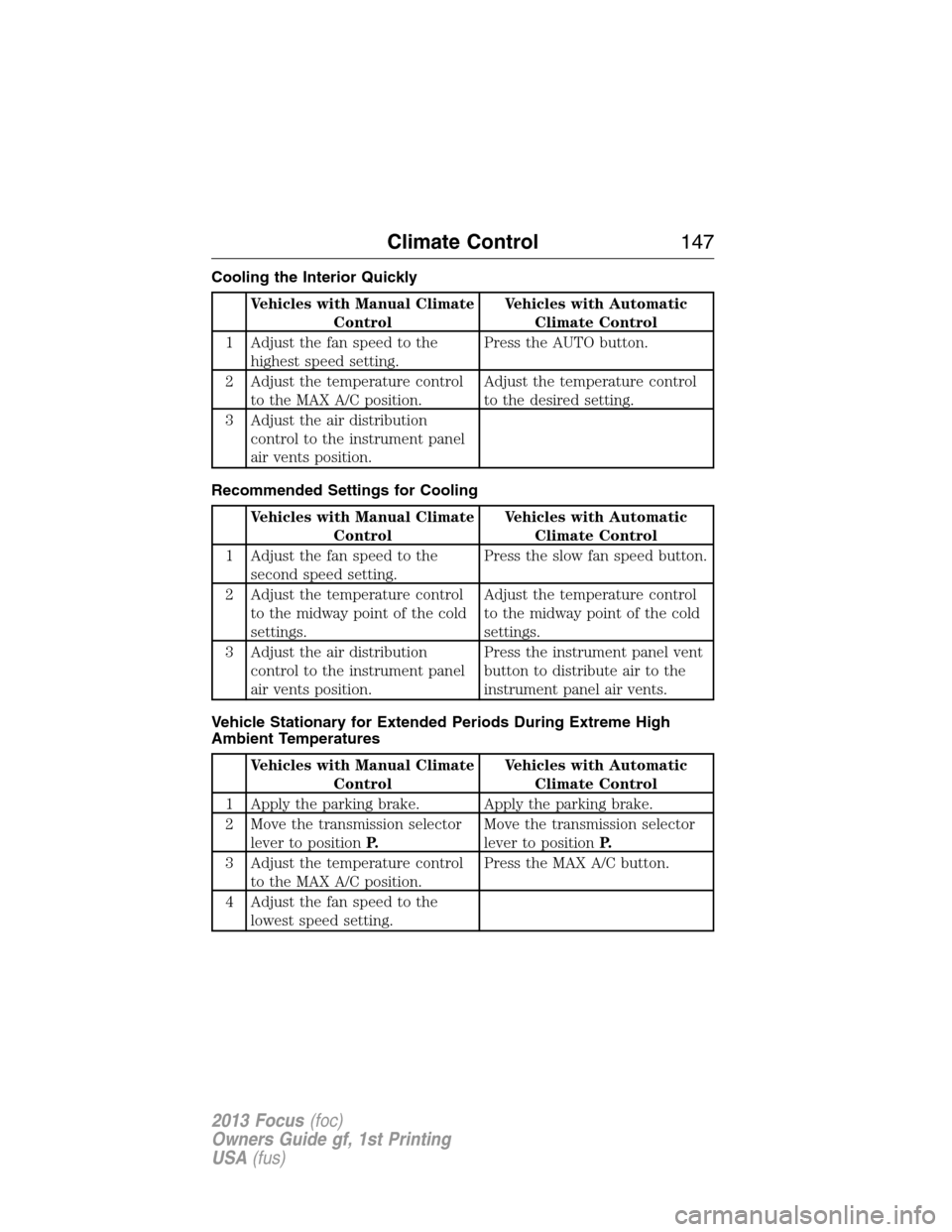
Cooling the Interior Quickly
Vehicles with Manual Climate
ControlVehicles with Automatic
Climate Control
1 Adjust the fan speed to the
highest speed setting.Press the AUTO button.
2 Adjust the temperature control
to the MAX A/C position.Adjust the temperature control
to the desired setting.
3 Adjust the air distribution
control to the instrument panel
air vents position.
Recommended Settings for Cooling
Vehicles with Manual Climate
ControlVehicles with Automatic
Climate Control
1 Adjust the fan speed to the
second speed setting.Press the slow fan speed button.
2 Adjust the temperature control
to the midway point of the cold
settings.Adjust the temperature control
to the midway point of the cold
settings.
3 Adjust the air distribution
control to the instrument panel
air vents position.Press the instrument panel vent
button to distribute air to the
instrument panel air vents.
Vehicle Stationary for Extended Periods During Extreme High
Ambient Temperatures
Vehicles with Manual Climate
ControlVehicles with Automatic
Climate Control
1 Apply the parking brake. Apply the parking brake.
2 Move the transmission selector
lever to positionP.Move the transmission selector
lever to positionP.
3 Adjust the temperature control
to the MAX A/C position.Press the MAX A/C button.
4 Adjust the fan speed to the
lowest speed setting.
Climate Control147
2013 Focus(foc)
Owners Guide gf, 1st Printing
USA(fus)
Page 148 of 475
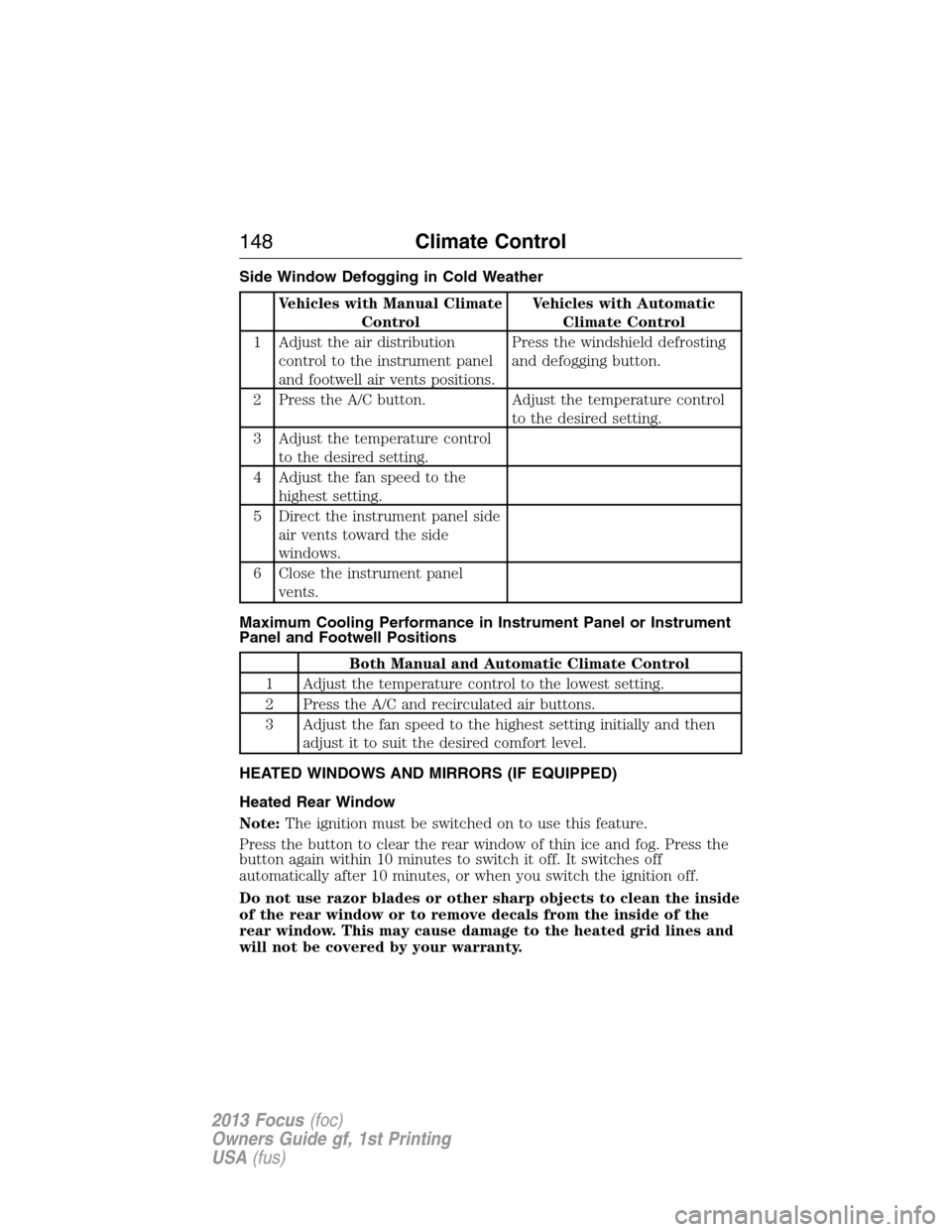
Side Window Defogging in Cold Weather
Vehicles with Manual Climate
ControlVehicles with Automatic
Climate Control
1 Adjust the air distribution
control to the instrument panel
and footwell air vents positions.Press the windshield defrosting
and defogging button.
2 Press the A/C button. Adjust the temperature control
to the desired setting.
3 Adjust the temperature control
to the desired setting.
4 Adjust the fan speed to the
highest setting.
5 Direct the instrument panel side
air vents toward the side
windows.
6 Close the instrument panel
vents.
Maximum Cooling Performance in Instrument Panel or Instrument
Panel and Footwell Positions
Both Manual and Automatic Climate Control
1 Adjust the temperature control to the lowest setting.
2 Press the A/C and recirculated air buttons.
3 Adjust the fan speed to the highest setting initially and then
adjust it to suit the desired comfort level.
HEATED WINDOWS AND MIRRORS (IF EQUIPPED)
Heated Rear Window
Note:The ignition must be switched on to use this feature.
Press the button to clear the rear window of thin ice and fog. Press the
button again within 10 minutes to switch it off. It switches off
automatically after 10 minutes, or when you switch the ignition off.
Do not use razor blades or other sharp objects to clean the inside
of the rear window or to remove decals from the inside of the
rear window. This may cause damage to the heated grid lines and
will not be covered by your warranty.
148Climate Control
2013 Focus(foc)
Owners Guide gf, 1st Printing
USA(fus)
Page 149 of 475
Heated Exterior Mirror (If Equipped)
Note:Do not remove ice from the mirrors with a scraper or attempt to
readjust the mirror glass if it is frozen in place. These actions could
cause damage to the glass and mirrors.
Note:Do not clean the housing or glass of any mirror with harsh
abrasives, fuel or other petroleum-based cleaning products.
Both mirrors are heated to remove ice, mist and fog when the rear
window defroster is activated.
CABIN AIR FILTER
Note:A cabin air filter must be installed at all times to prevent foreign
objects from entering the system. Running the system without a filter in
place could result in degradation or damage to the system.
Your vehicle is equipped with a cabin air filter; it is located in the
passenger footwell area.
The particulate air filtration system is designed to reduce the
concentration of airborne particles, such as dust, spores and pollen, in
the air being supplied to the interior of the vehicle. The particulate
filtration system gives the following benefits to customers:
•Improves the customer’s driving comfort by reducing particle
concentration.
•Improves the interior compartment cleanliness.
•Protects the climate control components from particle deposits.
The filter should be replaced at regular intervals. See theScheduled
Maintenancechapter.
For additional information, or to replace the filter, see an authorized
dealer.
Climate Control149
2013 Focus(foc)
Owners Guide gf, 1st Printing
USA(fus)
Page 150 of 475
REMOTE START CLIMATE OPERATION
The climate control system adjusts the cabin temperature during remote
start.
You cannot adjust the system during remote start operation. Turn the
ignition on to return the system to its previous settings. You can now
make adjustments. You will need to turn certain vehicle-dependent
features back on, such as:
•heated seats
•heated mirrors
•heated rear window.
You can adjust the settings using the information display controls. See
theInformation Displayschapter.
Automatic Climate Systems
Automatic Settings
You can set the climate control to operate in AUTO mode through the
information display setting: Remote Start > Climate Control > Heater –
A/C > Auto. The climate control system automatically sets the interior
temperature to 72°F (22°C).
In hot weather, the system is set to 72°F (22°C).
In moderate weather, the system either heats or cools (based on
previous settings). The rear defroster and heated mirrors are not
automatically turned on.
In cold weather, the system is set to 72°F (22°C). The rear defroster and
heated mirrors are automatically turned on.
Last Settings
You can set the climate control to operate using the last climate control
settings through the information display setting: Remote Start > Climate
Control > Heater – A/C > Last Settings. The climate control system
automatically uses the settings last selected before the vehicle was
turned off.
Heated and Cooled Devices
The climate control system controls other heated and cooled devices
inside the vehicle. These devices (if available, and selected to AUTO in
the information displays) may also be switched on during remote start.
Heated devices are typically switched on during cold weather, and cooled
devices during hot weather.
150Climate Control
2013 Focus(foc)
Owners Guide gf, 1st Printing
USA(fus)
Page 167 of 475
3. Start the engine. The engine may continue cranking for up to
15 seconds or until it starts.
Note:If you cannot start your engine on the first try, wait for a short
period of time and try again.
If you have difficulty starting the engine when the temperature is below
-13°F (-25°C), press the accelerator pedal slightly and try again.
If you cannot start your engine after three attempts, wait 10 seconds,
then follow this procedure:
1. Fully press the brake pedal.
2. Fully press the accelerator pedal and hold it there.
3. Move the transmission selector lever to positionPorN.
4. Start the engine.
Guarding Against Exhaust Fumes
WARNING:If you smell exhaust fumes inside your vehicle, have
this checked immediately. Do not drive your vehicle if you smell
exhaust fumes. Carbon monoxide is present in exhaust fumes. Take
precautions to avoid its dangerous effects.
Important Ventilating Information
If you stop your vehicle and leave the engine idling for long periods of
time, we recommend that you do one of the following:
•Open the windows at least 1 inch (2.5 centimeters).
•Set your climate control to outside air.
ENGINE BLOCK HEATER (IF EQUIPPED)
WARNING:Failure to follow engine block heater instructions
could result in property damage or physical injury.
WARNING:Do not use your heater with ungrounded electrical
systems or two-pronged (cheater) adapters. There is a risk of
electrical shock.
Note:The heater is most effective when outdoor temperatures are below
0°F (-18°C).
Starting and Stopping the Engine167
2013 Focus(foc)
Owners Guide gf, 1st Printing
USA(fus)
Page 168 of 475
The heater acts as a starting aid by warming the engine coolant. This
allows the climate control system to respond quickly. The equipment
includes a heater element (installed in the engine block) and a wire
harness. You can connect the system to a grounded 120 volt A/C
electrical source.
We recommend that you do the following for safe and correct operation:
•Use a 16-gauge outdoor extension cord that is product certified by
Underwriter’s Laboratory or Canadian Standards Association. This
extension cord must be able to be used outdoors, in cold
temperatures, and be clearly markedSuitable for Use with Outdoor
Appliances. Never use an indoor extension cord outdoors; it could
result in an electric shock or become a fire hazard.
•Use as short an extension cord as possible.
•Do not use multiple extension cords.
•Make sure that when in operation, the extension cord plug and the
heater cord plug connections are free and clear of water. This could
cause an electric shock or fire.
•Make sure your vehicle is parked in a clean area, clear of
combustibles.
•Make sure the heater, heater cord and extension cord are firmly
connected.
•Check for heat anywhere in the electrical hookup once the system has
been operating for approximately 30 minutes.
•Make sure the system is unplugged and properly stowed before driving
your vehicle. Make sure the protective cover seals the prongs of the
block heater cord plug when not in use.
•Make sure the heater system is checked for proper operation before
winter.
Using the Engine Block Heater
Make sure the receptacle terminals are clean and dry prior to use. Clean
them with a dry cloth, if necessary.
The heater uses 0.4 to 1.0 kilowatt-hours of energy per hour of use. The
system does not have a thermostat. It achieves maximum temperature
after approximately three hours of operation. Using the heater longer
than three hours does not improve system performance and
unnecessarily uses electricity.
168Starting and Stopping the Engine
2013 Focus(foc)
Owners Guide gf, 1st Printing
USA(fus)
Page 216 of 475
If your vehicle is towed from the rear with wheel lift equipment, the
front wheels must be placed on a dolly to prevent damage to the
transmission.
If your vehicle is towed from the front with wheel lift equipment, it is
recommended that the rear wheels be placed on a dolly to prevent
damage to the rear fascia.
TOWING THE VEHICLE ON FOUR WHEELS
Emergency Towing
In the event your vehicle becomes disabled (without access to wheel
dollies, car-hauling trailer, or flatbed transport vehicle), it can be
flat-towed (all wheels on the ground, regardless of the
powertrain/transmission configuration) under the following conditions:
•The vehicle is facing forward so that it is towed in a forward
direction.
•The transmission is placed in positionN.SeeAutomatic
transmissionin theTransmissionchapter if you cannot move the
transmission intoN.
•Maximum speed is 35 mph (56 km/h).
•Maximum distance is 50 miles (80 kilometers).
Recreational Towing
Note:Put your climate control system in recirculated air mode to
prevent exhaust fumes from entering the vehicle. Refer to theClimate
Controlschapter for more information.
Note:The vehicle must be towed in the forward position to ensure no
damage is done to the internal transmission components. In addition, it is
recommended that you follow the instructions provided by the
aftermarket manufacturer of the towing equipment, if provided.
Follow these guidelines if you have a need for recreational (RV) towing.
An example of recreational towing would be towing your vehicle behind
a motor home. These guidelines are designed to ensure that your
transmission is not damaged.
Before you tow your vehicle, follow these directions for your specific
vehicle configurationafterit is hooked-up to the RV or tow dolly:
216Towing
2013 Focus(foc)
Owners Guide gf, 1st Printing
USA(fus)
Page 253 of 475
If you drive in extremely hot climates:
•It may be necessary to have a Ford authorized dealer decrease the
coolant concentration to 40%.
•A coolant concentration of 40% will provide improved overheat
protection. Decreased engine coolant concentrations below 40% will
decrease the corrosion/freeze protection characteristics of the engine
coolant and may cause engine damage.
Vehicles driven year-round in non-extreme climates should use
prediluted engine coolant for optimum cooling system and engine
protection.
Powertrain Limiting and Protection
Note:Driving the vehicle without repairing the engine problem increases
the chance of engine damage. Take your vehicle to an authorized dealer
as soon as possible.
The engine control module (ECU) is equipped with a feature called
powertrain limiting and protection (PTLP). PTLP will help protect the
engine from damage in case the engine is overheating (coolant and/or oil
temperature too hot). PTLP will automatically intervene during normal
engine operation should it determine the engine coolant and/or oil
temperatures are too hot. It does this by gradually reducing the
maximum allowable engine rpm until the engine has cooled sufficiently.
PTLP will automatically reinstate normal engine operation if it
determines the engine temperatures have cooled sufficiently.
During an engine overheating condition, the instrument cluster will
display a message and a chime will sound. The engine may also have
temporarily reduced power and reduced rpm limit during an overheating
condition.
Operating the engine with high engine coolant temperature (coolant
gauge indicator is red) may cause powertrain damage. Stop the vehicle
as soon as safely possible, and let the engine cool off while idling.
Maintenance253
2013 Focus(foc)
Owners Guide gf, 1st Printing
USA(fus)
Page 278 of 475
Treadwear
The treadwear grade is a comparative rating based on the wear rate of
the tire when tested under controlled conditions on a specified
government test course. For example, a tire graded 150 would wear one
and one-half (1
12) times as well on the government course as a tire
graded 100. The relative performance of tires depends upon the actual
conditions of their use, however, and may depart significantly from the
norm due to variations in driving habits, service practices, and
differences in road characteristics and climate.
Traction AA A B C
WARNING:The traction grade assigned to this tire is based on
straight-ahead braking traction tests, and does not include
acceleration, cornering, hydroplaning or peak traction characteristics.
The traction grades, from highest to lowest are AA, A, B, and C. The
grades represent the tire’s ability to stop on wet pavement as measured
under controlled conditions on specified government test surfaces of
asphalt and concrete. A tire marked C may have poor traction
performance.
Temperature A B C
WARNING:The temperature grade for this tire is established for
a tire that is properly inflated and not overloaded. Excessive
speed, underinflation, or excessive loading, either separately or in
combination, can cause heat buildup and possible tire failure.
The temperature grades are A (the highest), B and C, representing the
tire’s resistance to the generation of heat and its ability to dissipate heat
when tested under controlled conditions on a specified indoor laboratory
test wheel. Sustained high temperature can cause the material of the tire
to degenerate and reduce tire life, and excessive temperature can lead to
sudden tire failure. The grade C corresponds to a level of performance
which all passenger car tires must meet under the Federal Motor Vehicle
Safety Standard No. 139. Grades B and A represent higher levels of
performance on the laboratory test wheel than the minimum required by
law.
278Wheels and Tires
2013 Focus(foc)
Owners Guide gf, 1st Printing
USA(fus)
Page 292 of 475
USING SNOW CHAINS
WARNING:Snow tires must be the same size, load index, speed
rating as those originally provided by Ford. Use of any tire or
wheel not recommended by Ford can affect the safety and performance
of your vehicle, which could result in an increased risk of loss of vehicle
control, vehicle rollover, personal injury and death. Additionally, the use
of non-recommended tires and wheels could cause steering, suspension,
axle or transfer case/power transfer unit failure.
Note:The suspension insulation and bumpers will help prevent vehicle
damage. Do not remove these components from your vehicle when using
snow tires and chains.
The tires on your vehicle may have all-weather treads to provide traction
in rain and snow. However, in some climates, you may need to use snow
tires and chains. Use chains on the tires only in an emergency or if the
law requires them.
Follow these guidelines when using snow tires and chains:
•If possible, avoid fully loading your vehicle.
•Chains may damage aluminum wheels.
•Use SAE Class S chains with 195/65R15 or 215/55R16 tires only; do
not use tire chains with any other size tires.
•Install chains securely, verifying that the chains do not touch any
wiring, brake lines or fuel lines.
•Drive cautiously. If you hear the chains rub or bang against your
vehicle, stop and retighten the chains. If this does not work, remove
the chains to prevent damage to your vehicle.
•Remove the tire chains when they are no longer needed. Do not use
tire chains on dry roads.
292Wheels and Tires
2013 Focus(foc)
Owners Guide gf, 1st Printing
USA(fus)